The vents blow icy cold for the first ten or fifteen minutes, then quietly drift back to warm, and a while later the cold returns on its own. That on-again, off-again pattern is the clue: a system that never cools is a different problem, but one that cools and then loses it is cycling for a reason. That pattern helps narrow the possibilities: note whether cooling stops after several minutes, only at idle, or at random.
Quick answer
Common causes include evaporator icing from low refrigerant or restricted airflow, a condenser fan that cannot maintain cooling at idle, and a compressor clutch that disengages when hot. The timing and airflow pattern can help separate these faults, but confirming the cause requires inspection and pressure or temperature testing. It is usually safe to drive, but running a system that is low on refrigerant wears the compressor, so do not keep using it hard once you notice the cycling. A recharge with leak dye commonly runs $150 to $300; bigger parts cost more.
What the timing tells you
Pay attention to exactly when the air turns warm. The pattern narrows the cause fast.
| When it goes warm | Likely cause |
|---|---|
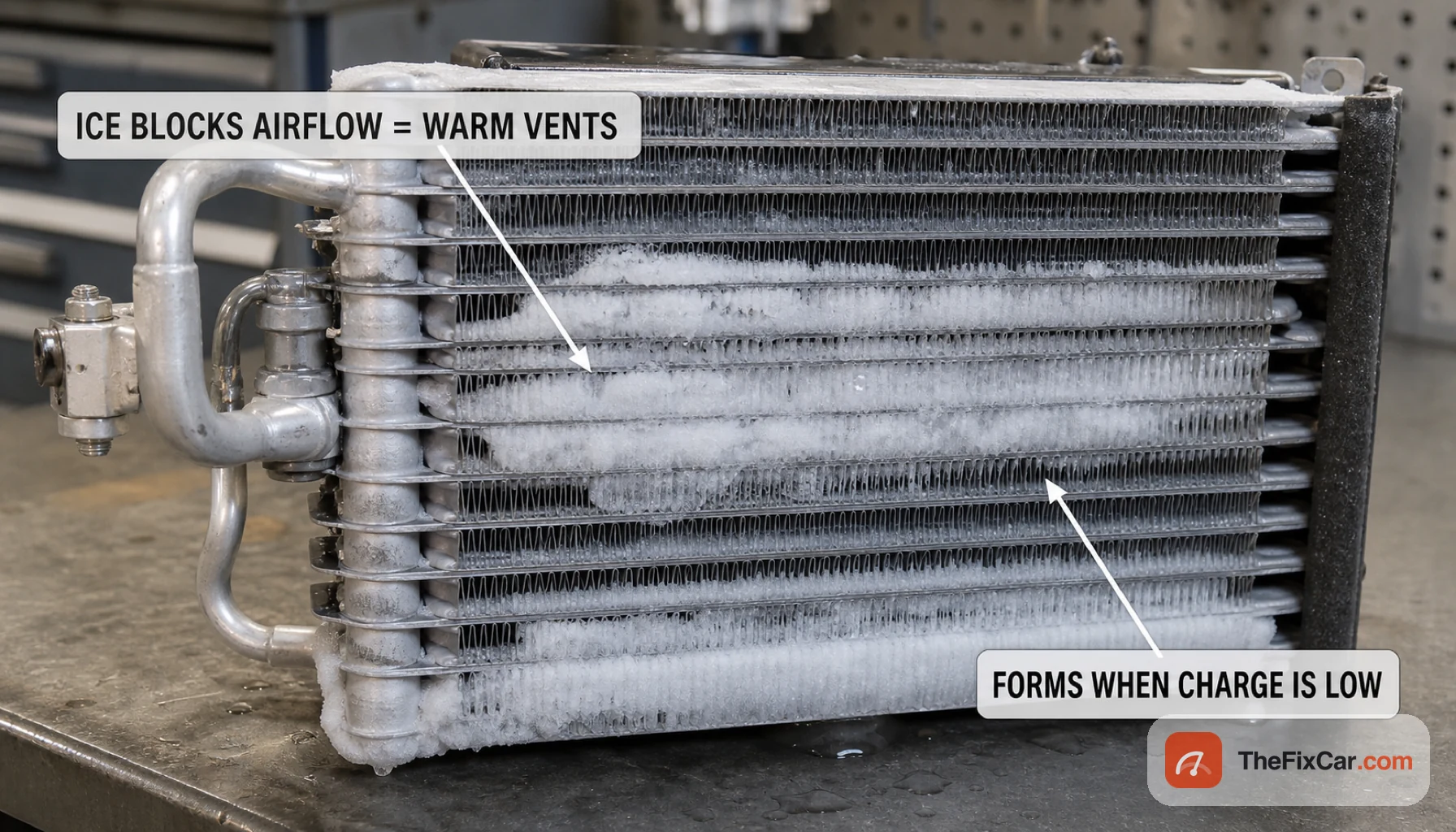
| After 10 to 20 minutes of good cooling, then recovers later | Evaporator icing from a low charge or restricted airflow |
| At idle or in slow traffic, cold again once you speed up | Weak condenser fan or blocked condenser airflow |
| Randomly, with rapid clicking from the engine bay | Compressor clutch short-cycling on a low charge |
| Goes warm and never comes back | Refrigerant leak, compressor, or an electrical fault |
Most common causes
- Low refrigerant charge: the coil runs cold enough to freeze cabin humidity into ice, the ice blocks airflow until it melts, and the cycle repeats.
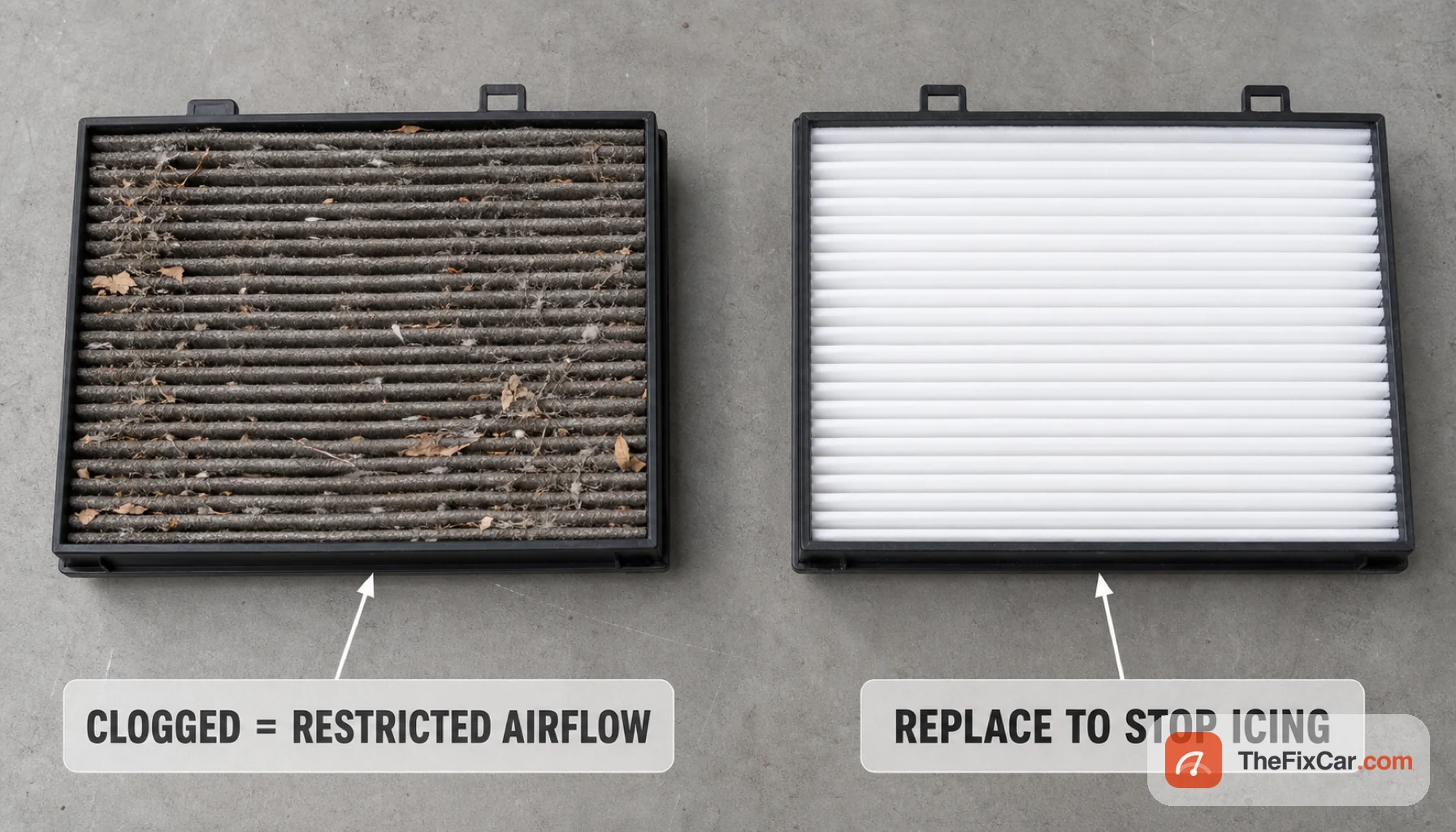
- Restricted evaporator airflow: a clogged cabin filter or blocked vents starve the coil of warm air, so it ices over faster.
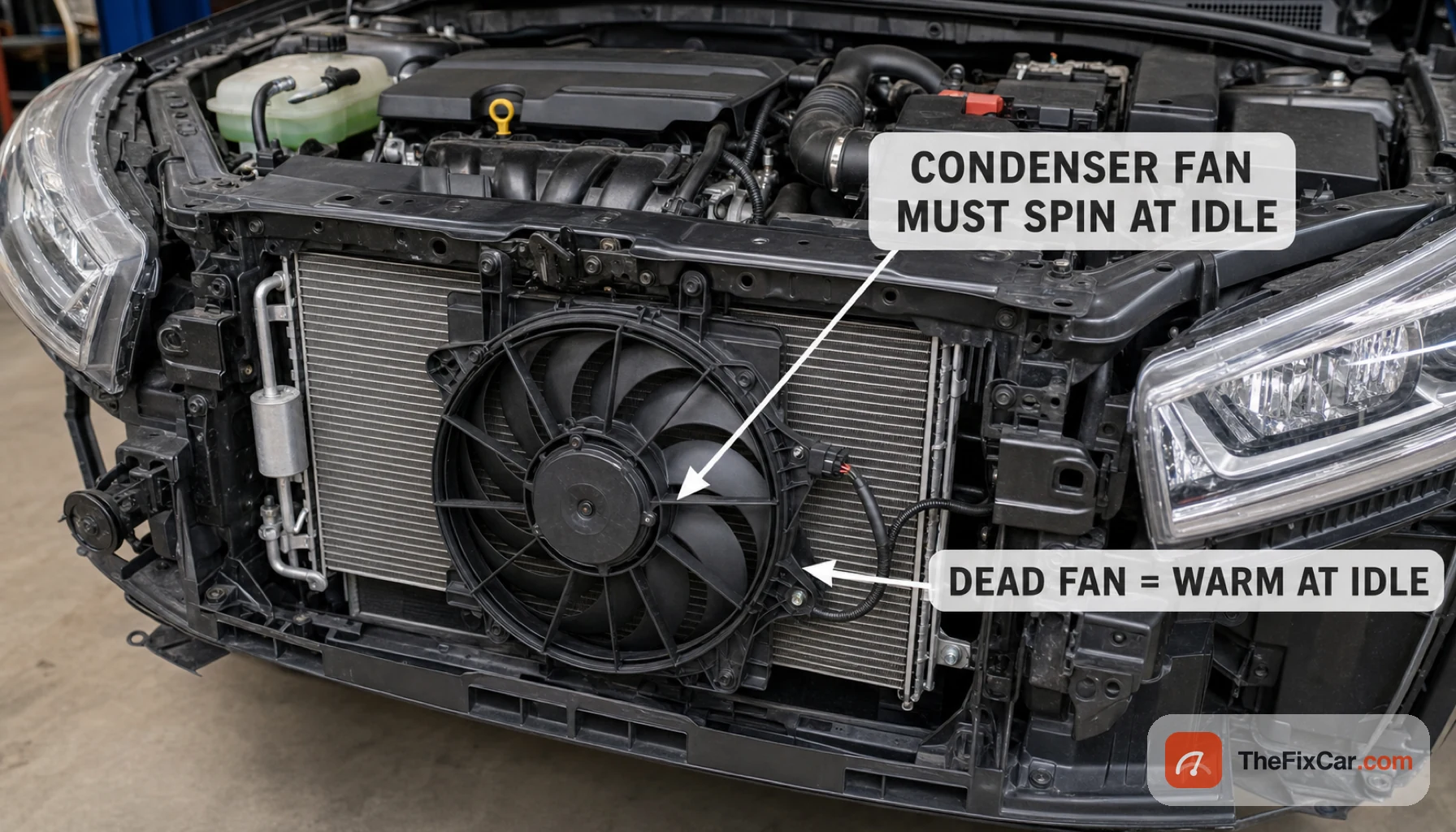
- Weak or failed condenser fan: with little airflow over the condenser, the system cannot shed heat at idle and warms until the car moves again.
- Failing compressor clutch: the clutch slips or drops out when it heats up, then re-engages once it cools.
- Clogged expansion valve or orifice tube: moisture can freeze at the metering point, while debris can restrict refrigerant flow; either fault may cause intermittent cooling.
- Electrical cycling: a marginal pressure switch, relay, or temperature sensor cuts the compressor in and out.
What to check first
- Note exactly when the air goes warm, using the table above. The timing alone rules several causes in or out before you touch anything.
- Pull the cabin air filter and look at it. A matted, dirty filter restricts the evaporator and is the cheapest cause to fix.
- With the AC on at idle, open the hood and confirm the condenser fan is spinning. Keep hands, clothing, hair, and tools away from the fan, belts, and pulleys because an electric fan can start without warning. A dead fan explains warm air that only shows up at idle or in traffic.
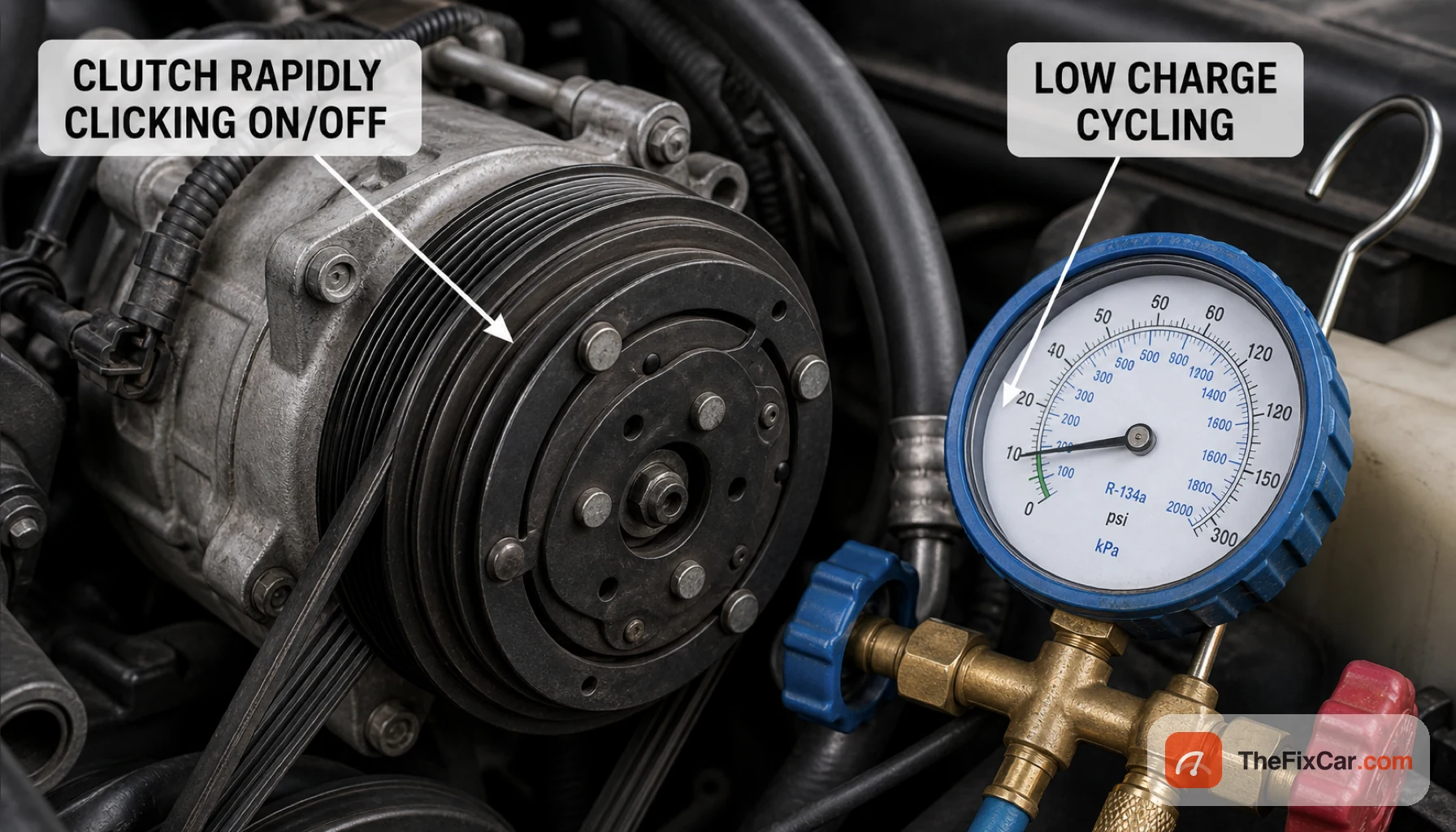
- Listen for the compressor clutch engaging and disengaging every few seconds. Rapid cycling can suggest low refrigerant or a pressure-control fault, but some systems cycle normally and others use variable-displacement compressors without obvious clutch cycling.
- After the air turns warm, check whether vent airflow has also weakened. Airflow that gradually falls and later returns after the AC is switched off is a stronger sign of evaporator icing; water dripping under the passenger side is usually normal condensation.
- Manifold-gauge readings can support the diagnosis when compared with ambient temperature and the manufacturer’s specifications, but pressure readings alone do not confirm the refrigerant charge or distinguish every restriction.
Is it safe to drive?
The car is usually drivable if the engine temperature stays normal, there are no burning smells or belt noises, and clear windows can be maintained. Stop using the AC if the engine temperature rises, the compressor area squeals or smells hot, or the windshield cannot be cleared. In very hot weather, unreliable AC can also be unsafe for children, older adults, pets, and anyone sensitive to heat.
Do not do this
- Do not keep adding refrigerant to chase the cold back; overcharging makes cooling worse and hides the leak that caused the low charge.
- Do not assume warm air at idle means a low charge. Check the condenser fan first, since airflow is the usual culprit there.
- Do not run the AC on MAX nonstop when it keeps icing. Switch to a lower setting or fresh air for a few minutes to let the coil thaw.
- Do not ignore a dirty cabin filter and recharge instead; the ice will come back.
- Do not use stop-leak cans to silence a leak, since they can clog the expansion valve or orifice tube and contaminate a shop’s recovery equipment.
When the problem is urgent
- The compressor clutch cycles every few seconds and cooling is poor. Stop using the AC continuously and have the charge, pressure controls, and clutch operation checked.
- A squeal, grinding noise, smoke, or burning smell comes from the belt or compressor area. Switch the AC off because the compressor, clutch, pulley bearing, or belt may be failing.
- The engine temperature climbs with the AC on at idle, since a failed condenser fan can also hurt engine cooling.
- A loud hiss is followed by a sudden, total loss of cold air, which points to a large refrigerant leak.
- Water enters the cabin near the passenger footwell. A blocked, disconnected, or damaged evaporator drain needs attention because continued leakage can damage carpet, wiring, and control modules.
Typical repair cost
These are broad U.S. estimates before tax. Vehicle design, refrigerant type, local labor rates, diagnostic time, and leak location can move the final price substantially.
- Cabin air filter: $15 to $60, often a DIY job that takes minutes.
- Recharge with leak dye: commonly $150 to $300, including a basic leak check.
- Pressure switch or relay: typically $100 to $250 depending on access.
- Condenser fan or motor: workshop estimates run $200 to $600.
- Expansion valve or orifice tube: roughly $200 to $500, more if the system needs a full evacuation.
- Compressor replacement: often $700 to $1,500 or more once parts and labor are added.