You plug in overnight, walk away, and in the morning the battery sits at the same percentage it did the night before. Sometimes there is no light on the charger at all. Sometimes the status light glows red, or the car flashes a charging fault and chimes once before going quiet. Home charging failures get blamed on the car first, but the cause is usually somewhere in the chain between the breaker and the connector. The usual suspects are a tripped circuit, a nuisance GFCI trip, a half-seated plug, or a schedule setting delaying the session. If the car charges fine on a public Level 2 AC station, start with the home outlet, breaker, EVSE, and schedule settings; if it fails on public Level 2 too, suspect a car-side AC charging fault.
Quick answer
Before anything else, confirm the outlet has power. On a normal 120V wall outlet, plug in a lamp or phone charger to check. On a 240V EV outlet such as a NEMA 14-50, or a hardwired wall charger, check the breaker and the charger’s status display instead. Never use household plug adapters to test a 240V EV outlet. Then find your situation in the table.
| What happens | Most likely | Do first |
|---|---|---|
| No light on charger, nothing reacts | Tripped breaker or dead outlet | Reset the breaker or GFCI once, then test a 120V outlet with a lamp or check the EVSE display on a 240V setup |
| Charger light is red or blinking a fault | Ground fault, bad connection, or charger error | Unplug 15 seconds, reseat both ends, then retry |
| It charges, just very slowly | Level 1 (120V) charging, working as designed | Confirm whether you are on a wall outlet or a 240V station |
| Charging starts then stops after a while | Scheduled charging, departure timer, or GFCI nuisance trip | Check the charge schedule in the car, then watch for a tripped breaker |
| Breaker trips every time you plug in | Double ground-fault protection or a real fault | Stop using it and have the circuit checked by an electrician |
| Public chargers work, home does not | Usually the home circuit, outlet, or EVSE; an AC onboard-charger fault is still possible if only DC fast charging works | Focus on the home wiring and charging unit first |
This is a rough guide to narrow things down, not a full diagnosis. Follow your owner’s manual for model-specific steps.
Is it the car or the home setup?
This is the main split that decides where to look. Note where charging fails, then read across.
| Where it won’t charge | What it more often means |
|---|---|
| Only at home | Outlet, breaker, GFCI, EVSE, wiring, or a charge schedule, not the car |
| At home and at public Level 2 | Possible car-side AC charging fault: onboard charger or charge port |
| At home, but DC fast charging works | Test a public Level 2 AC charger next: if it also fails, suspect the car’s AC onboard charger or charge port; if it works, suspect home equipment |
| Nowhere, including public chargers | Car-side fault: 12V battery, charge port, or a software / high-voltage warning |
Level 1 vs Level 2: is it broken or just slow?
A common “won’t charge” complaint is really charging that works but is limited by a 120V outlet or a low current setting. Match your setup before you assume a fault.
| Setup | Voltage | Rough range added per hour | What’s normal |
|---|---|---|---|
| Level 1 portable cord | 120V wall outlet | About 3 to 5 miles | Slow overnight gain is expected, not a fault |
| Level 2 home station | 240V dedicated circuit | About 20 to 30 miles | Full charge usually overnight on most cars |
Figures are general guidance from charging resources and vary with the car, battery size, temperature, and the circuit’s amperage.
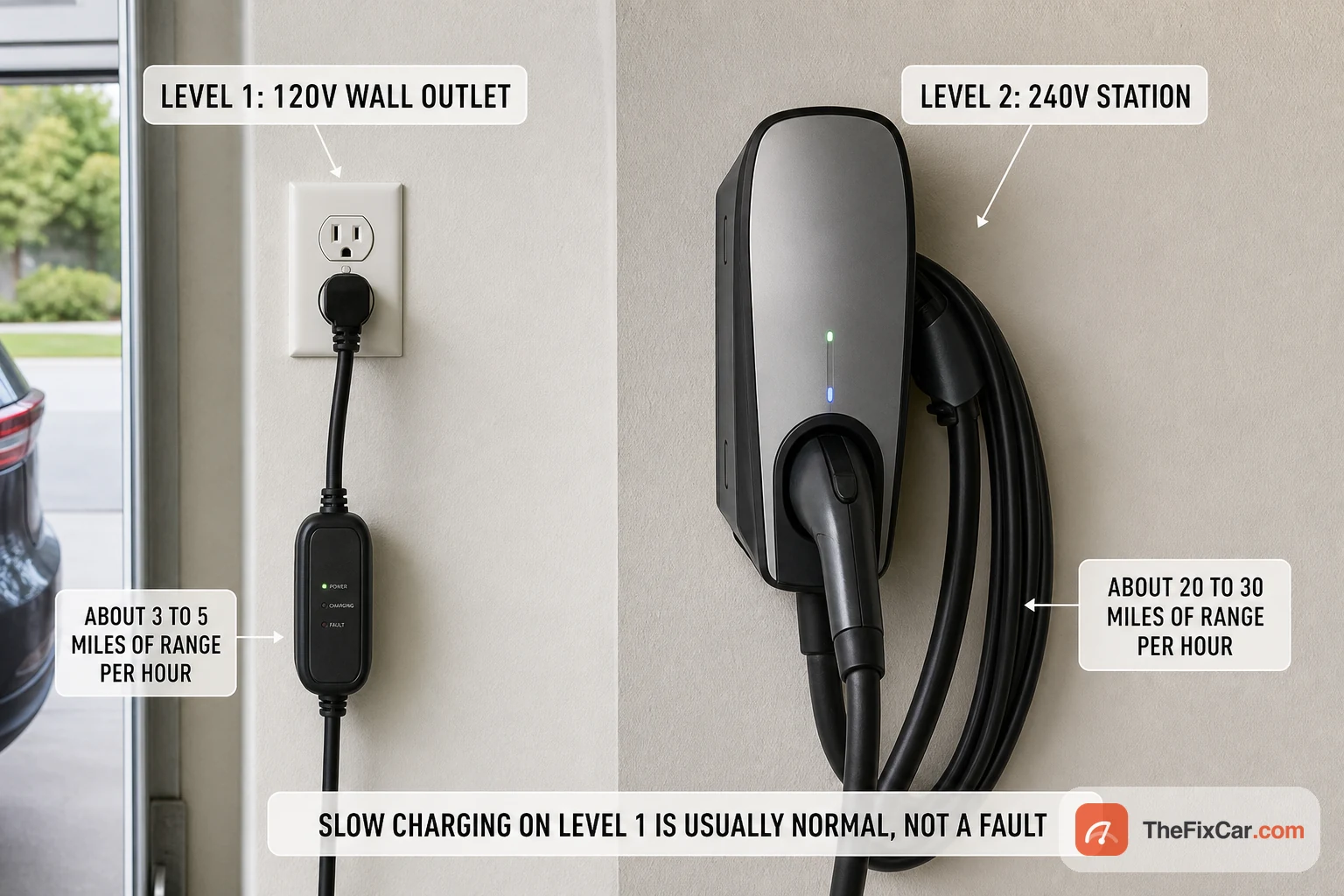
Did it add any range overnight?
If the battery percentage moved up at all by morning, charging did start. On a 120V Level 1 outlet, the U.S. Department of Transportation notes a battery-electric car can take roughly 40 to 50 hours or more to reach 80 percent from empty, so a small overnight gain on a big battery is normal, not a fault. If the gain was tiny or the session stopped early, still check whether you are on Level 1, whether the charge limit was already reached, and whether the breaker or charger faulted during the night. If it gained nothing at all, treat it as a real charging problem and work through the checks below.
Most common causes
- Tripped breaker or GFCI — the circuit feeding the charger lost power, often after a storm, a heavy appliance cycling on, or a nuisance trip on a ground-fault device.
- Loose or half-seated connector — if the plug is not pushed in until it clicks at the car, or the cord is loose at a wall outlet, the charger will not start or will drop out.
- Scheduled or delayed charging — a departure time, off-peak schedule, or charge limit set in the car or app can hold the session, which looks like a failure in the morning.
- You are on Level 1 by mistake — a 120V household outlet adds only a few miles of range per hour, so an overnight charge can look like almost nothing on a large battery.
- EVSE (the charging unit) fault — the wall box or portable cord has its own electronics that can fail, overheat, or throw an error and refuse to deliver power.
- Outlet or wiring problem — a worn NEMA 14-50 outlet, a loose terminal, or an undersized circuit can overheat and cause the charger to cut power.
- Car-side fault — less common, but a dead 12V battery, a stuck charge-port door, or a software glitch can stop the car from accepting a charge.
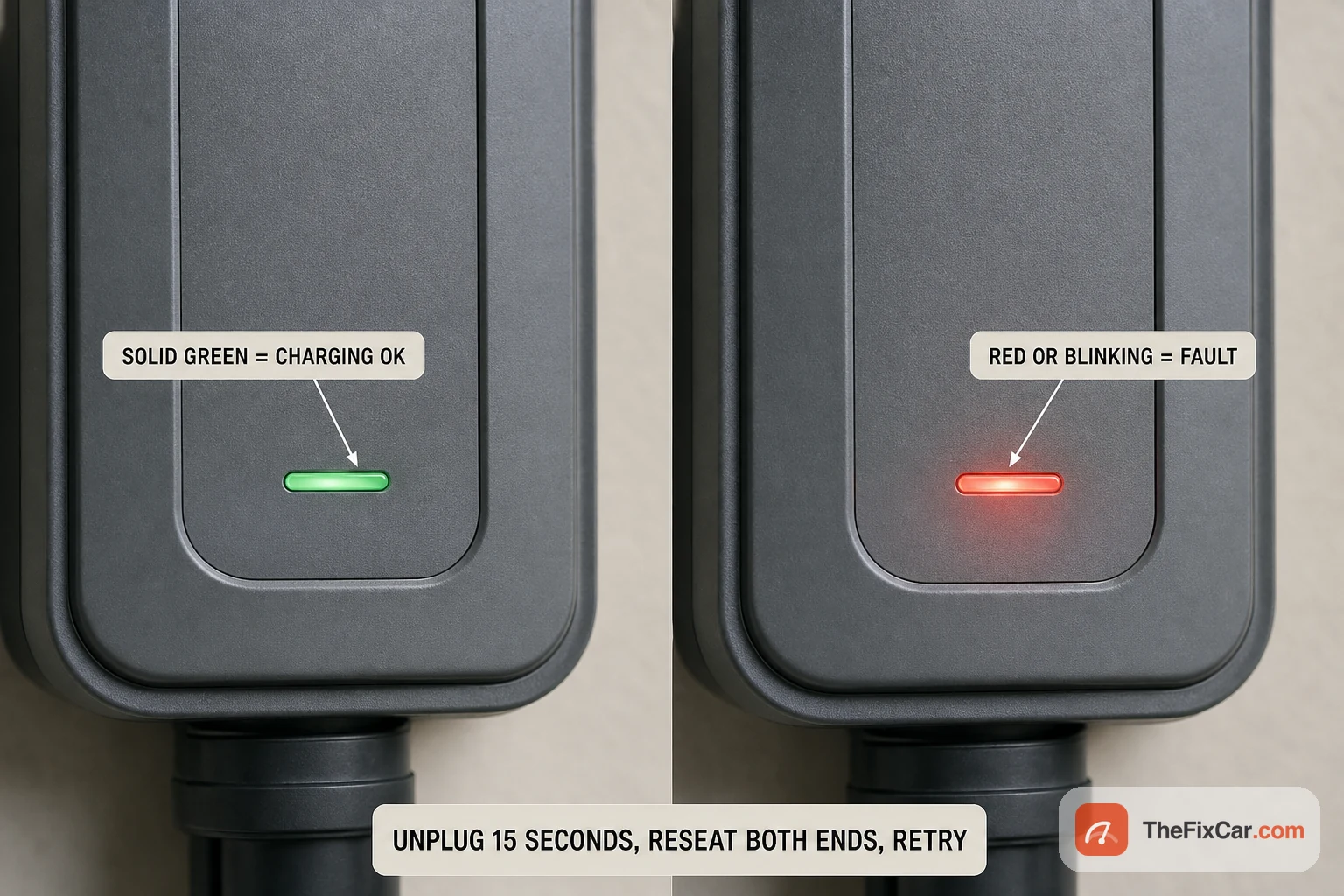
What to check first
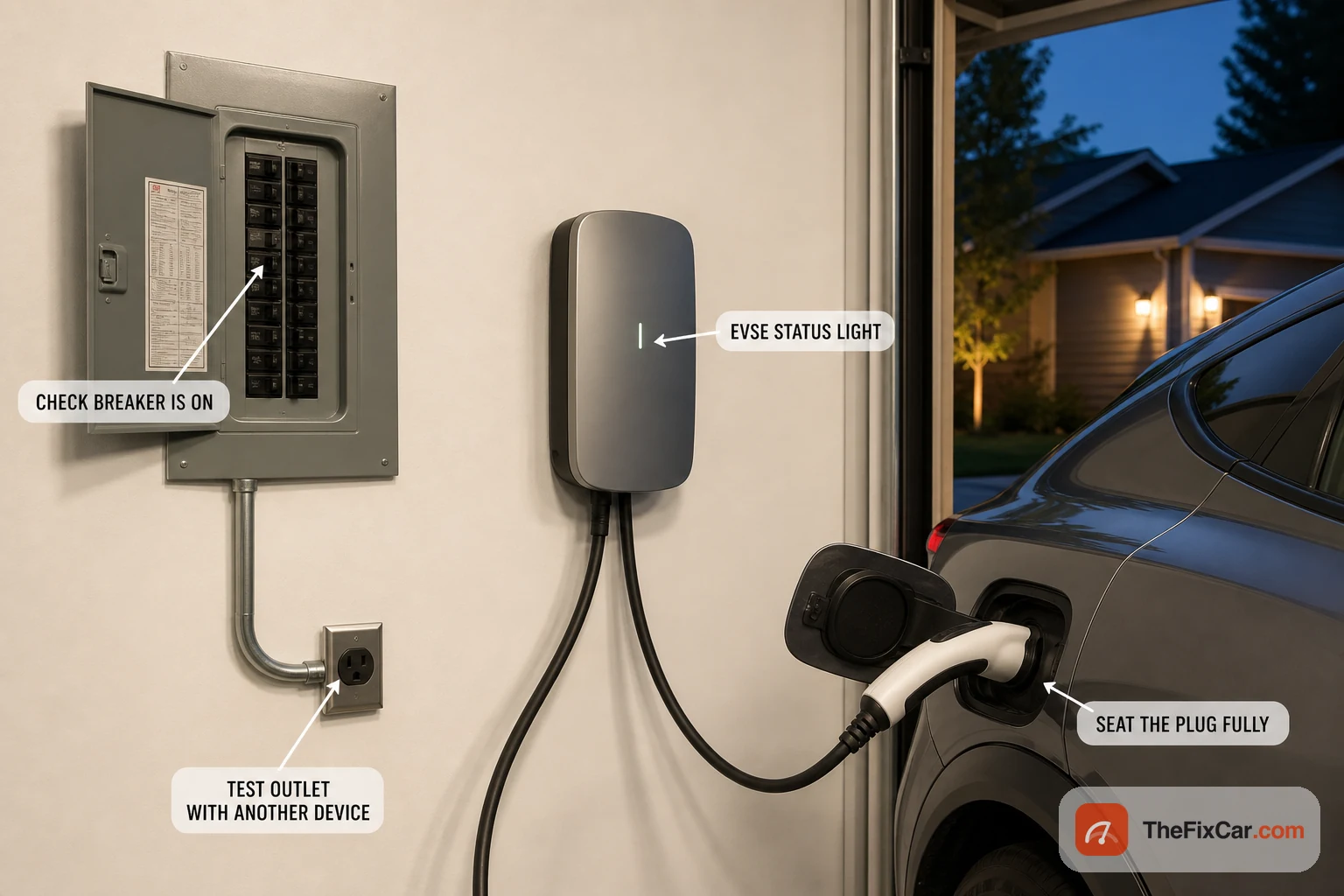
- For a 120V outlet, test it with a lamp or phone charger before blaming the car. For a 240V EV outlet or hardwired charger, check the breaker, the charger’s status display, and any GFCI reset. If power is still unclear, have an electrician test the circuit.
- Check the breaker panel for a tripped breaker on the charger circuit, and reset any GFCI outlet or breaker that feeds it.
- Reseat the connector at the car until it clicks, and check the other end is fully plugged in and the cord is not damaged.
- Look at the charger’s status light and match the exact color or blink pattern to your charger manual. Do not assume a solid, blinking, or red light means the same thing across brands.
- Open the charging schedule in the car and the app, and look for a departure timer, off-peak window, or charge limit that is delaying the session.
- If you have a wall box and a portable cord, swap to the other one to see whether the problem follows the charger or stays with the car.
Car settings that can look like a charging fault
Before you suspect hardware, rule out a setting that is doing exactly what it was told to. Any of these can leave you at the same percentage in the morning.
- Scheduled charging or an off-peak charging window
- A departure timer that holds the charge until close to leave time
- A charge limit the battery has already reached
- A reduced amperage setting in the car or app
- A location-based charging profile that behaves differently at home
When a weak 12V battery is more likely
EVs use a small 12V battery to wake the electronics and start the charging handshake. If it is weak or dead, the car may never respond to the connector. This pattern points at the 12V battery:
- The car will not wake up or unlock normally.
- The app cannot connect to the car.
- The charge port door or lock does not respond.
- The dashboard is dead or shows several random warnings.
- The charger has power, but the car never starts the handshake.
If that sounds familiar, see our guide on an EV 12V battery that won’t charge.
Is It Safe to Drive?
Yes, as long as the battery has enough charge for your trip. If there are no warning lights, heat, burning smells, stuck connectors, or driveability issues, a home-only charging failure is usually safe to drive on the range already in the battery. The real risk is getting stranded, so plan around your remaining miles and use a public charger to top up while you sort out the home setup. If charging fails everywhere, including public stations, treat it as a car-side fault and get it looked at before the battery runs low.
Do not do this
- Do not keep resetting a breaker that trips again the moment you plug in. Repeated tripping points to a real fault that needs an electrician.
- Do not use an extension cord or a multi-plug adapter for EV charging unless the vehicle or charger maker explicitly allows that exact setup. Electrical safety groups advise against it because the high, steady current can overheat connections.
- Do not ignore a warm or discolored plug or outlet. Heat at the connection is a fire risk and needs inspection before further charging.
- Do not force a connector that will not seat or release. Check for ice or debris in the port first.
- Do not assume the car is broken before you have tested the outlet and tried a different charger or charging location.
When the problem is urgent
- The plug, outlet, or charger is hot, melted, or discolored, which signals overheating at the connection.
- A burning or plastic smell near the outlet or charging unit.
- The breaker trips every time, or trips immediately, which can mean a ground fault or short.
- Visible damage to the cable, connector, or charge port, including cracks, exposed wire, or scorch marks.
- The car shows a high-voltage or battery warning, not just a charging-failed message.
- The charge port or connector is stuck and will not release after you stop the session.
When to call an electrician
Home charging is an electrical safety issue, not just car troubleshooting. Stop using the setup and call a licensed electrician if:
- The breaker trips again after one reset.
- The outlet, plug, breaker, or wall charger feels hot.
- You see discoloration, melting, scorch marks, or smell burning plastic.
- A NEMA 14-50 outlet feels loose or the plug does not sit tightly.
- The charger works on another circuit but fails on this one.
Typical repair cost
- Reset breaker or GFCI, reseat plug — $0, a do-it-yourself check.
- Replace a worn NEMA 14-50 outlet — $150 to $350 with an electrician, depending on the outlet and access.
- Replace a portable Level 1/2 charging cord — $200 to $500 for a quality replacement unit.
- Repair or rewire the charging circuit — $300 to $800 if a breaker, wiring, or terminal needs work.
- Replace a wall-mounted Level 2 station — $500 to $1,200 installed, more if the panel needs an upgrade.
- Car-side charge-port repair — often a few hundred dollars, while a full onboard-charger replacement can reach $1,000 to $2,500 or more. Many EVs may still have warranty coverage, so check the vehicle warranty first.
Ranges are rough U.S. figures. Warranty coverage, your car and charger model, part type, and local labor rates all move the price.
FAQ
Why won’t my EV charge at home but works at public chargers? If public Level 2 AC charging works and home charging does not, the car and battery are usually fine. The problem is more likely in the home setup: outlet, breaker, GFCI protection, wiring, charging cord, wall box, or schedule settings. Start with the outlet and breaker.
Why does my EV charger keep tripping the breaker? Many Level 2 chargers have built-in ground-fault protection. If the outlet is also on a GFCI breaker, the two can sometimes nuisance-trip from normal leakage or self-test behavior, but repeated trips can also indicate a real fault. A real ground fault, a loose terminal, or an overheating connection can also cause it. An electrician can test the circuit and confirm whether a hardwired EVSE with built-in ground-fault protection is allowed without a separate GFCI breaker under local code. Do not remove or bypass GFCI protection yourself: code requirements vary by jurisdiction and installation type, so have an electrician follow the code version adopted locally and the charger maker’s installation instructions.
My EV charges really slowly overnight. Is it broken? Probably not. A 120V wall outlet (Level 1) typically adds only about 3 to 5 miles of range per hour, so an overnight charge on a large battery can look like very little. A 240V Level 2 station is far faster. Confirm which one you are using before assuming a fault.
Can a dead 12V battery stop an EV from charging? Yes. EVs use a small 12V battery to run electronics and wake the charging system. If it is dead, the car may not respond to the connector or open the charge port at all. This is one of the few common car-side causes worth checking. See our guide on an EV 12V battery that won’t charge.
Why does charging start and then stop after a while? The usual reasons are a charge schedule or departure timer holding or ending the session, a charge limit the car has reached, a GFCI breaker tripping partway through, or the charger reducing power because it detects heat at the connection. Check the schedule first, then watch for a tripped breaker.
Is it safe to use an extension cord for EV charging? For Level 2 charging, no. The high, continuous current can overheat a cord and its connections. If you must extend a Level 1 setup, the manufacturer’s guidance and a heavy-duty, properly rated cord are the minimum, and a dedicated outlet is far better.