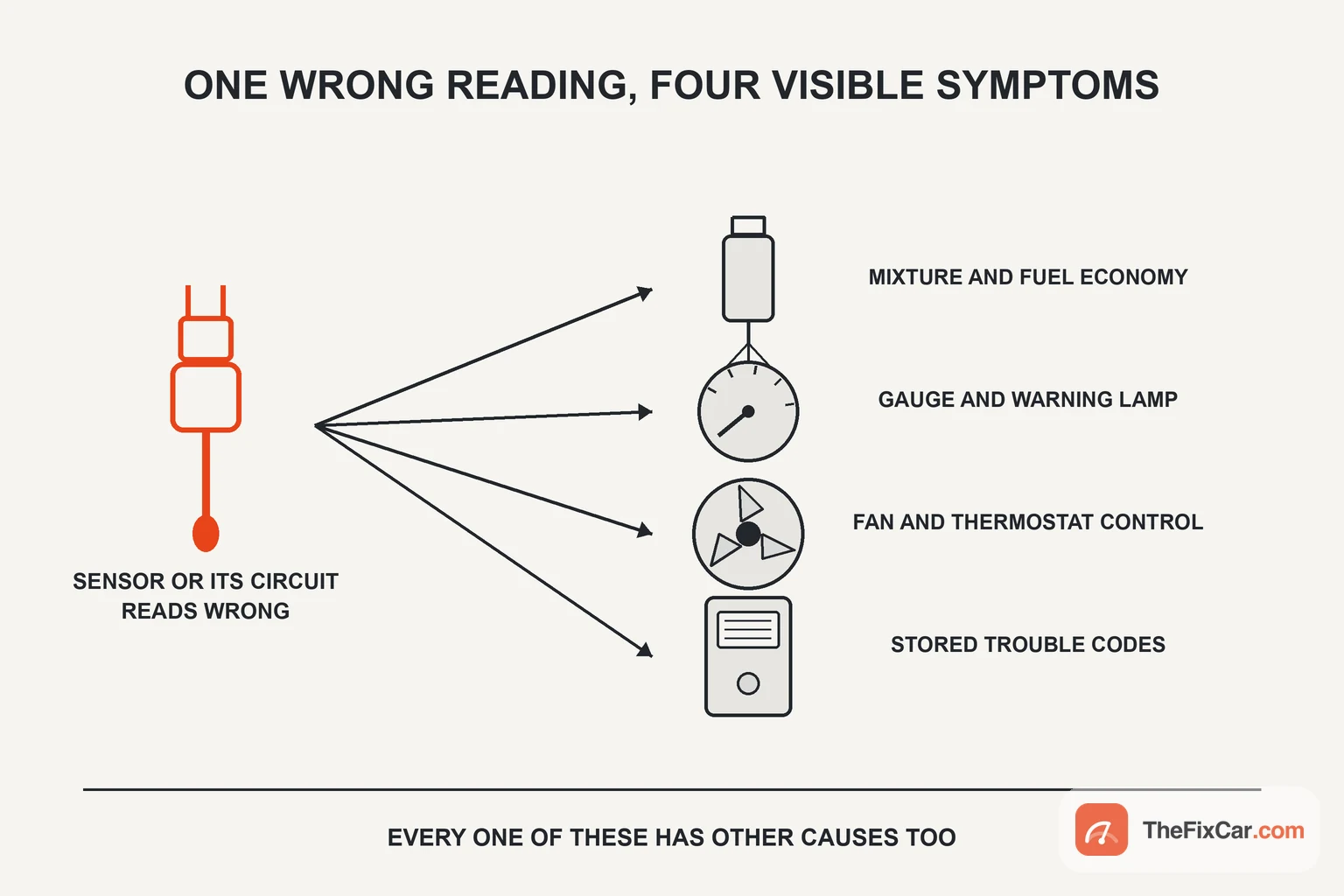

A coolant temperature sensor fault can show up as hard starting, worse fuel economy, cooling fans that run from the moment the key turns, or a stored code with no drivability complaint at all. It does not have to move the gauge to do any of that, because on many vehicles the needle shows a filtered version of the engine control input, and on some it is fed by a separate sender entirely.
Use the checks below to separate a sensor fault from the other faults that produce the same complaints.
Quick answer
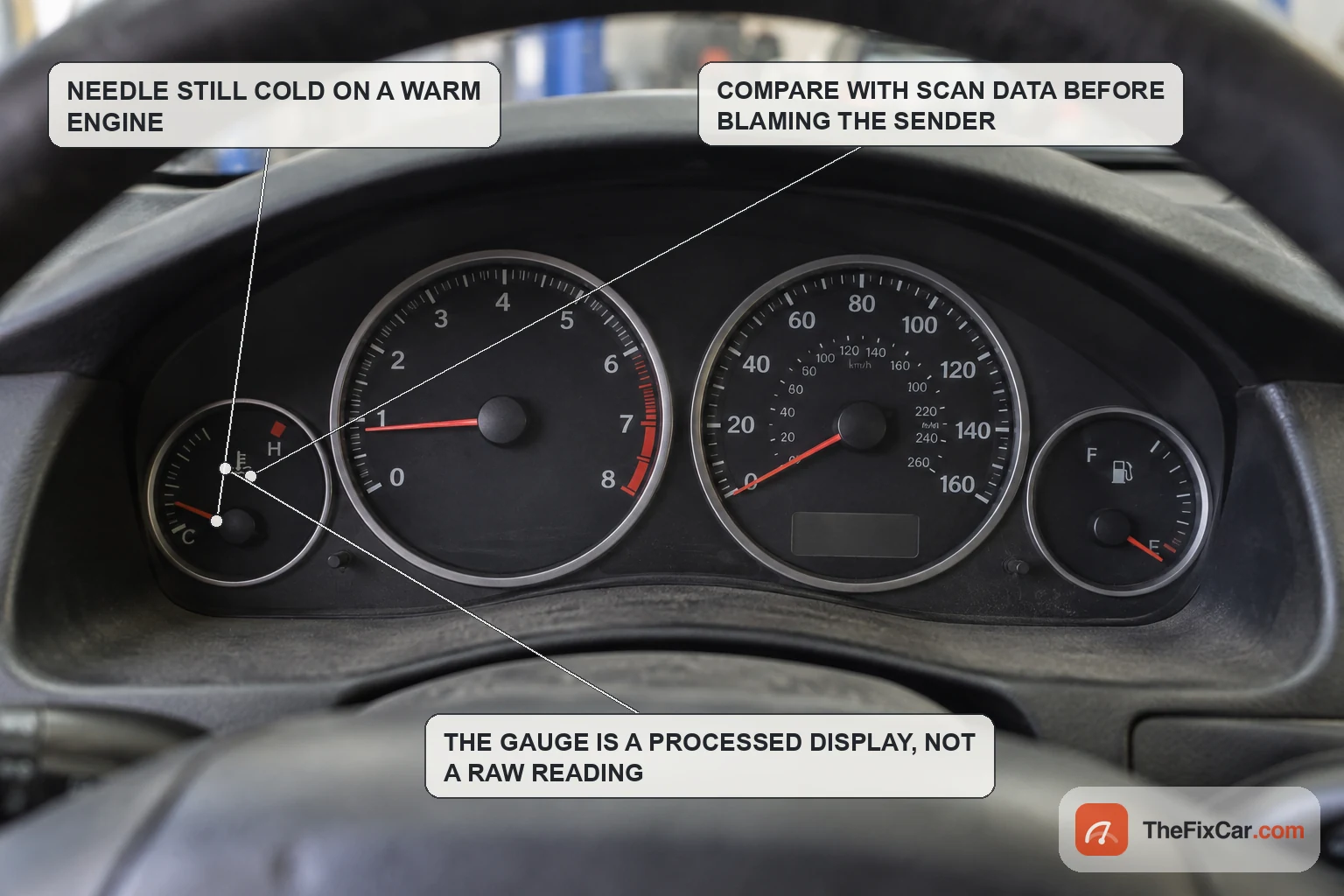
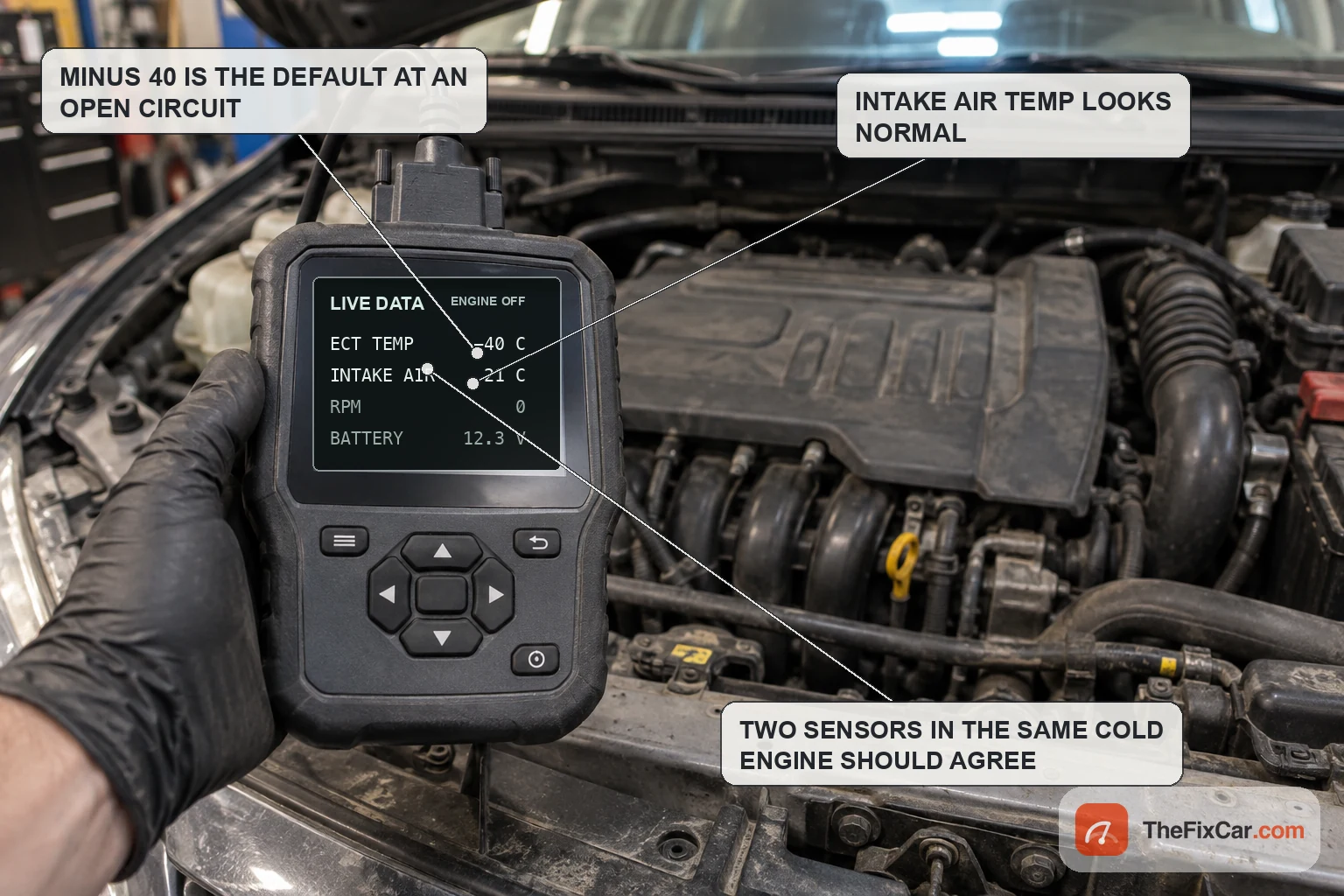
Before anything else, put the gauge aside and read live coolant temperature on a scan tool with the engine cold. Compared against intake air temperature and the actual ambient temperature, a wide split is a strong clue, though sensor tolerance and retained engine heat mean it is not a verdict on its own.
| What happens | Where to look | Do first |
|---|---|---|
| Scan value sits at the bottom or top of its displayed range, often shown as minus 40, and does not move | A fault somewhere in the signal path: sensor, connector, wiring or the module input | Read codes, then follow the circuit test and pinout in your service information before replacing anything |
| Scan value looks plausible but the engine runs rich, uses more fuel, or sets a cold-running code | A drifting sensor, a thermostat stuck open, or a low coolant level | After an overnight soak, compare coolant temperature against intake air temperature |
| Gauge disagrees with the scan tool | The display path: a separate sender, damping, or a display threshold | Trust the live data, and check whether the vehicle uses one sender or two |
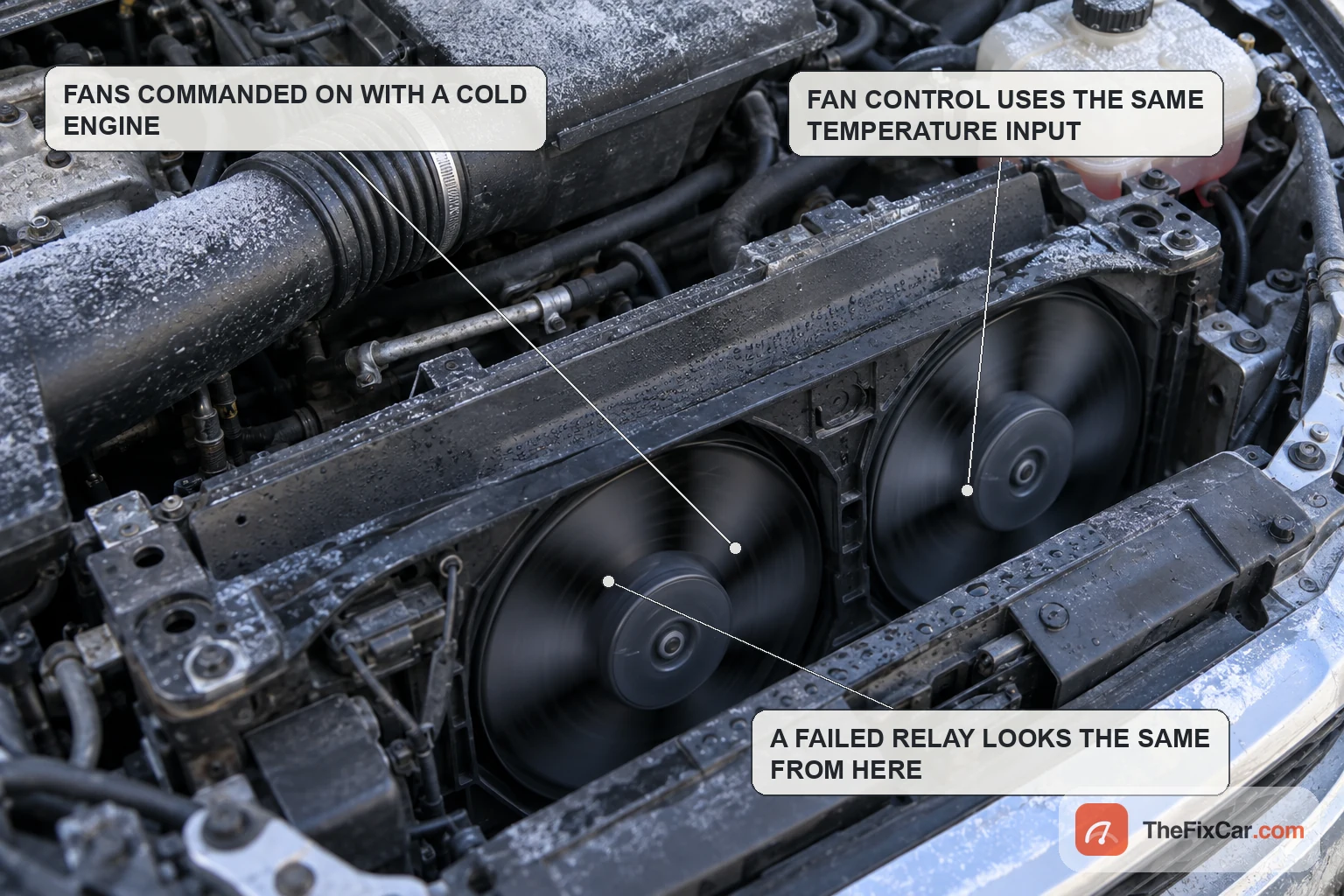
| Cooling fans run constantly from a cold start | The temperature input the fan strategy uses, a relay, or the control circuit | Watch the live value and the commanded fan state together |
| Hard starting when cold, better once warm | Cranking fuel calculated from a wrong temperature input | Compare the coolant reading at the moment of a cold start against the actual ambient temperature |
A rough guide to where to look first, not a diagnosis. Every row has more than one possible cause, and the sensor is only one of them.
What can make a coolant temperature sensor appear bad
Some of the entries below are not faults of the sensor at all. They are neighbouring failures that produce the same complaint, which is why the part gets replaced without fixing anything.
- Corrosion inside the sensor. BMW ran a service action on R55 to R58 MINI models with N16 or N18 engines built between August 2010 and March 2012, where internal corrosion could bridge the sensor’s contacts and produce an inaccurate reading, showing up as difficult starting or an illuminated lamp[1]. That is a documented example on named models, not a general rule.
- A corroded or wet connector. On the common two-wire NTC circuits, added series resistance makes the module calculate a colder temperature, because it cannot separate that resistance from the thermistor. A short or a leakage path moves the calculated value the other way on those circuits, and the direction depends on the design, so confirm the circuit type for your vehicle before reading anything into it.
- An open or shorted wire. Mitsubishi’s own cause lists for the coolant temperature circuit codes name the harness, the connector and the ECM alongside the sensor[4][5].
- Low coolant or an air pocket. A sensing tip surrounded by vapour reports the pocket around it, not the coolant, and the reading can swing as that pocket moves.
- A thermostat stuck open. This produces the cold-running codes people blame on the sensor. California’s OBD II regulation requires the system to monitor both the thermostat and the coolant sensor[7], and a code from that family points at how fast the engine reached temperature rather than at one part, so coolant level, thermostat operation and the sensor input all stay in the diagnosis.
- The display path rather than the input. General Motors describes a dampening program on the analog gauge of the 2014 Corvette and a digital display that does not begin to read until coolant reaches 100 °F[2]. A Lexus tech tip written for 2016 to 2018 RX350, RX450h, ES350 and ES300h models covers a gauge that intermittently reads maximum hot with no other overheating symptom, and asks technicians to record data and measure the upper radiator hose before repairing anything[3].
Clues that shift suspicion
Each of the headline symptoms below has more than one candidate. The third column is the observation that moves suspicion between them, before anything is replaced.
| Symptom | Competing sources | What shifts suspicion |
|---|---|---|
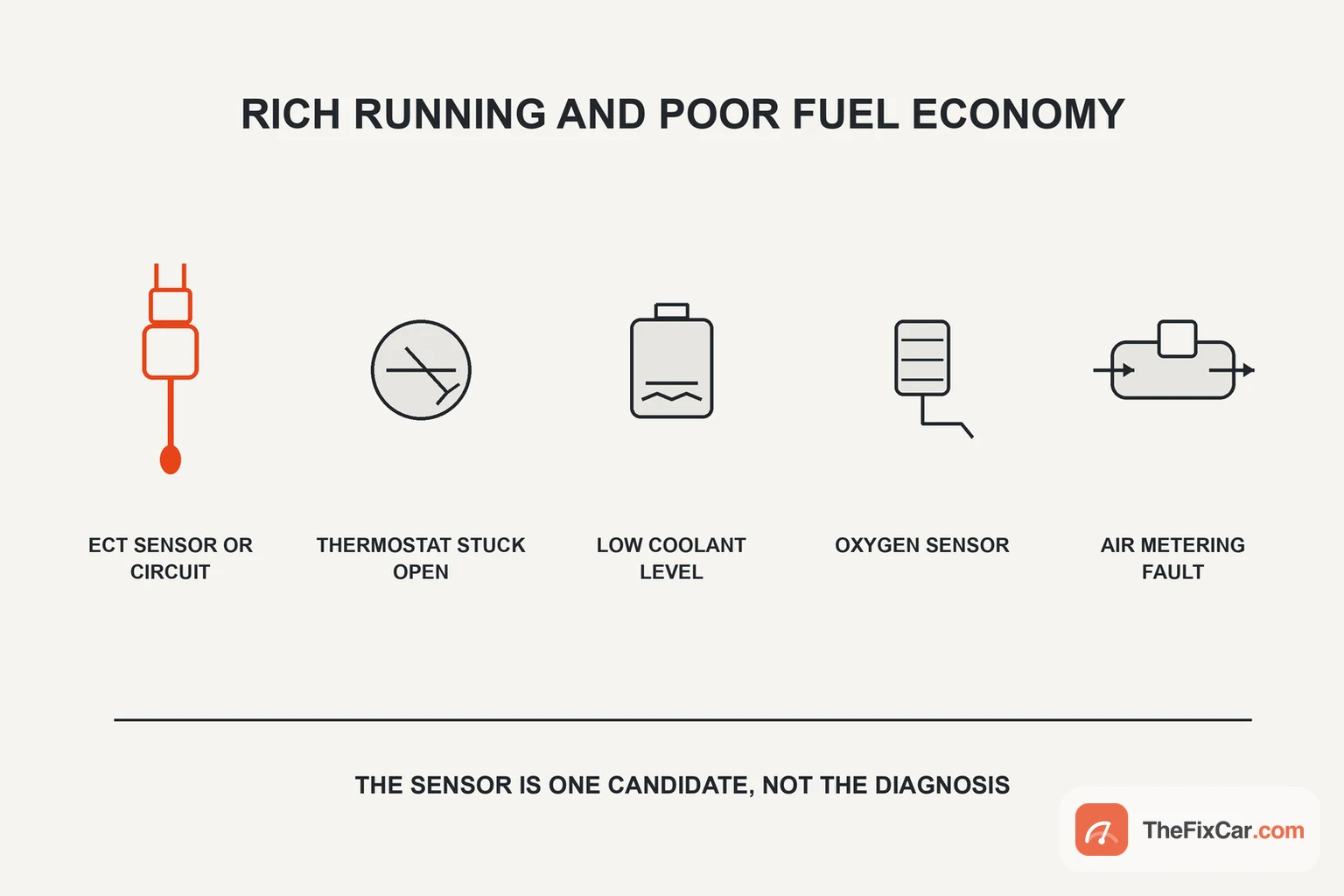
| Rich running, sooty plugs, worse fuel economy | Coolant sensor reading cold, thermostat stuck open, low coolant, an oxygen sensor or air metering fault | A cold-soak comparison against intake air temperature. If coolant and intake air agree overnight and the engine still warms slowly, the thermostat and coolant level move ahead of the sensor |
| Hard starting when cold only | Wrong temperature input, fuel delivery, ignition, compression | What the module saw at the moment of the start. A coolant value close to ambient at that moment makes a cold-offset fault less likely, though it does not rule out a fault that only appears as the engine heats |
| Fans run from a cold start | Temperature input, fan relay stuck closed, control module strategy, an air conditioning request | The commanded fan state read alongside the coolant value, the air conditioning request and the fan strategy for that vehicle. An unexplained command with an implausible coolant reading shifts suspicion to the temperature input; fans running with no command shift it to the relay or its circuit |
| Gauge reads wrong | Separate gauge sender, damping and display thresholds, cluster fault, the shared input | Live scan data read alongside the needle, then the wiring diagram to see whether the gauge has its own sender. The Corvette and Lexus bulletins show why display behavior has to be confirmed per vehicle[2][3] |
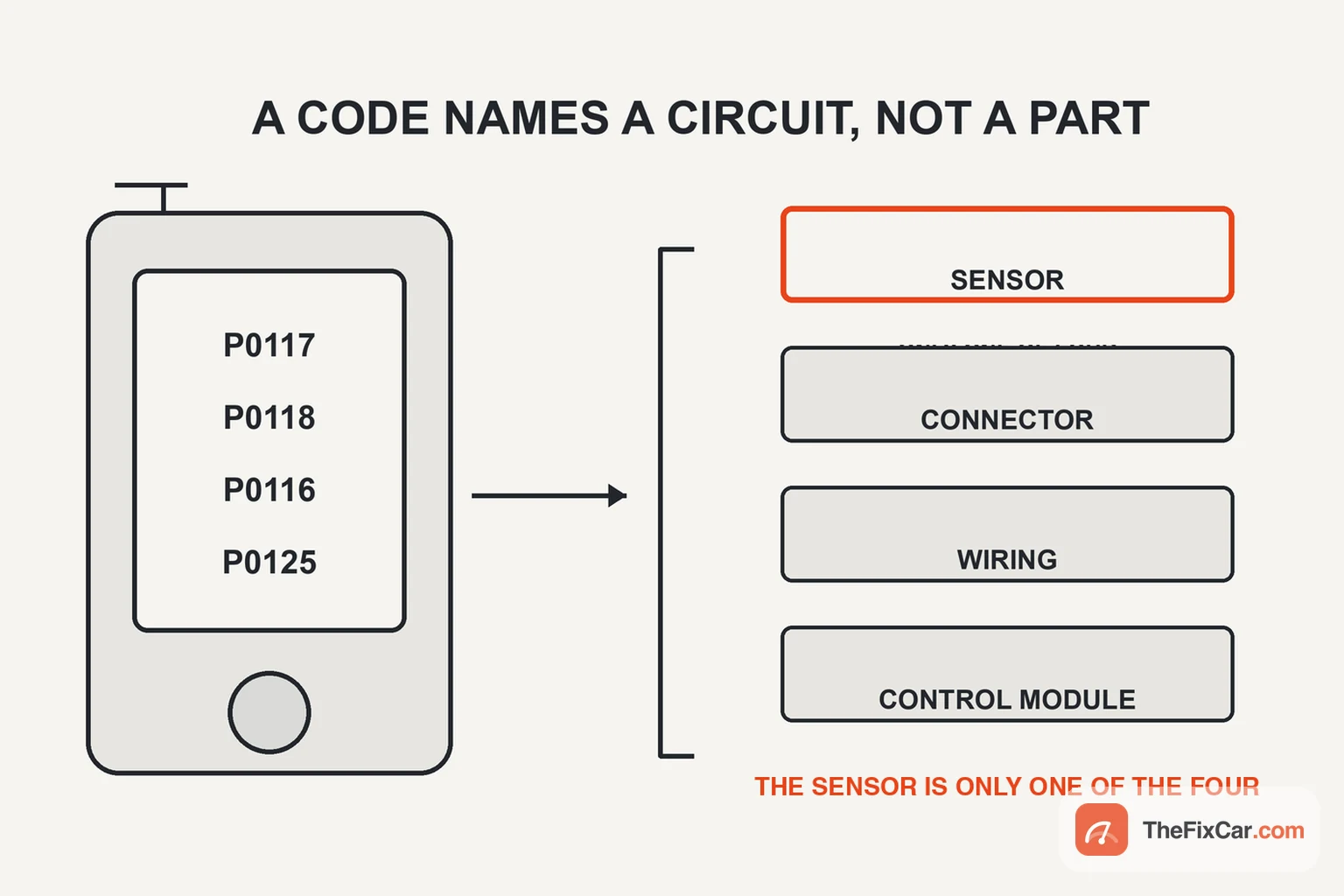
| Coolant temperature code with no drivability complaint | Sensor, connector, wiring, module | Whether the value is stuck at a circuit extreme or merely implausible. A value pinned at an extreme justifies circuit checks while the sensor, connector, wiring and module input all stay in play[4][5], while a plausible but inconsistent value is what a rationality monitor is built to catch[6] |
What to check first
- Read the codes before anything is unplugged. On systems that separate them, an out-of-range circuit code says the signal left the window that ECU calibrates for, while a rationality code says it stayed inside the window and still did not fit the operating conditions. Mitsubishi’s P0117, P0118 and P0116 logic are worked examples of that split rather than universal rules[4][5][6].
- Compare coolant against intake air after a full cold soak. Two sensors in the same cold engine bay should sit close together. A wide split is worth chasing, but retained heat, sensor placement and accuracy can move either reading, so it points at the pair rather than convicting one.
- Watch the value through a warm-up. A reading that climbs smoothly behaves differently from one that jumps in steps, sticks, or drops back.
- Check the coolant level using the cold-engine method for your vehicle. It is the cheapest first check, though a low level needs its own cause found before it explains anything, and a normal level in the tank does not rule out trapped air or a circulation problem.
- Look at the connector. Green or white crust, a spread terminal or coolant residue inside the housing can all affect what the module sees, so confirm the terminals and the circuit electrically rather than judging by sight.
- Test the circuit before the part. Work from the wiring diagram and the probing method your service information approves, and hand it to a technician if those are not available. The measurement order, where to put the probes and what each step leaves untested are in our guide to testing and replacing an engine coolant temperature sensor.
Is it safe to drive?
Treat it as unresolved rather than safe. The problem is not the sensor itself, it is that the gauge and the warning lamp may be fed from the same temperature signal you no longer trust, so a normal-looking needle does not clear an overheating risk. Do not drive it if coolant is low, if there is any coolant loss, steam, a hot or sweet smell, a loss of heater output, or drivability that has got worse, and get it diagnosed promptly instead. Do not read the absence of those signs as clearance either: on many vehicles the same input feeds fan control, so it can affect cooling before anything is visible from the driver’s seat. Arrange diagnosis or recovery rather than a trip you hope is short enough.
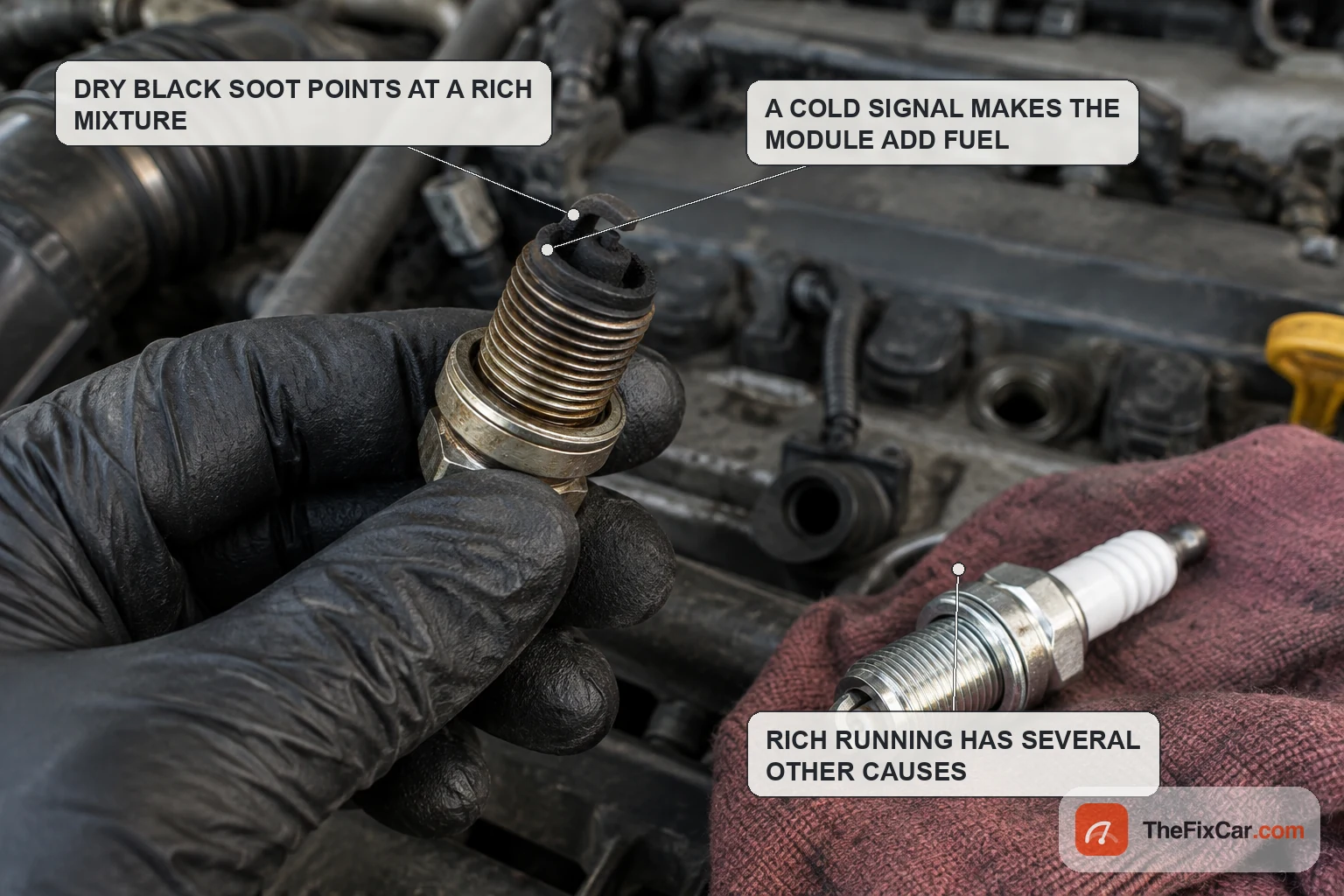
The other reason to deal with it promptly is fuel. A cold-biased signal can make the module command extra fuel, most of all during cold and open-loop running, though closed-loop correction may pull much of that back once the engine is warm. Left alone it wastes fuel and can foul plugs over time. If drivability gets worse, misfires appear or power drops, it has stopped being only a cost problem.
When it becomes urgent
- Any physical sign of overheating, whatever the gauge shows: steam, boiling sounds after shutdown, coolant on the ground, a hot or sweet smell.
- The heater stops producing heat while the gauge claims a normal temperature, which can indicate a low coolant level rather than a sensor fault.
- The reading swings between extremes while driving, which points at an intermittent sensor, connector or wiring fault, once air pockets, coolant level and a genuinely changing temperature have been ruled out.
- The engine starts to run poorly enough to lose power, because a very wrong temperature input can move fuelling far enough to affect drivability.
- A cooling fan runs well beyond the after-run behavior documented for that vehicle, or unexplained fan operation is flattening the battery between trips.
What the repair costs depend on
- The sensor itself is one of the cheaper engine-management parts, and on an accessible installation the bill is mostly labor plus coolant.
- Access sets the labor, not the part. A sensor reachable from above is a short job; one under an intake assembly is a much larger one.
- A connector or wiring repair can cost more than the sensor, because the time goes into the harness rather than the part.
- If the real fault is the thermostat or a coolant leak, the repair is a different job entirely, which is the practical reason to test before buying anything.
We do not publish a dollar range here because we have no source for one that would hold across vehicles. Prices in the United States move with the diagnosis, the access, the parts, warranty coverage and local labor rates, so treat any estimate you are given as local.
FAQ
Can a bad coolant temperature sensor cause a car not to start? It can contribute on vehicles whose control strategy uses coolant temperature as a starting-fuel input. The MINI service action cited here lists difficult starting where internal corrosion bridged the sensor contacts on the models it covers[1]. A no-start has many other causes, so treat it as a contributing suspect rather than a conclusion.
Will a bad coolant temp sensor throw a code? Not always. A circuit fault sets a code when it crosses the threshold that ECU calibrates for. A sensor reading plausibly and wrongly may set nothing, or may set a rationality code only once the conditions that monitor needs have accumulated. Mitsubishi’s P0116 criteria are one documented example of those conditions[6].
Why does my temperature gauge read normal when the scan tool disagrees? On many vehicles the needle is a processed display rather than a direct reading. General Motors documents both a damping program and a display threshold on the 2014 Corvette[2]. Whether your car adds a separate gauge sender on top of that is a question for its wiring diagram, which also tells you whether the value on the scan tool is the engine control input itself or a reported version of it.
Can a bad coolant sensor cause bad fuel economy? It can, when the module reads the engine as colder than it is and commands warm-up fuel that is not needed. A thermostat stuck open, a low coolant level, an air metering fault and fuel control faults produce the same complaint, so the cold-soak comparison comes before the part.
Does a P0128 or cold-running code mean the sensor is bad? Not on its own. The exact definition and enable criteria are vehicle-specific, and they describe how quickly coolant reached the temperature the strategy needs rather than which part failed. Check the definition for your vehicle, then look at thermostat operation, coolant level and the sensor input together.
Is it the same part as the temperature sender for the gauge? Not always. Some vehicles use two separate senders in the same coolant housing, and even a shared signal can be filtered before it reaches the needle[2].