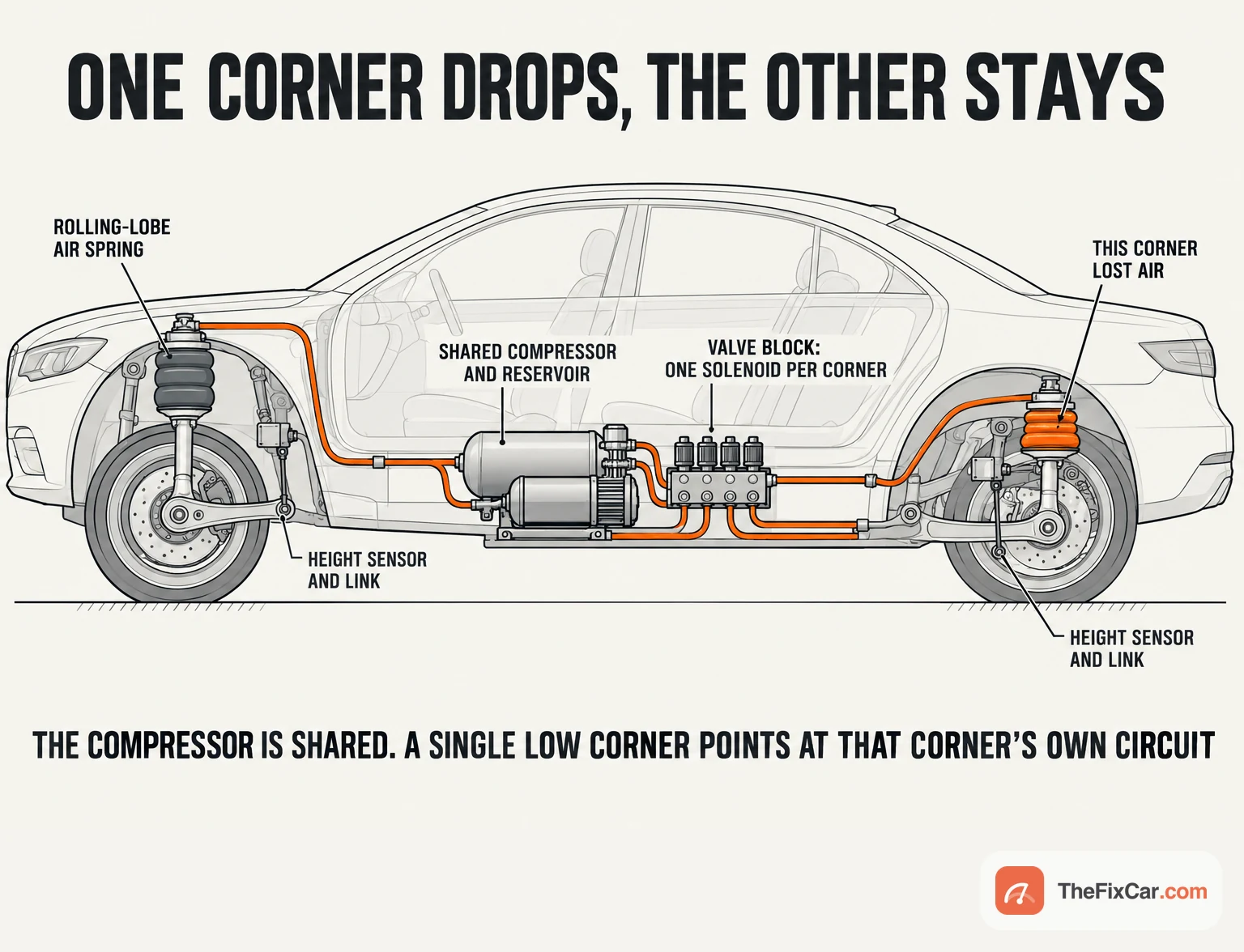
A car on air suspension that sits low at one corner is telling you where to look. On a four-corner system the compressor, the dryer and the reservoir feed every corner through valve blocks (one on some cars, front and rear blocks plus a reservoir block on the Land Rover specified below), so a dead compressor shows up as the whole car low and slow to lift; on a car with air springs on the rear axle only, the same logic applies to that axle. One low corner means the fault sits in that corner’s own circuit: the air spring, the line and fitting to it, its solenoid in the valve block, or the height sensor that tells the module how high that corner is.
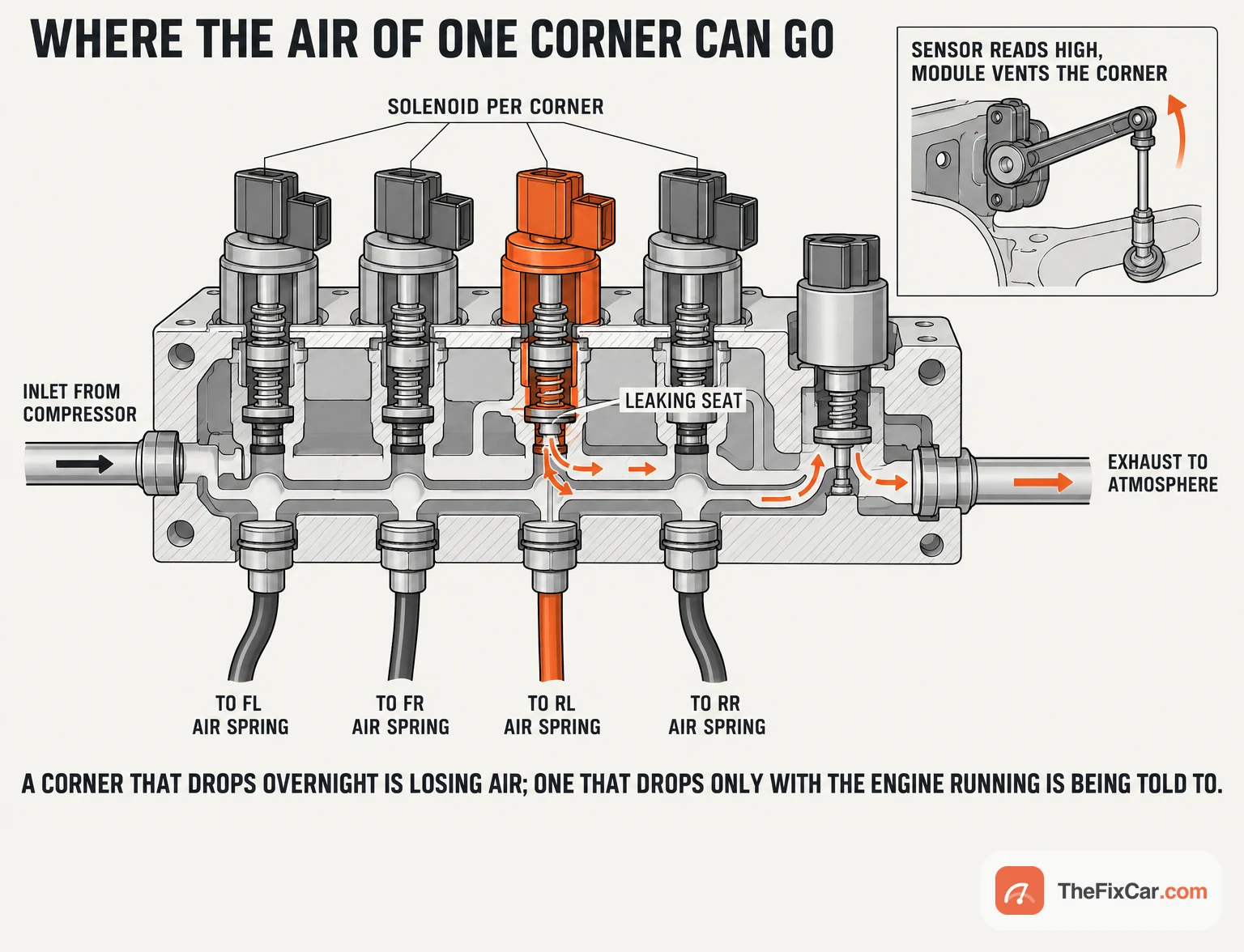
Those four causes produce the same photo in the morning and behave differently over 24 hours. A spring, a fitting or a solenoid loses air while the car is parked. A height sensor only misleads the module while the module is awake, which means the ignition on and, on cars that level themselves after locking, a few minutes after you walk away; so that corner drops after a start and stands level after a night in the driveway. One complication: some systems wake on their own while parked and re-level, Land Rover’s among them, which can hide a slow leak overnight or produce a drop that is not a leak; that is why the overnight test below asks you not to touch the car, and why one night is a clue rather than a verdict. The checks below use the thresholds Mercedes and Ram print for their own dealers, and they say which vehicles they cover.
Quick answer
Measure the low corner tonight and again in the morning, before you buy anything.
| What you see | Where to look | First thing to do |
|---|---|---|
| One corner lower after the car sat overnight | That corner’s air spring, its line and fitting, its solenoid | Measure wheel centre to fender arch on both sides, evening and morning |
| Corner level in the morning, drops after a start or a drive | Height sensor or its link on that corner | Read the four height values with a scan tool |
| Whole car low, compressor runs long or not at all | Compressor, its relay or fuse, the intake and dryer | Check the compressor fuse, then read suspension codes |
| Corner low only with weight in that corner | Air spring near the end of its life, or a leak that opens under load | Soapy water on the bellows fold with the load on and the car on its wheels |
A guide, not a diagnosis: each row has more than one cause.
Why one corner and not the other
A four-corner air suspension shares one compressor among four separate air circuits. Land Rover’s 2005 specification for its Vehicle Dynamic Suspension lists one height sensor per wheel, a 9 litre reservoir, a compressor limited to 16.8 bar, and normal spring pressures of 8.0 to 10.0 bar at the front and 5.0 to 8.0 bar at the rear, with two corner valves and one cross link valve in each valve block. Those pressures are for the vehicles that document covers, and your model will differ, but the layout is the point: pressure is made once and then metered to each corner through its own valve.
So a single corner drops in two ways, and there is a third that only looks like a drop. Air leaves that corner’s circuit, through cracked bellows, a loose or cut line, or a solenoid seat that no longer seals and lets the spring bleed back into the gallery, from where the air ends up in the other circuits or out through the exhaust valve. Or the module vents the corner on purpose because the height sensor for that wheel says the body is too high. The first family loses air with everything switched off. The second needs the module awake, which on some cars includes timed wake-ups while parked. The third is the opposite corner sitting too high, covered below.
Clues that shift suspicion
| Behaviour | Competing causes | Clue that shifts suspicion |
|---|---|---|
| Drops overnight, recovers after a minute of running | Air spring bellows, line or fitting, solenoid seat, cold air | For the 212 and 218 series AIRmatic rear axle, Mercedes puts the line at 15 mm overnight: less can be the air cooling, more sends you to the fittings and then the spring |
| Drops only after the engine starts, level after a night | Height sensor, bent or loose sensor link, corroded sensor connector | Scan tool shows one corner’s height reading off the other three while the car is visibly level |
| Compressor runs every time you unlock the car, corner still low | Leak large enough to beat the compressor, or a corner valve that never opens | Soapy water finds bubbles at the spring or a fitting; no bubbles at any fitting you can reach moves suspicion inside the valve block |
| Both corners of one axle low, nose or tail down | Axle pair of springs of the same age, reservoir or cross link leak, or the module’s own ride-height mode | Check the switch and the mode message first: Land Rover’s access height is 50 mm below normal by design |
| Corner sags in the cold, fine in the afternoon | Hardened bellows, water in the system freezing in the dryer or a line | Ram’s own case notes for the 2013 to 2015 1500 start with the compressor fuse and purging moisture before any part is replaced |
Air spring fault, or something else?
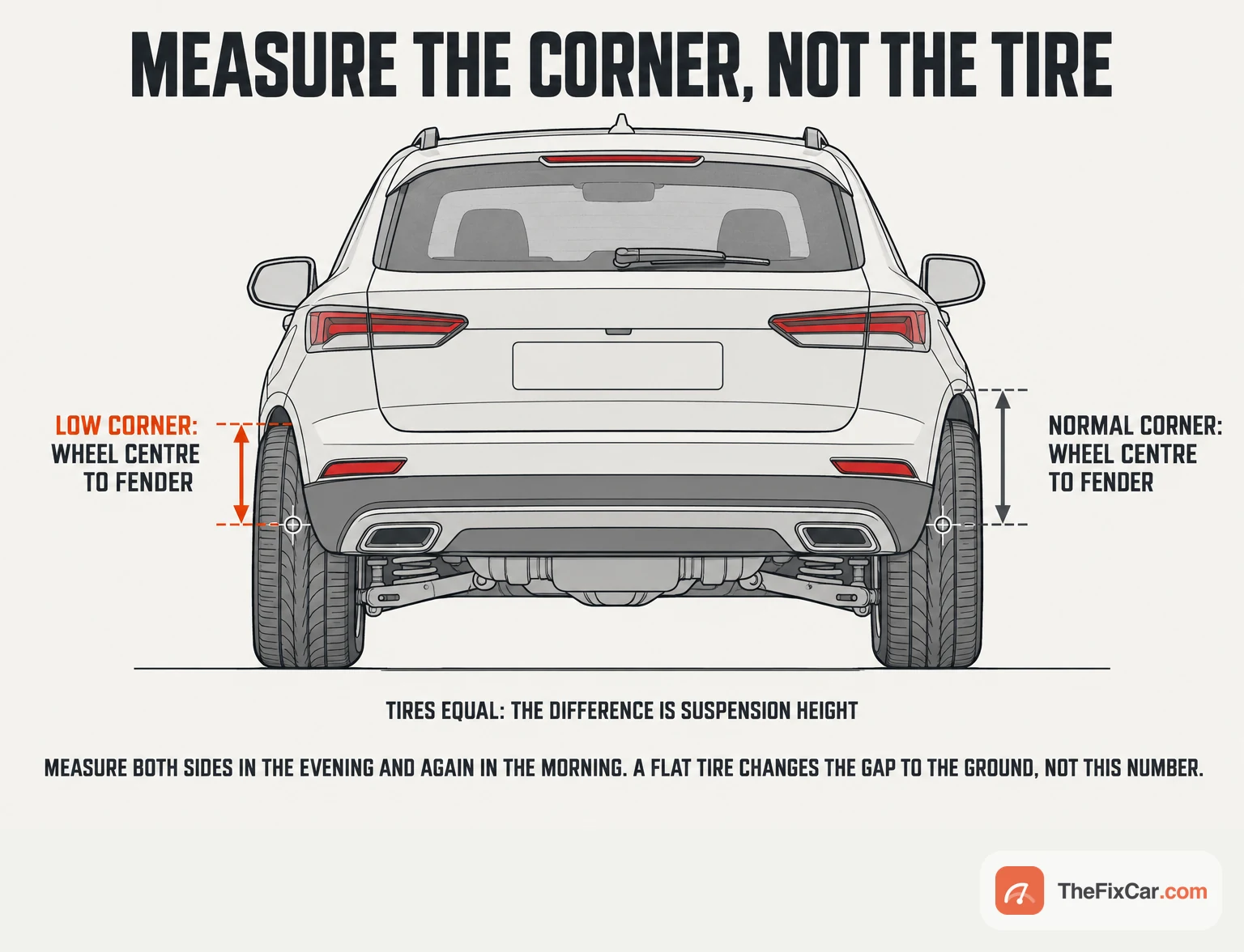
Some of what looks like a dead air spring is not a fault in the spring. A height sensor link knocked during a tire change makes the module hold that corner low every time it levels. A low tire makes the car sit lower to the eye but does not change the wheel-centre-to-fender measurement, which is why that measurement, and not the gap above the tire, is the one to use. And the dashboard messages you will meet mean the system refused to move, not that a corner failed: on 2014 and 2015 Range Rover and Range Rover Sport models with dynamic suspension, Land Rover’s bulletin Q590NAS3 ties the amber “Suspension fault” message to a compressor that is unable to lower the car on demand, and the red version adds “Do not exceed 30 MPH” because the body is sitting above normal height.
The low side is not always the faulty side. GM’s bulletin PIT5801F for the 2021 to 2026 Tahoe, Suburban, Yukon and Escalade with air ride suspension describes an air line not fully seated at an air spring fitting, where a one-way check valve lives: that spring over-inflates, the opposite side of the truck looks low, and the diagnosis goes to the wrong corner. Measure both sides against the specified height before deciding which corner is wrong.
A trouble code names a circuit, not a part. Land Rover’s 2012 bulletin for the 2010 Range Rover ties DTC C1A36-01 and the message “Electronic air suspension fault” to a compressor that over-ran, and the fix was a compressor and relay on the vehicles that bulletin covers. A code for a corner that did not reach pressure can come from a leak, a stuck valve or a sensor that did not report the rise: the same candidates as the table above.
What to check first
- The overnight measurement. Park on level ground, wait about two hours for the air to cool, then measure from the wheel centre to the fender lip at both wheels of the affected axle. Do not unlock or touch the ignition until morning, then measure again. Mercedes’ AIRmatic bulletin for the 212 and 218 series gives the scale: the level can fall about 1 mm for every 1 °C the air cools, a drop under 15 mm overnight means the springs are fine, and more than 15 mm with no bubbles at the fittings means that side’s air spring gets replaced.
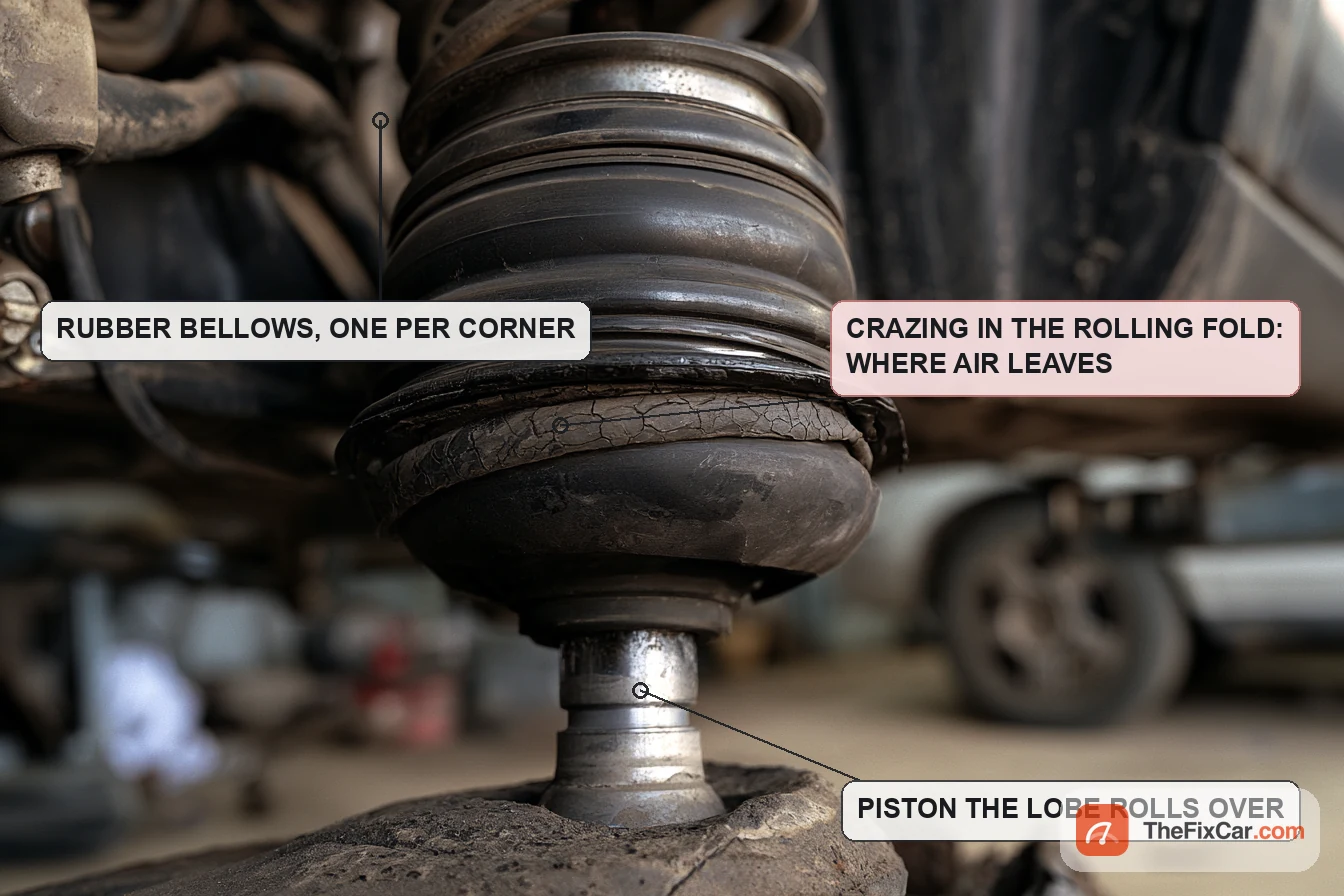
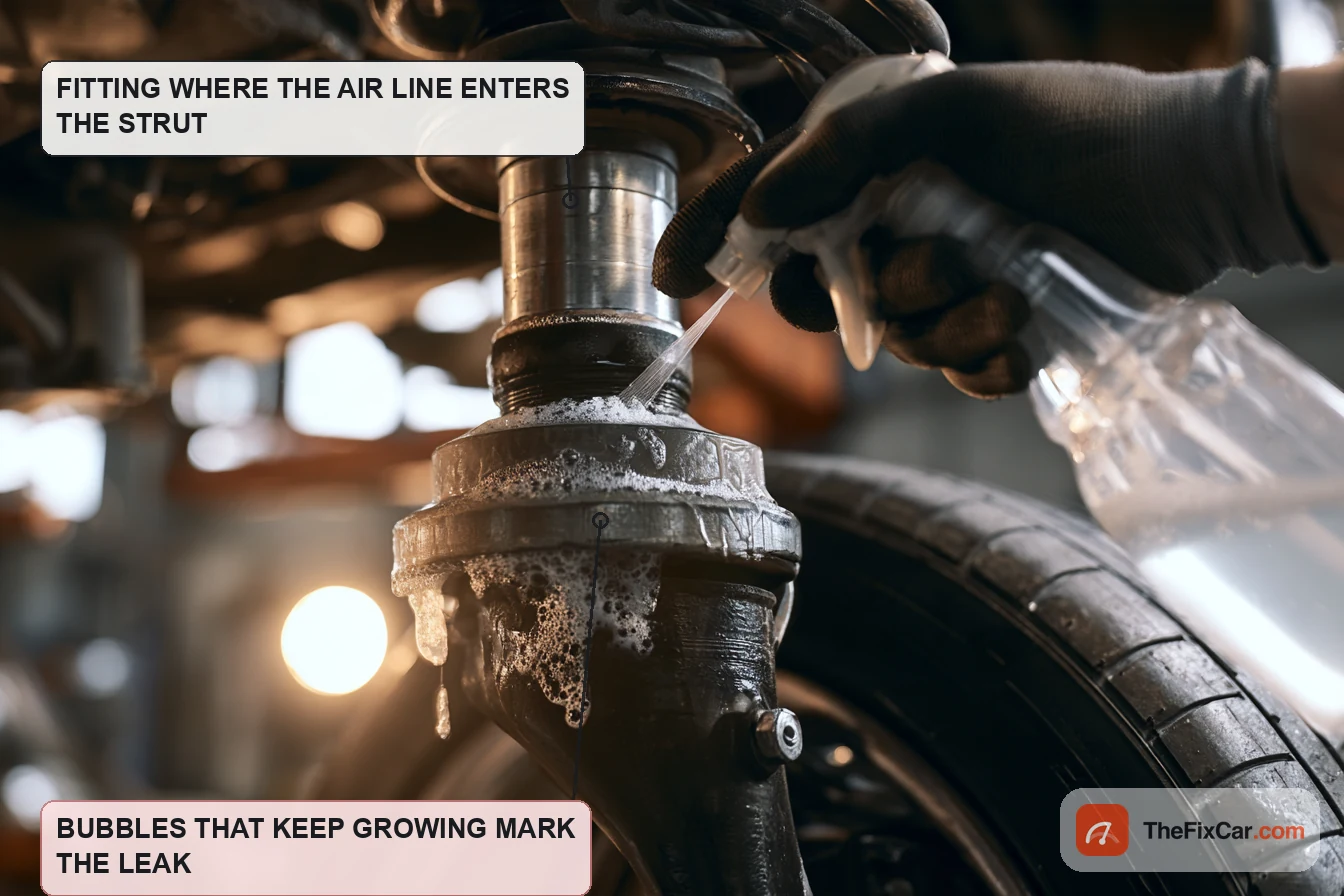
- Soapy water with the car at its highest setting. Spray the bellows fold, the fitting on top of the strut, the line where it enters the valve block and the compressor intake. Ram’s service case for the 2013 to 2015 1500 has the system raised to its Off Road 2 setting for the leak test, then left for two hours in a plant mode that stops the module from re-leveling, and the pressure and air mass readings per corner before and after are compared to find the corner that lost air. The case leaves plant mode by completing an ASCM routine on the scan tool, and the C2212 code the mode sets is cleared then; wiping codes without that exit leaves the module in plant mode.
- The four height sensor values on a scan tool. With the car on level ground, compare left to right on the same axle in the units the tool shows (millimetres from the calibrated zero on most systems). One that stands apart while the body looks level, or that jumps when you wiggle the link, is the sensor, its link or its wiring, and no amount of air will fix it. Compare heights, not raw voltages: Land Rover’s 2005 specification gives the sensors a 5 volt supply and outputs that move toward 0.5 volts on two corners and toward 4.5 volts on the other two with bump travel, so the raw numbers differ by design. A signal stuck at the end of its range with the car level is a sensor, link or wiring problem, not a height.
Lifting the car to reach the bellows puts you under it. The jack and stand sequence we use for a tire change is the minimum: the body on stands, never on the jack or the air springs alone. Select the jacking or lift mode the manual names first, the one that disables leveling (transport mode is a different setting), because the module will try to level a car that is hanging from a jack, and do not open a line or a fitting until the system has been depressurized the way the service manual describes; the Land Rover sheet lists a 35 bar burst pressure for its springs.
Can you drive on it?
A corner that holds normal height once the engine runs, on a car that handles as usual, is drivable to the shop. Two things change that. A leak the module keeps filling makes the compressor run until it overheats, and Land Rover’s 2012 bulletin exists because compressors that over-ran did not come back. And a rolling-lobe spring collapsed onto its bump stop rubs its fold against the piston at every bump, so a crack grows with every mile.
Stop driving if:
- the corner has collapsed onto its bump stop;
- a tire touches the arch or the body on bumps;
- a red suspension message or a speed limit such as “Do not exceed 30 MPH” is on the cluster;
- the compressor runs continuously and the corner still does not rise;
- the car leans enough to change steering feel in a straight line.
FAQ
Why does my air suspension go down on one side overnight?
On most cars that corner’s circuit is losing air with the car off: the bellows, the line and fitting to it, or the solenoid for that corner in the valve block. On a system that wakes and re-levels while parked, one night can mislead, so measure two nights or use the scan tool. Mercedes’ threshold for its 212 and 218 AIRmatic is 15 mm overnight; under that, the air may simply have cooled.
Can a bad compressor make only one corner sag?
Not on its own. The compressor feeds every corner through the valve block, so its failure shows as the whole car low and slow to rise. A weak compressor can leave a corner with a small leak unable to recover, but the leak is still in that corner’s spring, line, valve or sensor.
Can a height sensor cause one corner to drop?
Yes, and it is the cause that looks fine in the morning. A sensor or link that reads too high makes the module vent that corner once the ignition is on. The scan tool shows one height value standing apart from the other three.
Is it safe to drive with air suspension down on one corner?
To the shop, if the corner holds normal height with the engine running, the car handles as usual and no red message is on the cluster. Not if the corner has collapsed onto the bump stop, a tire touches the arch, the compressor runs without a pause, or the car is limited to 30 mph by the system.