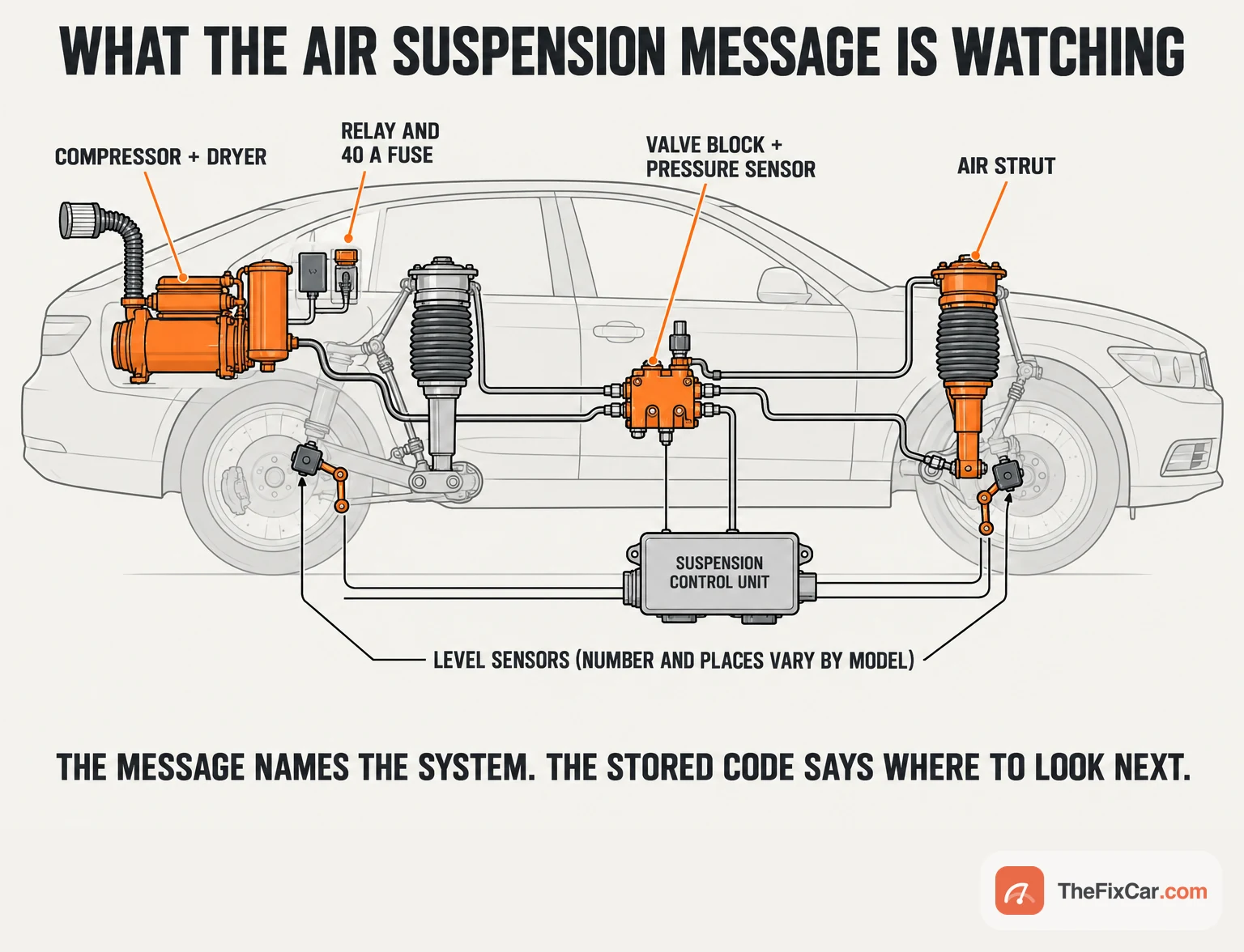
An AIRMATIC message on a Mercedes cluster reports that the air suspension control unit stored a fault, and the Daimler bulletins on this page trace that one message to five different parts: a compressor blocked by ice, a compressor whose vent valve sticks, a strut leaking at its top cover, a kinked air line, and a control unit whose own software needed updating. The cluster warning is the same kind in all five, and its wording changes with the generation: the AIRMATIC symbol on the 166, “AIR BODY (AIRMATIC)” on the 223, “Air Suspension – Service Required” on the series the later bulletins list. What differs underneath is the stored code and the way the car behaves while it sits.
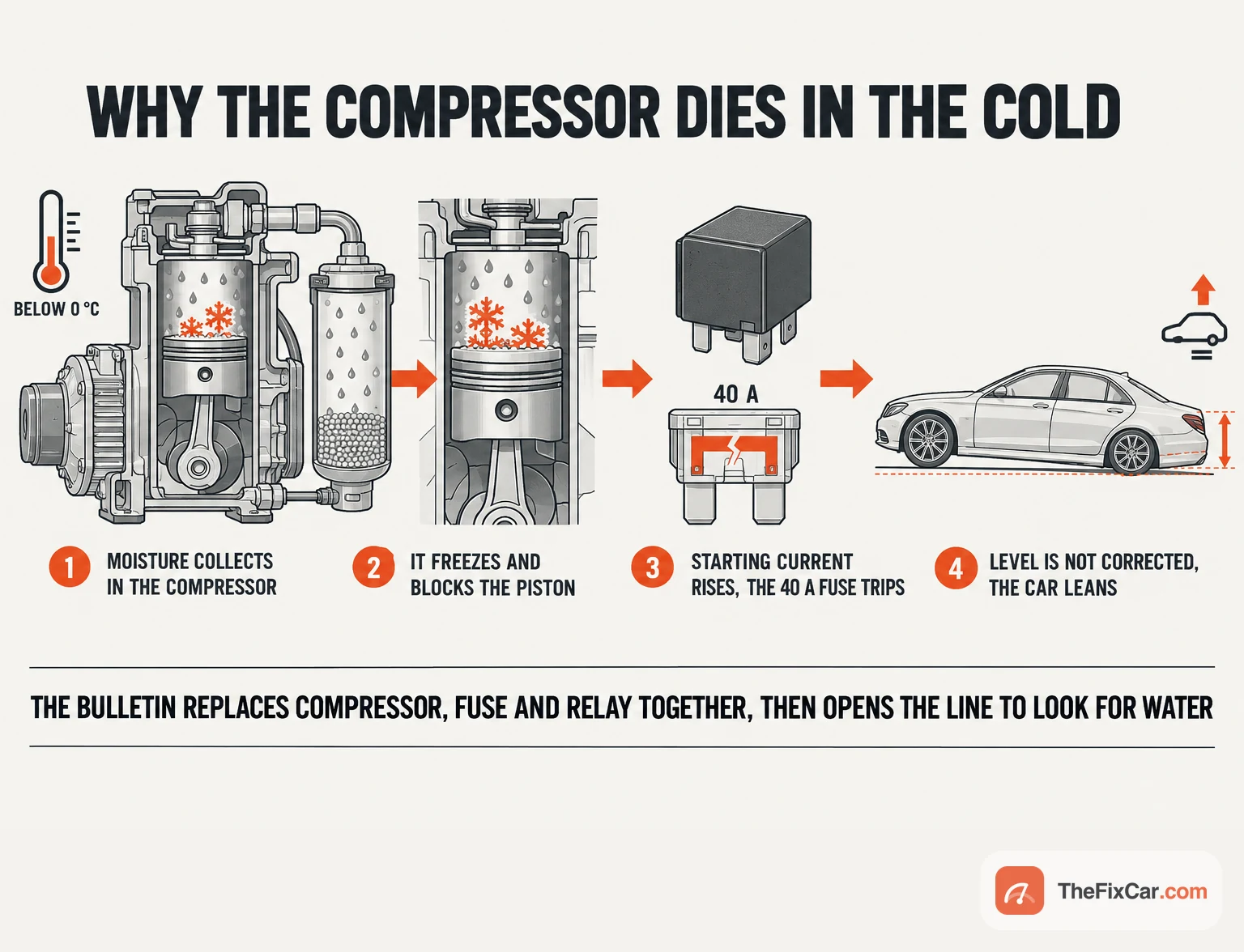
Daimler’s bulletin LI32.33-P-070817 for the 213, 253, 205 and 293 series with code 489 puts numbers on the one that strands cars in winter: moisture in the compressor freezes below 0 °C and blocks it, the starting current rises, and the 40 A compressor fuse trips, so the level is no longer corrected and the car leans. On those series the remedy replaces the compressor, the fuse and the relay together, then opens the pressure line to look for water. Below: the codes that go with each cause, three checks to make before any part is ordered, and what Daimler replaces in each case.
Quick answer
Read the stored codes first; the message does not name the part, and two of the five causes need no compressor, strut or valve block.
| What you see | Where to look | What to do first |
|---|---|---|
| Message, car leaning or low after a cold night | 40 A compressor fuse, relay, compressor (213, 253, 205, 293) | Check the fuse; tripped on a cold morning, on these series, it sends you to the freeze bulletin first |
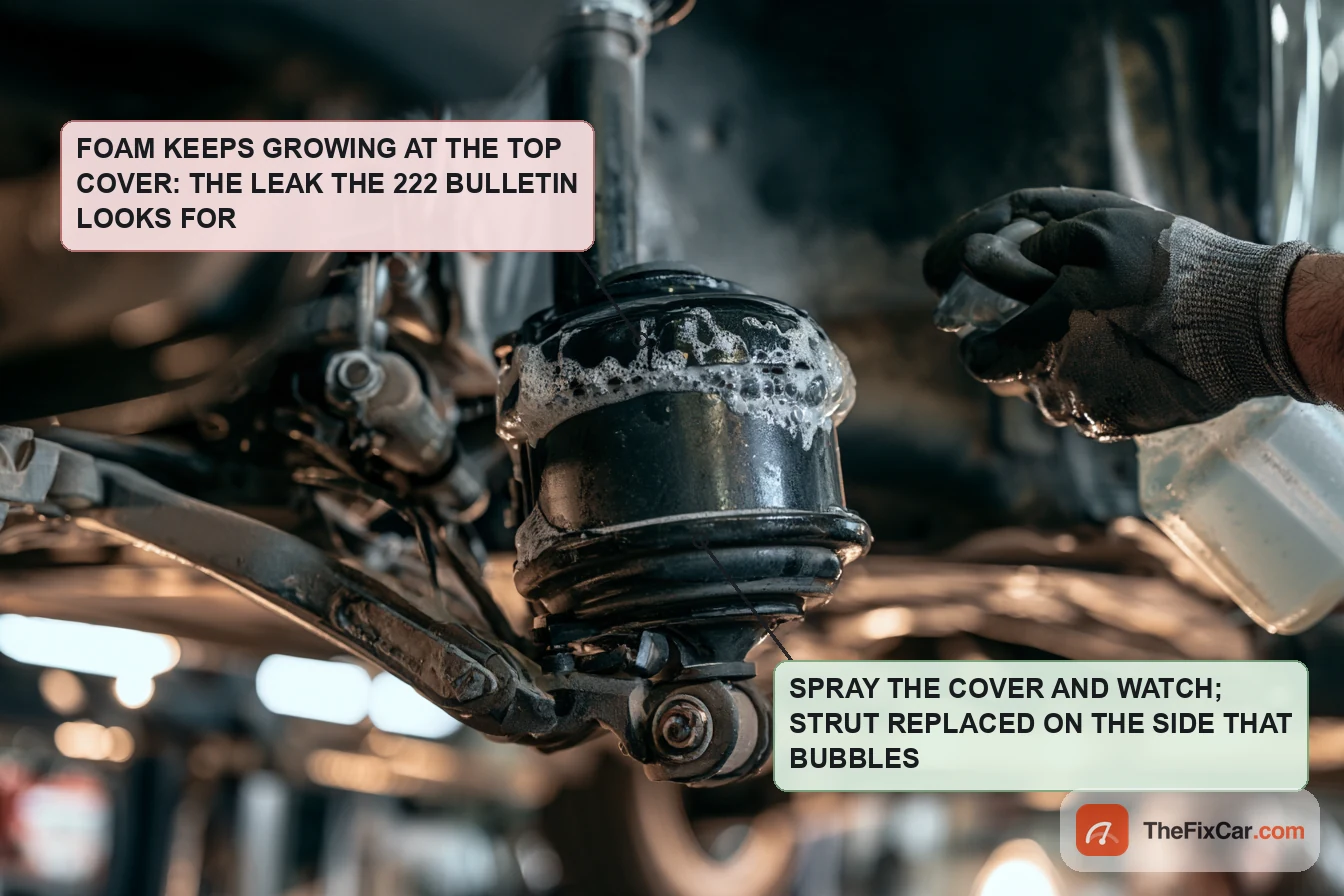
| Front drops more than 2 cm overnight; “STOP Vehicle Too Low” that does not clear | Top cover of the front strut (222) | Soapy water around the strut cover, as the 222 bulletin has it |
| One strut down today, a different one next week | Compressor vent valve (166) | Read codes: C155664, C157200 and C156C00 together point at the compressor |
| Level will not raise or lower, message on | Air lines at the left front and left rear (223) | Look for a kinked line before a part is ordered |
| Level moves about 10 mm up and down on the road, no message | Compressor software (2025 bulletin) | A software update for compressors from 08/2022 or cars built after 08/2020; the movement afterwards is by design, no parts |
Each row has more than one cause behind it; the code and the overnight behaviour decide.
What Daimler’s bulletins blame, series by series
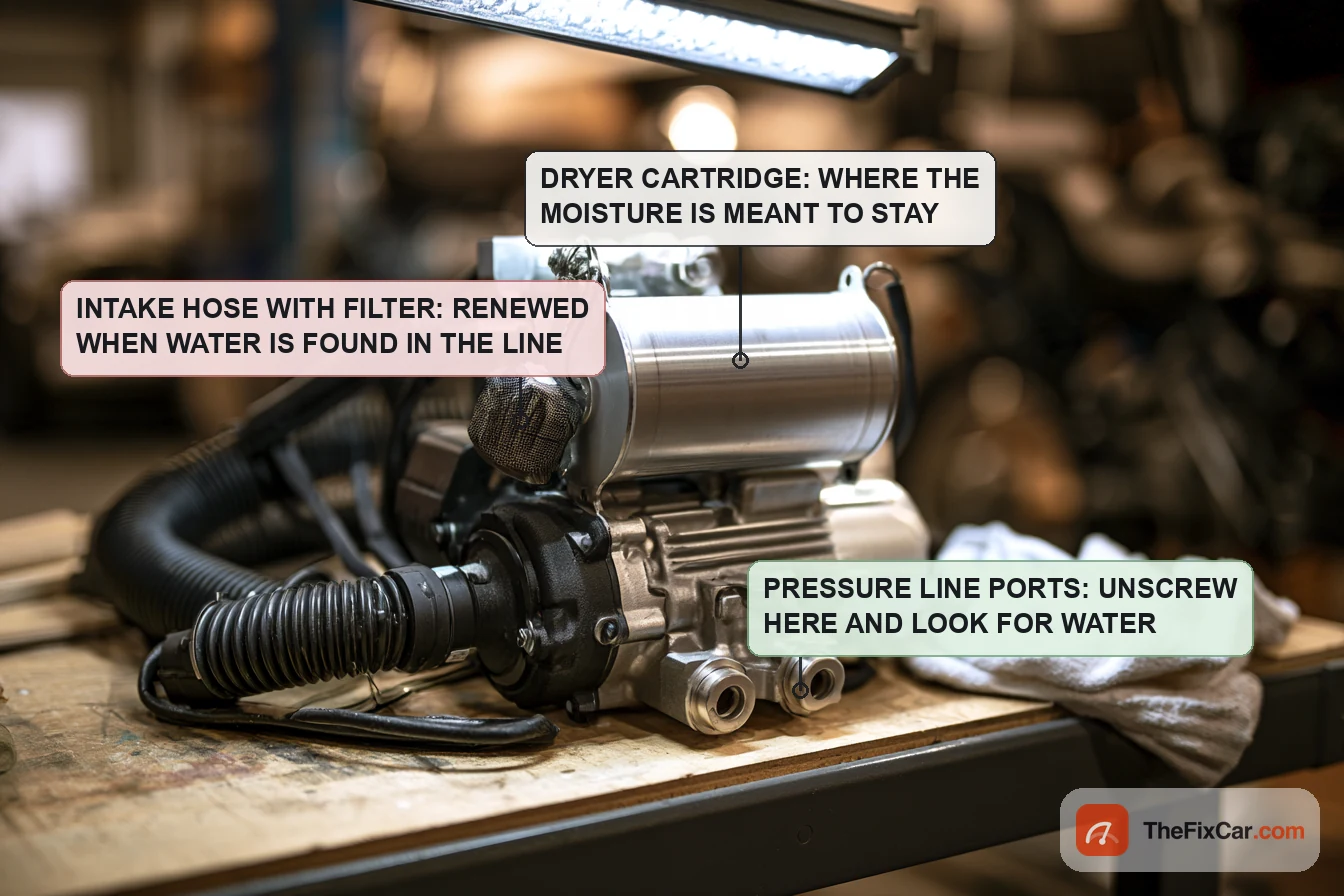
A bulletin applies to the series it names. The 2023 freeze bulletin covers the 213 E-Class, 253 GLC, 205 C-Class and 293 EQC with AIRMATIC, and its complaint reads “compressor inoperative, 40A compressor fuse possibly triggered, vehicle possibly leans at an angle”. Water collects in the compressor, freezes below zero, blocks the piston, and the compressor draws too much current on startup. Daimler replaces compressor, fuse and relay, updates the software, then unscrews the pressure line between compressor and valve block. Moisture there is taken, in the bulletin’s words, to mean moisture in the valve block too, so the valve unit is replaced, the line blown out and the intake hose renewed.
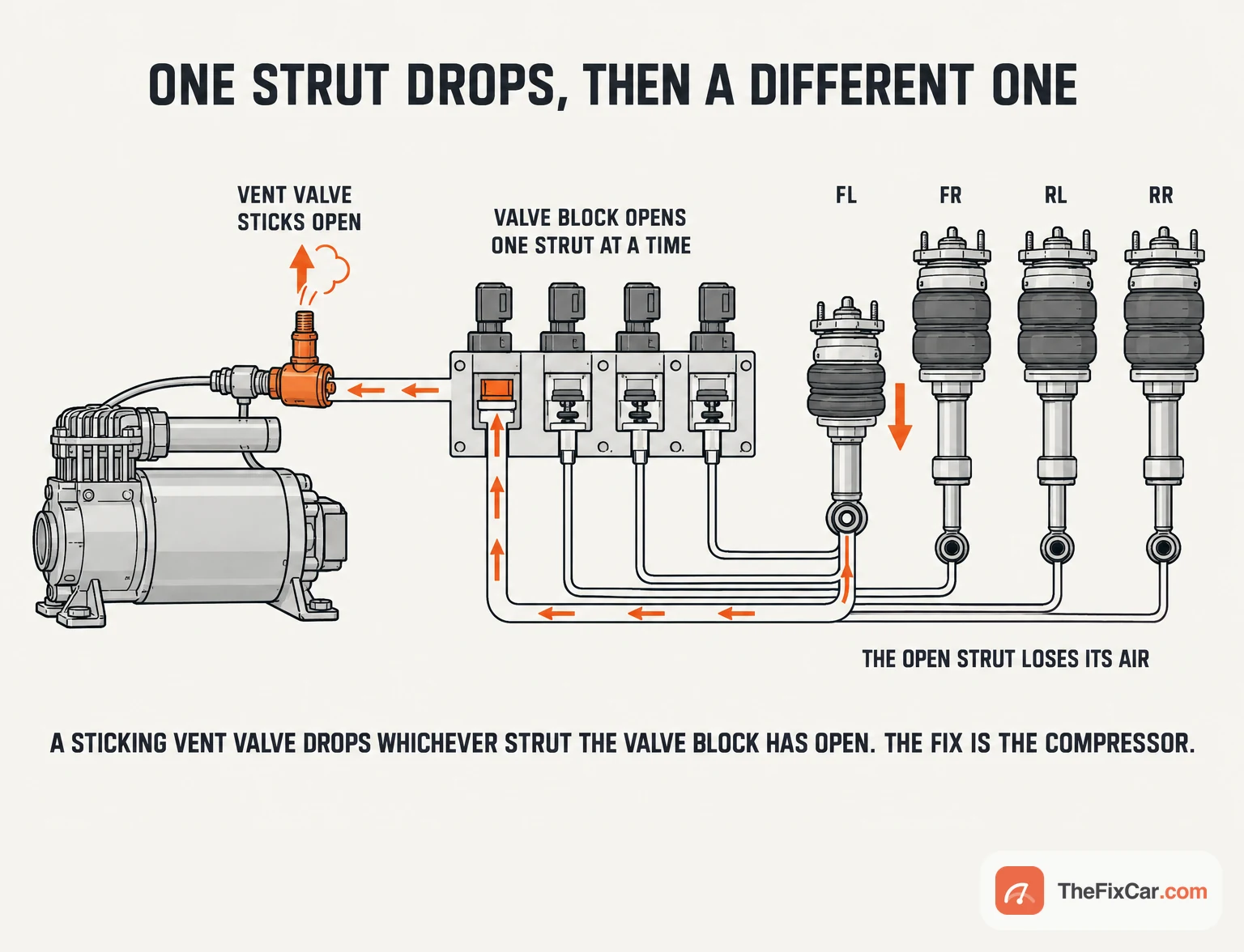
On the 166 series, the ML and GL, LI32.22-P-055731 describes a car that “occasionally drops at one or more suspension struts” with the AIRMATIC symbol in the display and three codes stored together: C155664, the system pressure sensor reporting an implausible signal, C157200, the correction time while filling too long, and C156C00, the compressed air distribution leaking. The cause is the compressor’s vent valve sticking open now and then, and the consequence is specific: the air escapes from whichever strut the valve block is actuating at that moment. The corner that drops can change from one event to the next, and the bulletin’s fix is the compressor, not a strut.
The 222 S-Class gets the leak case, LI32.22-P-058343: a front axle that drops “on one or both sides by more than 2 cm overnight”, a leak in the area of the cover on top of the air strut, soapy water around that cover, and a new strut on the side that bubbles. Its symptom list carries the second message owners search for, “Air Suspension – Stop, Vehicle Too Low”. For the rear axle of the 212 E-Class and 218 CLS in its validity list, bulletin LI32.22-P-048597 sets a different line, more than 15 mm overnight after a two-hour cooling wait, and notes that the level falls about 1 mm per 1 °C of cooling. Two series, two axles, two thresholds, and neither applies to a car the bulletin does not name.
Two bulletins replace no major part. LI32.22-P-072610 for the 223 S-Class blames a message and a level that “cannot be raised or lowered” on kinked air lines at the left front and left rear, repaired with a connector. LI32.22-P-073368 for the 167 GLE and GLS traces the message to codes C220C06 and C220C04, internal faults in the control unit, and says that replacing the unit does not fix it; a software update does.
Compressor fault, or something else?
Three of the conditions that put the message up are not air faults, and a compressor bought for them changes nothing.
| Symptom | Competing causes | Clues that shift suspicion |
|---|---|---|
| Message on, ride suddenly hard | Damping valve wiring or the valve itself; compressor; strut | Daimler’s LI32.22-P-067318 for the 166, 292, 217 and 222 stores damping valve codes such as C153013 and checks the connector for corrosion first; a car that holds its height while the ride goes hard fits that electrical fault, and the connector is checked before any air part |
| Car low on a cold morning | Frozen compressor and tripped fuse; cooling air, about 1 mm per 1 °C in Daimler’s 212 and 218 figure; a strut leak | A tripped 40 A fuse on the series the freeze bulletin names sends you to that bulletin; an equal drop on both sides that recovers as the day warms reads as cooling; one side down with bubbles growing at the cover is the strut |
| Car drops at a strut while parked | Vent valve sticking; strut leak; valve block | A different strut each time, with C155664, C157200 and C156C00, is the vent valve; the same corner every time is that corner’s strut, its line or its valve in the block |
| Level moves up and down on the road | Moisture-removal routine; sticking valve; sensor | LI32.30-P-079405 has the compressor software updated on compressors from 08/2022 or cars built after 08/2020; the updated software lifts and lowers the level up to 10 mm to purge moisture, and the bulletin replaces no parts for it |
The per-corner level codes in the 2023 bulletin, C156784, C156984, C156684 and C156884, “vehicle level is outside the tolerance”, describe a corner sitting below its tolerance; a frozen compressor explains them, and they do not by themselves condemn a sensor.
What to check first
- The 40 A compressor fuse and the relay, found from the car’s fuse chart. On the 213, 253, 205 and 293 the freeze bulletin starts here, and a tripped fuse is replaced together with compressor and relay, because it tripped for a reason; a higher-rated fuse is not a repair.
- The overnight measurement, both sides of the axle. Daimler’s 212 and 218 procedure: park, wait two hours, measure hub centre to arch on both sides, measure again in the morning without touching the locks or the ignition, and more than 15 mm is the leak case; the 222 bulletin gives only its threshold, more than 2 cm overnight at the front. Past the figure for the car, the leak test page has the spray sequence and what each result does and does not prove.
- The stored codes, read as a set. C155664 with C157200 and C156C00 is the vent valve pattern on the 166; C220C04 or C220C06 on a 167 is software; damping valve codes with the message are wiring before anything else. The chassis code format page explains why a C-code names a condition in a chassis system, not a part.
Can you drive on it?
Mercedes’ own operator’s manuals split the answer by message. “STOP Vehicle Too Low”, in the 2014 E-Class manual, means you pulled away while the level was still low: pull over and stop safely, secure the car against rolling, and wait until the message disappears before pulling away, because AIRMATIC brings the car to the selected level after a short period. “Malfunction”, in the 2013 M-Class manual, allows driving in a manner appropriate for the current level but no faster than 50 mph (80 km/h), with enough ground clearance, and sends the car to a workshop. A “Stop” message that does not clear after the wait, or a corner that stays visibly down, is the case the leak and freeze bulletins describe, and that car does not continue.
Stop driving if:
- “STOP Vehicle Too Low” stays on after you have stopped and waited, or one corner sits visibly lower than the others;
- the car leans at an angle and will not come back up, the freeze pattern with a tripped fuse;
- the ride has turned hard enough that the car skips over bumps: “hard damping” is how the damping valve bulletin lists it.
FAQ
How do I reset the Mercedes air suspension?
There is no reset button, and none of the bulletins on this page clears the fault without a repair: the code returns when the control unit sees the same condition. The two cases without a major part are the kinked line on the 223, repaired with a connector, and the 167 control unit fault, cleared by a software update with the diagnostic system.
What does “AIRMATIC Visit Workshop” mean?
The older cluster wording for the same event; Daimler’s bulletins for the later series list it as “Air Suspension – Service Required”. A fault is stored in the suspension control unit, and the code decides whether it is the compressor, a strut, a line, a damping valve or the unit itself.
Why does my Mercedes drop overnight?
Cooling air first, about 1 mm per 1 °C in Daimler’s 212 and 218 figure. Past the threshold, 15 mm at the rear of a 212 or 218, 2 cm at the front of a 222, the bulletins look for a leak at the strut cover and the line connections, and on the 166 for a vent valve that lets air out of the strut the valve block has open. The single-corner page covers why one side drops and the other does not.
Which Mercedes have AIRMATIC?
Cars built with option code 489; the bulletins here name series 212, 218, 166, 292, 222, 217, 213, 253, 205, 293, 223 and 167, from the E-Class and CLS to the S-Class, GLC, GLE, GLS and EQC. The 2023 bulletin itself lists a 213 variant without code 489, so the series alone does not say which suspension is fitted; the equipment list for the VIN does.
How much does an AIRMATIC repair cost?
None of the bulletins publishes a price, and the bill depends on which case the code points at: a connector for a kinked line or a software update at one end, compressor with fuse and relay in the middle, compressor plus valve unit plus intake hose when water is found in the line at the other. Ask which test confirmed the fault and whether the bulletin applies to your VIN before approving a strut.