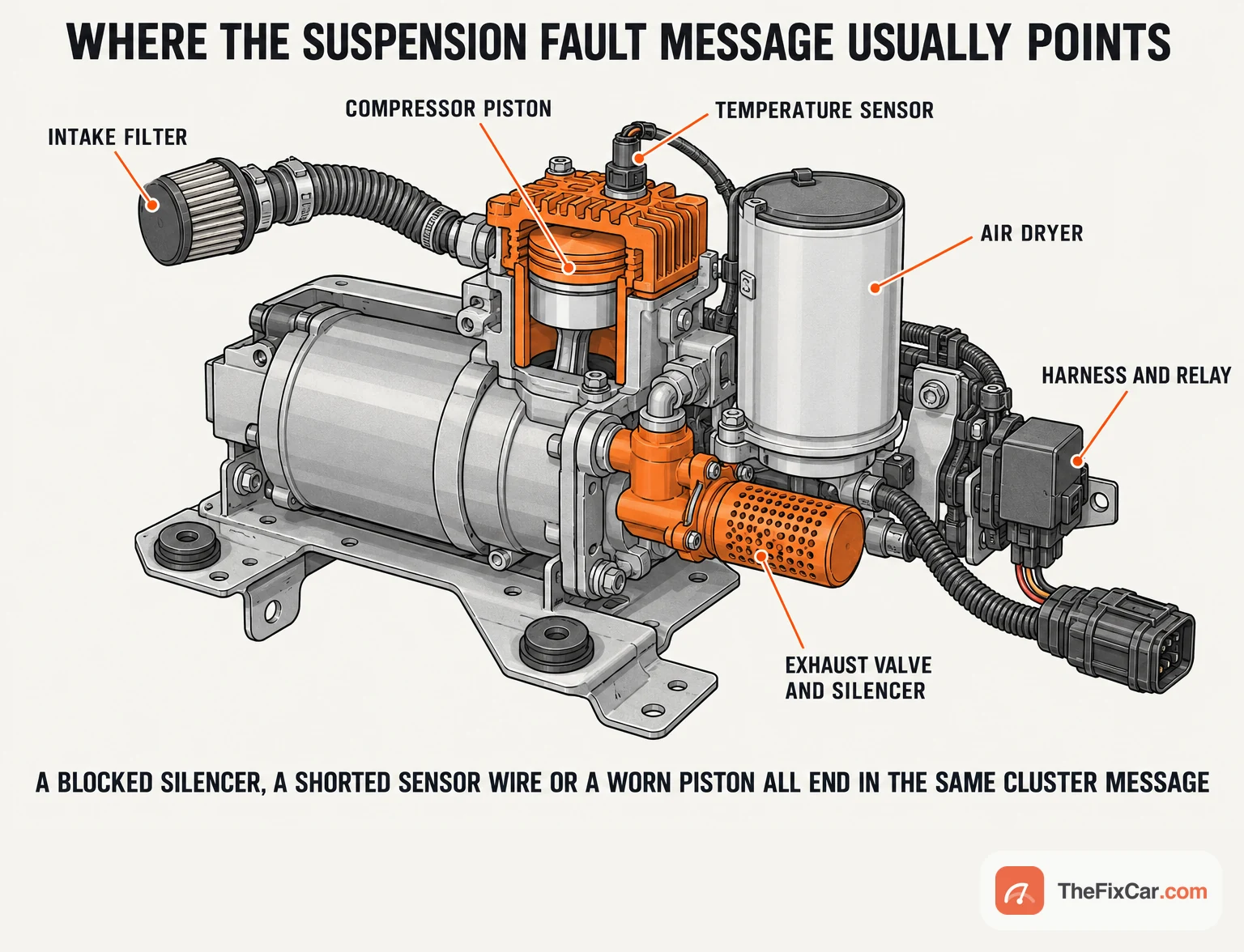
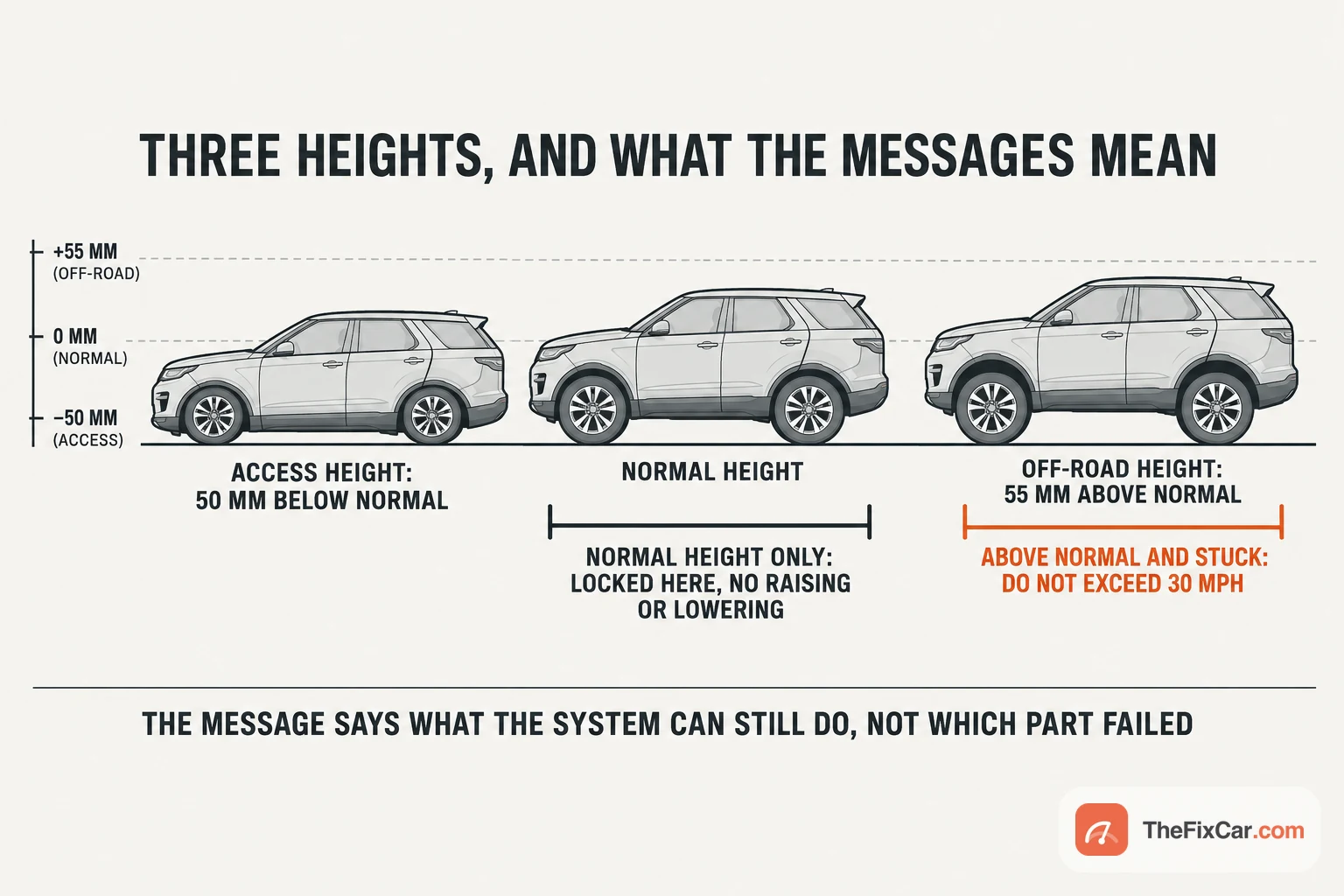
“Suspension fault” on a Range Rover or Land Rover cluster is a statement about what the air suspension can still do, not about which part failed. Land Rover’s own bulletins use the same words for a blocked compressor silencer, a leaking expansion chamber, a worn compressor and a shorted sensor wire, and they tell the two apart by the symbol colour, the second line of text and the code the module stored. On the 2014 and 2015 cars in bulletin Q590NAS3, an amber symbol with “Suspension fault” means the car will not lower on demand but drives normally, and the red symbol with “Do not exceed 30 MPH” means the body is stuck above normal height; on other models the amber words appear with no cause attached, and the stored code is the only thing that says why. “Normal height only” means the car is parked at its road setting and will not raise or lower. “Air suspension inactive” means the module stopped answering the switch.
In the five bulletins on this page, published between 2012 and 2018 for cars from 2005 on, every one of those messages led to the air supply unit under the car, the compressor with its dryer, exhaust valve and silencer, or to the wiring that feeds it. That is where this page points you, with the code that goes with each message and the one check that separates a compressor that is worn from a compressor that is only working too hard.
Quick answer
Read the stored codes before anything is replaced; the message alone never names the part.
| What the cluster shows | What the system can still do | Where to look | First thing to do |
|---|---|---|---|
| Amber symbol, “Suspension fault” | A fault is stored; on the Q590NAS3 cars the car drives at normal height and will not lower on demand | Air supply unit: blocked silencer, worn compressor, leak at the unit | Read codes; listen for the compressor running long |
| Red symbol, “Do not exceed 30 MPH” | Stuck above normal height | Same unit, with the car unable to vent down | Keep under 30 mph, read codes, check the exhaust side of the unit |
| “Normal height only” | Holds road height, no raising or lowering | Expansion chamber or elbow on the air supply unit, slow pressure rise | Soapy water on the expansion chamber and its connectors |
| “Air suspension inactive” | Switch does nothing | Harness to the air supply unit, thermistor wiring, relay, fuse | Inspect the harness at the unit for chafing |
A guide, not a diagnosis: the same message appears on different model years for different reasons.
What Land Rover’s bulletins blame, model by model
The numbers below are Land Rover’s, from bulletins published through NHTSA, and each applies to the vehicles it names.
| Vehicles | Message and code | Competing causes | Clue that shifts suspicion |
|---|---|---|---|
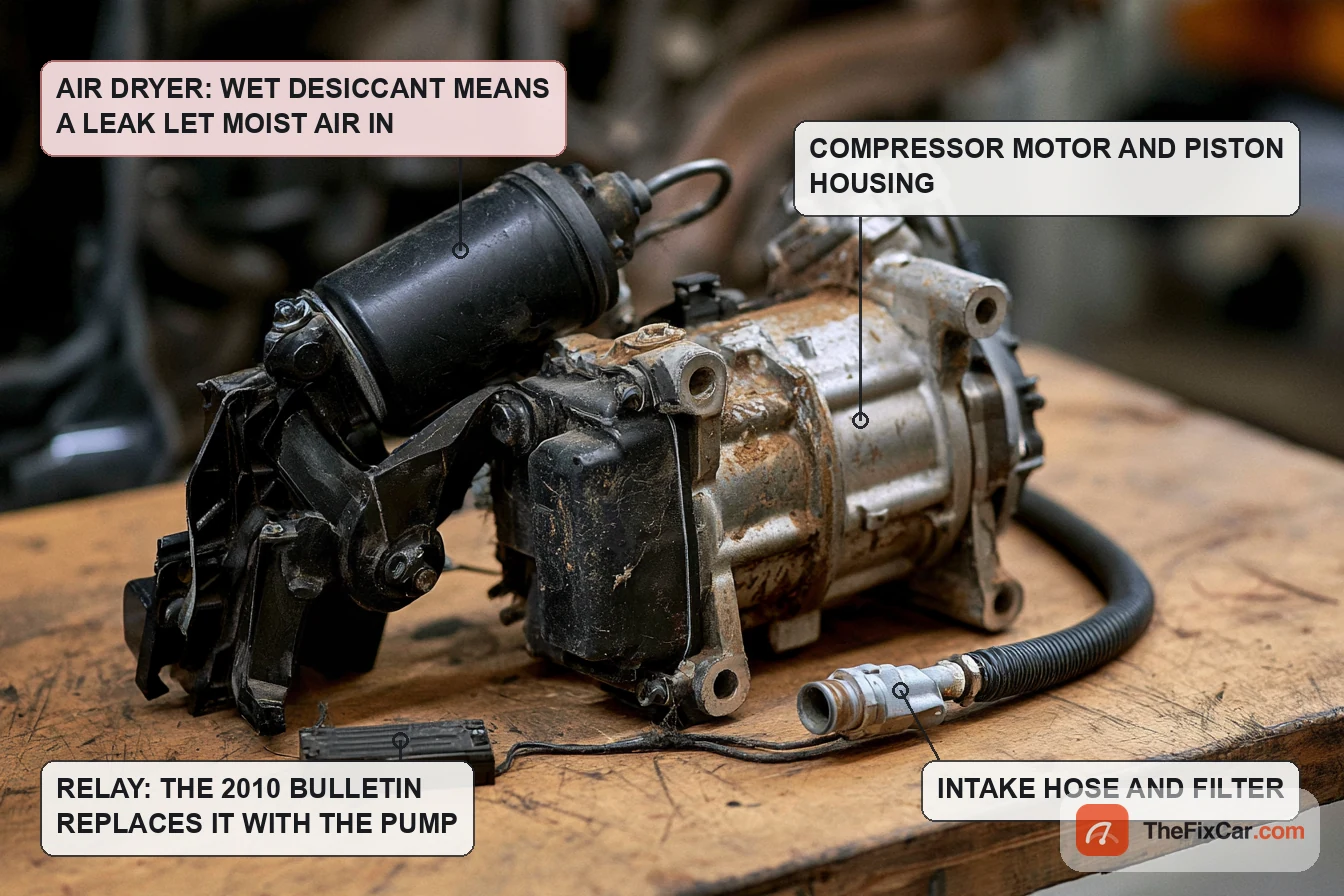
| 2010 Range Rover (L322), bulletin LTB00438NAS1 | “Electronic air suspension – fault”, DTC C1A36-01 | Compressor that over-ran and failed; the leak that made it over-run; relay | The repair is a compressor and its relay; a leak elsewhere brings the same code back |
| 2005 to 2009 LR3, 2010 to 2012 LR4, 2006 to 2013 Range Rover Sport (L320), LTB00420NAS3 | Warning lamp, car will not raise, DTC C1A20-64 (pressure rises too slowly) | Hitachi or old-design AMK compressor; a leak between compressor and reservoir | Soapy water finds nothing and the compressor runs hot: the bulletin replaces the compressor with the new AMK kit |
| 2014 to 2015 Range Rover (L405) and Range Rover Sport (L494) with dynamic suspension, Q590NAS3 | Amber “Suspension fault” or red “Do not exceed 30 MPH” | Blocked compressor silencer; air supply unit; valve connector | Step 16 of the bulletin: white powder at the air supply unit silencer means the whole unit is replaced; no powder, and only the silencer is |
| Discovery (L462) and Range Rover Velar (L560), note SSM73563 of September 2017; Range Rover (L405) and Range Rover Sport (L494), note SSM73780 of May 2018 | Lamp plus “only normal height is available”, DTCs C1A20-64 and C1131-92 | Expansion chamber or its elbow on the air supply unit, leaking air | Bubbles at the expansion chamber with the compressor running; the part is replaced with three new line connectors |
| 2013 Range Rover (L405), service action Q322 | “Air suspension inactive”, DTC U210A-16 | Thermistor wiring short at the air supply unit harness | The fix is a protective sleeve on the harness, not a part |
Compressor fault, or something else?
Three of these bulletins end in a new compressor, which is how the message and the part came to be treated as the same thing. They are not. The compressor in the 2010 bulletin failed from over-running, which is a pump that ran longer than it was designed to; the usual reason a pump runs long is a system that keeps losing air, so the leak is worth finding before the new pump goes in. The LR3 and LR4 bulletin names C1A20-64, pressure rising too slowly, and a leak between the compressor and the reservoir or a blocked silencer produces that code with a healthy compressor. The expansion chamber notes from 2017 and 2018 fit the same pattern: the leak sits on the air supply unit, so the car reads it as a supply fault, and the repair is the chamber, not the pump.
Two messages that sound like this one belong to a different system. On the Range Rover Sport owner guide, the Dynamic Response anti-roll system has its own lamp: amber with “Vehicle lean when cornering” means reduced roll control and the car can be driven at reduced speed, and red with “Stop vehicle, stop safely, stop engine” means a fault that can cause serious damage, stop as soon as it is safe and switch off. That red message is not an air suspension warning and is not covered by anything on this page.
A fault at one corner looks different. A spring or line that bleeds shows up as a corner low in the morning, and the compressor message arrives later, once the module has run the pump against the leak long enough. One corner lower than the other three is worked out at the corner first, not at the pump.
What to check first
- The code, and whether it names time or electricity. C1A20-64 says pressure rose too slowly when the compressor was asked to fill: a leak, a blocked intake or silencer, or a tired pump. C1A36-01 on the 2010 car is the module recording an over-run. U210A-16 on the 2013 car came with a shorted thermistor wire, and the service action fixed it with a sleeve over the repaired harness. For scale, Land Rover’s 2005 specification for the Range Rover Sport and LR3 lists a compressor limited to 16.8 bar feeding a 9 litre reservoir at a working pressure of 17.5 bar; those are component ratings, not a fill-time test.
- How long the compressor runs, and how hot. With no red message and the car at normal height, start it and ask for off-road height. On the Range Rover Sport guide the lift is 55 mm and the change is allowed at any speed up to 40 km/h; other models differ by a few millimetres. A compressor that runs for minutes and still does not reach height, or that cuts out and resumes once it cools, is either leaking to atmosphere or worn; the thermistor on the cylinder head exists to stop it from cooking itself, which is why the 2013 wiring short disabled the whole system rather than letting it run.
- Soapy water at the unit before the corners. The expansion chamber and its elbow, the three air line connectors into the unit, the dryer and the exhaust silencer. The 2017 and 2018 notes replace the expansion chamber together with three new air line connectors every time. Bubbles here explain a “normal height only” message on their own.
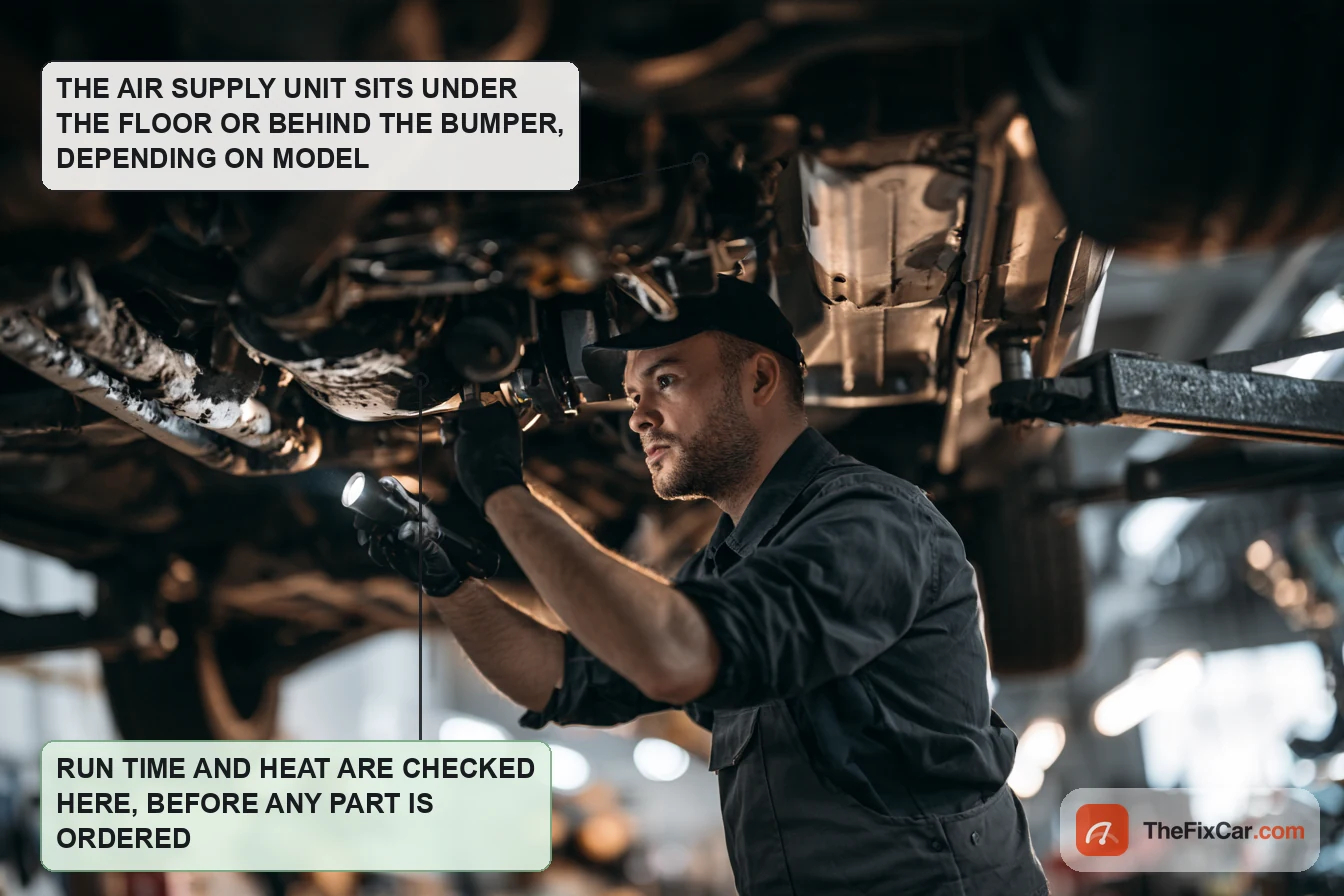
The unit sits under the rear floor or behind the bumper depending on the model, and reaching it means lifting the car; stands under the body, not the jack alone, the leveling disabled in the jacking mode the handbook names before a wheel leaves the ground, and no line or connector opened until the system has been depressurized the way the manual describes.
Can you drive on it?
With the amber symbol on the Q590NAS3 cars, yes: Land Rover’s bulletin says there is no change to suspension performance, only that the car will not lower on demand; on other models, amber plus a car that sits level and handles as usual is the same answer, and amber plus a low corner is not. With “normal height only”, yes, at normal height, with no access or off-road setting until it is fixed. With the red symbol and “Do not exceed 30 MPH”, the limit is the instruction, provided the car sits level and handles as usual: the body is above normal height and the system cannot bring it down, which is why Land Rover puts a speed on the message.
Stop driving if:
- the red symbol is on and the car has to go faster than 30 mph to get where it is going;
- the body sits low at one or both axles and the compressor cannot raise it;
- the compressor runs without a pause with the car parked;
- a tire touches the arch, or the car leans and the steering feel changes;
- the message is “Stop vehicle, stop safely, stop engine”: that one is the handbook’s own instruction;
- the message comes with a burning smell from under the rear floor.
FAQ
How do I reset a suspension fault on a Range Rover?
Clearing the code with a scan tool removes the message, not the condition. A battery disconnect may blank the cluster, but many of these modules keep the stored code through a power loss, and on some older Range Rovers it brings up “Air suspension inactive” until the system is woken again. The bulletins above list repairs, not resets. The reset that lasts is the repair the code points to.
Does “suspension fault” mean the compressor is dead?
Not by itself. Land Rover’s bulletins tie the message to a blocked silencer, a leaking expansion chamber, a shorted thermistor wire and a worn compressor, on different years. The code and a soapy-water check at the unit say which.
What does “normal height only” mean?
The system will only run at its road height and will not raise or lower the car. On the 2017 and 2018 models in Land Rover’s notes the cause was an air leak at the expansion chamber of the air supply unit, with codes C1A20-64 and C1131-92.
Can I drive with “Do not exceed 30 MPH”?
At 30 mph or less, to a shop. The car is above normal height and cannot come down, which is why Land Rover puts a speed on the warning.
What is the C1A20-64 code?
Pressure increased too slowly when the compressor was commanded to fill. Land Rover attaches it to worn Hitachi and early AMK compressors on the LR3, LR4 and Range Rover Sport, and to expansion chamber leaks on later cars; a leak large enough on the path between the pump and the reservoir sets it too.