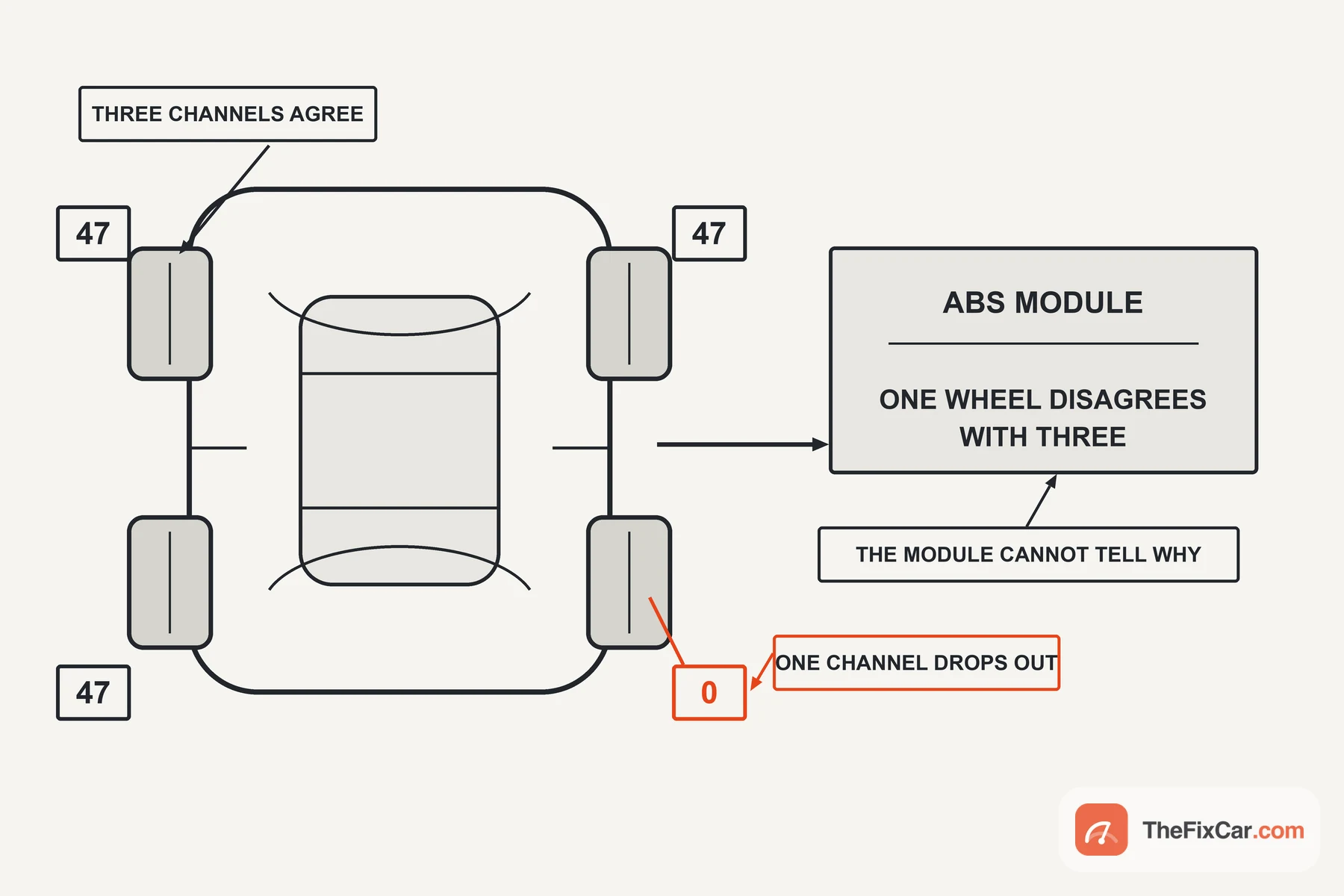
A wheel speed sensor rarely announces itself as a wheel speed sensor. What you get instead is three warning lamps at once, or a speedometer that drops to zero for a second, or the stability light flashing while you crawl around a car park with nothing wrong with the road.
Most of those come from the same place: the module comparing four wheels and finding one that does not agree with the other three. It cannot see why. Working out which observations narrow that down, and which ones do not, is the whole job.
Quick answer
The classic set is the ABS, traction control and stability lamps lighting together, because they share the same wheel speed inputs. Less obvious, and more useful diagnostically: a wheel speed fault can exist with no stored code. GM documents low speed clicking or ABS pump activity with only a brief flashing traction or stability telltale and no current or history codes.[1]
Common signs of a bad wheel speed sensor
- ABS warning light on.
- Traction control or stability control warning at the same time.
- ABS activating, or the brake pedal chattering, just before the car comes to a stop.
- Intermittent speedometer dropout, on vehicles that take road speed from the ABS system.
Each of those has more than one possible cause, which is what the rest of this page is about.
What the module is actually reacting to
Wheel speed codes are not all the same kind of fault. The MV-1 bulletin supports three families at once: excessive wheel speed variation, wheel speed circuit open or shorted, and wheel speed frequency out of range.[2] The first is a plausibility judgement, the second is an electrical threshold, and they behave very differently on the road.
The plausibility kind is where the logic becomes visible. On that vehicle an excessive wheel speed variation code can set when an increase greater than 15 kph, about 9 mph, occurs three times with less than 200 milliseconds between occurrences.[2]
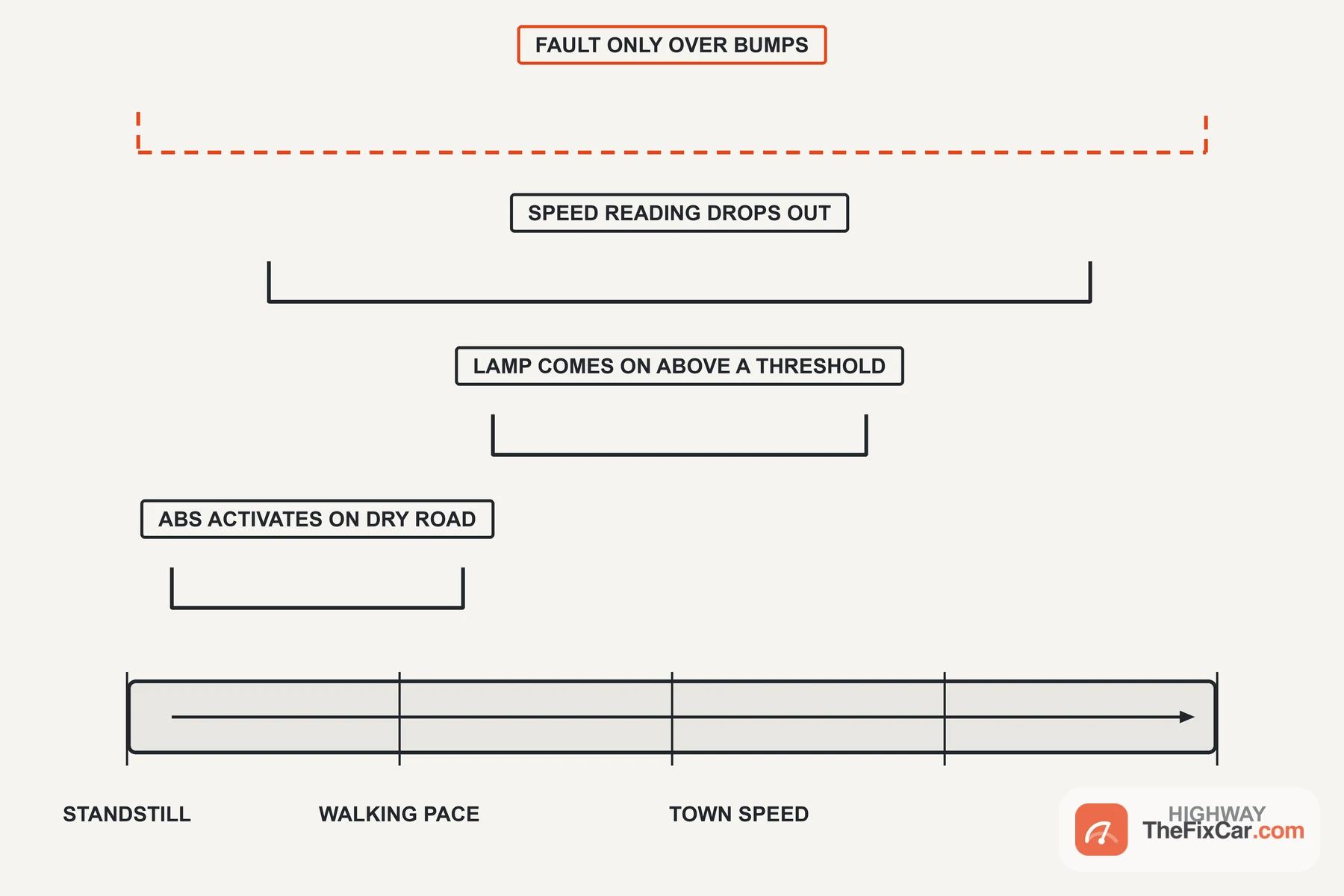
That is one reason some wheel speed faults appear only above or below a particular road speed. A signal that disappears at walking pace may never produce the jump the module is watching for, while the same fault at road speed sets a code in seconds.
The symptoms, and what separates them
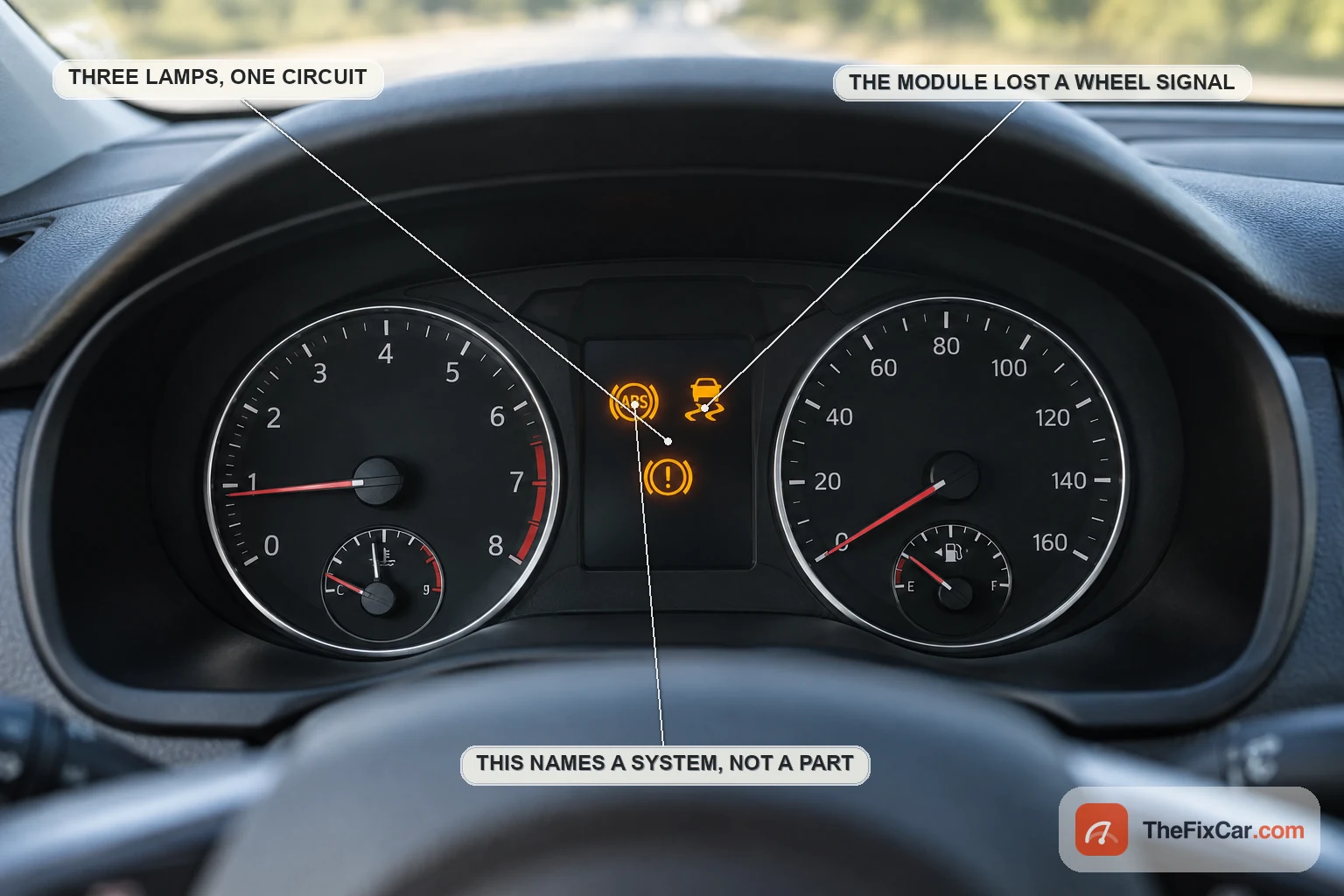
Three lamps at once: ABS, traction control and stability.
Likely sources: anything in one wheel speed circuit, which includes the sensor, the tone ring or encoder, the air gap, the wiring and the connector. GM lists this exact combination of telltales as the first customer-reported condition for debris on an encoder ring.[1]
What separates it: a wheel specific code can identify the corner to investigate, and that is the useful information behind the lamps. It identifies the circuit, not the failed part. The absence of a stored code does not clear the wheel speed circuit either, particularly with the intermittent low speed faults described below.
ABS engaging on dry road at low speed.
Likely sources: one wheel reporting a speed the others do not agree with, so the module believes that wheel is locking. A dropout as the wheel slows, a damaged tone ring tooth, or a large air gap all do this.
What separates it: pay attention to when it happens. Braking to a stop from walking pace is the classic pattern, because that is where a passive sensor’s output is weakest and where a single missing pulse looks most like a locked wheel. If it happens at speed instead, the answer is usually elsewhere.
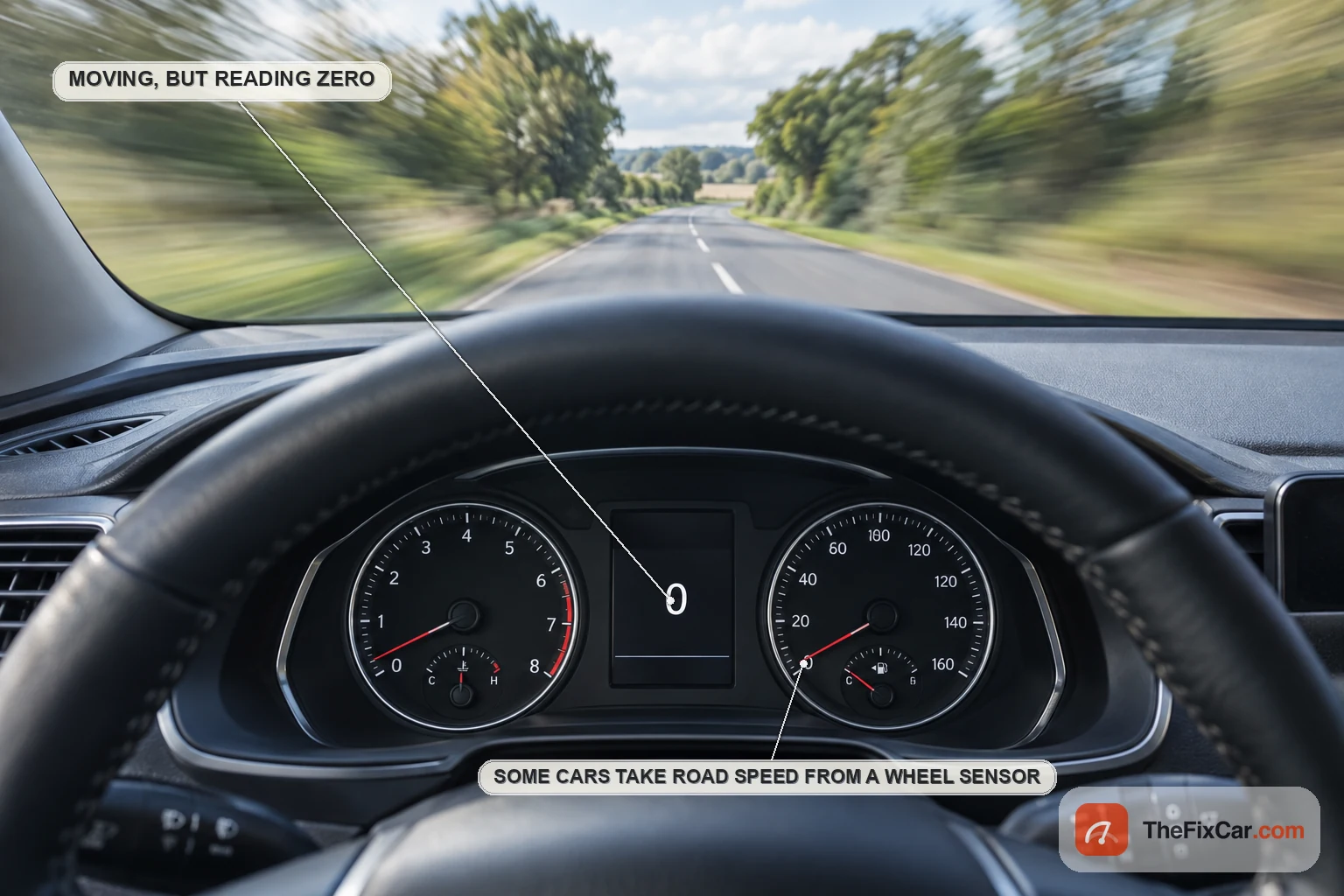
Speedometer dropping to zero while moving.
Likely sources: on vehicles that take road speed from a wheel sensor, the same circuit that feeds ABS. On others the speedometer runs from a transmission output sensor and is unaffected, which is itself a useful clue about your car.
What separates it: whether the speedometer and the ABS lamp fail together. Together points at the shared wheel circuit. Speedometer alone, with the ABS lamp untroubled, points away from it.
A fault that comes and goes over bumps rather than with speed.
Likely sources: the harness and the connector. A joint that has corroded can pass a static continuity check and separate when the suspension moves.
What separates it: the trigger. A dropout that tracks road surface, cornering load or temperature rather than road speed points at the harness and the connector rather than the sensor. Catch it with recorded data rather than a meter.
Clicking or grinding at parking lot speed, with no lamp and no code.
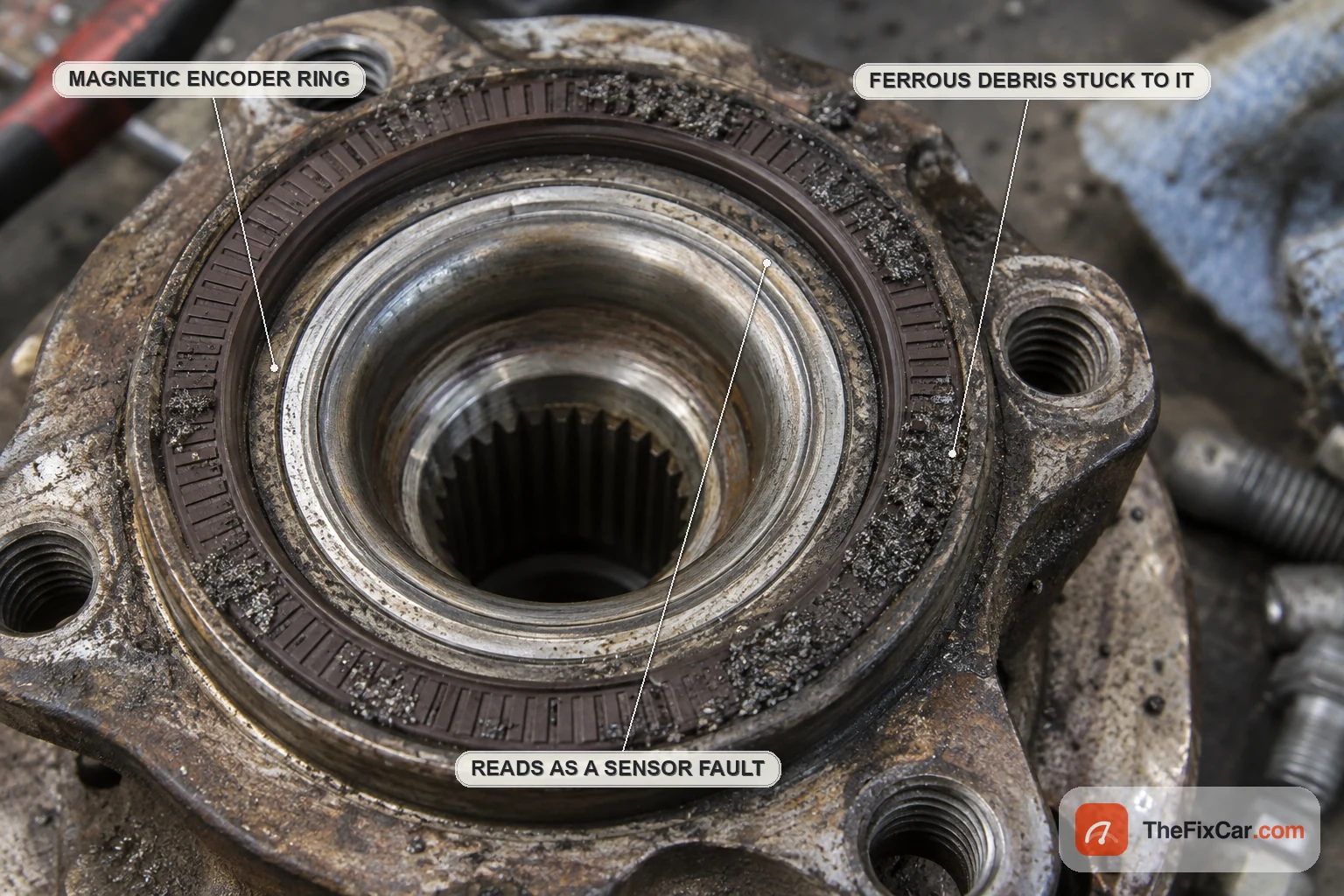
Likely sources: this is the case worth knowing about. GM describes brief intermittent noise, clicking, ratcheting, grinding or ABS pump motor noise heard from inside the car at parking lot speeds, along with a flashing traction or stability telltale at low speed, and states that these two conditions come with no ABS or stability codes stored at all.[1] The cause they document is ferrous debris stuck to the magnetic encoder ring.
What separates it: the absence of a code is the diagnosis, not a dead end. A scan tool that reports nothing has not cleared the wheel speed circuit.
Heavy steering at low speed, with a steering message.
Likely sources: on some GM applications fitted with electric power steering, losing a wheel speed signal can also produce a service steering message and heavier steering at low speed or when steering while stationary, with the steering module setting its own communication code.[1] GM describes this as a normal fallback response on the affected vehicles, not as a second fault.
What separates it: a steering complaint arriving at the same time as ABS lamps is not two faults. Chasing the steering module first is the mistake this symptom sets up.
What gets mistaken for a bad wheel speed sensor
A wheel speed code does not automatically condemn the sensor. The signal can be corrupted by several mechanical and electrical faults upstream of the module, and each of them gets the sensor replaced.
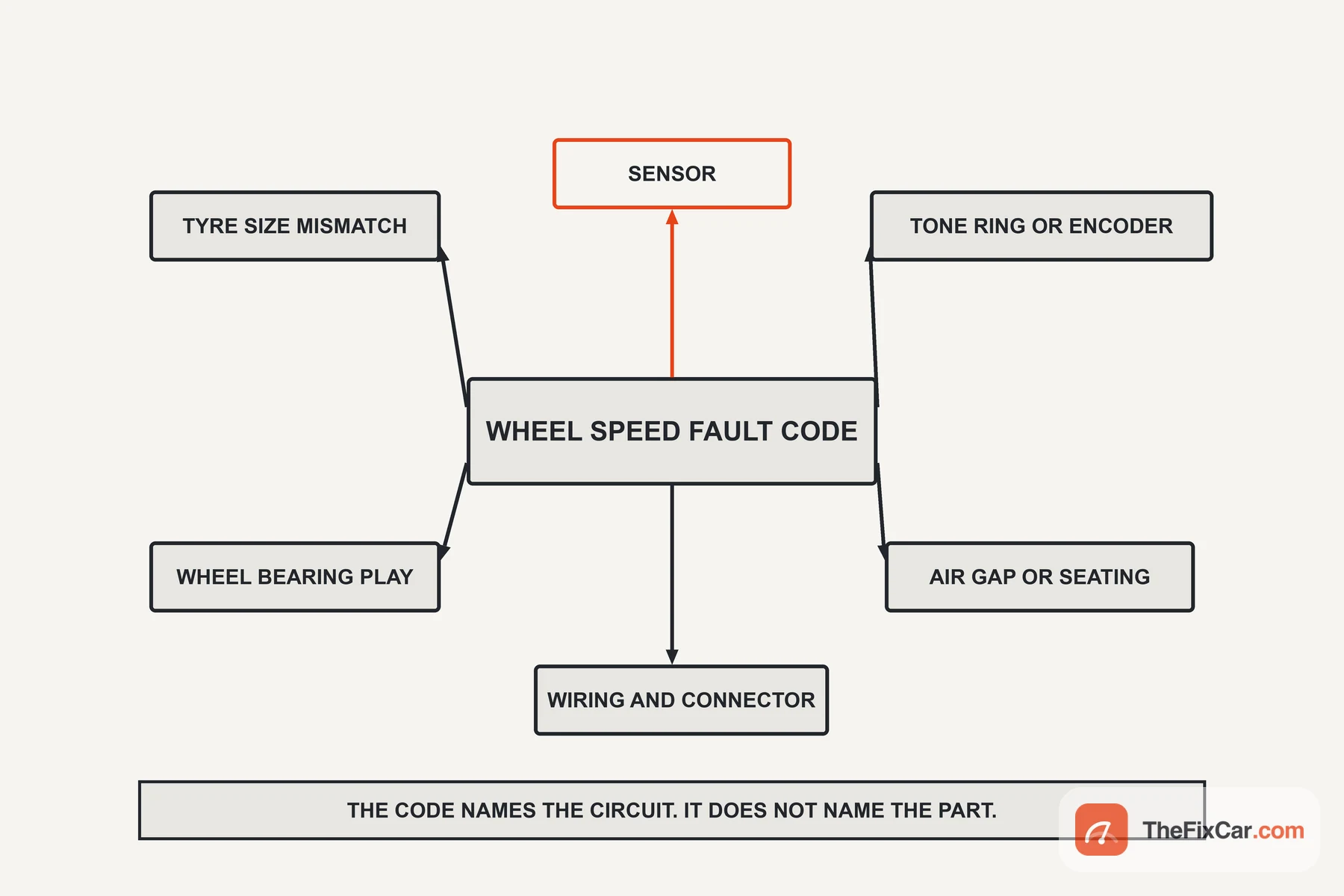
The tone ring or magnetic encoder. A chipped tooth disturbs the pulse train at the same point in every revolution. A magnetic encoder collects ferrous debris and reports nonsense while looking perfectly clean to someone who does not know what it is.[1]
The air gap and how the sensor sits. Rust scale under the sensor shoulder holds it out of its bore and widens the gap it reads across.
The wiring and the connector. The failure that most convincingly imitates a dead sensor, because it is invisible while the car is standing still.
Wheel bearing play. A bearing that lets the hub move changes the gap as the wheel turns, and on many designs the encoder is part of that bearing.
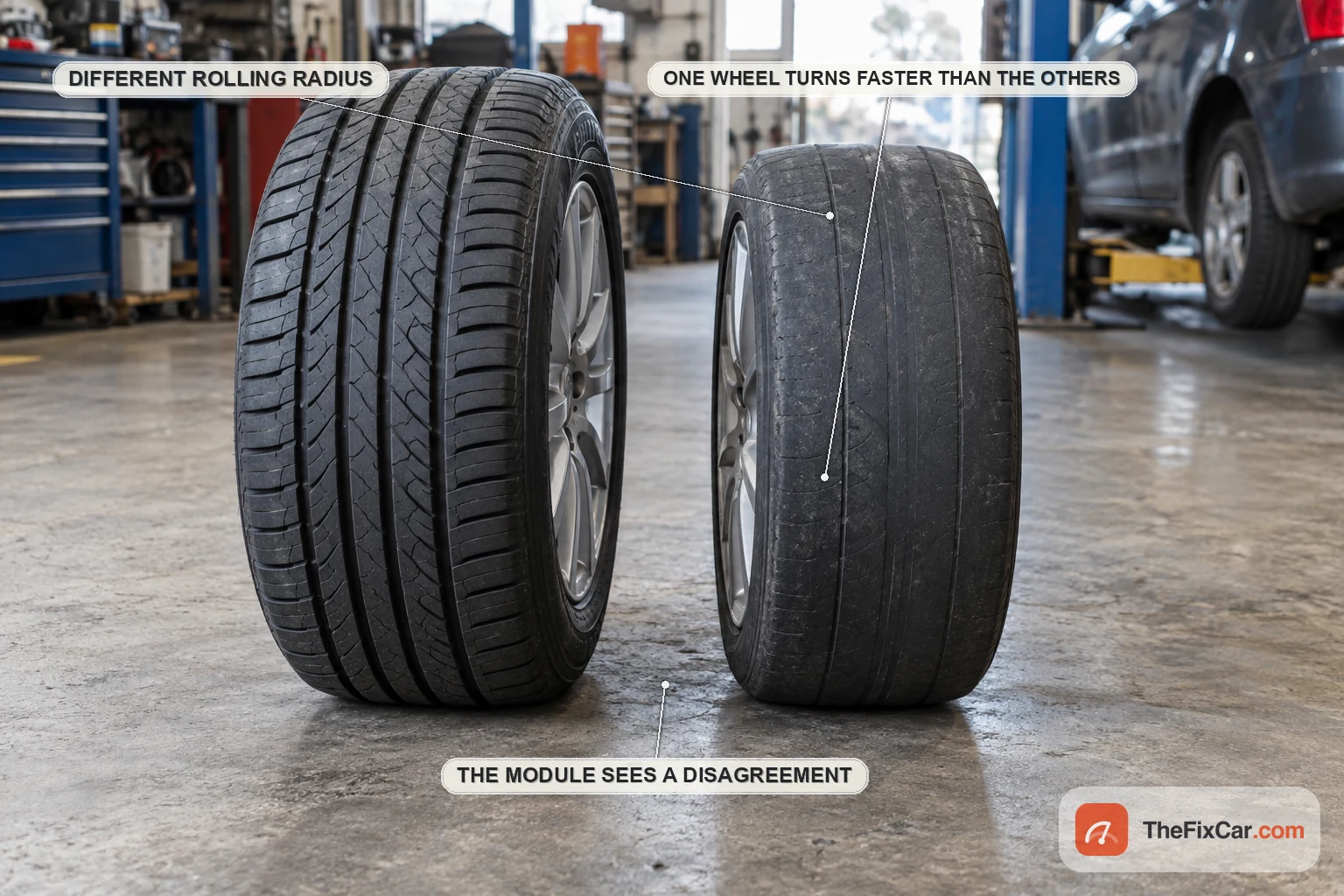
Tyre rolling circumference mismatch. A wrong size tyre, a temporary spare or a severe circumference difference can make one wheel genuinely rotate at a different rate from the others. The module is not wrong here. The wheel really is turning at a different speed.
What the warning lamp does and does not tell you
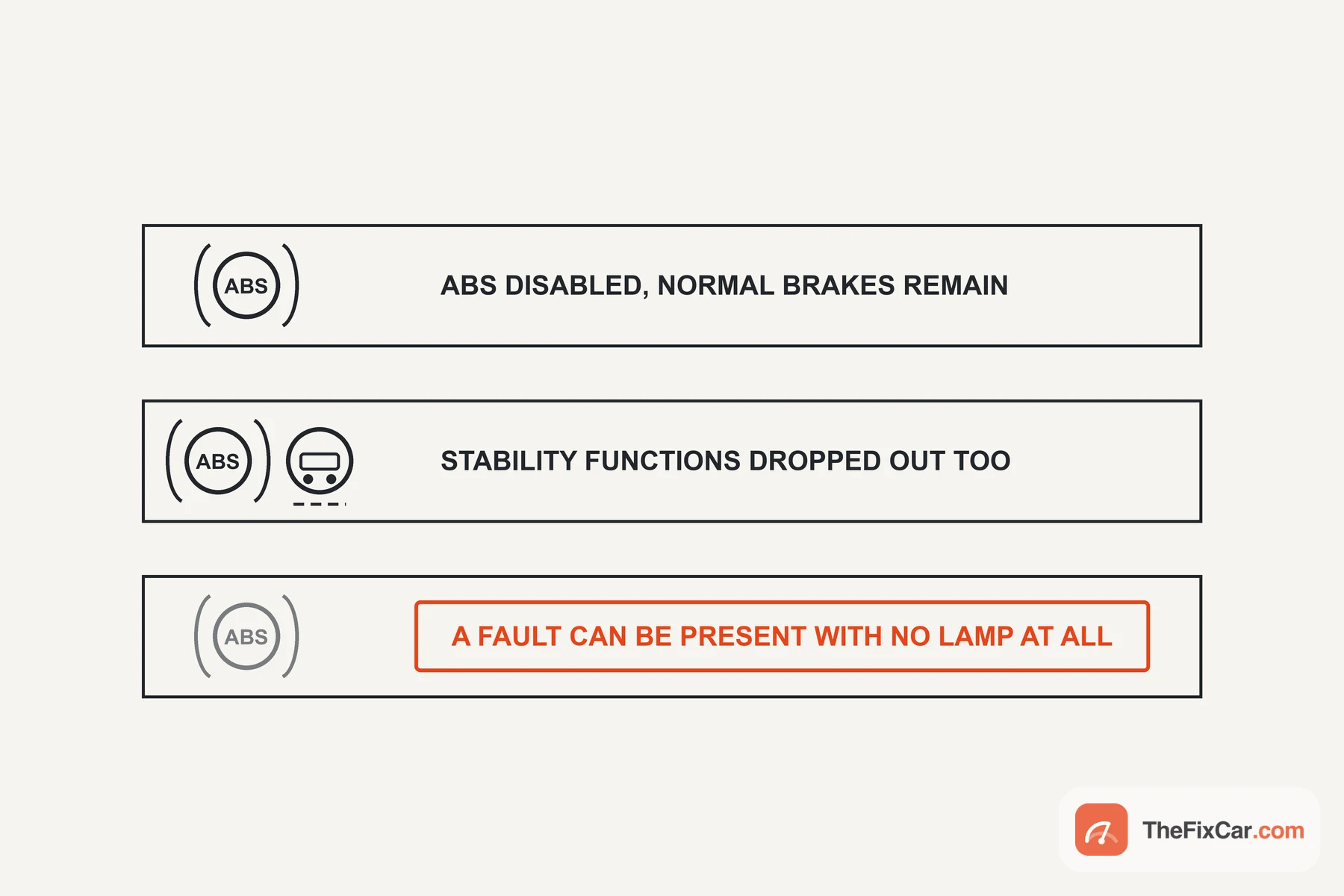
An ABS lamp means the anti-lock function has been switched off. Normal braking remains, and the pedal should feel and work as it always did. If the pedal itself has changed, that is a separate fault and a more urgent one.
Lamps for traction and stability arriving with it mean those functions dropped out too, which is expected: they read the same wheels. What none of the lamps tell you is which component in that circuit failed, and the case above shows that no lamp at all does not mean no fault.
What to do about it
Read the code and note the wheel, then work the circuit rather than the parts list. The order that keeps you from guessing is in our guide to testing, cleaning and replacing an ABS wheel speed sensor, and the published figures the tests are compared against are collected in our wheel speed sensor specifications.
One thing worth doing before any of that: look at the tyres. It costs nothing and it rules out the one cause on this page that no amount of electrical testing will find.
FAQ
Can I drive with a bad wheel speed sensor? With an ABS related fault alone, the base braking system may still work normally, but anti-lock and often traction and stability assistance are unavailable, so braking hard on a slippery surface can lock a wheel and cost you steering control. If the red brake warning is also on, the pedal feels different, braking force has changed or the car pulls under braking, treat that as a separate and more urgent brake fault rather than assuming it is only a wheel speed sensor.
How do I know which wheel speed sensor is bad? Start with a scan tool that can read the ABS module. A wheel specific code tells you which corner to investigate, and live wheel speed data can show one wheel dropping out or disagreeing with the other three. The code identifies the circuit, so inspect the sensor, the wiring and the encoder before replacing anything. The order for that is in our guide to testing, cleaning and replacing an ABS wheel speed sensor.
Will a wheel speed sensor fault affect anything besides ABS? It can. Traction and stability control read the same wheels, some vehicles take the speedometer from a wheel sensor, and on cars with electric power steering the loss of a wheel speed signal can change steering effort at low speed.[1]
Why does the ABS light only come on above a certain speed? Because the module is watching for a rate of change rather than a voltage. The MV-1 example sets its code on a jump of more than 15 kph occurring three times in quick succession, and a fault that never produces that jump at low speed will not set it.[2]
Can there be a fault with no warning light? Yes, and GM documents it: clicking at parking lot speeds and a flashing stability lamp caused by debris on an encoder ring, with no ABS or stability codes stored at all.[1]
Does a wheel speed code mean the sensor is bad? No. It names a circuit and a condition. One manufacturer opened a bulletin because functioning hub bearing assemblies were being returned under warranty for wheel speed faults.[2]
Related brake and ABS guides
Sources & verification
Last technically reviewed: Sep 2026
Reviewed by: Tyler Brandt
Primary references: manufacturer service bulletins filed with NHTSA, and a published guided test for intermittent signal capture
Image credit: Photographs and diagrams produced for TheFixCar. Diagrams illustrate the operating principle and are not to scale.
Suggested citation: TheFixCar, “Bad Wheel Speed Sensor Symptoms,” updated Sep 2026. https://thefixcar.com/symptoms/bad-wheel-speed-sensor-symptoms/