A wheel that is hot enough to smell after an ordinary drive, a car that tugs toward one side only while you are on the pedal, or one brake pad worn to the backing while its partner still looks new. Those are common reasons people suspect a caliper, and each has at least two other explanations that look the same. So the first job is proving brake drag, then separating piston, slide, pad, hose and hardware faults.
Quick answer
Smoke or a burning smell from a wheel, a visible fluid leak, a soft pedal or a hard pull mean stop and investigate where you are, not carry on testing. Otherwise, after a normal drive, compare wheel temperatures without touching anything: a dragging brake can get hot enough to burn, and it can be dragging well before anything else shows. Hold the back of your hand near each wheel, or point an infrared thermometer at each one. Do not touch the wheel, rotor, caliper or lug nuts. A corner much hotter than the others suggests it is dragging, and that is the finding worth chasing first.
| What happens | Where suspicion shifts | Do first |
|---|---|---|
| One wheel far hotter than the rest after a drive | Brake drag at that corner is likely; rule out bearing, parking brake and driveline resistance before blaming the caliper | On a lift or jack stands at the approved lifting points, spin that wheel by hand against the others |
| Pulls to one side only under braking | Uneven braking force on one side; caliper, pads, rotor, hose, tire or suspension all remain possible | Compare pad thickness left and right on the same axle |
| Pulls all the time, braking or not | Alignment, tire pressures or tire wear, though a constantly dragging brake can also do it | Check pressures and cross-check tires before touching brakes |
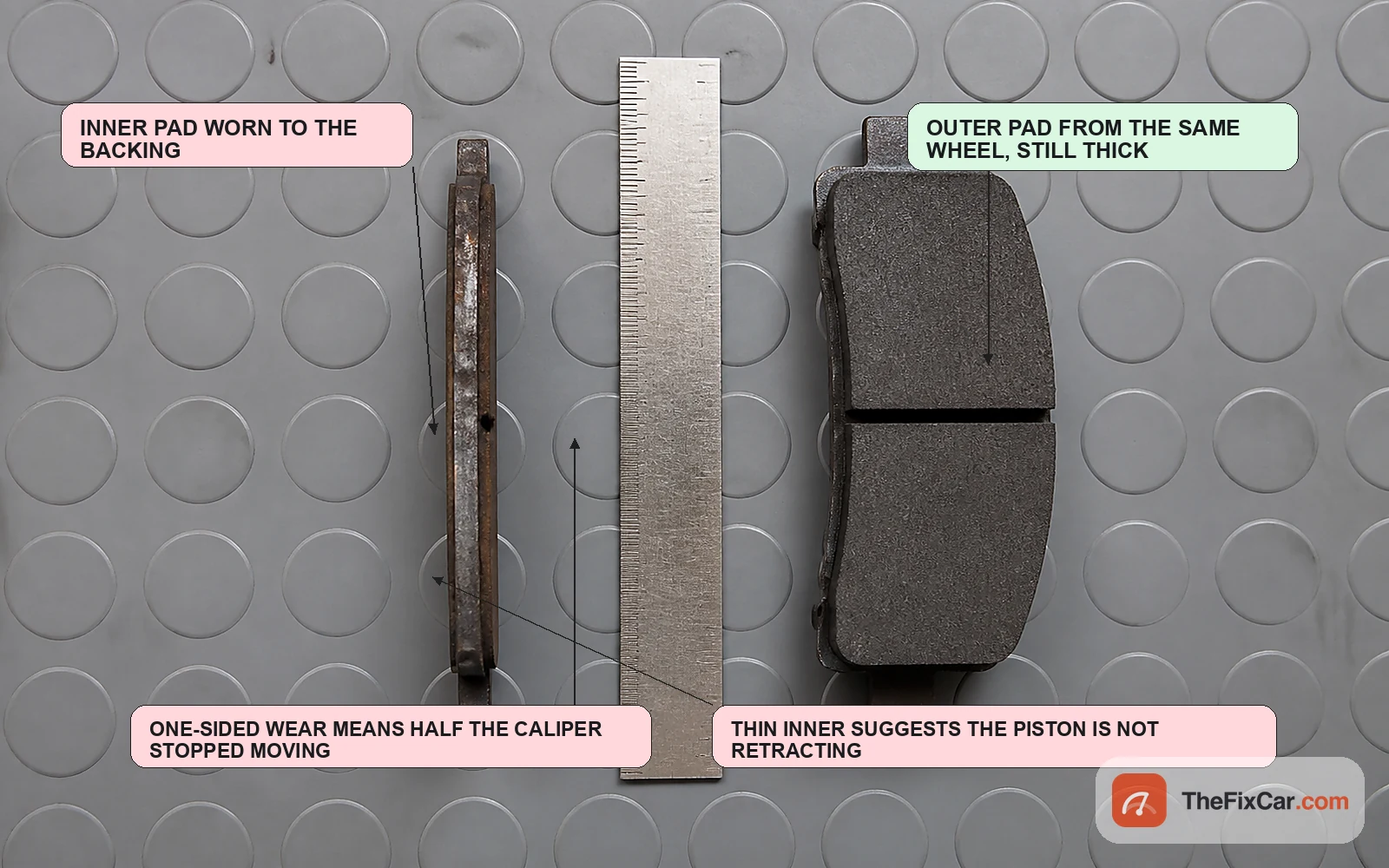
| Inner pad worn out, outer still thick (floating caliper) | Piston-side loading is the stronger suspicion; retained hydraulic pressure or a pad binding in the bracket produce a similar pattern | Inspect the piston and its boot with the caliper off |
| Outer pad worn out, inner still thick (floating caliper) | Slide, bracket or hardware binding becomes the stronger suspicion | Pull the pins and check they slide, and clean the bracket |
| Clunk or squeal when turning or braking lightly | Pad retainers, shims or loose hardware | Inspect the retainers and anti-rattle hardware for damage |
| Wet film or drips at one wheel | Caliper seal, hose or line fitting, or a non-brake leak running down | Identify the fluid and trace the wet path upward before condemning the caliper |
A rough guide for narrowing the search, not a full diagnosis. Several of these rows share causes with each other. For any caliper removal, guide pin service or bracket cleaning, work from the service information for that exact vehicle, including lifting points, lubricant, published caliper bolt torque figures, and any electric parking brake retraction procedure.
What can make a brake caliper appear bad
Only some of these are faults of the caliper itself. The rest sit next to it and produce the same complaint, which is why a caliper gets bought before the real fault is found.
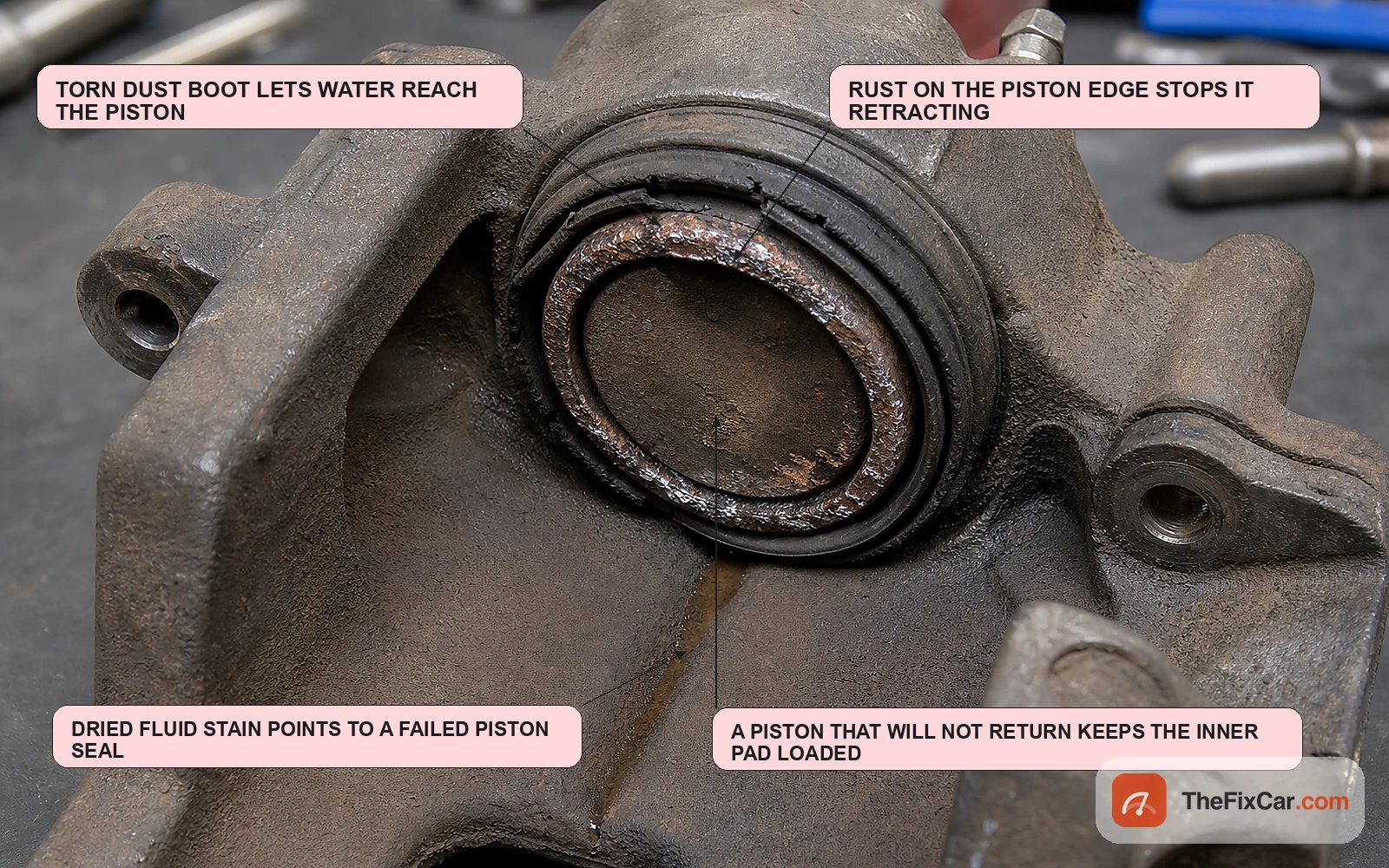
- Piston seized or slow to retract. On a floating caliper that can leave the inboard pad loaded after you lift off the pedal. Fixed calipers do not map pad wear to slide and piston movement the same way, so establish which design you have before reading the pads.
- Guide pins dry, corroded or seized on a floating caliper, so the body cannot move freely and wear or drag becomes uneven. Which side wears depends on the design and where the pin stuck. Fixed calipers have no guide pins and fail differently.
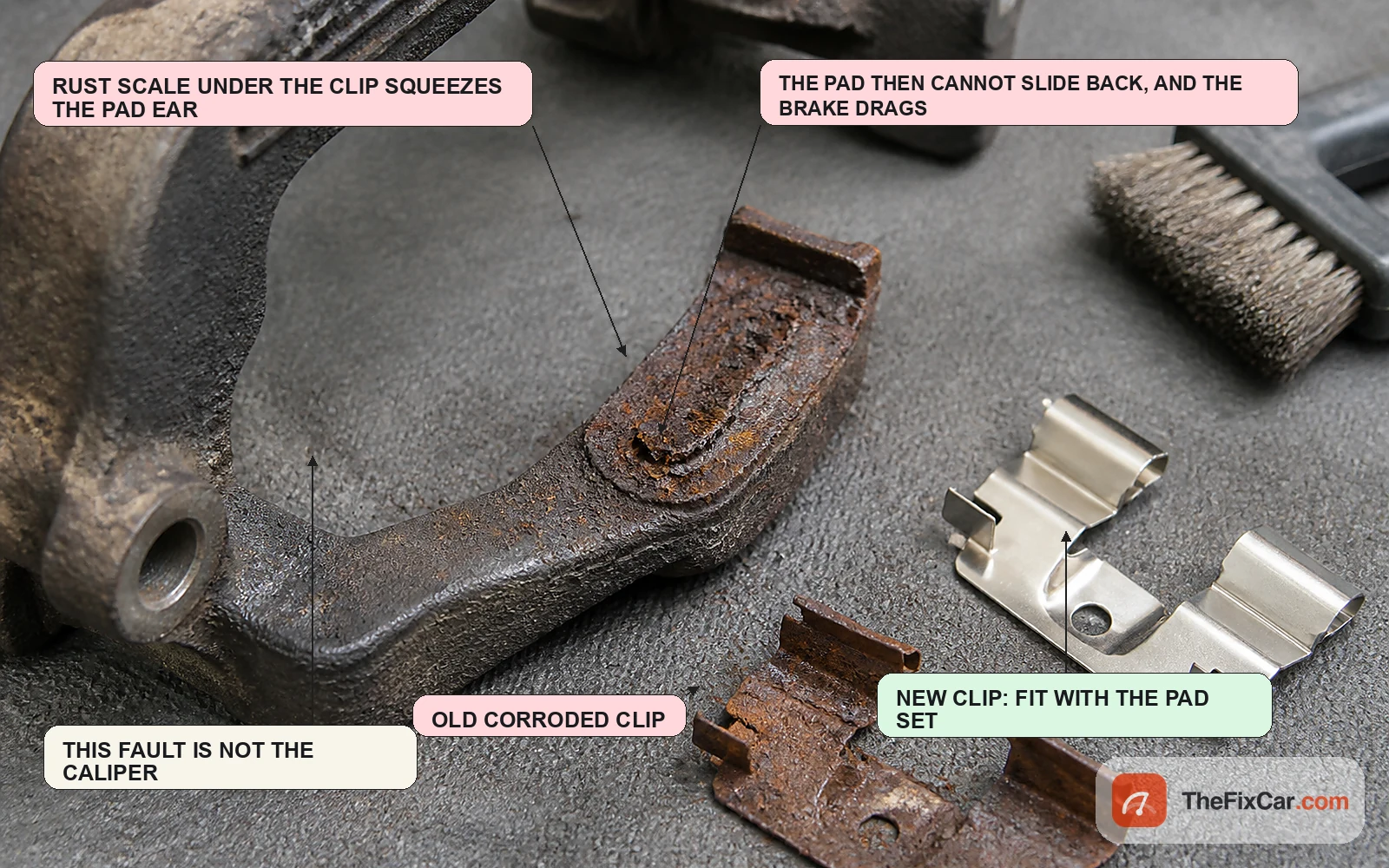
- Pads binding in the bracket where corrosion under the abutment clips squeezes the pad ears and stops them sliding back.
- A brake hose restricting return flow, which holds pressure at the caliper after the pedal is released and can mimic a stuck piston.
- Damaged or deformed pad hardware, which can mimic a caliper fault. Mitsubishi documents one application-specific case where a low-rigidity front pad retainer deforms and contacts the disc on the models that bulletin covers[3].
- Fluid at the caliper, which can come from the piston seal, the bleeder screw, the hose connection, a line fitting, or fluid running down from above. Trace the wet path before naming the seal.
Clues that shift suspicion
None of these separates the faults cleanly. Each one moves the odds, which is all a clue does.
| Finding | Leans toward | Still possible |
|---|---|---|
| Inner pad much thinner than outer | Piston not retracting | A hose holding pressure at that corner |
| Outer pad much thinner than inner | Slides or bracket binding | A distorted retainer holding the pad in |
| Both pads at one corner worn faster than the opposite side | Drag or higher braking force at that corner | Hose restriction, piston not retracting, parking brake drag, or a hydraulic control issue |
| Wheel frees up after cracking the bleeder open | Pressure trapped upstream: hose, master cylinder, ABS hydraulic unit or a related valve | Piston that happened to release as the pressure dropped |
| Pull appears only when cold, then fades | Corrosion that frees as parts warm and move | Pad material behaving differently cold |
| Noise only on turns, not on the pedal | Hardware, retainers or a loose shim | Wheel bearing or CV joint, which have nothing to do with the caliper |
| Brake fluid level dropping with a wet wheel | Caliper piston seal, hose or line fitting at that corner | Fluid from a hose, hard line, fitting or bleeder running down into the wheel area |
Manufacturers keep the same discipline. General Motors, diagnosing uneven front pad wear on 2014 to 2016 Silverado 1500 and Sierra 1500 and 2015 to 2016 Escalade, Suburban, Tahoe and Yukon, tells the technician to find the drag first and then determine its cause, naming caliper piston binding, binding pads or pins in the bracket, and brake hose restriction as the candidates[1]. Three separate faults, one symptom.
What to check first
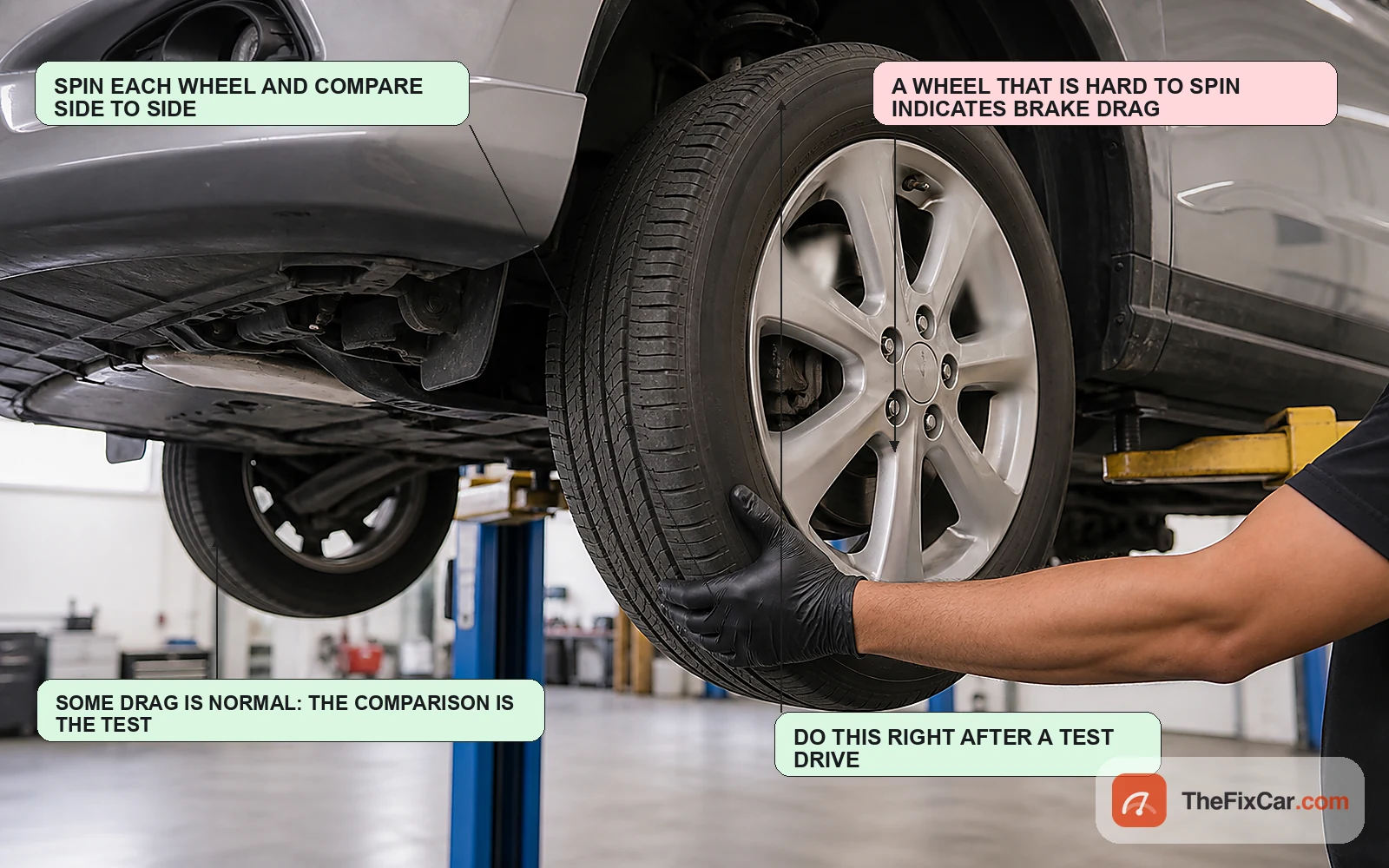
- Spin the wheels by hand. After a test drive, raise the car on a lift or on jack stands at the manufacturer’s lifting points, never on a jack alone, then spin both wheels on the axle and compare them. GM’s procedure treats a wheel that is hard to spin as an indication of brake drag[1]. Some drag is normal, so the comparison between sides matters more than the absolute feel. Driven axles, some all-wheel-drive layouts, limited-slip differentials and rear electric parking brakes can each add resistance of their own, so check the service information before reading a stiff wheel as a brake fault.
- Compare pad thickness on both sides of the rotor. On a floating caliper, which pad is thin can shift suspicion toward the piston side or the slide and bracket side. Retained pressure, pad fit and hardware overlap with both, so it is a clue, not a verdict.
- Pull the guide pins. They should slide as the service information for that caliper describes. Mazda’s brake noise and dragging bulletin has the technician check that the caliper and sliders are not seized, then rebuild or replace them as necessary[2].
- Look under the abutment clips. Corrosion there squeezes the pad and produces binding that is not the caliper’s fault at all. Maine’s inspection manual rejects a vehicle if the brake pads are binding on the caliper brackets or if the brake slides are frozen[5], and treats those as two separate findings.
- Check for trapped pressure. This opens the hydraulic system, so follow the bleeding and fluid procedure for your vehicle, and do not attempt it if you are not set up to bleed the brakes afterwards. Where a wheel frees up after the bleeder is cracked open, the pressure was probably being held upstream of the caliper, which moves the hose, the master cylinder and the ABS hydraulic unit up the list ahead of the piston. Follow the bleeding procedure for your vehicle afterwards, since opening the system introduces air.
- Measure the drag rather than guessing at it. Some manufacturers publish a figure: Mitsubishi’s procedure removes the pad, shim cover and pad retainer and measures hub sliding torque with a spring scale[3]. That figure belongs to the models that bulletin covers. Where your own service information publishes a method, it beats an opinion formed by hand.
Is it safe to drive?
Treat a dragging or seized caliper as a stop-and-fix item, not a wait-until-payday item. A caliper that will not release keeps generating heat even when you are off the pedal, and heat is what boils fluid, cooks the pad material and distorts the rotor. If a wheel is hot enough that you cannot hold your hand near it, if you can smell the brakes, if the car pulls hard enough to need correction at the wheel, or if the pedal has gone long or soft, stop at the nearest safe place rather than continuing, and have it recovered rather than driven if the pedal is soft or fluid is leaking. A visible brake fluid leak at a wheel is its own answer: fluid loss can take the pedal with it, and Virginia lists leakage in the master cylinder, wheel cylinders or brake calipers as a rejection item[4], and a leak from a hose, hard line or fitting puts fluid on the ground just as effectively. Where the only evidence is slightly uneven pad wear, with no abnormal wheel heat, no smell, no leak, no pull, no soft pedal and no grinding, a short gentle trip to a shop may be reasonable.
When the problem is urgent
- Smoke or a burning smell from one wheel. Something at that corner is running far hotter than it should; stop before deciding what.
- The pedal goes long, soft or sinks. Boiled fluid, fluid loss, air in the system or a failing master cylinder can each do it, and all of them reduce what the pedal can do.
- Visible fluid at the wheel or a falling reservoir level. Virginia rejects a vehicle for any leakage in the master cylinder, wheel cylinders or brake calipers[4].
- The car pulls hard enough that you fight the wheel while braking. Uneven braking can worsen or change as temperatures rise, as pressure balance shifts, as ABS intervenes, or as one side loses friction.
- Grinding you can feel through the pedal. Often friction material worn through, though debris trapped between pad and rotor produces something similar. Our page on what a grinding noise when braking means and when to stop driving covers that case.
- The wheel will barely turn by hand. Severe drag at that corner. Driveline resistance on a driven wheel, an all-wheel-drive layout or a rear electric parking brake can also resist rotation, so confirm the brake before assuming the caliper, but do not drive on it either way.
Typical repair cost
- Cleaning and regreasing slides with a new hardware kit at roughly $80 to $200 per affected corner, and only where nothing is worn or scored.
- Brake hose replacement at roughly $120 to $300 per corner including bleeding.
- Reman or new caliper, one corner at roughly $200 to $500 fitted, more on vehicles with an electric parking brake at the rear.
- Caliper with pads and rotor on that axle at roughly $400 to $900, which may be needed once a dragging corner has cooked the rotor.
Rough U.S. workshop estimates, not quotes. Warranty coverage, model, part choice and local labour rates move them, and a seized rear caliper with an integrated parking brake actuator sits toward the top of these ranges.
FAQ
How do I know if my brake caliper is sticking? Compare, do not judge in isolation. After a drive, one wheel noticeably hotter than the other on the same axle, or noticeably harder to spin with the car raised, is the finding. GM uses the hard-to-spin wheel as its indication of brake drag, then looks for the cause among the piston, the pads and pins in the bracket, and the hose[1].
Can a bad caliper cause the car to pull? Yes. A caliper that only misbehaves under pressure can pull while you are on the pedal, and a dragging brake can contribute to a pull even off the pedal. A pull present off the pedal can also point to alignment, tire pressures or tire wear, which is why the heat comparison is worth doing before paying for an alignment.
Why is only one brake pad worn out? On a floating caliper it means one pad is doing different work than the other, which shifts suspicion toward the piston, the slides, pad fit or hardware. On many floating calipers an inboard pad worn alone moves suspicion toward piston-side loading, and an outboard pad worn alone toward slide, bracket or hardware binding. Retained hose pressure and pad fit overlap with both, so neither pattern settles it. Maine’s inspectors treat pads binding on the bracket and frozen slides as two distinct rejection findings[5].
Is it the caliper or the brake hose? A failing hose can trap hydraulic pressure at the wheel, while a caliper can drag either hydraulically or mechanically, through a seized piston, slides or pads stuck in the bracket. If cracking the bleeder frees the wheel, trapped upstream pressure is more likely, so the hose, master cylinder or ABS hydraulic unit moves up the list. If the wheel stays tight with hydraulic pressure released, mechanical drag becomes more likely: the caliper, the pads and hardware, a parking brake mechanism, a bearing or driveline resistance can all keep a wheel tight.
Can I just clean and lubricate a sticking caliper? Sometimes, where the slides and bracket are the problem and nothing is worn or scored. Use the lubricant the service information specifies and keep solvents away from rubber components, since the wrong product swells boots and seals. It does nothing for a seized piston, a torn boot or a failed seal, and the parts cooked by the drag still need checking. Our guide on inspecting and servicing a caliper, and deciding between a rebuild and replacement covers the work itself.
Will a stuck caliper cause a burning smell? A dragging brake heats the pad and rotor continuously, and the smell can be the first thing anyone notices. It is not proof by itself, since an oil or coolant leak onto hot exhaust smells similar, so locate the hot wheel before assuming.
Does a bad caliper fail a state inspection? In some states, yes. Virginia rejects a vehicle for any evidence of a caliper sticking or binding and for any leakage in the calipers[4], and Maine rejects for frozen slides and for pads binding on the bracket[5]. Criteria vary by state, so check your own.
Sources & verification
Last technically reviewed: Aug 2026
Reviewed by: Marcus Holt
Primary references: manufacturer service bulletins filed with NHTSA (General Motors, Mazda, Mitsubishi) and state vehicle inspection standards (Virginia Administrative Code, Maine State Police)
Suggested citation: TheFixCar, “Bad Brake Caliper Symptoms and Diagnosis,” updated Aug. 2026. https://thefixcar.com/symptoms/bad-brake-caliper-symptoms/