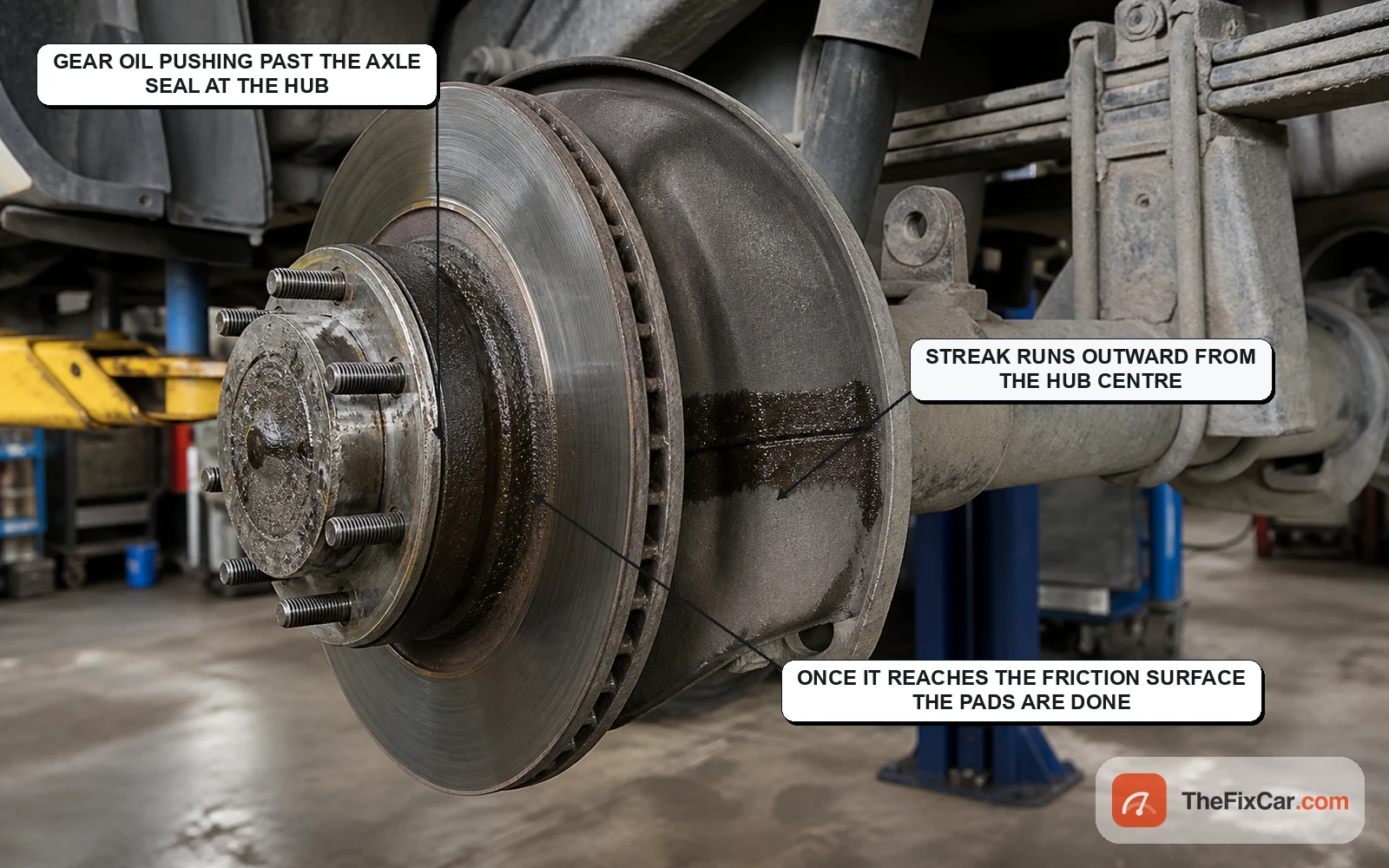
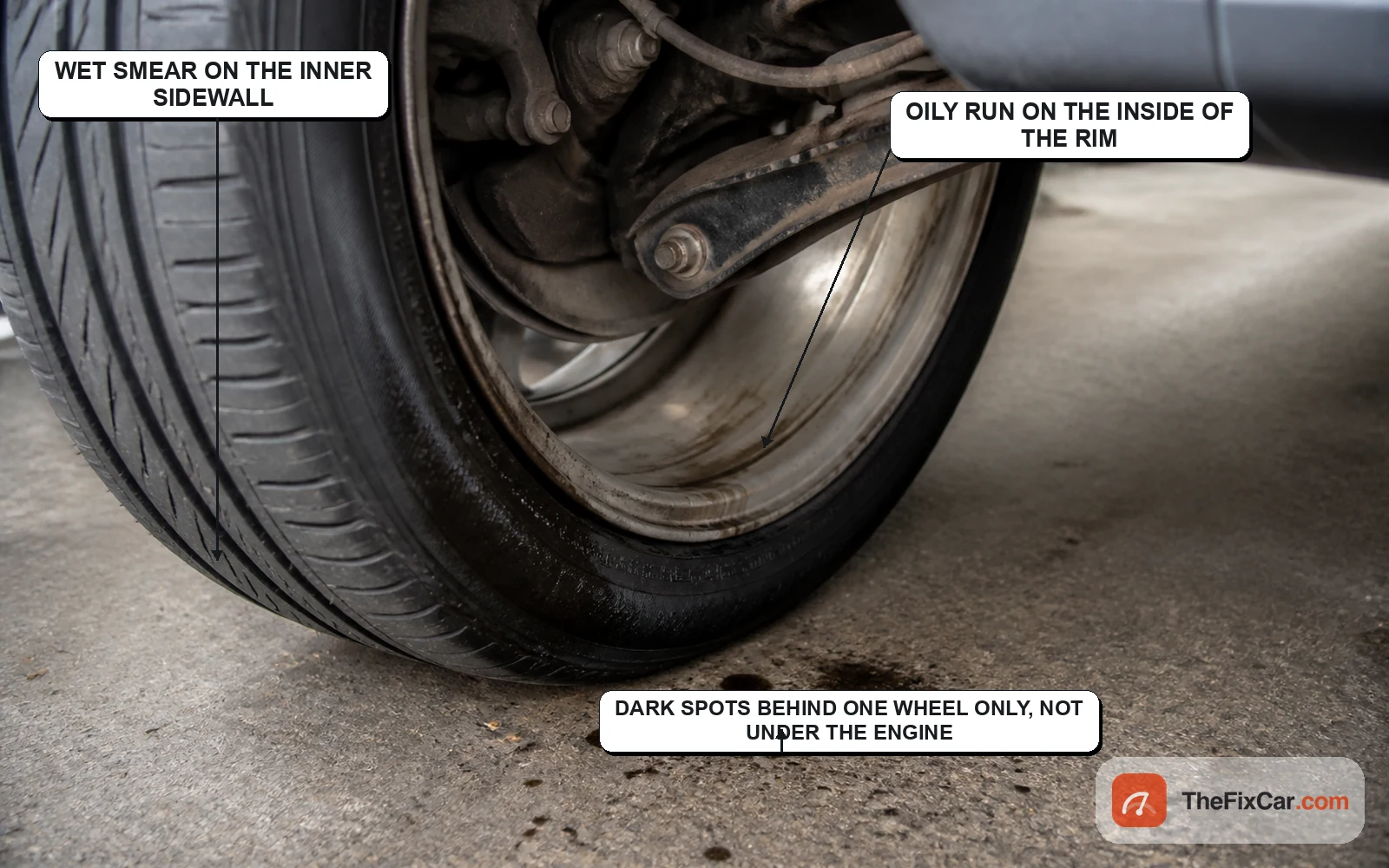
A dark, oily film on one brake rotor, a wet streak across the backing plate behind it, and a faint burning smell after a long drive usually mean gear oil is getting past the axle seal and reaching the friction surface. Owners often spot the stain on the inner face of the wheel or a few dark spots on the driveway well behind the engine, then assume a caliper is leaking. The two faults look similar from three feet away and are fixed in completely different places, so identify the fluid before anyone quotes you for brake work.
Quick answer
Wearing gloves, blot a little of the fluid onto a clean white rag, keep it off painted surfaces, and look at what comes off before you touch anything else.
| What you find | Most likely | Do first |
|---|---|---|
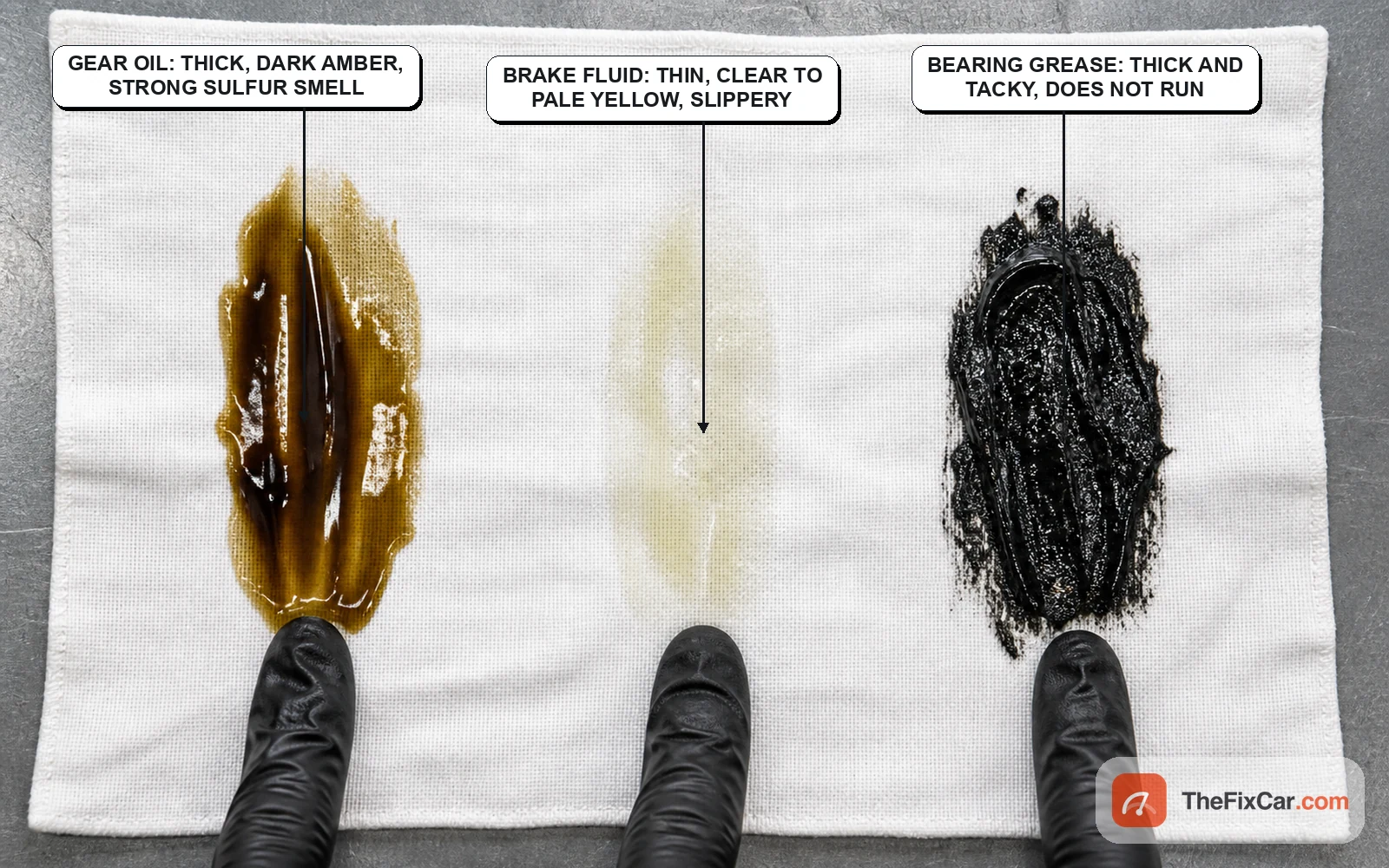
| Thick dark amber fluid, strong sulfur or rotten-egg smell, streak spreading outward from the hub | Axle shaft seal on a rear solid or live axle | Check the differential fluid level, then book the seal and the pads on that axle |
| Thin clear or pale yellow fluid, slippery, wettest at the caliper or the flex hose | Brake fluid leak | Check the brake fluid reservoir and stop driving if the level has dropped |
| Near-black tacky grease flung around the inside of the wheel, split rubber boot visible | CV joint boot (front-wheel drive, all-wheel drive, or independent rear suspension) | Inspect the boot and listen for clicking on tight turns |
| Oily film running down the shock or strut body, rotor itself dry | Shock absorber, not a brake fault | Compare left and right, and check ride quality |
| Damp all over, no color on the rag, only after rain or a wash | Water | Drive a few miles and look again when dry |
This is a first-pass check, not a full diagnosis: the fluid and the direction of the streak narrow it down, but a wheel-off inspection is still needed to confirm the source.
Gear oil or brake fluid: the split that matters
Many wrong diagnoses on this symptom come from mixing up those two fluids, and they behave differently enough to tell apart in a minute.
| Gear oil from an axle seal | Brake fluid | |
|---|---|---|
| Color on a white rag | Amber to dark brown, sometimes almost black when old | Clear to pale yellow, darker amber when overdue for a change |
| Feel | Thick, clings, slow to spread | Thin, watery, spreads and soaks in fast |
| Smell | Sharp sulfur note from the extreme-pressure additives | Faintly chemical, no sulfur |
| Where it starts | Ring of wetness around the axle flange, spreading outward across the backing plate | Wettest at the caliper piston seal, bleeder, or the flex hose fitting, running downward |
| Reservoir check | Brake fluid level normal | Brake fluid level dropping, often with a soft pedal |
| Urgency | Brake friction may be reduced or uneven, bearing at risk: repair before normal driving | Potential loss of braking on that circuit, do not drive |
If the reservoir is low, treat it as a hydraulic fault and stop there. Our guide on how often brake fluid needs changing and how to read the reservoir against its MIN and MAX marks explains what healthy fluid should look like.
Most common causes
- Age-hardened axle shaft seal: the rubber lip rides on the axle shaft and loses its grip as it hardens with heat cycles and mileage, so a thin film starts to pass and then builds up. The seal is what keeps axle lubricant in and road contamination out at the wheel end[5].
- Worn axle shaft sealing surface: a groove worn into the shaft where the lip rides means a new seal alone may still weep, which is why some jobs need a repair sleeve or a new shaft.
- Blocked differential vent: mud, undercoating, or a seized vent valve lets pressure build inside the housing as the oil heats, and the seal becomes the easiest way out.
- Overfilled differential: too much gear oil raises the level above the seal on some axle designs and pushes lubricant past it, usually after a recent service.
- Failing wheel bearing: play in the bearing lets the shaft move off center, and the seal lip cannot follow it. On axle designs where bearing play lets the shaft move inside the seal, the bearing is often the real fault and the seal is only the symptom.
- Damaged seal from a previous repair: a seal driven in crooked, nicked on installation, or the wrong part number for that axle can leak within weeks of the work.
- Transaxle output shaft seal: on front-wheel-drive cars an output shaft seal can also leak transmission fluid, but because it sits at the transmission end of the CV axle it usually wets the gearbox, the inner CV joint, or the subframe rather than the brake rotor.
What to check first
- Look behind each wheel with the car parked and cool. If you raise the vehicle or take a wheel off, work on level ground, chock the wheels at the opposite end, and support the car on jack stands rather than trusting the jack. Use the factory jacking points, and never put any part of your body under a vehicle held up by a jack alone. A leak from one corner only, with the other three dry, points at that corner rather than at anything shared like the master cylinder.
- Check the brake fluid reservoir level before anything else. A normal brake fluid level alongside an oily rotor makes an axle seal or another wheel-end lubricant leak more likely than a hydraulic brake leak.
- Follow the direction of the streak. Wetness spreading outward from the middle of the hub comes from behind the rotor. Wetness running down from the caliper comes from the hydraulic side.
- Check the differential fluid level through the fill plug, or the transmission level on a front-wheel drive car. A low level supports a driveline oil leak, though a cover gasket, pinion seal, drain plug, or a leaking transmission case can drop it too, so rule those out before calling it settled.
- Check for dark spots on the ground behind one wheel rather than under the middle of the car, and look at the inner sidewall of the tire for a wet smear thrown off the rotating hub.
- Ask when the brakes last felt normal. A pull, a grab, or a soft spot that started in the last few weeks suggests the contamination has already reached the pads.
Is it safe to drive?
It depends on whether the oil has reached the friction surfaces yet, so answer that question first. If the leak is still a light seep around the axle end and the rotor, pads, shoes, and parking-brake lining are dry, a short trip to a nearby shop may be reasonable once you have checked the differential level and confirmed that the brake fluid level is normal and the pedal firm. If gear oil has already reached the rotor, pads, shoes, or parking-brake lining, do not rely on the vehicle for normal driving: friction material soaked in oil grips unpredictably, so that corner can bite late and then grab, which shows up as a pull under braking and a longer stop in the wet. Have it repaired before driving again, and stop straight away if the car pulls hard to one side when you brake, if the wheel smokes or smells hot, or if the differential is already low on oil, because on axle designs that rely on axle oil to lubricate the bearing, a low level can overheat or seize that bearing while the wheel is turning.
Why the pads have to be replaced too
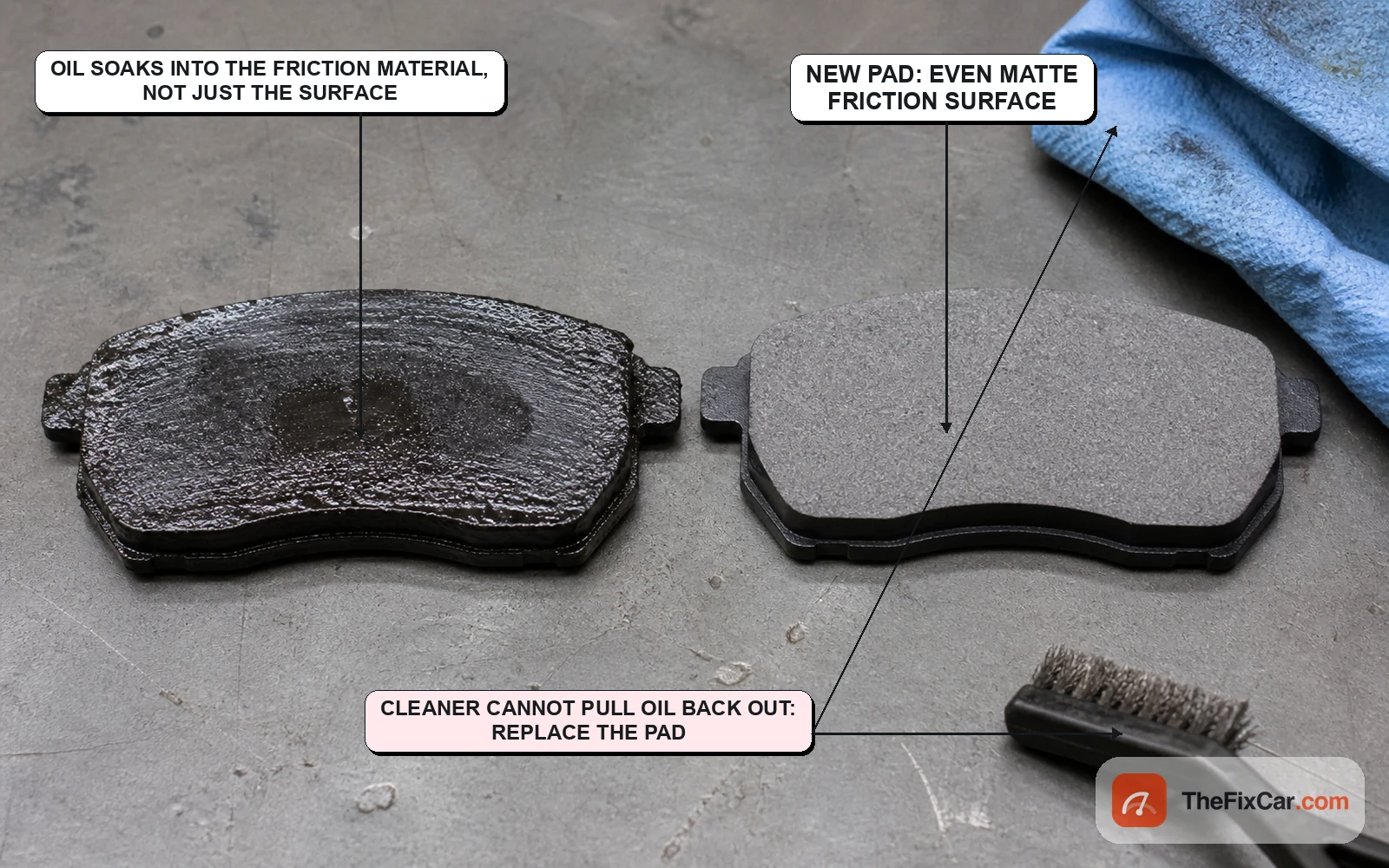
Brake friction material is porous by design, so oil does not sit on the surface where a rag can reach it, it wicks into the body of the pad and keeps bleeding back out under heat. Cleaning the rotor with brake cleaner makes the assembly look fixed for a day or two, then the same corner starts grabbing again. Some state inspection rules treat visible brake contamination as a rejection item: Virginia lists a rejection when grease or other contamination is present on the linings, drums, or rotors[1]. Plan on new pads across that axle once the seal is fixed. The rotor itself can often be cleaned and reused if the surface is not scored and it still measures above the minimum thickness cast or stamped into the rotor hat or edge, or listed in the service information, though many shops replace both rotors on the axle while everything is apart.
Do not do this
- Do not spray the rotor with brake cleaner and put the same pads back. The oil is inside the friction material, not on it.
- Do not sand or torch a contaminated pad to save it. Neither method reaches the oil held deeper in the material, and heating friction material is a poor idea in general.
- Do not top up the differential and leave the seal for later. The oil keeps arriving at the pads, and the second set of pads is ruined the same way as the first.
- Do not assume the wheel bearing is fine because it is quiet. On axle designs where the bearing shares the seal, gear oil washing through the bearing grease is a common reason it fails later, and how long that takes depends on the axle design and how far the grease was washed out.
- Do not replace only the leaking side of the pads. Different friction levels left and right are what produce the pull you are trying to cure.
- Do not leave the car sitting for weeks with the leak unrepaired if you can avoid it. Continued leakage keeps wetting the pads or the parking-brake lining while the vehicle sits.
When the problem is urgent
- The car pulls to one side under braking, or the rear steps out slightly on a firm stop. The contaminated corner is no longer matching the other side.
- A rumble, growl, or howl that changes with road speed rather than engine speed, which points at a bearing that has been running in thinned or washed-out lubricant.
- Smoke, heat shimmer, or a hot smell from one wheel after a normal drive.
- Gear oil visibly running rather than seeping, or a fresh puddle after every parking stop, which means the differential level is dropping fast.
- The brake fluid reservoir is dropping, the pedal feels soft, or there is fresh wetness at the caliper, bleeder, or brake hose. Treat any of those as a hydraulic brake leak until it is proven otherwise.
- A new vibration or wobble felt through the seat or the wheel, covered in more detail in our guide on what makes a car shake when braking.
When to call a pro
Pulling a wheel to look is a reasonable driveway job. Replacing the seal usually is not, because it takes a slide hammer or a seal puller, a correctly sized driver to seat the new seal square, the right gear oil specification for that axle, and on many rear axles the removal of a C-clip inside the differential to free the shaft. Hand it to a shop if the axle has to come out, if the wheel bearing is being replaced at the same time, if the sealing surface on the shaft is grooved, or if the vehicle uses a pressed-on bearing that needs a press. If you refit a wheel yourself afterwards, torque the fasteners properly using our lug nut torque reference by vehicle type.
Typical repair cost
- Axle seal, part only: roughly $10 to $40 for a common rear axle seal, which is why the labor drives the bill.
- Differential gear oil refill: roughly $20 to $60 in fluid for most light vehicles, more where a limited-slip additive or a synthetic specification is required.
- Rear axle seal replaced at a shop, one side: roughly $300 to $600 on many vehicles including fluid, with pickups and designs that need more disassembly running $500 to $800 or more.
- Pads and rotors for that axle: commonly around $250 to $550 fitted, since the contaminated pads cannot be reused.
- Axle seal plus wheel bearing, one side: commonly around $550 to $1,200 where the bearing has been running in leaked oil.
- Transaxle output shaft seal, front-wheel drive: commonly around $250 to $550, because the CV axle has to come out first.
- Everything at once on a neglected corner: seal, bearing, pads, rotors and fluid together often land somewhere between $900 and $1,800.
These are rough U.S. figures, in line with published estimator ranges[4]. Read them as independent-shop parts and labor estimates before tax, shop supplies, disposal fees, and diagnostic time, with dealer pricing usually higher. Vehicle type, axle design, whether the bearing or shaft is damaged, parts brand, and local labor rates all move the price, and a solid rear axle on a pickup is a very different job from a sealed hub on a compact car.
FAQ
Can I just clean the oil off the brake rotor and keep the pads? The rotor usually cleans up, the pads do not. Friction material absorbs oil through its thickness and releases it again once the brakes get hot, so the grabbing comes back. Pennsylvania inspection rules make the same distinction, rejecting a lining that is contaminated with oil, grease or another substance[2].
How long can I drive with a leaking axle seal? There is no safe mileage figure, because it depends on how fast the oil is escaping and whether it has reached the pads yet. A light seep that has not yet reached the rotor or the pads can usually wait for the next shop opening, provided you check the differential level before each drive and skip the trips you do not need. A visible run down the backing plate, a dropping differential level, or any pull under braking should be treated as an urgent repair, with no more driving than it takes to reach a nearby shop, and only while braking still feels normal.
Why is only one wheel affected? Each axle end has its own seal, so one wet hub with the opposite side dry is a common picture when a seal fails. A one-wheel leak does not prove it is gear oil, though: a caliper, a flex hose, a wheel cylinder, or a local section of brake line can all leak at a single corner too. The fluid type and the point where the wetness starts are better clues than how many wheels are wet.
Will an axle seal leak fail a state inspection? The seal itself is often not listed by name, but the contamination it causes usually is. Virginia and Pennsylvania both list contaminated linings or rotors as a rejection item[1][2], and California’s inspection manual has inspectors check linings for contamination by grease, oil, or brake fluid[3]. Rules vary by state, so check your own program.
Is a rear axle seal leak the same as a differential leak? They share the same oil, but not the same repair. A pinion seal or a cover gasket drips near the center of the axle and rarely touches the brakes. An axle shaft seal leaks at the wheel end, which is what puts oil onto the rotor and the pads.
Does the wheel bearing have to be replaced too? Not automatically. It depends on the axle design and how long the leak ran. Where the bearing is packed with grease and the seal is what keeps gear oil away from it, leaked oil thins that grease and many shops replace the bearing while the shaft is out. Where the bearing is lubricated by the axle oil in the first place, a bearing that is quiet and free of play is often left alone.
My brakes squeal after the seal was fixed. Did the shop miss something? A slight bedding-in noise from new pads can be normal, but grabbing, pulling, or an oily smell is not. If any of those are still there after the seal repair, have the brake assembly inspected again for residual contamination or a leak that has not stopped, rather than waiting for it to wear in. Our guide on what a grinding noise while braking means covers the sounds that call for an immediate stop.