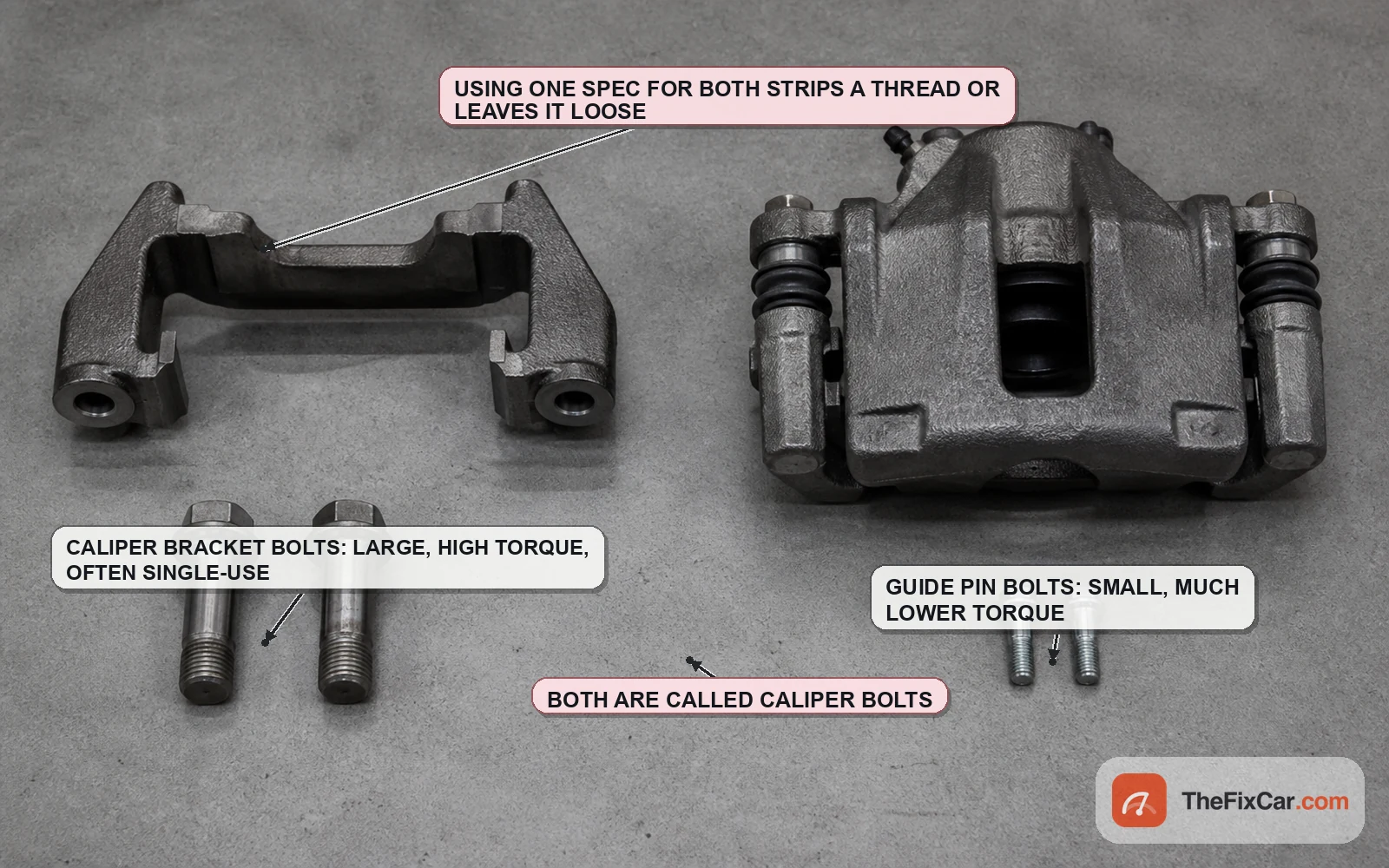
Two fasteners on the same brake caliper can both be called caliper bolts. One wants 27 N·m. The other wants 380. Get them the wrong way round and you either strip a thread or leave a caliper hanging on a bolt that was never tightened.
That spread is real, and it is why a single number to the question “what does a caliper bolt torque to” does not exist. Guide pin bolt, caliper mounting bolt, bracket bolt, adapter bolt: the names sound interchangeable, the figures are not.
Two of the documents below are not service tips. They are a safety recall and a customer satisfaction program, issued because caliper fasteners left the factory at the wrong torque. Every figure on this page is quoted from a manufacturer document you can open yourself, with the vehicles it covers named next to it.
Quick answer
There is no generic caliper bolt torque. Among the vehicles below, guide pin bolt final torques run 27 to 100 N·m while caliper mounting, bracket and adapter bolts run 83 to 380 N·m, and one procedure adds a 20 N·m snug pass before final torque. Two of them require new bolts rather than reused ones. Get the figure from the service information for your exact vehicle, use a torque wrench, and treat any caliper fastener you found loose as a reason to inspect the threads rather than simply retighten.
Piston diameter is a different kind of number: the OEM bulletins here do not carry it, but Wilwood publishes bore diameters and total piston area for its own calipers, and the table below shows why total piston area, not piston count, is the figure worth comparing. Hardware belongs in the same check: on a floating caliper the guide pins have to slide freely, two of the procedures below call for new bracket or adapter bolts, and abutment clips are supplied with many pad sets.
Verified specifications at a glance
| Vehicle / application | Specification | Conditions | Primary source |
|---|---|---|---|
| Stellantis, front, recall 27C / NHTSA 25V-191 | Adapter bracket mounting bolts 202 N·m (149 ft lbs) | NEW bolts required, not reused | FCA US safety recall[1] |
| Stellantis, front, same recall | Caliper guide pin mounting bolts 37 N·m (27 ft lbs) | After the bracket bolts are torqued | FCA US safety recall[1] |
| Chevrolet Silverado LD, GMC Sierra LD, front | Caliper guide pin bolts 100 N·m (74 lb ft) | Backup wrench held on the guide pin | GM program 16095[2] |
| GM, rear, service update 17488 | Caliper guide pin bolts 36 N·m (27 lb ft) | Four bolts, backup wrench on the pin | GM service update[3] |
| Stellantis, front, TSB 05-002-21 | Caliper adaptor bolts 380 N·m (280 ft lbs) | Revised specification in that bulletin | Stellantis TSB[4] |
| Stellantis, front, TSB 05-002-21 | Guide pins snug 20 N·m (15 ft lbs), final 75 N·m (55 ft lbs) | Upper pin first, then lower, at both stages | Stellantis TSB[4] |
| Stellantis, TSB 05-010-15 Rev A | Caliper adaptor bolts 165 N·m (122 ft lbs) | NEW bolts; rotor retaining bolt 7 N·m (61 in lbs) | Stellantis TSB[5] |
| Stellantis, TSB 05-010-15 Rev A | Caliper guide pin bolts 27 N·m (20 ft lbs) | Final torque, lowest guide pin figure quoted here | Stellantis TSB[5] |
| Tesla, front | Caliper mounting bolt 94 N·m | Inspection and retorque procedure | Tesla SB-20-33-001[6] |
| Tesla, rear | Caliper mounting bolt 83 N·m | Same procedure, different corner | Tesla SB-20-33-001[6] |
| Honda Odyssey 2014 to 2015, front (listed VIN ranges only) | Caliper bracket bolts 137 N·m (101 lb-ft) | New bracket fitted; caliper reused | American Honda SB 14-038[10] |
| Honda Odyssey 2014 to 2015, front (listed VIN ranges only) | Caliper flange bolts 50 N·m (37 lb-ft) | Hold the caliper pin with a wrench; do not damage the pin boot | American Honda SB 14-038[10] |
| Honda Odyssey 2014 to 2015, front (listed VIN ranges only) | Brake hose mounting bolt 21 N·m (15 lb-ft) | Lowest figure quoted on this page | American Honda SB 14-038[10] |
| Freightliner Cascadia, 6 wheel positions | Caliper mounting bolts 226 N·m (167 lb·ft) | Checked using the torque sequence; a clicker is allowed if no digital wrench | Daimler Trucks advisory[7] |
Coverage: each row applies only to the vehicles named in the document cited beside it. Figures are quoted as the source states them, including the units the source used.
What these numbers do NOT mean
- They do not transfer between vehicles. Final torques for fasteners with nearly the same name span 27 to 380 N·m in the table above, and one procedure adds a separate 20 N·m snug stage. A figure borrowed from another car is not a conservative guess, it is a different number.
- A torque figure is not permission to reuse the bolt. Two of these procedures call for NEW bolts[1][5]. Torquing an old bolt to the right number does not restore a fastener designed to be replaced.
- They do not carry the sequence. One procedure snugs both guide pins before final torque and names the order both times[4], and a truck advisory specifies a torque sequence across the bolts[7]. A single number tells you none of that.
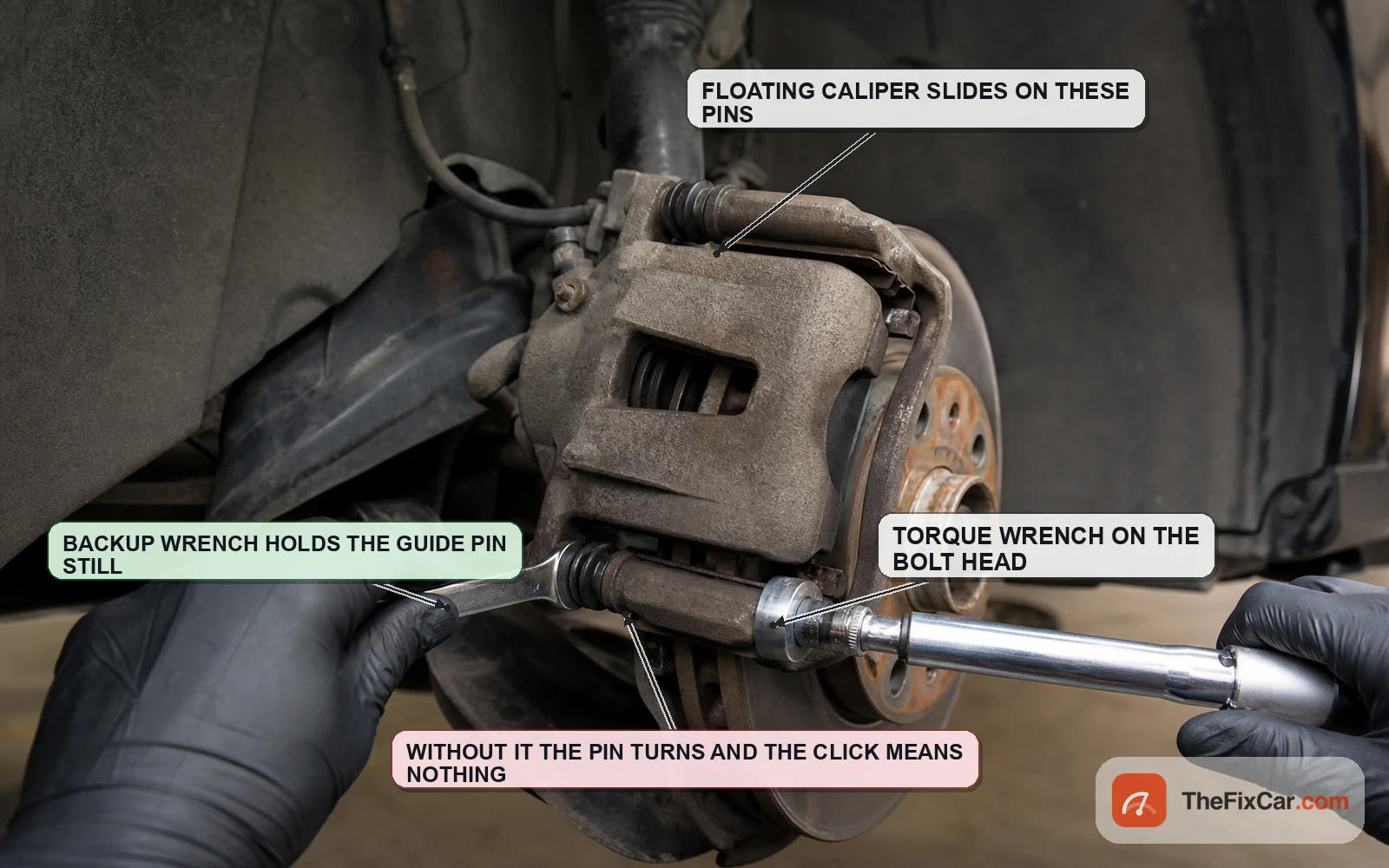
- They do not describe how to hold the pin. Both GM documents have the technician hold the guide pin with a backup wrench while tightening[2][3]. Without it the pin can turn with the bolt, and the reading may not represent clamp load.
- A correct click does not prove a sound thread. Tesla’s procedure has the technician inspect the bolt, the caliper threaded bore and the knuckle hole where a fastener was not at specification[6].
- None of this covers piston size or hardware condition. Torque values say nothing about whether the caliper is the right part, whether the piston is the right diameter, or whether the slides move.
Why caliper torque is a safety item, not a preference
Cars have been recalled over this. General Motors issued customer satisfaction program 16095 for certain Chevrolet Silverado LD and GMC Sierra LD vehicles whose front caliper assemblies were suspected of being below the 100 N·m specification, stating that if not corrected the condition has the potential to degrade vehicle stopping distance during normal operation[2]. That is the manufacturer’s own wording, not an inference.
Missing bolts get their own paperwork. GM service update 17488 covers rear caliper bolts found loose or missing, with instructions to replace the missing bolt and torque the set to 36 N·m[3]. Stellantis ran a North American safety recall specifically titled Brake Caliper Bracket Bolt Torque[1].
What to do if you find one loose. Do not simply retighten and drive. Tesla’s procedure for the vehicles it covers removes a fastener that was not at specification and inspects the bolt, the caliper threaded bore and the knuckle hole before anything is reinstalled[6]. Follow the equivalent step in your own service information rather than assuming a retighten is enough. A caliper that has been moving on a loose bolt can have elongated holes or a damaged bracket. A wrench may give a hint through thread pull or an inability to reach torque, but it is not an inspection.
Two-stage torque and tightening order
Some of these bolts are not tightened in one go. Stellantis bulletin 05-002-21 has the technician install the caliper to the adaptor, snug the upper pin bolt to 20 N·m (15 ft lbs), then snug the lower to the same figure, then return and take the upper to 75 N·m (55 ft lbs) followed by the lower[4]. On that procedure, taking one bolt straight to final torque skips the staging the bulletin asks for.
On trucks the order itself is specified. The Freightliner advisory has the technician check every caliper mounting bolt using the torque sequence, with the wrench set to 226 N·m, and the advisory allows a clicker where no digital wrench is available[7]. The bulletin gives the sequence without stating a reason; follow it as written rather than substituting your own order.
Where a bulletin gives no sequence, that absence is not permission to invent one. Check the service information for your vehicle rather than assuming a single pass is fine.
Verified caliper piston sizes and why they are part-specific
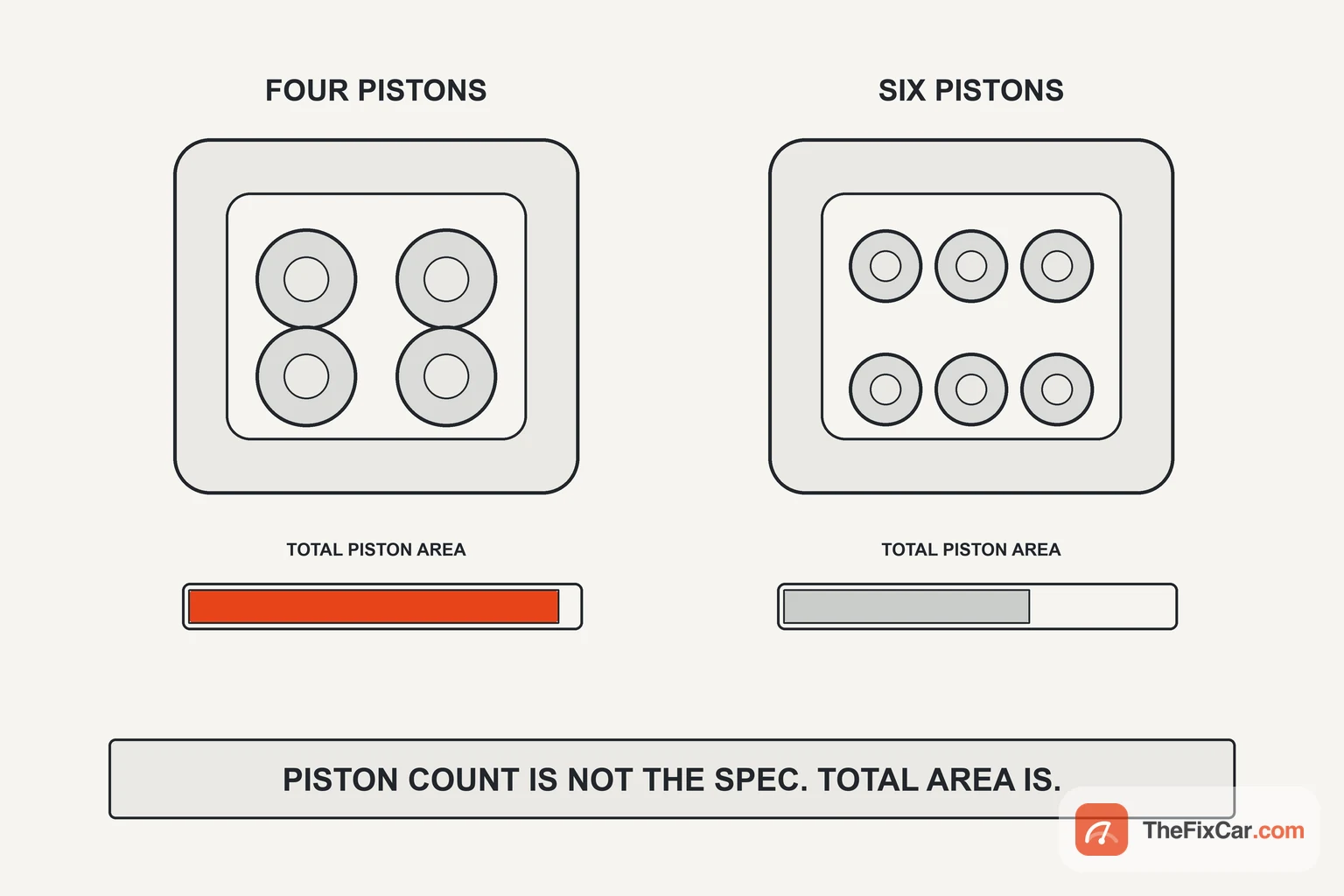
Where real piston dimensions are published. The OEM bulletins and recalls cited above do not give caliper piston diameters, but caliper manufacturers publish them for their own products. Wilwood lists piston count, each bore diameter and total piston area against individual part numbers[11], which makes it possible to compare real calipers on piston area rather than on piston count.
| Caliper and part number | Design | Published bore diameters | Total piston area |
|---|---|---|---|
| Wilwood D154 floater, P/N 120-11873 | 2 piston, floating | 1.62 in (41.1 mm) and 1.62 in | 4.12 in² |
| Wilwood Aero4 Radial Mount, P/N 120-13288 (left hand) | 4 piston, fixed | 1.88 in (47.8 mm) and 1.62 in (41.1 mm) | 4.84 in² |
| Wilwood Aero6 Radial Mount, P/N 120-15768 (right hand) | 6 piston, fixed | 1.62 in, 1.12 in (28.4 mm) and 1.12 in | 4.04 in² |
Read the area figure the way the manufacturer calculates it. Wilwood lists the bores on one side of the caliper and computes total piston area from those. So do not double a Wilwood area figure simply because a fixed caliper has opposed pistons on both sides of the rotor, and check how any other manufacturer defines the figure before comparing across catalogues. The arithmetic confirms it: for the Aero6 above, the three listed bores give 0.7854 x (1.62² + 1.12² + 1.12²) = 4.03 in², which is the 4.04 in² published[11].
Figures as published by the manufacturer for its own calipers, in inches; millimetre equivalents are converted. A family name alone is not enough: Wilwood lists three piston configurations for the D154 family, a 2.50 in single piston and two-piston versions at 1.62 in or 1.12 in, so the part number is the identifier. These are aftermarket calipers, not OE fitments, and they are examples rather than universal piston sizes.
What the numbers show about piston count. A four-piston Aero4 at 4.84 in² has more total piston area than a six-piston Aero6 at 4.04 in², and a two-piston floater at 4.12 in² also exceeds that six-piston caliper on piston area[11]. Piston count describes the layout. On its own it does not tell you how much clamp load a caliper can generate.
Bores within one caliper are not always the same size. Several rows show different diameters in the same caliper, such as 1.88 in paired with 1.62 in[11]. Whatever the design reason on a given caliper, the practical point is that it is specified as a set of bores rather than as a single number.
What piston area controls. Piston area is one input in converting hydraulic pressure into caliper clamp load, and the exact relationship depends on the caliper design. It is engineered together with the master cylinder bore, the pad friction material, the rotor diameter and the pedal ratio. Changing piston area on one axle without changing anything else can shift front to rear balance, depending on the hydraulic layout and the control strategy, which makes it a system decision rather than a parts swap.
Getting the number for a road car. None of the manufacturer bulletins or recalls cited here publish an OE piston diameter, and FMVSS 135 sets braking performance requirements for light vehicles rather than component dimensions[9]. Match by part or casting number using catalogue data for your exact year, model and brake code, preferring the manufacturer’s own parts information, since aftermarket listings can be incomplete on brake-code matching. Brake packages can be identified by a sales code: the FCA recall cited here applies only to vehicles carrying particular brake sales codes[8]. Two cars of the same model year can take different calipers.
Caliper hardware
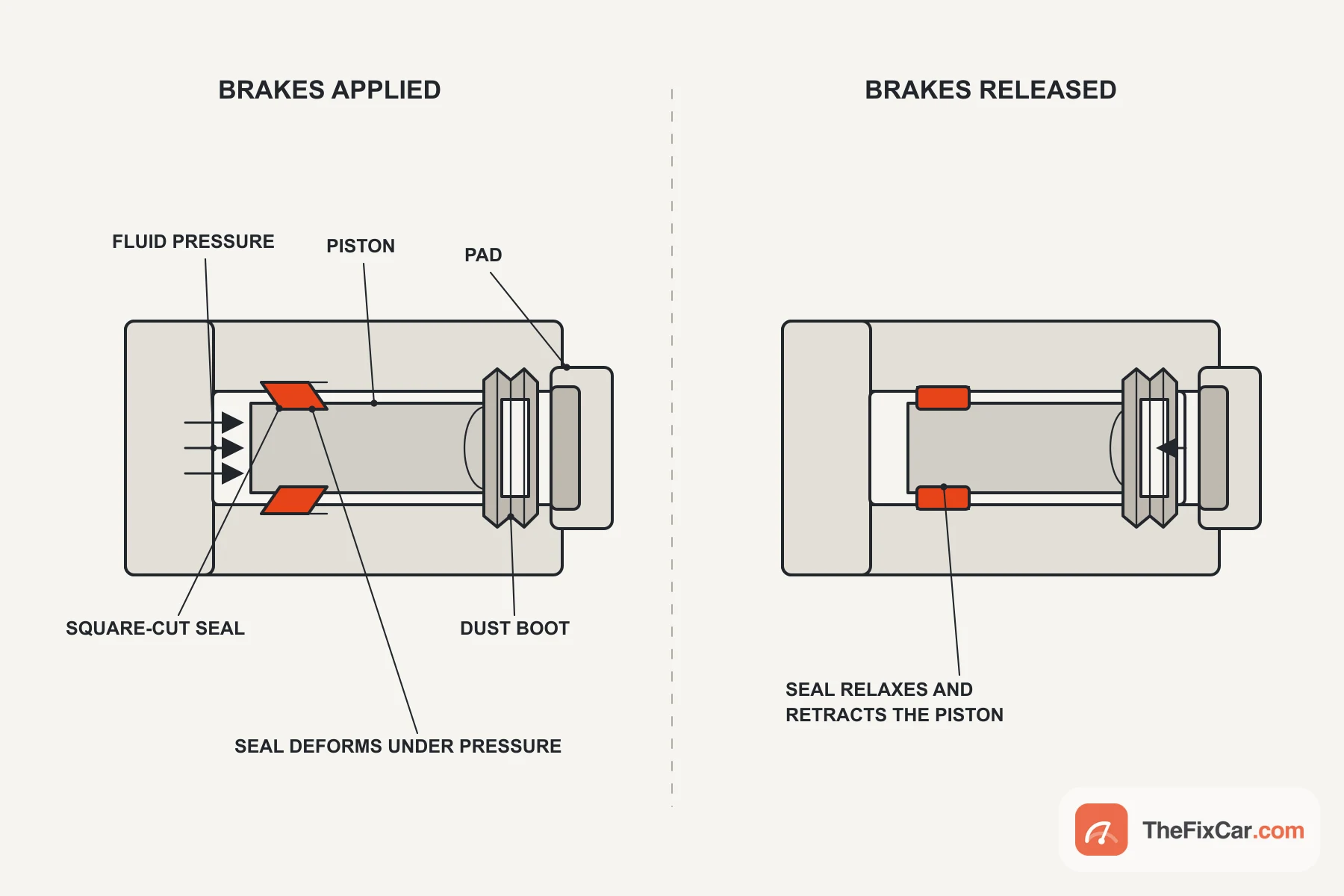
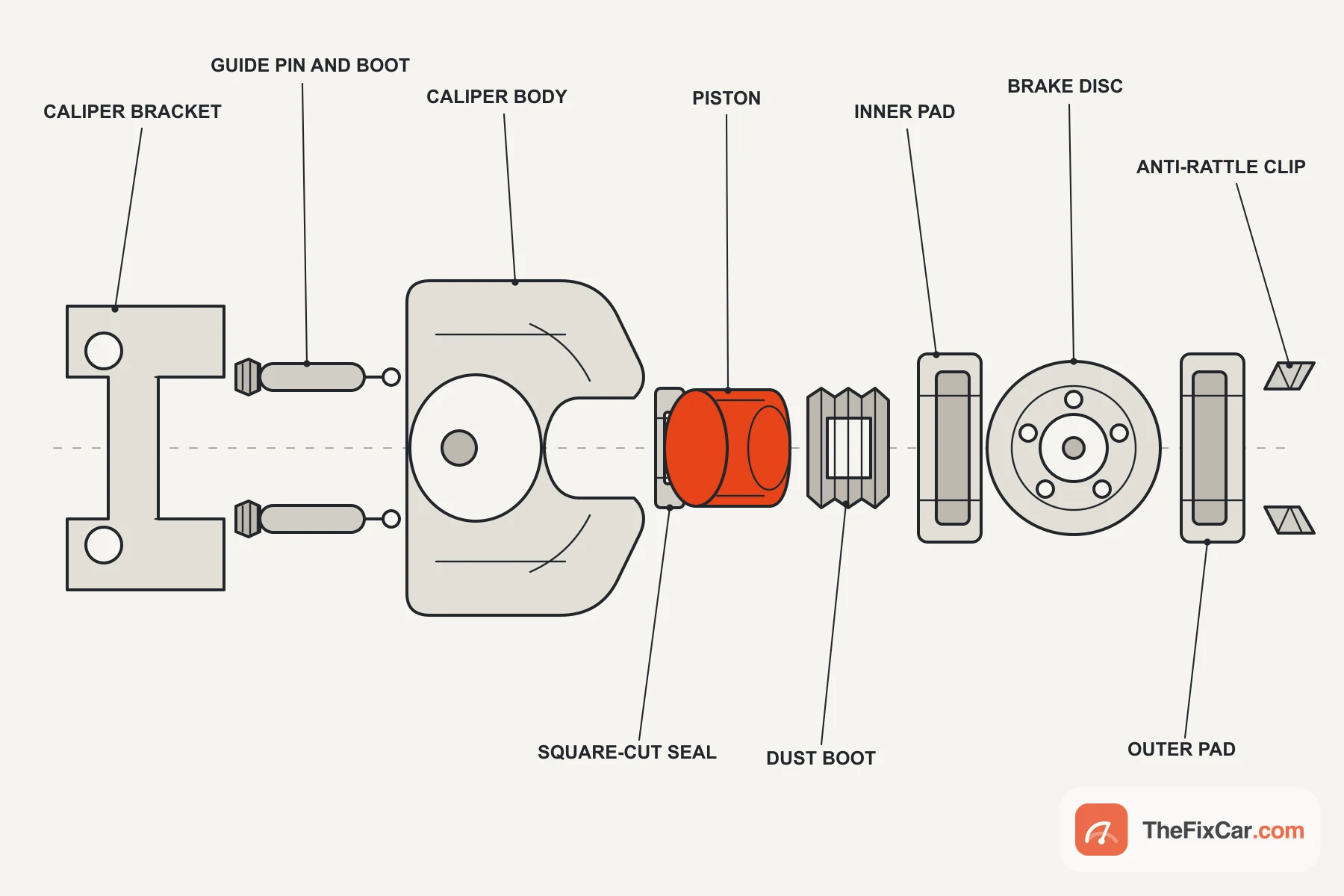
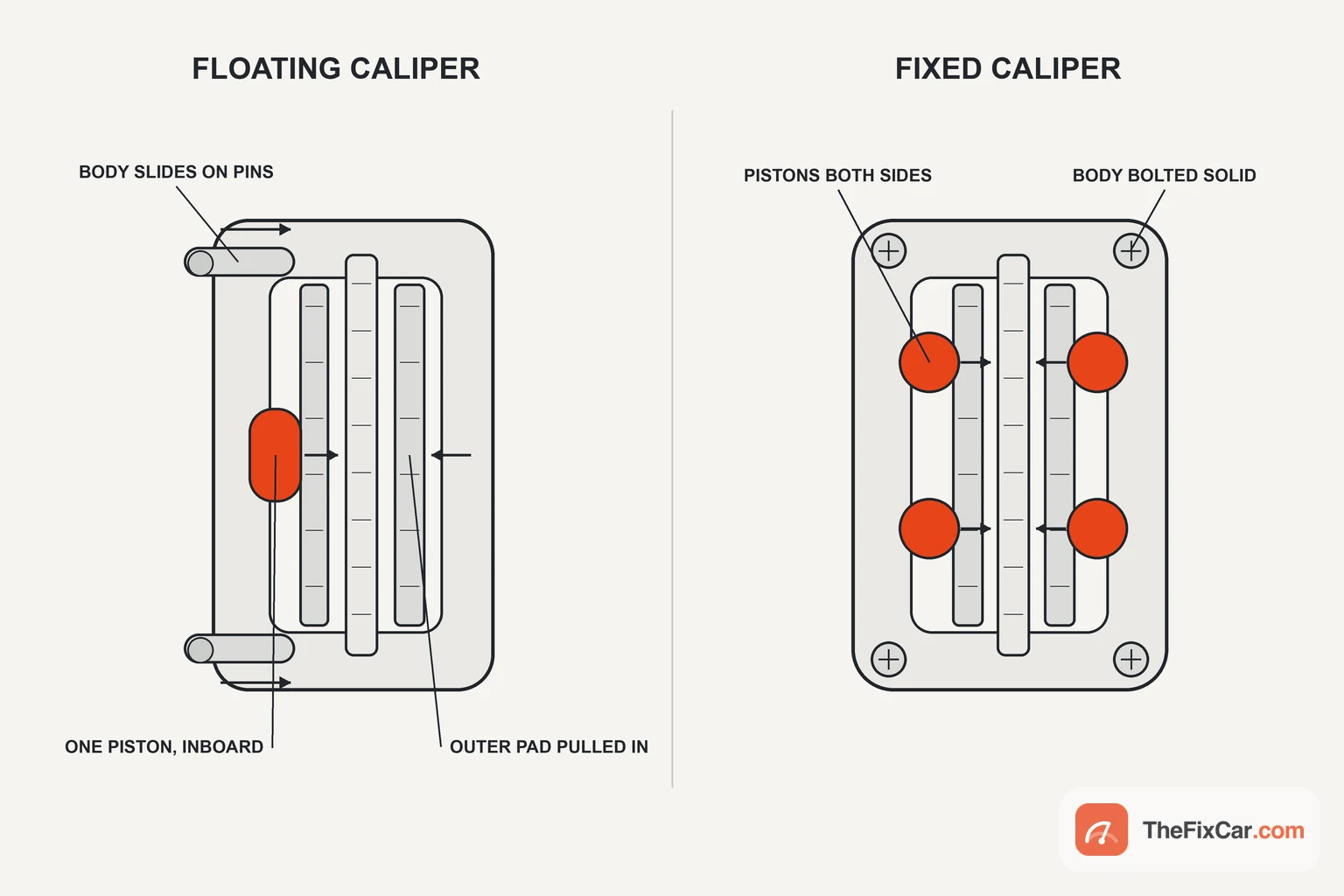
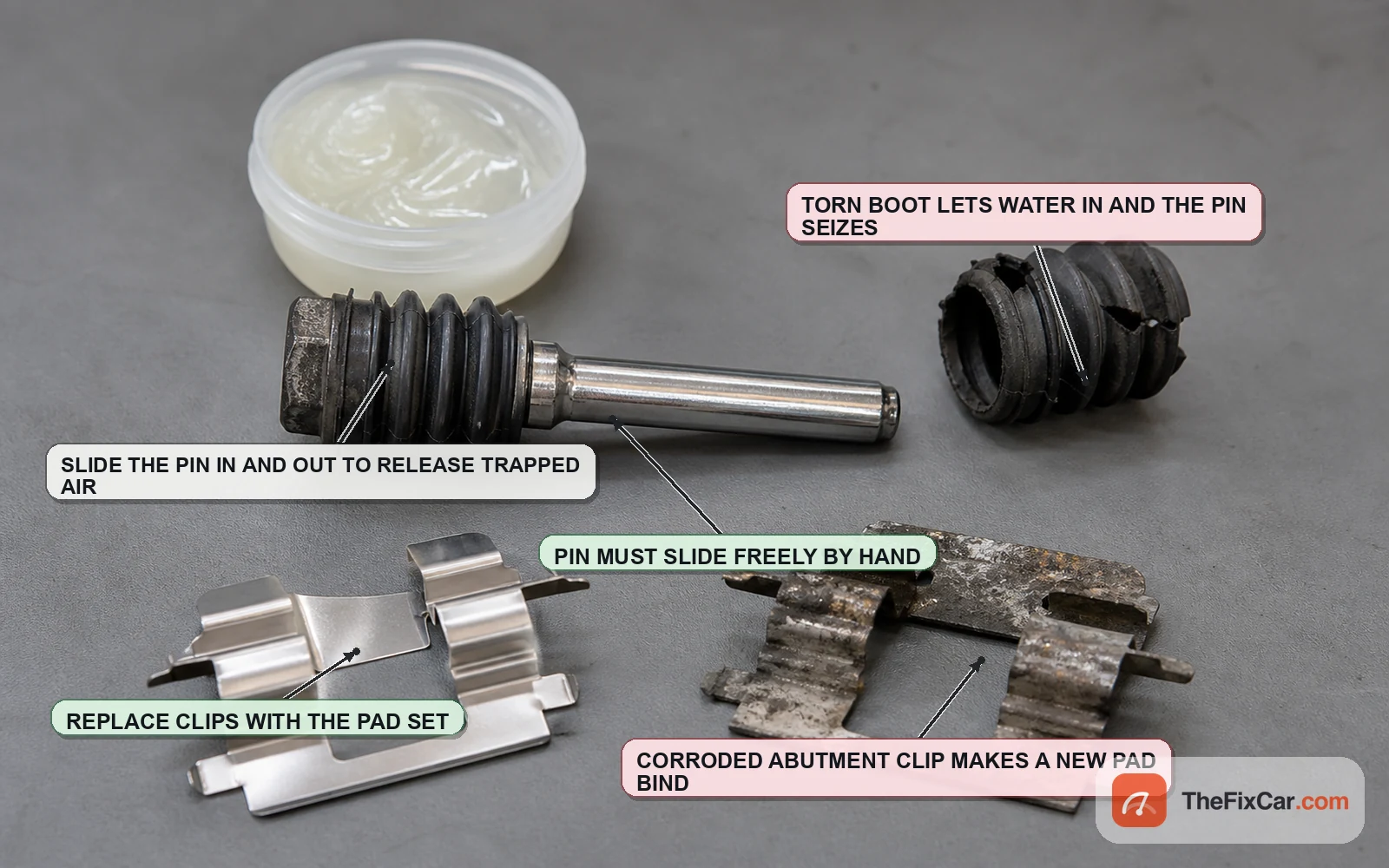
Guide pins and boots. A floating caliper has a piston on one side only and borrows the other half of its clamping force from being free to slide. Take the sliding away and half the brake stops working. That is why the pins matter as much as the torque figures. Stellantis includes a step to remove excess air from the guide pin boots by sliding the pin in and out during assembly[4]. A torn boot lets water and grit reach the pin. On the procedure that calls for boot air removal, a trapped pocket can interfere with pin movement on that design[4]. A pin that does not slide can leave one pad loaded harder than the other.
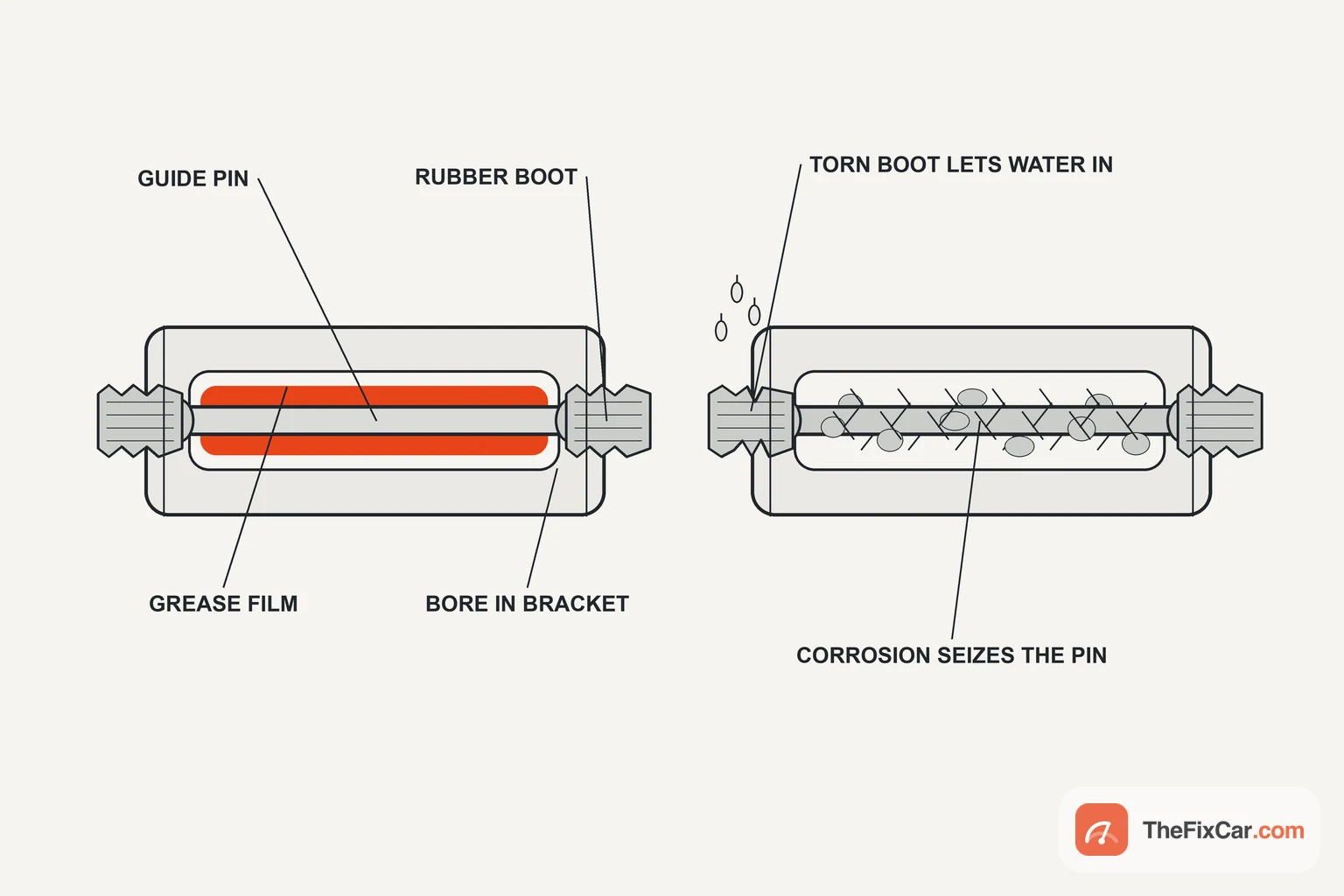
Single-use fasteners. Where a procedure says to obtain new bolts, that is a specification in the same sense as the torque figure. Both the Stellantis recall and bulletin 05-010-15 call for new caliper bracket or adaptor bolts[1][5].
Abutment clips and anti-rattle hardware. On the designs that use them, these locate the pad in the bracket, and they are supplied with many pad sets. Reusing corroded clips can leave a pad binding after a service, and the symptom looks like a sticking caliper.
The caliper casting itself. Hardware faults are not always wear. FCA recalled about 22,800 2015 to 2016 Jeep Grand Cherokee and Dodge Durango vehicles because the left front caliper housing may have been cast from an incorrect material and could rupture under extreme brake application, which the recall states could increase stopping distance and cause a crash[8]. Affected housings were identified by date code.
How to check
- Look up your own figures first. Bolt name, torque, whether the bolt is reusable, and any sequence, for your exact year and model. Write them down before the wheel comes off.
- Check for an open recall. Enter the VIN on NHTSA’s recall lookup, which covers safety recalls. Manufacturer customer satisfaction programs are separate and may need a dealer to look them up. Caliper fastener torque has been the subject of both[1][2].
- Inspect before you torque. Bolt threads, the threaded bore, and the mounting holes. Tesla’s procedure for the vehicles it covers inspects those parts where a fastener was not at specification[6]; follow the equivalent step in your own service information rather than retightening blind.
- Hold the guide pin. Where the procedure calls for it, use a backup wrench on the pin while tightening the bolt. Both GM documents[2][3] and the Honda bulletin[10] specify it for their applications.
- Torque with a calibrated wrench, in the stated order. Snug pass first if the procedure has one, then final torque in the sequence given[4].
- Confirm the slides move. Check pin movement against what the service information for your caliper describes as normal, and confirm the boots are intact.
- Pump the pedal before moving the car until it is firm, then check for a dragging wheel and for leaks at the hose fitting.
What goes wrong
A number borrowed from another car. This is the one that bites, because the wrench still clicks and the job still feels finished. A figure remembered from a different caliper fastener can be wildly wrong: the verified examples on this page range from 21 N·m for a brake hose bolt and 27 N·m for a guide pin bolt to 380 N·m for an adapter bolt.
The guide pin turns with the bolt. Without a backup wrench the pin can turn with the bolt, so the wrench may click on a reading that does not represent clamp load. Both GM documents call for the backup wrench explicitly[2][3].
Old bolts where new ones are specified. The torque reading looks identical. The clamp load does not necessarily survive.
A seized guide pin after a pad change. Dry or corroded pins, a torn boot, or, on procedures that call for boot air removal, trapped air interfering with guide pin movement can leave one pad doing most of the work. That can show up as a pull, uneven pad wear or one corner running hot, and the caliper gets blamed when the hardware is at fault.
Assuming a bigger caliper is an upgrade. Swapping in a caliper with different piston area changes brake balance. Where the rest of the system is not matched to it, the result can be worse than what was there.
FAQ
What torque do brake caliper bolts need? Whatever your vehicle’s service information specifies. The published final torques here span 27 to 380 N·m depending on the fastener and the vehicle, with one procedure adding a 20 N·m snug stage, so a generic figure would be wrong on almost every vehicle in the table.
Can I reuse caliper bracket bolts? Only if the procedure for your vehicle allows it. The Stellantis safety recall and bulletin 05-010-15 both call for new bolts[1][5]. Where the document says new, treat that as part of the specification.
Is it safe to drive with a loose caliper bolt? No. Stop and inspect. A loose caliper fastener has produced manufacturer programs on grounds of increased stopping distance[2], and a bolt that backs out fully can let the caliper contact the wheel. This is one of the cases where the conservative answer is the correct one.
What is the piston size in my brake caliper? The OEM recalls and service bulletins cited on this page do not publish piston diameter. Some caliper manufacturers, Wilwood among them, do publish bore dimensions against specific part numbers[11]. For an OE road-car caliper, match the exact year, model, brake package and caliper part or casting number rather than using a generic piston size, since the same model year can carry different calipers depending on the brake package[8].
Are four-piston calipers better than single-piston? Not by piston count alone. Piston area and hydraulic pressure affect clamp load, while pad material, rotor size, cooling, caliper stiffness and tire grip affect the braking result. In a floating caliper the piston presses the inboard pad against the rotor, and the reaction slides the caliper body on its pins to draw the outboard pad in.
Do I need a torque wrench for caliper bolts? Yes. These joints are structural, two of the cited procedures call for one-time bolts, and the figures are far apart. Guessing by feel gives you no way to know which side of the specification you landed on.
Why did my new pads start dragging? Check the guide pins and the abutment clips before suspecting the caliper. Seized pins, a torn boot, trapped air in a guide pin boot where the service procedure calls for air removal[4], or reused corroded clips can each leave a pad binding.
Related brake caliper guides
- Bad brake caliper symptoms and what else produces them, for proving the fault first
- Brake caliper inspection and service: rebuild vs replacement, for the job these figures belong to
- Lug nut torque specifications: the other fastener on the same corner
- When to replace brake pads and what wear actually looks like
- How often to change brake fluid and why moisture matters
- Brake-by-wire systems: EHB and EMB braking explained
- Axle seal leaking onto a brake rotor: how to tell and what it costs
Sources & verification
Last technically reviewed: Aug 2026
Reviewed by: Tyler Brandt
Primary references: manufacturer safety recalls and service bulletins filed with NHTSA (FCA US, General Motors, Stellantis, American Honda, Tesla, Daimler Trucks), Wilwood Engineering caliper specifications, and 49 CFR 571.135
Suggested citation: TheFixCar, “Brake Caliper Specs: Torque, Piston Size and Hardware,” updated Aug. 2026. https://thefixcar.com/specs/brake-caliper-specs-torque-piston-size-hardware/