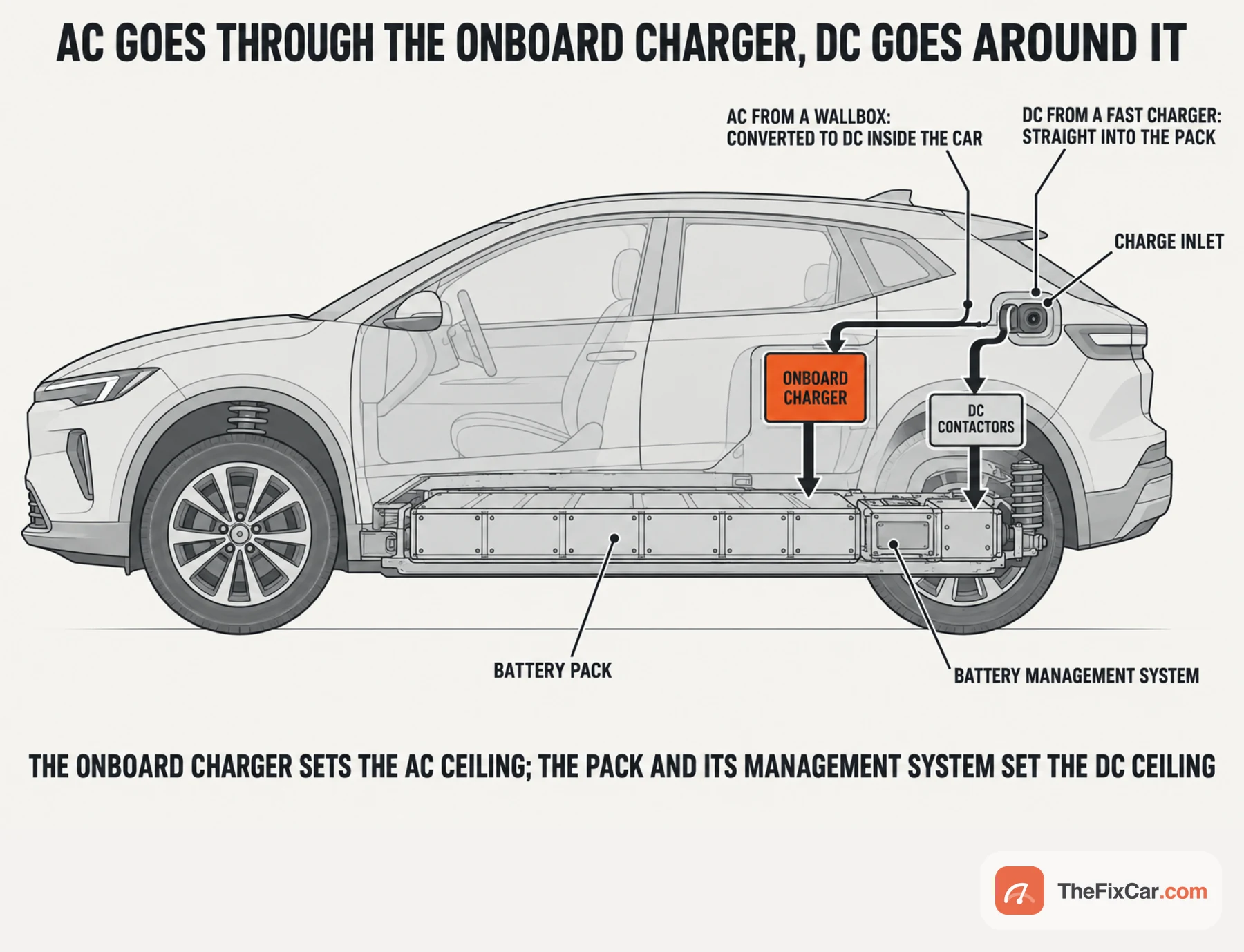
There is no single number for how fast an electric car charges, because two different limits are in play and the lower of them wins, inside whatever the station and its cable can supply. On AC, the ceiling is the car’s own onboard charger: a wallbox can supply anything from 2.9 to 19.2 kW, and the car takes what its converter is rated for, which in the specifications cited here runs from 7.2 kW on the 2026 Nissan LEAF to 19.2 kW on the Lucid Air.[1][2][3] On DC, the cabinet can be rated at 150, 350 or 500 kW, and the car’s battery and its management system decide how much of that to accept, minute by minute, as the pack fills and warms.[1][4]
This page collects the published numbers behind those limits: the charging levels as the U.S. Department of Energy defines them, the NEVI minimums for federally funded corridor fast chargers, the IEC coupler voltage and current ratings behind CCS, CHAdeMO and GB/T, the standardisation milestones behind NACS, and the onboard-charger, pack-voltage and fast-charge figures that five manufacturers publish for named models. It explains kW against kWh, the onboard charger, the vehicle acceptance limit and 400 V against 800 V systems, in that order.
Quick answer
A Level 2 wallbox delivers 2.9 to 19.2 kW of AC, and a typical residential unit runs at 30 A for 7.2 kW; a Level 1 cordset on a 120 V outlet is about 1.9 kW.[1] Current U.S. DC fast-charging equipment reaches up to 500 kW in the DOE figures used here, NEVI-funded corridor chargers must supply at least 150 kW per port across 250 to 920 V DC, and the car takes only what its onboard charger (AC) or its battery management system (DC) allows.[1][5] There is no universal charging specification: every kW figure in the table is tied to a named standard, rule or model, and the number for your car is on its spec sheet.
The Level 1 and Level 2 figures on this page use the North American DOE terminology. IEC-based markets commonly use Mode 3 AC charging through the Type 2 coupler, which IEC 62196 defines for single- and three-phase supply, including three-phase 11 and 22 kW installations of the kind Porsche describes at its European sites.[6][4]
Verified specifications at a glance
| Application or item | Value | Conditions | Primary source |
|---|---|---|---|
| AC Level 1, J1772 cordset | About 1.9 kW; roughly 5 miles of range per hour | 120 V AC household outlet; DOE’s assumed power for its range figure | DOE AFDC[1] |
| AC Level 2, J1772 or J3400 | 2.9 to 19.2 kW; about 25 miles of range per hour | 208 or 240 V AC; output varies by unit, with public and workplace equipment operating at 40 to 80 A per DOE; roughly 25 miles per hour is DOE’s typical figure | DOE AFDC[1] |
| Typical residential Level 2 unit | 7.2 kW at 30 A | 240 V; DOE cites a dedicated 40 A circuit under NEC Article 625, subject to the locally adopted code | DOE AFDC[1] |
| DC fast charging equipment | Up to 500 kW | Three-phase AC input; delivered power varies by vehicle and state of charge (DOE) | DOE AFDC[1] |
| NEVI-funded corridor DC fast charger, per port | At least 150 kW continuous | Must meet the EV’s power request up to 150 kW at each port simultaneously; power sharing allowed only if that holds | 23 CFR 680.106(d)(1)[5] |
| NEVI-funded DC fast charger, output voltage | 250 to 920 V DC | Required support range per port | 23 CFR 680.106(d)(1)[5] |
| NEVI-funded AC Level 2 port | At least 6 kW continuous | Per port, simultaneously across all AC ports; J1772 connector required | 23 CFR 680.106(c), (d)(2)[5] |
| IEC 62196-3 DC couplers, as listed in CharIN’s design guide (pre-2026 edition) | Up to 1,000 V DC, 400 A | Rated operating voltage and current for dedicated DC charging couplers under the edition the guide was written to | CharIN design guide[6] |
| IEC 62196-3:2026, edition 3 | Increased ratings for all configurations; the CCS-type configuration GG at 1,500 V / 600 A, with Annex AA implementations allowed above 600 A | Published 23 April 2026; cancels and replaces the 2022 edition; corrigendum 1 (2026-08) included | IEC[7] |
| CCS Combo 1 and Combo 2 (IEC 62196-3) | 850 V, 200 A DC | Coupler configuration rating as listed in the design guide, pre-2026 edition | CharIN design guide[6] |
| CHAdeMO Type 1 coupler (IEC 62196-3) | 600 V, 200 A DC | Coupler configuration rating as listed, pre-2026 edition | CharIN design guide[6] |
| China DC Type 2 coupler, GB/T (IEC 62196-3) | 750 V, 250 A DC | Coupler configuration rating as listed, pre-2026 edition | CharIN design guide[6] |
| CHAdeMO 2017 high-power protocol | 100 kW continuous, 150 to 200 kW peak | 400 A at 500 V | CHAdeMO Association[8] |
| CHAdeMO 3.0 / ChaoJi | 500 to 900 kW | Up to 600 A, 1 to 1.5 kV; co-developed with the China Electricity Council | CHAdeMO Association[8] |
| Hyundai IONIQ 5 (2024), onboard charger | 10.9 kW max | All models; Level 2 at 240 V from 10 to 100% in 7 h 10 min (Long Range) | Hyundai 2024 IONIQ 5 specifications[9] |
| Hyundai IONIQ 5 (2024), DC fast charging | 18 min from 10 to 80% at over 250 kW (800 V); 25 min est. at 150 kW (400 V) | 77.4 kWh pack at 697 V; ultra-fast charger up to 800 V / 350 kW | Hyundai 2024 IONIQ 5 specifications[9] |
| Kia EV6 (2025), onboard charger and pack | 10.9 kW OBC; 523 V / 63.0 kWh or 697 V / 84.0 kWh | All trims; pack by battery option | Kia 2025 EV6 specifications[10] |
| Porsche Taycan (2025), DC fast charging | Up to 320 kW; 18 min from 10 to 80% | 800 V charging stations, ideal conditions; more than 300 kW sustained for up to five minutes | Porsche press kit[4] |
| Porsche Taycan (2025), 400 V stations and AC | Up to 150 kW, about 35 min; 11 kW AC onboard charger | Through the Combined Booster Charger at 400 V charging points | Porsche press kit[4] |
| Nissan LEAF (2026) | 7.2 kW onboard charger; up to 150 kW DC; 35 min from 10 to 80% | 75 kWh pack; J1772 port for AC and a NACS port for DC | Nissan 2026 LEAF press kit[2] |
| Lucid Air | 19.2 kW AC maximum; up to 350 kW DC | 900 V-class architecture; the 200 miles in 12 minutes claim applies to the Grand Touring on a 350 kW charger with 19-inch wheels | Lucid Motors[3] |
| SAE J3400 (NACS) milestones | TIR December 2023; Recommended Practice September 2024; J3400/2 connector standard May 2025 | Standardisation of the Tesla-designed connector; adapters allowed on federally funded DC chargers alongside CCS1 since May 2023 (Joint Office wording) | Joint Office; J3400 market update[11][12] |
Note: these are published values for the named standards, rules and models, not a universal table. The onboard-charger rating and DC limit for your car come from its own specification sheet.
What these numbers do NOT mean
- A station’s kW rating is not your car’s charging speed. A 350 kW cabinet supplies what the vehicle requests; the IONIQ 5’s 18-minute figure is Hyundai’s number for its own car on such a charger, not a charging time that applies to every vehicle using that charger.[1][9]
- A coupler rating is not a charging rate. The 850 V / 200 A figure for Combo 1 and 2 is the connector configuration as CharIN’s guide lists it under the earlier edition of the IEC coupler standard; the 2026 edition raised the ratings of every configuration, with the CCS-type configuration GG at 1,500 V and 600 A, and stations and cables are built to those later specifications.[6]
- The 10 to 80% times are not 0 to 100% times. Charging power tapers toward a full pack, which is why the manufacturers cited here quote the 10 to 80% window.[9][4]
- An 800 V car does not always charge at 800 V rates. The Taycan takes 320 kW at an 800 V station and 150 kW at a 400 V one, through a booster; the IONIQ 5’s 25-minute estimate at 150 kW is the same effect.[9][4]
- The NEVI minimums are procurement rules, not physics. 150 kW per port and 250 to 920 V describe what a federally funded corridor charger must offer, not what any car will draw.[5]
- kW and kWh are not interchangeable. One is a rate, the other a quantity; the section below is about that, and no table entry above mixes them.
EV charging levels: what Level 1, Level 2 and DC fast charging deliver
This page uses the U.S. Department of Energy’s framework, with North American supply voltages; other markets use other voltages and names. AC Level 1 is a 120 V household outlet through the portable cordset that DOE says most EVs come with: about 1.9 kW, roughly 5 miles of range per hour, and about 40 miles from an eight-hour overnight session on a mid-size EV.[1] AC Level 2 is 240 V at home or 208 V in commercial buildings, with equipment operating at 40 to 80 A; the range is 2.9 to 19.2 kW, the typical residential unit is 30 A for 7.2 kW on a dedicated 40 A circuit, and DOE’s typical figure is about 25 miles of range per hour.[1] DC fast charging, which DOE also calls Level 3, takes a three-phase supply into a cabinet that delivers DC directly, at outputs up to 500 kW; as of 2023, nearly 80% of public U.S. ports were Level 2 and more than 20% were DC fast.[1]
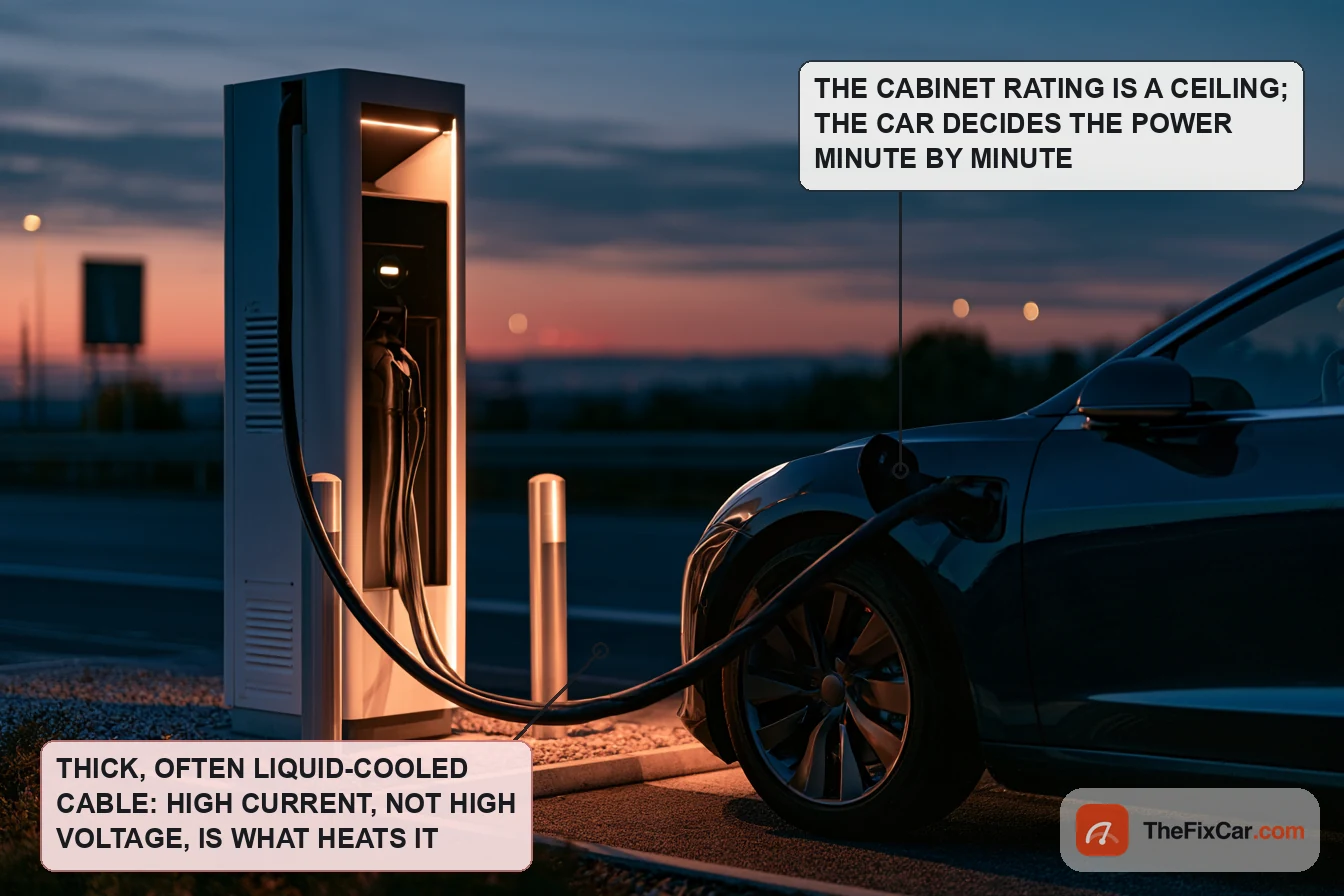
The NEVI rule adds minimums on top of those definitions for the chargers it funds. Under it, a DC fast charging station on a designated corridor must have at least four ports, each with a continuous rating of at least 150 kW, each able to meet the vehicle’s request up to 150 kW at the same time as the others, and each supporting 250 to 920 V DC; an AC Level 2 port must hold at least 6 kW.[5] For a NEVI-funded site, 150 kW per port is the minimum continuous capability that qualifies; it is not a property of any car.
kW vs kWh: the rate and the quantity
A kilowatt is a rate of energy flow; a kilowatt-hour is an amount of energy. A pack rated at 77.4 kWh holds 77.4 kilowatt-hours; a charger delivering 150 kW moves 150 kilowatt-hours per hour, so it would put 75 kWh into an ideal pack in half an hour if the pack accepted the full rate throughout, which a real pack does not sustain across a session.[9] Manufacturers therefore quote time for a window, 10 to 80%, at a stated charger power, because kWh divided by kW assumes constant delivered power, and real sessions have a falling curve, temperature limits and conversion losses.[9][4]
The same units explain range-per-hour figures. DOE’s 25 miles per hour for Level 2 is its assumed power multiplied by an assumed efficiency in miles per kWh; a heavier vehicle at the same kW adds fewer miles per hour, and a 19.2 kW unit adds more than a 7.2 kW one only if the car’s onboard charger can take 19.2 kW.[1]
The onboard charger: why Level 2 speed is set by the car
AC from a wallbox cannot be stored; the onboard charger in an EV converts it to DC at the pack voltage, and that converter has a rating, which is the number to look for before asking how many kW Level 2 charging delivers to a given car. Hyundai lists the 2024 IONIQ 5’s at 10.9 kW maximum on all models, and Kia lists the 2025 EV6’s at the same 10.9 kW on every trim; Porsche fits an 11 kW AC charger as standard on the 2025 Taycan; Nissan’s 2026 LEAF has 7.2 kW; Lucid’s Air charges at a maximum of 19.2 kW on AC.[9][10][4][2][3] Plug any of them into a 19.2 kW wallbox and the car draws up to what its charger is rated for, no more, and less when supply voltage, charge settings or battery conditions hold it back; plug the Lucid into a 7.2 kW unit and the unit is the limit.
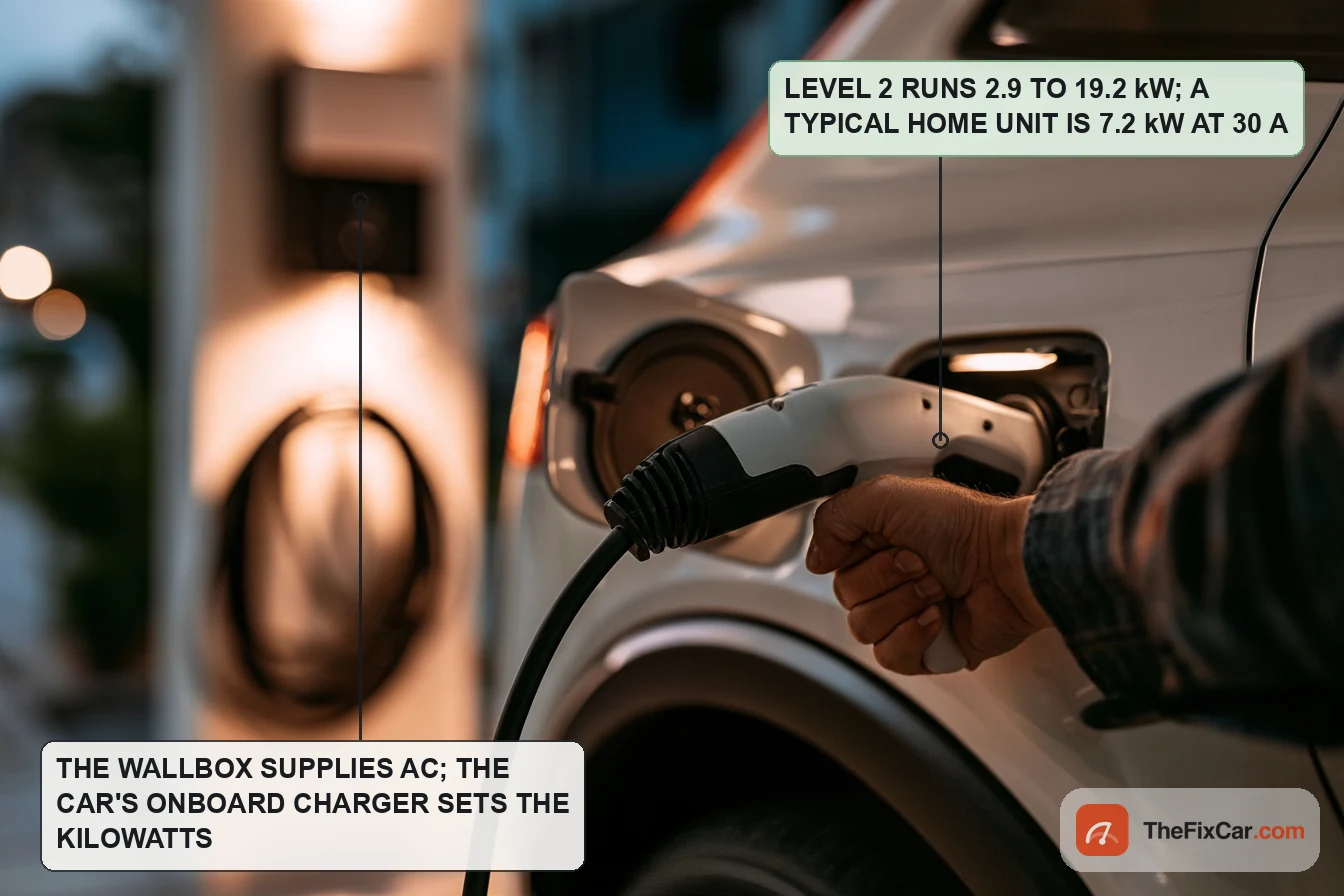
The spec sheet gives the number in kW, and the circuit gives it in amps; on a single-phase 240 V supply volts times amps gives the input figure before losses, so a 48 A onboard charger is about 11.5 kW and an 80 A one 19.2 kW, which is why DOE’s Level 2 ceiling and Lucid’s onboard maximum are the same 19.2 kW.[1][3] Hyundai’s 7 hours 10 minutes from 10 to 100% for the 77.4 kWh IONIQ 5 on 240 V is the published figure for a 10.9 kW charger; a 19.2 kW wallbox would not shorten it.[9] What happens when a car will not charge on AC at all, and how to separate the wallbox from the car, is on the page about an EV that won’t charge at home.
DC fast charging and the vehicle acceptance limit
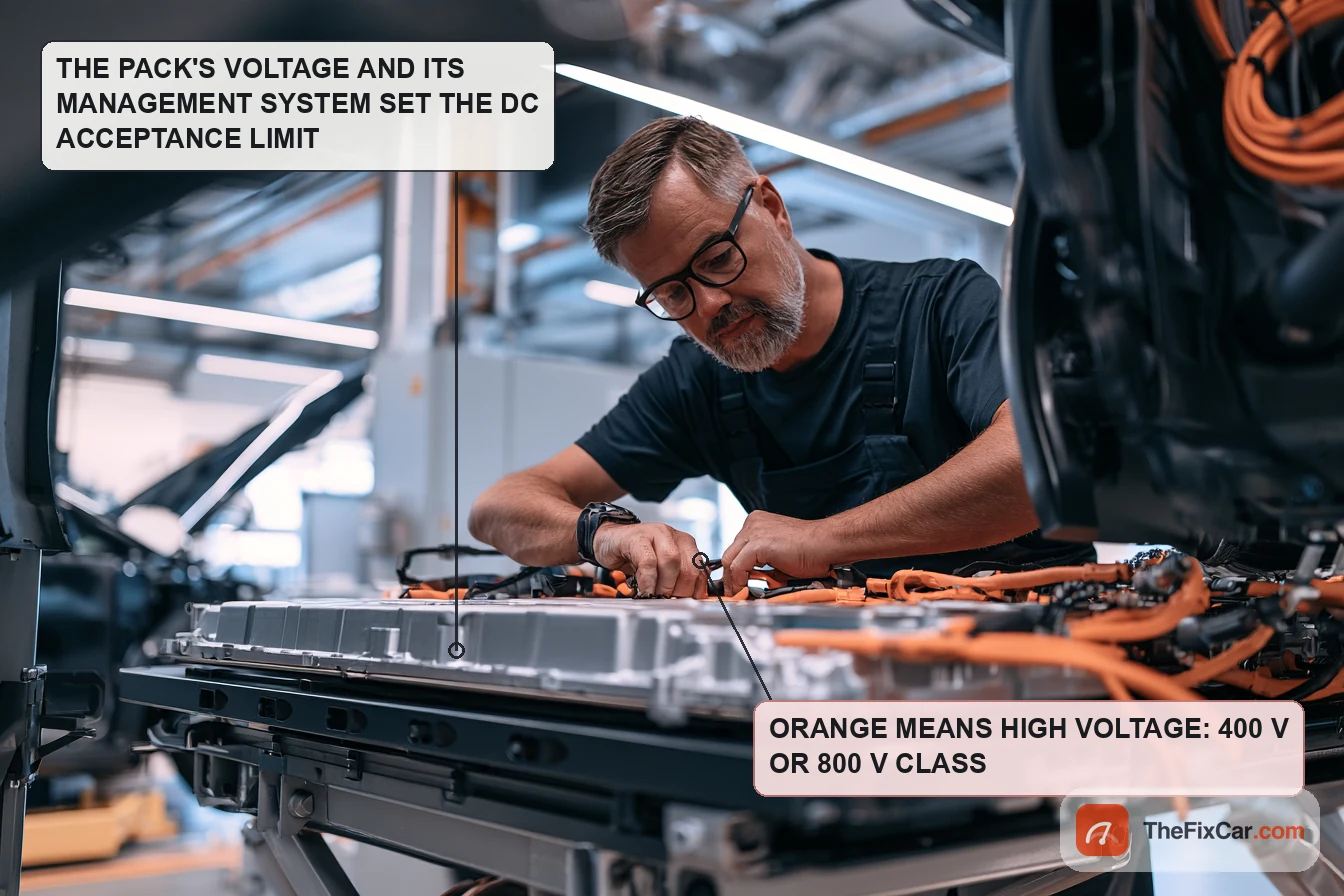
On DC the AC onboard charger is bypassed. The charger feeds the vehicle’s high-voltage DC charging path; depending on the architecture, power may reach the battery bus directly or pass through an onboard DC/DC boost stage, which is how the IONIQ 5 and the Taycan take 400 V stations. Either way the battery management system tells the cabinet how much current to send, within what the cabinet, its cable and any shared site power can supply. The station rating is therefore a ceiling, and the vehicle’s acceptance is the curve underneath it, with a shape that differs by model and by conditions; the one curve documented here is Porsche’s.[1] Porsche’s own description of the 2025 Taycan makes the shape explicit: up to 320 kW under ideal conditions, more than 300 kW sustained for up to five minutes, 18 minutes from 10 to 80%.[4] DOE says the same thing in one line: charging power varies by vehicle and battery state of charge.[1]
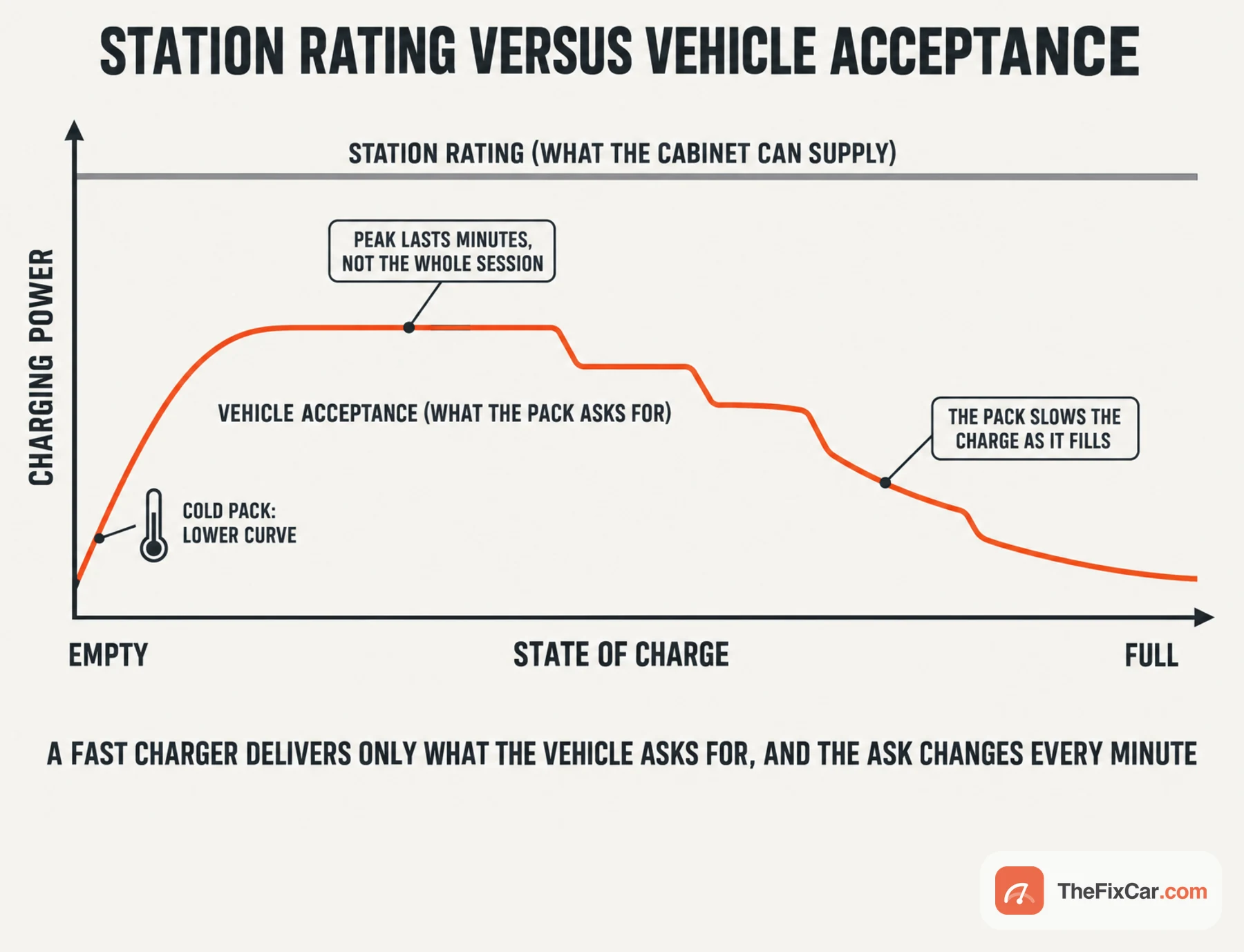
The acceptance limit is why the same 150 kW station gives different results to different cars. Nissan quotes 35 minutes from 10 to 80% for the 2026 LEAF’s 75 kWh pack at up to 150 kW; Hyundai estimates 25 minutes for the IONIQ 5’s 77.4 kWh pack at the same 150 kW, its 400 V-station figure; the two numbers come from two manufacturers’ own conditions and do not isolate any single cause.[9][2] Neither number transfers to another model, and neither is a station rating: an EV charging speed comparison between brands only means something at the same station class and the same 10 to 80% window. Battery temperature is the other variable, the one behind questions about EV charging speed in cold weather; Hyundai lists battery preconditioning, which brings the pack toward its charging temperature before a fast charge, as standard on the IONIQ 5.[9]
400 V vs 800 V systems
Power is voltage multiplied by current, and the cable and connector are rated in current. At 400 V, 200 kW needs 500 A; at 800 V it needs 250 A, and in the same conductor that is a quarter of the resistive heating. That is the main case for the higher voltage, and the coupler ratings show the limits it works against: the couplers in CharIN’s guide, written to the earlier edition of IEC 62196-3, top out at 1,000 V DC and 400 A; the 2026 edition of the standard, published on 23 April 2026, raised the ratings of every configuration, with the CCS-type configuration GG at 1,500 V and 600 A and Annex AA implementations allowed above 600 A; and the 2017 CHAdeMO high-power protocol reached its 200 kW peak at 400 A and 500 V.[6][7][8] Where the car, the station, the cable and the connector all support the voltage, and the car’s own acceptance limit allows it, an 800 V-class car can pull more power through the same current-limited connector than a 400 V-class car can; the IEC ratings are component ratings, not a car’s charging rate.
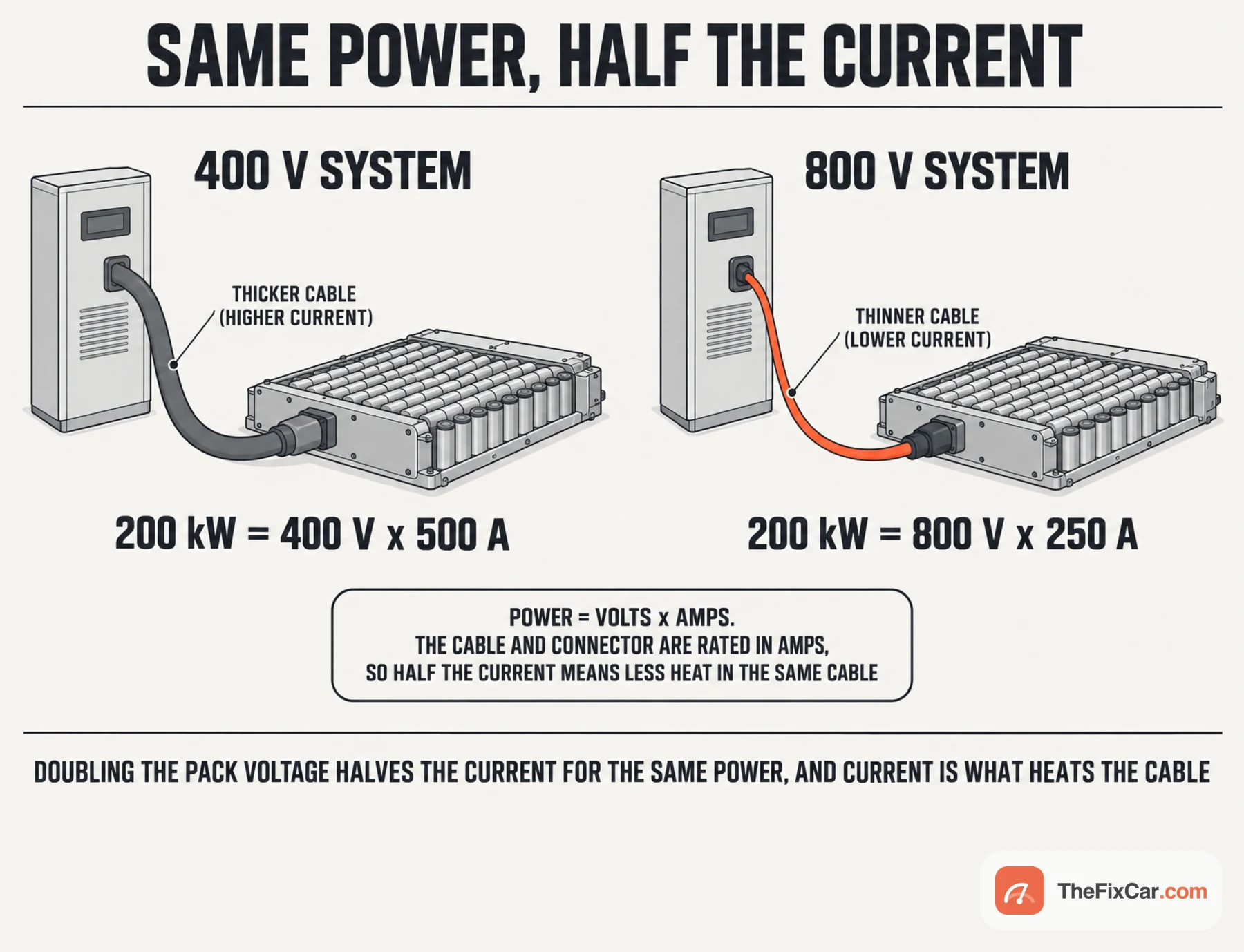
The pack voltages behind the marketing labels are lower than the labels. Hyundai lists the IONIQ 5 Long Range at 697 V and the Standard Range at 522.7 V; Kia lists the EV6 at 697 V and 523 V by battery; Lucid describes the Air’s architecture as 900 V-class.[9][10][3] At lower-voltage DC stations, compatibility and power are vehicle-specific. Porsche’s 2025 Taycan carries a 150 kW DC/DC converter for 400 V points and charges there in about 35 minutes instead of 18, and Hyundai’s 150 kW figure for the IONIQ 5 is a 400 V estimate against an 18-minute 800 V time.[9][4] The NEVI rule’s 250 to 920 V requirement spans both classes.[5]
CCS vs NACS vs CHAdeMO vs GB/T: the connector standards
Four DC connector families matter, and they differ in geometry and in how they signal, not in the physics above. In North America the AC-only J1772 plug is the base of CCS Combo 1, and NACS uses a different combined inlet, which is why the comparison is framed as J1772 versus CCS versus NACS. CCS is the Combined Charging System: the AC connector, J1772 Type 1 in North America or Type 2 in Europe, with two large DC pins added below it, so one inlet on the car takes Level 1, Level 2 and DC fast charging; DOE calls it the J1772 combo, and CharIN’s design guide ties it to IEC 62196-3, IEC 61851, ISO 15118 and DIN 70121 for the coupler, the charging system and the communication.[1][6] The NEVI rule requires a permanently attached CCS Type 1 connector on every funded DC port.[5]
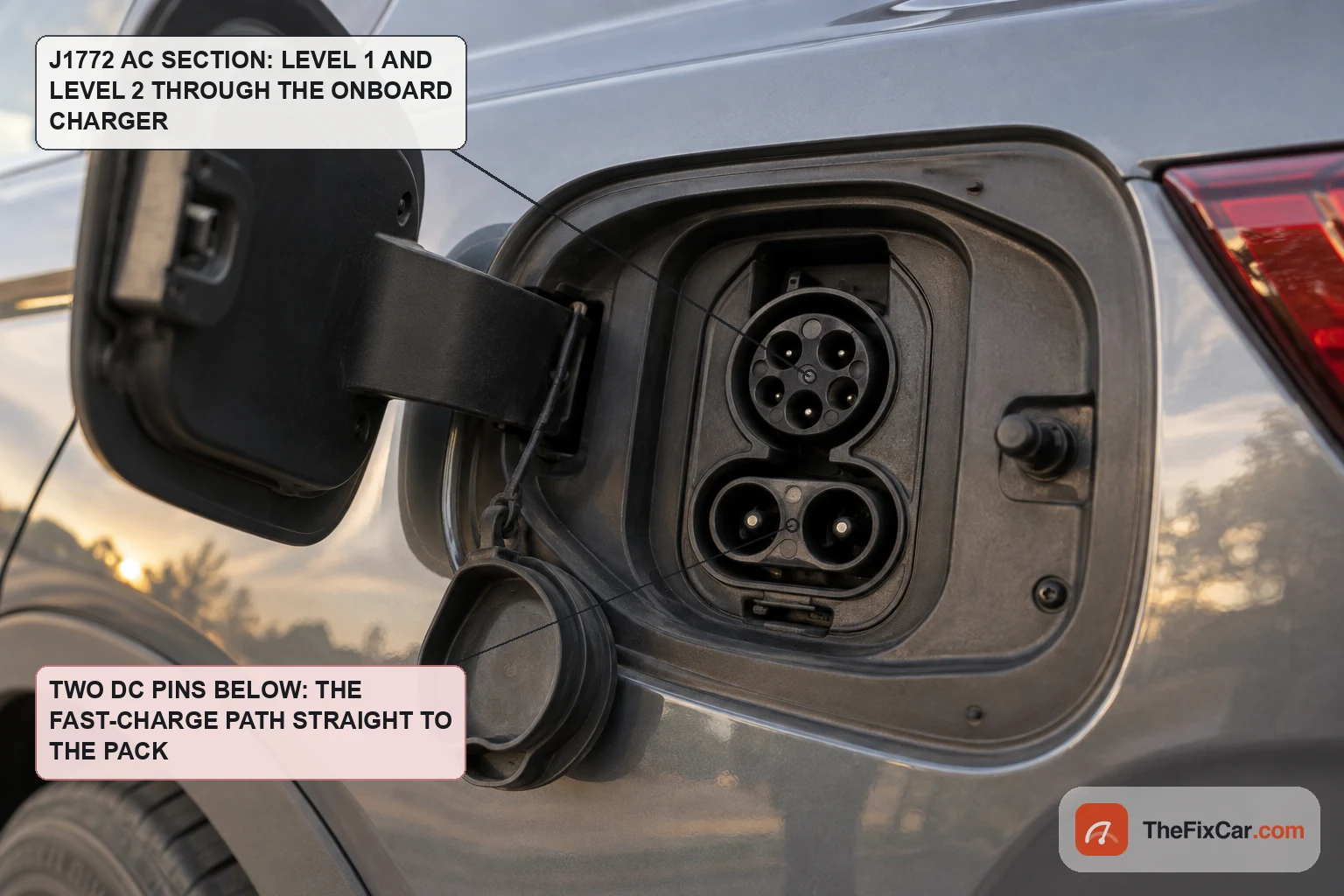
NACS, standardised as SAE J3400, is the Tesla-designed connector: one small plug for AC Levels 1 and 2 and for DC fast charging. SAE published the Technical Information Report in December 2023 and the Recommended Practice in September 2024, and the connector standard J3400/2 followed in May 2025; the Joint Office of Energy and Transportation notes that FHWA has allowed J3400 adapters on federally funded fast chargers since May 2023 as long as a CCS1 connector is also present, and that most manufacturers committed to J3400 inlets from 2025 with adapters for CCS cars from 2024.[11][12] Nissan’s 2026 LEAF shows the transition in hardware: a J1772 port on one fender for AC and a NACS port on the other for DC.[2][1]
CHAdeMO is the Japanese DC-only connector, common on Japanese-brand EVs and separate from the car’s AC inlet. Its 2017 protocol reached 100 kW continuous and 150 to 200 kW peak at 400 A and 500 V; the CHAdeMO 3.0 generation, developed as ChaoJi with the China Electricity Council, is specified up to 600 A and 1 to 1.5 kV for 500 to 900 kW, with backward compatibility to existing GB/T and CHAdeMO chargers as a design goal.[8] In the United States, the NEVI rule allows CHAdeMO connectors only with fiscal-year 2022 funds, a signal of where the network is going.[5] GB/T is China’s national connector family: the DC coupler appears in IEC 62196-3 as the China DC Type 2 configuration at 750 V and 250 A, and ChaoJi, the joint CHAdeMO and China Electricity Council effort, is intended as the next generation for both ecosystems, with backward compatibility as a stated goal.[6][8] What a connector standard does not fix is the charge-port latch, the cable lock, the adapter, the vehicle software and the network authorisation, any of which can stop a session; the page on a charging cable stuck in the port covers that end.
How to use these values
- Match a home wallbox to the car’s onboard charger, then to the house. A car rated at 10.9 or 11 kW gains nothing from a 19.2 kW unit; check the spec-sheet OBC figure first, and have the circuit, service capacity and local code confirmed by a qualified installer before the unit is chosen.[9][10]
- Read a fast-charge claim with its conditions: the window (10 to 80%), the station power and voltage class, the pack, and the temperature or preconditioning state the manufacturer tested at; the 18-minute figures above are for 800 V stations, and the same cars quote 25 to 35 minutes at 150 kW.[9][4]
- Match the connector before the kilowatts. A CCS car at a NACS-only site, or a CHAdeMO car at a new corridor station, is limited by the adapter, the network’s access rules or has no option at all, whatever the cabinet is rated for.[1][5]
FAQ
How many kW is Level 2 charging?
Level 2 equipment ranges from 2.9 to 19.2 kW at 208 or 240 V. A typical residential unit runs at 30 A for 7.2 kW on a dedicated 40 A circuit, and the car’s onboard charger caps what any unit can deliver.[1]
What determines EV charging speed on a DC fast charger?
The lower of what the vehicle accepts and what the station can supply. The cabinet’s rating is a ceiling; the battery management system sets the current from state of charge and temperature, so power changes through the session. Porsche quotes more than 300 kW sustained for up to five minutes on the 2025 Taycan, inside an 18-minute 10 to 80% session.[1][4]
What is the difference between CCS and NACS?
CCS combines the J1772 AC connector with two DC pins in one inlet; NACS, standardised as SAE J3400, is a single smaller plug for both AC and DC. NEVI-funded DC ports must carry CCS Type 1 and may add J3400; most manufacturers committed to J3400 inlets from 2025, with adapters bridging the two.[5][11]
Is CHAdeMO obsolete?
Not as a standard: CHAdeMO 3.0, developed as ChaoJi with the China Electricity Council, is specified to 500 to 900 kW. For new NEVI-funded U.S. sites its eligibility is limited, since the rule allows CHAdeMO connectors only with fiscal-year 2022 funds, and Nissan’s 2026 LEAF moved to a NACS port for DC; that describes new funded sites and one model, not every existing network.[5][8][2]
Does an 800 V car charge faster at every station?
No. At an 800 V station the 2025 Taycan takes up to 320 kW and charges from 10 to 80% in 18 minutes; at a 400 V station it is limited to 150 kW through its converter and takes about 35 minutes. Hyundai publishes its own pair for the IONIQ 5, 18 minutes at over 250 kW on 800 V and an estimated 25 minutes at 150 kW on 400 V, through Hyundai’s hardware rather than Porsche’s booster.[9][4]
What is the onboard charger kW on the IONIQ 5 and EV6?
10.9 kW on both, per Hyundai’s 2024 IONIQ 5 specifications and Kia’s 2025 EV6 specifications, on every trim. That is the cars’ AC maximum; a lower-rated wallbox or circuit, or the car’s own charge settings, can bring the actual rate below it.[9][10]
Sources & verification
Last technically reviewed: Sep 2026
Reviewed by: Marcus Holt, diagnostic technician
Primary references: U.S. Department of Energy AFDC, 23 CFR 680, Joint Office of Energy and Transportation, IEC 62196-3:2026, CharIN design guide, CHAdeMO Association, manufacturer specification sheets and press kits (Hyundai, Kia, Porsche, Nissan, Lucid)
Suggested citation: TheFixCar, “EV Charging Specs: Charging Levels, Onboard Charger kW, DC Fast Charging, 400 V vs 800 V, CCS vs NACS vs CHAdeMO,” updated Sep 2026. https://thefixcar.com/specs/ev-charging-specs/