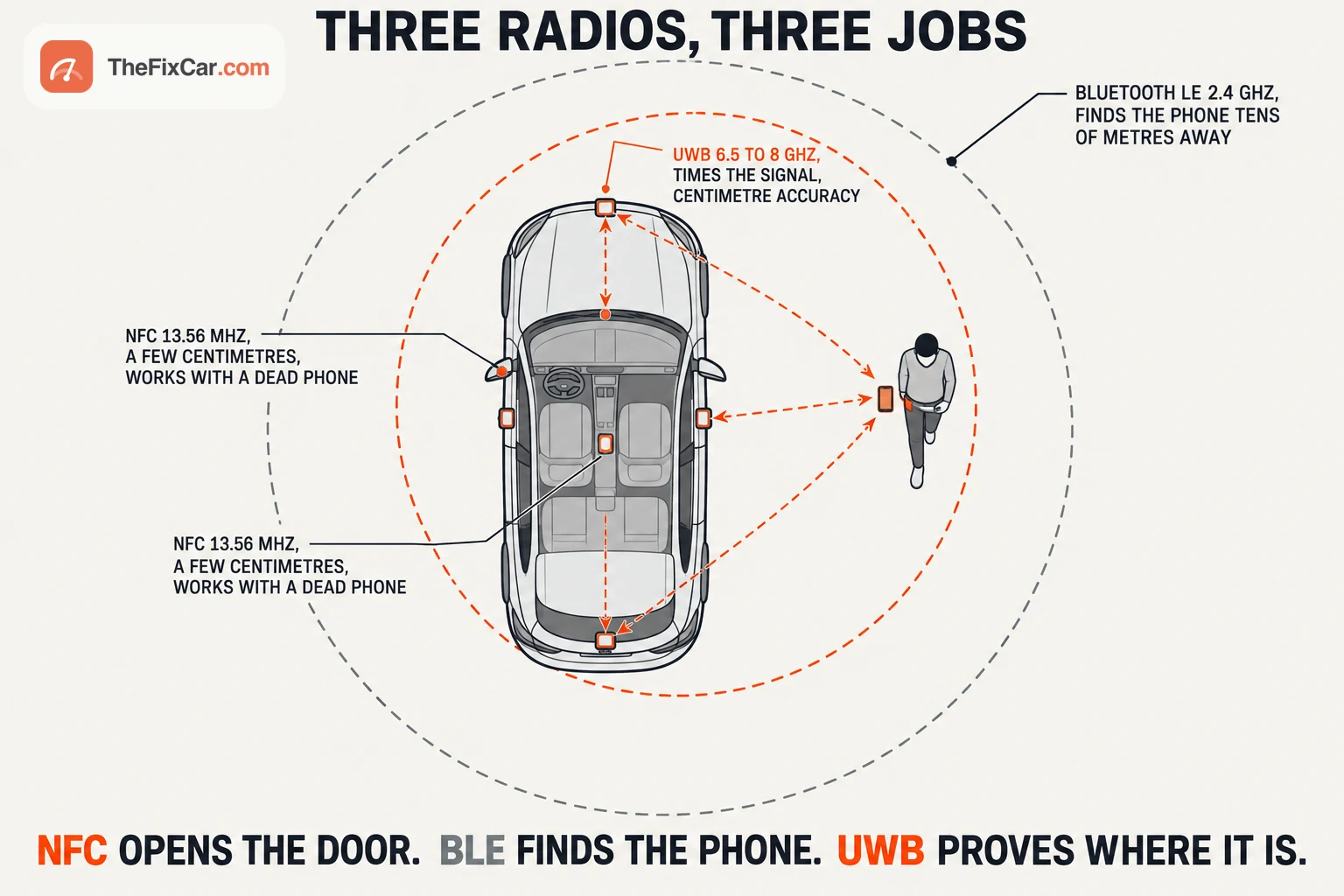
A digital car key can use up to three radios, and each covers a different distance. NFC works over a few centimetres at 13.56 MHz and is the layer behind the tap, including the tap a supported phone can still make from its power reserve.[3][8] Bluetooth Low Energy works over tens of metres in the 2.4 GHz band and, in the Car Connectivity Consortium’s Release 3 architecture, is the layer that finds the phone and checks its credential.[4][1] Ultra Wideband, which current CCC Digital Key implementations run on UWB channel 9 at 7.7 to 8.3 GHz, is the layer that measures the distance to a few centimetres, which is what lets a car unlock as you walk up and detect a relayed signal.[5][21][1] Which of the three your car and your phone actually have decides whether you tap the handle or simply walk up to it.
This page collects the published numbers behind those layers: the frequencies, channel widths and ranging accuracy from the NFC Forum, the Bluetooth SIG and the FiRa Consortium, the Car Connectivity Consortium’s Digital Key releases, the phone and watch requirements Apple and Google publish, dated compatibility lists from BMW, Hyundai, Genesis and Samsung, the ADAC relay-attack results, and the fallback each system documents for a phone that is off. The table separates radio specifications from vehicle settings and compatibility snapshots.
Quick answer
NFC operates at 13.56 MHz between devices a few centimetres apart, which is why a phone key tap needs the phone’s NFC antenna at the reader the car maker names.[3] Bluetooth LE uses 40 channels at 2 MHz spacing with centres from 2.402 to 2.480 GHz, and FiRa’s UWB profile defines channels 5 and 9, centred near 6.49 and 7.99 GHz and nominally 500 MHz wide, with distance accuracy down to a few centimetres; current CCC Digital Key implementations use channel 9 (7.7 to 8.3 GHz) for secure ranging.[4][5][21] In the CCC Digital Key Release 3.0 architecture, the key is authenticated over BLE and the distance is then measured over UWB, with NFC kept for backward compatibility and for the battery-low case.[1][2] Hyundai puts the UWB approach-unlock distance of its Digital Key 2 at approximately 1.5 metres.[6] The published standards do not make every phone and car interchangeable: every distance, phone model and vehicle in the table below is tied to the document that states it, and the pairing that applies to you is the one your car maker lists for your model year and your phone.
Current CCC version. Release 3 established the NFC plus BLE and UWB architecture this page describes, but it is no longer the newest specification. As of September 2026 the Car Connectivity Consortium distributes Digital Key V3.1.4 and V4.1.0, and its June 2026 Plugfest tested Version 4 devices against Version 3 devices for backward compatibility, alongside NFC, BLE, remote keyless entry and passive entry test cases and UWB test equipment.[22][23] The radio layers below are unchanged by that; the version matters when a car maker or phone maker states which one a given implementation is certified to.
Verified specifications at a glance
| Application or item | Value | Conditions | Primary source |
|---|---|---|---|
| NFC, operating frequency and distance | 13.56 MHz; a few centimetres | Short-range wireless between two devices; the NFC Forum’s stated operating band and range | NFC Forum[3] |
| Bluetooth LE, band and channels | 2.402 to 2.480 GHz; 40 channels at 2 MHz spacing (3 primary advertising, 37 data) | 2.4 GHz ISM band; LE 1M PHY 1 Mb/s, LE 2M PHY 2 Mb/s, LE Coded down to 125 kb/s | Bluetooth SIG[4] |
| Bluetooth LE, transmit power | 100 mW (+20 dBm) maximum | Specification ceiling, not a measured vehicle figure; the specification’s receiver sensitivity requirements are -70 dBm for LE 1M and 2M and -82 dBm for LE Coded S=8 | Bluetooth SIG[4] |
| UWB (FiRa), channels and bandwidth | Channels 5 and 9, centred near 6.49 and 7.99 GHz; nominal 500 MHz channel bandwidth | General FiRa UWB figures: its stated range of 6.490 to 7.987 GHz spans those two channel centres; CCC Digital Key currently uses channel 9 (7.7 to 8.3 GHz), with channel 5 no longer a global alternative | FiRa Consortium[5] |
| UWB (FiRa), ranging accuracy | A few centimetres at 99.9% reliability; about 30 cm at 95% in a factory environment | Time-of-flight ranging under normal operating conditions versus a challenging multipath environment | FiRa Consortium[5] |
| UWB (FiRa), range and data rate | Up to 100 m line of sight; data rates of 27 and 31 Mb/s | Technology figures for UWB products under line-of-sight conditions and per IEEE 802.15.4z, not the settings of any car key below | FiRa Consortium[5] |
| CCC Digital Key Release 3.0 | Passive keyless access and engine start over UWB combined with BLE; NFC retained | Published to members 13 July 2021; keys authenticated in a Secure Element; UWB secure distance measurement; NFC kept for backward compatibility with Release 2.0 | Car Connectivity Consortium[1] |
| CCC Digital Key Release 3 v1.1 | Public specification; NFC kept for battery-low mode | Made public 26 July 2022 | Car Connectivity Consortium[2] |
| CCC Digital Key V4.1.0 (with V3.1.4) | Current specification generation distributed by the CCC; Version 4 test cases and V3/V4 cross-version interoperability under test | Both versions offered for download as of September 2026; Plugfest #18 (June 2026) ran v4 test cases, v3-to-v4 interoperability, NFC, BLE, remote keyless entry and passive entry scenarios, and identified candidate v4 devices for the Interoperability Device List | Car Connectivity Consortium[22][23] |
| CCC Digital Key UWB channel | IEEE UWB channel 9, 7.7 to 8.3 GHz | CCC’s 2025 spectrum position: channel 5 (6.2 to 6.8 GHz) “used to be an alternate channel” and channel 9 “remains as the only global channel for UWB” | Car Connectivity Consortium[21] |
| Apple Wallet car key, minimum iPhone | iPhone XS or later, or iPhone SE (2nd generation) | Tap keys; Express Mode is turned on automatically when a key is added; Apple’s list as accessed in September 2026 | Apple Support[7] |
| Apple Wallet car key, passive entry and remote features | iPhone 11 or later, excluding iPhone SE (2nd and 3rd generation) and iPhone 16e | Apple groups passive entry and remote features under one requirement; Apple Watch Series 5 or later or SE for tap keys, Series 6 or later for passive entry; the iPhone 17e, which Apple lists without UWB, is not named on the car-key page | Apple Support[7] |
| Apple power reserve for Express Mode keys | Up to five hours | After a supported iPhone needs to be charged, for keys with Express Mode on; a limited reserve that repeated checks shorten; not a promise after the reserve is used up | Apple Support[8] |
| Apple Ultra Wideband availability | Not available in Armenia, Azerbaijan, Belarus, Kazakhstan, Kyrgyzstan, Russia, Tajikistan, Turkmenistan, Ukraine, Uzbekistan; partial in Japan | First-generation UWB on iPhone 11 to 14; second-generation on iPhone 15 and later, excluding iPhone 16e and 17e | Apple Support[9] |
| Google Wallet digital car key, phones | Pixel 6 and later including Pixel Fold; Samsung Galaxy S21 and later; select Android 12 and up devices | Internet needed to set up; hold the back of the phone near the door handle, place it on the key reader to start; passive entry not on all devices or vehicles | Google Wallet Help[10] |
| BMW Digital Key (NFC), 2020 launch | iPhone XR, XS or newer; Apple Watch Series 5 or newer | Vehicles built after 1 July 2020: 1, 2, 3, 4, 5, 6, 8 Series, X5, X6, X7, X5 M, X6 M, Z4; start by placing the iPhone in the smartphone tray; share with up to 5 people | BMW Group PressClub[11] |
| BMW Digital Key Plus (UWB), iPhone | Announced 13 January 2021, first on the BMW iX | Uses the U1 chip; BMW describes the UWB localisation as protection against relay attacks; developed with the CCC for Digital Key 3.0 | BMW Group PressClub[12] |
| BMW Digital Key Plus (UWB), Android, April 2023 announcement | Galaxy S23+, S23 Ultra, S22+, S22 Ultra, S21+, S21 Ultra, Z Fold4, Z Fold3, Note20 Ultra; Pixel 7 Pro, Pixel 6 Pro | “Android 13.1 or later” in BMW’s wording; Digital Key Plus-capable vehicles produced from November 2022; share with up to 5 users on Android or iOS | BMW Group PressClub[13] |
| Hyundai Digital Key 2 (UWB), approach unlock | Approximately 1.5 m | UWB-equipped phones; NFC tap at the driver and passenger door handles; start by placing the phone on the wireless charging pad; 15 additional shared keys (UK) | Hyundai Motor UK[6] |
| Hyundai Digital Key 2 (US), NFC tap and sharing | Hold the phone near the driver’s door handle for 1 second; share with up to 3 people | Through Samsung Pass, Google Wallet or Apple Wallet; NFC key card as a backup; Digital Key 2 Touch is NFC-only | Hyundai Motor America[14] |
| Genesis GV60 with Galaxy UWB key | First vehicle with a UWB digital key on Galaxy; 7 supported devices | Announced 19 May 2022: Galaxy S22+, S22 Ultra, Z Fold3, S21+, S21 Ultra, Z Fold2, Note20 Ultra; unlock by approaching is optional | Samsung Newsroom[15] |
| 2023 Genesis GV60 owner’s manual, digital key limits | May not operate with a discharged phone or vehicle battery, NFC or Bluetooth off, a credit card near the phone, or a metal or thick case | Registration needs the smart key in the car; a phone without UWB is registered on the wireless charging pad | Genesis owner’s manual[16] |
| ADAC keyless relay-attack tests | More than 850 vehicles tested; no UWB-protected vehicle opened by the relay | About 70% of tested vehicles now better protected; UWB seen from Jaguar Land Rover (2018) and later Audi, Cupra, Seat, Škoda, Volkswagen, BMW, Genesis, GWM, Hyundai, Kia, Mercedes and Suzuki; page updated 18 August 2026 | ADAC[17] |
| Ford Phone As A Key, Backup Start Passcode | At least 6 characters of letters, numbers and symbols, or 10 characters if all numbers | Created on the SYNC touchscreen with the key fob present | Ford Support[18] |
Note: these are published values for the named standards, phones and models, not a universal table. The phone list and the unlock behaviour for your car come from your car maker’s compatibility page for your model year.
What these numbers do NOT mean
- The FiRa ranging accuracy and 100 m reach describe the radio, not a car’s unlock rule. The car maker decides where the unlock zone starts and stops; Hyundai’s 1.5 m is a product setting, not a UWB limit.[5][6]
- A phone on the Apple or Google list is not automatically a passive-entry phone for your car. Apple’s passive-entry list and Google’s “not all devices” wording both defer to the vehicle side; BMW’s Android list for Digital Key Plus is shorter than Google’s general list for the same reason.[7][10][13]
- The five-hour power reserve is an Apple figure for Express Mode keys after the phone shuts down, not a rule for Android phones or for cars that use their own app rather than a wallet key.[8]
- “No UWB car opened” in the ADAC tests is a statement about the relay method ADAC uses, on the vehicles it tested, as of its August 2026 update. It does not cover other attack methods or vehicles outside the database.[17]
- The +20 dBm figure is a specification ceiling, not a measured car transmit power, and Bluetooth Channel Sounding is a separate feature: the Bluetooth SIG overview does not establish that any car listed here implements it.[4]
- The CCC releases are standards documents. A car described as “digital key capable” by its maker may implement the NFC release only, the NFC plus BLE and UWB release in its Version 3 or Version 4 form, or a proprietary app-based BLE key that is outside the CCC specification.[1][2][22]
NFC: the tap, and what it can do from power reserve
Near Field Communication is the shortest-range layer. The NFC Forum puts it at 13.56 MHz between devices “just a few centimeters apart,” which is why the makers cited here all describe a close, deliberate gesture at a named reader rather than a wave.[3] Hyundai’s version is to hold the phone near the driver’s door handle for one second; Google’s is to hold the back of the device near the door handle, then place it on the car’s key reader to start.[14][10]
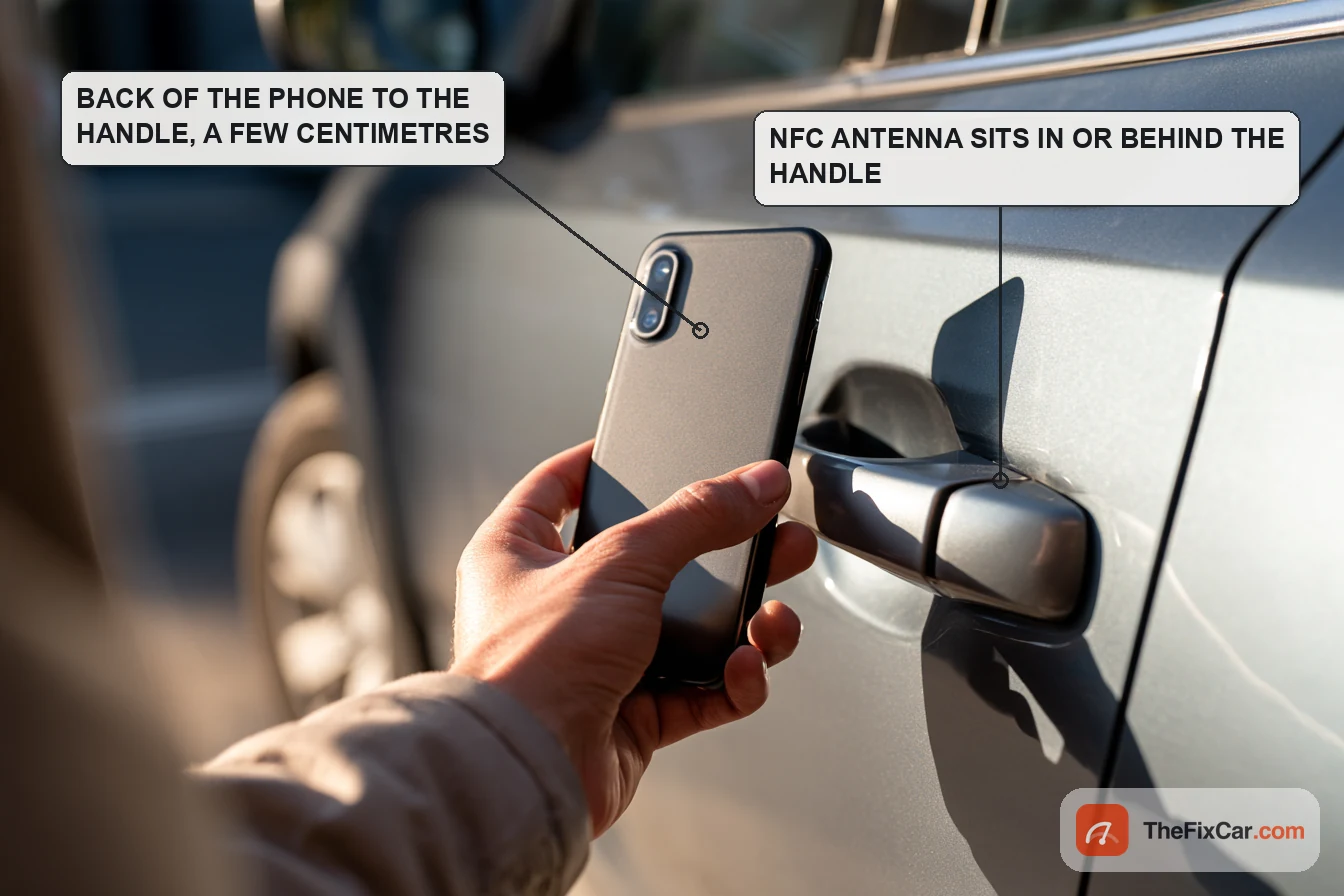
The CCC kept NFC in Release 3 “to ensure backward compatibility and battery-low mode,” and Apple describes the battery-low case from the phone side: on a supported iPhone with a key in Express Mode, power reserve keeps that key usable for up to five hours after the phone needs to be charged.[2][8] BMW quoted the same five hours when it launched its NFC key in 2020.[11] Power reserve is limited, and pressing the side button to check what is still available shortens it; it is not a promise after the reserve is used up or after the phone has been switched off deliberately.[8]
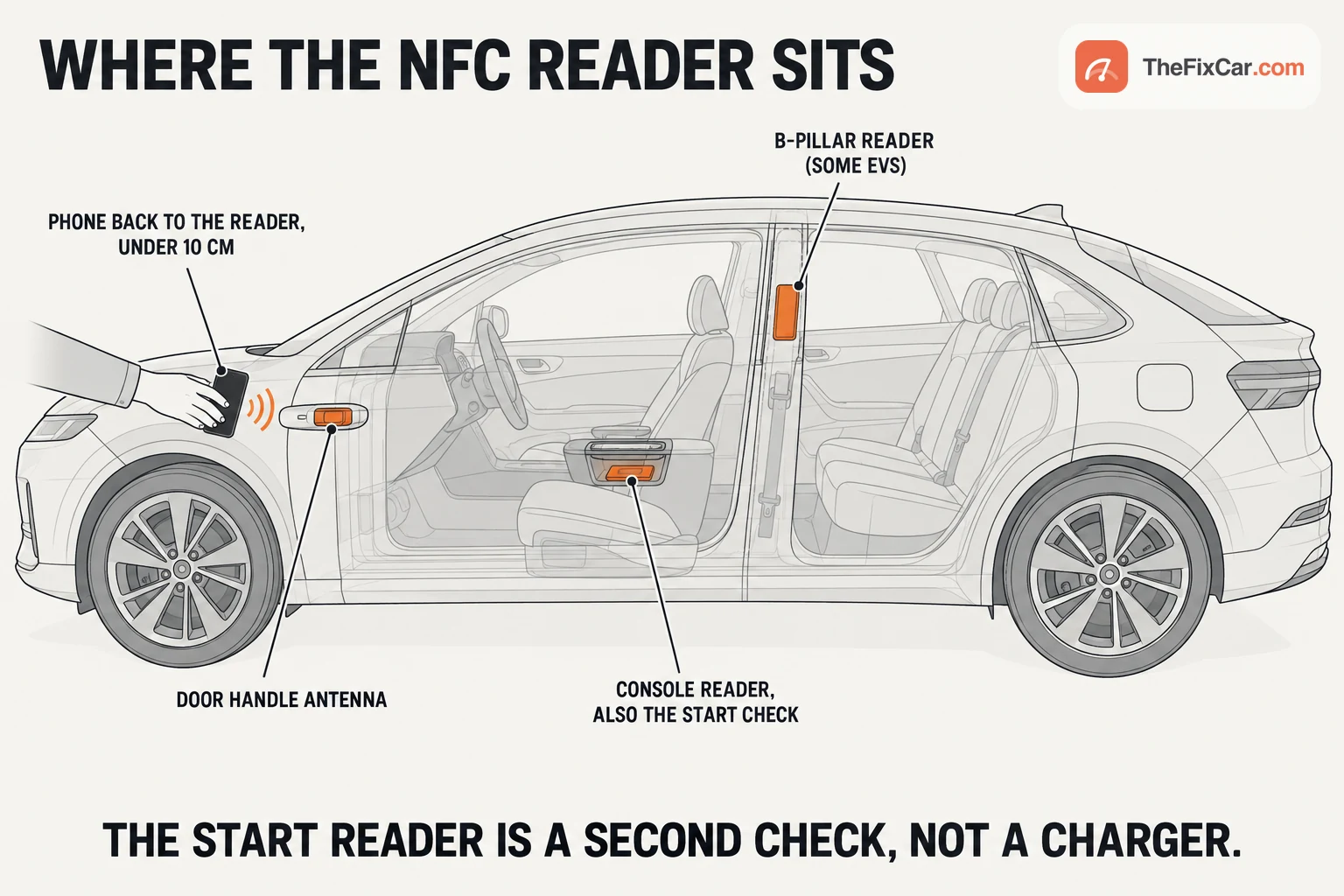
Where the NFC reader sits: handle, pillar and console pad
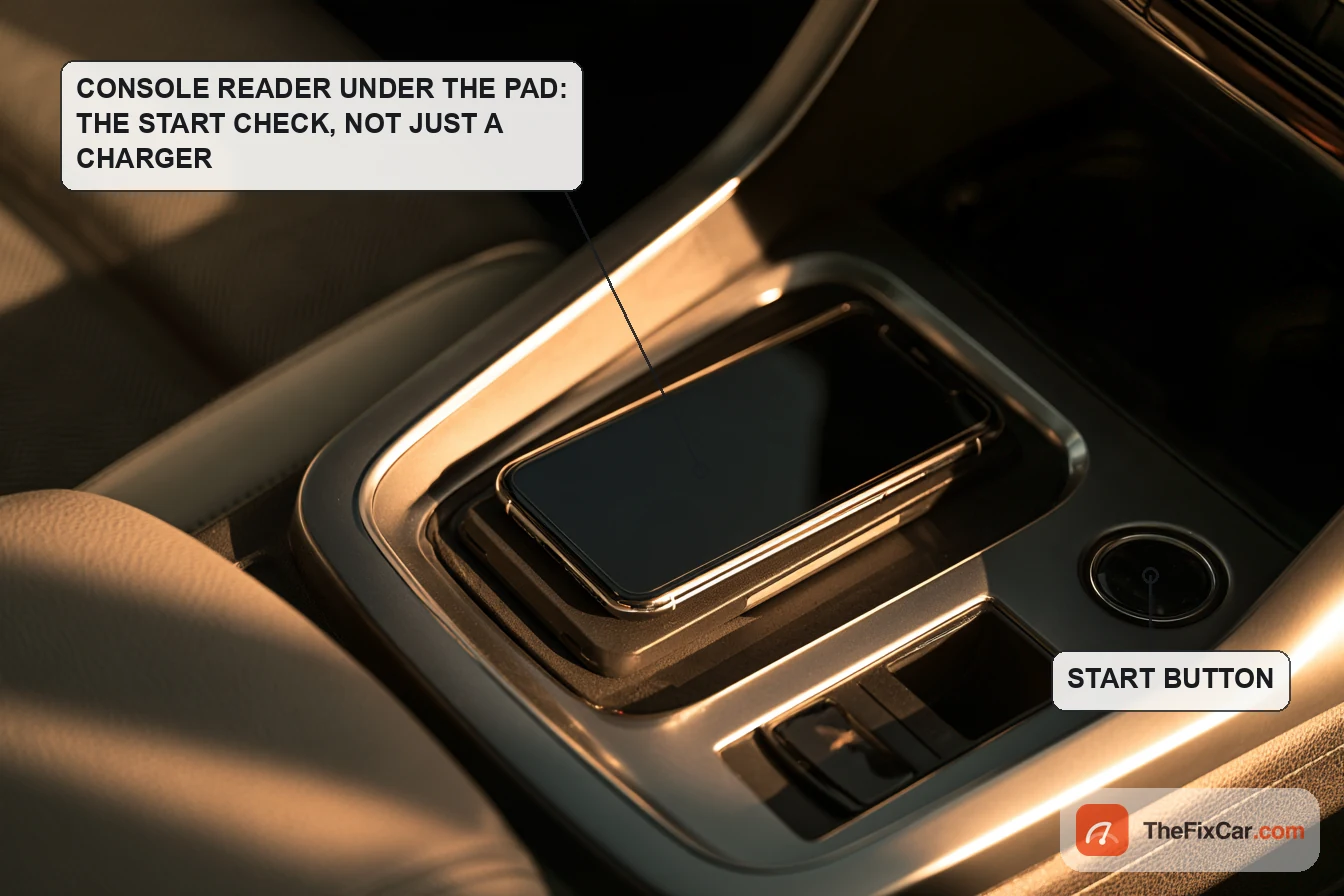
The examples cited here use an exterior reader for entry and an interior reader for the start check; how many readers a car has and where they sit varies by vehicle. The exterior one is in or behind the door handle on the Hyundai, Google and BMW instructions cited here; Tesla’s support page puts it in the driver’s side door pillar instead, and its key card, a passive RFID card, is presented at that pillar.[14][10][11][20] The interior one is the start check: BMW’s 2020 instruction is to place the iPhone in the smartphone tray and press the start button, and Hyundai’s is to place the phone on the wireless charging pad, which the Genesis manual names as the “vehicle authentication pad”; Tesla’s support page places the interior card reader on the centre console behind the cup holders for the Model 3 and Model Y and at the top of the left phone charger for the Model S, Model X and Cybertruck, with the owner’s manual illustration as the reference for a given build.[11][14][16][20]
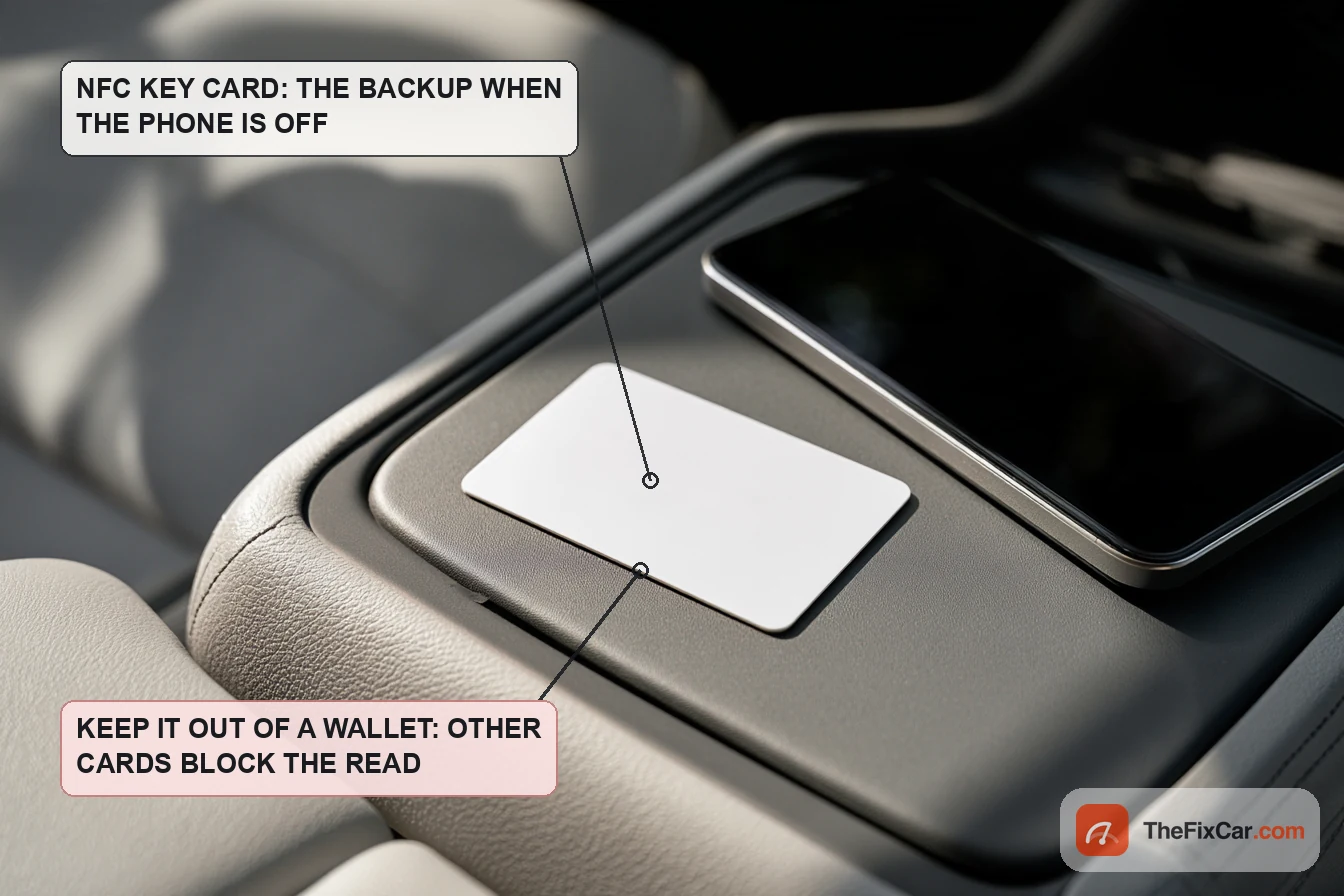
The console pad is also where a phone without UWB gets registered on the 2023 GV60: the manual says a UWB-capable phone can be enrolled anywhere inside the car, while a phone without UWB has to be placed screen-up on the pad.[16] The same manual lists conditions under which the digital key “may not operate”: a discharged phone or vehicle battery, NFC or Bluetooth switched off, a credit card next to the phone, a metal or thick case, and, for the card key, being kept near other cards or used from a wallet.[16] A discharged vehicle 12 V battery can stop powered entry and starting for any credential; a mechanical emergency key can still open the door where the car has one, and the phone’s power reserve does nothing for the car. That case is covered in car won’t start but lights turn on.
Bluetooth LE: finding and authenticating the phone
In the CCC Release 3 architecture, Bluetooth Low Energy is the layer that lets the car and phone find each other and check the key without a tap. The Bluetooth SIG specifies it in the 2.4 GHz ISM band, 2.402 to 2.480 GHz, on 40 channels with 2 MHz spacing, three primary advertising channels the car and phone use to find each other and 37 data channels for the session that follows.[4] Transmit power is capped at 100 mW, and the LE Coded PHY trades data rate (down to 125 kb/s) for reach.[4] In the CCC architecture the credential itself is authenticated over this BLE link, using a key held in the phone’s Secure Element.[1]
Received signal strength on its own is a poor way to judge where a phone is: pockets, bags, bodies and reflections all change it, so a key that relies on it can find a phone tens of metres away yet struggle with inside versus outside. What a given car can do about that depends on its antennas and its ranging implementation. The Bluetooth SIG has since added Channel Sounding, which it describes as enabling “centimeter-level” ranging, but the cars on this page that range the phone at all do it with UWB.[4][1] The 2023 GV60 manual also notes that an active phone call, an emergency call or audio playing on the phone, including through wireless earphones, can stop the phone from controlling the car.[16] A digital key that the car never sees can be a provisioning, power, settings or compatibility problem, so follow the car maker’s key setup and troubleshooting steps; working Bluetooth audio does not show that a key is provisioned, and a failed audio pairing does not diagnose the key. The general pairing checks in Bluetooth not connecting to car cover the infotainment side only.
UWB: measuring distance instead of signal strength
The CCC Release 3 architecture uses Ultra Wideband for the distance measurement. FiRa’s profile specifies channels 5 and 9, centred near 6.49 and 7.99 GHz and nominally 500 MHz wide; the CCC’s 2025 spectrum position states that Digital Key uses channel 9, at 7.7 to 8.3 GHz, and that channel 5 “used to be an alternate channel” before IMT and Wi-Fi allocations reached that band.[21] The distance is measured from the time a pulse takes to travel, not from how loud it arrives.[5] FiRa’s own figures are accuracy down to a few centimetres at 99.9% reliability under normal conditions, about 30 cm at 95% on a factory floor, and reach up to 100 m in line of sight.[5]
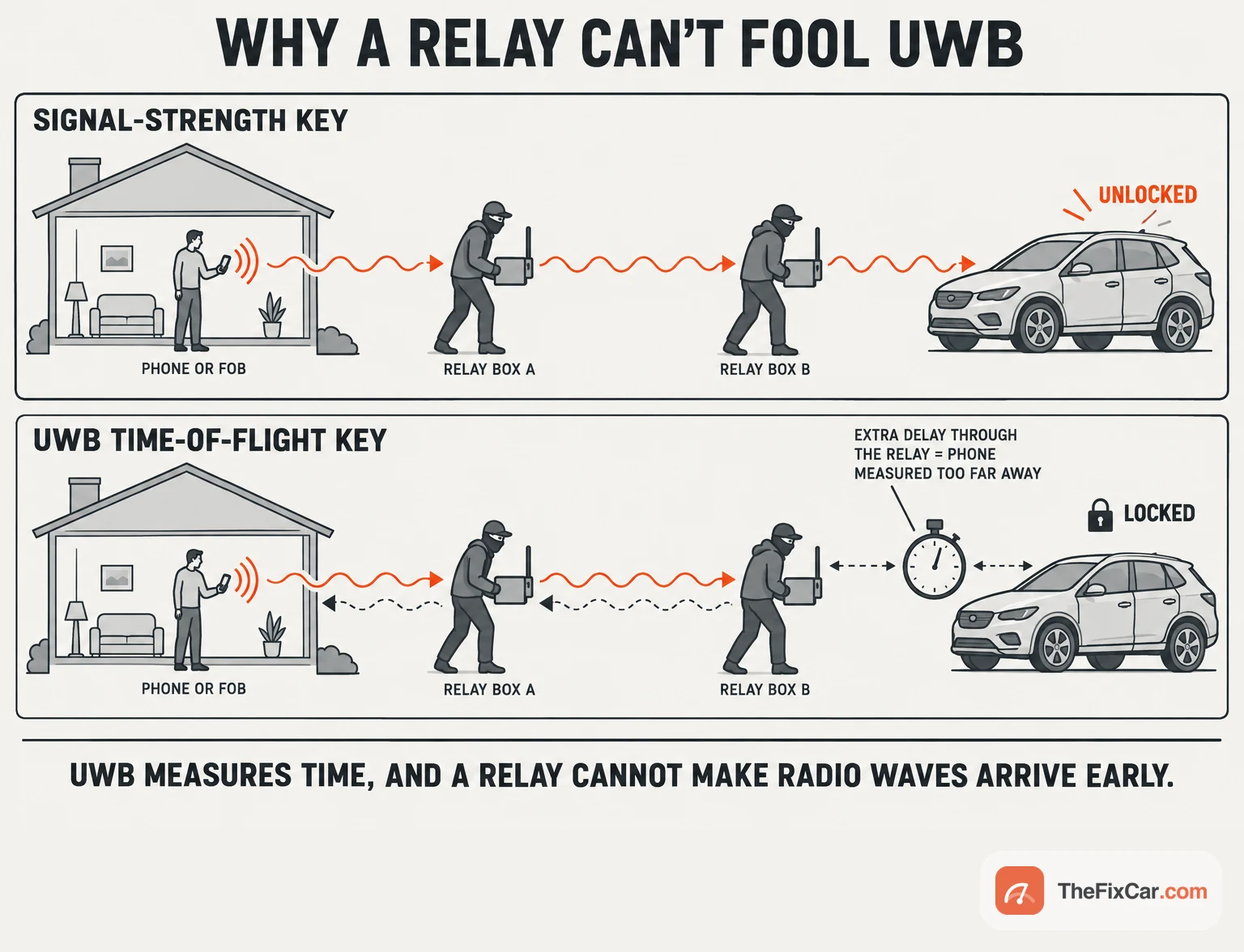
The time-of-flight measurement is also the security property. A relay attack forwards the exchange between the car and a credential that is far away, so a key judged only by whether its signal is present, or how strong it is, looks like a key standing at the door. Secure UWB ranging is designed to catch the extra delay the relay adds: the round trip through it is longer than the round trip to a phone that is really there, and FiRa’s wording is that propagation time and the speed of light are “extremely difficult (if not impossible) to alter.”[5] How well that works in a given car is an implementation question. BMW’s January 2021 announcement put it in product terms, in its own words: with Digital Key Plus, “relay attacks, where the radio signal is jammed or intercepted, are not possible.”[12] ADAC reports a separate result from its tests of vehicle keyless systems: more than 850 vehicles tried with a signal extender, about 70% now better protected, and none of the vehicles ADAC identifies as UWB-protected opened with its method.[17] Those tests cover the keyless systems ADAC tried, largely with the cars’ own fobs, and do not show that every phone-and-wallet implementation on this page was tested. ADAC lists Jaguar Land Rover from 2018 as the first, followed by Audi, Cupra, Seat, Škoda, Volkswagen, BMW, Genesis, GWM, Hyundai, Kia, Mercedes and Suzuki.[17]
The handshake order and the unlock distance
The CCC describes Release 3.0 as authenticating the digital key over Bluetooth Low Energy and then using UWB for “secure and accurate distance measurement allowing cars to locate authenticated mobile devices,” so that the phone can stay in a bag or pocket.[1] The order helps to sort a fault, without naming the failed part: a car that never sees the phone points to discovery, key provisioning, phone settings or vehicle power; a car that sees the phone but never unlocks on approach points to a phone or car without UWB, passive entry switched off, a regional restriction or a vehicle fault; a car that unlocks but will not start points to key permissions, interior detection, brake or gear interlocks or the starting system itself.
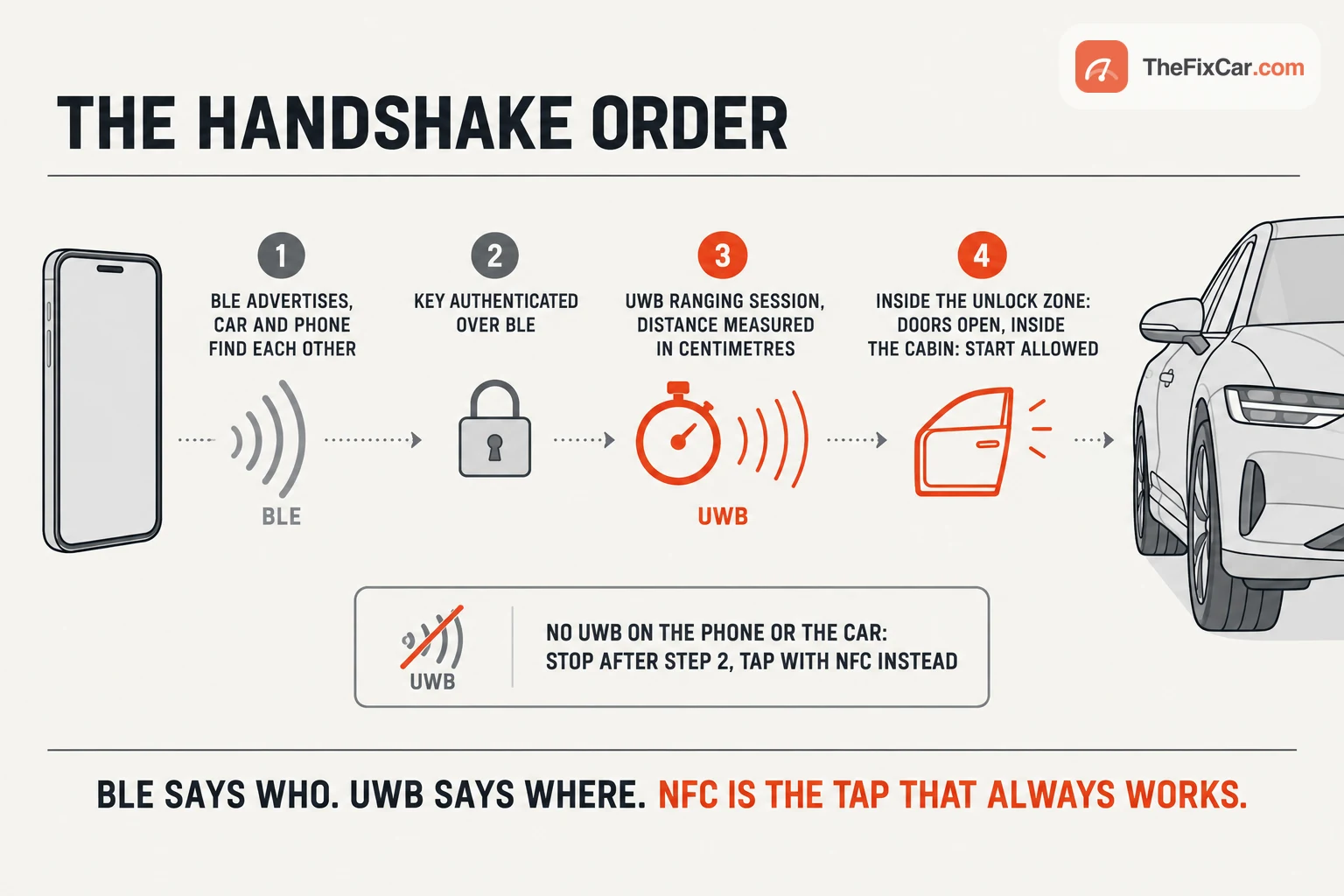
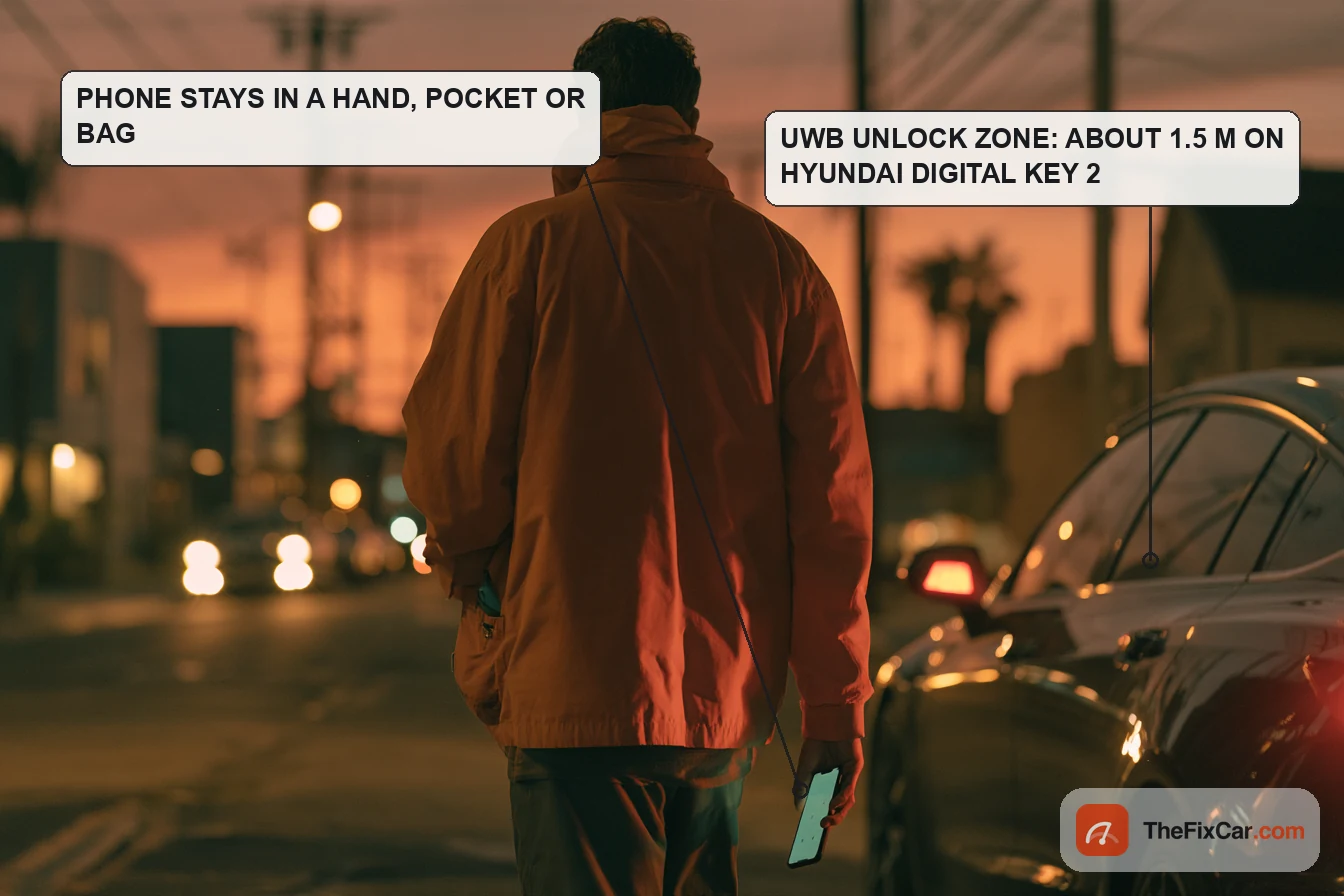
The NFC tap is a separate workflow, not the tail end of this sequence: a phone or car without UWB does not fall through to it automatically, and which fallback exists depends on the phone, the car and the registered key.[2] How far away the doors unlock is a product setting. Hyundai Motor UK states that Digital Key 2 with ultra-wideband unlocks “from approximately 1.5 metres away,” and Samsung’s GV60 launch note adds that on the Galaxy implementation you can either press the handle with the phone in your pocket or let the car unlock as you approach, with “unlock by approaching” optional.[6][15] Neither BMW press release cited here gives a distance for Digital Key Plus, so no BMW figure appears in the table.[12][13]
Which phones and watches support which layer
Phone requirements differ between the NFC tap, passive entry and remote commands. On the Apple side, a tap car key needs an iPhone XS or later or an iPhone SE (2nd generation), while Apple groups passive entry and remote features under one requirement, iPhone 11 or later excluding the iPhone SE (2nd and 3rd generation) and the iPhone 16e; on the watch, Series 5 or SE for tap keys and Series 6 or later for passive entry.[7] The passive-entry line tracks the UWB hardware: Apple lists first-generation Ultra Wideband on iPhone 11 through 14 and second-generation on iPhone 15 and later, excluding the 16e and the 17e, and the 17e is not named on the car-key page as accessed, so check Apple’s current requirements for that model.[9][7] Remote commands travel over the phone’s connection to the car and have their own requirements on Apple’s page.[7]
Google’s general list is Pixel 6 and later including the Pixel Fold, Samsung Galaxy S21 and later, and select devices on Android 12 and up, with the caveat that “not all devices support passive entry.”[10] The vehicle-side lists are narrower and dated: BMW’s April 2023 Android list for Digital Key Plus and Samsung’s May 2022 GV60 list, both reproduced in the table, name Plus, Ultra, Fold, Note and Pro variants only.[13][15] UWB support depends on the exact variant: on those Android lists the base models are absent, while Apple’s range includes every iPhone from the 11 onward except the SE and the e models. A phone without UWB still needs the car maker and the wallet to list it for an NFC key; lacking UWB does not grant that on its own.
Region matters as well. Apple’s Ultra Wideband is switched off by regulation in Armenia, Azerbaijan, Belarus, Kazakhstan, Kyrgyzstan, Russia, Tajikistan, Turkmenistan, Ukraine and Uzbekistan, and some UWB frequencies are unavailable in Japan, so an iPhone that supports passive entry at home may fall back to the tap in those places.[9]
Backups for a dead phone: reserve, card and passcode
Each system documents a fallback, and they are different in kind. Apple’s is time: up to five hours of power reserve for Express Mode keys after the phone shuts down.[8] Hyundai’s is a second credential: “The NFC Key Card can be used to unlock and start your car if your phone is not available,” with the Genesis manual’s note that other cards can interfere when the key card is presented from a wallet.[14][16] Ford’s is a code: the Backup Start Passcode, created on the SYNC touchscreen with the key fob present, at least six characters of mixed letters, numbers and symbols or ten characters if all numbers.[18] The passcode authorises starting once you are inside; getting into a locked car without the phone depends on the vehicle’s own backup entry method, which the owner’s manual describes.
The cited documents give different sharing limits and platform rules. BMW’s Digital Key Plus announcement allows a key to be shared with up to five other users on either platform; Hyundai Motor America says up to three through the three wallets, while Hyundai Motor UK quotes 15 additional keys; and in October 2023 Hyundai Motor Group announced iOS-to-Android sharing for its Hyundai, Kia and Genesis applications, which those applications had not offered before.[13][14][6][19] Apple describes sharing through Messages, Mail, AirDrop and other messaging apps, with an activation code as the recipient’s verification step, and marking the iPhone as lost turns the car key off with the rest of the wallet.[7]
How to use these values
- Use the symptom to choose the checks, not to name a failed radio. For a failed tap: the registered credential, the reader position, a case or card in the way, and whether the phone is past its reserve. For a failed approach: compatibility of the exact phone and car, the passive-entry setting, the region, then the car maker’s digital-key troubleshooting.
- Check both lists: the wallet provider’s requirements and the car maker’s current compatibility page for the exact phone, software version, model year, equipment and market. The BMW and Samsung lists here are dated examples, not catalogues.
- Set up the fallback before you need it. The Ford passcode needs the fob at setup and covers starting, not entry; the Hyundai card has to be registered, and other cards can interfere when it is presented; the Apple reserve only covers keys with Express Mode on.
FAQ
What frequency does a digital car key use?
Depending on the radio: NFC at 13.56 MHz for the tap, Bluetooth LE across 2.402 to 2.480 GHz for discovery and authentication, and UWB for distance measurement, on channel 9 at 7.7 to 8.3 GHz in current CCC Digital Key implementations.[21][3][4][5]
How far away does a UWB car key unlock the car?
Hyundai states approximately 1.5 metres for Digital Key 2. The radio itself reaches much further, up to 100 m line of sight in FiRa’s figures, so the unlock distance is a setting chosen by the car maker.[6][5]
Does the phone key work if my phone is dead?
For a limited time on a supported iPhone: Apple’s power reserve keeps a key with Express Mode on usable for up to five hours after the phone needs charging, not after a deliberate shutdown or once the reserve is spent. Beyond that, or on a car without an NFC key, you need the maker’s fallback, such as Hyundai’s NFC card or Ford’s Backup Start Passcode together with the car’s own backup entry method.[8][14][18]
Which iPhones support passive entry car keys?
Apple lists iPhone 11 or later, excluding the iPhone SE (2nd and 3rd generation) and the iPhone 16e, on the page as accessed; the iPhone 17e, which Apple lists without Ultra Wideband, is not named there, so check Apple’s current page for it. Tap keys work from the iPhone XS and the SE (2nd generation).[7]
Can a relay attack open a UWB car key?
ADAC reports that its signal extender did not open any vehicle it identifies as UWB-protected across more than 850 tested vehicles. The mechanism is separate from that result: UWB measures time of flight, and a relay adds delay that secure ranging is designed to catch, with the outcome depending on the implementation.[17][5]
Why does my Android phone only tap and not unlock on approach?
Possible reasons: a phone or car without the required UWB support, approach unlocking switched off, a regional restriction, or a setup or communication fault. BMW’s April 2023 Android list for Digital Key Plus, for example, names specific Galaxy Plus, Ultra, Fold and Note models and the Pixel 6 Pro and 7 Pro, and Google’s general list is wider than that BMW list. Confirm the exact phone and car, then follow the car maker’s troubleshooting steps.[13][10]
Sources & verification
Last technically reviewed: Sep 2026
Reviewed by: Marcus Holt, diagnostic technician
Primary references: Car Connectivity Consortium Digital Key Release 3.0, Release 3 v1.1, V3.1.4 and V4.1.0 download page, Plugfest #18 announcement and UWB Spectrum Regulatory Position, NFC Forum, Bluetooth SIG, FiRa Consortium, Apple Support, Google Wallet Help, BMW Group PressClub, Hyundai Motor UK and Hyundai Motor America, Samsung Newsroom, Genesis owner’s manual, ADAC keyless test database, Ford Support, Tesla Support
Suggested citation: TheFixCar, “Digital Car Key Specs: NFC, Bluetooth LE and UWB Ranges, Frequencies and Passive-Entry Phone Requirements,” updated Sep 2026. https://thefixcar.com/specs/digital-car-key-specs-nfc-bluetooth-uwb/