Press the brake pedal in a modern EV and you are often not pushing fluid through a line. The pedal has become a sensor, a computer reads how hard and fast you press, and an electric actuator builds hydraulic pressure or, in fully dry systems, clamps the caliper directly. That shift is what lets a car blend regenerative braking with friction braking so smoothly that you rarely feel the handover.
The term covers two very different designs, and the gap between them matters: one keeps a hydraulic backup you can press through, and one removes the fluid entirely. Which one a car uses changes how it fails, how it is certified, and whether there is anything to fall back on.
Quick answer
Brake-by-wire replaces the direct hydraulic link between the pedal and the brakes with sensors, an electronic control unit, and electric actuators. In 2026, electro-hydraulic brake-by-wire (EHB) is still the common production setup, especially in EVs and hybrids, using units like the Bosch iBooster and Continental MK C1. Fully dry electro-mechanical braking (EMB) is just reaching production: Brembo says its Sensify platform has entered large-scale series production, while Chery’s Exeed EX7 has been reported as an early mass-production EMB application. Treat any specific fluid-free claim as market and model-year dependent until confirmed by the vehicle’s own service data.
To tell the two apart, match your case to the type:
| If you mean | Type | What defines it |
|---|---|---|
| Brake-by-wire with a hydraulic backup (common today) | Electro-hydraulic (EHB) | Pedal is a sensor, but a hydraulic path can still stop the car if electronics fail |
| Fully dry, no brake fluid (newest) | Electro-mechanical (EMB) | Motors clamp each caliper; no hydraulic circuit at all, so safety rests on redundancy |
| The booster that started it in EVs | Bosch iBooster / Continental MK C1 | Electric brake assist that enables regen blending and one-pedal driving |
| The newest fluid-free production system | Brembo Sensify (2026) | Software-controlled braking at each wheel; supplier-announced 2026 production program, so confirm the exact vehicle and market from manufacturer data |
Specifications
| Element | What it does | Notes |
|---|---|---|
| Pedal travel sensor | Reads how far and fast you press | Replaces the pedal’s old hydraulic job; usually duplicated |
| Pedal feel simulator | Creates the resistance and travel you feel | The pedal no longer pushes fluid, so feel is generated |
| ECU / brake controller | Turns pedal input into a braking command per wheel | Blends regen and friction; coordinates with ABS and stability control |
| Actuator (EHB) | Electric motor drives a hydraulic pump to build pressure | iBooster can build pressure quickly on electronic command |
| Actuator (EMB) | Electric motor clamps each caliper directly | No hydraulic circuit; each wheel is its own actuator |
| Redundancy and backup | Keeps braking after a single fault | EHB keeps a hydraulic path; EMB uses redundant electronics and power |
Component layout varies by supplier and generation. Treat the table as the general architecture, not one vehicle’s part list. Exact figures and procedures follow the maker’s service data.
How it works
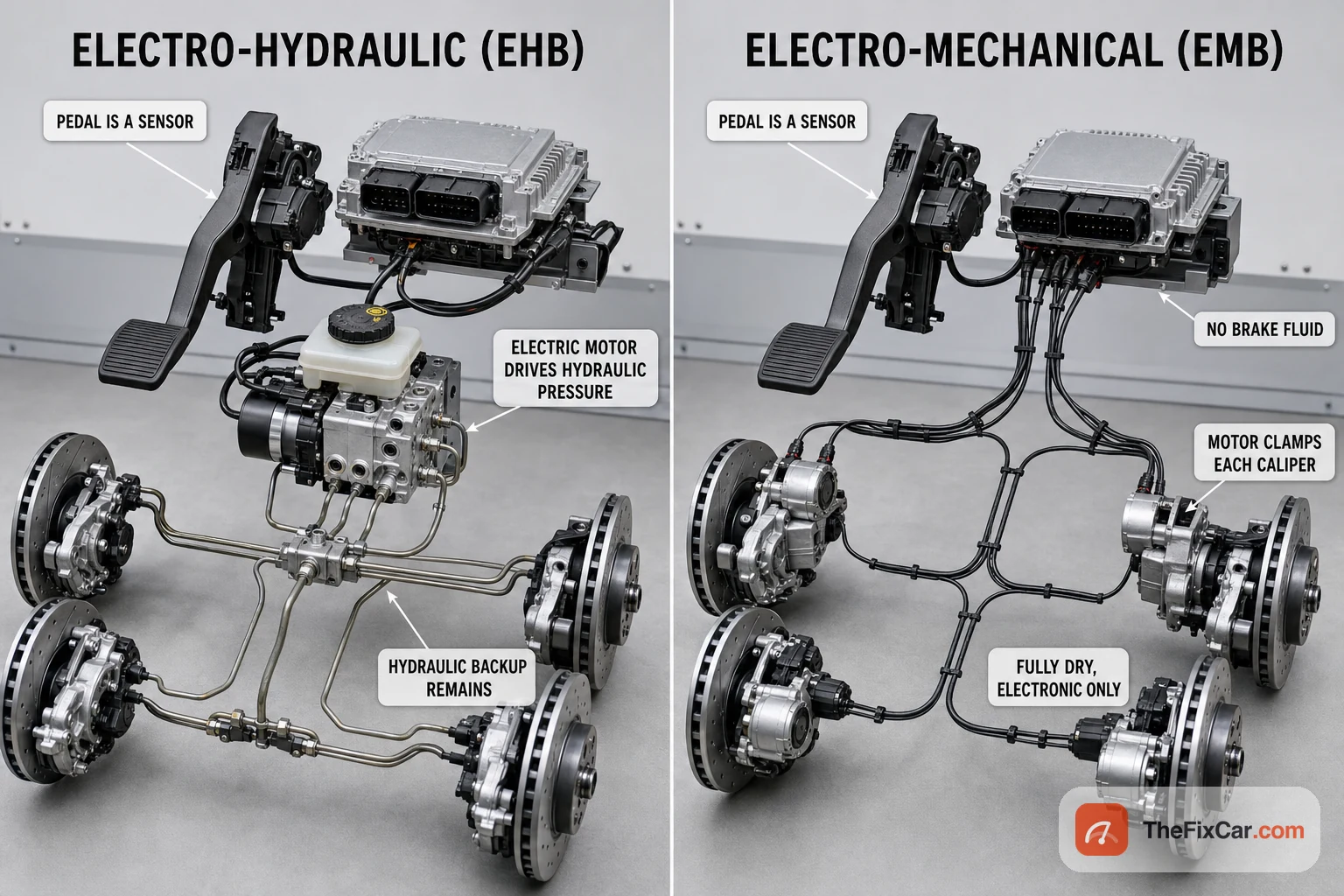
Input side. The pedal connects to travel and pressure sensors instead of a master cylinder you push directly. A feel simulator gives the pedal its weight and travel, because there is no longer fluid resisting your foot. Without that simulator, pedal travel and resistance would no longer track braking force in a familiar way.
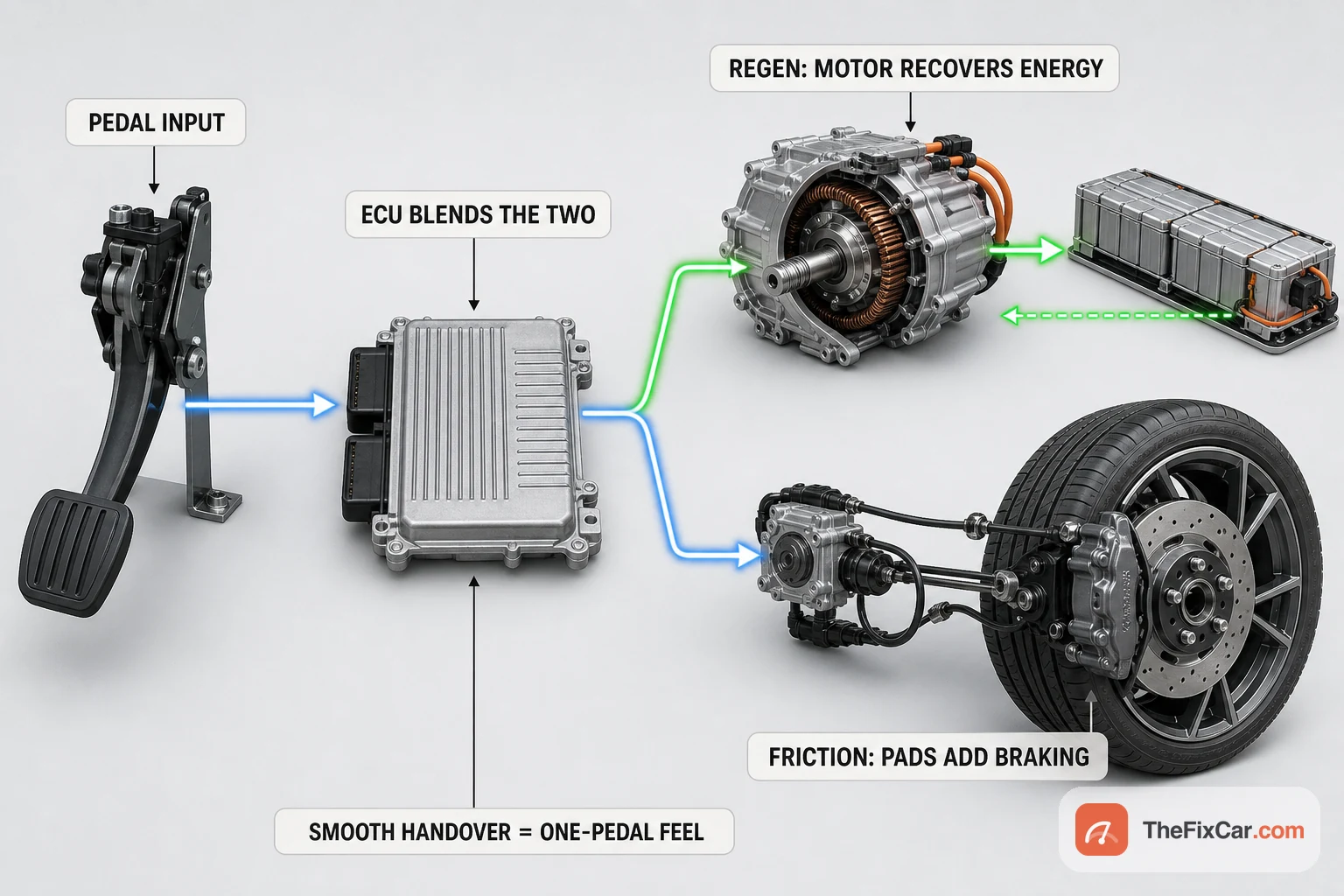
Output side. The controller decides how much braking each wheel needs, then either commands a motor-driven hydraulic unit (EHB) or a motor at each caliper (EMB). Because the computer sits in the middle, it can split braking between the electric motor’s regeneration and the friction brakes, which is why one-pedal driving and smooth regen blending exist.
Redundancy. Removing a guaranteed mechanical path means the safety case has to be rebuilt in electronics. EHB systems keep a hydraulic backup that opens a direct path from pedal to calipers if the electronics fault. EMB systems, with no fluid at all, rely on duplicated power supplies, controllers, and communication so a single failure still leaves braking at the remaining wheels.
EHB vs EMB: the difference that matters
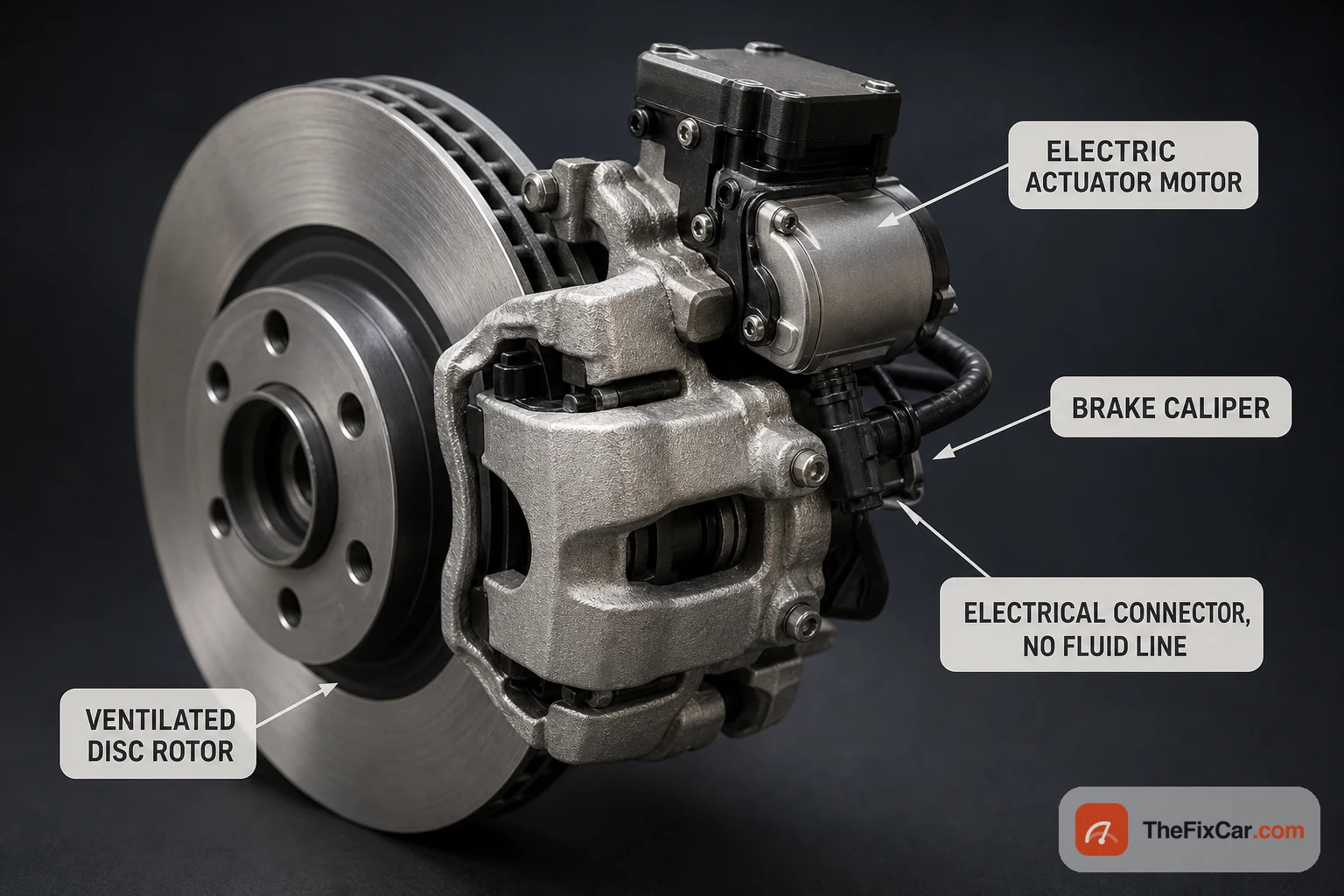
Electro-hydraulic (EHB). This is what most current EVs and many new combustion cars use. The pedal is decoupled for normal braking, but hydraulics remain, and a valve can open a direct hydraulic path as a fallback. It delivers fast, fine pressure control and regen blending while keeping a familiar mechanical safety net.
Electro-mechanical (EMB). The dry version deletes the fluid, lines, and master cylinder. Each caliper has its own electric actuator. It promises faster response, easier packaging, and simpler assembly, but every part of the safety case now depends on redundant electronics rather than a hydraulic backup, which is why it took longer to certify and reach production.
How to check what a car has
- Read the braking section of the manual and spec sheet. Look for terms such as brake-by-wire, electro-mechanical brake, EMB, iBooster, integrated brake control, or one-pedal driving.
- Check whether there is brake fluid to service. A fully dry EMB service-brake system should not have a conventional brake-fluid reservoir for the service brakes, but confirm this against the vehicle’s service manual because layouts can vary by market and system generation. An EHB car still has fluid and a normal flush interval.
- Look at how regen and braking blend. Strong, seamless one-pedal driving suggests electronic brake blending, but it does not prove whether the car uses EHB, EMB, or a conventional hydraulic system with coordinated regen.
- Confirm the supplier and model year. Systems like Brembo Sensify or specific Bosch and Continental units are tied to certain platforms and model years, so two trims can differ.
- Ask the dealer or service data. Brake-by-wire diagnosis and bleeding, where bleeding still applies, use a scan tool and a defined procedure, not a manual pump-and-bleed.
What goes wrong
Brake-by-wire warning or reduced braking mode. A sensor or controller fault can trigger a warning and drop the system into a backup mode. On an EHB car that usually means firmer, less-assisted pedal effort through the hydraulic fallback. Stopping is still possible, but it feels different.
Pedal feel changes. Because the feel is simulated, a fault in the simulator or its sensors can make the pedal feel soft, hard, or inconsistent even when braking still works. The pedal feel and the actual braking are no longer the same system.
Regen blending glitches. If the handover between regenerative and friction braking is mistuned or faulting, you can feel a surge or a dead spot as the car switches sources. This is a software and calibration issue more than a worn-part issue.
Power and electrical dependence. A dry EMB system has no hydraulic last resort, so it leans entirely on redundant power and wiring. A weak 12V system or a charging fault is more serious here than on a car with a conventional hydraulic backup.
Calibration after service. Brake-by-wire units may need a scan-tool procedure after pad, sensor, or actuator work, similar to how driver-assist cameras and radars need recalibration after related repairs. Skipping it can leave a fault stored or the feel wrong. Owner checks should stop at reading warnings, checking the manual, and confirming service history; actuator, bleeding, calibration, and brake-controller faults belong to a qualified shop with the correct scan tool.
Below is how the common reports map to where the fault usually sits and what a shop checks first. It is a starting point, not a diagnosis.
| What you notice | Likely area | What to check |
|---|---|---|
| Brake system warning or reduced braking | Controller, sensor, or actuator fault | Scan for brake-by-wire fault codes; note any backup mode |
| Soft, hard, or inconsistent pedal feel | Pedal feel simulator or its sensors | Compare against normal; check for codes and software updates |
| Surge or dead spot when slowing | Regen-to-friction blending calibration | Dealer-level diagnostics on the brake controller |
| Faults after pad or brake work | Calibration needed | Run the scan-tool calibration after the repair |
Brake-by-wire is safety-critical and largely dealer-level to diagnose. Use this to understand a report, not to self-repair the system. U.S. light-vehicle braking must still meet the federal standard, FMVSS 135.
FAQ
Is brake-by-wire safe without a hydraulic backup? Dry electro-mechanical systems are designed to be fail-operational, using redundant controllers, sensors, and power so a single fault still leaves braking at the remaining wheels. Light-vehicle braking in the U.S. must meet FMVSS 135 regardless of the technology. The trade-off is that the safety net is now electronic rather than a hydraulic path.
What cars have brake-by-wire in 2026? Many EVs and newer combustion cars already use electro-hydraulic brake-by-wire through units like the Bosch iBooster and Continental MK C1. The fully dry electro-mechanical type is just arriving: Brembo’s Sensify entered series production in 2026, and Chery’s Exeed EX7 was announced as an early mass-production EMB model.
What is the difference between EHB and EMB? EHB keeps hydraulics and a fluid backup, with motors and valves controlling pressure on command. EMB removes the fluid entirely and clamps each caliper with its own motor. EHB is widespread now; EMB is the newer, harder-to-certify step.
Does brake-by-wire need brake fluid? EHB systems still use brake fluid and a normal flush interval. Fully dry EMB systems have no brake fluid for the service brakes at all, which removes the flush but adds reliance on redundant electronics.
Why do EVs use brake-by-wire? It lets the car blend regenerative braking with the friction brakes smoothly, which improves efficiency and enables one-pedal driving. A computer in the middle can move braking between the motor and the pads without you feeling the change.