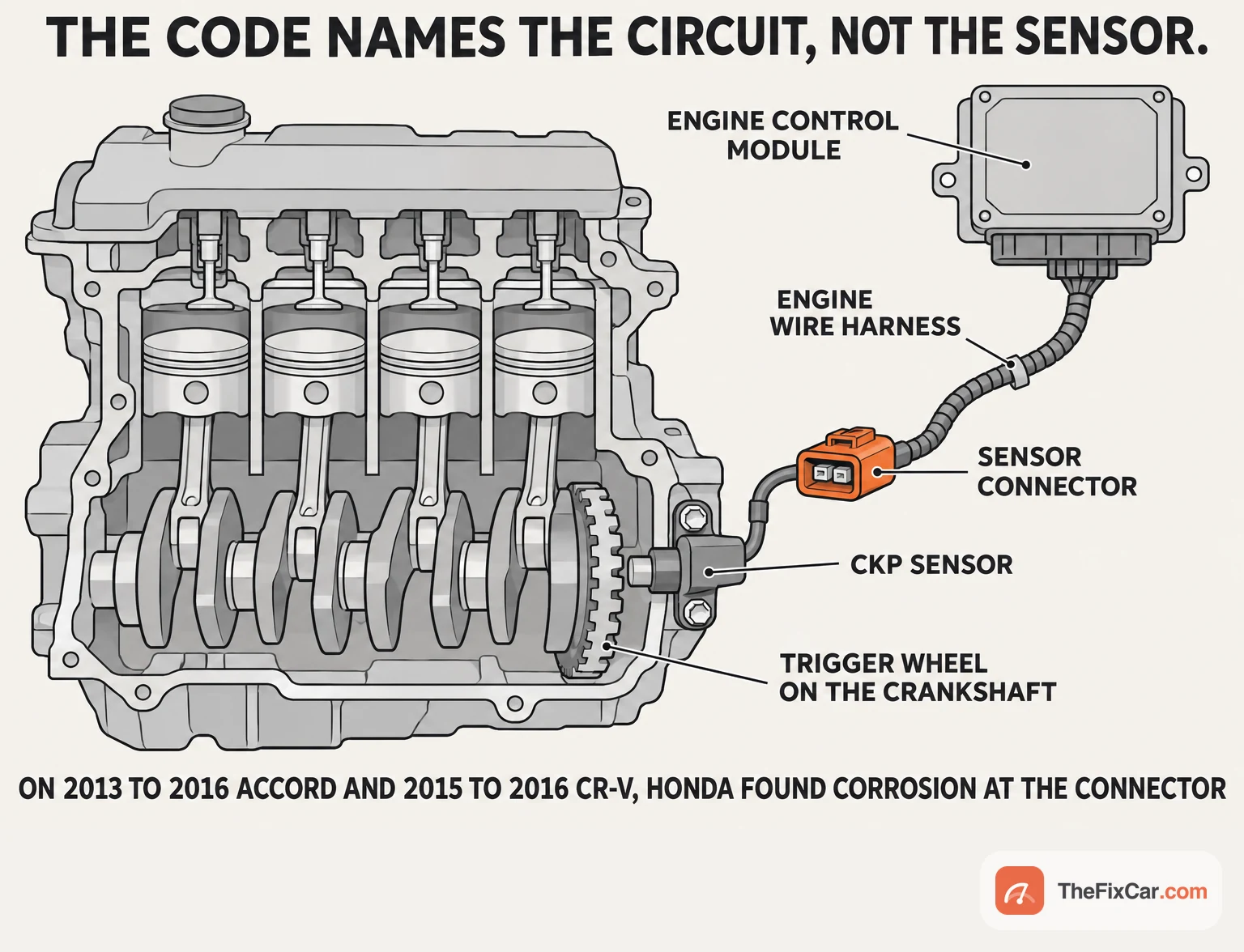
Honda’s name for P0339 is “CKP sensor circuit intermittent interruption”: the engine computer detected an intermittent problem with the crankshaft position signal. That does not have to mean a failed sensor. On 2013 to 2016 Accord four-cylinder cars and 2015 to 2016 CR-V, Honda Service Bulletin 16-011 traces that code, and its partner P0335, to corrosion between the engine wire harness and the CKP sensor connector. The corrective action in the bulletin replaces the engine wire harness and the sensor together[1].
A sensor by itself is not the repair Honda wrote for those cars. The bulletin also stops at named models and VIN ranges. On 2023 Accord Hybrid and CR-V Hybrid cars affected by Honda’s emissions recall, the same code leads to an inspection of the engine block[2][3]. On 2008 and listed 2009 Accord four-cylinder cars, Honda’s fix is a software update[4]. On every other Honda it is a circuit code that still needs a diagnosis.
Quick answer
Read every stored code, then match the car to the table before buying a part.
| What you see | Where to look | What to do first |
|---|---|---|
| Check engine light on, P0339 and/or P0335 stored, 2013 to 2016 Accord 2.4L (not Hybrid) or 2015 to 2016 CR-V | The VIN against bulletin 16-011: every 2013 to 2015 four-cylinder Accord and every 2015 CR-V, and 2016 cars by VIN range[1] | Have the CKP sensor connector checked for corrosion. If it is corroded, Honda’s repair is a new engine wire harness and a new sensor[1] |
| P0339 on a 2008 or 2009 Accord 2.4L, sometimes with misfire codes P0302 and P0303 | The VIN against bulletin 09-050: every 2008 four-cylinder Accord and 2009 cars by VIN range[4] | Ask a Honda dealer whether the PGM-FI software update in 09-050 has been done. Honda’s repair is that update plus the CKP pattern clear and learn, with no parts[4] |
| 2023 Accord Hybrid or CR-V Hybrid with P0339 or P0017, a no start, a rough idle at low speed or hunting engine rpm | Honda’s emissions recall bulletins 23-048 and 23-049[2][3] | Ask a Honda dealer to run the VIN. The dealer inspects the block markings before anything is replaced |
| P0339 on any other Honda | Freeze frame data, the sensor connector, the harness run | Diagnose the circuit: sensor, connector, wiring, the toothed wheel the sensor reads, and the control module |
| Check engine light blinking | The 2016 CR-V owner’s manual: blinking means engine misfiring is detected[5] | Park in a safe place with no flammable items and wait at least 10 minutes with the engine stopped until it cools[5] |
| Engine cut out, or cranks and will not start | Stored codes, before anyone clears them | Do not keep driving it. Have it towed and diagnosed |
A guide, not a diagnosis: every row has more than one possible cause.
What Honda bulletin 16-011 says
Honda Service Bulletin 16-011, dated March 18, 2016, gives one symptom, one possible cause and one corrective action for 2013 to 2015 Accord L4, 2015 CR-V and listed VIN ranges of the 2016 Accord L4 and 2016 CR-V. The symptom: the MIL is on with DTC P0335 (CKP sensor no signal) and/or P0339 (CKP sensor circuit intermittent interruption). The possible cause: corrosion between the engine wire harness and the CKP sensor connector. The corrective action: replace the engine wire harness and the CKP sensor[1]. The bulletin does not cover the Accord Hybrid, V6 cars, or 2016 cars outside its VIN ranges.
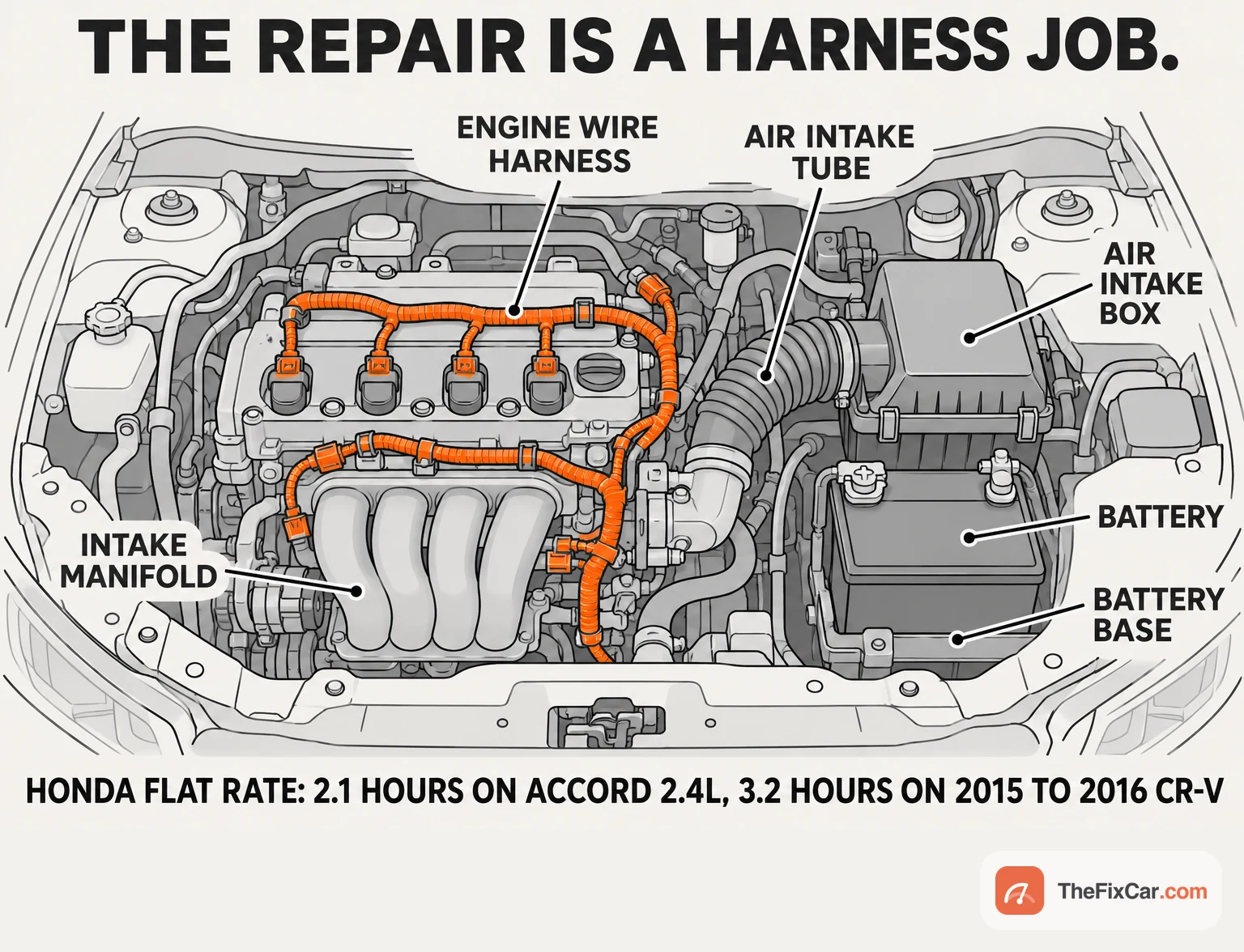
The parts list is longer than a sensor. Alongside the crank sensor and its O-ring, Honda lists the complete engine wire harness and four intake manifold gaskets, and the procedure removes the air intake tube, the air intake box, the intake manifold, the battery and the battery base[1]. Honda’s flat rate for the job is 2.1 hours on the covered 2013 to 2016 Accord 2.4L and 3.2 hours on the 2015 to 2016 CR-V. Those are Honda’s warranty labor times for this bulletin, not a price and not a promise of what an independent shop will bill[1].
The last step in the bulletin is the CKP pattern clear and CKP pattern learn procedure[1]. A shop that fits the parts should finish with it. Bulletin 16-011 is not a recall, and its warranty section reads “The normal warranty applies”[1].
For 2016 the Accord ranges are two-door L4 cars from 1HGCT1…GA000001 through 1HGCT1…GA005984 and four-door L4 cars from 1HGCR2…GA000001 through 1HGCR2…GA100769. The 2016 CR-V is listed in five VIN ranges split by VIN prefix and by 2WD or AWD[1]. A Honda dealer can match a VIN to them.
2008 to 2009 Accord: a software update, not a part
Honda Service Bulletin 09-050, revised October 2009, covers every 2008 Accord L4 and 2009 Accord L4 cars inside listed VIN ranges. The symptom is the MIL on with DTC P0339, and misfire codes P0302 and P0303 for cylinders 2 and 3 may also be stored. Honda’s probable cause: if the engine is cranked with a low battery, the ECM/PCM may incorrectly judge the crankshaft sensor position. The corrective action is to update the PGM-FI software with Honda’s HDS scan tool and do the CKP pattern clear and learn procedure, at a flat rate of 0.3 hour[4]. No sensor and no harness is on the list.
The 2009 ranges are four-door cars from 1HGCP2…9A000001 through 1HGCP2…9A114315 and from JHMCP2…9C000001 through JHMCP2…9C017331, and two-door cars from 1HGCS1…9A000001 through 1HGCS1…9A015888[4]. The bulletin tells the technician that if the current program ID already matches its list, the software is already installed, so a dealer can settle the question by reading the module. Out of warranty, Honda wrote that the repair may be eligible for goodwill consideration, requested before work starts[4]. A battery that cranks the engine weakly is the other half of this story: see how to test a car battery with a multimeter. Toyota documents the same link between low cranking voltage and crank sensor codes, covered in our guide to P0335 on Toyota.
Symptoms and what else causes them
On the Accord and CR-V in bulletin 16-011, Honda lists exactly one symptom: the check engine light, with the codes stored[1]. Honda’s bulletins for the 2023 hybrids list more: a no start condition, a low speed rough idle and engine rpm hunting[2][3]. None of these belongs to the crank sensor circuit alone.
| Symptom | What can cause it | Clues that shift suspicion |
|---|---|---|
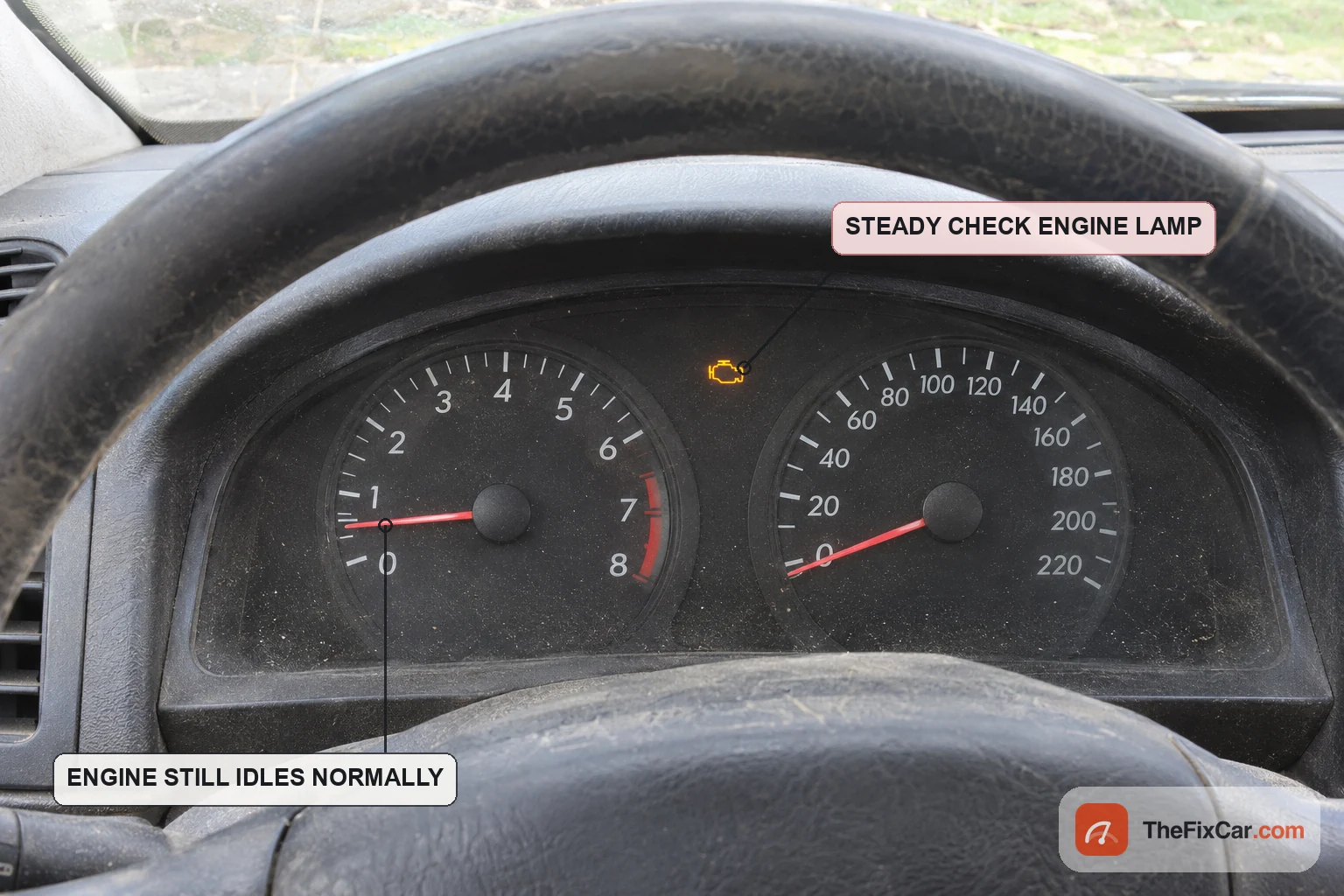
| Steady check engine light, car drives as before | Corrosion at the CKP connector on the cars in 16-011[1]; a failing sensor; a damaged harness. With no crank code stored, the lamp has other sources: the 2016 CR-V manual names an emissions control problem or a missing or loose fuel fill cap[5] | P0339 or P0335 actually stored, on a car the bulletin covers. Visible corrosion where the harness plugs into the sensor matches the cause Honda names[1] |
| P0339 together with P0302 and P0303 on a 2008 or 2009 Accord 2.4L | The software behaviour in bulletin 09-050 after cranking on a low battery[4]; a real misfire on cylinders 2 and 3 from ignition or fuel faults | The codes appeared after a weak start, and the module still carries a program ID older than the bulletin’s list[4] |
| Cranks but does not start | No crank signal; a weak battery; fuel delivery; the immobilizer | Whether P0335 is stored, and whether a scan tool shows any engine speed while the starter turns the engine. A slow, labored crank points at the battery first |
| Rough idle at low speed, rpm hunting | On 2023 Accord Hybrid and CR-V Hybrid, an incorrectly machined block at the sensor mounting location[2][3]; on other cars an intake air leak, a dirty throttle body or a misfire | P0017 or P0339 stored on a 2023 hybrid. Both recall bulletins list those two codes, and either can be present[2][3] |
| Engine cuts out while driving | Loss of the crank signal; fuel pump or fuel pump relay; ignition switch; charging system | P0335 with freeze frame data recorded at road speed. Honda’s bulletin 16-011 does not mention stalling, so a stall on those cars needs its own diagnosis |
What can make a Honda CKP sensor appear bad
Honda’s own documents name three causes that a new sensor alone does not fix: the software behaviour on 2008 to 2009 Accords above, and the two below.
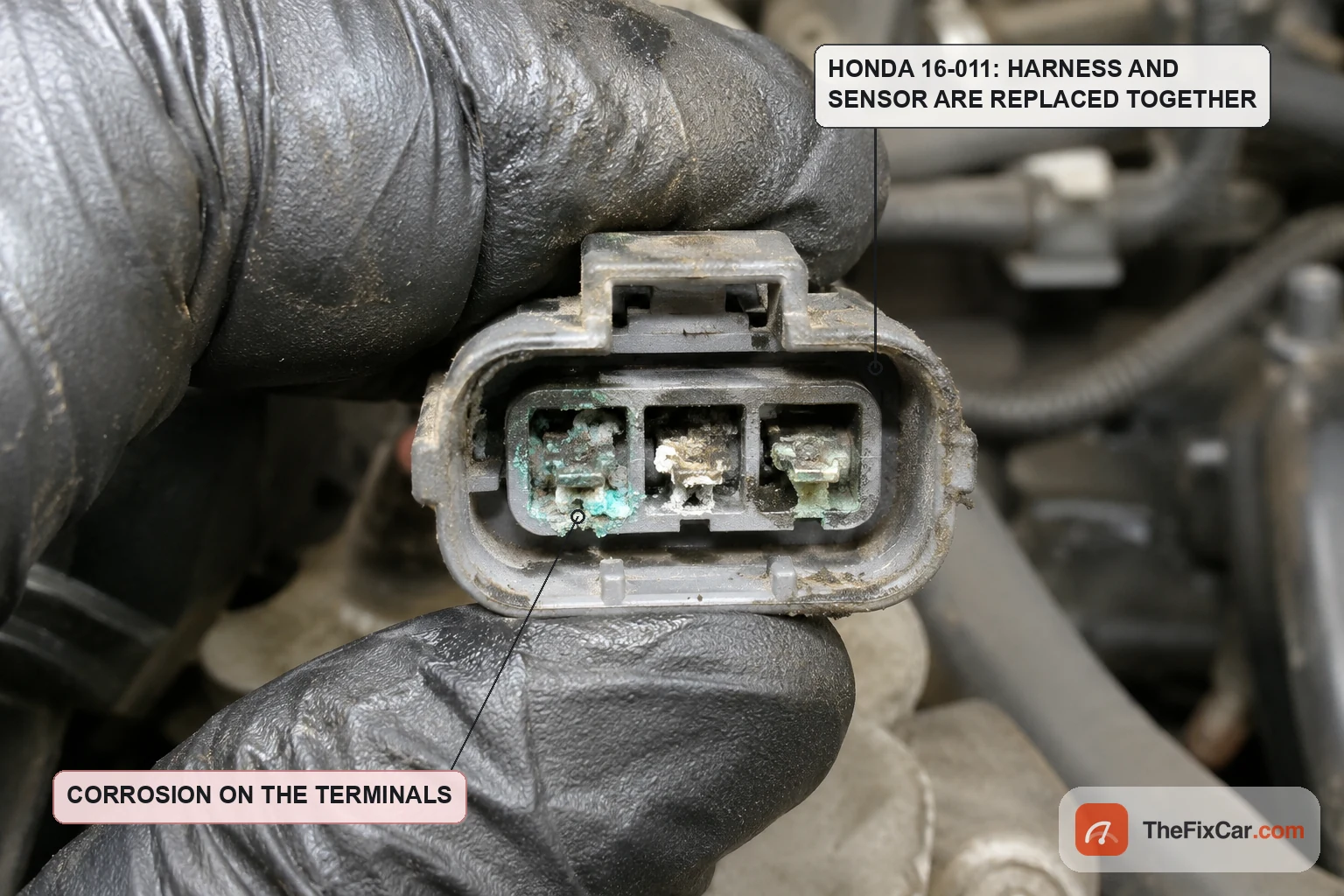
Corrosion where the harness meets the sensor
Before the bulletin existed, American Honda asked dealers for help. Engineering Request for Investigation AER15040A, filed in 2015, covers 2014 to 2015 Accords with the MIL on and P0335 and/or P0339 stored, and Honda wanted the parts collected before any repair. Its first qualifier reads: no previous repairs, with the CKP sensor not disconnected from the engine harness. Accord Hybrids were excluded[6]. Honda was asking for the joint between sensor and harness untouched, and bulletin 16-011 the following year named that joint as the cause[1].
The engine block on 2023 hybrids
Honda bulletins 23-048 (2023 Accord Hybrid) and 23-049 (2023 CR-V Hybrid), first issued July 21, 2023 and revised October 4, 2023, are emissions recalls for engines that may have an incorrectly machined block at the CKP sensor mounting location. The dealer first looks for an L or K manufacturing stamp on the block. An L ends the inspection. A K leads on to the block manufacturing date: after 3/5/23 the repair does not apply, and before 3/4/23 the dealer goes on to a measurement in place of the CKP sensor with an inspection tool whose fixture bolt is torqued to 12 N·m (9 lb-ft)[2][3]. The CR-V Hybrid bulletin adds that the measurement can only be done with the crankshaft set to TDC[2]. Where needed, the corrective action in both bulletins is a short block and a catalytic converter, after Tech Line approval, and Honda states that the expected failure rate is very low[2][3].
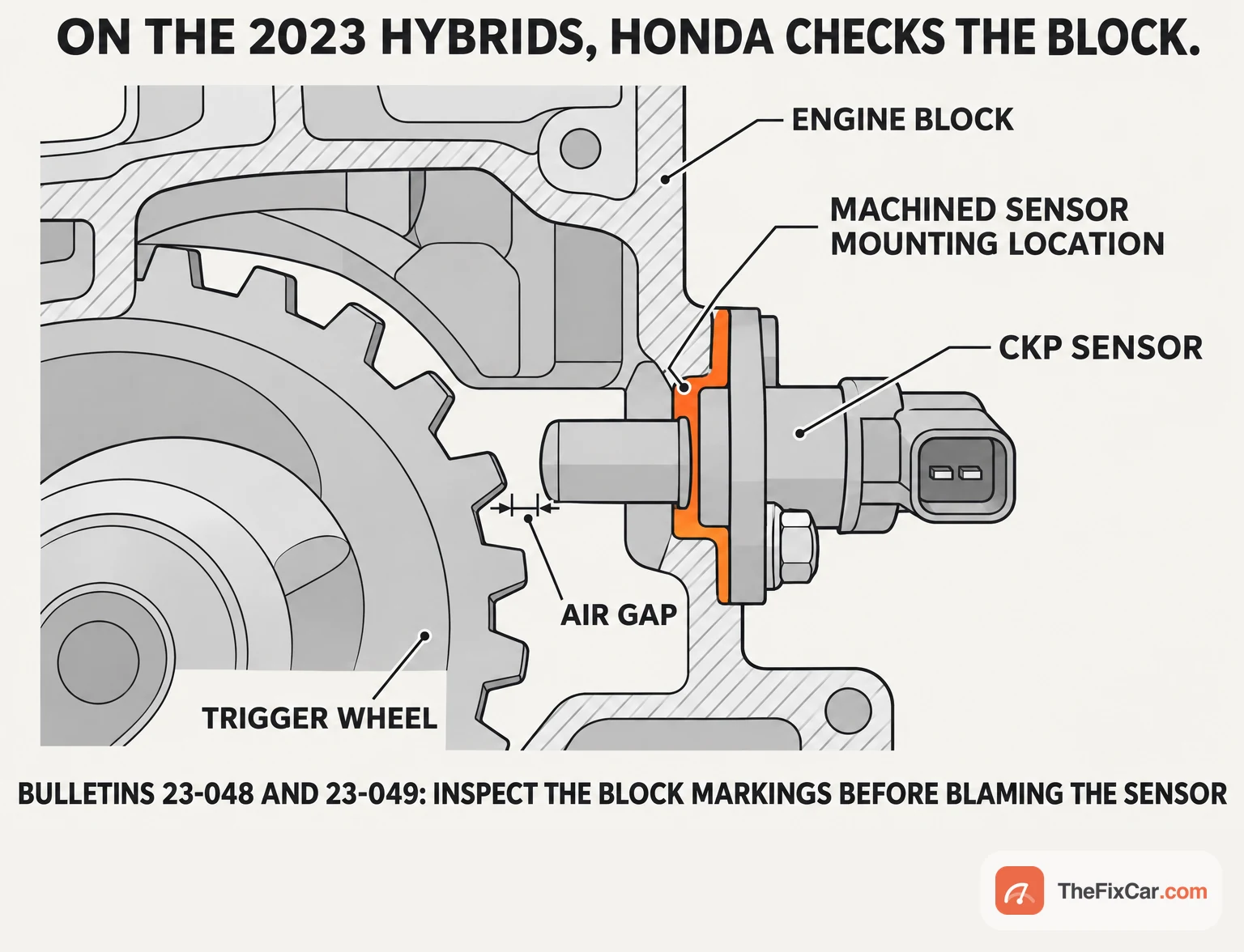
A Honda outside these bulletins
Honda ends both the harness repair and the Accord Hybrid short block procedure with a CKP pattern learn[1][3], so it belongs on the invoice of any shop doing this work. On a Honda that none of these bulletins covers, the code keeps its plain meaning: the module saw the crank signal interrupted. The sensor is one candidate. The connector, the wiring between sensor and module, the toothed wheel and the module itself are the others.
What to check first
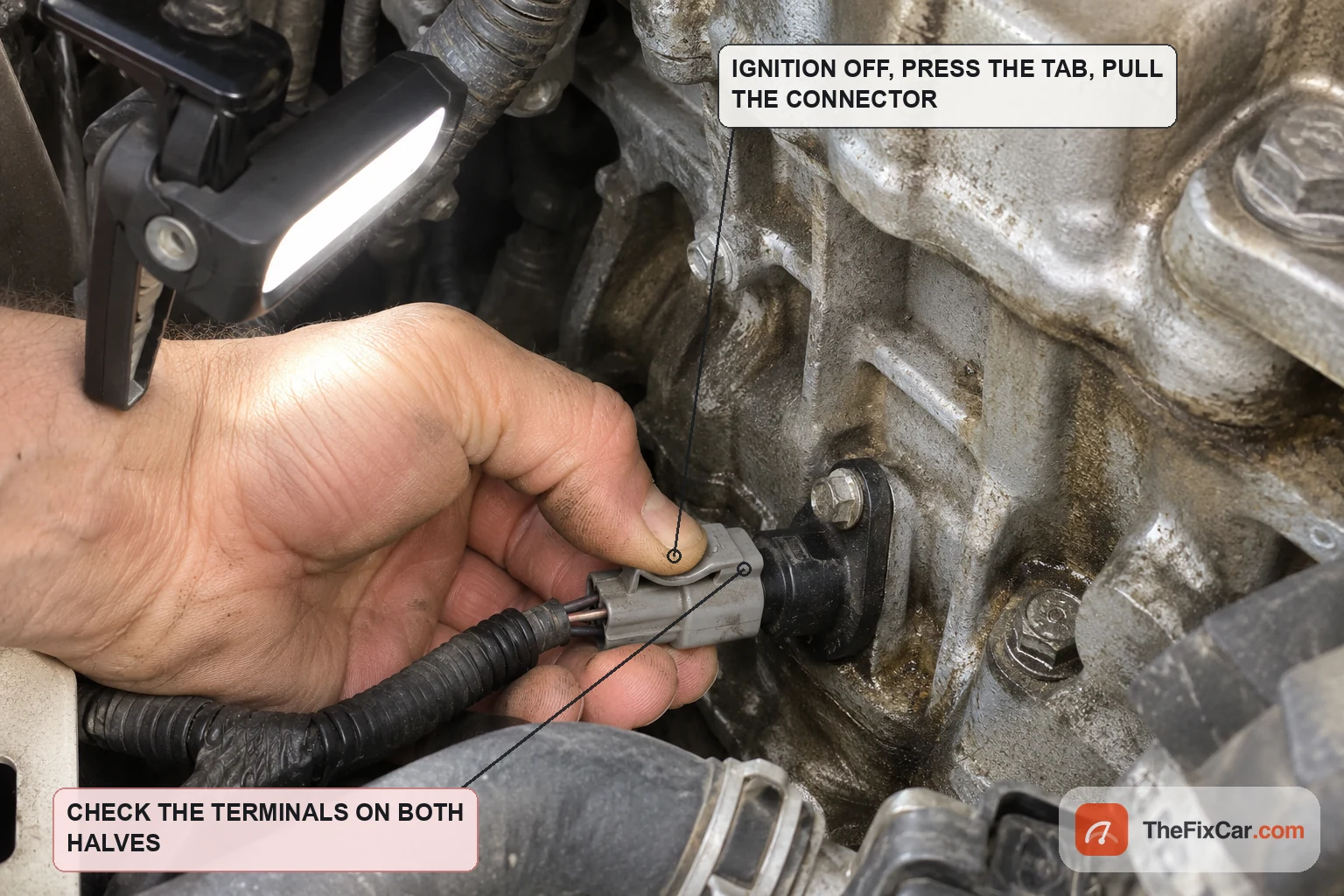
- Read and save the codes and freeze frame data before clearing anything. Note whether P0335, P0339 or P0017 is stored and what the engine was doing when the code set.
- Match the car to a bulletin. A 2008 Accord 2.4L, or a 2009 inside the VIN ranges, goes to 09-050[4]. A 2013 to 2015 Accord 2.4L or 2015 CR-V goes to 16-011, and so does a 2016 car inside the bulletin’s VIN ranges[1]. A 2023 Accord Hybrid or CR-V Hybrid goes to the dealer for a VIN check against 23-048 or 23-049[2][3].
- Look at the connector, with the ignition off. On the bulletin cars the sensor sits under a bolted cover and the harness repair needs the intake manifold and battery out, so this is where many owners hand the car to a shop[1]. Follow the service information for your model for anything you remove.
Can you drive with P0339?
Treat it as a drive to the shop, not a code to live with. An engine that runs normally with a steady light has not shown that the next interruption will be harmless. Honda’s guidance in the 2016 CR-V owner’s manual for a check engine light that comes on is to avoid high speeds and immediately get the vehicle inspected at a dealer[5]. The code describes an interrupted crankshaft signal, and the engine computer needs that signal to run the engine. Honda lists a no start among the conditions on its affected 2023 hybrids[2].
Stop driving and arrange a tow if:
- the engine has cut out, even once;
- it cranks longer than normal before it starts, or the tachometer needle drops out while the engine is running;
- the check engine light blinks. Per the 2016 CR-V manual, park in a safe place with no flammable items and wait at least 10 minutes with the engine stopped until it cools[5].
FAQ
What does P0339 mean on a Honda?
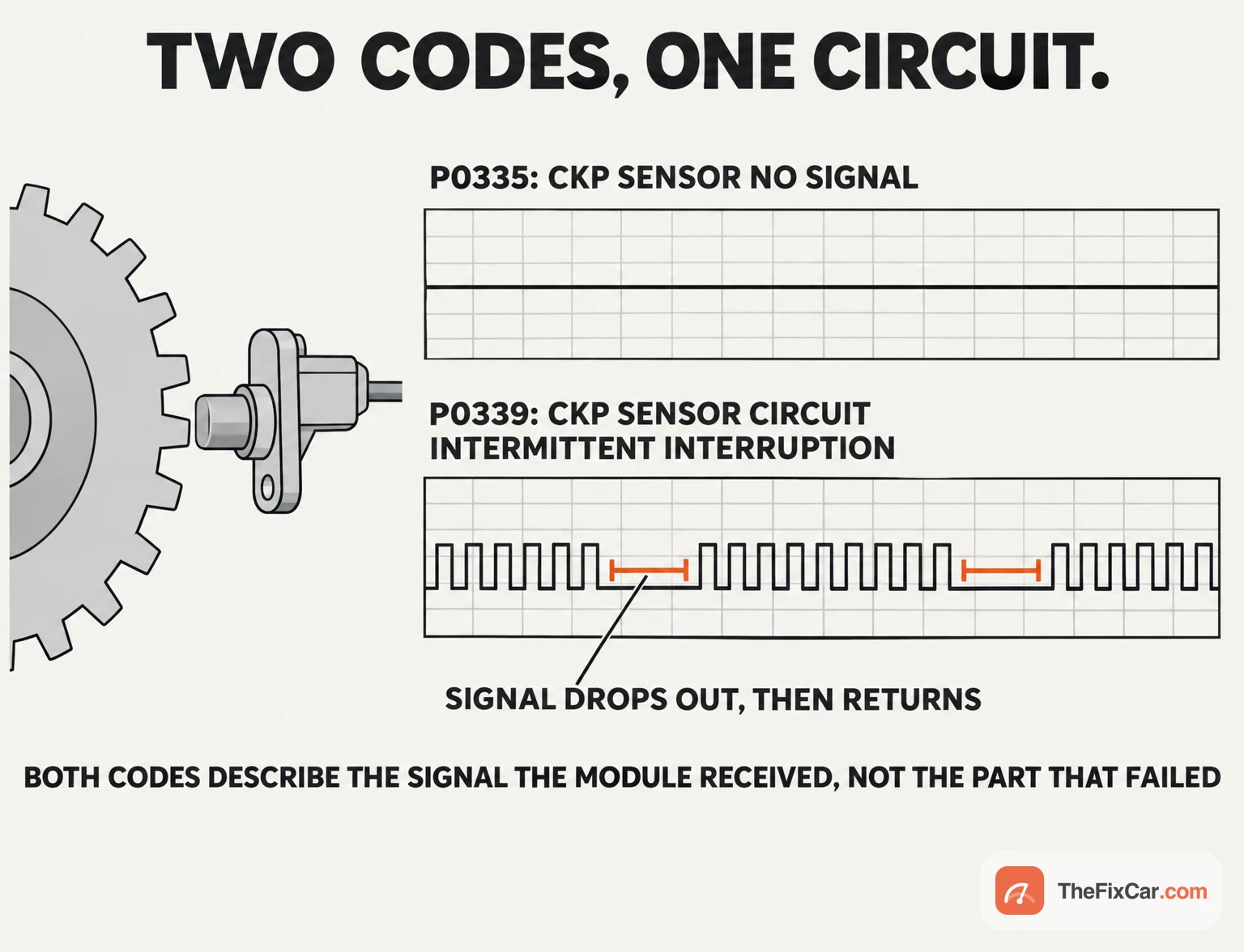
Honda defines P0339 as “CKP sensor circuit intermittent interruption”: the crankshaft position signal reached the engine computer with interruptions. The related code P0335 is “CKP sensor no signal”[1]. Both describe the signal, not the part that caused it.
What causes P0339 on a Honda Accord?
On 2013 to 2015 Accord four-cylinder cars, excluding the Hybrid, and on 2016 cars inside its VIN ranges, Honda Service Bulletin 16-011 gives the possible cause as corrosion between the engine wire harness and the CKP sensor connector[1]. On an affected 2023 Accord Hybrid, bulletin 23-048 points to an incorrectly machined engine block at the sensor mounting location[3]. On 2008 and listed 2009 four-cylinder Accords, bulletin 09-050 gives the probable cause as the ECM/PCM misjudging crankshaft sensor position after cranking on a low battery, fixed by a software update[4]. Other Accord years have no bulletin cited here and need a circuit diagnosis.
How do I fix code P0339?
Find the cause first. On the cars in Honda bulletin 16-011, where the connector corrosion is found, the repair is a new engine wire harness and a new CKP sensor with a new O-ring, followed by the CKP pattern clear and learn procedure[1]. Where the harness connector is corroded, a new sensor alone leaves that corrosion in place.
Is P0339 the same as P0335?
No. On Honda’s definitions P0335 is no signal and P0339 is an intermittent interruption[1]. They share a circuit, and Honda bulletin 16-011 treats them together: either or both can be stored on the same car.
Is Honda bulletin 16-011 a recall?
No. It is a service bulletin, and its warranty section says the normal warranty applies[1]. Bulletins 23-048 and 23-049 for the 2023 hybrids are different: Honda titles them emissions recalls, and owners of affected CR-V Hybrids are sent a notification[2].
How long does the Honda 16-011 repair take?
Honda’s flat rate time is 2.1 hours for the 2013 to 2016 Accord 2.4L and 3.2 hours for the 2015 to 2016 CR-V[1]. Those are warranty labor times.