An engine that idles rough at a stoplight, feels flat when you ask for a pass, and stores a P0011 or P0014 has a reported cam timing control or performance fault, and that fault may sit in the VVT oil control solenoid, the oil feeding it, the phaser, the wiring, the position sensors, or mechanical timing. The engine may still run and may use more fuel, though stalling, a flashing check engine light, an oil pressure warning, or a timing rattle make the fault urgent. The oil control solenoid is a practical first suspect because it can be easier to access and is often less expensive than a phaser or a timing chain repair, and on some engines it is the failed part. That does not make it the diagnosis: the same symptoms can come from the oil supply, the phaser, wiring, sensors, or mechanical timing.
Quick answer
A VVT system fault, including a failing or sticking oil control solenoid, can show up as rough idle, stalling, hesitation, weak pull higher in the rev range, fuel economy that may slip, and a check engine light carrying cam timing codes in the P0010 to P0025 family. Before you buy anything, pull the dipstick: check the level, smell it for fuel and look for obvious contamination, confirm the viscosity is what the engine calls for, and find out when it was last changed.
| What the symptom tells you | First suspicion to test | Do first |
|---|---|---|
| Rough idle, shaking at stops, sometimes stalling | Cam timing sitting somewhere it should not at idle: possibly a sticking solenoid, a plugged screen, oil supply, the phaser, wiring, sensor data, or an idle fault unrelated to VVT | Read the codes and compare commanded to actual cam angle on a scan tool |
| Feels normal in some conditions but loses pull as engine speed or load changes | Possibly a VVT response fault, though ignition, fuel delivery, air metering, an exhaust restriction, or transmission behavior can feel similar | Same scan tool check, then look at oil condition |
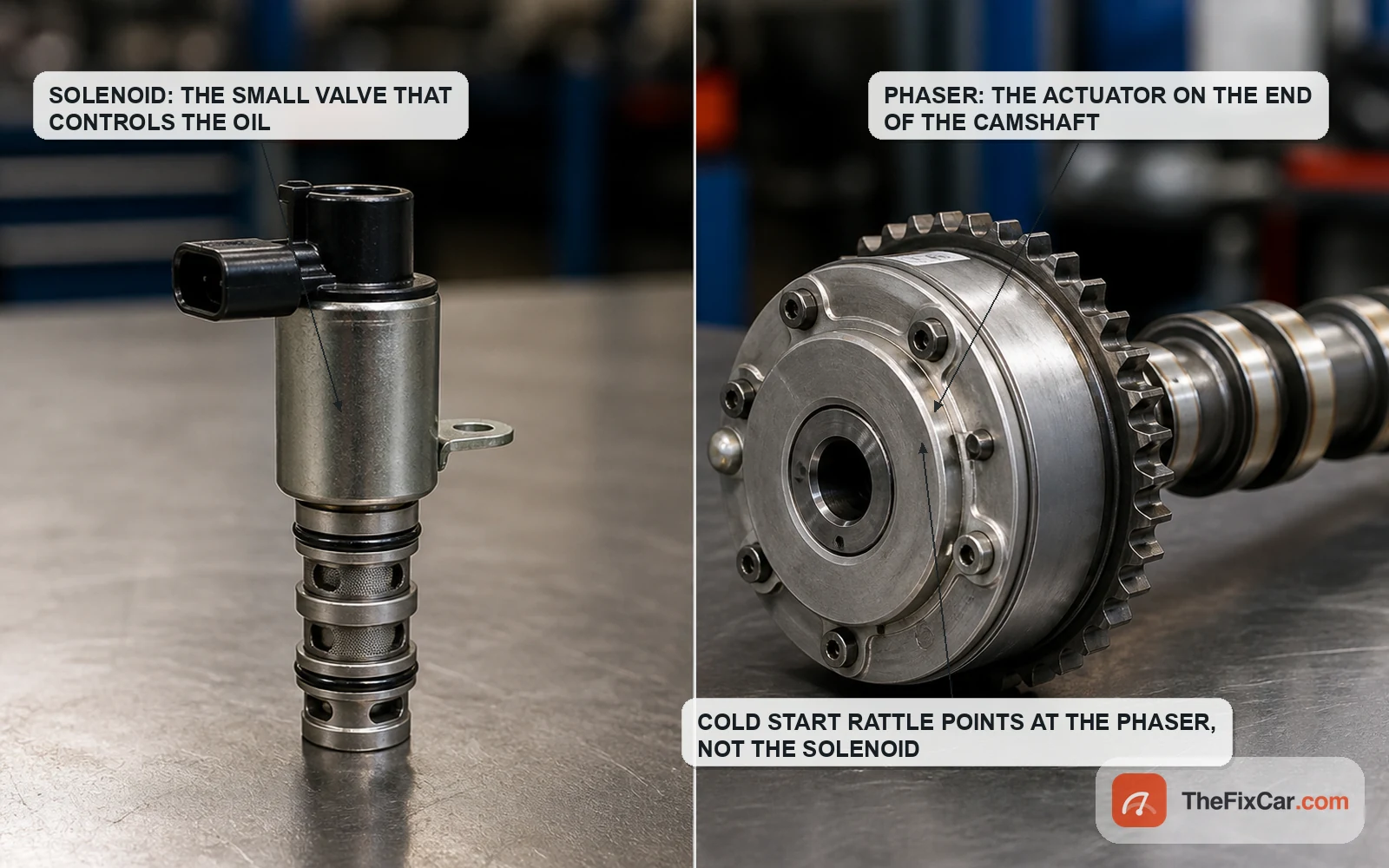
| Rattle or chatter briefly on a cold start | More suggestive of a phaser, a chain or tensioner, or an oil pressure problem than an isolated electrical solenoid fault | Note whether the noise fades once oil pressure builds |
| Codes stored, oil dark and overdue, level low | Oil supply becomes the first suspicion, though the valve can still be contaminated or faulty | Change oil and filter with the correct grade, clear the codes, then retest |
| Codes stored, oil fresh and at the full mark | Solenoid, its screen, wiring, phaser, oil pressure, mechanical timing, and sensor data all still need separating | Only where service information confirms the two are interchangeable, swap the solenoid to the other bank and see whether the code follows it |
| Long crank or hard starting, then runs normally | If the basic starting checks pass, the cam may be parked away from its intended start position, and a phaser that will not lock is one possible VVT-side cause | Check for correlation codes such as P0016 alongside the VVT codes |
This is a first-pass sort, not a full diagnosis: the codes tell you which bank and which direction, they do not name the failed part.
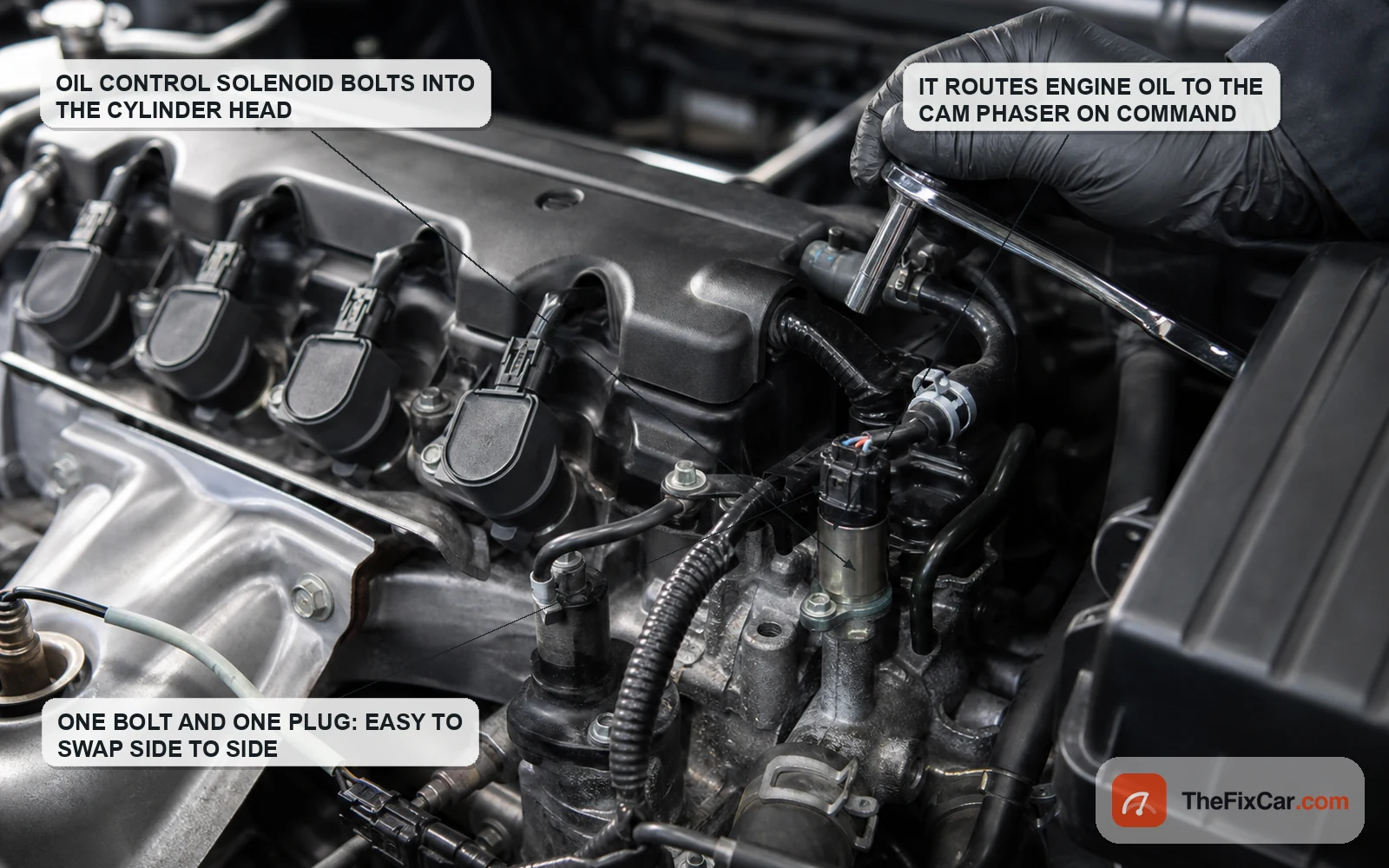
Stuck, restricted, or electrically dead: why the symptoms differ
A VVT solenoid meters and routes engine oil to the cam phaser. If its spool sticks, an oil passage is restricted, or the electrical control fails, the cam may stay too advanced, stay too retarded, or simply respond too slowly. Which direction it fails in depends on the engine and how that VVT system is designed, so treat the symptom as a clue about how the cam is responding, not as a label for the failed part.
| What has gone wrong | What it does to cam control | What you tend to feel |
|---|---|---|
| Spool sticking inside the solenoid | Oil is fed or blocked regardless of the command, so the cam may hold the wrong position, move late, or respond intermittently | Rough idle, hesitation off the line, or a loss of pull as revs and load rise, depending on where it stuck |
| Restricted passage or plugged filter screen | Flow is reduced, so the phaser moves late, part way, or not at all | Sluggish response, often coming and going with oil temperature |
| Electrical fault in the solenoid or its circuit | The valve may not receive the intended command, or the circuit may carry a weak, shorted, intermittent, or driver-limited signal | A circuit code is more likely than a performance-only code, with driveability symptoms set by wherever the cam ends up |
| Phaser or timing hardware | The actuator cannot hold or reach the commanded angle | Start-up rattle, and codes that may include cam-to-crank correlation |
For background on what the system is worth when it works: variable valve timing exists partly to improve efficiency across engine speeds and loads, and the U.S. Department of Energy estimates a 3 to 4 percent potential efficiency improvement for variable valve timing and lift technologies[1]. That figure describes the technology, not the fuel economy loss when it fails, which depends on where the cam ends up and how the ECM compensates.
Most common causes
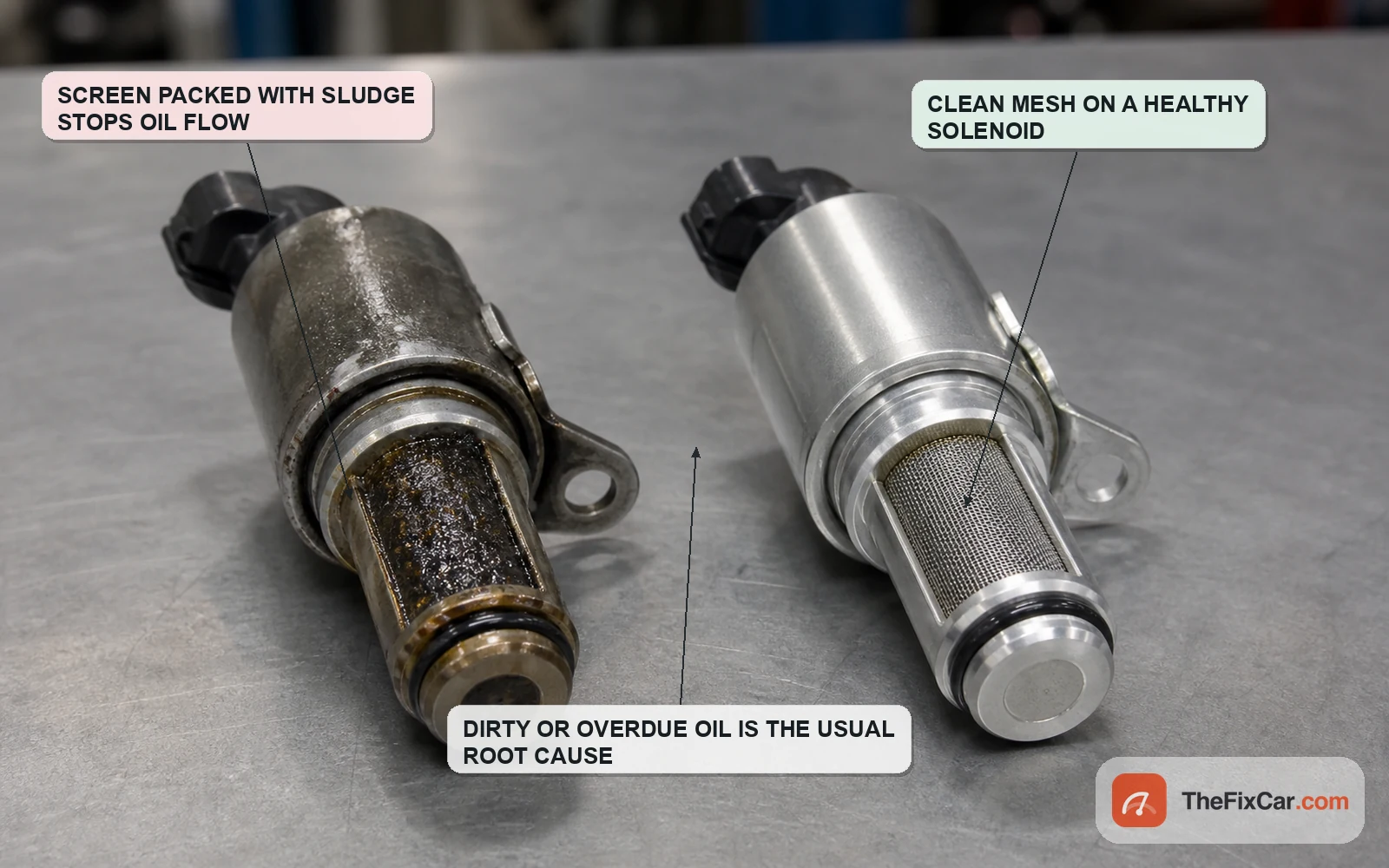
- Plugged filter screen on the solenoid: the fine mesh that protects the valve packs with sludge and varnish, so the phaser may not get enough oil flow to reach the commanded cam angle.
- Solenoid spool sticking: the internal spool sticks, leaks internally, or meters oil at the wrong time, sometimes intermittently. General Motors has published an application-specific bulletin on intake camshaft actuator park lock solenoid valves that stick or come apart on certain engines[2].
- Overdue, diluted, or low oil: the phaser is a hydraulic actuator, so oil that is overdue, badly diluted, or below the full mark can produce the same kinds of VVT symptoms with a perfectly good solenoid fitted.
- Wrong oil viscosity: engines with variable timing are calibrated around a specific grade, and a heavier oil than the manufacturer lists can slow phaser response enough to set a code, especially when cold.
- Electrical fault in the solenoid circuit: a chafed harness, a corroded connector, or an open coil stops the control signal, which is more likely to set a circuit code than a performance-only code.
- Worn cam phaser: the actuator on the end of the camshaft wears internally or its lock pin stops holding, which can produce a cold-start rattle and mimic a solenoid fault.
- Stretched timing chain or weak tensioner: if wear or tensioner trouble lets cam timing drift outside the expected relationship, the ECM may set cam timing or correlation codes that look like a VVT control fault.
- Cam or crank sensor, or a damaged tone wheel: bad position data can make the ECM report a cam timing error while the oil control hardware moves normally, which needs checking before a solenoid goes on the car when P0016 or P0017 appear.
Clues that shift suspicion
Solenoid, phaser, and oil supply faults produce overlapping codes, so they are often misdiagnosed as each other. No single clue below proves which part failed, but together they move the odds.
| What you find | Shifts suspicion toward |
|---|---|
| A circuit code stored, a coil outside its resistance spec, or the fault following an interchangeable solenoid when it is swapped | A circuit code or an out-of-spec coil points at the solenoid coil or its circuit: connector, wiring, power, ground, or driver. A fault that follows an approved swap points at the moved solenoid assembly, so check its part number, screen, and spool |
| Mechanical rattle in the first seconds after a cold start, cam-to-crank correlation codes, or play in the actuator | The phaser, the timing hardware behind it, cam or crank sensor data, or a damaged tone wheel, depending on the rest of the evidence |
| Low oil pressure, oil that is overdue, contaminated, fuel diluted, or the wrong viscosity, or multiple actuators responding slowly once shared electrical, sensor, command, and test-condition issues are ruled out | Oil supply |
| Actual cam angle failing to follow the commanded angle during the relevant active test or operating condition | Strongly suggests the VVT system is not responding, but confirm oil pressure, sensor data, wiring, and the scan tool’s test conditions before naming a part |
Check oil level, oil condition, and oil pressure before condemning anything, whichever way the clues point. The phaser is a hydraulic actuator too, so a supply problem can imitate either component. Our guide on an oil light that flickers at idle with the level full covers the pressure side.
Common VVT trouble codes and what they mean
These are standardized OBD-II definitions rather than one manufacturer’s shorthand[3]. On many engines the “A” camshaft is the intake and “B” is the exhaust, and bank 1 is the side with cylinder number 1, but check the service information for your engine rather than assuming.
| Code | Definition | What it can suggest |
|---|---|---|
| P0010 / P0020 | “A” camshaft position actuator circuit, bank 1 / bank 2 | An electrical-side fault to test first: coil, connector, wiring, power, ground, or driver circuit. Oil flow and mechanical checks still matter if symptoms or other codes remain |
| P0011 / P0021 | “A” camshaft position, timing over-advanced or system performance | The ECM sees the cam more advanced than expected, or a system performance error: oil control, oil pressure, a sticking valve, a plugged screen, phaser or timing hardware, wiring, sensor data, or ECU strategy |
| P0012 / P0022 | “A” camshaft position, timing over-retarded | The ECM sees the cam more retarded than expected, or not reaching its target: restricted oil flow, a sticking valve, oil pressure, phaser or timing hardware, wiring, or sensor data |
| P0013 / P0023 | “B” camshaft position actuator circuit | The same electrical-side fault on the B camshaft actuator circuit: confirm in the service information whether B is intake or exhaust on your engine |
| P0015 / P0025 | “B” camshaft position, timing over-retarded | The ECM sees the B camshaft more retarded than expected, or not reaching its target: same list of oil control, oil supply, wiring, phaser and timing hardware, and sensor data |
| P0014 / P0024 | “B” camshaft position, timing over-advanced or system performance | The ECM sees the B camshaft, exhaust on many engines, more advanced than expected, or a system performance error: check oil control, oil supply, wiring, phaser and timing hardware, and sensor data before naming a part |
| P0016 / P0017 | Crankshaft and camshaft position correlation, bank 1 | Cam and crank are out of the expected relationship: think mechanical timing, the phaser, a sensor or tone wheel, and in some cases a VVT control fault |
A flashing light rather than a steady one changes the priority entirely, as our guide on what a flashing check engine light means explains.
What to check first
- Check the oil level and condition on level ground using the procedure in the owner’s manual, which on most engines means with the engine off after the oil has settled. Oil that is low, overdue, contaminated, fuel diluted, or the wrong viscosity can make a healthy VVT system stop responding, and color alone is a poor test because oil can darken quickly while still doing its job. Our guide on how to check engine oil properly covers the method.
- Find out when the oil was last changed and with what grade. If it is overdue or the wrong viscosity for the engine, change it before condemning parts and read the grade off the cap or the owner’s manual, not off a parts-store chart.
- Pull the codes with a scan tool rather than reading the light. A circuit code and a performance code start the diagnosis in different places, though both still call for connector, wiring, oil supply, phaser, mechanical timing, and sensor data checks where they apply.
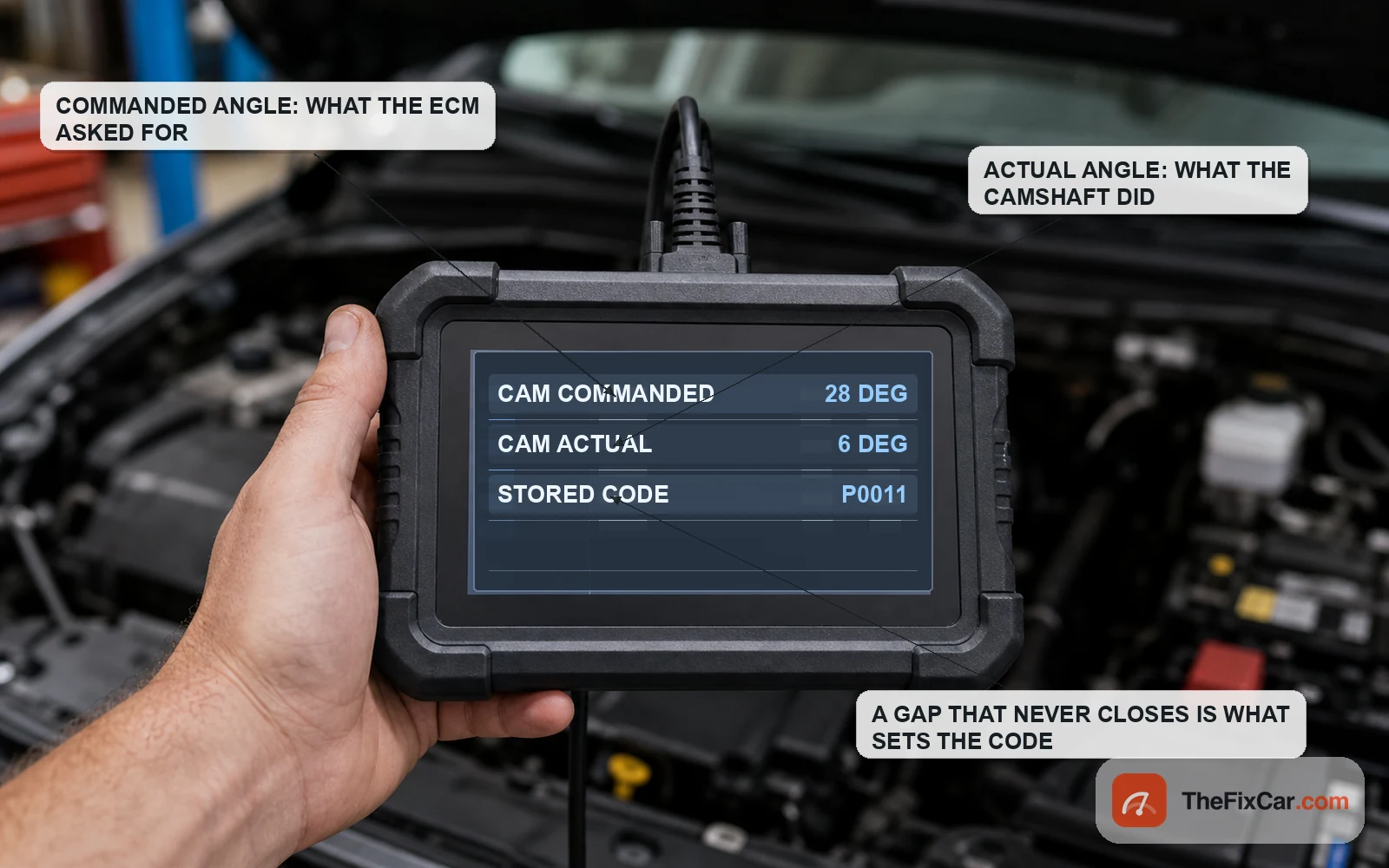
- Look at commanded versus actual cam angle under the test conditions the service information gives, or during a scan tool active test. Revving with no load may not command enough cam movement to prove anything. A command the cam never follows strongly suggests the system is not moving, though it still does not say whether the cause is oil supply, wiring, the solenoid, the phaser, or bad position data.
- Unplug the solenoid connector and inspect it for oil, corrosion, and spread terminals. Oil sitting in the connector or wicking into the harness can be the fault on some applications.
- If the service information confirms the solenoid can be removed safely without disturbing other components, remove it and inspect the filter screen. A screen packed with sludge may be worth cleaning and retesting before you buy a new part, but only where the service information allows cleaning and names the solvent and the procedure.
How to confirm the solenoid is actually bad
Three checks, cheapest first. Stop at the point where the service information, the access, running-engine testing, or the tooling goes past what you can do safely.
- Resistance across the coil: manufacturers publish a resistance value for the solenoid winding. Measure it and compare against the spec for your engine, not against a number from a forum. Open or badly out of range means the coil or its connector path has failed that electrical test, which still says nothing about spool movement, oil flow, phaser operation, or ECM control.
- Bank-to-bank swap, only where the service information allows it: if the manufacturer confirms the two solenoids are identical and interchangeable on your engine, swap them side to side, clear the codes, and repeat the same operating conditions, provided the safety checks in this article pass. A fault that follows the solenoid shifts suspicion strongly toward that part. Do not assume interchangeability: solenoids that look identical often carry different part numbers and flow specifications. General Motors documents this check for particular intake camshaft actuator park lock solenoid valves as an application-specific procedure, not a universal one[2].
- Command it with the scan tool: many tools can run an active test that switches the solenoid through the ECM with the engine running. An audible click only proves the circuit energized something inside the solenoid: it says nothing about oil flow, spool travel under load, phaser movement, or ECM control, so watch whether actual cam angle follows the commanded angle and whether idle quality changes. Bench testing by applying power and ground directly is a separate procedure with its own steps in the service information.
Cleaning can be a legitimate step where the manufacturer allows it. Use the specified solvent and procedure, clear the filter screen and the oil passages, lubricate the valve with clean engine oil, and fit a new O-ring before refitting. Do not force a sealed spool, and do not soak seals or plastic parts in an aggressive solvent the manufacturer has not named. If cleaning fixes the car, oil contamination or debris was part of the fault, so change the oil at the same time or the same restriction may return.
Is it safe to drive?
Do not treat every VVT fault as safe to drive. A short, low-load trip to a shop may be reasonable only after checking the oil level and confirming there is no oil pressure warning, and only if the check engine light is steady, the engine is not misfiring or stalling, oil level and pressure are normal, and there is no persistent timing rattle. An isolated VVT control fault in that state usually costs power and economy rather than safety. Stop driving if the light is flashing, which points at a misfire that can damage the catalytic converter, if the oil pressure warning comes on, or if the engine has a persistent, repeated, or worsening timing rattle after start-up, because a chain or tensioner problem that shifts cam timing can end in bent valves on an interference engine.
Do not do this
- Do not buy a solenoid because the code number mentions camshaft timing. The code names a circuit or a timing condition, often with a bank and a direction, never the failed component.
- Do not skip the oil check because the engine “was serviced recently”. Fuel-diluted or wrong-grade oil produces these codes with a perfect solenoid fitted.
- Do not clear the code and keep driving to see whether it returns without checking oil pressure first. If oil supply is the fault, you are running a bearing risk, not just a timing fault.
- Do not fit a cheap unbranded solenoid where the service information, a manufacturer bulletin, or a reliable parts history points to sensitivity to solenoid quality. The screen mesh and the spool machining are what decide whether the valve meters oil accurately, and a poor part can set the same code again.
- Do not ignore a cold-start rattle because the car drives fine once warm. That noise can point to the phaser, the chain tensioner, oil pressure bleeding down while the car sits, or another timing drive fault, and it should be diagnosed before it turns into a mechanical timing problem.
- Do not reach for an aggressive engine flush additive to clear a plugged screen. A flush can loosen deposits faster than the engine can safely carry them away, moving debris into the sump, the pickup screen, small oil passages, or the VVT control screens. Follow the manufacturer’s cleaning and service procedure instead.
When the problem is urgent
- The check engine light is flashing rather than steady, which points at an active misfire that can overheat the catalytic converter.
- The oil pressure warning light comes on, or the pressure gauge reads low at idle when warm.
- A metallic rattle from the front of the engine that persists after start-up, repeats on most starts, or appears under load.
- P0016 or P0017 stored alongside the VVT codes, which points at mechanical timing, the phaser, or a sensor and reference problem before you treat it as a simple solenoid fault.
- The engine stalls in traffic or will not restart when hot.
- Oil consumption that has climbed at the same time, since oil level is what the whole system depends on.
When to call a pro
Replacing an accessible solenoid can be a driveway job on some engines, but follow the service information for access, seal replacement, torque, oiling, and any relearn or calibration step. Hand it over when the fault is deeper than that. Anything that needs the timing cover off, a phaser replaced, a chain or tensioner renewed, or a locked camshaft to keep timing while parts come apart belongs with a shop that has the cam holding tools for that engine. The same goes for a low oil pressure reading you cannot explain, or codes that come straight back after a correct solenoid and a fresh oil change. At that point the next test path needs service information, live data, oil pressure testing, circuit checks, and timing checks before any more parts go on the car.
Typical repair cost
- Oil and filter change first: workshop estimates commonly land around $50 to $130, moved by oil capacity, the specification the engine needs, and local labor rates, and on a neglected car this may be enough to stop the code returning if oil condition was confirmed as the cause, though you still clear the codes and retest live cam data before calling it fixed.
- VVT solenoid, part only: commonly reported at roughly $25 to $130, depending on the engine, the brand, and whether the part is OEM or aftermarket.
- Solenoid replaced at a shop: roughly $200 to $700 on many vehicles according to published estimator ranges[4], with hard-access applications quoted higher by shops.
- What moves that number: access. A solenoid in plain view at the front of the head is a short job, while one that needs the intake manifold or a cover removed is almost all labor.
- Cam phaser replacement: workshop estimates commonly run $700 to $1,800 per bank, because access often involves timing drive disassembly, depending on the engine layout.
- Timing chain, tensioner, and phasers together: commonly quoted at $1,500 to $3,500 on a V6 or V8, and this is why it pays to separate the solenoid, the oil supply, the phaser, and mechanical timing before replacing anything.
These are rough U.S. figures. Read them as independent-shop parts and labor estimates before tax, shop supplies, and diagnostic time. Only the shop solenoid range is tied to a published estimator[4]. Every other figure here is a workshop estimate offered for comparison, not a sourced price, and has to be checked against the labor time and parts prices for your exact engine. Engine layout moves this range more than anything else: the same nominal repair can be a brief access job on one four-cylinder and a much longer labor job on a transverse V6.
FAQ
Can I drive with a bad VVT solenoid? Only in limited cases: short, low-load trips, with the check engine light steady rather than flashing, no stalling, and oil level and pressure normal. You may lose power and fuel economy where cam timing is stuck, slow to respond, or parked in a fallback position. Treat a flashing light, an oil pressure warning, or a persistent start-up rattle as reasons to stop.
Will a bad VVT solenoid throw a check engine light every time? Not always at first. A sticking valve can cause a rough idle or a flat spot for a while before the ECM sees enough of a deviation to set a code and turn the light on. Live data showing commanded versus actual cam angle can catch some faults earlier than the light does, provided the fault is active under the test conditions.
Can dirty oil cause P0011 on its own? Yes, it can. Dirty, overdue, low, diluted, or wrong-viscosity oil can contribute to P0011, because the phaser depends on controlled oil flow and pressure. The phaser is hydraulic, so oil that is thick with deposits, overdue, or below the full mark can stop it moving with a perfectly good solenoid fitted. Change the oil and filter with the specified grade, clear the code, and retest before buying parts.
How do I know if it is the VVT solenoid or the cam phaser? Use cold-start noise, the codes, live data, the oil checks, and an approved swap test together as clues, because no single check separates the two. A repeated cold-start rattle points toward the phaser, its lock pin, the timing chain tensioner, or oil pressure bleeding down while the engine sits. If the service information confirms both solenoids are identical, and you move only the solenoid to the other bank, clear the codes, and the fault follows the part, the solenoid becomes the leading suspect.
Can I clean a VVT solenoid instead of replacing it? Sometimes, where the manufacturer permits it. Follow the specified solvent and procedure, clear the screen and passages, lubricate the valve with clean engine oil, and use a new O-ring. Do not force a stuck spool or soak seals and plastics in an aggressive solvent nobody specified. A clean solenoid that fixes the car means oil contamination or debris was part of the fault, so change the oil too.
Should I replace both VVT solenoids at once? Not automatically. Replace only the solenoid that has been confirmed faulty, unless the manufacturer specifies pair replacement for that engine, or both units show the same contamination or wear. The General Motors bulletin cited here is one application-specific example where pair replacement appears in the service path[2]. Shop access and confirmed contamination on both units can affect the decision, but do not generalize that bulletin to other engines.
Why did the code come back a week after I replaced the solenoid? The new part may be wrong or defective, the original cause may still be present, or the first diagnosis may have missed oil supply, wiring, sensor data, phaser operation, the ECM command, or mechanical timing. Recheck oil condition and level, inspect the screen on the new solenoid for fresh debris, then look at oil pressure and the phaser. A repeat code after a correct part is a sign the problem may sit outside the valve: oil supply, a debris source, wiring, sensor data, phaser operation, the ECM command, or mechanical timing.