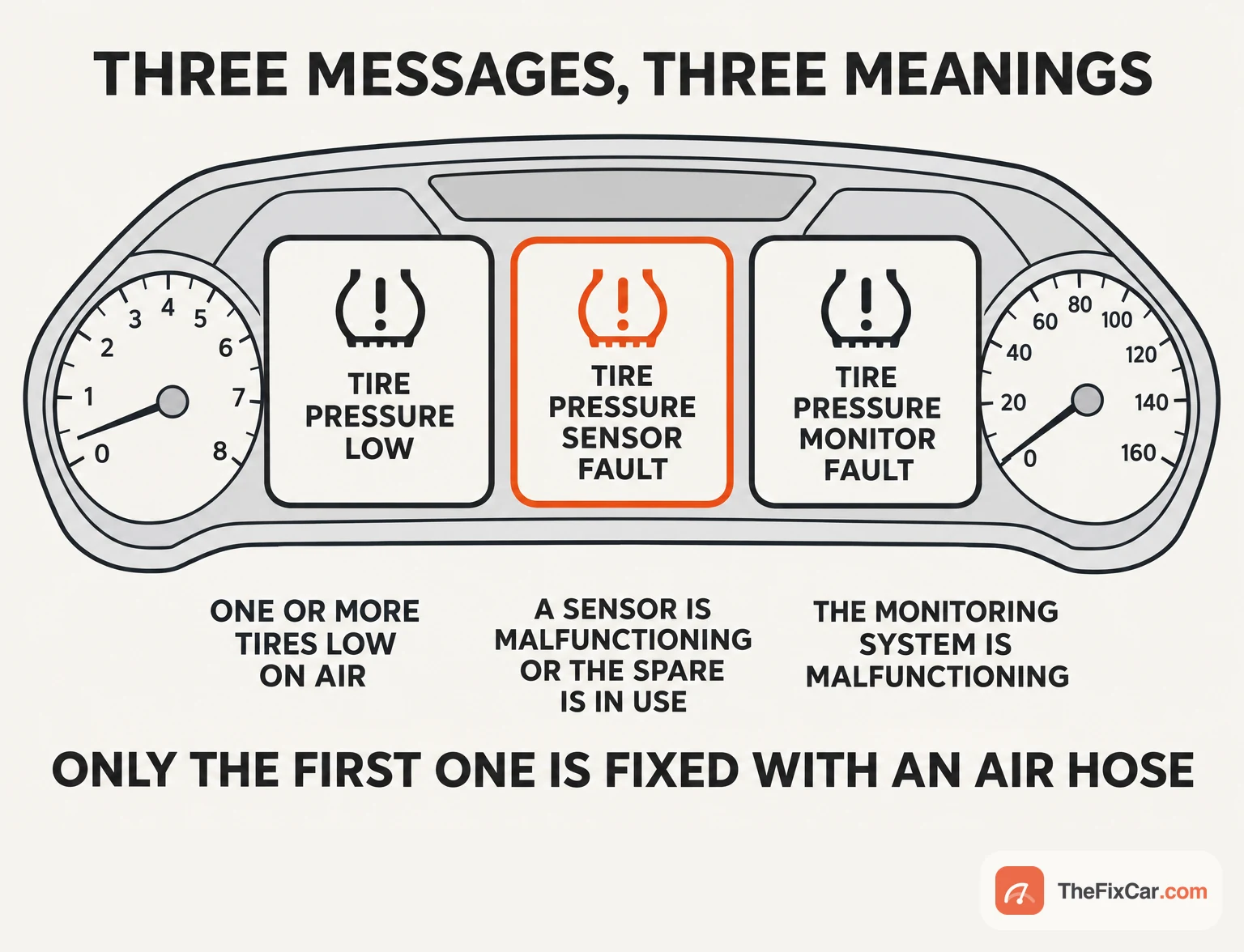
“Tire Pressure Sensor Fault” on a Ford is not the low-tire warning. Ford’s 2020 Explorer owner’s manual lists three separate tire messages, and gives this one a meaning of its own: “A tire pressure sensor is malfunctioning, or your spare tire is in use”[1]. Low air has a different line, “Tire Pressure Low”. Check the tires with a gauge anyway, because the same manual says that while the malfunction indicator is lit the system cannot detect or signal low pressure as intended[1].
The word “sensor” in the message sends people straight to the parts counter. Ford’s own service documents show why that can be the wrong first move. On some 2021 to 2023 F-150 trucks with the 2 kW onboard inverter Ford points the technician at radio interference, on some 2021 F-150 trucks with navigation at the telematics module, and on a batch of 2020 Escape S models at the body control module, where Ford states that replacing sensors will not fix it[2][3][4]. This page sorts the causes by what you can check yourself: which wheels are on the car, what the lamp does in its first minute, and what was done to the tires last.
Quick answer
Put a gauge on all four tires, confirm no spare is on the car, then switch the ignition off and on and watch the tire light for the first minute.
| What you see | Where to look | What to do first |
|---|---|---|
| “Tire Pressure Low”, light on solid | The Tire Label on the driver door edge or B-pillar, and a gauge | Inflate to the label pressure. Ford’s 2020 Explorer chart calls for at least two minutes of driving over 20 mph (32 km/h) before the light turns off[1]. A tire that keeps losing air needs repair, not a drive |
| “Tire Pressure Sensor Fault” with a spare on the car | Which wheel is mounted | Expected. Ford’s 2020 Explorer manual says the system keeps flagging an issue until the repaired road wheel is back on the vehicle[1] |
| “Tire Pressure Sensor Fault”, four road wheels on, pressures correct | The lamp at start-up: about one minute of flashing, then solid | Have the stored codes read. If the warning stays on or keeps coming back, the manual’s instruction is an authorized dealer as soon as possible[1] |
| The message appeared after new tires, new wheels, new sensors or a rotation | Whether the sensors were trained afterwards, and whether the new parts suit the system | After a rotation, run the reset procedure in your owner’s manual. After new tires or wheels, Ford tells owners to check the malfunction light to make sure the replacements let the system work[1] |
| 2021 to 2023 F-150 with the 2 kW inverter, tire light on, code B124D:02 | Ford bulletin 24-2122 | Ask the dealer to run the bulletin’s interference test before sensors are replaced[2] |
| 2021 F-150 with navigation, tire light on and short key fob range | Ford message SSM 50098, telematics control unit | Mention the key fob range to the service advisor: Ford names the telematics unit as a possible cause of both[3] |
| “Tire Pressure Monitor Fault” | The system, not one wheel | Ford’s wording: the monitoring system is malfunctioning, contact a dealer if it stays on or returns[1] |
A guide to where to look first, not a diagnosis: each row has more than one cause.
What “Tire Pressure Sensor Fault” means
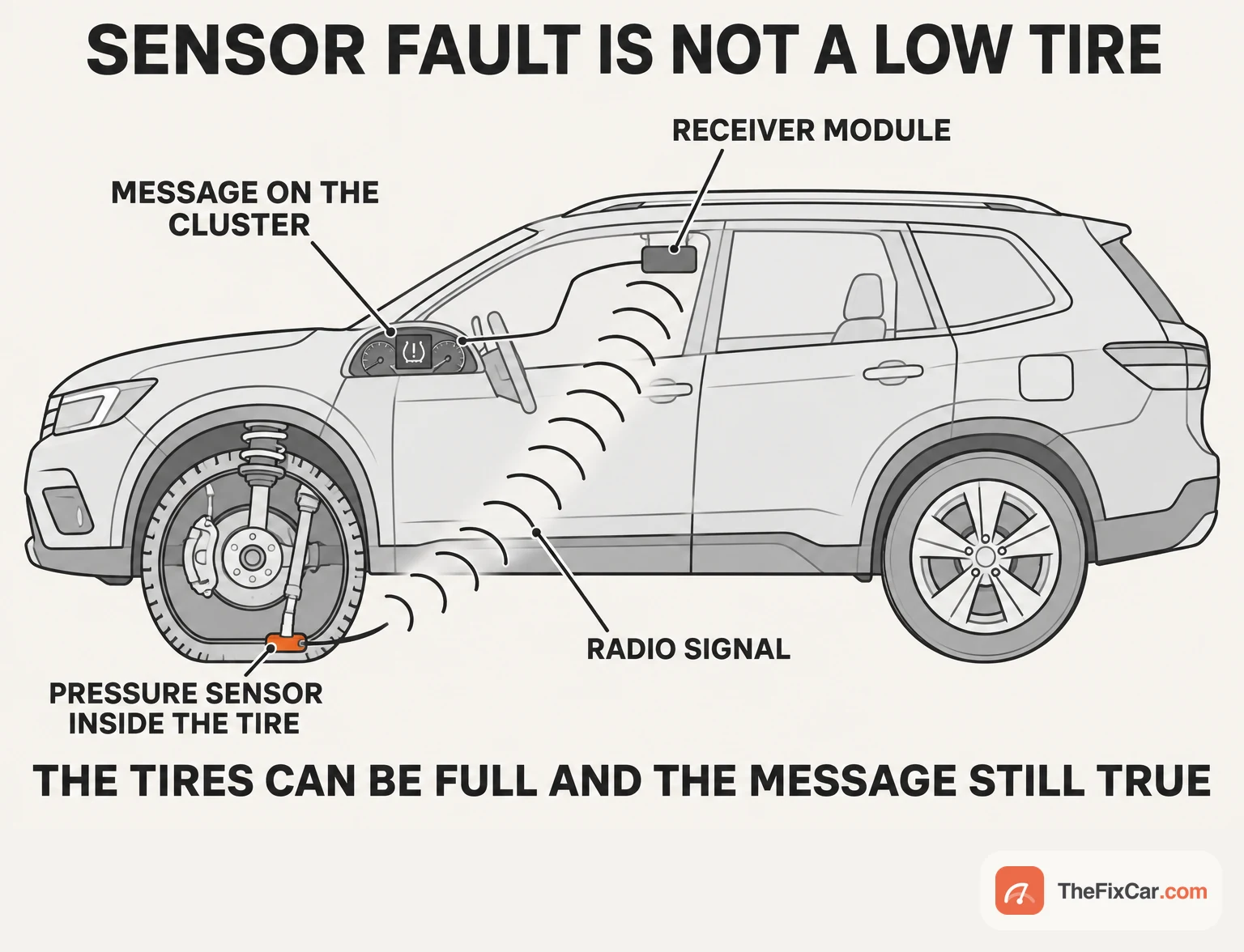
Each road tire on the 2020 Explorer carries a pressure sensor inside the wheel and tire cavity, attached to the valve stem and invisible until the tire comes off[1]. The sensors send their readings to the vehicle, and one warning light on the cluster carries both the low-pressure warning and the malfunction warning[1]. The text in the information display says which one is being reported. It does not measure the air for you: with a malfunction showing, a tire can still be low.
Ford’s 2020 Explorer manual describes the malfunction pattern this way: the telltale flashes for approximately one minute, then stays on, and repeats that at every start-up for as long as the malfunction exists[1]. The timing matches federal law. Federal Motor Vehicle Safety Standard 138 requires a combined telltale to flash for at least 60 seconds and no longer than 90 seconds after the ignition is switched on, then remain lit, and it allows up to 20 minutes between a malfunction and the warning[5]. So the moment the message appears does not date the fault. Ford’s troubleshooting chart for the 2020 Explorer lists a spare in use and a TPMS malfunction under both the solid and the flashing light[1], so read the lamp, the message text and a gauge together.
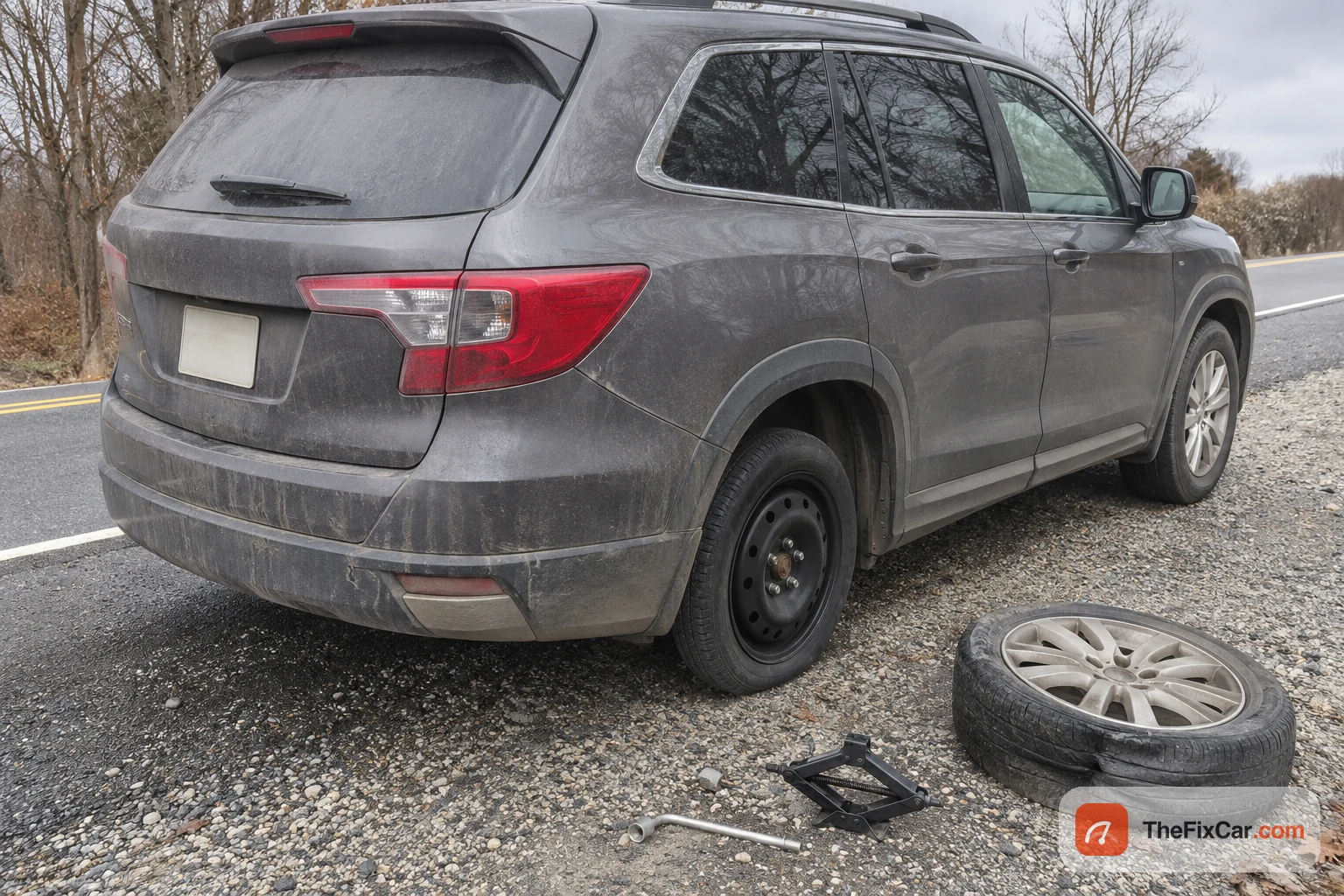
The spare is the expected half of the message. Ford’s instruction for the 2020 Explorer is that all road wheels equipped with sensors must be mounted on the vehicle to restore the full function of the system, and that the system will keep identifying an issue as a reminder until the damaged wheel is repaired and refitted[1]. If you are on the spare, the message is doing its job, and the spare’s own speed and load limits still apply. Our guide to changing a tire covers the swap back.
Symptoms and what else causes them
With four road wheels on the car and correct pressures, the message still needs a diagnosis. It does not say which sensor, or prove that a sensor has failed. The table lists the candidates, most of them named in Ford’s documents.
| Symptom | Competing sources | Clues that shift suspicion |
|---|---|---|
| Message stays on, tires at label pressure | A failed or damaged sensor; a spare still fitted; a replacement sensor never trained to the vehicle; a module fault | A spare on the car explains it. Recent tire work points at damage or training. A 2020 Escape S with keyed ignition built 22 July to 5 August 2020 points at the body control module[4] |
| Message appeared right after a tire shop visit | Sensor damaged during the tire change; tires or wheels that do not let the system work; rotation without training | Ford warns that the sensor is hidden under the tire and can be damaged in a tire change, and that replacement tires or wheels can stop the system functioning[1] |
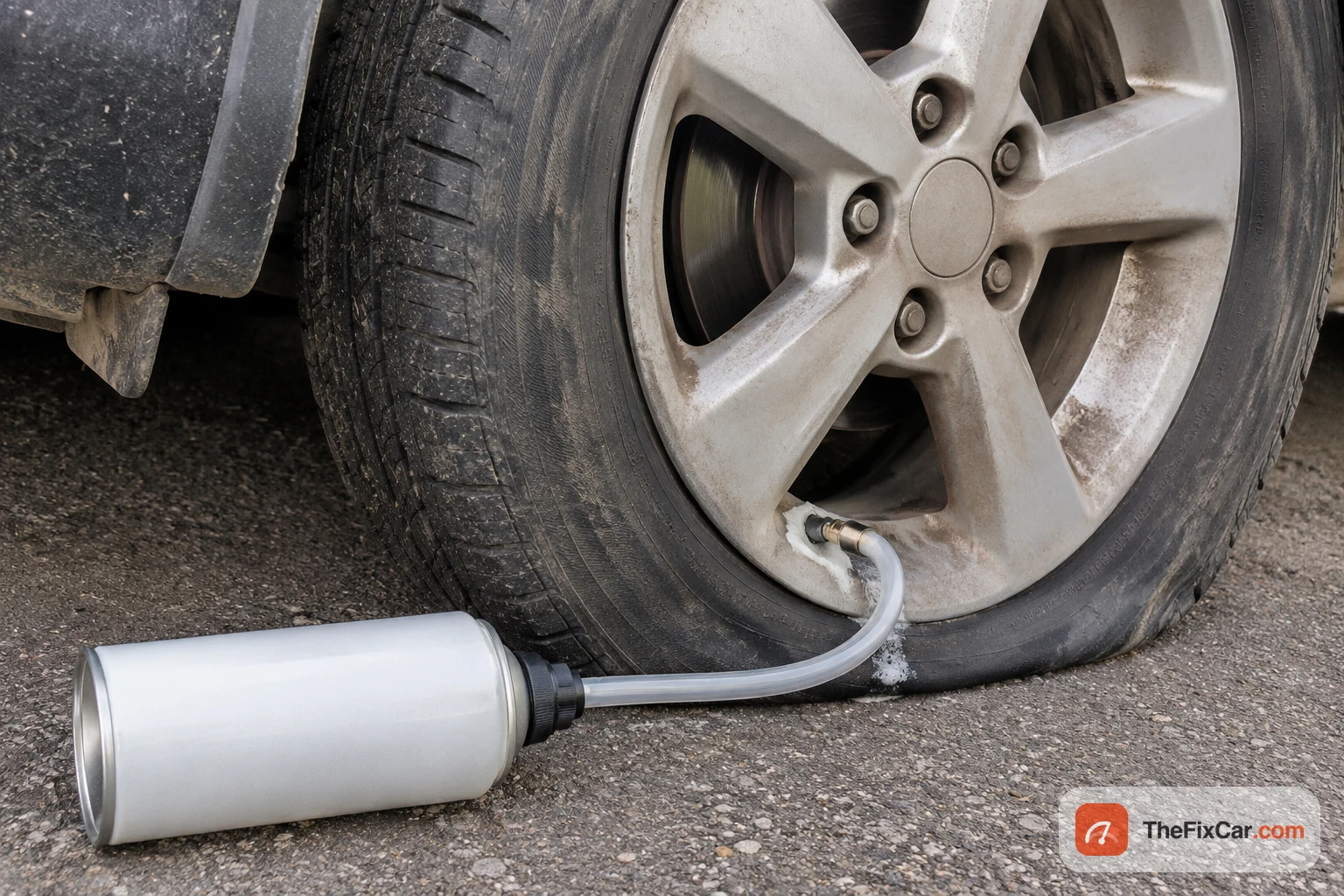
| Message appeared after a can of tire sealant | Sensor damage from the sealant; separately, air loss from the puncture | Ford allows sealant only in roadside emergencies because it could damage the sensor[1]. Tell the tire shop sealant was used |
| Tire light on a 2021 to 2023 F-150 with the 2 kW inverter | Radio interference from the inverter; a sensor fault; other faults that set the same code | Code B124D:02 in the body control module that is gone after a 20 minute road test at 20 mph (32 km/h) or higher with the inverter unplugged[2] |
| Tire light plus a key fob that only works up close, 2021 F-150 with navigation | Telematics control unit, per Ford; two unrelated faults at the same time | Ford’s test for its technicians: remove the telematics fuse and see whether the concern is no longer present[3] |
| Light on a cold morning, gone by afternoon | Low pressure from the temperature drop; an intermittent system fault | Read the message and use a gauge. Ford: pressure could fall about 3 psi (21 kPa) for a 30°F (17°C) overnight drop, which could trigger the low-pressure light[1] |
Sensor fault, or something else?
Three of Ford’s service documents describe a tire light whose cause may sit outside the wheels. They are written about the warning lamp and the stored code, not about the exact text on the display, and each applies only to the vehicles it names.
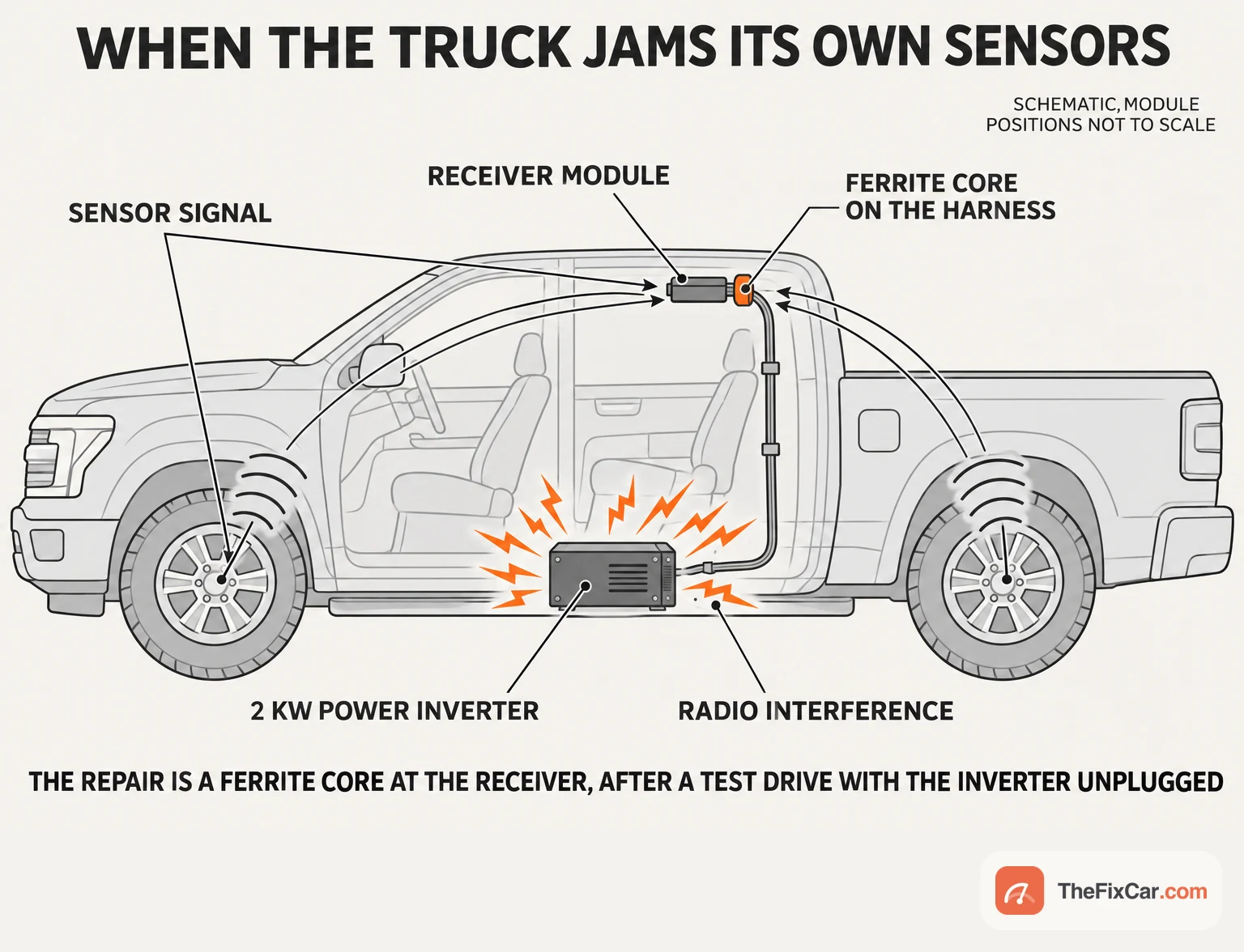
2021 to 2023 F-150 with the 2 kW inverter. Ford Technical Service Bulletin 24-2122, dated 25 April 2024, covers F-150 trucks built with the 2 kW onboard inverter (minor feature code HUKAK) that show the tire pressure indicator with code B124D:02 stored in the body control module. Ford says this may be due to radio frequency interference from the inverter, and gives a test. The technician unplugs the inverter connector and road-tests for 20 minutes at 20 mph (32 km/h) or higher. If B124D is still present afterwards, the bulletin does not apply and Ford sends the technician to normal diagnosis. If it is gone, the repair is a snap-on ferrite core on the harness about 1 inch (25 mm) before the radio transceiver module’s connector, followed by a second 20 minute road test[2]. The bulletin excludes trucks with the 400 W inverter and is written for technicians, not as a driveway job[2].
2021 F-150 with navigation. Ford Special Service Message 50098 links an illuminated tire pressure indicator, reduced key fob range, or both, to the telematics control unit. The check is to pull that module’s fuse; if the concern disappears, the module is replaced[3].
2020 Escape S with keyed ignition, built 22 July to 5 August 2020. Special Service Message 49193 is blunt: sensor replacement will not resolve the illuminated lamp because of internal components of the body control module, and if diagnosis leads to a sensor with pressures set to placard, the dealer replaces the module instead[4].
The F-150 bulletin is also a lesson about fault codes. On those trucks Ford does not accept B124D:02 as a verdict on a sensor: the code leads to an interference test first, and to the rest of the diagnosis only if the code survives it[2]. A stored code is where the diagnosis starts, not where it ends.
What to check first
Start with a gauge. Ford’s warning for the 2020 Explorer is that the pressures shown in the information display are not a substitute for one[1]. The label pressures are explained in our tire pressure specifications. Then:
- Look at what is bolted on. A spare in use is one of the two meanings Ford gives the message. Ford’s fix is the repaired road wheel back on the car, not a reset[1].
- Switch off, switch on, watch the lamp. About a minute of flashing followed by a steady light is the malfunction pattern[1][5]. Read the text in the display at the same time: “Low”, “Sensor Fault” and “Monitor Fault” are three different findings.
- Write down what changed. New tires or wheels, a rotation, a sensor replaced, sealant used, a module reprogrammed. One Ford message for 2021 F-150 trucks built on or before 24 February 2021 tells technicians to relearn the tire pressure sensors after a body control module software update[6], so module work belongs on the list. Give the list to whoever reads the codes.
How the Ford reset works, and what it cannot do
Ford’s “Tire Pressure Monitoring System Reset Procedure” is sensor training: it teaches the module which sensor sits at which corner. The 2020 Explorer manual requires it after each tire rotation, because vehicles with different front and rear pressures warn at two different thresholds and need to know which tires are on the front[1]. The procedure uses released air, not a dedicated TPMS tool, so have a pump and a gauge ready. The horn tone confirms that the module learned a sensor for that corner. It is not a health test, and the module cannot learn a sensor it never hears. A newly installed sensor is a separate case. Service data for the 2023 F-150 from Mitchell 1, published by Modern Tire Dealer, says the reset procedure in the owner’s literature does not program new sensors to the module[7]. If a replacement sensor will not train, that is a job for the shop’s own training procedure, not for another round with the hazard switch.
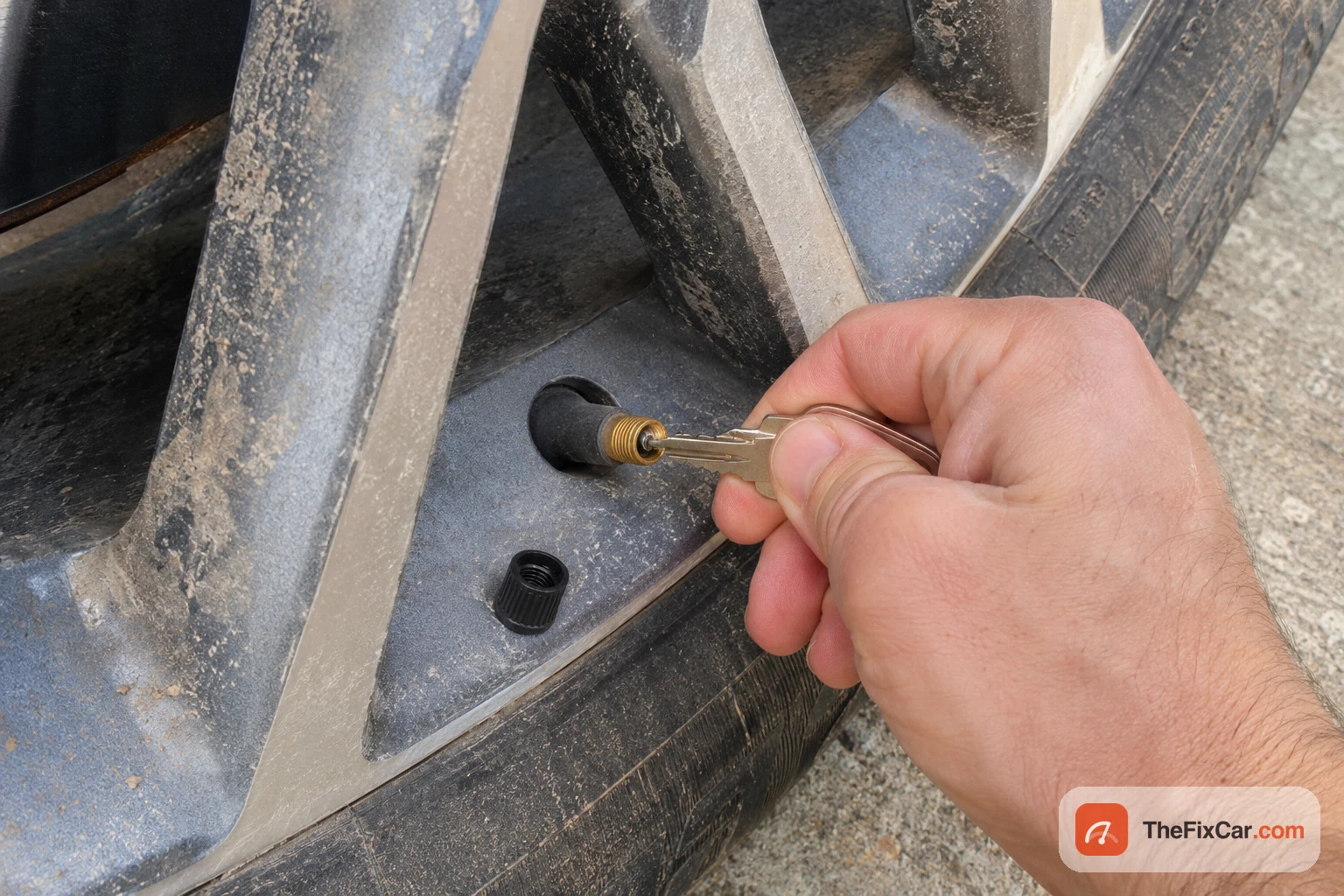
The procedure in the 2020 Explorer manual, in short[1]. Read the full version in your own manual before starting, and do not attempt it on a tire that is damaged or losing air:
- Drive above 20 mph (32 km/h) for at least two minutes, then park where you can reach all four tires and an air pump.
- Ignition off with the key left in, then on with the engine off.
- Turn the hazard flashers on then off three times within 10 seconds. The horn sounds once, the indicator flashes and a message appears.
- Starting at the left front, remove the valve cap and let air out until the horn sounds. Repeat at the right front, right rear and left rear, with no more than two minutes between wheels. If a wheel never produces the horn, stop letting air out and refill it. Training is complete when the horn sounds for the last tire, the indicator stops flashing and a message appears.
- Ignition off. Two short horn beeps mean the procedure failed and must be repeated. If it fails again, Ford’s instruction is a dealer.
- Set all four tires back to the label pressure with a gauge.
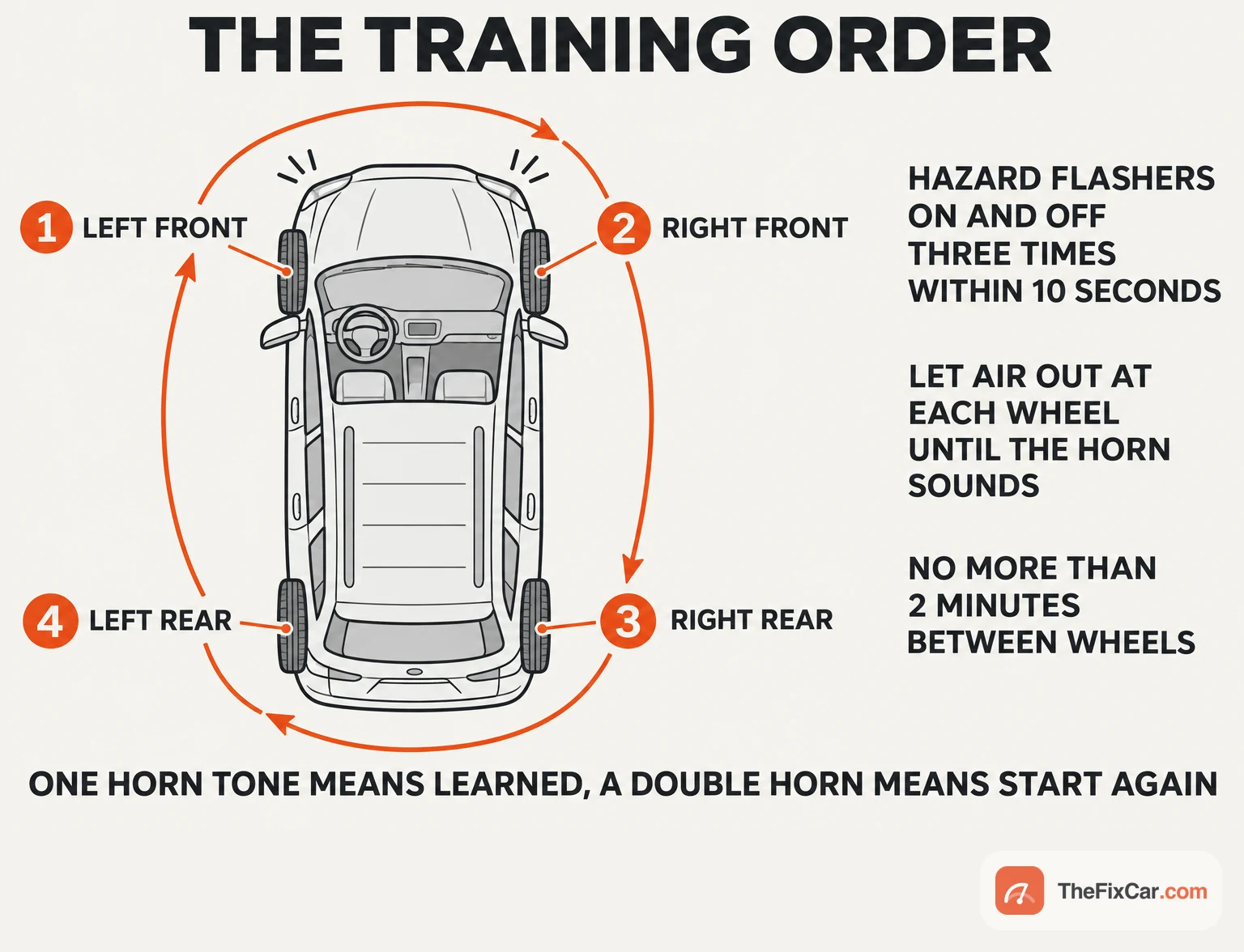
The 2023 F-150 owner’s manual prints the same hazard-flasher entry, the same instruction to let air out until the horn sounds and the same two-minute limit[8]. The entry steps are printed per model and year, so use the procedure in your own manual. Ford adds a tip for busy shops and driveways: keep at least 3 ft (1 m) from another Ford going through the same procedure at the same time[1].
A single horn tone is the module confirming that it learned a sensor for that position; a double horn means the attempt failed[1]. A wheel that never produces the tone while the other three do is a hint about where to look, although the silence could come from the sensor or from whatever is blocking its signal. If repeated attempts to enter the mode produce no horn, no flashing indicator and no message, Ford’s instruction is to seek service[1].
Can you drive with “Tire Pressure Sensor Fault”?
The message alone does not say the tires are safe. Check all four with a gauge against the label and look them over for damage first. If they hold pressure and the car drives normally, you can drive, but without the automatic low-pressure warning: Ford says that with the malfunction indicator lit the system will not detect or signal low tire pressure as intended[1]. Check pressures by hand until the fault is fixed, and book the repair.
Stop and deal with the tire, not the message, if:
- a tire looks low or flat, or the car pulls, wobbles or vibrates;
- the display shows “Tire Pressure Low” as well;
- a spare is fitted and you are asking more of it than its label allows. As maximums, not cruising speeds, Ford sets for the 2020 Explorer 50 mph (80 km/h) for a T-type mini spare and for a full-size spare labeled for temporary use, and 70 mph (113 km/h) for an unlabeled dissimilar full-size spare[1].
FAQ
What does Tire Pressure Sensor Fault mean?
In Ford’s 2020 Explorer owner’s manual, “Tire Pressure Sensor Fault” means a tire pressure sensor is malfunctioning or the spare tire is in use[1]. It is separate from “Tire Pressure Low”, which reports low air, and from “Tire Pressure Monitor Fault”, which reports a malfunction of the monitoring system.
Why does it say Tire Pressure Sensor Fault but the tires are fine?
Because the message is about the monitoring hardware, not the air. With correct pressures and no spare fitted, the causes in Ford’s documents include a damaged or failed sensor, a sensor never trained after tire work, tires or wheels the system cannot work with, and on specific F-150 and Escape models radio interference or a control module[1][2][4].
How do I reset a Tire Pressure Sensor Fault on a Ford?
Ford’s reset procedure trains the sensors to their wheel positions. On the 2020 Explorer and 2023 F-150 it is entered by switching the hazard flashers on and off three times within 10 seconds, then letting air out of each tire in turn until the horn sounds[1][8]. Training records which sensor is at which corner. It does not repair a failed sensor, and a warning that stays afterwards still needs diagnosis.
How do I fix a Tire Pressure Sensor Fault?
Refit the repaired road wheel if a spare is on, set the pressures, and run the training procedure in your manual if the tires were rotated. If the message stays, have the stored codes read before buying parts. Ford’s manual sends owners to a dealer when the warning stays on or keeps returning[1].
Can a tire shop cause a Tire Pressure Sensor Fault?
It can happen. On the 2020 Explorer the sensor sits on the inside end of the valve stem, hidden by the tire, and Ford warns that it can be damaged during a tire change and that sealant could damage it too[1]. The 2020 Explorer manual also lists a rotation without sensor training among the causes of a flashing warning light[1].
What is the difference between Tire Pressure Sensor Fault and Tire Pressure Monitor Fault?
Ford’s 2020 Explorer manual assigns “Sensor Fault” to a malfunctioning sensor or a spare in use, and “Monitor Fault” to a malfunction of the tire pressure monitoring system[1]. In Ford’s wording the first is about one sensor or the spare, the second about the system.