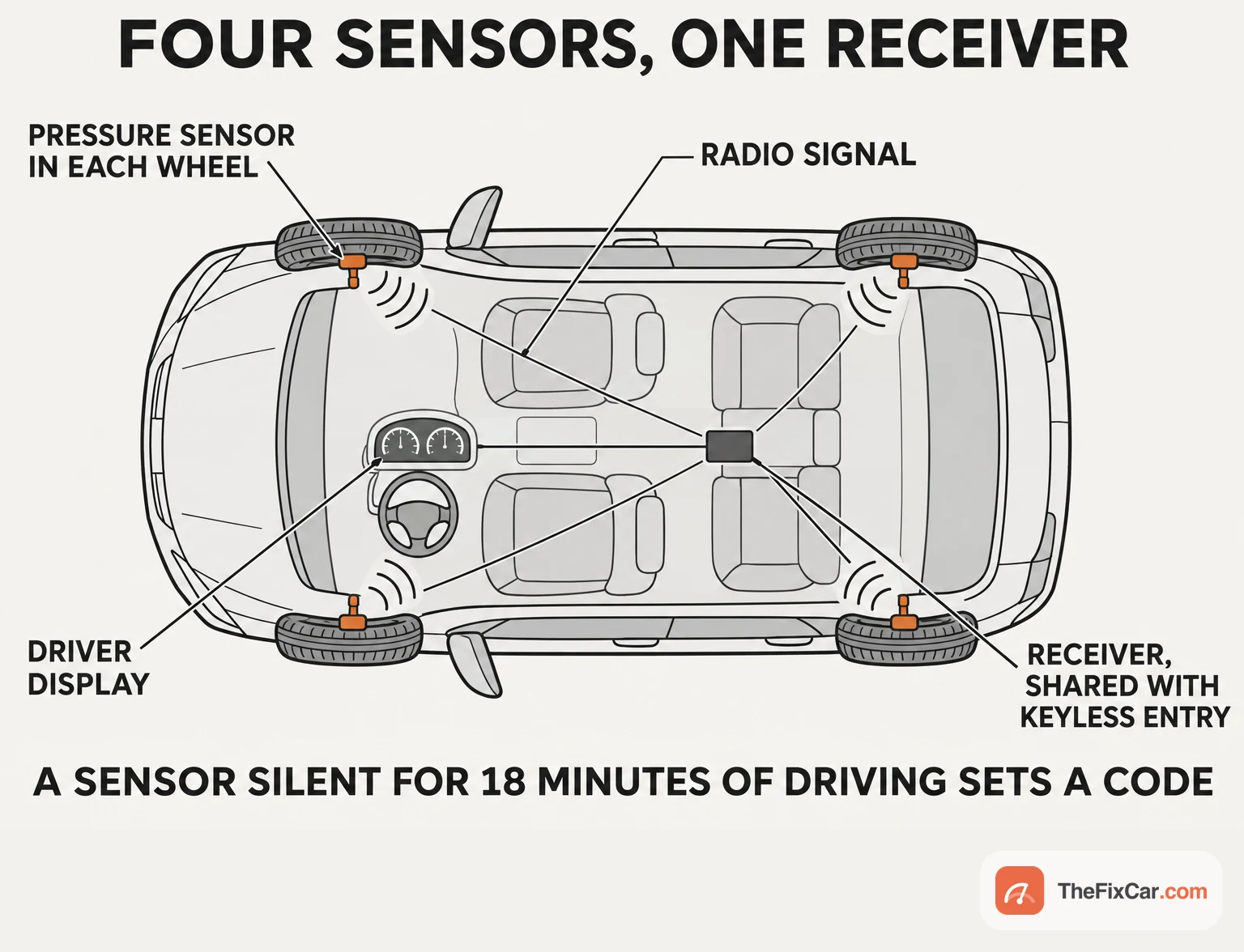
“Service Tire Monitor System” on a Chevrolet, GMC, Buick or Cadillac is not a low-tire warning. General Motors bulletin 07-03-16-004E, written for 2023 and prior GM passenger cars and light-duty trucks, separates the two: a “Check Tire Pressure” or “Low Tire Pressure” light stays on solid and sets no codes, while a Service Tire Monitor light blinks, the message appears and the system stores a code[1]. GM’s own example of a fault is a wheel sensor that sends nothing for 18 minutes of driving[1]. Set the pressures anyway, but air alone does not repair a sensor that has gone quiet.
The stored code is filed against a wheel position, and it is tempting to buy the sensor for that wheel. GM’s bulletins keep going: on the vehicles they cover, the message, the blinking lamp or the dashes were traced to a loose antenna cable, to the receiver that also handles the key fob, to a sensor on the wrong radio frequency, to a spare tire with no sensor in it and to a relearn that stored another car’s sensor[2][3][4][5][6]. This page sorts those causes by what the driver can see: which readouts show dashes, what the key fob is doing, and what was done to the wheels last.
Quick answer
Put a gauge on all four tires first. Then turn the key off and on, watch the tire light for the first minute, and have the stored codes read before anyone sells you a sensor.
| What you see | Where to look | What to do first |
|---|---|---|
| Light on solid from key-on, “Check Tire Pressure” or “Low Tire Pressure” | Tire and Loading Information label in the driver door opening, and a gauge | Set the pressures cold. GM: the system is working as designed, low pressure alone sets no code and no relearn is needed after adding air[1] |
| Light blinks for about a minute, then stays on, with “Service Tire Monitor System” | Stored tire pressure monitor codes | Have the codes read. GM treats this as a condition to diagnose, not a pressure to top up[1] |
| The message appeared after a tire rotation, a new sensor or different wheels | Whether the sensors were matched to the vehicle afterwards | Check whether your owner manual calls for sensor matching after that work, and run it if it does. The 2019 Silverado 1500 manual lists an unfinished matching process among the causes of the malfunction light[7] |
| The message appeared with the spare on the road | Which wheel is on the car | Expected on the 2019 Silverado 1500: its spare carries no sensor. Refit the road tire and match the sensors[7] |
| The message plus short key fob range, “No Fob Detected” or “No Remote Detected” | The receiver and its antenna lead, on the models in GM’s bulletins | Have the receiver side checked before any wheel sensor is replaced[2][3][8] |
| Dashes or 148 psi in the readouts after a battery disconnect, light not blinking | The tires themselves, with a gauge | Check the pressures and the tires by hand; if they are sound, drive above 20 mph (32 km/h) for 2 minutes. GM says the system is waiting for the sensors to report and no malfunction warning is shown[1] |
A guide to where to look first, not a diagnosis: each row has more than one cause.
What “Service Tire Monitor System” means
GM’s tire pressure monitor has four sensors, one in each wheel, sending radio signals to a receiver in the vehicle, which GM describes as typically the same receiver that does keyless entry[1]. One amber lamp, the horseshoe with an exclamation point, carries both warnings. GM bulletin 07-03-16-004E gives the rule for telling them apart on 2023 and prior Buick, Cadillac, Chevrolet and GMC cars and light trucks: a low tire puts the lamp on solid immediately after key-on with a “Check Tire Pressure” message, and a system malfunction makes it flash for the first 60 seconds of key-on and then go solid[1]. The bulletin excludes the Saturn Astra and Canadian vehicles built without the system[1].
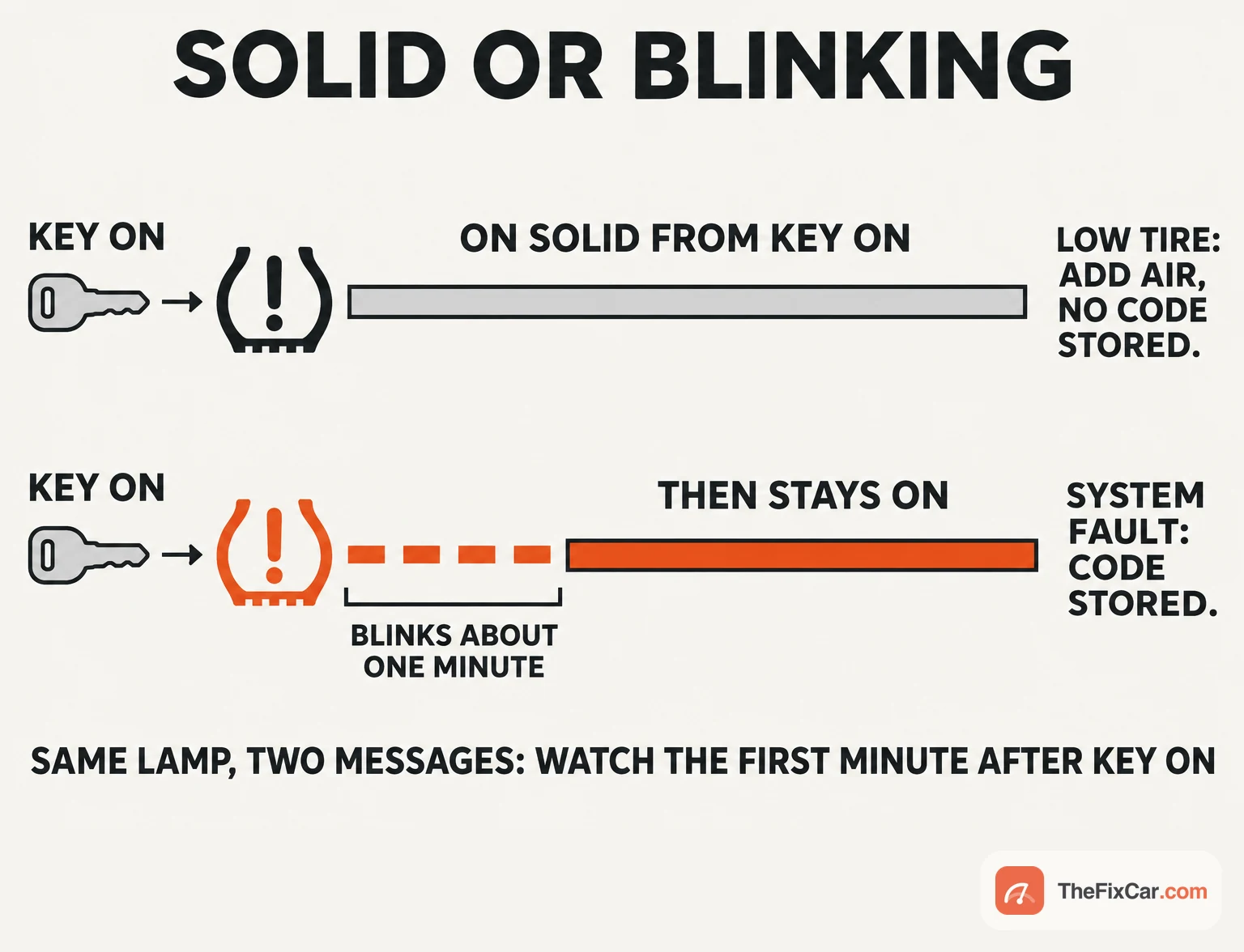
The blink is not a GM habit. Federal Motor Vehicle Safety Standard 138 requires a combined low-pressure and malfunction telltale to flash for at least 60 seconds and no longer than 90 seconds after the ignition is switched on, then stay lit while the malfunction exists, and to repeat that at every key-on until the cause is corrected[9]. The same standard allows up to 20 minutes between a malfunction and the warning[9], so the moment the message appears does not tell you when the fault began.
Two more lines from the GM bulletin matter before any money is spent. Codes are reported only with a malfunction: a low tire by itself, with its solid lamp, sets none[1]. And an intermittent fault gives an intermittent message, on during some ignition cycles and off during others[1], so a message that went away by itself is not proof that the fault has gone. Tell the shop it appeared, even if the lamp is behaving today.
What to check first
Start with a gauge on all four tires. With the malfunction lamp on, do not count on the system to watch them for you. The cold pressures to set are on the door label and explained in our tire pressure specifications. Then:
- Key off, key on, watch the lamp. Solid from the start points to pressure, and a low tire and a system fault can be present together. About a minute of blinking, then solid, is the malfunction warning, and GM’s advice to its own dealers is to repeat the key cycle while watching the lamp and the message if there is any doubt[1].
- Write down the dashes and test the fob. Which readouts are blank, and does the remote still work from about 30 ft (9 m) at each corner? That check comes from GM’s PI1085A for 2012 to 2013 trucks and crossovers[8]; on those vehicles GM uses it to choose between normal tire monitor diagnosis and a new receiver. On other models it is a free observation worth handing to the shop.
- Recall what was done last. Rotation, new tires, different wheels, a spare, a new battery. Then have the codes read with a scan tool that reaches the body and chassis modules, which a basic engine-code reader may not, and each sensor woken with a TPMS tool. A sensor that answers the tool but still shows dashes on the display is a reason to check its type, its matching and the vehicle’s reception before replacing it. One reply at a standstill does not rule out a sensor that drops out on the road.
Symptoms and what else produces them
The Driver Information Center shows more than the message. The GM bulletins cited here use two of its details as clues: the pattern of dashes and the behaviour of the key fob.
| Symptom | Competing sources | Clues that shift suspicion |
|---|---|---|
| Dashes in one or two tire readouts | A sensor that has stopped transmitting; a relearn that stored another vehicle’s sensor | GM’s 2006 to 2014 service-lane bulletin says dashes in only one or two readouts are likely an earlier relearn done incorrectly because of interference from another vehicle’s sensors[6]. Ask whether the wheels were off or the tires rotated shortly before the message appeared |
| Dashes in three readouts, right rear still reading | Three sensors failing together; the receiver’s coax cable off at the antenna amplifier | On the 2014 to 2018 Cadillac ATS, CTS and XTS and the 2015 to 2018 Escalade, Suburban, Tahoe and Yukon, GM describes exactly this: the three sensors farthest from the receiver drop out and the right rear, the closest, keeps reporting[2] |
| Dashes in all four readouts | A receiver that hears no sensors at all; a battery that was just disconnected | With the lamp blinking, the 2006 to 2014 bulletin calls it a system problem[6]. With no blinking after battery work, GM calls it normal until the sensors report[1] |
| Message plus weak or dead key fob, “No Fob Detected”, “No Remote Detected” | Receiver antenna lead; the receiver itself | The tire sensors and the fob talk to the same receiver on these vehicles, so two unrelated-looking complaints arriving together point at the shared part[2][3][8] |
| A scan tool wakes the sensor, but the vehicle will not learn it | Sensor on the wrong frequency; wrong vehicle selected on the tool; the matching window timed out | GM bulletin 16-NA-043 covers this on 2016 and 2017 GM vehicles with accessory wheels[4]. GM’s EL 52545 tool reporting “Sensor Not Compatible” has found a working sensor of the wrong type for the vehicle selected[1] |
| Message comes and goes between drives | An intermittent sensor or receiver fault; radio interference | The 2019 Silverado 1500 manual lists electronic devices and facilities using similar radio frequencies among the causes[7]. Note where and when it happens, and whether the fob misbehaves at the same time |
Sensor fault, or something else?
Several entries on GM’s own lists are not failed sensors. Rule them out before a wheel sensor is ordered.
The spare is on the road
The 2019 Silverado 1500 owner manual says the sensors are mounted in each tire and wheel assembly except the spare, and it puts “one of the road tires has been replaced with the spare tire” first on its list of conditions that turn on the malfunction light and message[7]. The message is the system reporting, correctly, that one wheel position has gone silent. It should go off after the road tire is back on and the matching process has been completed[7]. If a flat is what put the spare on, the steps are in how to change a tire safely at the roadside.
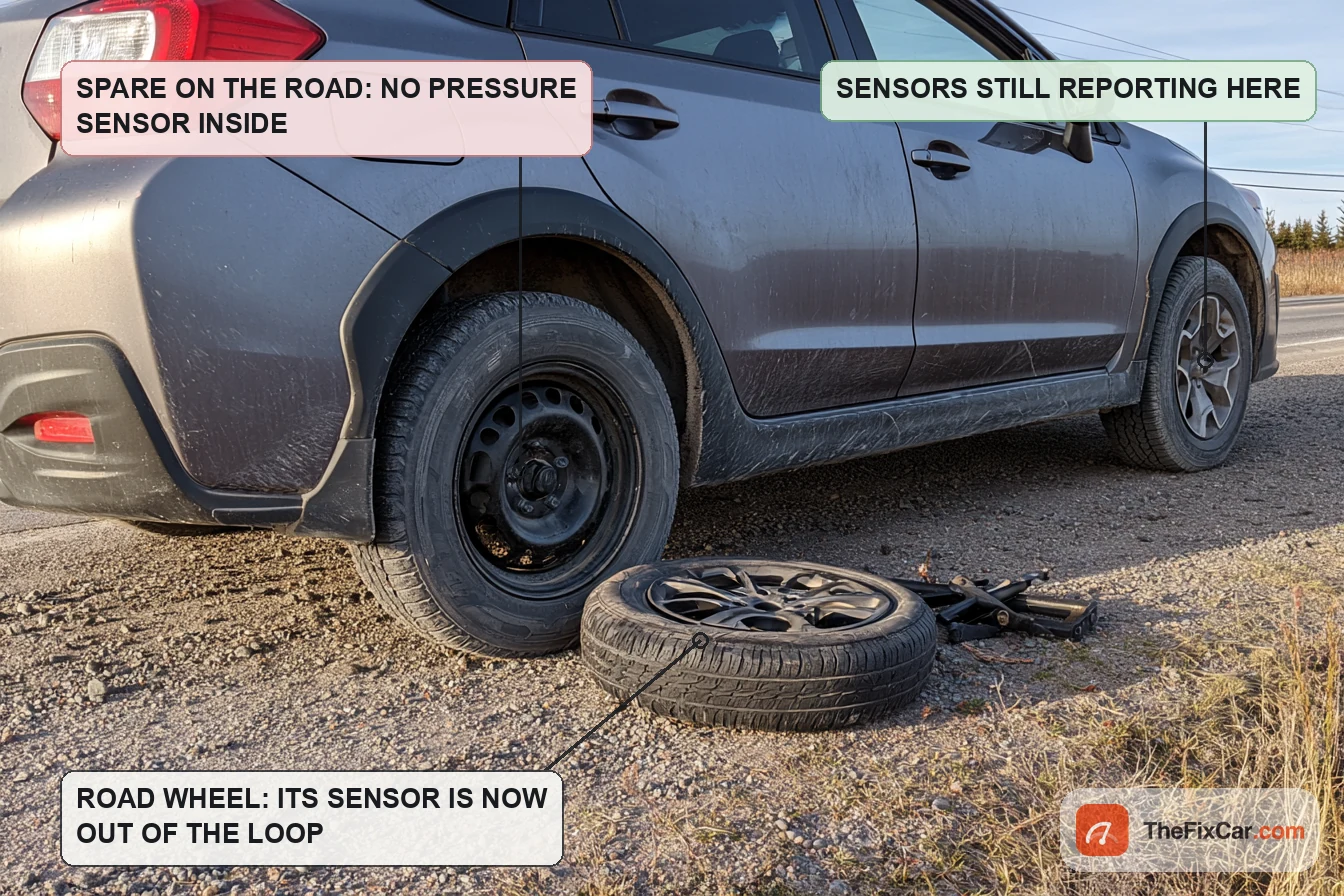
GM documented one case where the spare was meant to have a sensor and did not. Program bulletin 29110 covers certain 2014 to 2016 Chevrolet Silverado and GMC Sierra trucks ordered with a full-size spare and road wheel (option SEO 00A) that may have been built without a sensor in that spare: put it into rotation, program the system to the wheels in use, and a tire pressure monitor error is displayed[5]. Dealers were told to install a sensor, and the program ran until April 30, 2018[5]. A truck from those years that was never brought in can still carry the empty spare.
The sensors were never matched
Each sensor broadcasts its own ID, and the receiver stores which ID sits at which corner[1]. How the IDs get stored depends on the model year: older trucks need a tool, and by 2025 the Silverado 1500 learns them by itself (both methods are below). GM says sensor learning should be done when the tires are rotated or a sensor is replaced, and must always be done when accessory wheels are installed[1]. It is not needed after adding air[1]. If your shop rotates tires on the schedule in our guide to how often to rotate tires, the matching step belongs on the same work order.
The opposite mistake is also in GM’s files. The service-lane bulletin for 2006 to 2014 GM cars and trucks warns that a relearn can pick up a sensor from another vehicle in the shop, and tells dealers to start the relearn from the scan tool because that locks out other vehicles’ signals and avoids storing false IDs[6]. The car leaves with one or two readouts that later turn to dashes.
The sensor is on the wrong frequency
GM bulletin 16-NA-043, for 2016 and 2017 GM passenger cars and trucks with accessory wheels, describes a sensor that the tool can read but the vehicle cannot learn, and gives the cause as a sensor of the wrong frequency in the wheel: these vehicles were built for either 433 MHz sensors (option code XL8) or 314.9 MHz sensors (XL7)[4]. The frequencies are the ones in that bulletin and apply to those two model years; what they show for any GM vehicle is that a sensor can be alive, in the right wheel and still unreadable to the receiver. GM’s general bulletin adds that sensors come from different suppliers and send different radio signals, and that only some are interchangeable[1].
The receiver or its antenna lead
These two bulletins show why a sensor code is not a verdict on the sensor. In bulletin 16-NA-061 GM lists codes C0750, C0755, C0760 and C0765, which it describes as associated with the tire pressure sensors, and then names the cause as a poor or disconnected antenna connection for the Remote Control Door Lock Receiver[2]. In bulletin 16-NA-396 the same four codes, with symptom 29 “Too Few Pulses”, lead to a fault inside the receiver[3]. Read each code with its symptom number and the service information for the vehicle. In these two bulletins the codes did not say which end of the radio link had failed.
Wheels and tires the system was not built for
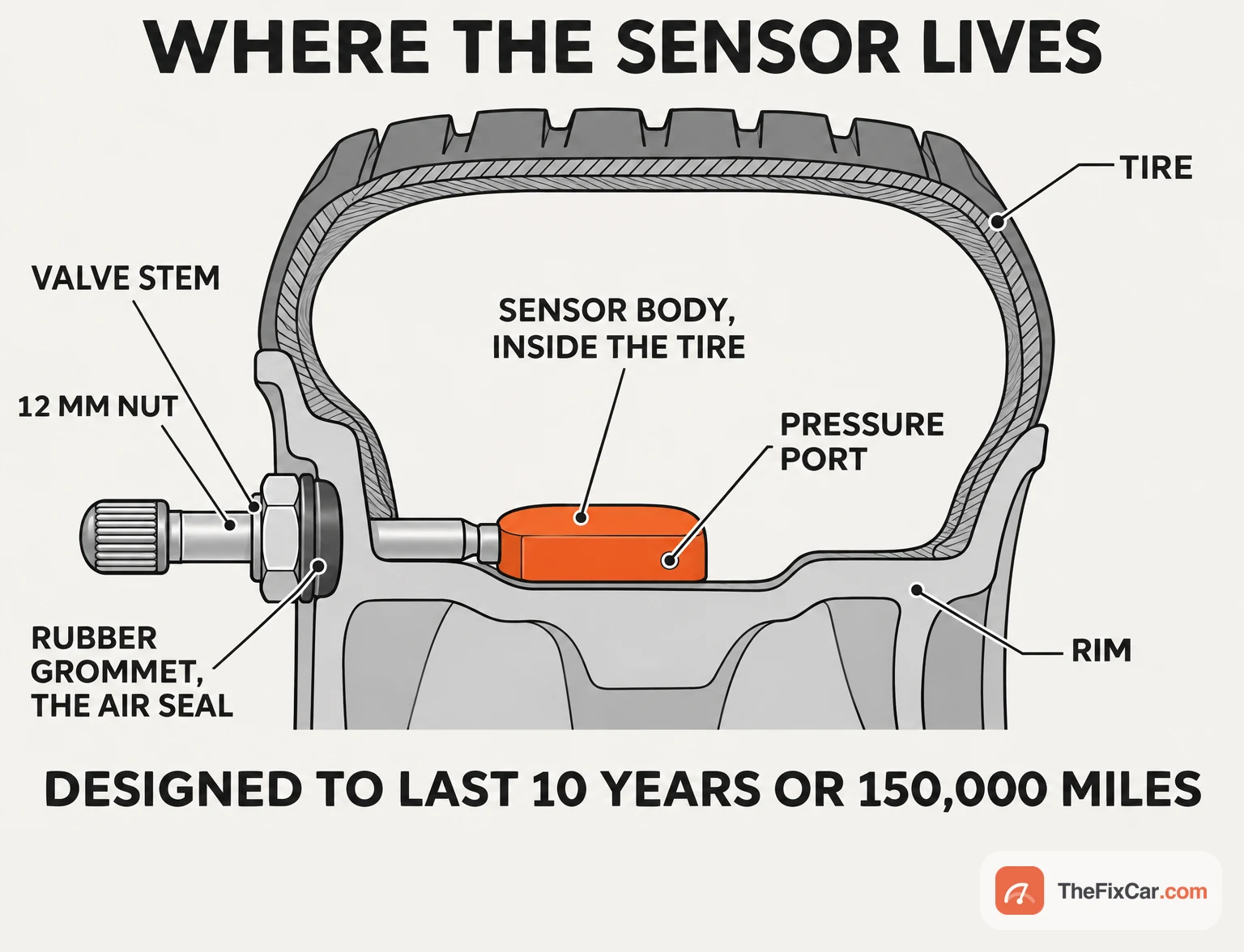
The 2019 Silverado 1500 manual lists replacement tires or wheels that do not match the original equipment among the causes of the malfunction light[7]. GM’s bulletin gives one mechanism: on some aftermarket wheels the valve stem hole points straight into the middle of the wheel, and the motion-detecting parts inside the sensor do not work in that position[1].
The sensor itself
GM states a design life for the sensor of 10 years or 150,000 miles (240,000 km)[1]. That figure is a design target for GM’s own sensors, not a replacement interval, but age alone does not prove a sensor has failed. GM adds two warnings about damage: commercially available tire sealants can clog the sensor’s pressure port, and some can degrade the potting over its electronics, while the sealant in GM’s own inflator kits was tested as compatible; and the port must never be cleaned with a sharp object[1].
By model: what GM’s bulletins say
These are the model-specific GM documents in NHTSA’s archive that tie the message, the lamp or the dashes to a named cause. Each applies only to the vehicles and build dates it lists.
| Vehicles | GM document | What GM found | GM’s correction |
|---|---|---|---|
| 2014 to 2018 Cadillac ATS, CTS, XTS; 2015 to 2018 Cadillac Escalade, Chevrolet Suburban and Tahoe, GMC Yukon | 16-NA-061, December 2017 | “Service Tire Monitor System”, dashes, poor fob range or “No Fob Detected”, with C0750, C0755, C0760 or C0765: receiver antenna connection poor or disconnected[2] | Reconnect and re-evaluate before replacing any component, then perform a tire pressure learn[2] |
| 2016 to 2017 Chevrolet Cruze (VIN B), Malibu (VIN Z), Camaro and Volt, Buick Regal and Verano; 2017 Buick LaCrosse, Cadillac CT6 and XT5, Chevrolet Bolt EV, GMC Acadia (VIN N); 2018 Chevrolet Equinox, each within the bulletin’s build dates | 16-NA-396, October 2017 | Intermittent key fob and passive entry, “No Remote Detected”, tire pressure monitor indicator on with the four sensor codes and symptom 29: fault internal to the receiver[3] | Replace the Remote Control Door Lock Receiver[3] |
| 2012 to 2013 Buick Enclave, Chevrolet Captiva, Silverado, Suburban, Tahoe and Traverse, GMC Acadia, Sierra and Yukon built April 1, 2012 to May 1, 2013 | PI1085A, August 2014 | Very poor remote range, dashes for the rear tire readings, with or without the four sensor codes[8] | Pace off fob range at about 30 ft (9 m) from each corner. Good range: normal tire monitor diagnosis. Poor range or a tire monitor code: replace the receiver[8] |
| 2014 to 2016 Chevrolet Silverado and GMC Sierra with full-size spare (SEO 00A) | Program 29110, April 2016 | Spare may have been built without a sensor[5] | Install a sensor in the spare. Program ended April 30, 2018[5] |
| 2016 to 2017 GM cars and trucks with accessory wheels | 16-NA-043, September 2016 | Tool reads the sensor, vehicle will not learn it: wrong-frequency sensor[4] | Relearn first; if the sensor is defective or the wrong type, replace it with the correct one[4] |
The Equinox, Malibu and Cruze rows are narrow. Bulletin 16-NA-396 covers the 2018 Equinox built from start of production to April 14, 2017, the 2016 to 2017 Malibu built May 20 to December 7, 2016, and the 2016 to 2017 Cruze built August 2 to December 29, 2016[3]. An Equinox, Malibu or Cruze outside those dates, and models such as the Terrain or Trax, fall back on the general bulletin and the diagnosis in GM’s service information.
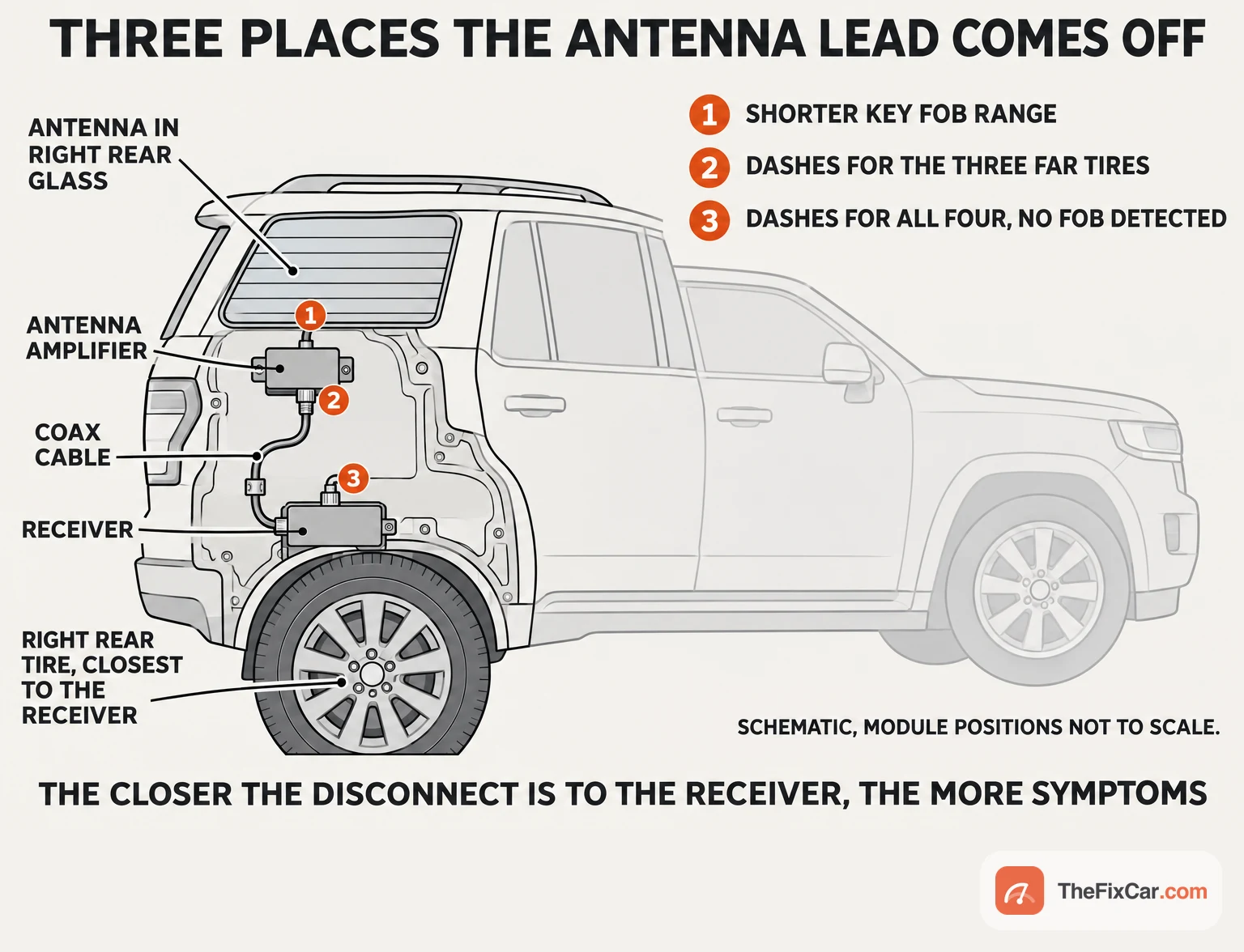
Bulletin 16-NA-061 is the most useful of the group to read as a driver, because it maps symptoms to distance. The receiver’s antenna is in the right rear glass, joined to the receiver by an amplifier and a coax cable, and GM writes that the closer the disconnect is to the receiver, the more symptoms appear[2]. With the amplifier off the glass antenna there may be little more than slightly shorter fob range. With the coax off at the amplifier, the three sensors farthest from the receiver (left front, left rear, right front) may drop out and show dashes while the right rear keeps reporting. With the coax off at the receiver, all four readouts may show dashes and the vehicle may report “No Fob Detected”, though it will start with the fob in its pocket[2]. Three readouts going blank together while the wheel nearest the receiver keeps reporting is the pattern that, on the vehicles in this bulletin, sends the technician to the antenna connections before any wheel sensor.
The relearn, as GM’s 2019 Silverado manual gives it
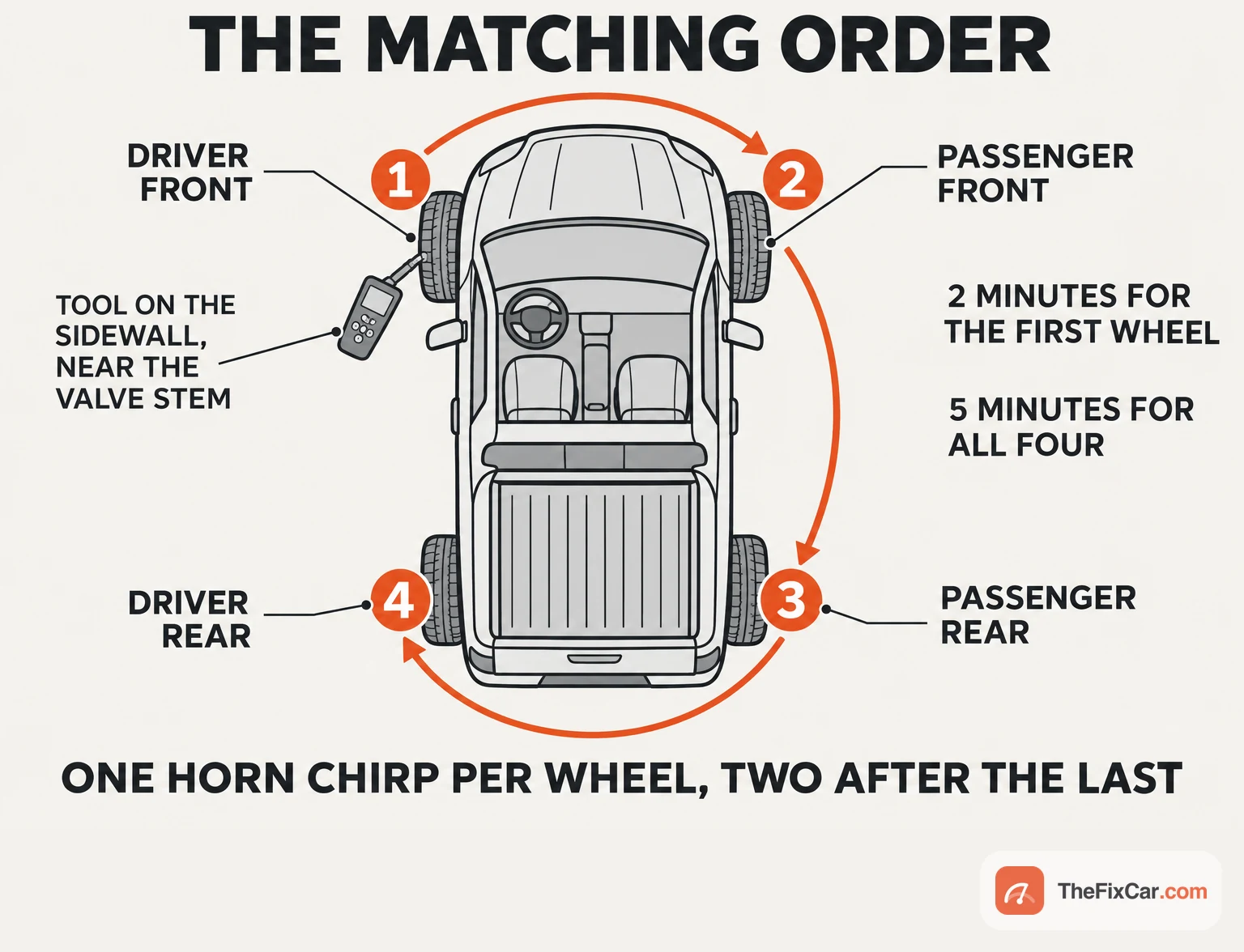
GM calls it the TPMS Sensor Matching Process. On the 2019 Silverado 1500 it is done with a TPMS relearn tool, and the owner manual describes no other method[7]. The manual allows two minutes to match the first wheel and five minutes for all four, after which the process stops and has to be restarted[7]. The steps and the order below are the 2019 Silverado 1500’s. Other GM models and years enter learn mode differently, so follow the Tire Pressure Monitor section of your own owner manual.
- Set the parking brake and turn the ignition on without starting the engine[7].
- Scroll to the Tire Pressure screen in the Driver Information Center; with the uplevel display that page has to be switched on in the Options menu first. With the uplevel display, press and hold the thumbwheel; with the base display, press and hold the trip odometer stem for about five seconds and confirm[7].
- The horn sounds twice and “TIRE LEARNING ACTIVE” appears[7].
- Hold the tool against the tire sidewall near the valve stem of the driver-side front tire and press its button. A horn chirp confirms that wheel[7].
- Repeat at the passenger-side front, passenger-side rear and driver-side rear, in that order. After the last wheel the horn sounds twice and the message goes off[7].
- Turn the vehicle off, then set all four tires to the pressure on the Tire and Loading Information label[7].
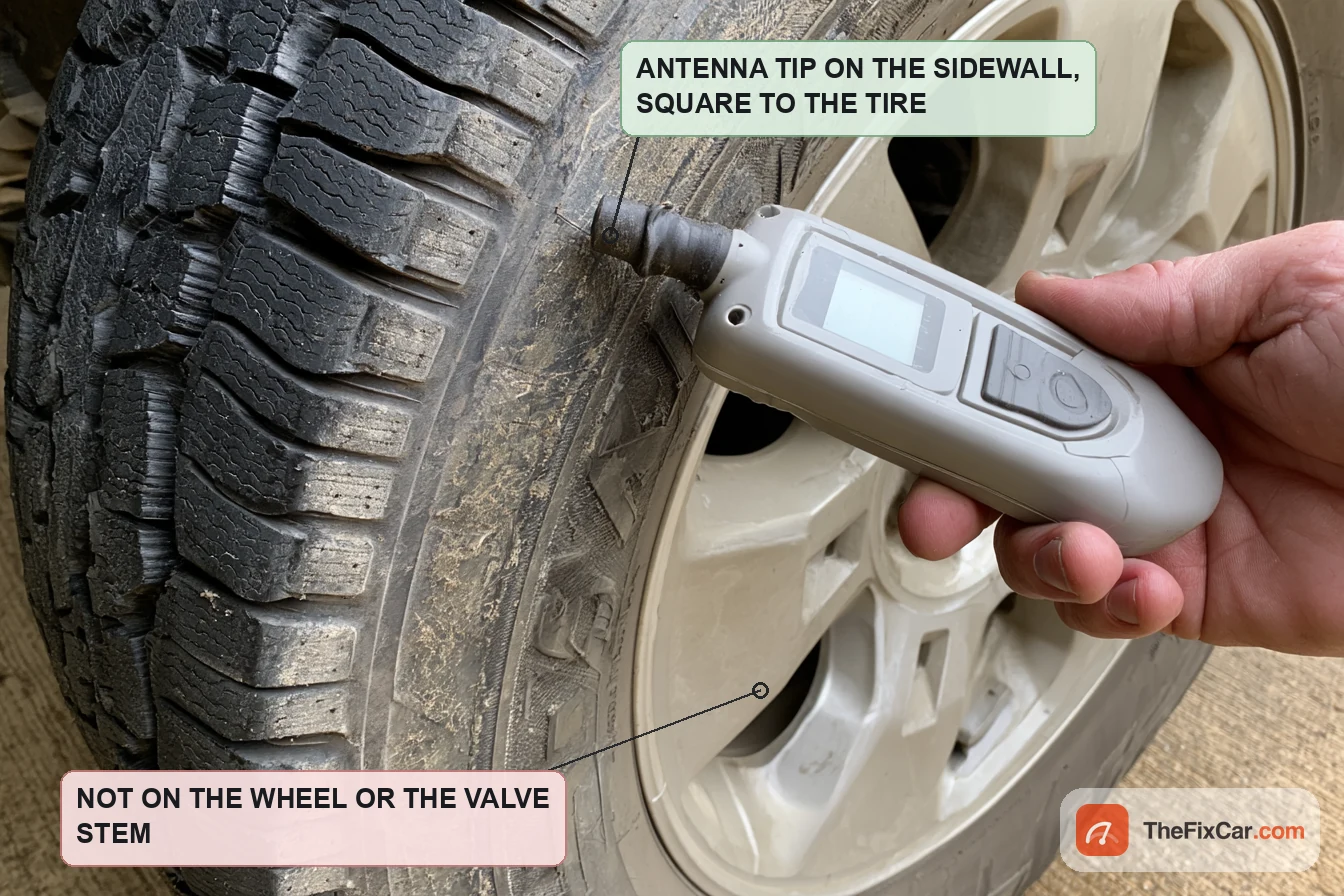
Tool position matters: GM tells its technicians to place the antenna on the sidewall, perpendicular to the tire and close to the valve stem, because a tool held on the stem or on the wheel may not activate the sensor[1]. If one sensor will not answer, GM’s tip is to go back to one that answered before[1]. A reply there shows the tool can wake a sensor; it does not yet say why the other sensor stayed quiet.
GM’s bulletin does mention a slower “Delta P method” of learning sensors by changing tire pressure, without saying which vehicles accept it[1]. Do not let air out of the tires of a truck whose manual lists only the tool.
Newer trucks learn by themselves
The 2025 Silverado 1500 owner manual replaces the tool procedure with what GM calls the Auto Learn Function. After a tire is installed, the truck must stand still for about 20 minutes before the system recalculates; the relearn then takes up to 10 minutes of driving at 12 mph (20 km/h) or more, with a dash or a pressure value in each readout while it runs, and a warning message if the process hits a problem[10]. Those figures are the 2025 Silverado 1500’s. The two manuals cited here do not say in which model year the change was made, so check which procedure your own manual prints before buying a relearn tool.
Can you keep driving?
The message by itself says nothing about the tires, good or bad. If all four road tires are at the door-label pressure by gauge (a spare at the pressure marked on it), show no damage and the vehicle handles normally, the monitoring fault alone is not a reason to stop. What it removes is the warning: the 2019 Silverado 1500 manual says that when the system is not functioning properly it cannot detect or signal a low tire pressure condition[7]. Until the fault is fixed, treat the vehicle as one without a tire pressure monitor. Check all four pressures cold with a gauge now, and keep checking; GM asks dealers to encourage a monthly check even with a working system[1], and with a system that cannot warn you, check more often than that, with a gauge and not by eye.
Stop driving and deal with the tire if:
- any tire looks low, the vehicle pulls to one side or the steering feels heavy;
- you hear a rhythmic thump or feel a new vibration;
- the message appeared together with a pressure reading that was dropping before the display went to dashes.
On a compact spare, stay inside the speed and distance limits printed on it and in the owner manual for the whole trip. And do not have the system disabled as a workaround: GM’s bulletin notes that tire pressure monitoring is a mandated safety system in the United States and cannot knowingly be disabled by the manufacturer or by an aftermarket service provider[1].
FAQ
What does Service Tire Monitor System mean?
On the 2023 and prior GM cars and light trucks covered by bulletin 07-03-16-004E, “Service Tire Monitor System” means the tire pressure monitor has detected a fault in itself and stored a code. The bulletin says the lamp blinks for about one minute and then stays on for the rest of the ignition cycle, and gives a sensor that has not transmitted for 18 minutes of driving as an example[1]. Low pressure produces a different message, “Check Tire Pressure”, with a solid lamp.
How do I fix Service Tire Monitor System?
Find which of the causes applies before replacing anything: a spare on the road, sensors not matched after a rotation or wheel change, a wrong-type sensor, a silent sensor, or a receiver or antenna fault on the models in GM’s bulletins[2][3][4][7]. A scan of the stored codes and a TPMS tool that wakes each sensor in turn narrow the list; receiver, antenna or sensor-type checks for the specific vehicle may still be needed.
How do I reset or clear Service Tire Monitor System?
The GM documents cited here describe no reset button for this message. The 2019 Silverado 1500 manual says the malfunction light and message come on at each ignition cycle until the problem is corrected, and should go off after a successful sensor matching process when matching was what was missing[7].
Why is Service Tire Monitor System flashing or blinking?
The blinking lamp is the malfunction signal itself. Federal Motor Vehicle Safety Standard 138 requires a combined tire pressure telltale to flash for 60 to 90 seconds at key-on when the system has a malfunction and then stay lit[9]. If the message also comes and goes between drives, GM says an intermittent fault produces an intermittent message[1].
Can I relearn a 2019 Silverado TPMS without a tool?
The 2019 Silverado 1500 owner manual says the sensors are matched using a TPMS relearn tool and gives no tool-free procedure[7]. By the 2025 model year the Silverado 1500 manual describes an Auto Learn Function instead: about 20 minutes parked, then up to 10 minutes of driving at 12 mph (20 km/h) or more[10].
Will disconnecting the battery clear the message?
GM’s bulletin says a battery disconnect can leave dashes or 148 psi (1,020 kPa) in the readouts with no malfunction warning, and that driving above 20 mph (32 km/h) for 2 minutes restores the values[1]. Check the tires with a gauge before that drive. And it is the display refilling, not a repair: disconnecting the battery does not repair a sensor that has stopped transmitting, and GM’s tire pressure bulletin repeats that a sensor silent for 18 minutes of driving sets a code[11].
Does cold weather cause Service Tire Monitor System?
Cold is on GM’s list for the other warning. Pressure changes about 1 psi (7 kPa) for every 10 °F (6 °C), so a cold morning can bring on the solid “Check Tire Pressure” lamp, which may go out as the tires warm[1]. The GM documents cited here do not list temperature as a cause of the service message.