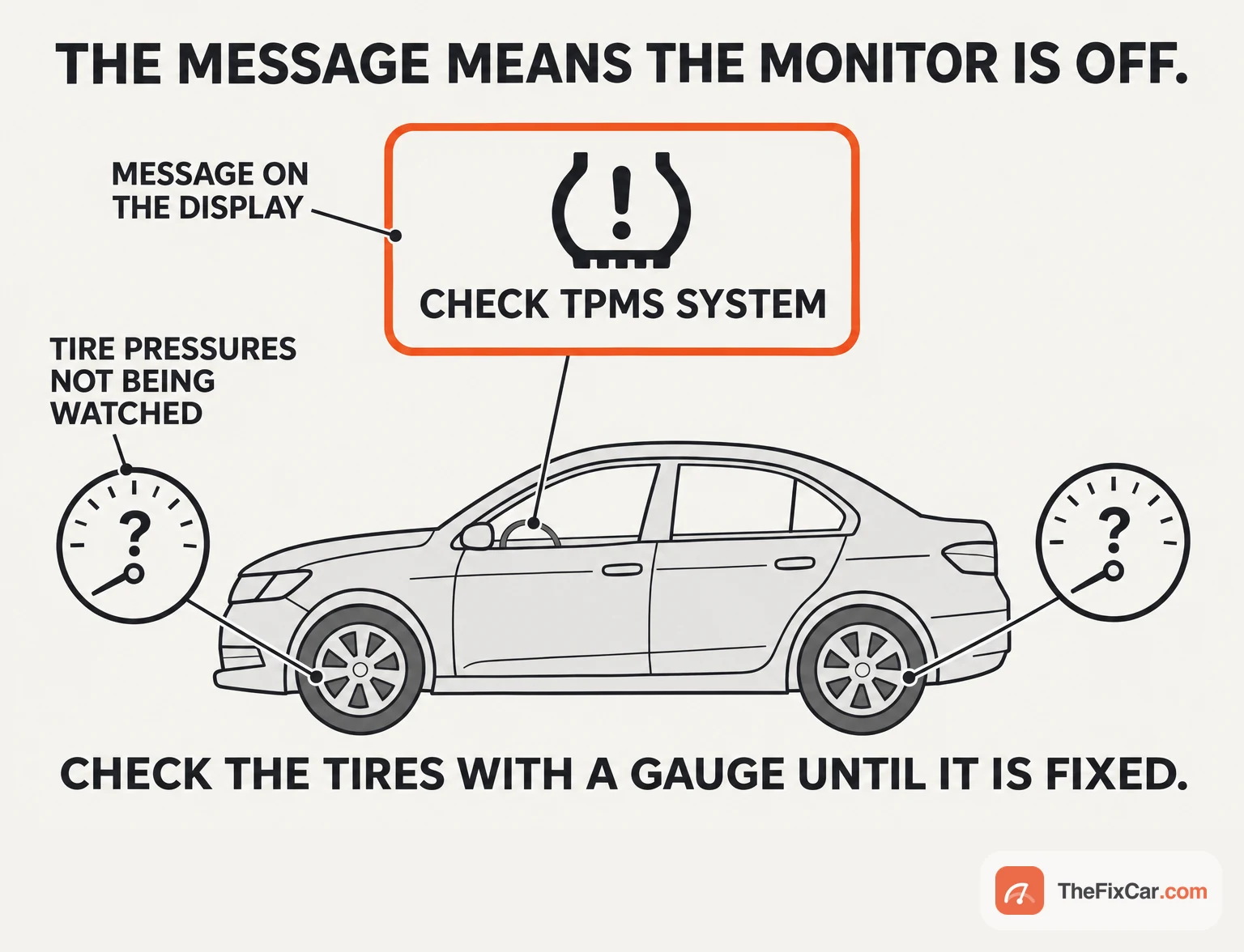
“Check TPMS System” on a Honda or Acura is the car reporting on its tire pressure monitor: a problem with the system, or a compact spare on the car. Honda’s 2011 Odyssey owner’s manual is direct about what that means: “If you see this message, the system is off and is not monitoring the tire pressures”[1]. The low-tire warning is a different message, “Check Tire Pressure”. The sign that goes with the system message is the tire light blinking for about one minute and then staying on[1][2].
Two things make this message easy to misread. With a compact spare fitted it is expected, and Honda’s manuals call it normal[1][2]. And Honda has built two different systems under the same words: wheels with pressure sensors on cars such as the 2013 Civic, 2011 Odyssey and 2009 Acura TL, and a sensorless system that works from wheel speed on the 2014 to 2015 Civic and many models after the 2013 Accord[3]. A tire pressure sensor cannot fail on a car whose tires have none, so the first job is to find out which car you have.
Quick answer
Check all four tires with a gauge, look at which wheels are on the car, then restart and watch the tire light for the first minute.
| What you see | Where to look | What to do first |
|---|---|---|
| “Check Tire Pressure”, light on steady | The driver’s doorjamb label and a gauge | Inflate the low tire. On cars with the indirect system, start TPMS calibration afterwards[4] |
| “Check TPMS System” with a compact spare on the car | Which wheel is mounted | Normal, per Honda. On the 2013 Civic the message and light go off a few miles after the specified regular tire is refitted[2] |
| “Check TPMS System”, light blinks about a minute then stays on, four regular wheels | The valve stems: gray alloy or black rubber | Have the system checked. Honda’s manuals send this to a dealer as soon as possible[1][2] |
| Light on steady after adding air, rotating or replacing tires, black rubber stems | The TPMS calibration button or menu | Set the pressures cold and start calibration. On these cars the light stays on until that is done[3][4] |
| Light on after one or two new tires, 2014 to 2016 CR-V | Whether all four tires match | Honda traced this to mismatched tires with different rolling characteristics[5] |
| Message appeared after aftermarket wheels or new sensors | What was fitted and by whom | Go back to the installer. Honda’s warranty bulletin excludes TPMS repairs where the light is on because accessory wheels were installed without following instructions, a code was caused by incorrect sensors, or a sensor was physically broken[6] |
A guide to where to look first, not a diagnosis: each row has more than one cause.
What “Check TPMS System” means
Honda’s wording has been consistent across the manuals that use this message. The 2013 Civic sedan manual: the indicator “blinks for about one minute, and then stays on if there is a problem with the TPMS, or when a compact spare tire is temporarily installed”, with CHECK TPMS SYSTEM shown on the display[2]. The 2011 Odyssey and 2009 Acura TL manuals add that the indicator flashes for approximately 1 minute and that the dealer should check the system as soon as possible[1][7]. On the 2009 TL the tire pressure readout itself goes blank and shows “TPMS ERROR”[7].
The blink is a federal requirement, not a Honda habit. Federal Motor Vehicle Safety Standard 138 requires a combined tire light to flash for 60 to 90 seconds after the ignition is switched on when the system has a malfunction, then stay lit, and to repeat that at each start until the cause is corrected[8]. Once the blinking stops, the lamp alone looks the same as a low-tire warning; the message on the display is what differs.
Two side effects are worth knowing. On the 2013 Civic and 2011 Odyssey, when the tire light comes on or blinks, the stability system (VSA) switches itself on and cannot be turned off with the VSA OFF button[1][2]. And the message is not on every Honda: the 2011 Odyssey LX, EX and EX-L have no text display for it and use a separate “TPMS” lamp, while the 2016 Pilot shows “Tire Pressure Monitor Problem” for the same condition[1][9].
Direct or indirect: which system your Honda has
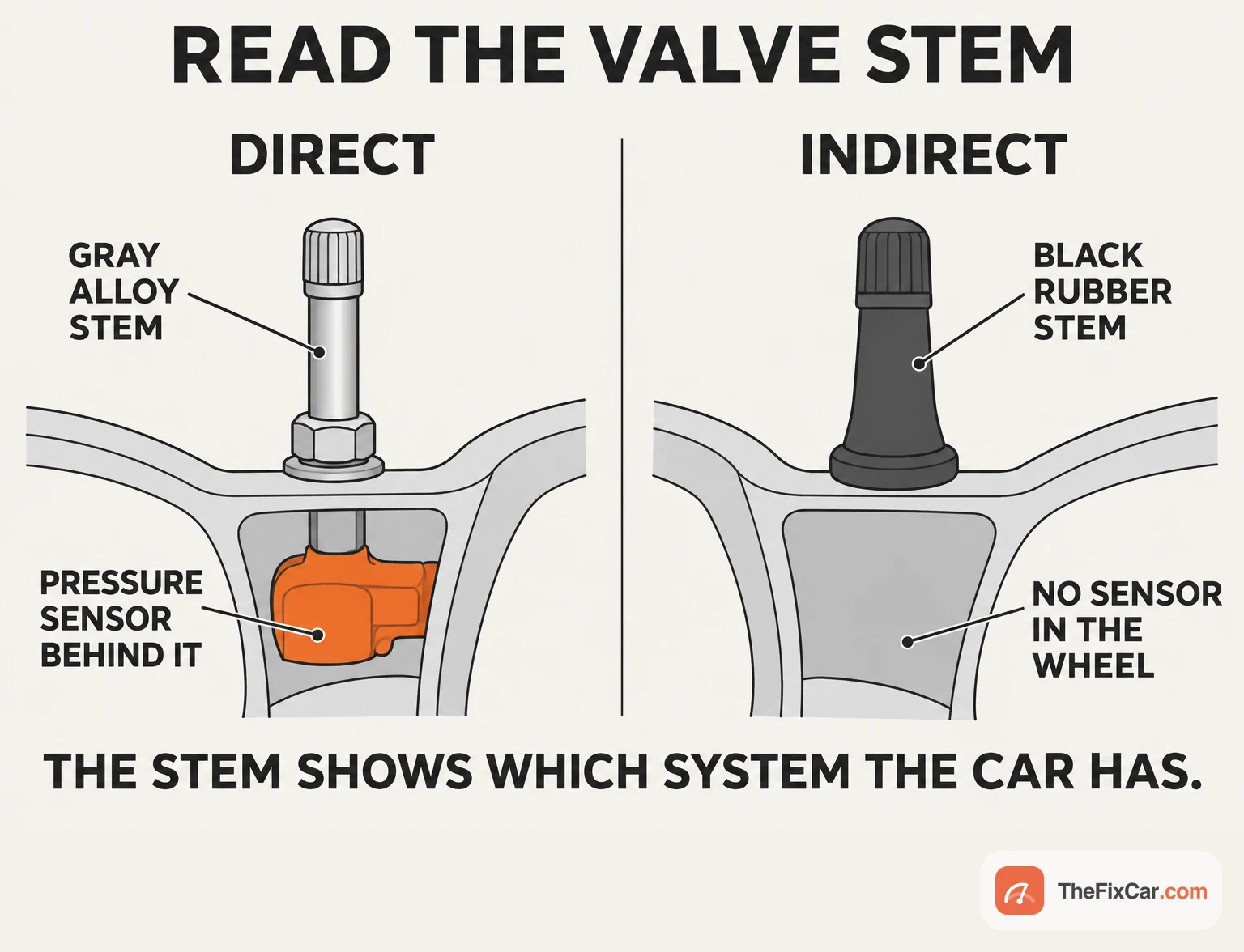
American Honda’s own guide for its technicians gives an easy test: look at the valve stems. Vehicles with indirect TPMS have black rubber valve stems. Vehicles with direct TPMS have gray alloy valve stems[3]. Honda wrote that for cars as built; wheels or sensors fitted later can look different.
| System | How it works | Examples in Honda’s documents | What “reset” means |
|---|---|---|---|
| Direct | A pressure sensor inside each wheel, behind the valve stem[1][2] | 2013 Civic sedan, 2011 Odyssey, 2009 Acura TL[1][2][7] | No owner reset in the manuals cited. They send the owner to a dealer[1][2] |
| Indirect | No sensors in the tires. The stability control unit compares wheel behavior using the wheel speed sensors and other inputs[3] | 2013 to 2017 Accord, 2014 to 2017 Civic, 2014 to 2017 CR-V, 2015 to 2018 Fit, 2016 to 2017 HR-V[3] | TPMS calibration by button, touchscreen or steering wheel menu[3] |
Honda dates the change to the 2013 Accord[3]. The Civic shows why the year matters: the 2013 sedan has sensors in the wheels, and the 2014 to 2015 Civic is listed as indirect in every trim[2][3]. The indirect Civic manual still shows the same “Check TPMS System” picture for the blink-then-steady light[4].
Symptoms and what else causes them
The table mixes two warnings on purpose, because owners arrive with both. The software bulletins for the 2014 Civic and the 2015 to 2017 Fit describe a steady low tire pressure/TPMS indicator on cars with the indirect system. Honda does not tie them to the “Check TPMS System” message.
| Symptom | Competing sources | Clues that shift suspicion |
|---|---|---|
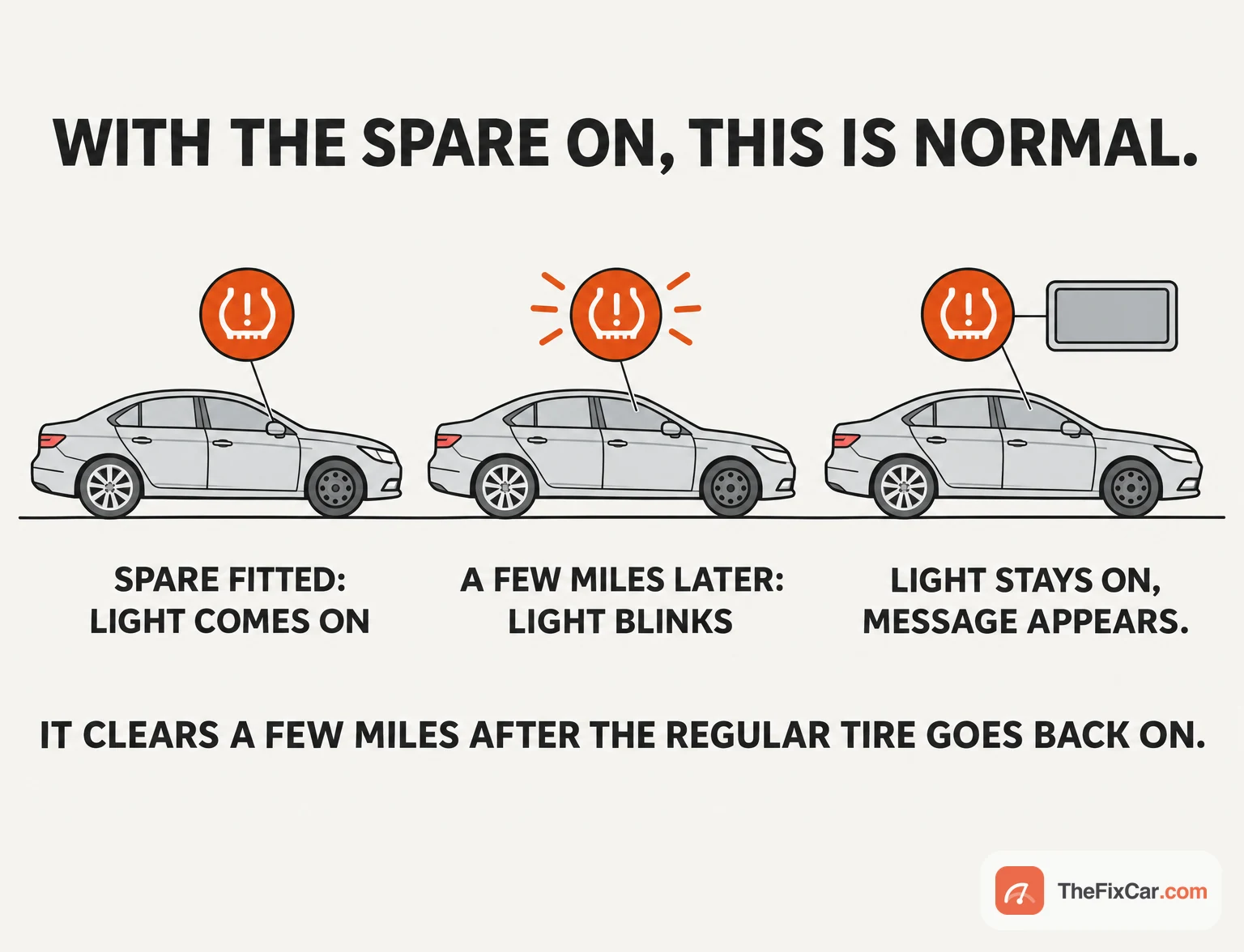
| Message with a spare on the car | The spare itself; a system problem that happens to be present as well | Honda: the light comes on, starts blinking after a few miles, and the message appears, “but this is normal”[2]. Judge the system only after the regular tire is back |
| Message on a car with gray alloy stems, regular wheels on | A failed sensor; a wheel without a sensor; a sensor damaged in a tire change or by sealant | Recent tire or wheel work, or a can of sealant. Honda’s 2013 Civic manual says a puncture-repairing agent, other than the one in the kit supplied with the car, can damage the sensor; the 2011 Odyssey manual says the sensor must then be replaced[1][2] |
| Steady light that will not go out on a car with black rubber stems | Calibration never started or never finished; a tire that is in fact low; mismatched tires | Honda says the light stays on after the tires are inflated until the system is calibrated[4] |
| Steady light on a 2014 Civic (except Si), Civic Hybrid or Civic Natural Gas with pressures at the label | System software; a real pressure loss | Honda bulletin 14-042: no code or VSA code 151-11, cause “the TPMS system misinterprets different driving conditions”, remedy a software update of the VSA unit[10] |
| Steady light on a 2015 to 2017 Fit with code C0077-78 | System software; a real pressure loss | Honda bulletin 17-005: the software may not properly adapt to driving up or down steady grades[11] |
| Light on a 2021 or 2022 Odyssey or Ridgeline under 16,000 miles | A faulty sensor; low pressure | In 2022 American Honda asked dealers for such vehicles where the fault could be duplicated, the tires were not low, and clearing codes and relearning the sensor had not helped[12]. Honda’s request describes the light as on due to a faulty sensor and gives no repair |
Sensor fault, or something else?
Several of the causes in Honda’s and Acura’s own documents are not a sensor that wore out.
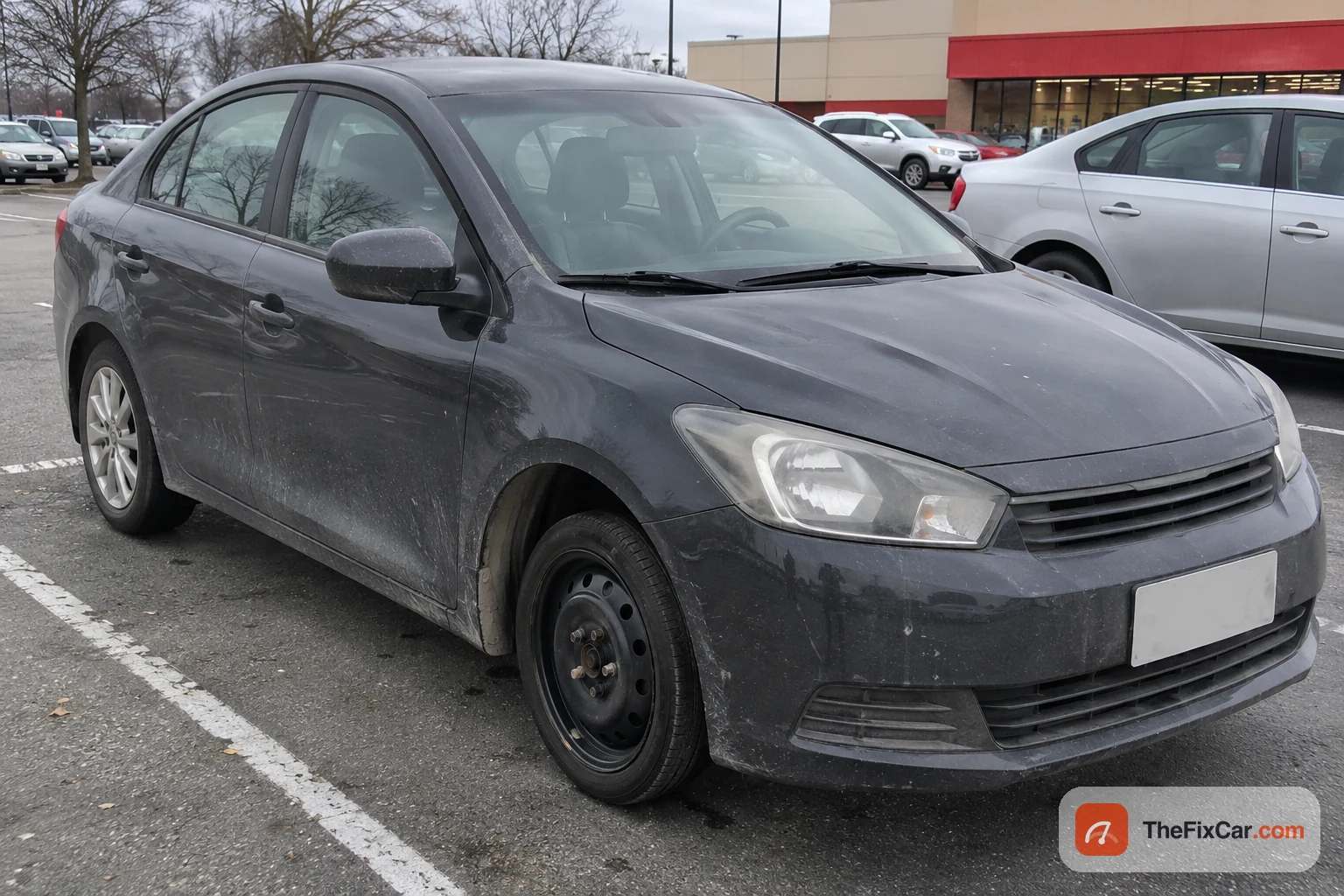
The compact spare. The spare has no sensor and cannot be monitored. Honda describes the sequence for the 2013 Civic: the light comes on while driving, after a few miles it starts blinking and then stays on, and the message appears[2]. On the 2011 Odyssey the message goes away several miles after the regular tire with its sensor is refitted[1]. A blinking light without the spare is the case Honda sends to a dealer[2].
Calibration on indirect cars. The indirect system learns what “normal” looks like for the tires that are on the car. Honda requires calibration to be started every time a tire pressure is adjusted, the tires are rotated or a tire is replaced[3][4]. Skip it and the light comes on or stays on. Honda’s technician guide admits that owners in this situation “are often confused and think there is something wrong with the TPMS and end up back at their dealership”[3].
Mismatched tires. The indirect system compares how the wheels roll, so a tire that rolls differently can trigger the light. Honda’s ServiceNews article for the 2014 to 2016 CR-V traces a light after tire replacement to same-size tires of different construction and weight, and the Honda technician guide says a new tire with a different tread depth from the others can trigger the light[3][5].
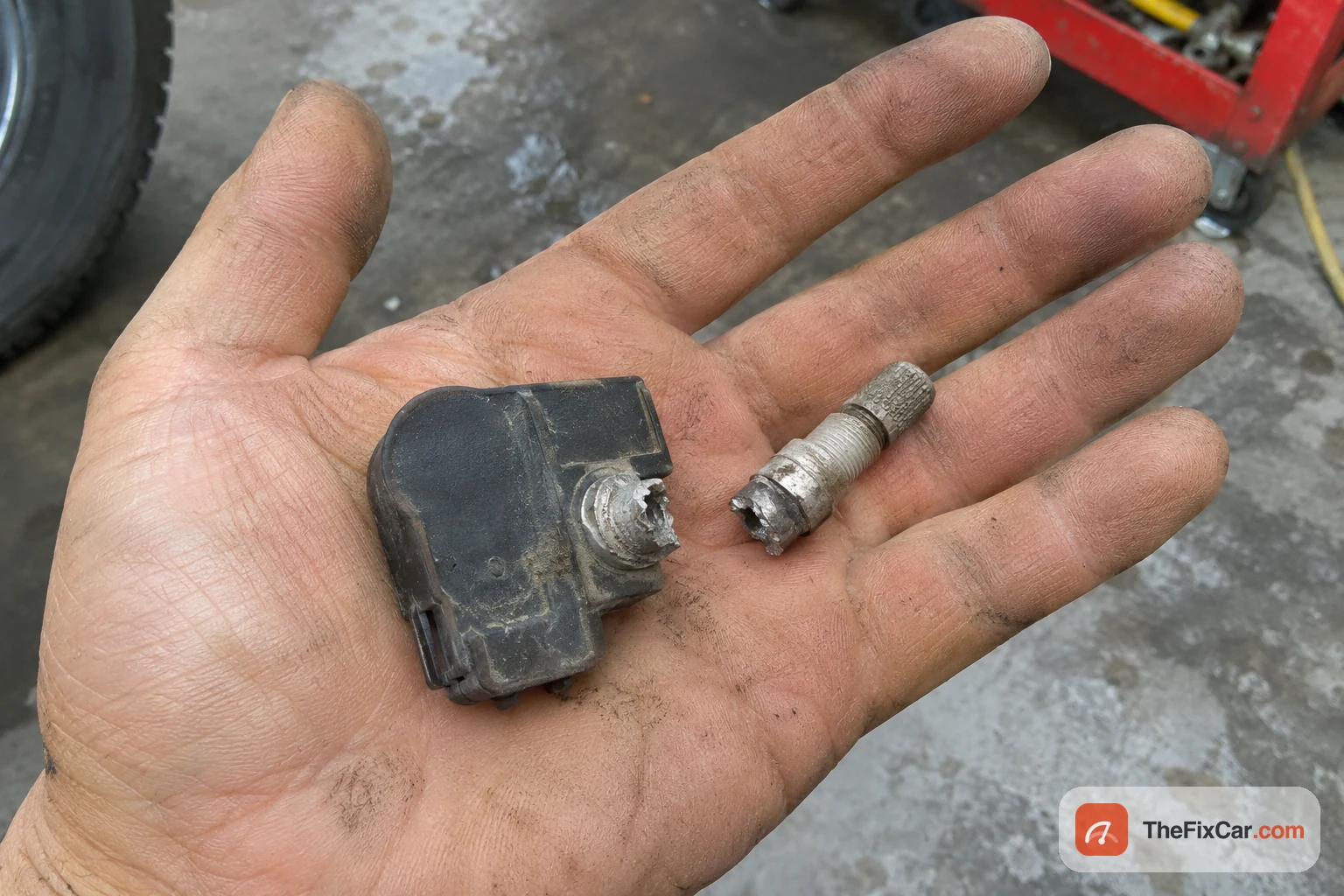
Wheels, sensors and breakage. Honda bulletin 14-073 and its Acura twin 14-048 list what the company will not pay for on the models each bulletin names: a tire light caused by accessory wheels installed without following instructions, a code caused by incorrect sensors, and a physically broken sensor, whether the dealer or the customer broke it[6][13]. The manuals add the reason for the wheels: use TPMS-specific wheels, each with a sensor mounted behind the valve stem[1][2].
What to check first
Start with a gauge on all four tires, cold. Honda’s technician guide defines cold as parked for at least 3 hours or driven less than 1 mile[3]. The doorjamb pressures are explained in our tire pressure specifications. Then:
- Look at the wheels. A compact spare explains the message. Gray alloy valve stems mean sensors; black rubber stems mean the indirect system[3].
- Restart and read the display. Blinking for about a minute with “Check TPMS System” is the system warning. A steady light with “Check Tire Pressure” is the pressure warning[2].
- List what changed. Air added, tires rotated or replaced, different wheels, sealant. On an indirect car Honda requires calibration to be started after the first three[3].
How the reset works
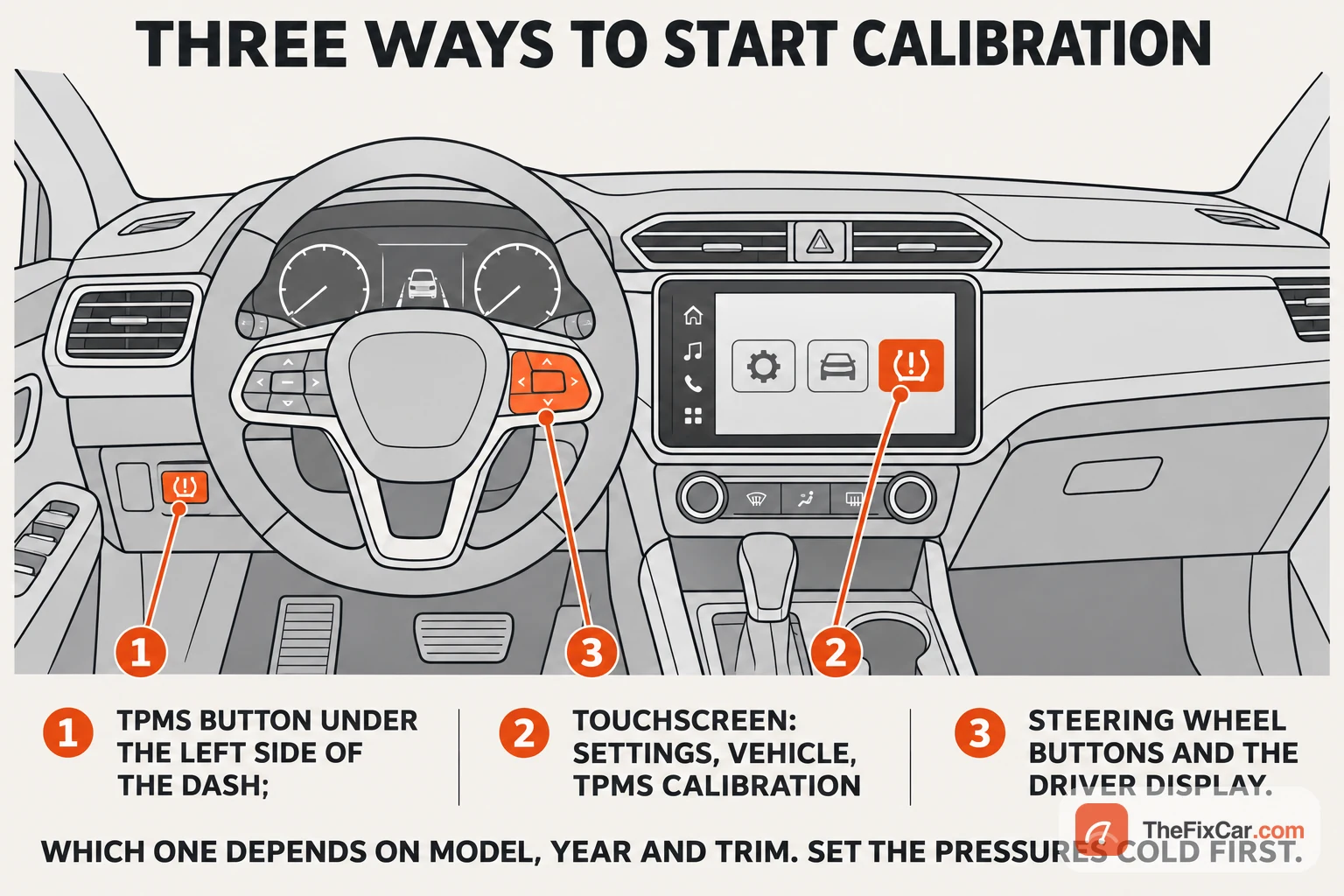
Indirect system: calibration. Set all four pressures cold first. Then start calibration by the method your car uses. American Honda lists three[3]:
- a TPMS button under the left side of the dashboard, held until the tire light blinks twice (for example 2013 to 2017 Accord except Touring, 2014 to 2016 CR-V except Touring, 2015 to 2017 Fit, 2016 to 2017 HR-V);
- the touchscreen: Home, Settings, Vehicle, TPMS Calibration, Calibrate (for example 2016 to 2017 Civic EX and Touring, 2017 CR-V except LX);
- the steering wheel buttons and the driver display: Settings or Menu, TPMS Calibration, then Calibrate or Initialize (for example 2014 to 2015 Civic, 2013 to 2017 Accord Touring).
Calibration then finishes on the road. The Civic manual for the indirect system gives approximately 30 minutes of cumulative driving at 30 to 60 mph (48 to 97 km/h), and says the system cannot be calibrated with a compact spare fitted[4]. During calibration, if the ignition is cycled and the car is not moved within 45 seconds, the light comes on briefly; Honda calls this normal and says it means calibration has not yet completed[3].
Direct system: no button. The manuals for the 2013 Civic, 2011 Odyssey and 2009 TL give the owner two actions for “Check TPMS System”: refit the regular tire if the spare is on, and otherwise have the dealer check the system[1][2][7]. They describe no reset. The one sensor-learning procedure in the documents cited here is a dealer scan tool routine. It appears in a 2017 to 2019 Ridgeline bulletin about an unrelated alarm fault, where the replaced part is a combined Keyless Access/TPMS control unit[14].
Can you drive with “Check TPMS System”?
The message does not tell you the tires are fine. Honda’s wording for the 2011 Odyssey is that the system is off and not monitoring the tire pressures; for the 2013 Civic, that it may not be able to detect or signal low tire pressure as intended[1][2]. Gauge all four and look for damage. Honda’s instruction is to have the system checked as soon as possible[1]. Until then the pressures have to be checked by hand.
Stop and deal with the tire if:
- a tire looks low, or the car pulls or vibrates;
- “Check Tire Pressure” appears as well;
- you are on the compact spare and treating it like a normal tire. For the 2011 Odyssey Honda sets 60 psi (420 kPa) for the spare and says never to exceed 50 mph (80 km/h)[1].
FAQ
What does Check TPMS System mean?
On the Honda and Acura models that show it, “Check TPMS System” means there is a problem with the tire pressure monitoring system, or a compact spare is fitted. The tire light blinks for about one minute and then stays on, and Honda’s 2011 Odyssey manual says the system is off and not monitoring the tire pressures[1][2].
How do I reset Check TPMS System on a Honda or Acura?
On cars with sensors in the wheels the manuals cited here give no owner reset: the message clears when the regular tire replaces the spare or after the fault is repaired[1][2]. On cars with the indirect system, set the pressures and run TPMS calibration by button, touchscreen or steering wheel menu[3].
Why does my 2012 or 2013 Honda Civic say Check TPMS System?
Honda’s 2013 Civic sedan manual gives two reasons: a problem with the TPMS, or a compact spare temporarily installed[2]. That car has a pressure sensor in each wheel behind the valve stem, so with four regular wheels on, Honda’s instruction is an inspection by a dealer. We did not have a 2012 manual to confirm the same text for that year.
Is Check TPMS System the same as Check Tire Pressure?
No. In the 2013 Civic manual “Check Tire Pressure” is displayed when a tire has significantly low pressure and the light is steady. “Check TPMS System” goes with the light that blinks and then remains on[2].
Will Check TPMS System go away after I put the regular tire back?
If the spare was the cause, yes. Honda says the indicator and message go off after driving a few miles on the specified regular tire[1][2]. On an indirect car, calibrate after the full-size tire is back on[4].
Why can’t I turn VSA off when the TPMS light is on?
Honda designed it that way on the models cited: when the tire light comes on or blinks, VSA turns on automatically and the VSA OFF button no longer switches it off[1][2][7].