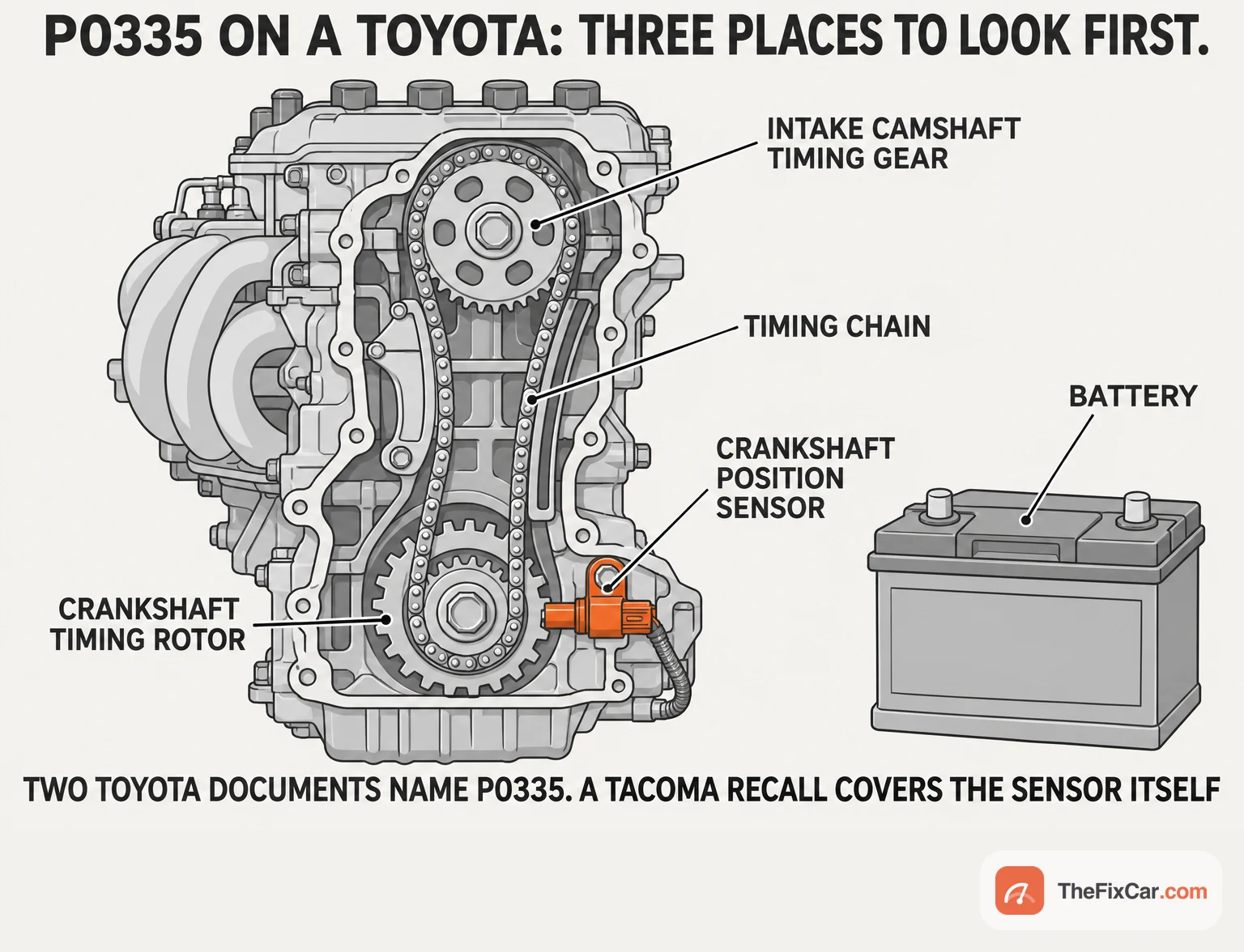
Two Toyota documents deal with P0335 by name, and neither of them replaces the crankshaft position sensor. On listed 2006 to 2012 models with the 2AZ four-cylinder engine, Toyota bulletin T-SB-0192-12 answers an intermittent check engine light and P0335 by replacing the intake camshaft timing gear assembly[1]. Toyota Tech Tip T-TT-0010-10 says low battery voltage can contribute to the same code, and tells technicians to look for battery voltage under 11 volts in the freeze frame data[2]. A third document belongs next to them: on certain 2016 to 2017 Tacoma V6 trucks, a safety recall replaces the sensor because of the coating on the crankshaft timing rotor. That recall notice describes a sensor malfunction and does not name a trouble code, so the VIN check applies to those trucks with or without P0335[3].
The first two show up in the freeze frame data saved with the code, and the VIN settles the third. Check both before paying for a sensor.
Quick answer
Read the freeze frame data stored with P0335 before clearing the code or buying a part.
| What you see | Where to look | What to do first |
|---|---|---|
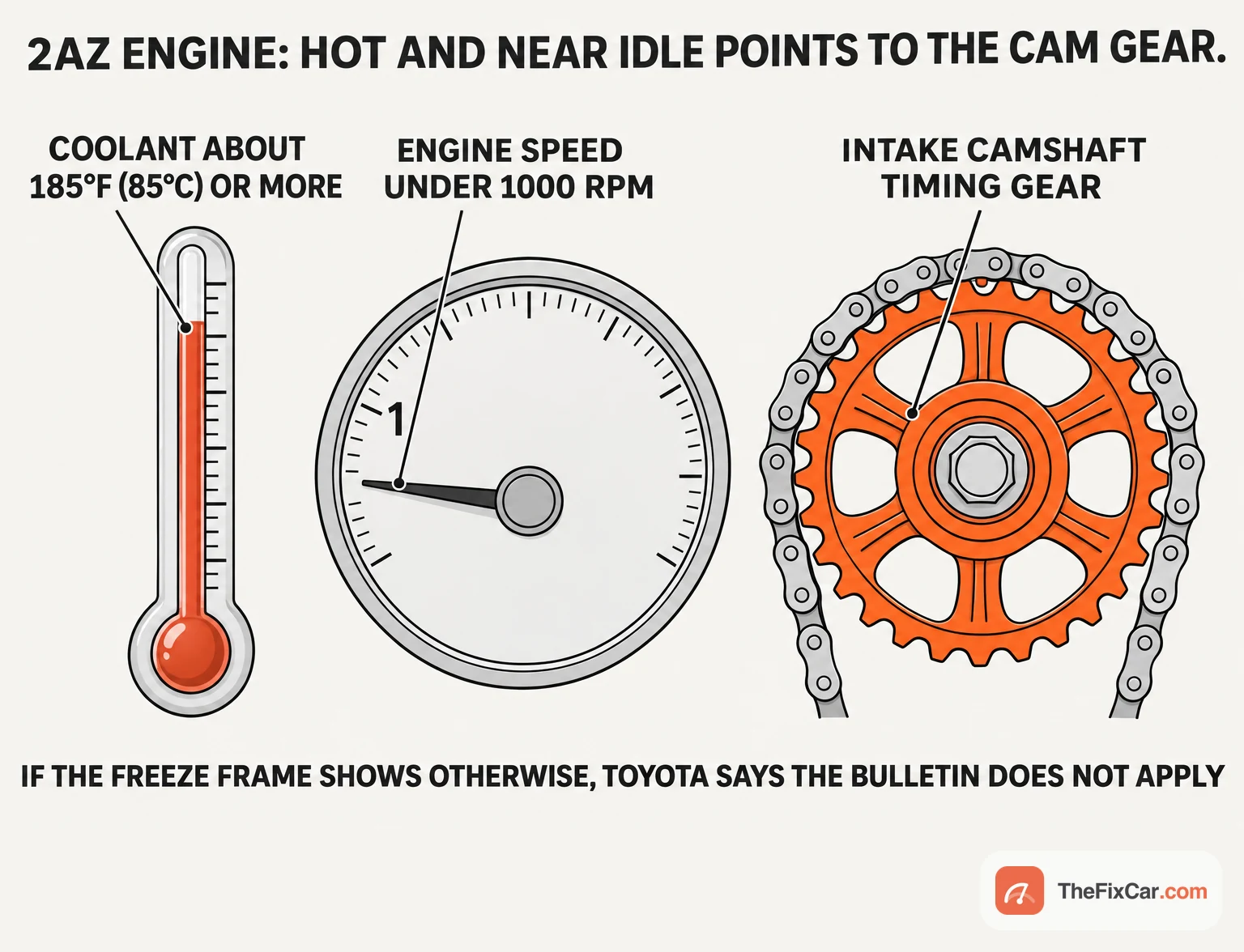
| Intermittent check engine light and P0335 on a 2AZ engine: 2007 to 2009 Camry, 2007 to 2011 Camry Hybrid, 2009 to 2010 Corolla, 2009 to 2012 Matrix, 2006 to 2008 RAV4, 2007 to 2008 Solara | Freeze frame data: coolant temperature and engine rpm when the code set[1] | Coolant about 185°F (85°C) or more and under 1000 rpm: Toyota’s repair is the camshaft timing gear assembly. Anything else: the bulletin does not apply[1] |
| P0335 and/or P0340 after a slow crank, a dead battery or a jump start | Freeze frame data: battery voltage[2] | Below 11 volts: find out why the battery was low and repair that first[2] |
| 2016 to 2017 Tacoma V6 with a check engine light, rough running, misfire or stalling | The VIN, against safety recall 17V-356[3][4] | If the recall is open, a Toyota dealer replaces the crankshaft position sensor at no charge[3] |
| P0335 with normal battery voltage on any other Toyota | The repair manual procedure for the code | Toyota’s tech tip sends the technician there when voltage is within specification[2] |
| Engine stalls while driving | Stored codes, before anyone clears them | Stop driving it and have it diagnosed |
A guide, not a diagnosis: the code names a circuit, and each row has more than one possible cause.
Symptoms and what else causes them
The three Toyota documents describe different complaints, and only the first two name P0335. The 2AZ bulletin describes a check engine light that comes and goes[1]. The Tacoma recall lists a check engine light, rough running, misfire and, in some instances, stalling, and Toyota adds that these symptoms can occur for issues unrelated to the recall[3].
| Symptom | What can cause it | Clues that shift suspicion |
|---|---|---|
| Check engine light comes and goes, P0335 stored, car drives normally | Intake camshaft timing gear on the 2AZ cars in T-SB-0192-12[1]; low battery voltage[2]; the sensor, its connector or wiring | Freeze frame data showing a hot engine near idle on a listed 2AZ car points at the gear. Freeze frame data from any other condition takes the bulletin off the table[1] |
| P0335 or P0340 appeared around a hard start | Low battery voltage during cranking[2]; a failing battery, poor terminals or a charging fault behind it | Freeze frame battery voltage below 11 volts. Toyota’s own example shows about 6.3 volts with engine speed at 0 rpm[2] |
| Rough running, misfire, check engine light on a 2016 to 2017 Tacoma V6 | Crankshaft timing rotor coating covered by recall 17V-356[3]; ignition or fuel faults unrelated to the recall | A VIN inside the recall with the remedy not yet done |
| Engine stalls | A crankshaft position sensor malfunction, which the Tacoma recall says can end in a stall[3]; fuel delivery; ignition; charging system | P0335 stored together with the stall, and the recall status of the truck |
What can make a Toyota crank sensor appear bad
Each cause below comes from a Toyota document, and each applies only to the vehicles that document names.
The intake camshaft timing gear on 2AZ engines
Toyota bulletin T-SB-0192-12, dated October 15, 2012, covers listed 2006 to 2012 model year vehicles with the 2AZ engine that show an intermittent MIL with DTC P0335, Crankshaft Position Sensor “A” Circuit. Toyota states that the intake camshaft gear assembly has been improved to help prevent the condition. Step 1 is a freeze frame check: the engine at operating temperature, with coolant at approximately 185°F (85°C) or more, and engine speed under 1000 rpm. If the freeze frame data does not show that, the bulletin states that it does not apply and sends the technician to the repair manual[1].
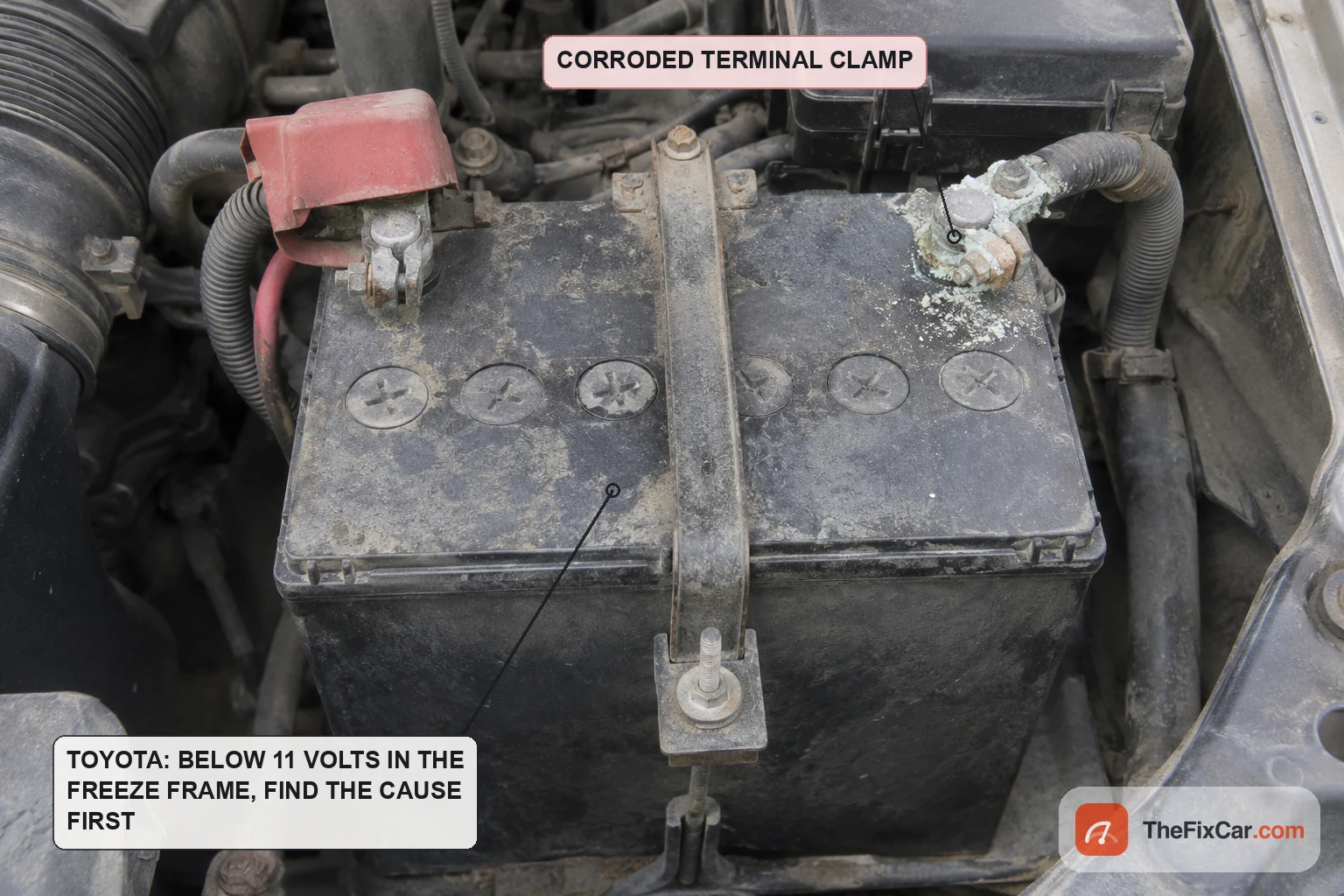
The repair is the gear, and it is not a driveway job. The procedure follows the repair manual’s camshaft removal, checks whether the new gear is locked or unlocked by the position of two dots, releases the lock pin with approximately 21 psi of air at the oil feed hole if it is locked, and torques the camshaft bolt to 54 N·m (40 ft·lbf) with the gear unlocked. After the bolt is torqued, the technician rotates the gear clockwise while holding the camshaft until the dots align and the lock pin engages again, and only then installs the timing chain: Toyota notes that camshaft timing is performed with the gear in the locked position[1]. Toyota’s warranty time is 1.8 hours on Camry and Camry Hybrid and 1.9 hours on Corolla, Matrix, RAV4 and Solara. The bulletin placed the repair under the Toyota Powertrain Warranty, 60 months or 60,000 miles from the in-service date, whichever occurs first[1].
Low battery voltage
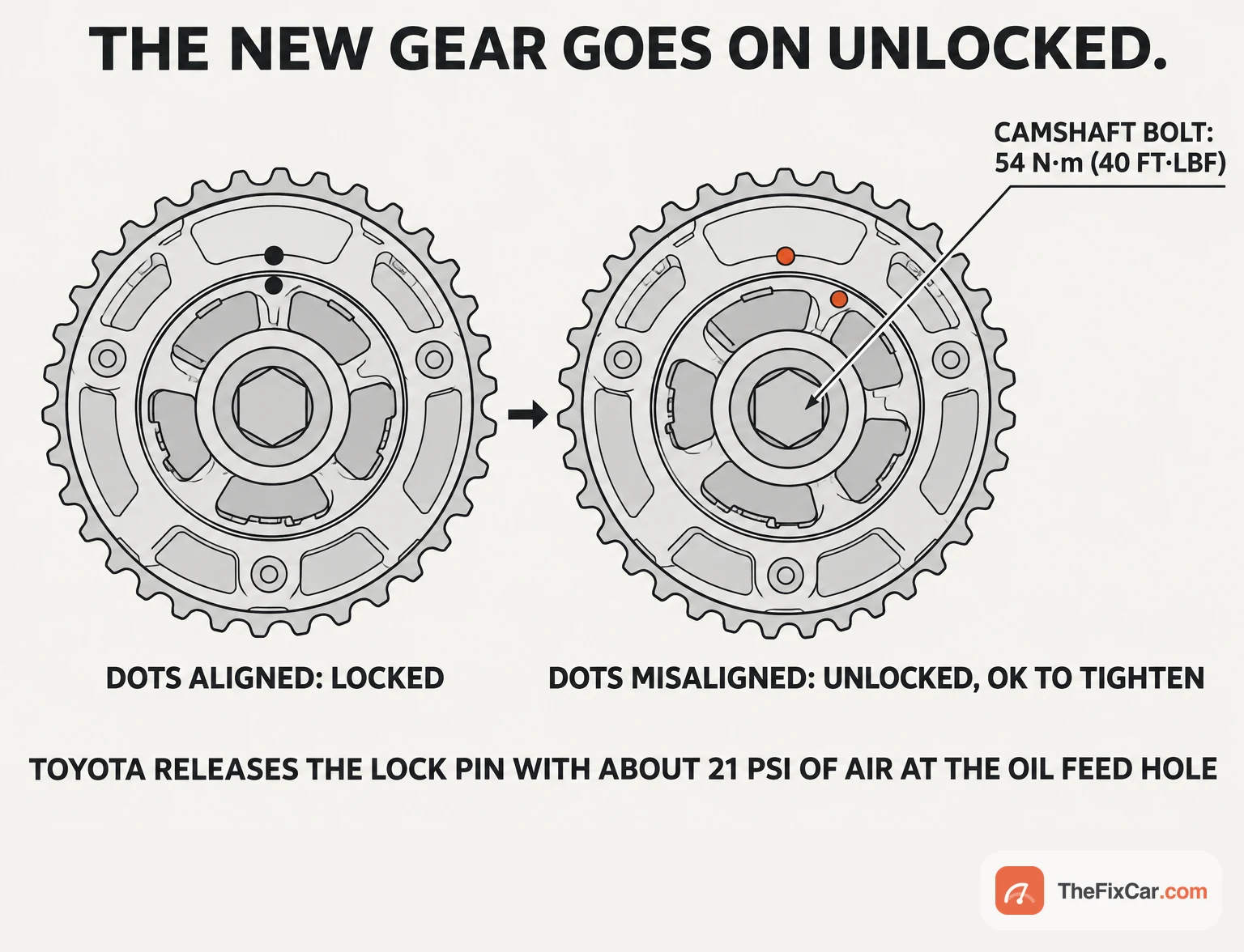
Toyota Tech Tip T-TT-0010-10 states that low battery voltage can contribute to a MIL “ON” condition for P0335 and/or P0340 due to inconsistent rotational speed of the engine’s crankshaft. Its instruction is to review the freeze frame data and verify whether battery voltage was below the minimum specification of 11 volts when the code set. If it was, determine the cause and repair accordingly. If it was not, go to the repair manual procedure for the code[2]. The example freeze frame in the tip shows battery voltage from 6.328 to 6.445 volts, engine speed 0 rpm and engine run time 0 seconds. The tip’s applicability reads “All Vehicles” and its list runs from the 1994 Camry to 2015 models, including Corolla, RAV4, Tacoma, Tundra, Highlander, Prius and Sienna[2].
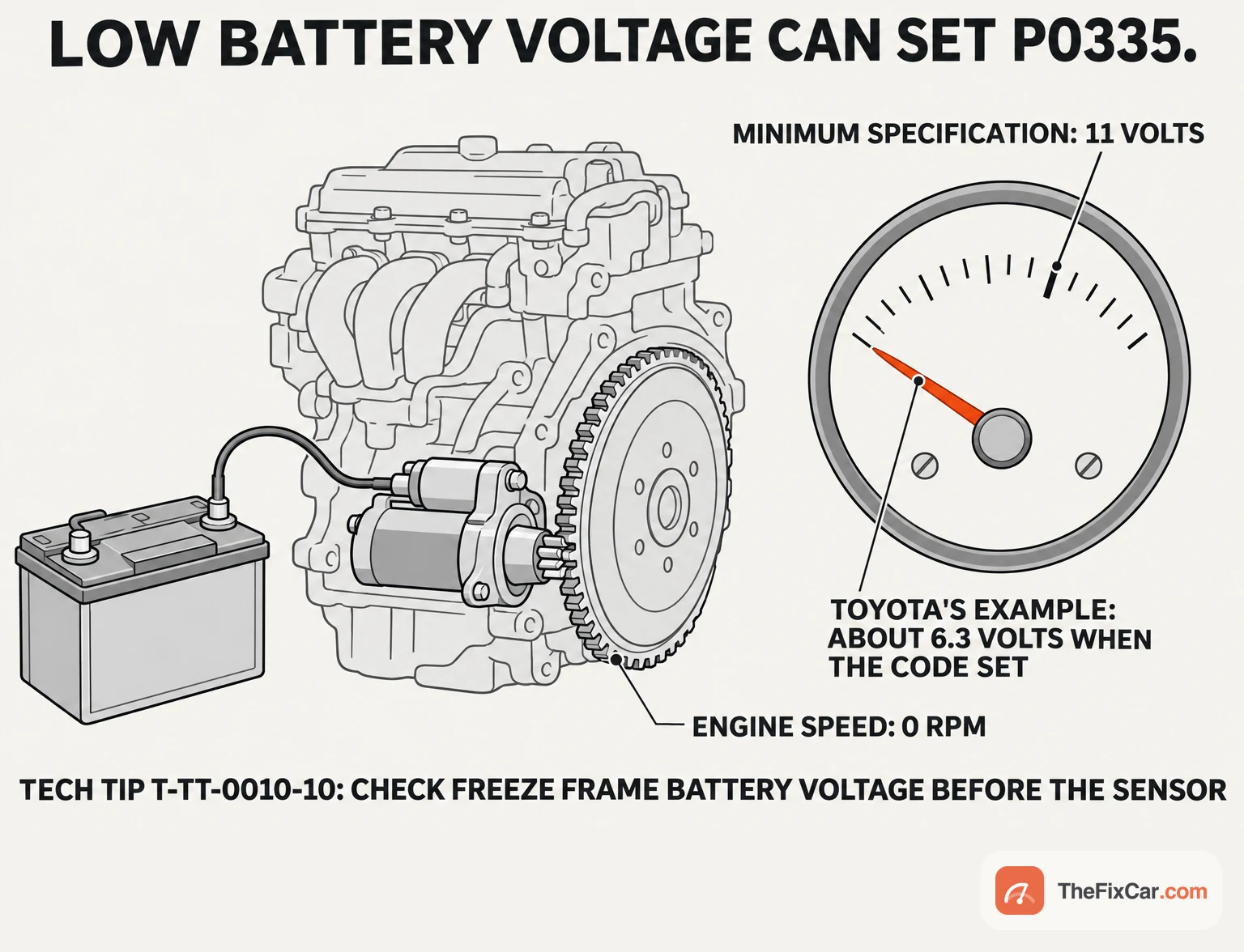
A new sensor does not address low battery voltage. A present-day battery test is not the freeze frame reading, but it is the next step: our guide on how to test a car battery with a multimeter covers the measurement.
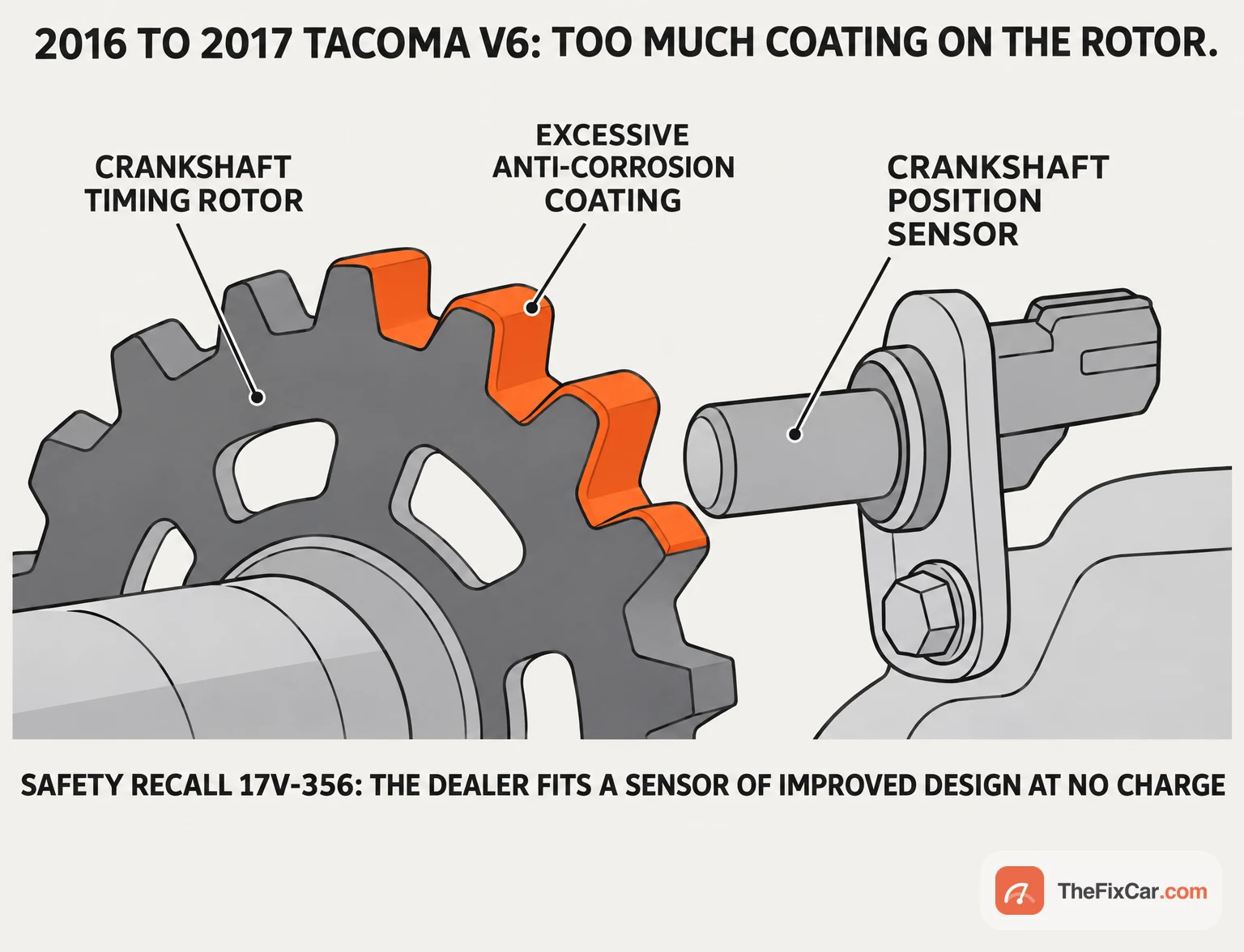
The rotor coating on 2016 to 2017 Tacoma V6
Toyota safety recall H0H, NHTSA recall 17V-356, covers approximately 32,000 Tacoma trucks of model years 2016 and 2017 produced from mid-September 2015 to late October 2016. The V6 engine crankshaft timing rotor may have been produced with excessive anti-corrosion coating, which could cause the crankshaft position sensor to malfunction. The remedy is a crankshaft position sensor of an improved design, fitted at no charge, and Toyota gives the repair time as approximately one hour[3]. The notice lists symptoms, not trouble codes, so an open recall is worth closing on these trucks whether or not P0335 is stored. Other vehicles with the same V6 engine are not covered, in Toyota’s words, because they have a different coating for the crankshaft timing rotor or use an anti-electrification crankshaft position sensor[3].
What to check first
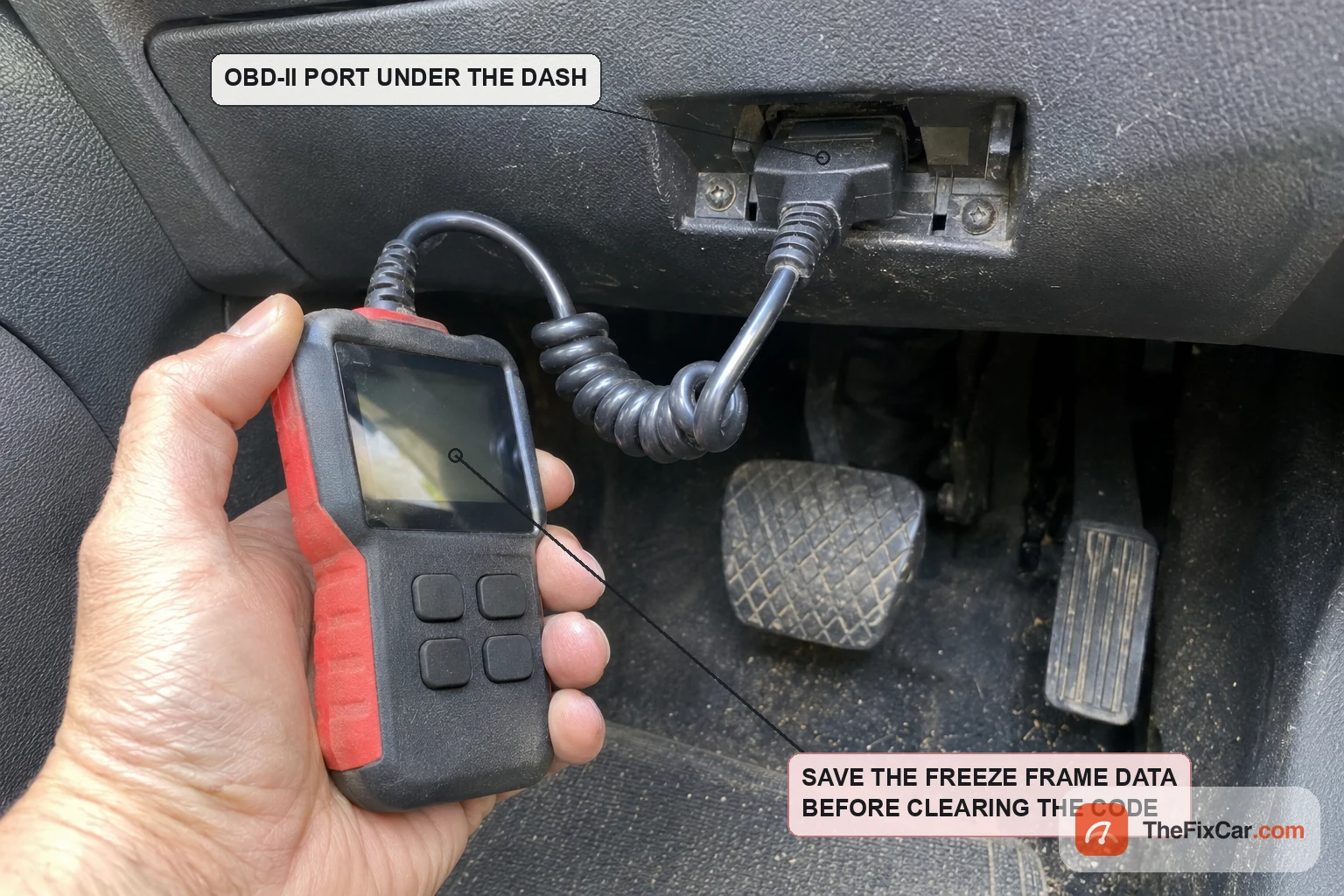
- Save the freeze frame data. Write down coolant temperature, engine rpm and battery voltage for P0335 before the code is cleared. Clearing the code can erase the data both Toyota documents rely on.
- Find out why the voltage was low, if it was. Under 11 volts in the freeze frame, Toyota’s instruction is to determine the cause and repair it[2]. The battery, its terminals and the charging system are where that search starts.
- Run the VIN. NHTSA’s recall lookup shows whether recall 17V-356 is open on a Tacoma[4], and a Toyota dealer can say whether T-SB-0192-12 fits a 2AZ car.
On a Toyota outside those documents, the repair manual procedure for the specific engine takes over[2]. As general practice, not a Toyota instruction, that work covers the crankshaft position sensor connector and harness, whether the scan tool shows engine rpm while the starter cranks, and then the sensor signal itself, checked the way the manual for that engine describes. No rpm reading during cranking is a clue that the signal is missing. It does not say whether the sensor, the wiring or something else took it away.
Can you drive with P0335?
Treat it as a trip to the shop, not a code to live with. Toyota’s recall notice for the Tacoma says the condition can cause stalling, and that a stall while driving at higher speeds may increase the risk of a crash[3]. An engine that runs normally today has not shown that the signal will hold tomorrow.
Stop driving and arrange a tow if:
- the engine has stalled, even once;
- it runs roughly or misfires with the light on;
- it cranks slowly or needed a jump start. Have the battery and charging system tested before judging anything else.
FAQ
What does P0335 mean on a Toyota?
Toyota’s bulletin T-SB-0192-12 names P0335 as Crankshaft Position Sensor “A” Circuit[1]. The code reports a problem with the crank signal the engine computer received. It does not say which part caused it.
What causes P0335 on a Toyota Camry?
On 2007 to 2009 Camry and 2007 to 2011 Camry Hybrid with the 2AZ engine, Toyota bulletin T-SB-0192-12 ties an intermittent P0335 set with a hot engine near idle to the intake camshaft timing gear assembly[1]. On any Camry from 1994 to 2015, Toyota’s tech tip adds low battery voltage as a contributor[2]. Outside those two documents the code needs the repair manual diagnosis.
Can a weak battery cause P0335?
Yes, according to Toyota. Tech Tip T-TT-0010-10 says low battery voltage can contribute to P0335 and/or P0340 because the crankshaft turns at an inconsistent speed, and it sets 11 volts in the freeze frame data as the minimum specification[2].
Is there a recall for P0335 on Toyota?
Not one that names the code. The recall cited here is safety recall 17V-356 for certain 2016 to 2017 Tacoma V6 trucks, where the dealer replaces the crankshaft position sensor at no charge; its notice describes a sensor malfunction without listing P0335[3]. T-SB-0192-12 for the 2AZ engine is a service bulletin, not a recall, and its coverage was the Toyota Powertrain Warranty of 60 months or 60,000 miles[1].
How do I fix P0335 on a Toyota?
Start with the freeze frame data. Battery voltage under 11 volts means the battery side comes first[2]. Freeze frame data showing a hot engine under 1000 rpm on a listed 2AZ car with an intermittent P0335 points to the camshaft timing gear in T-SB-0192-12[1]. A 2016 to 2017 Tacoma V6 calls for a recall check[3]. If none fits, Toyota’s direction is the repair manual procedure for the code[2].