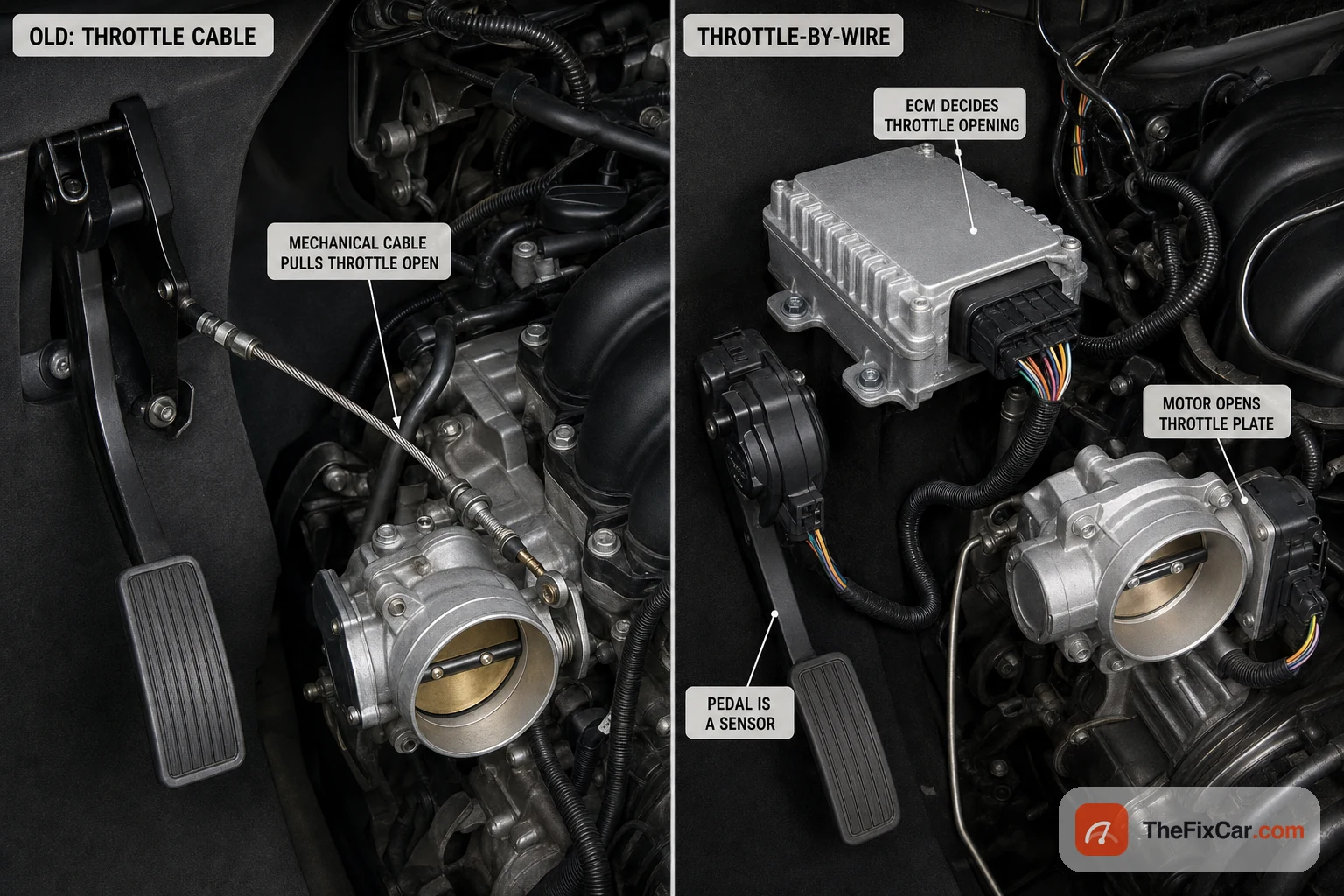
Of the three drive-by-wire systems, throttle is the one you almost certainly already have. Steer-by-wire and brake-by-wire are still arriving, but the cable between your accelerator pedal and the engine disappeared from most cars more than a decade ago. Press the pedal now and you move a sensor, not a cable. A computer decides how far the throttle opens.
That handoff is why cruise control, traction control, stability control, and adaptive cruise can all override or trim the throttle without a mechanical fight. It also put electronic throttle control at the center of a high-profile safety investigation, which is worth understanding before you trust or blame it.
Quick answer
Throttle-by-wire, also called electronic throttle control (ETC), replaces the accelerator cable with a pedal position sensor, the engine control module (ECM), and a motorized throttle body. It is standard on nearly all gasoline cars built in the last 10 to 15 years, after electronic throttle control became common on mainstream Toyota and other vehicles in the early 2000s and then spread industry-wide. There is no mechanical backup; safety comes from redundant pedal and throttle sensors plus a default limp mode. When it fails, drivers usually notice an electronic throttle control light, a reduced-power mode, rough idle, or hesitation, often with a throttle or pedal position sensor correlation code such as P2135 or P0122. A 2011 NHTSA-NASA study of Toyota unintended acceleration found no electronic throttle-control defect capable of causing the reported events; known non-electronic causes included floor-mat pedal entrapment and sticky accelerator pedals.
To see where you sit, match your case:
| If you mean | What it is | Notes |
|---|---|---|
| The drive-by-wire system already in your car | Electronic throttle control (ETC) | Near-universal on gas cars since the mid-2000s to early 2010s |
| A gas-engine setup | Pedal sensor, ECM, motorized throttle body | Motor opens a throttle plate to control air into the engine |
| An EV or hybrid setup | Pedal sensor to motor or inverter controller | No throttle body; the pedal asks for torque, not airflow |
| The reason it exists | Cruise, traction, stability, ADAS control | Lets the car trim or cut throttle without a mechanical override |
Specifications
| Element | What it does | Notes |
|---|---|---|
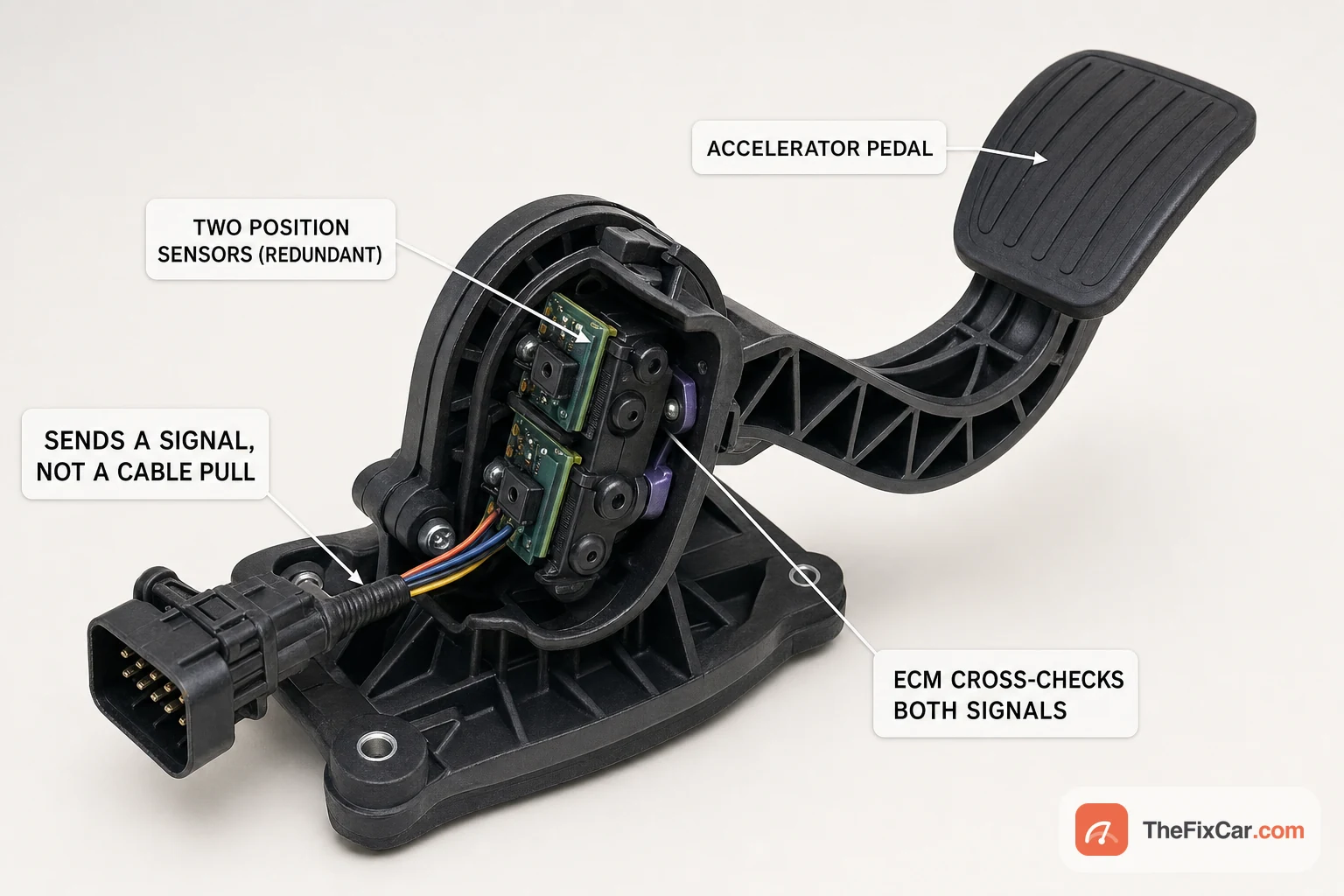
| Accelerator pedal position sensor | Reads how far and fast you press | Two or three sensors for redundancy and cross-checking |
| ECM / engine controller | Calculates throttle opening from pedal and other inputs | Weighs RPM, load, gear, and stability or cruise demands |
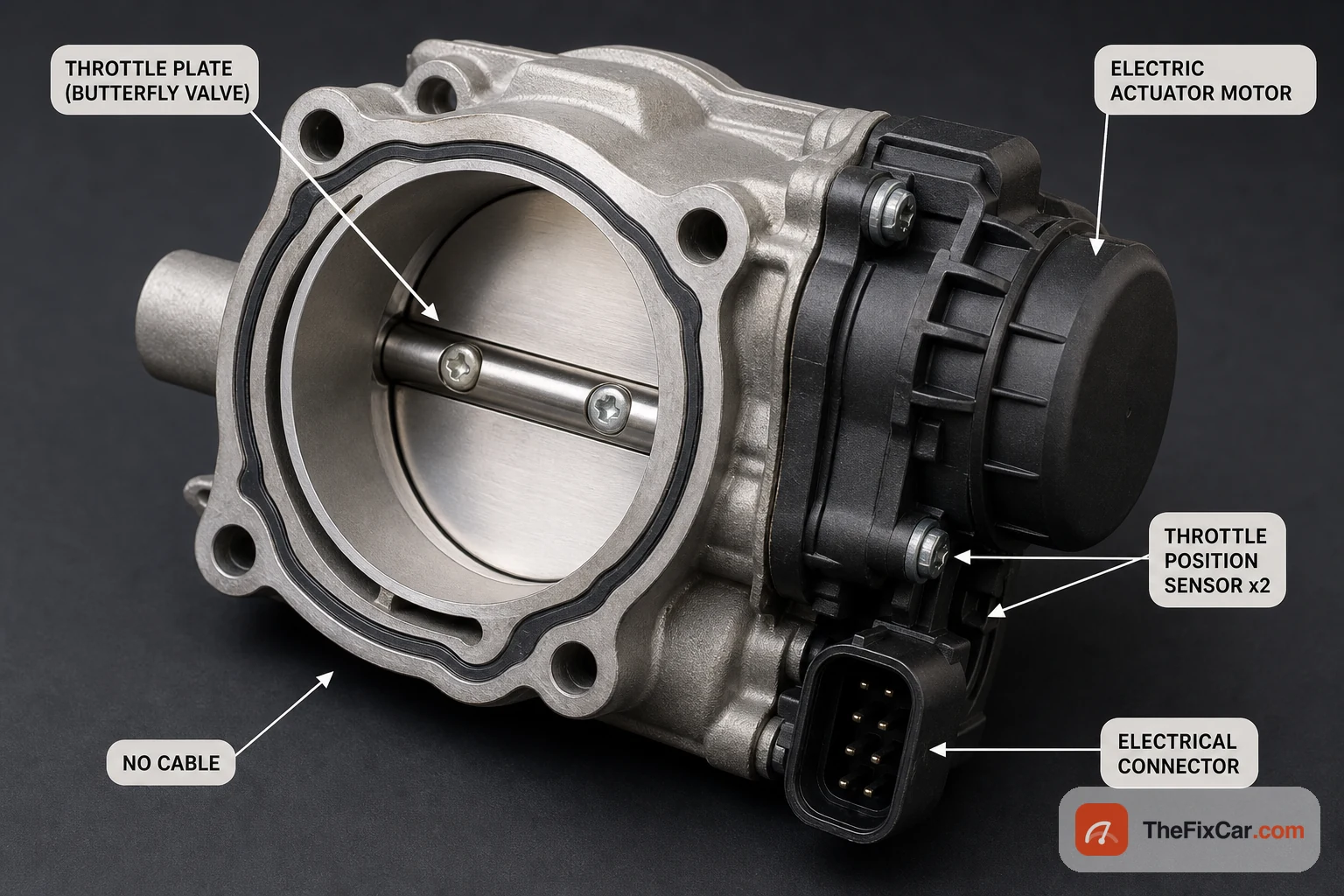
| Throttle body actuator motor | Opens and closes the throttle plate | Replaces the cable’s direct pull |
| Throttle position sensor (TPS) | Reports the actual plate angle back to the ECM | Usually two sensors; the ECM compares command to result |
| Default return spring | Sets a safe, near-closed position on failure | Limits airflow if the motor loses control |
| Limp mode | Cuts power if signals disagree | Reduced power until the fault is cleared |
Layout varies by manufacturer and generation. Treat the table as the general architecture, not one vehicle’s part list. Exact procedures follow the maker’s service data.
How it works
Input side. The accelerator pedal holds two or three position sensors. Press it and their output changes, and the ECM reads the values, checks that they agree, and treats a mismatch as a fault. There is no cable pulling anything; the pedal is purely an input device.
Output side. The ECM combines pedal position with engine speed, load, gear, and any demand from cruise or stability control, then commands the throttle body motor to open the plate by a calculated amount. A throttle position sensor reports the actual angle back, so the computer can confirm the throttle did what it asked.
Redundancy. Without a cable as a fallback, the system relies on redundant signals and plausibility checks. Dual pedal sensors, dual throttle sensors, and continuous comparison of pedal against throttle against engine speed let the system catch an implausible reading. When something does not add up, the throttle defaults toward closed and the car drops to a reduced-power limp mode rather than guessing.
The Toyota unintended acceleration case
What happened. After reports of unintended acceleration in Toyota vehicles around 2009 to 2011, many people suspected the electronic throttle. Congress asked NHTSA to investigate, and NHTSA brought in NASA engineers to examine the electronics, software, and electromagnetic interference.
What they found. The 2011 NHTSA-NASA study reported no electronic defect in the throttle control capable of causing the dangerous events. NASA reviewed the circuitry and analyzed the software, and NHTSA’s known non-electronic causes included sticking accelerator pedals, pedals trapped by floor mats, and driver pedal misapplication in some events. The episode is a useful reminder that a by-wire system gets blamed first, but the fault is not always in the electronics.
How to check what a car has
- Look at the throttle body, not the pedal. A throttle-by-wire car has wiring to the throttle body and no cable running from the pedal to the engine. Confirm against the service manual rather than guessing under the hood.
- Read the trouble codes if a light is on. Codes in the P012x and P213x families point at pedal or throttle position sensor and correlation faults. A scan tool reads these in seconds.
- Notice reduced-power events. A car that suddenly limits power and lights a warning is usually in throttle limp mode, which points at the ETC system.
- Check for a throttle control warning. Many cars show a dedicated electronic throttle control light or message when the system faults.
- Confirm with service data. Cleaning, relearning, or replacing a throttle body often needs a scan-tool relearn procedure, which the manual or dealer can confirm.
What goes wrong
Dirty throttle body. Carbon buildup on the throttle plate and bore changes how the motor has to move to hit a target opening. It shows up as rough idle, hesitation, or a stored code, and a cleaning plus relearn often fixes it.
Pedal or throttle sensor faults. When a pedal or throttle position sensor drifts or disagrees with its partner, the ECM flags a correlation fault and can cut power. This is one of the more common real causes of a sudden limp mode.
Reduced power and limp mode. A signal mismatch, a failing motor, or a wiring fault drops the car into reduced power on purpose. It feels alarming, but it is the system protecting you when it cannot verify the requested throttle opening.
Throttle body motor wear. The actuator motor and its gears can wear or stick, so the plate no longer tracks the command. The fix is usually a throttle body replacement and a relearn, not a repair of the internal motor.
Calibration after service. Many throttle bodies need an idle relearn or calibration after cleaning, battery disconnection, or replacement. Skip it and you can get a hunting idle or a stored fault even though the part is fine.
Below is how common reports map to where the fault usually sits and what a shop checks first. It is a starting point, not a diagnosis.
| What you notice | Likely area | What to check |
|---|---|---|
| Reduced power warning or limp mode | Pedal or throttle sensor mismatch, or motor fault | Scan for P012x / P213x codes; note when it triggers |
| Rough idle or hesitation | Dirty throttle body or needed relearn | Inspect and clean the throttle plate; run the idle relearn |
| Electronic throttle control light | ETC sensor or circuit fault | Read codes before clearing; check wiring and connectors |
| Hunting idle after a battery disconnect | Lost throttle relearn | Perform the throttle relearn procedure |
Throttle-by-wire faults are best diagnosed with a scan tool. Use this to understand a report, not to chase parts. U.S. emissions-related throttle faults are monitored through OBD-II.
FAQ
Is throttle-by-wire safe without a mechanical cable? It is designed to be, through dual pedal and throttle sensors, constant cross-checking, and a default to closed plus limp mode on any disagreement. A 2011 NHTSA-NASA study of Toyota unintended acceleration found no electronic throttle defect behind the dangerous events and identified mechanical causes instead.
What cars have throttle-by-wire? Nearly all gasoline cars built in roughly the last 10 to 15 years, after Toyota’s ETCS-i appeared on the 2002 Camry and the industry moved away from cables. EVs are by-wire because the pedal requests motor torque; hybrids usually use by-wire torque control too, but many still have an electronic throttle body for the gasoline engine.
What causes a reduced power or limp mode warning? Usually a pedal or throttle position sensor that disagrees with its partner, a failing throttle body motor, or a wiring fault. The ECM cuts power on purpose when it cannot trust the signals. A scan tool and the stored codes point to the area.
Does cleaning the throttle body need a relearn? Often yes. Many cars need an idle relearn after cleaning or replacing the throttle body, or after a battery disconnect. Without it you can get a hunting or high idle even though the part is fine.
Why does my car hesitate before accelerating? Throttle-by-wire adds a brief computed step between pedal and plate, and a dirty throttle body, a tired sensor, or a conservative tune can make that feel like lag. If the throttle body is dirty or the idle calibration is lost, cleaning followed by the correct relearn can help; stored codes or live scan-tool data should guide the repair.