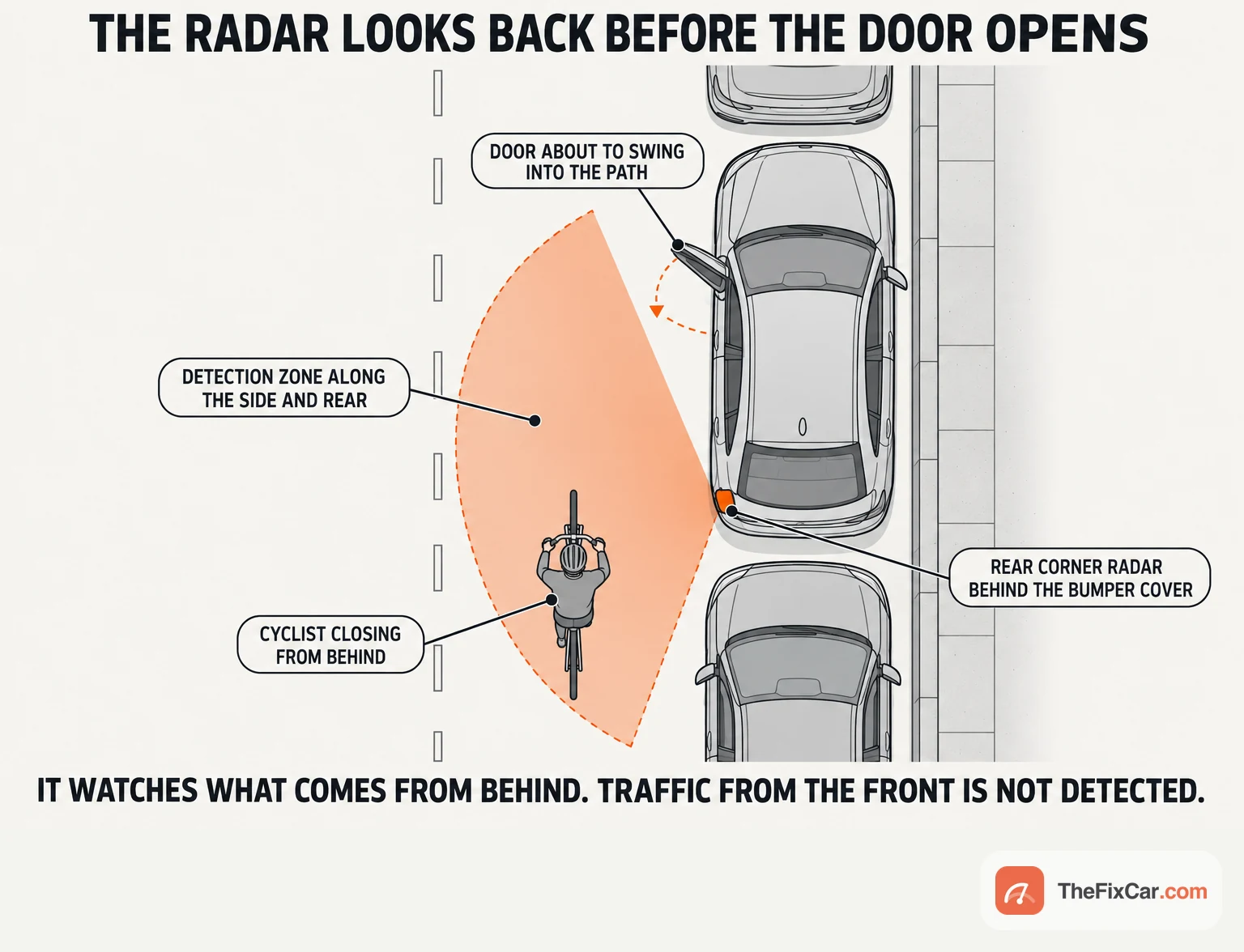
A search for “door opening warning system” lands on four names for one function. Hyundai calls it Safe Exit Assist, Ford, Audi and BMW call it Exit Warning, and the two test documents that now measure it, the Euro NCAP 2026 protocol and China’s GB/T 44173-2024, call it DOW or DOWS. The function is the same: a parked or stopping car watches the traffic closing on it from behind and warns, or holds the door, when someone is about to open it into that traffic. The numbers behind the four names are not the same, and no single specification exists.
What follows is the published data, separated by document: the sensor each cited manufacturer names, the speed and timing thresholds one owner’s manual and one manufacturer announcement state, the three response levels Euro NCAP distinguishes, the test geometry and pass criteria of both standards, and the fault code one manufacturer logs when the radar behind the bumper can no longer calibrate itself.
Quick answer
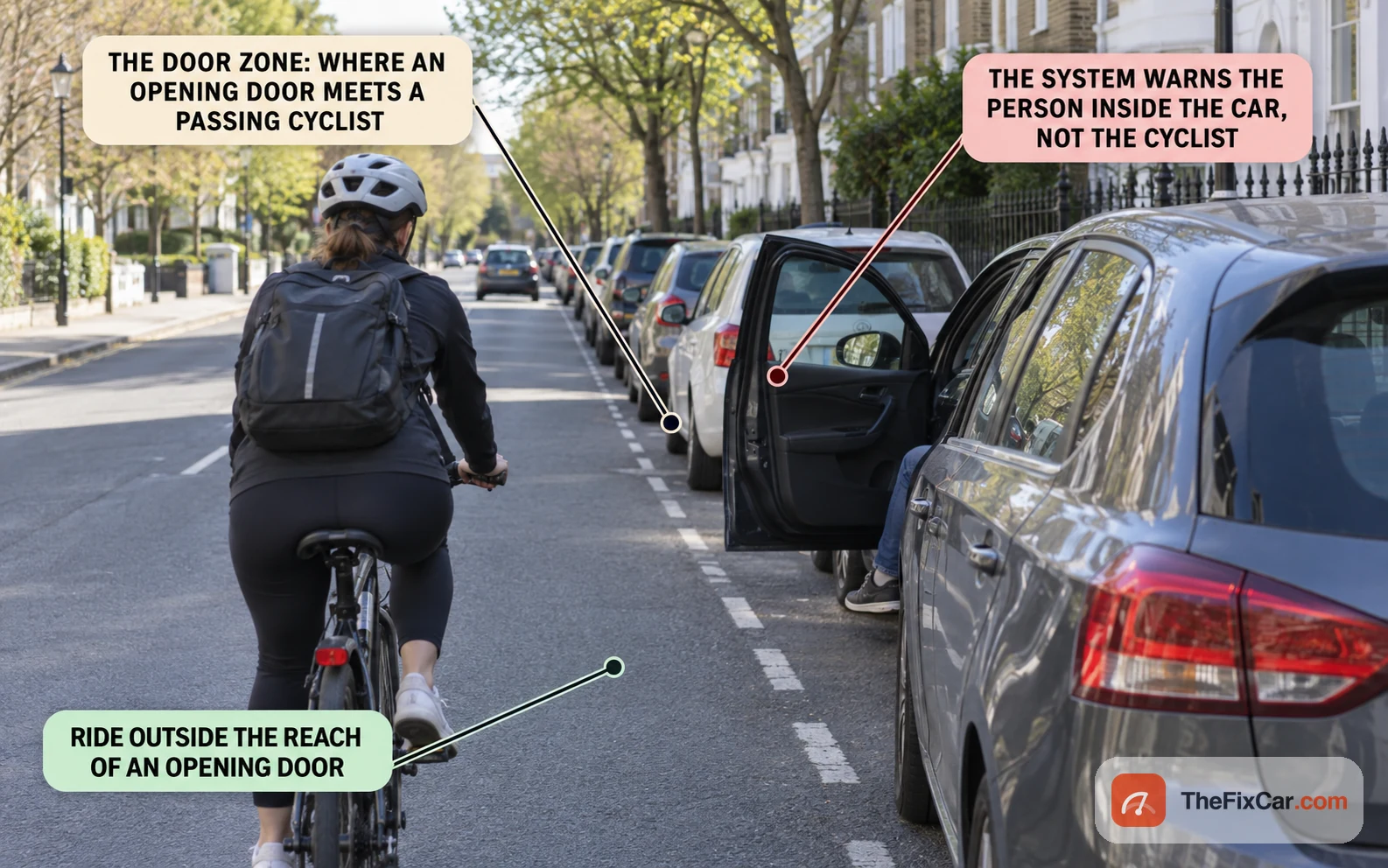
A door opening warning system monitors the side and rear of a parked or stopping car and reacts when a vehicle or bicycle closes from behind while a door is about to open. The sensing can be rear-corner radar, cameras or a fusion of several sensors: ISO’s account of the Chinese standard describes vision-based and multi-sensor implementations[12]. On the production vehicles documented on this page, rear or side radar is the primary sensor: the Hyundai Ioniq 5 N manual names the rear corner radar, and Ford and BMW name rear and side radars[2][3][4]. On the 2024 Hyundai Santa Fe the warning is armed below 3 km/h with an approaching vehicle above 6 km/h, it stays live for about 3 minutes after the engine is switched off, and it goes to sleep the moment the doors are locked[1]. Euro NCAP’s 2026 Low Speed Collisions protocol scores three response levels: information at a time-to-collision of at least 2.30 s, a warning at 1.70 s, and door retention that starts at 1.70 s and holds until 0.40 s after the bicycle has passed[5]. GB/T 44173-2024 requires the warning at a time-to-collision of at least 1.5 s, on the correct side, and for at least 3 minutes after power-off[6]. No universal specification exists: each figure below belongs to the vehicle or document named in its row.
Verified specifications at a glance
| Vehicle or document | Specification | Conditions | Primary source |
|---|---|---|---|
| Hyundai Santa Fe 2024, Safe Exit Assist | Warns when own speed is below 1.8 mph (3 km/h) and the approaching vehicle exceeds 4 mph (6 km/h) | Vehicle stopped or rolling to a stop, vehicle detected approaching from the rear at the moment a door is opened | Hyundai owner’s manual[1] |
| Hyundai Santa Fe 2024, Safe Exit Assist | Operates for about 3 minutes after the engine is turned off; turns off immediately when the doors are locked | After engine off | Hyundai owner’s manual[1] |
| Hyundai Santa Fe 2024, Safe Exit Assist with electronic child safety lock | Rear doors stay locked while traffic is detected; a second press of the child-lock button within 10 seconds releases them | Electronic child safety lock engaged, approaching vehicle detected from the rear | Hyundai owner’s manual[1] |
| Hyundai Ioniq 5 N 2026, Safe Exit Assist | Detecting sensor: rear corner radar; child-lock button will not unlock while a vehicle approaches from the rear | Vehicle stopped; precautions for the radar are those of the Blind-Spot Collision-Avoidance Assist section | Hyundai owner’s manual[2] |
| Ford Mustang 2024, Exit Warning | Identifies vulnerable road users travelling at least 4 mph; alerts on the cluster, the touchscreen and the side mirror; active up to 3 minutes after ignition off | Vehicle in park, rear-mounted radar | Ford announcement, Jul 2023[3] |
| BMW iX3 (Neue Klasse), Exit Warning with active door opening delay | Electronic door lock delays door opening until the detected risk has passed | Parked vehicle, side radars monitoring approaching vehicles, bicycles and other road users | BMW Group press release, Aug 2026[4] |
| Euro NCAP Low Speed Collisions v1.1, CBDA scenario geometry | Bicycle target at 10, 15 and 20 km/h; rear gap to the obstruction car 0.50 to 2.00 m; both cars 1 m from the bicycle path | Test within 180 s of propulsion off, driver unbelted | Euro NCAP protocol[5] |
| Euro NCAP Low Speed Collisions v1.1, door operation distance | 5.5 m at 10 km/h, 8 m at 15 km/h, 11 m at 20 km/h (plus stated tolerances) | Measured from the bicycle front reference point to the most rearward point of the driver’s door | Euro NCAP protocol[5] |
| Euro NCAP Low Speed Collisions v1.1, pass criteria | Information: TTC ≥ 2.30 s; Warning: TTC ≥ 1.70 s; Retention: begins at TTC ≥ 1.70 s and does not release before TTC −0.40 s | Reference point is the rear of the front door; warning needs a visual element in the driver’s side window view plus an audible or haptic element | Euro NCAP protocol[5] |
| Euro NCAP Low Speed Collisions v1.1, scoring | Dooring carries 2 of the 10 Pedestrian & Cyclist points; grid cells score green 1.00, yellow 0.75, orange 0.50, brown 0.25, red 0 | Retention on all doors scores green, on the driver’s door only yellow; warning on all doors yellow, driver’s door only orange | Euro NCAP protocol[5] |
| GB/T 44173-2024, warning performance | Warning must be issued at a time-to-collision of not less than 1.5 s and must state left or right | M1 passenger cars equipped with a DOWS; target vehicle and target bicycle; lateral zone bounded 1.5 m outside the body edge; standard in force since July 24, 2024 | SAMR record and English excerpt[7][6] |
| GB/T 44173-2024, delayed shutdown | System continues to work for at least 3 minutes after power-off (or at standstill on vehicles without a power-off switch) | Tested per clause 6.7 | GB/T 44173-2024 English excerpt[6] |
| GB/T 44173-2024, test conditions | Bicycle target 1.8 ± 0.2 m long, 0.5 ± 0.2 m wide, 1.7 ± 0.2 m high with rider; equipment accuracy 0.05 m, 30 ms, 0.1 km/h | Illumination at least 500 lx, −20 to +45 °C, visibility over 1 km | GB/T 44173-2024 English excerpt[6] |
| Audi TSB 2063336/2, listed 2018 to 2023 models | DTC C12BFF0 “radar sensor automatic calibration not possible” sets when the dynamic angle offset exceeds ±5° | Continuous calibration while driving above a defined speed; message “Side assist and exit warning system: fault” | Audi bulletin filed with NHTSA[8] |
Note: these are the published values for the named vehicles and documents, not a universal table. Take the figure for your car from its own owner’s manual.
What these numbers do NOT mean
- The 3 km/h and 6 km/h thresholds come from the 2024 Santa Fe manual alone. The Ioniq 5 N manual names the sensor and the child-lock behaviour without a speed figure, and other brands publish their own thresholds or none at all.
- A green Euro NCAP dooring cell means the door was retained in the CBDA scenario: an adult bicycle target at 10 to 20 km/h, one metre from the car, in daylight above 2,000 lux. It says nothing about pedestrians, scooters, traffic from the front, or night[5].
- GB/T 44173-2024 applies to M1 cars that are equipped with a DOWS. It is a performance standard for vehicles that have the system, not a requirement to fit one[6].
- DTC C12BFF0 names a calibration condition, not a dead sensor. The Audi bulletin lists loose mounts, stickers, dirt, bumper damage and paint repairs ahead of the sensor itself, and states that replacing the radar without clear findings will not resolve the fault[8].
How a door opening warning system works
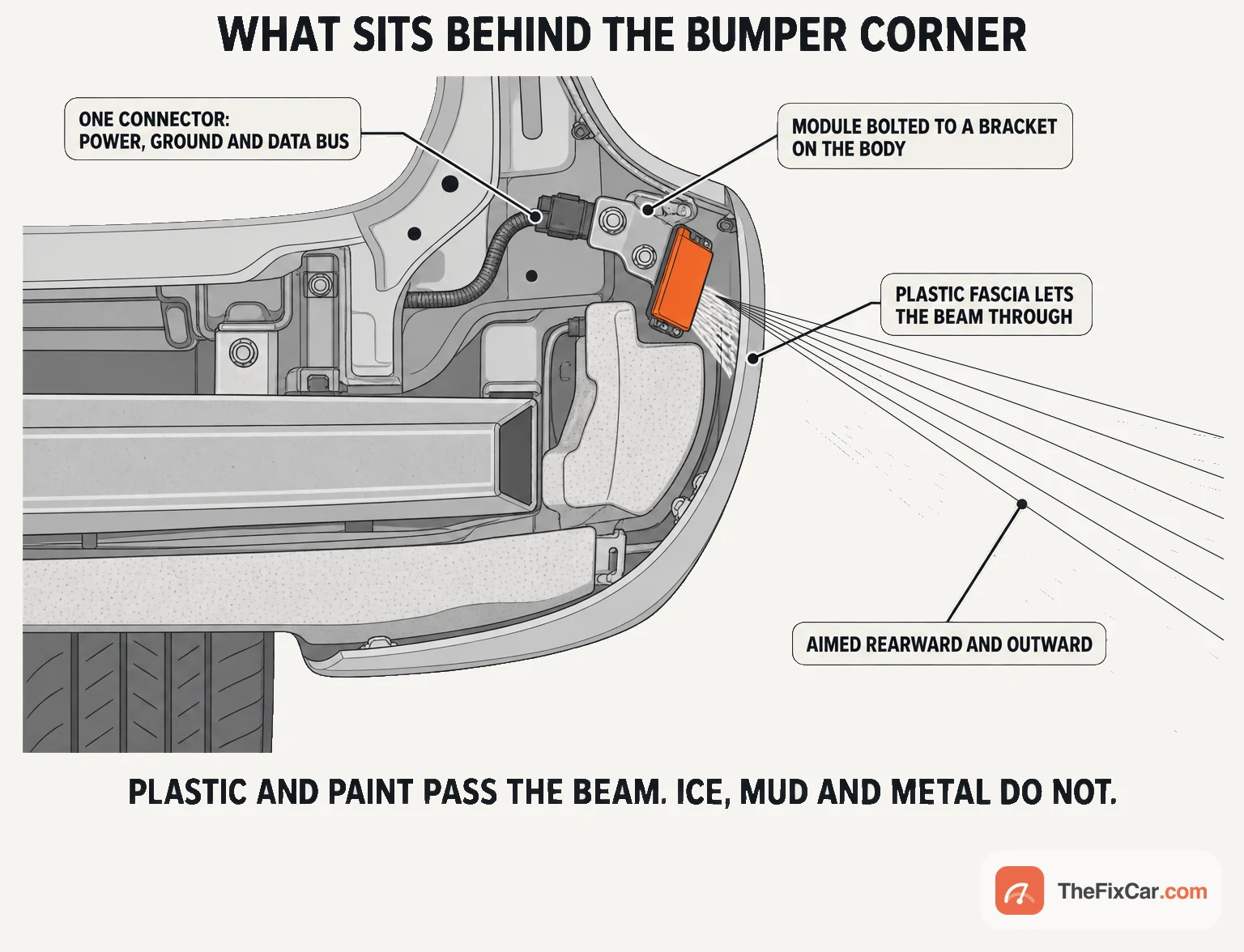
For a warning or a held door, three things line up. The car is stopped or nearly stopped. Something is closing on it from behind, on the side where a door is. And a door is being opened. The vehicle knows the first condition from its own speed signal; the second is read by radar: the Hyundai Ioniq 5 N manual names the rear corner radar as the detecting sensor and sends the reader to the Blind-Spot Collision-Avoidance Assist section for its precautions[2], BMW describes side radars monitoring the area around the parked car[4], and Ford refers to radar at the rear of the vehicle[3]. The third condition is the door itself: the Santa Fe warns at the moment a door is opened[1], and Euro NCAP triggers its warning and retention runs by operating the door control[5]. Information can come earlier than that: Euro NCAP’s first run passes the bicycle without anyone touching the door, to see what the driver is shown[5].
What the car then does is a ladder, and Euro NCAP’s 2026 protocol grades its rungs separately[5]. Information is a visual cue in the driver’s side-window field of view. A warning adds a flashing visual element plus an audible or haptic one. Retention physically holds the door until the threat has passed[5]. The cited production systems sit on different rungs. The 2024 Ford Mustang gives audio and visual alerts on the cluster, the touchscreen and the mirror[3]. The 2024 Santa Fe warns on the cluster with a chime and, on the rear doors, keeps the electronic child safety lock engaged while traffic approaches[1]. The BMW iX3 lets the electronic door lock delay opening until the danger has passed[4], the behaviour the Euro NCAP protocol defines as retention; the press release describes the feature, not a test result.
The same rear-corner radars serve three functions that are easy to confuse, and the Audi bulletin cited below lists their fault messages together for exactly that reason[8]. What separates them is when the car is doing what:
| Function | Vehicle state | What it watches | What triggers it |
|---|---|---|---|
| Door opening warning (DOW, Safe Exit Assist, Exit Warning) | Stopped or parking | Traffic approaching from behind on the door side | A door being opened, or the door control operated |
| Blind spot warning (BSW, Side Assist, BCA) | Driving | The adjacent lane’s blind zone | A vehicle in the zone, or a lane change toward it |
| Rear cross traffic alert (RCTA) | Reversing | Traffic crossing behind the car | Reverse gear with a crossing vehicle detected |
The sensor hardware behind all three, and how its range and field of view are specified, is on our Bosch ADAS hardware page.
Sensors: what the rear corner radar sees and what blocks it
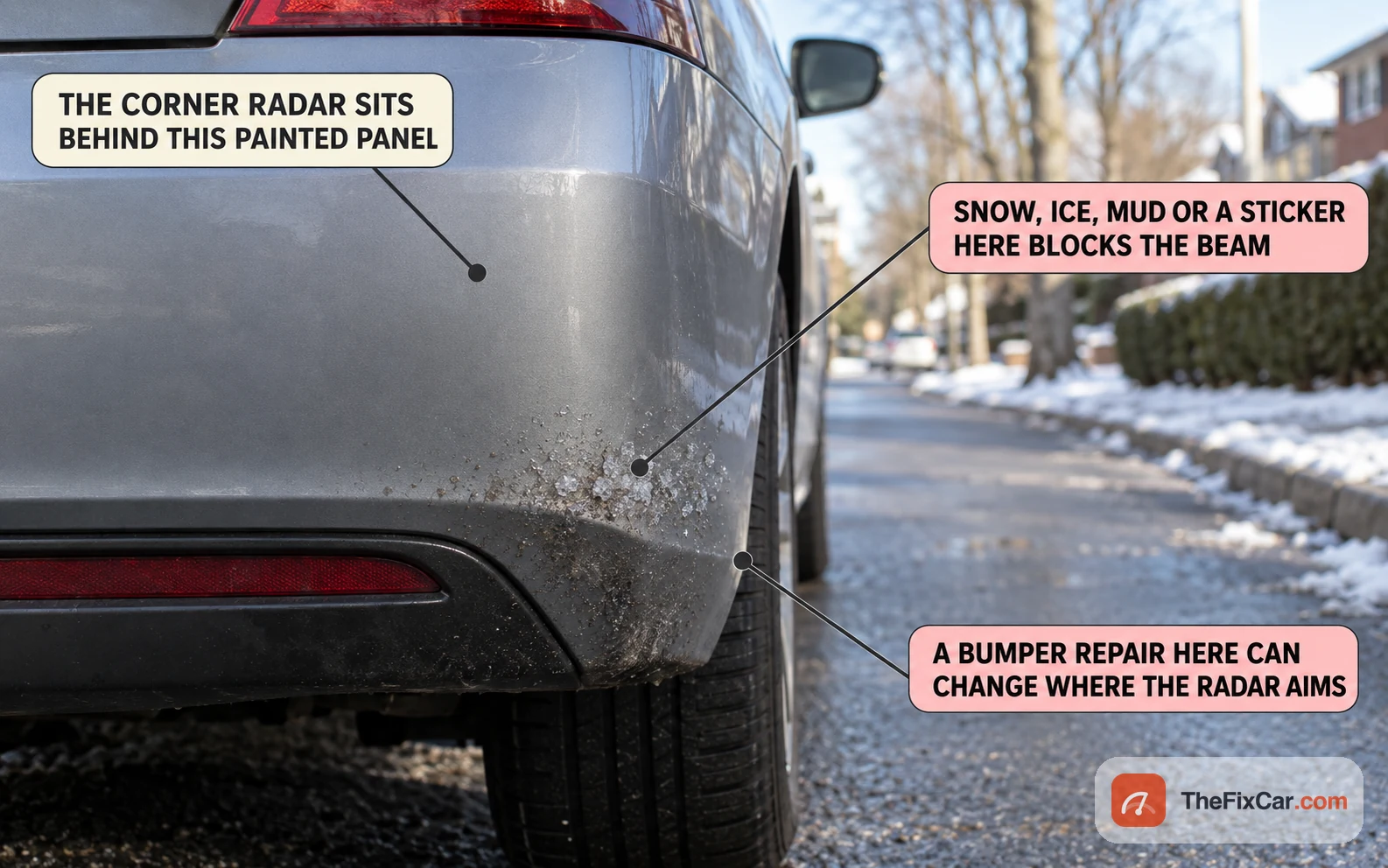
The radar module sits behind the painted plastic corner of the rear bumper, aimed rearward and outward, and nothing on the outside marks its position. That is why the Audi bulletin on the fault message “Side assist and exit warning system: fault” lists what interferes with it in this order: sensors loose or not fully seated in their mounts, incomplete calibration after replacement, decals, stickers or NFC tags in the field of view on either side of the bumper cover, excessive dirt, damage to the cover, and paint repairs or non-conforming paint on the inside or outside of the cover[8]. Five of those seven items are on the bumper cover or its paint, one is the sensor’s own mounting, and one is calibration. None of them is a failed radar.
Advertised radar range is not what limits this function. A bicycle at 20 km/h covers about 9.4 m in the 1.70 seconds Euro NCAP requires between the warning and the collision, and the protocol operates the door control at 11 m for that speed[5], so the decision is made within the last car-length or two behind the door. What matters more is what sits inside the beam. Euro NCAP parks an obstruction car behind the test vehicle with a rear gap of only 0.50 to 2.00 m, so the bicycle emerges from behind it late in its approach[5], and the Hyundai manual states plainly that the system may warn late or not at all depending on road and driving conditions, and that its chime may be masked by another system’s warning or by noise[1].
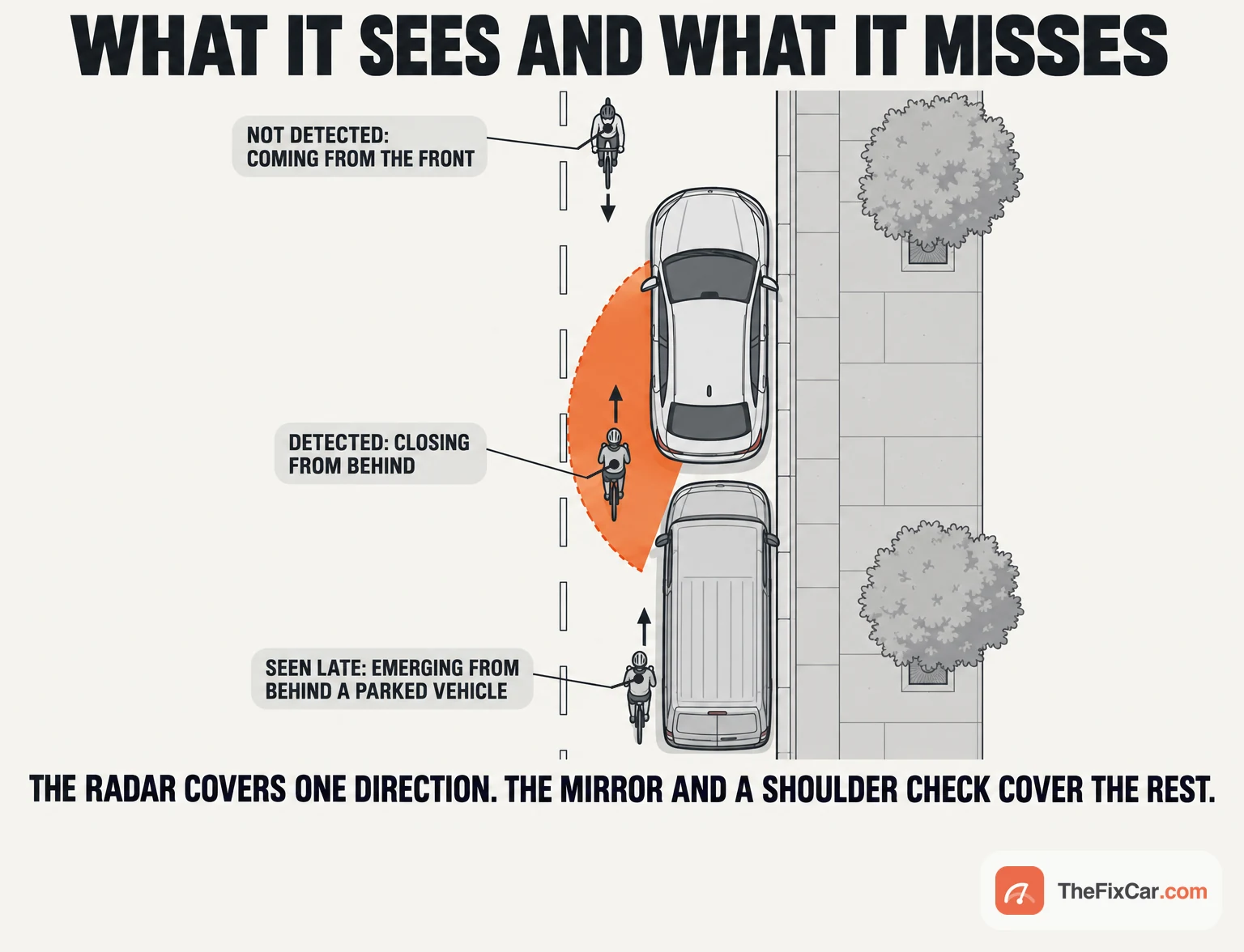
Direction is fixed by the definition. Both Hyundai manuals describe a vehicle approaching from the rear[1][2], Ford’s system watches behind the car[3], and the Chinese standard defines DOWS as monitoring road users to the side and rear[6]. A cyclist riding towards the car from the front, on a contraflow lane or a one-way street ridden the wrong way, is outside every one of those descriptions. Unless the owner’s manual for your car says otherwise, the mirror and a shoulder check cover that direction, not the radar.
Thresholds and timing on named vehicles
The 2024 Hyundai Santa Fe manual is the most specific of the cited documents. Safe Exit Assist warns when the car’s own speed is below 1.8 mph (3 km/h) and the vehicle approaching from the rear is faster than 4 mph (6 km/h), the “Collision Warning” message appears on the cluster with a chime at the moment a door is opened, the system keeps working for about 3 minutes after the engine is turned off, and it switches off at once when the doors are locked[1]. Ford’s figure for the 2024 Mustang is a road user travelling at least 4 mph, with the system active for up to 3 minutes after ignition off[3].
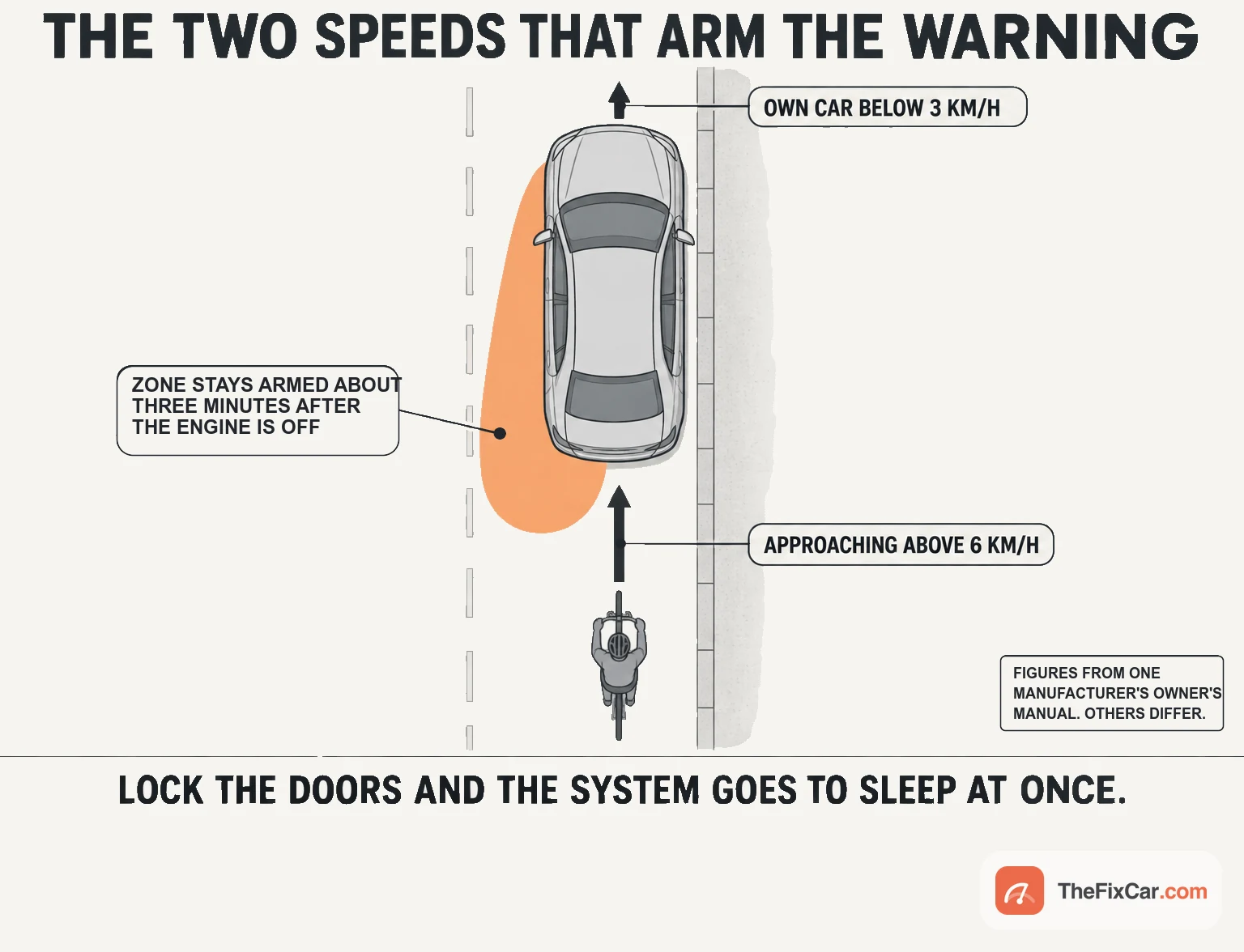
Three minutes is the number that keeps recurring. Hyundai and Ford both keep the function alive for about that long after the engine stops[1][3], GB/T 44173-2024 requires at least 3 minutes of delayed shutdown after power-off[6], and Euro NCAP runs every dooring test within 180 seconds of the propulsion system being switched off, with the driver unbelted[5]. On those two vehicles, a passenger who lingers past that window steps out of a car whose radar has gone to sleep. On the Santa Fe, locking the doors ends the window early[1].
Door retention and the child lock
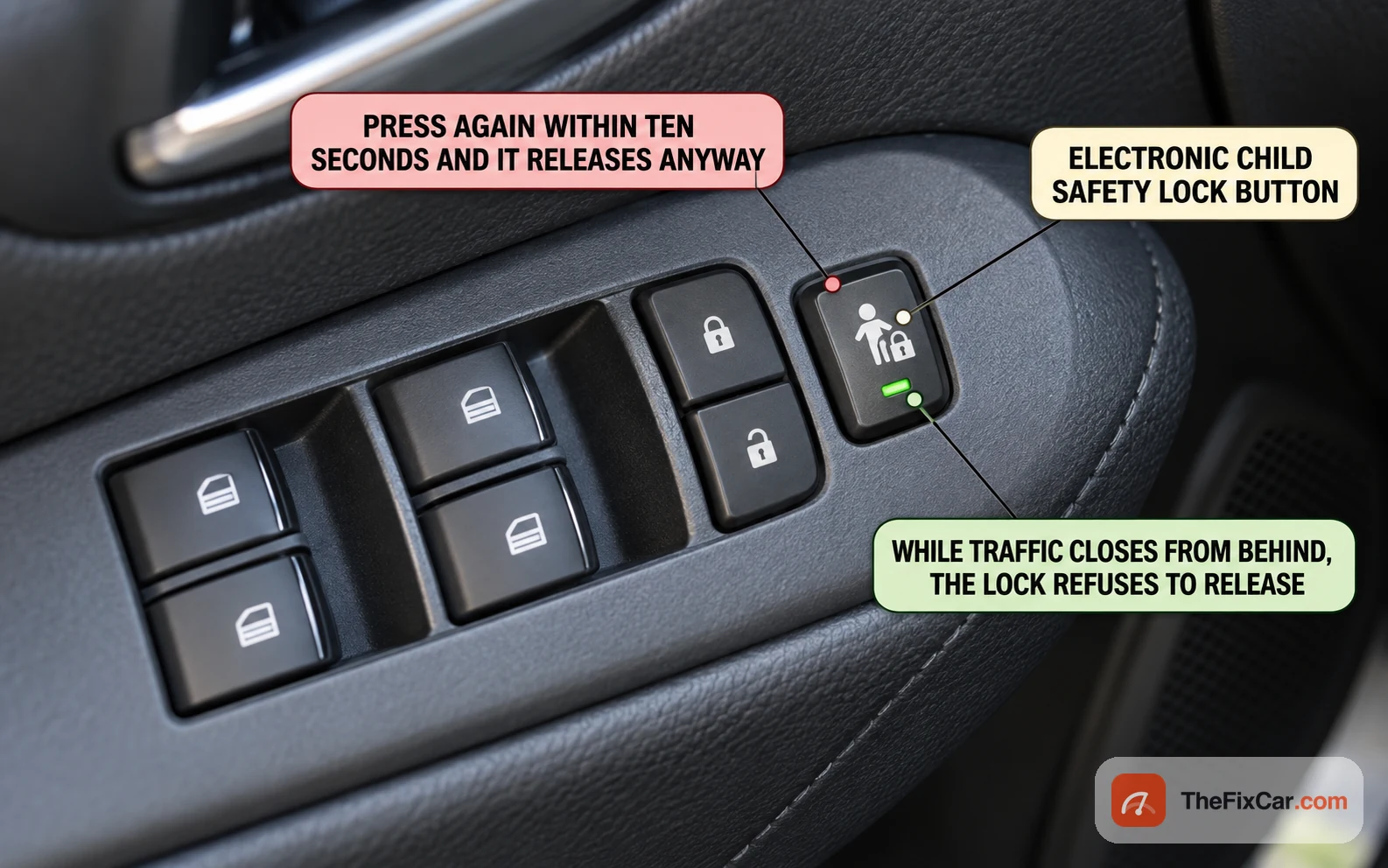
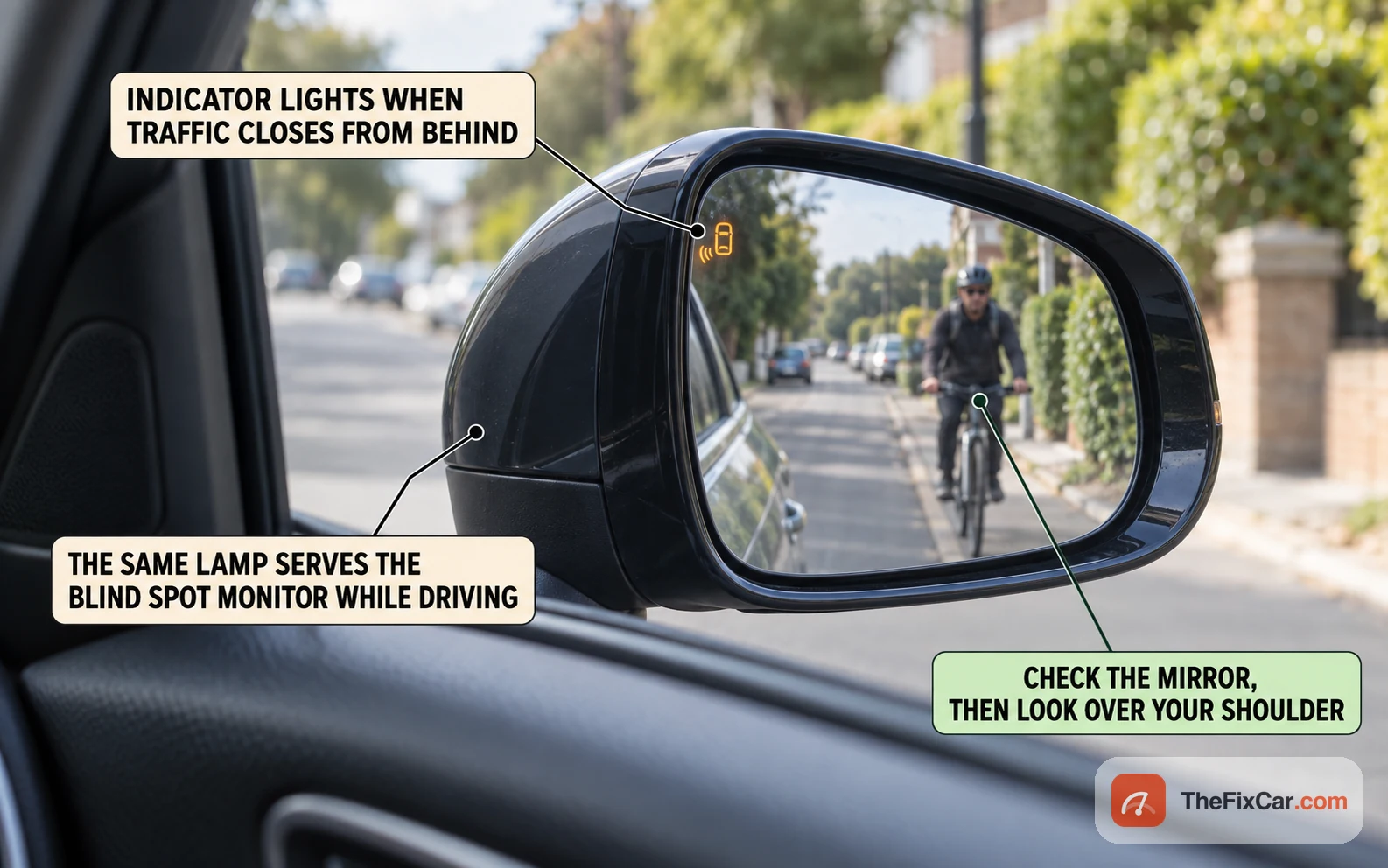
Holding the door is where the implementations diverge most. On the 2024 Santa Fe, retention is limited to the rear doors and only through the electronic child safety lock. With the lock engaged and a vehicle detected from the rear, the rear doors stay locked even when the driver presses the button, the mirror lamp blinks, and the cluster shows “Check traffic in the blind spot, then try again”. A second press within 10 seconds is read as the driver acknowledging the traffic, and the doors release. A rear door opened from outside opens regardless[1]. The manual adds that Safe Exit Assist is not a substitute for the child lock itself[1].
BMW’s Neue Klasse moves retention to the door lock: if the side radars detect a risk of collision, the electronic door lock delays the opening of the door until the danger has passed[4]. Euro NCAP writes the timing for this class of system in numbers. Retention must begin at a time-to-collision of 1.70 s or more and must not end before a time-to-collision of −0.40 s, that is, 0.4 s after the bicycle’s reference point has passed the rear edge of the front door. Retention on the driver’s door alone scores yellow; on all doors on the threatened side it scores green[5]. The protocol permits an emergency exit function triggered by an additional action such as a second pull, and it lets a sliding door that opens only a little be scored on warning instead of retention, with that warning allowed to stop 10 seconds after the door control is operated[5].
Safety standards: Euro NCAP 2026, GB/T 44173-2024 and ISO/DIS 25354
The test documents exist because the crash type is common: a ten-year analysis of US emergency-department data estimated 17,156 cyclists treated after collisions with an open car door, from 644 recorded cases, and the German Insurance Association put dooring at 8% of Berlin’s bicycle accidents in 2024[9][4]. Euro NCAP added Door Opening Warning to its 2026 protocols as part of the new Low Speed Collisions tests[11]. The protocol defines DOW as an audio-visual warning given automatically in response to the detection of a likely dooring collision with a passing bicyclist, and tests it in one scenario, Car-to-Bicyclist Dooring Adult. The bicycle target travels in a straight line at 10, 15 and 20 km/h, one metre from the widest structure of the test car, past an obstruction car parked behind it with a rear gap of 0.50, 1.00, 1.50 or 2.00 m. In the first run nobody touches the door, to see what information the driver gets. In the second run the driver’s door control is operated when the bicycle is 5.5, 8 or 11 m away, one distance per speed[5].
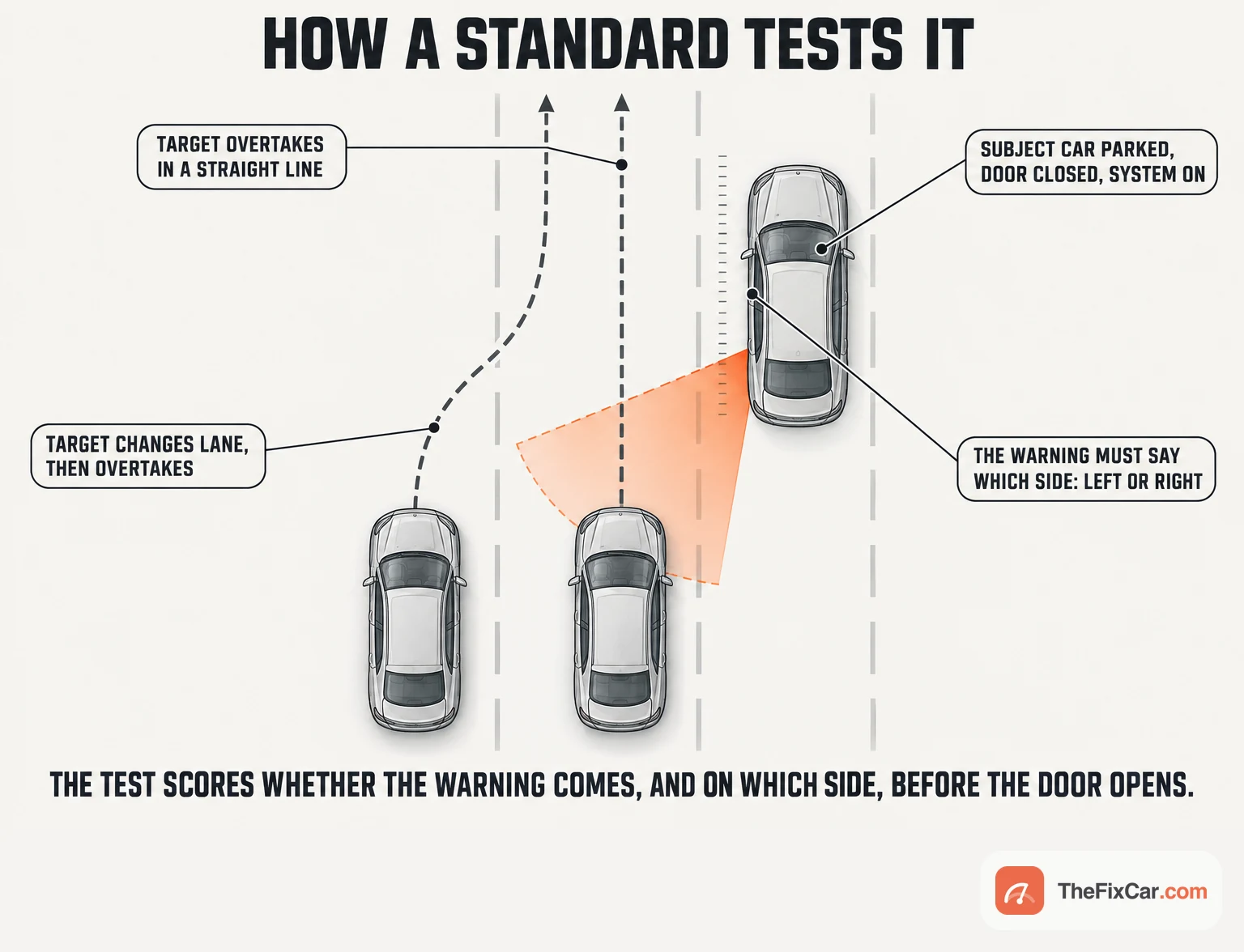
The pass line is time-to-collision at the moment the car responds, measured to the rear of the front door. Information at 2.30 s or more scores brown, a warning at 1.70 s or more scores orange on the driver’s door and yellow on all doors, and retention that starts by 1.70 s and holds until 0.40 s after the pass scores yellow or green on the same split. Anything later is red. Dooring is worth 2 of the 10 Pedestrian & Cyclist points in this protocol, and each grid cell is weighted 1.00, 0.75, 0.50, 0.25 or 0 by colour[5]. BMW states that the iX3 was one of the first vehicles evaluated under the revised 2026 protocols and that it took five stars, with the door delay fitted as standard[4].
China’s GB/T 44173-2024 was issued and implemented on July 24, 2024, under the Ministry of Industry and Information Technology, and applies to M1 passenger cars equipped with a door open warning system[7]. It requires a self-check of the electrical and sensor components, a fault indication that is distinct from the warning itself, and a warning by at least one of the optical, acoustic or tactile routes that clearly states whether the target is on the left or the right. The performance clause sets the time-to-collision at the moment of warning at not less than 1.5 seconds, the alarm zone extends 1.5 m outside the body edge, and delayed shutdown must last at least 3 minutes after power-off. The test methods run a target car and a target bicycle past every door on each side, in a straight overtake and in a lane-change overtake, with equipment accurate to 0.05 m, 30 ms and 0.1 km/h[6]. The international version is in progress: ISO 25354, Road vehicles, Test method to evaluate the performance of door open warning system, sits at the Draft International Standard stage as of September 2026 and covers M1 and N1 vehicles[10]. ISO’s own account credits China’s experience with the technology, including vision-based and multi-sensor implementations, as input to that draft[12].
When the system faults: messages, DTC C12BFF0 and what to check first
On the Audi models covered by bulletin 2063336/2, from the 2018 A8 to the 2023 e-tron GT, the cluster reports “Side assist and exit warning system: fault. Please contact workshop.” together with intersection assist or rear cross-traffic messages, because those functions share the rear corner radars. The stored code is C12BFF0, radar sensor automatic calibration not possible, in the lane change assist modules J769/J770 or the object detection modules J1088/J1089. Audi explains that these sensors calibrate themselves continuously against the surroundings while the car drives above a defined speed, and the code is logged when the calculated dynamic angle offset exceeds ±5°[8]. The code reports aim, not health: a sensor pushed out of alignment by cover damage can be electrically sound and still set it, and the bulletin’s list of causes also includes mounting and calibration items that are not at the cover.
The bulletin’s order of work matters more than the code. On the Audi models it covers, and with Audi’s own diagnostic tool, the sequence is: check the bumper-side causes first: seating, stickers and tags, dirt, cover damage, paintwork. If none applies and calibration still fails, remove and reseat the sensor and calibrate again, and if it fails a second time, swap the left and right sensors, run the full replacement procedure in ODIS-S so each sensor carries the correct data set, and calibrate again, dynamic calibration preferred[8]. Which procedure your car needs after a bumper repair is a per-model question, covered on our OEM ADAS calibration requirements page, and the code format itself is explained on the ADAS DTC codes page. A message that appears only in snow or heavy dirt and clears after a wash points to a blocked sensor rather than a failed one, the same logic as a “clean sensor” message on a front radar; the stored codes still tell the difference. On the Santa Fe, a warning that never comes has a simpler first check: whether the doors were locked, because locking ends the function immediately[1].
How to use these values
- Find the exact speed thresholds and the after-engine-off window in your own owner’s manual before relying on the function for rear-seat passengers. The 3 km/h and 6 km/h figures here apply to the 2024 Santa Fe, and Ford publishes a different threshold for the 2024 Mustang.
- After any rear bumper repair, repaint, wrap or sticker, treat a “side assist and exit warning” or “blind spot unavailable” message as a bumper-side problem first, in the order Audi’s bulletin uses for its listed models, and expect your own model’s calibration step before a sensor is condemned.
- Read a Euro NCAP dooring result by its colour and by which doors it covers: green is retention on all doors, yellow can be retention on the driver’s door alone or a warning on all doors, brown is information only.
FAQ
Is Safe Exit Assist the same thing as a door opening warning system?
Same class of function, different implementations. Hyundai’s Safe Exit Assist, Ford’s and BMW’s Exit Warning, and Audi’s exit warning within side assist all describe a radar function that reacts when traffic approaches a stopped car whose door is about to open, and they differ in thresholds, warning channels and whether any door is held[1][3][4][8]. Euro NCAP and GB/T 44173-2024 use Door Opening Warning and DOWS for the generic function[5][6].
Does it still work after the engine is off?
On the 2024 Santa Fe it works for about 3 minutes after the engine is turned off, unless the doors are locked first[1]. Ford quotes up to 3 minutes for the 2024 Mustang[3], and GB/T 44173-2024 requires at least 3 minutes[6]. After that window, exit the car as if no system were fitted.
Can it physically stop a door from opening?
Some systems can, on some doors. The Santa Fe holds only the rear doors, and only through the electronic child safety lock, with a 10-second override[1]. The BMW iX3 delays the electronic door lock itself until the risk has passed[4]. Euro NCAP scores this as retention and permits an emergency exit function triggered by an additional action[5].
Will it see a cyclist coming from the front?
Not in any system cited here. Every cited manufacturer and both standards describe the function around road users approaching from the rear and the side[1][3][6]. Oncoming traffic on the door side is the driver’s job.
Why does mine say “exit warning unavailable” after a bumper repair?
Because the rear corner radars sit behind the bumper cover and calibrate themselves against the road while driving. Audi’s bulletin sets DTC C12BFF0 when the measured angle offset exceeds ±5°, and lists a damaged or repainted cover, stickers, dirt and a loose sensor as the causes to clear before any replacement[8]. On another make the message text and the repair path are its own, so start from the stored codes and that manufacturer’s procedure.
Sources & verification
Last technically reviewed: Sep 2026
Reviewed by: Jamie Kowalski, Vehicle Safety Editor
Primary references: manufacturer owner’s manuals and press releases, the Euro NCAP Low Speed Collisions protocol, the GB/T 44173-2024 national standard, a manufacturer service bulletin filed with NHTSA, and a peer-reviewed injury surveillance analysis
Suggested citation: TheFixCar, “Door Opening Warning (DOW) System: How It Works, Sensors and Safety Standards,” updated Sep 2026. https://thefixcar.com/specs/door-opening-warning-system/