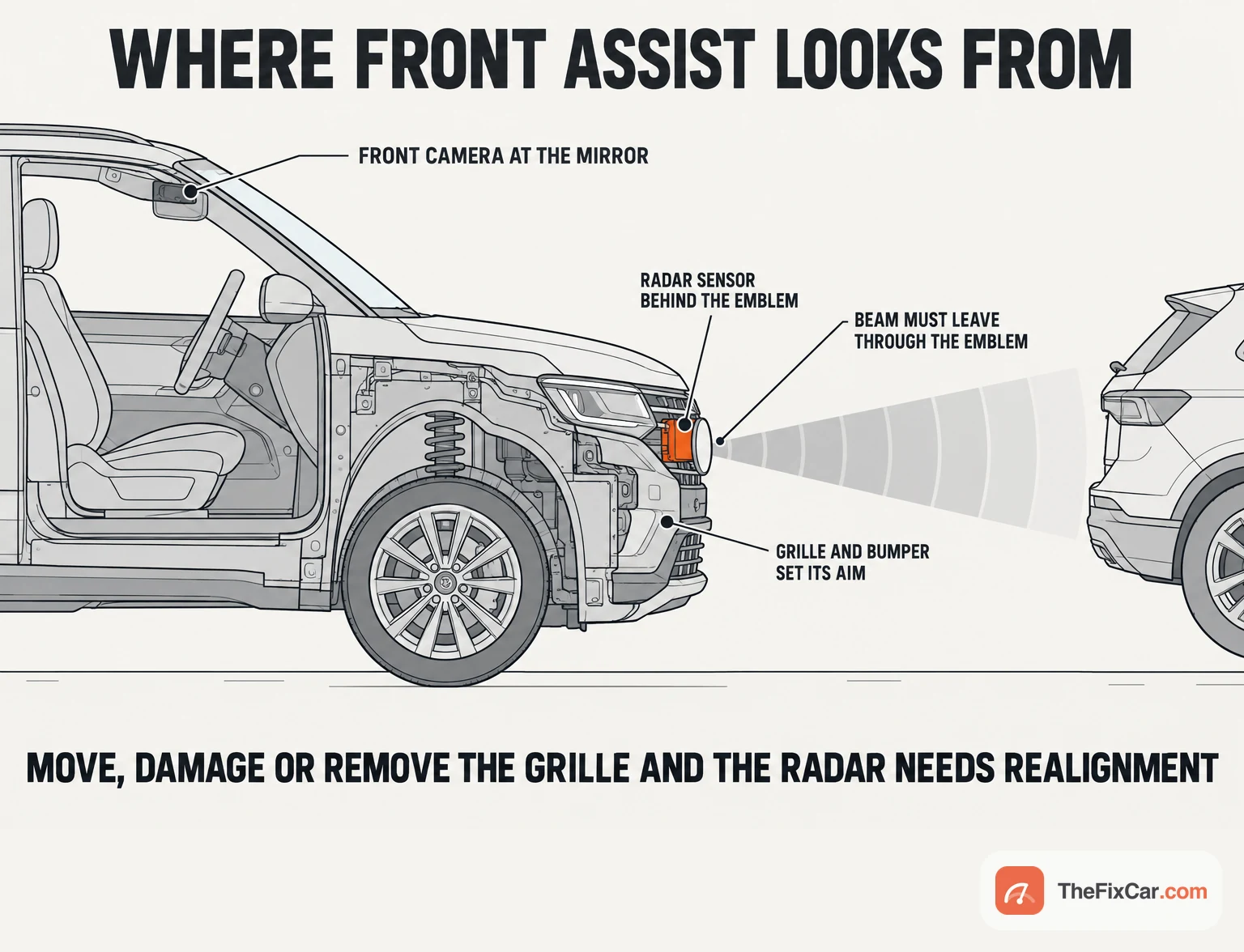
“Front Assist not available” on a Volkswagen cluster is an amber light plus a text line, and the text line is the part that matters. Volkswagen uses several wordings for the same system: “Front Assist: no sensor view!” when the radar is blocked, “Front Assist not available” when the system has shut itself off, with adaptive cruise control disabled alongside it on some models, and on 2022 to 2024 GTI and Golf R a longer “Driver assistance currently not available and/or Front Assist monitoring system available with limitations”[1][4][5]. Each wording points to a different set of documented causes.
The radar sits in the front grille, and where in it depends on the model: right behind the emblem on the Tiguan its supplier describes, in the lower air grille on the 2017 Golf and GTI of Volkswagen’s own calibration update[11][12]. Either way, anything that happens to the nose of the car happens to the radar: slush, a licence plate bracket, a replaced grille, a lowered suspension, even a loaded bike carrier on the rear hitch[1][3]. Volkswagen’s own bulletins separate these causes by model and by the fault code stored in the radar or camera module, and two of the newest ones say in capital letters to update the software before replacing the part. This page follows those documents; your owner’s manual shows where the radar and camera sit on your car.
Quick answer
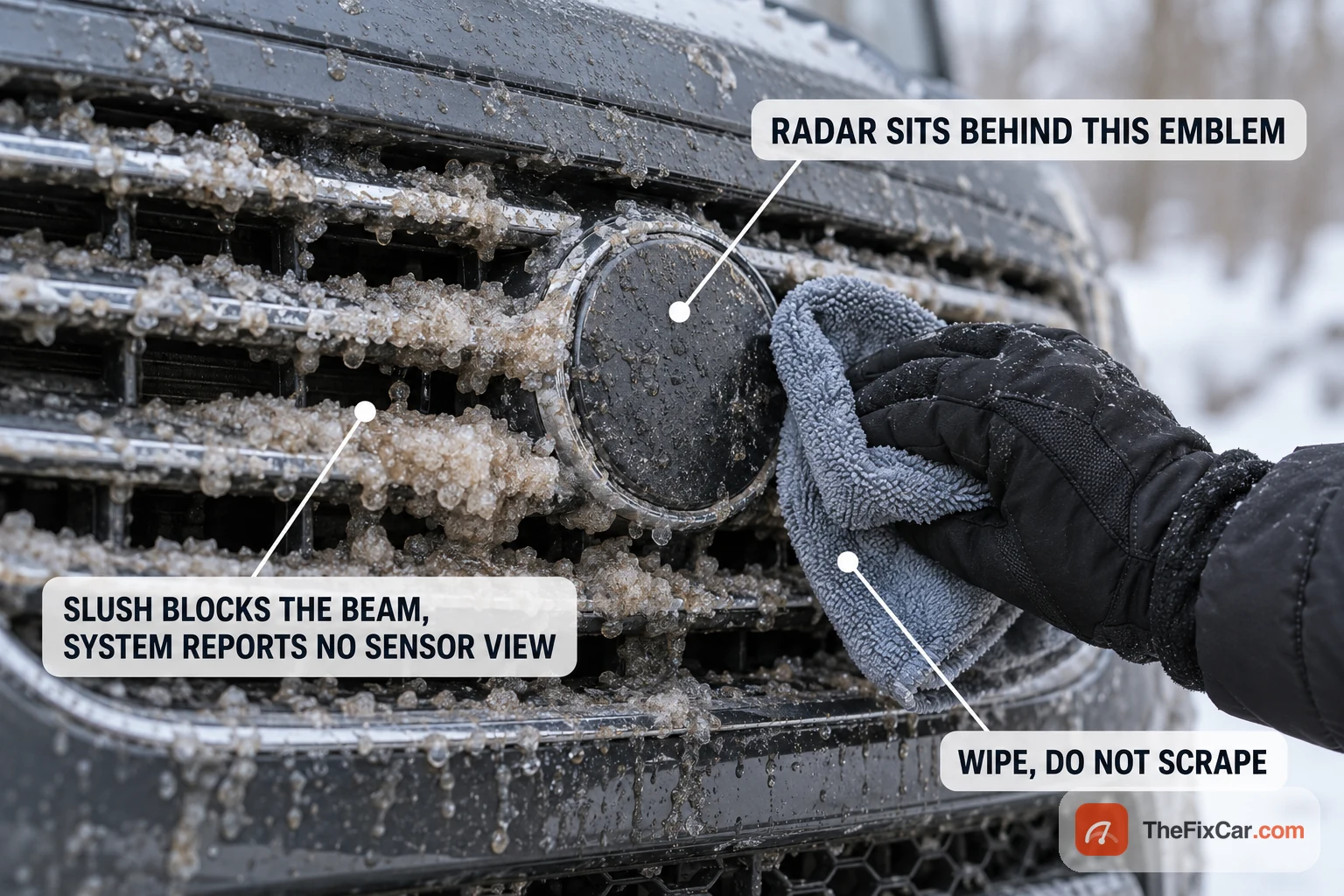
Wipe the radar area, behind the emblem or in the lower grille depending on the model, and the windshield in front of the mirror camera, then look at what has changed at the front of the car since the system last worked.
| What you see | Where to look | What to do first |
|---|---|---|
| “Front Assist: no sensor view!” in rain, snow or after a muddy road | The emblem and the grille, including the lower air intake | Clean it; Volkswagen says the system returns on its own once the radar is clear[1] |
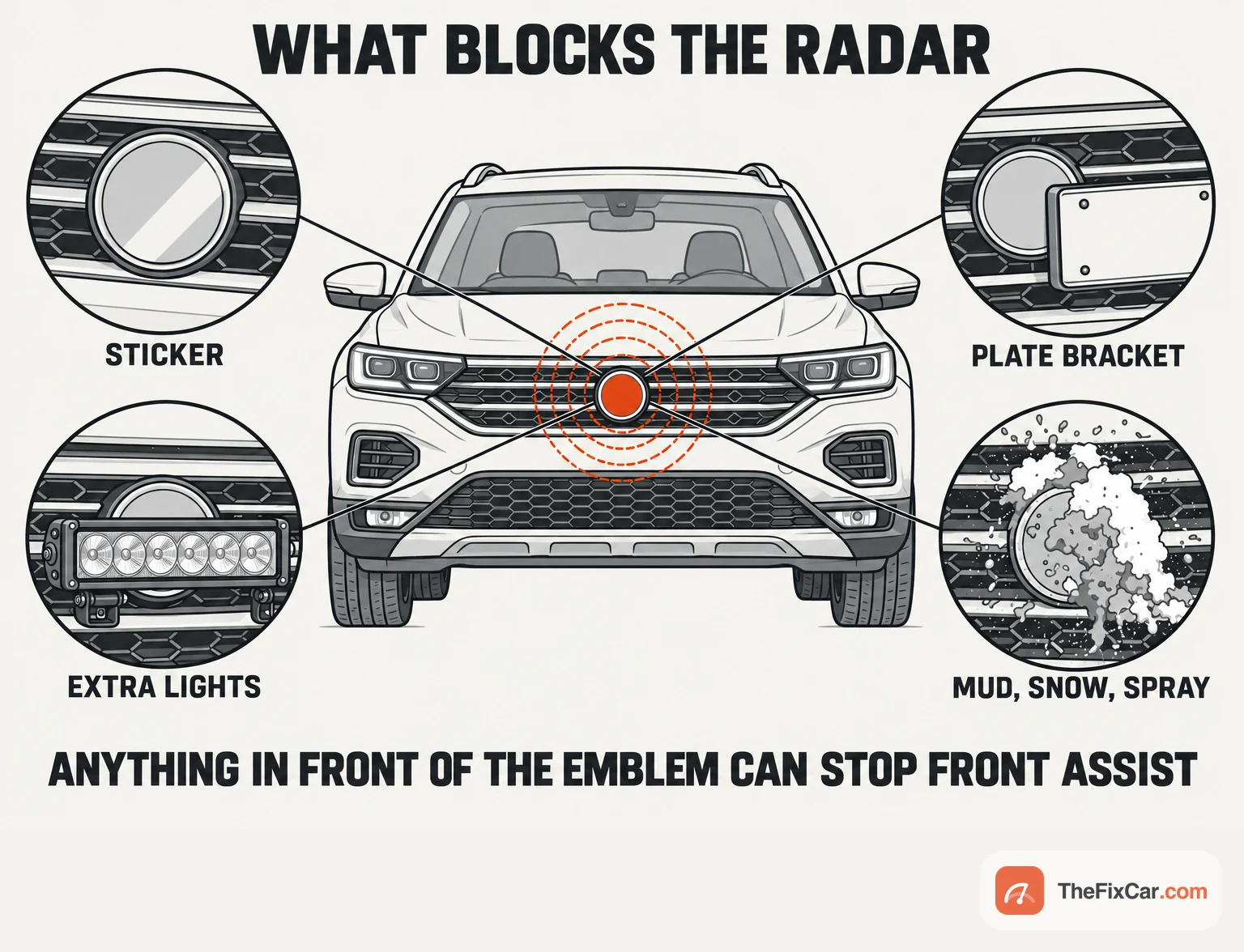
| “Front Assist not available” that stays on in dry weather | Stickers, plate bracket, add-on lights, paint or body work at the nose | Remove what covers the emblem; if nothing does, the next step is a scan of the radar module and, where the grille or bumper has been touched, an alignment[1][2] |
| “Front Assist not available” or ACC disabled on a 2024 to 2026 Atlas or Atlas Cross Sport | Radar module fault memory | If C110300 is stored, bulletin 91-25-06 calls for a software update before any diagnosis of the radar[4] |
| “Driver assistance currently not available” on a 2022 to 2024 GTI or Golf R | Front camera fault memory | If B200FF4 is stored on a camera with software 3302 and hardware H09, bulletin 96-25-03 calls for a camera update before any replacement[5] |
| Message after a bumper, grille or windshield job | The repair invoice | Ask whether the radar was aligned; for the 2015 to 2019 models in its tech tip, Volkswagen requires alignment after any grille damage, movement or removal[1] |
A guide, not a diagnosis: each line has more than one cause behind it.
Symptoms and what else produces them
Volkswagen describes Front Assist as a radar sensor, “and in select models a camera,” watching the road ahead, switched on with every ignition cycle and working from roughly 3 mph, with the exact speeds varying by model[6]. When the cluster says the system is unavailable, the question is whether the radar cannot see, cannot aim, or cannot be trusted by its own software. The table lists the competing sources for each symptom and the clue that shifts suspicion between them.
| Symptom | Competing sources | Clues that shift suspicion |
|---|---|---|
| Message appears in bad weather and clears later | Slush or spray on the emblem; detergent film from a car wash; a sticker added recently | Clears after cleaning and stays off in dry weather: blockage. Returns in dry weather: look further, starting with what sits in front of the emblem[1][2] |
| Message only in a parking garage or next to guard rails | Reflected radar signal; a real fault | Volkswagen lists multilevel parking structures and nearby metal rails or plates as conditions that impair the radar; a message confined to those places points to environment rather than a fault[1] |
| Message began after the car was lowered, lifted or fitted with a new grille or plate frame | Radar aim changed; radar view covered; sensor mounting damaged | Volkswagen says lowering, front-end trim changes and plate brackets can all impair the system, and that on the 2015 to 2019 models it covers, any damage, movement or removal of the grille requires radar alignment[1] |
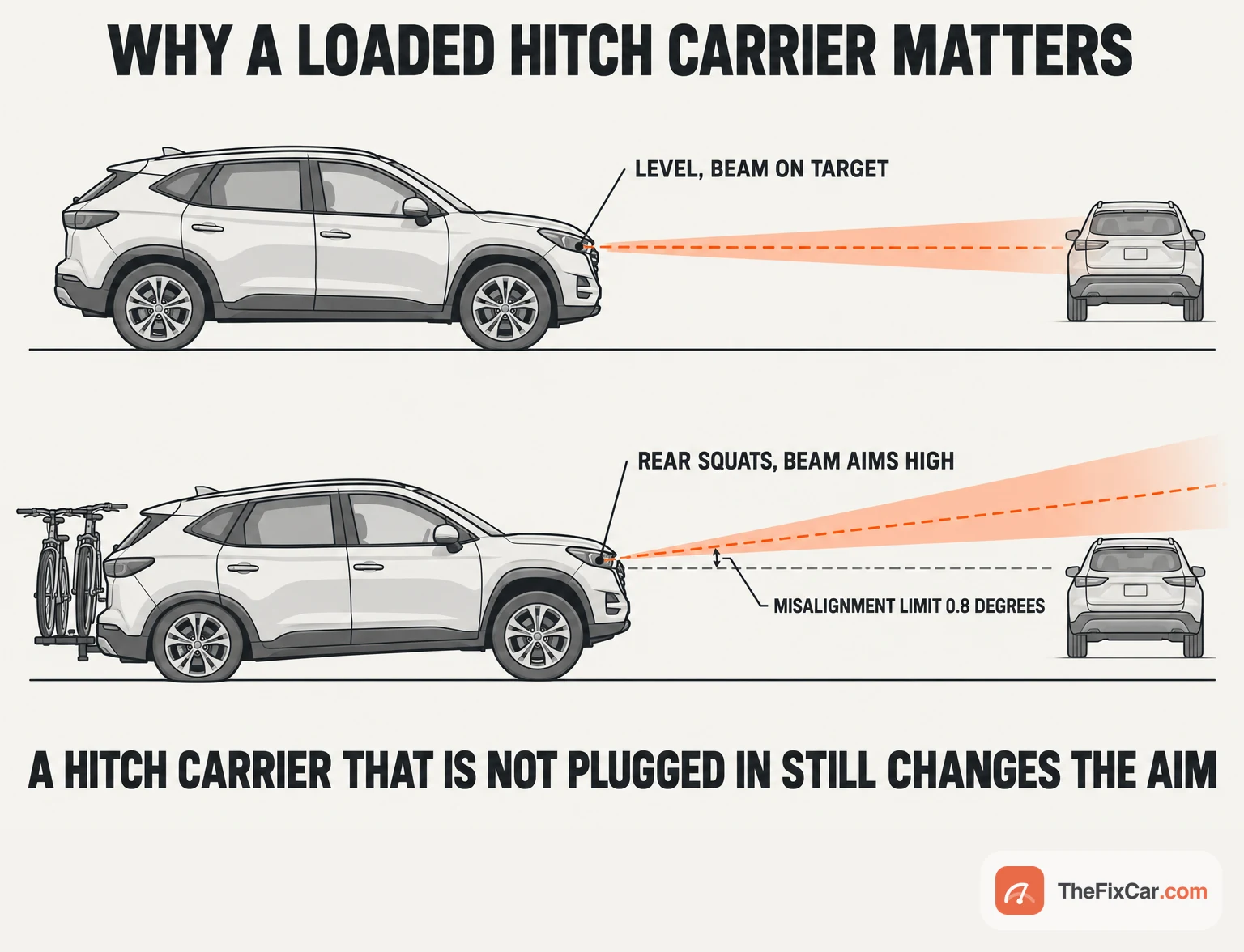
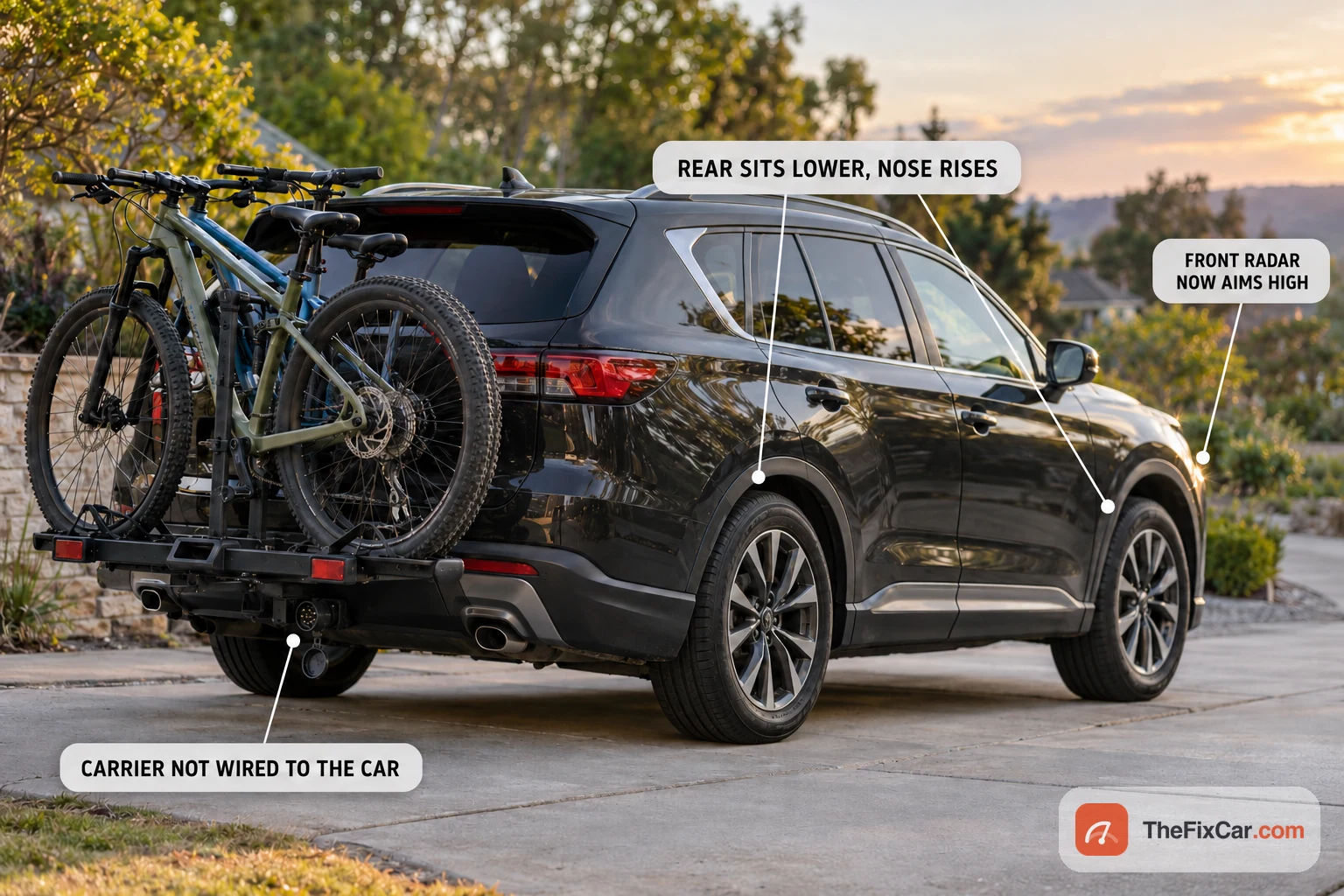
| Message with a loaded hitch carrier or heavy cargo in the back | Ride height change tilting the radar; coincidence | Unload and retest. Volkswagen’s bulletin says a hitch carrier that is not plugged into the car’s electrics can change ride height enough to misalign the front radar[3] |
| Message with no blockage, no modification, no impact | Radar software (Atlas 2024 to 2026); camera software (GTI, Golf R 2022 to 2024); a displaced or damaged sensor; a wiring, connector or communication fault | The stored code guides the next step: C110300 in the radar module or B200FF4 in the camera module each has a software bulletin, and a wiring or connector fault needs its own check[4][5] |
| Car braked hard with nothing ahead | Misaligned radar; a condition Volkswagen calls a system limitation | For the models in TSB 45-21-01, Volkswagen routes the complaint by speed and cruise status, then checks the radar’s misalignment angle[3] |
Sensor fault, or something else?
In the documents cited here, the causes are mostly not failures of the radar itself. They are things placed in front of it, things that moved it, or software that lost confidence in its own aim. The documents do not say how often each one happens.
- Something covering the emblem. Continental, which supplies the radar, said of the 2016 Tiguan that its ARS 410 long-range radar “is installed in the front grille right behind the VW badge” and detects pedestrians at up to 170 meters[11]; that is the sensor the emblem has to stay clear for. Volkswagen’s tech tip for 2015 to 2019 Jetta, Passat, Golf, GTI, Golf R, Sportwagen, Beetle, Tiguan, Touareg, Atlas, Tiguan LWB and Arteon names stickers, additional headlights and a licence plate bracket as items that must not cover the area in front of and around the radar[1]. The UK owner page adds the trim frames of number plate holders and detergent deposits or coatings[2].
- Grille work without alignment. The same tech tip states that on those models any damage, movement or removal of the front grille requires ACC radar alignment[1]. A bumper repaint or a replaced grille that nobody followed with that step leaves the requirement unmet. Our page on ADAS calibration requirements explains what a static and a dynamic calibration each involve.
- Ride height. Lowering the car is listed as a modification that can impair the system[1]. In the other direction, vw.com states that towing heavy trailers or carrying heavy cargo in the rear can elevate the front of the vehicle and change sensor angles, and that this can disable the system[6].
- Module software. Two current bulletins, one for the radar on 2024 to 2026 Atlas and one for the front camera on 2022 to 2024 GTI and Golf R, trace the message to software and tell technicians to update before diagnosing or replacing the part; both are in the model section below[4][5].
- A sensor that really is displaced or damaged. Volkswagen’s own list ends with damage to the front of the vehicle or the windshield, and its advice is to check whether damage is visible[2]. This is the case that may need a part, and inspection decides which.
One cause is missing from every Volkswagen document we read: the 12-volt battery. The only voltage figure in these bulletins is the dealer’s requirement to keep the battery above 12.5 volts with a charger connected during programming[4]. That does not rule a power-supply fault out, and voltage-related codes get checked like any other, but the checks at the front of the car come first.
By model: what Volkswagen’s bulletins say
The wording is shared across the range, but the documents are not. Use the table to find the bulletin that matches your car, then read the section for it. All of these are US-market documents published through NHTSA, except the UK owner page; a bulletin applies to the models and years it lists, by VIN, and a dealer can confirm coverage.
| If you have | Volkswagen document | Check first |
|---|---|---|
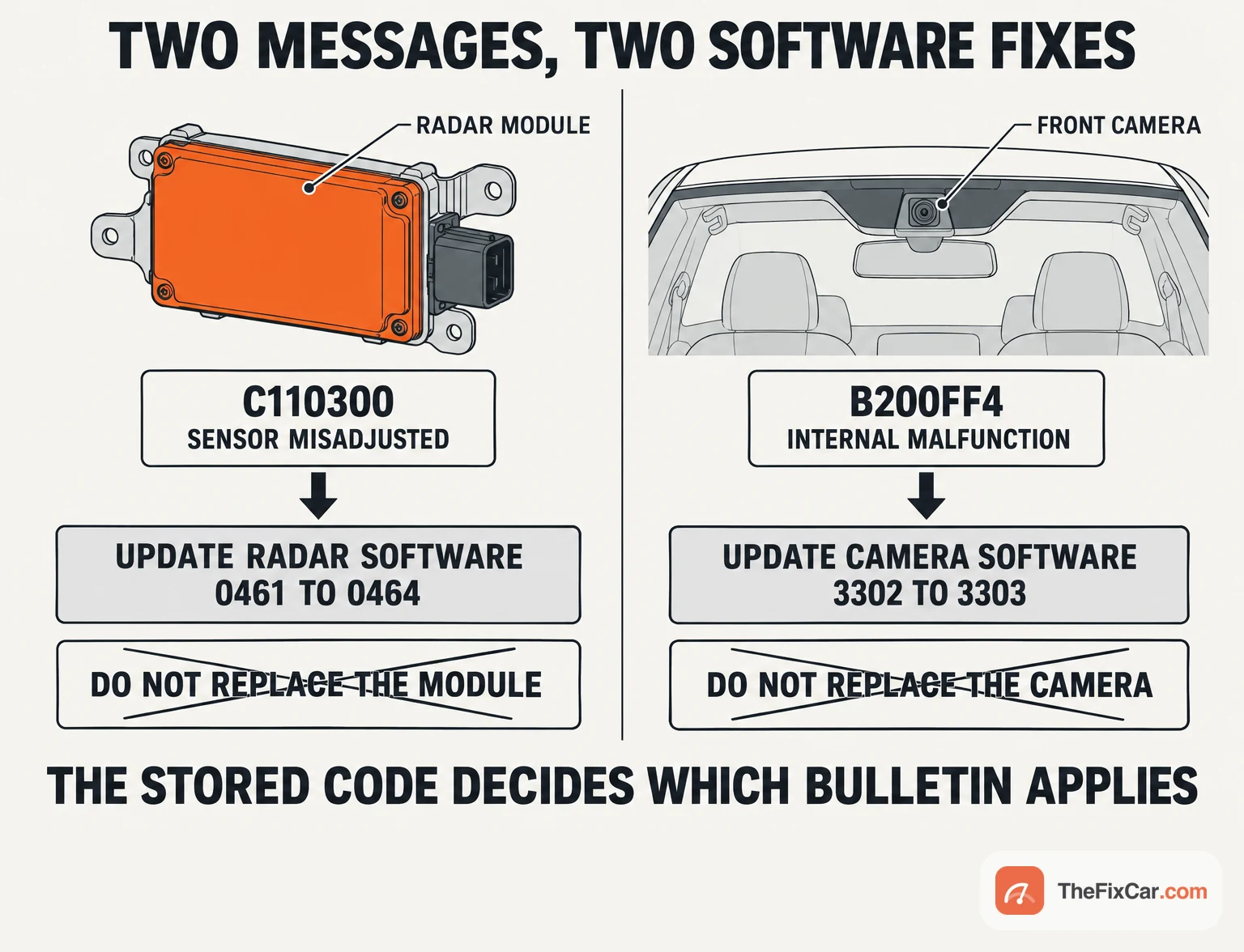
| Atlas or Atlas Cross Sport, 2024 to 2026 | TSB 91-25-06 | Code C110300 in the front radar on software 0461; update to 0464 before any diagnosis or replacement of the module |
| GTI or Golf R, 2022 to 2024 | TSB 96-25-03 | Code B200FF4 in the front camera with software 3302 and hardware H09; update to 3303 before any replacement |
| Golf, GTI 2020 to 2023; Jetta 2019 to 2023; Atlas, Tiguan LWB 2018 to 2023; Arteon 2019 to 2023; Atlas Cross Sport 2020 to 2023; ID.4 2021 to 2023; Taos 2022 to 2023, and the car braked on its own | TSB 45-21-01 | Walk-around for damage, hitch carrier use, then the radar misalignment angle |
| Atlas 2019 | NHTSA engineering analysis EA24004 | Inadvertent braking; engineering analysis opened December 18, 2024 |
| Jetta, Passat, Golf family, Beetle, Tiguan, Touareg, Atlas, Arteon 2015 to 2019 | Tech tip 27-17-01TT | Blockage, stickers, plate bracket, lowering, grille work |
| Jetta 2015 | Service action 45D8 | Front Assist warning indicators; software update, expired December 2016 |
| Tiguan (standard wheelbase), Passat, Taos, ID.4 with the message and no braking event | None found | The general checklist on this page |
Atlas and Atlas Cross Sport, 2024 to 2026: code C110300 and a radar update
Bulletin 91-25-06, first published December 17, 2025 and revised January 27, 2026, covers “Front Assist Not Available and/or ACC Temporarily Disabled” on 2024 to 2026 Atlas and Atlas Cross Sport. It applies only when the front radar module stores C110300, “Adaptive Cruise Control sensor misadjusted”; Volkswagen writes that “if the code below is not present this bulletin does not apply and will not be covered under warranty”[4]. Volkswagen’s explanation for the covered condition is software, not hardware: “in certain highway scenarios the elevation performance is less adequate if there are low locations affecting the drift of elevation angle.” The fix is radar software 5WA.907.572.C from version 0461 to 0464, after which the dealer reactivates ACC in the infotainment menu and road tests the car[4]. The instruction to technicians is in capitals: “DO NOT diagnose or replace the -J428- ACC module” before the update[4].
GTI and Golf R, 2022 to 2024: a camera software bulletin
Bulletin 96-25-03 of October 29, 2025 addresses the message “Driver assistance currently not available and/or Front Assist monitoring system available with limitations” on 2022 to 2024 GTI and Golf R. The fault lives in the front camera control unit at diagnostic address 00A5: code B200FF4, “Internal Malfunction,” on units running software 3302 with hardware H09. Volkswagen calls it a “software deviation” and updates the camera to version 3303[5]. Again the instruction is “DO NOT diagnose or replace the (MFK) 00A5 Lane Assist Camera before performing the update”[5]. The other documented candidate on a camera-equipped car is a camera displaced by windshield damage or replacement[2]; our guide to ADAS calibration after windshield replacement covers what the camera needs afterwards.
Golf, Jetta, Atlas, Tiguan LWB, Arteon, ID.4, Taos: when the car braked for nothing
Bulletin 45-21-01, revised July 21, 2022, is Volkswagen’s procedure for “an unwarranted Autonomous Emergency Braking” complaint on Golf and GTI 2020 to 2023, Jetta 2019 to 2023, Atlas and Tiguan LWB 2018 to 2023, Arteon 2019 to 2023, Atlas Cross Sport 2020 to 2023, ID.4 2021 to 2023 and Taos 2022 to 2023[3]. Before any scan tool, the technician walks around the car looking for “signs of damage or misalignment from previous damage or repair (i.e. bumpers, front grill, front VW emblem, windshield inc. interior mirror and sensor mounting)” and checks the hitch, because “use of a trailer or hitch carrier that does not connect to the vehicle electrical system can cause a change in vehicle ride height. This change can cause a temporary misalignment of the front radar sensor”[3]. The bulletin then routes the complaint by speed: below 5 mph it goes to the parking-assist test plans and the bulletin does not apply; with cruise engaged it goes to ACC; above 5 mph it continues down the Front Assist path[3].
The number in that bulletin worth keeping is the alignment limit. The technician reads the radar’s misalignment angle in the ACC module’s measuring values and “ensure[s] the angle is within specification (-0.8° to +0.8°)”; outside that band the radar is calibrated and the car retested[3]. Less than a degree of misalignment separates a radar Volkswagen accepts from one it recalibrates on these models, which is why a loaded carrier on the rear hitch and “frequent travel with vehicle loaded” are both on the dealer’s checklist[3].
Atlas 2019: the NHTSA investigation
Complaints about Atlas braking with nothing ahead went beyond dealer bulletins. On September 28, 2023 NHTSA’s Office of Defects Investigation opened preliminary evaluation PE23-017 into 2018 to 2019 Atlas, and on December 18, 2024 it upgraded the case to engineering analysis EA24004, narrowed to the 2019 Atlas, population 101,066 vehicles[7]. At the opening of the analysis ODI had 44 consumer complaints and had reviewed 187 unique reports, including four injury incidents and one crash; Volkswagen reported 226 reports of its own and “stated that some customers possibly had an inadequate understanding of Front Assist and its limitations,” while “many consumer complaints alleged that Volkswagen dealerships were unable to reproduce the condition”[7]. That opening resume is the latest document we found; it does not state the current status, and we found no recall tied to the investigation as of October 2026. For a 2019 Atlas owner the practical reading is that an unexplained braking event is worth reporting to NHTSA as well as to the dealer.
Jetta 2015 and the 2015 to 2019 range
An earlier Front Assist document is service action 45D8 of December 2014: on some 2015 Jetta “the Front Assist distance and advance warning indicators do not function as intended,” fixed by a software update of the distance regulation control module on about 241 cars in the US and 1,435 in Canada. The action expired December 31, 2016[8]. For the rest of the 2015 to 2019 range, Volkswagen’s guidance is the tech tip already quoted: blockage, stickers, plate brackets, extra lights, lowering and grille work, with the reminder that the system comes back by itself once the radar can see[1]. A second tip from November 2017 is for the shop rather than the owner: radar calibration can fail if it is attempted near an automatic door with an ultrasonic sensor while the door is in use[9]. If a calibration “would not take” on your car, that is one question to ask.
What to check first
- Clean the grille where your model’s radar sits, emblem or lower air grille, and the windshield in front of the camera, then drive, provided the car brakes and steers normally and has not braked on its own. Volkswagen’s tech tip says the system becomes available again as soon as the radar is no longer impaired and the message turns off by itself[1]. If it does, that matches the tech tip’s description of a blocked radar. The general version of this step is on our page about the clean sensor message.
- List what changed at the nose. A plate frame, a sticker, a light bar, a repaint, a replaced grille, a bumper tap, new springs, a loaded hitch carrier. Each one appears in Volkswagen’s guidance[1][2][3]. Remove or unload what you can and retest before paying for anything.
- Have the radar and camera modules scanned for stored codes, and ask for the code, not the diagnosis. C110300 on a 2024 to 2026 Atlas and B200FF4 on a 2022 to 2024 GTI or Golf R each point to a software bulletin that puts the update before any replacement[4][5]. Other codes name a circuit or a condition, not a part; our list of ADAS trouble codes explains how to read them. On the models covered by TSB 45-21-01, expect the radar’s misalignment angle to be checked against the -0.8 to +0.8 degree specification before any sensor is ordered[3].
Can you keep driving?
Yes, if the car brakes and steers normally and no other warning is showing, and with the understanding that Front Assist will not brake for you. Front Assist is a warning and braking aid for vehicles ahead that are stopped or moving in the same direction; with it unavailable, no warning or automatic braking will come from it, and that job falls to the driver[6]. Volkswagen UK’s instruction when the message persists is to switch Front Assist off and go to a qualified workshop[2]. Stop driving and get the car looked at if:
- the car has braked on its own with nothing ahead, since Volkswagen treats that as a misalignment or data-collection case rather than something to live with[3];
- the message followed a front-end impact or a windshield replacement, because the sensor may be displaced and its mounting and calibration need checking before the system can be trusted[2];
- other warnings appear with it, since a shared cause then needs reading before the Front Assist message means anything.
Pay attention to the colour. An amber Front Assist symbol means unavailable. A red one means the system has detected a collision risk right now and is telling you to brake or steer[10].
FAQ
What does Front Assist not available mean?
The forward collision warning and emergency braking system has switched itself off because the radar, or on some models the camera, cannot see or cannot be trusted. Volkswagen’s list of reasons runs from a dirty or snow-covered sensor to stickers and plate frames over the emblem, body or paint work at the front, a displaced or damaged sensor, and on specific models a software fault[2][4].
How do I reset Front Assist on a VW?
Volkswagen’s documents describe no owner reset, and in the documented cases none is needed. When the cause is blockage, the system returns on its own once the radar is clear and the message clears with it[1]. When the cause is misalignment, a dealer or ADAS shop calibrates the radar with the test plan for the car; when it is one of the software bulletins, the module is updated and ACC or Lane Assist is switched back on in the menu afterwards[4][5]. Switching the system off and on in the infotainment screen only confirms whether it will stay on.
Why does it say ACC and Front Assist not available together?
On the models in the Atlas bulletin, both run on the same front radar, Volkswagen’s J428 module. When the radar reports that it cannot see or that its aim is off, adaptive cruise control and Front Assist lose their sensor at the same moment, which is why the 2024 to 2026 Atlas bulletin is titled “Front Assist Not Available and/or ACC Temporarily Disabled”[4].
Can a bike rack or a trailer cause Front Assist not available?
Volkswagen says yes for ride height. Its bulletin states that a trailer or hitch carrier not connected to the vehicle’s electrics can change ride height and temporarily misalign the front radar, and vw.com lists heavy trailers and heavy rear cargo as conditions that can disable the system[3][6]. Unload, drive, and see whether the message returns.
Does a weak battery cause Front Assist not available on a VW?
Not in any Volkswagen document we found for this message. The bulletins name blockage, modifications, ride height, grille work and module software, and the only voltage figure in them is the 12.5 volt minimum the dealer must hold during programming[4]. If you suspect the battery anyway, test it rather than guess; our general pre-collision malfunction page covers the battery check that applies to any brand.
How much does a VW Front Assist sensor replacement cost?
Before pricing a sensor, make sure one is needed. Two current bulletins tell Volkswagen’s own technicians not to replace the radar or the camera until the software update has been tried, and a third, for its models, answers a misalignment angle outside specification with calibration and a retest, not a part[3][4][5]. We do not have a sourced parts price to publish, so ask for a quote that lists the stored code, the update attempted and the calibration separately from the part.