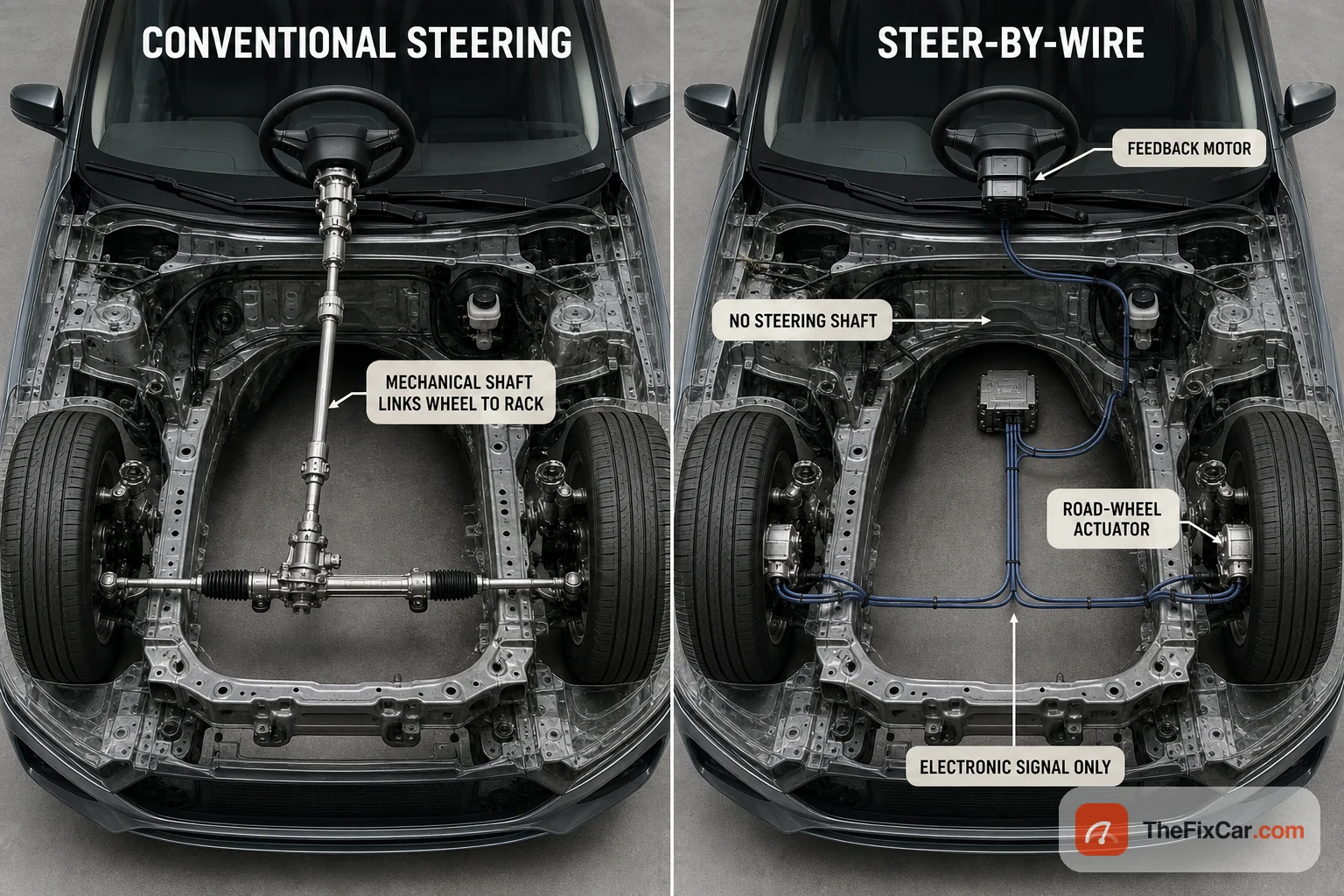
For a century the steering wheel turned the front wheels through a metal shaft and a rack. Steer-by-wire deletes that shaft. The wheel now reports its angle to a controller through sensors, and a separate motor turns the wheels, with the two ends connected only by wires and software. Because the mechanical fallback is reduced or removed, the safety case depends on duplicated sensors, controllers, power paths, and actuators. It also changes what a steering wheel can even look like.
The catch is that “steer-by-wire” covers two very different setups: one keeps a mechanical backup you can fall back on, and one has no physical link at all. Which one a car uses affects its redundancy strategy, failure behavior, and which regions get which version.
Quick answer
Steer-by-wire removes the mechanical link between the steering wheel and the road wheels and replaces it with sensors, an electronic control unit, and an actuator motor. As of 2026 the Tesla Cybertruck ships it as standard with no mechanical backup. Mercedes-Benz offers it on the new EQS with a redundant two-path signal architecture, while keeping electromechanical steering as standard. Lexus fits it as standard on the RZ 550e F SPORT and as an option on the RZ 500e Luxury in Europe. Market availability varies by region: US-spec versions have been more limited, and conventional steering remains common.
To pick by priority, match your case to a current model:
| If you want | Look at | Why |
|---|---|---|
| No-shaft steering as standard, sold in the US | Tesla Cybertruck (2024 on) | Full steer-by-wire, no mechanical backup |
| Newest European production example | Mercedes-Benz EQS (2026) | Optional steer-by-wire with redundant two signal paths; electromechanical steering stays standard |
| Steer-by-wire on a Lexus today | Lexus RZ 550e F SPORT (standard) or RZ 500e Luxury (optional), Europe | No mechanical connection, electronic signals to the front wheels |
| The earliest mass-production example | Infiniti Q50 Direct Adaptive Steering (2014) | Steer-by-wire, but kept a clutch-based mechanical backup |
Specifications
| Element | What it does | Notes |
|---|---|---|
| Steering angle sensor | Reads how far and fast you turn the wheel | Usually duplicated for redundancy |
| Feedback (reaction) motor | Creates artificial steering feel and centering | Replaces the resistance a column used to transmit |
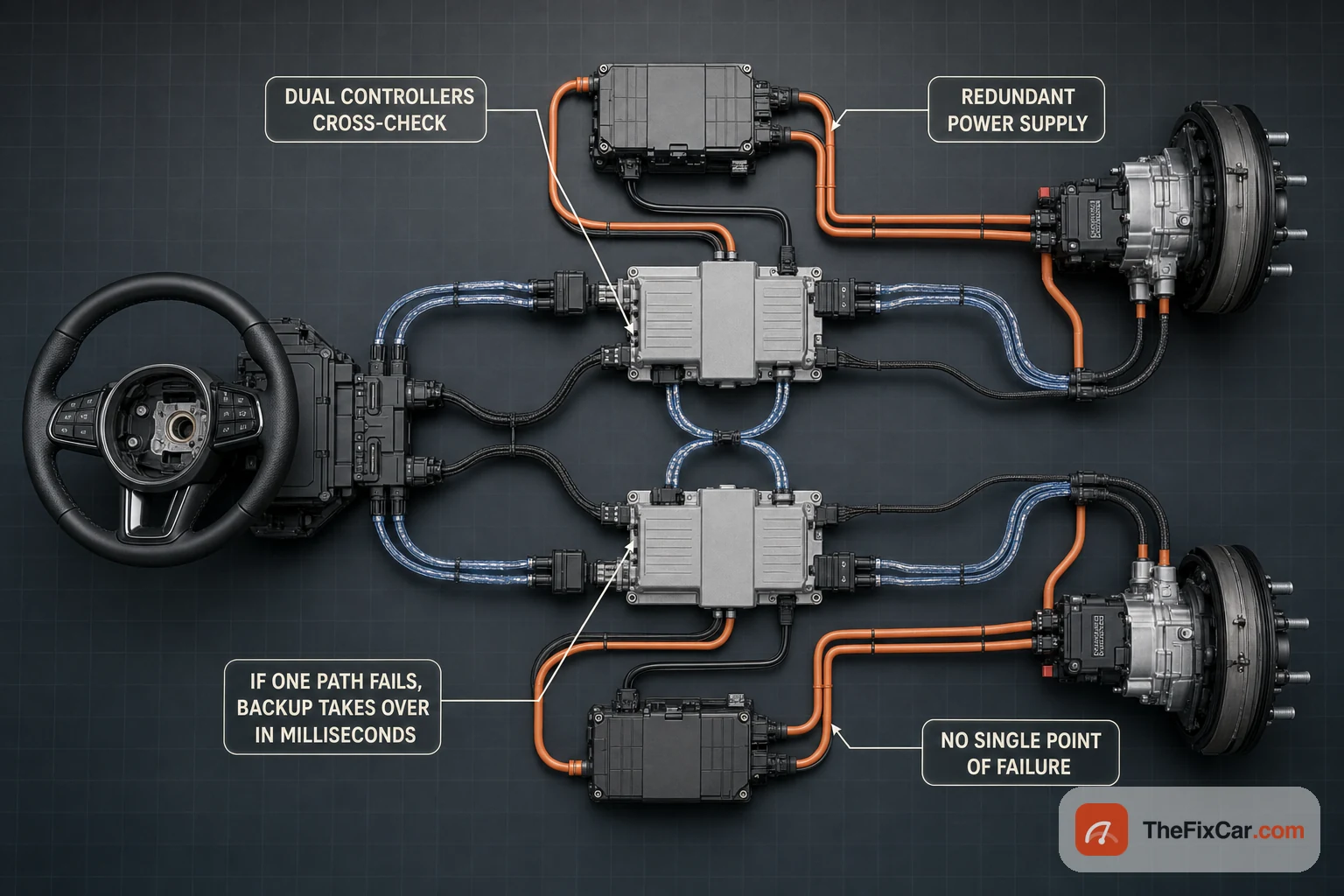
| ECU / controller | Converts driver input into a wheel-angle command | Often dual or triplex controllers cross-checking each other |
| Road-wheel actuator motor | Physically turns the front wheels | The only part that moves the tires |
| Redundant power and data | Keeps the system live after a single fault | Dual power supplies and communication links |
| Variable steering ratio | Changes how much the wheels turn per degree of input | Tight at low speed, calm at high speed |
Component layout varies by manufacturer and generation. Treat the table as the general architecture, not one specific vehicle’s part list. Exact figures follow the maker’s service data.
How it works
Input side. When you turn the wheel, angle and torque sensors measure the motion. A reaction motor on the column pushes back so the wheel feels weighted and self-centers, because there is no longer a rack doing that through friction. Without that motor the wheel would spin like a loose knob.
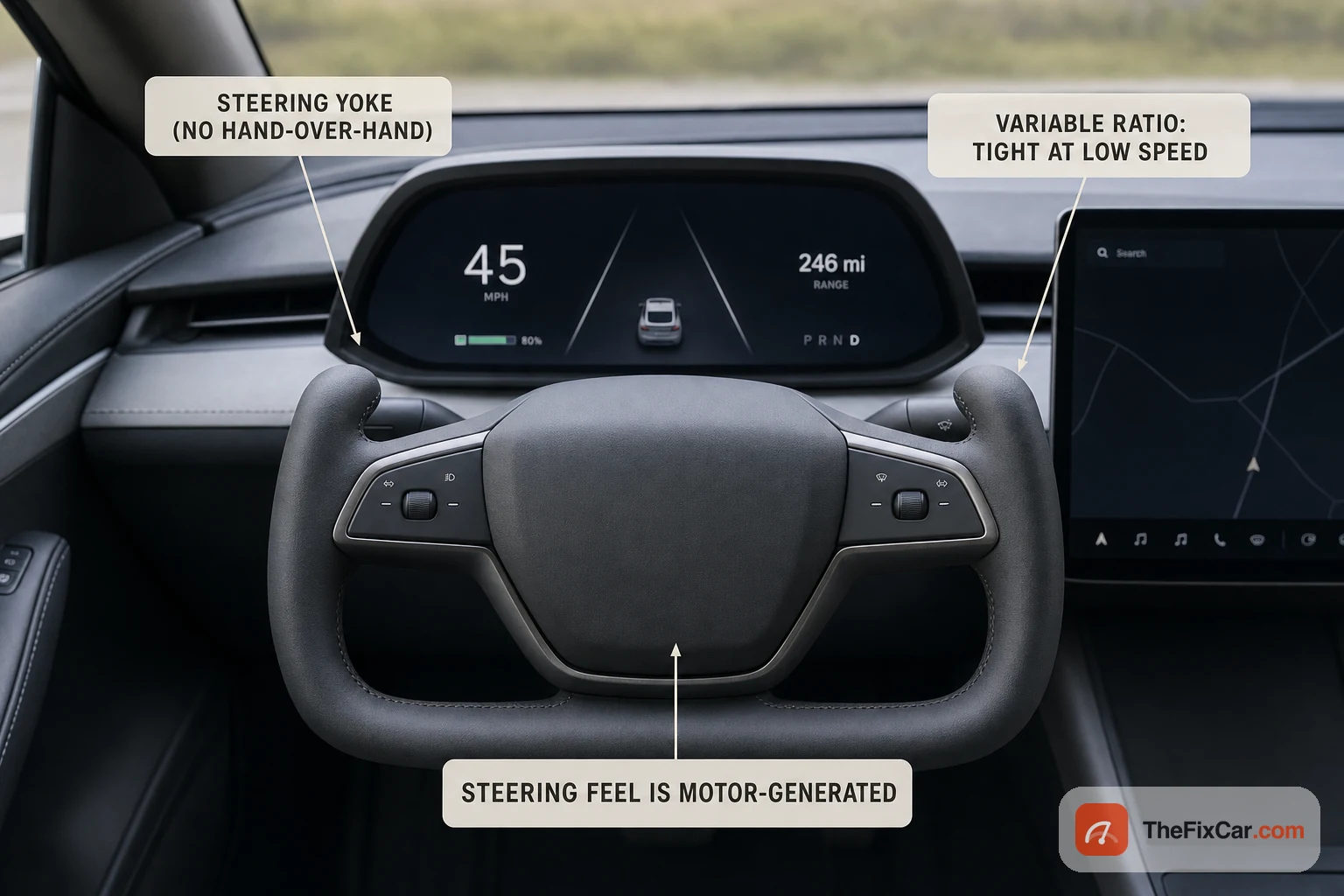
Output side. The controller takes the sensor reading, applies the current steering ratio for your speed, and commands the road-wheel actuator to turn the tires. On many systems the ratio is variable, so parking takes far less than the usual lock-to-lock turning while the wheel stays calm on the highway. That variable ratio is what lets a yoke work without hand-over-hand motion.
Redundancy. Because a single broken wire could otherwise remove all steering, full steer-by-wire designs duplicate the critical parts. Industry safety material describes dual or triplex controllers that compare outputs, plus duplicated sensors, power supplies, and actuation paths, so a single failure hands off to a backup within milliseconds rather than leaving the driver with nothing.
Full steer-by-wire vs steer-by-wire with a mechanical backup
With backup. The Infiniti Q50’s Direct Adaptive Steering, introduced for the 2014 model year, is widely cited as the first mass-production steer-by-wire system. It kept a clutch that mechanically reconnects the wheel to the rack if the electronics fault, so there is always a physical path of last resort.
Without backup. The Tesla Cybertruck removes the column entirely. There is no clutch and no shaft, so safety rests fully on redundant electronics. According to teardown reporting, the Cybertruck uses two motors in the steering for redundancy. This version has a harder safety case because steering must remain controllable through electronic redundancy instead of a mechanical fallback, part of why it took until recent years to reach a mass-market vehicle.
Redundant electronics, conventional option. The Mercedes-Benz EQS takes a middle path. It offers steer-by-wire with a redundant architecture that Mercedes describes as two signal paths plus high-precision sensors and control units, and it can keep lateral control through rear-axle steering and targeted ESP braking. Electromechanical steering stays the standard setup, so by-wire is the option, not the only choice. Mercedes says the system completed over a million test kilometers before reaching production.
Market availability by region
It varies. Lexus offers steer-by-wire on the new RZ in Europe and other markets, while US-spec availability has been more limited and conventional steering remains common. Earlier reporting linked the slower US rollout to steering rules written around a mechanical system and to validation feedback, so treat the exact regulatory cause as reported rather than confirmed. The practical takeaway: the same model can have steer-by-wire in one region and a conventional rack in another.
How to check if a car has it
- Read the owner’s manual and feature list. Look for terms such as steer-by-wire, One Motion Grip, Direct Adaptive Steering, variable steering ratio, or electronic steering control. Do not rely on the manual mentioning a reaction motor by name.
- Look at the wheel shape. A yoke that never needs hand-over-hand turning is a strong sign of a variable-ratio by-wire system, though some yokes still use a normal rack.
- Check the trim and market. It can be standard on one trim and optional or absent on another: standard on the Lexus RZ 550e F SPORT, optional on the RZ 500e Luxury, and region-dependent. Toyota markets its bZ4X version as One Motion Grip. Two identical-looking cars can differ.
- Do not rely on a visual under-dash check. Trim data, VIN build records, the owner’s manual, and dealer service information are safer ways to verify whether the car has true steer-by-wire than looking for a missing shaft yourself.
- Confirm with the VIN and a dealer. Build records show whether the by-wire option was fitted, which matters on cars where it was optional.
What goes wrong
Loss of steering feel calibration. Because the feel is synthetic, a sensor or software fault can make the weighting feel wrong: too light, too heavy, or oddly notchy. The wheels still respond, but the artificial feedback no longer matches the road.
Fault-mode limp behavior. If the system detects a problem it can drop into a reduced mode with a fixed ratio and a warning light. On cars with a mechanical backup, a fault engages the clutch and you steer through the rack, which feels heavier and slower.
Power and electrical dependence. A by-wire system without a mechanical path depends on its redundant power. That is why these designs duplicate supplies. A neglected 12V system or a charging fault is more consequential here than on a car with a physical column.
Calibration after work. Sensors that read wheel angle may need recalibration after suspension, alignment, or steering repairs, similar to how camera and radar driver-assist hardware needs recalibration after a windshield or bumper job.
Cost of components. Actuator motors, redundant controllers, and angle sensors are specialized parts. Out-of-warranty repair estimates are not yet well established because the production fleet is small, so treat any figure as a rough workshop estimate rather than a set price.
If a warning or a change in feel shows up, this maps the common reports to where the fault usually sits and what a shop checks first. It is a starting point, not a diagnosis.
| What you notice | Likely area | What to check |
|---|---|---|
| Steer-by-wire warning or steering system malfunction light | Controller, sensor, or signal-path fault | Scan for steering fault codes; note if the car dropped to a reduced mode |
| Steering feel changed (too light, heavy, or notchy) | Feedback (reaction) motor or feel calibration | Compare against normal; check for a recent software update or fault code |
| Steering wheel off-center after an alignment | Angle sensor calibration | Recalibrate the steering angle sensor per the maker’s procedure |
| Wheels respond oddly or lag the wheel | Road-wheel actuator fault | Dealer-level diagnostics on the actuator and its power supply |
| Faults after suspension or steering work | Calibration needed | Run steer-by-wire calibration after the repair, like ADAS recalibration |
Steer-by-wire diagnosis is dealer-level on most cars. Use this to understand the report, not to self-repair a safety-critical system.
FAQ
Is steer-by-wire safe without a mechanical backup? The design goal is fail-operational: redundant controllers, sensors, power, and actuators are intended to prevent a single detected fault from removing steering assist or wheel control. Loss-of-steering hazards are commonly treated at the highest ASIL level in ISO 26262 analyses, but the exact rating depends on the vehicle maker’s hazard analysis. The trade-off is that all of that safety now lives in electronics rather than a steel shaft.
What cars have steer-by-wire in 2026? The Tesla Cybertruck ships it as standard with no mechanical backup. Mercedes-Benz offers it on the new EQS with a redundant two-path architecture, while keeping electromechanical steering standard. Lexus fits it as standard on the RZ 550e F SPORT and as an option on the RZ 500e Luxury in Europe. The Infiniti Q50 used an earlier version with a mechanical backup starting in 2014.
Why is steer-by-wire harder to get in the US? Availability has varied by region. Lexus offers it on the RZ in Europe and other markets, while US-spec availability has been more limited and conventional steering remains common. Earlier reporting tied this to US steering rules and validation feedback, but treat the exact regulatory cause as reported rather than confirmed.
Does steer-by-wire feel different to drive? Yes. The steering feel is generated by a motor, and the ratio is usually variable, so low-speed turns need far less wheel movement. Drivers often describe it as quick and light, which takes some adjustment.
Can you lose steering if the battery dies? A no-backup system relies on redundant power to stay live, which is why these cars duplicate power supplies. Keeping the vehicle’s electrical and 12V systems healthy matters more on a by-wire car than on one with a physical column.