Two cars in the same parking lot can take completely different air conditioning refrigerant, and putting the wrong one in either is an expensive mistake. The split comes down to the year the car was built and the rules in force when it was sold, not the badge on the trunk.
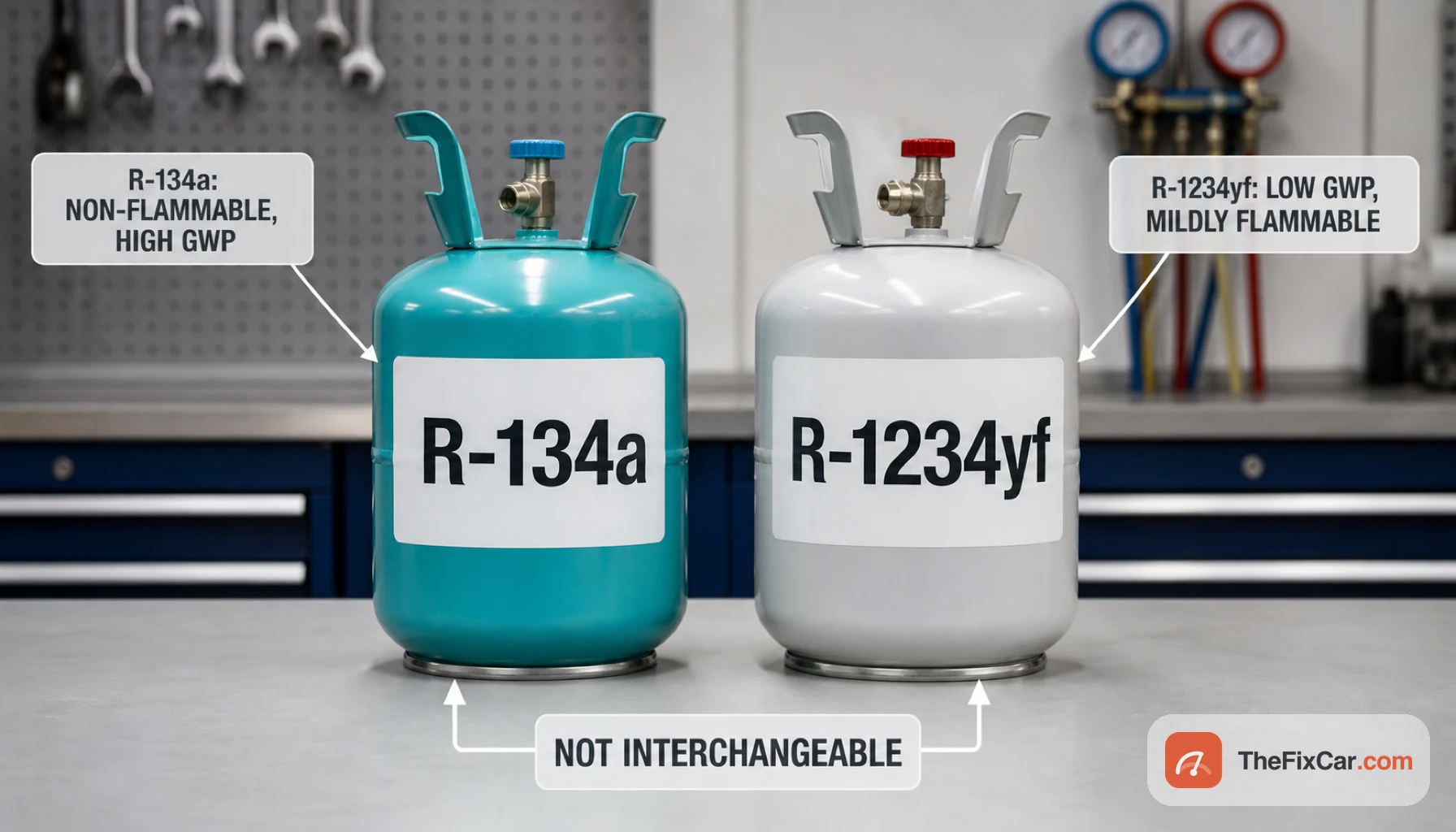
R-134a ran car AC systems for decades. R-1234yf replaced it to meet greenhouse-gas rules, and the two are not interchangeable: different chemistry, different service fittings, and very different cost. Which one your car needs is printed on a label under the hood.
Quick answer
Most vehicles built through roughly the mid-2010s use R-134a, and most built after the changeover use R-1234yf, though the exact cutover year varies by automaker, model, and market. They cool the same way but are chemically different and use different service ports, so they cannot be mixed or substituted. R-1234yf costs several times more than R-134a and is mildly flammable, while R-134a is non-flammable. Always confirm the type on the underhood AC label before buying refrigerant or having the system serviced.
Specifications
| Property | R-134a | R-1234yf |
|---|---|---|
| Chemical class | HFC (tetrafluoroethane) | HFO (tetrafluoropropene) |
| ASHRAE safety class | A1 (non-flammable) | A2L (mildly flammable) |
| Global warming potential (GWP) | about 1430 | about 4 |
| Typical first use in cars | early 1990s | around 2013 onward |
| Relative cost | baseline | usually higher, varies by market and package size |
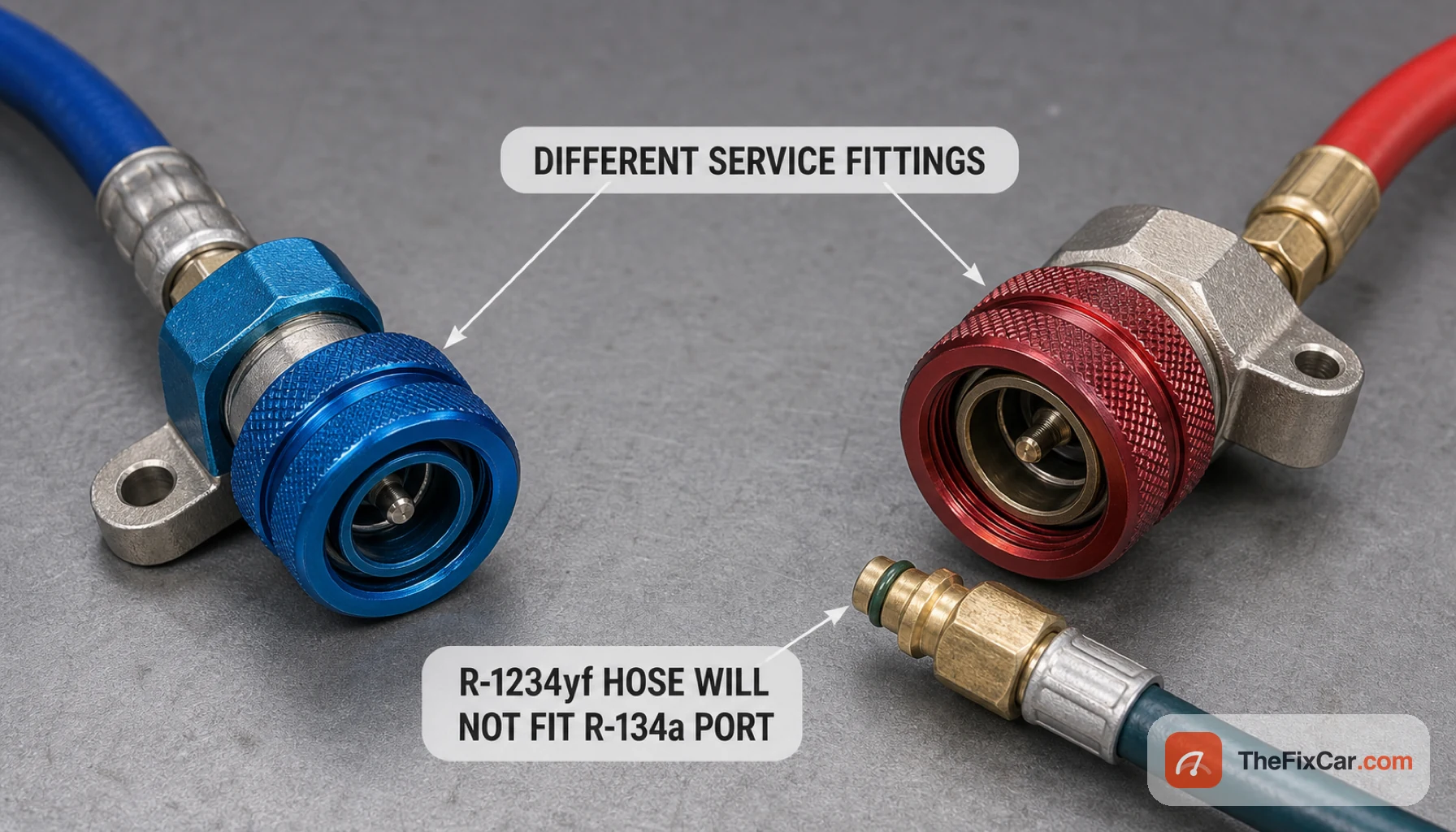
| Service fittings | R-134a quick-couplers | different, R-1234yf-specific couplers |
| Lubricant | System-specified PAG/POE oil; do not choose oil by refrigerant alone | System-specified PAG/POE oil; do not choose oil by refrigerant alone |
Disclaimer: GWP and class figures follow EPA and refrigerant-manufacturer data and ASHRAE Standard 34. Exact values, cost, and the year a given model switched depend on the source, market, and trim. Treat cost figures as workshop estimates, not fixed prices.
Oil type matters especially on hybrids and EVs with electric AC compressors. Use the vehicle label, service manual, or VIN lookup rather than assuming all R-134a or R-1234yf systems take the same oil.
Why cars switched
Regulation, not performance. R-1234yf did not replace R-134a because it cools better. R-1234yf can show slightly different efficiency and capacity in like-for-like tests, but production systems are engineered and calibrated for the specified refrigerant. The change came from greenhouse-gas rules. In the European Union, the mobile air conditioning directive phased in a low-GWP requirement for car AC, applying first to new vehicle types and then to all newly registered cars. In the United States, EPA rules under the SNAP program listed R-1234yf as acceptable for new light-duty vehicle AC systems, while later refrigerant-management and HFC-phasedown rules reduced reliance on high-GWP refrigerants. The applicable requirements and dates vary by vehicle class and model year. With a GWP near 4 against roughly 1430 for R-134a, R-1234yf meets those limits.
How to tell which your car uses
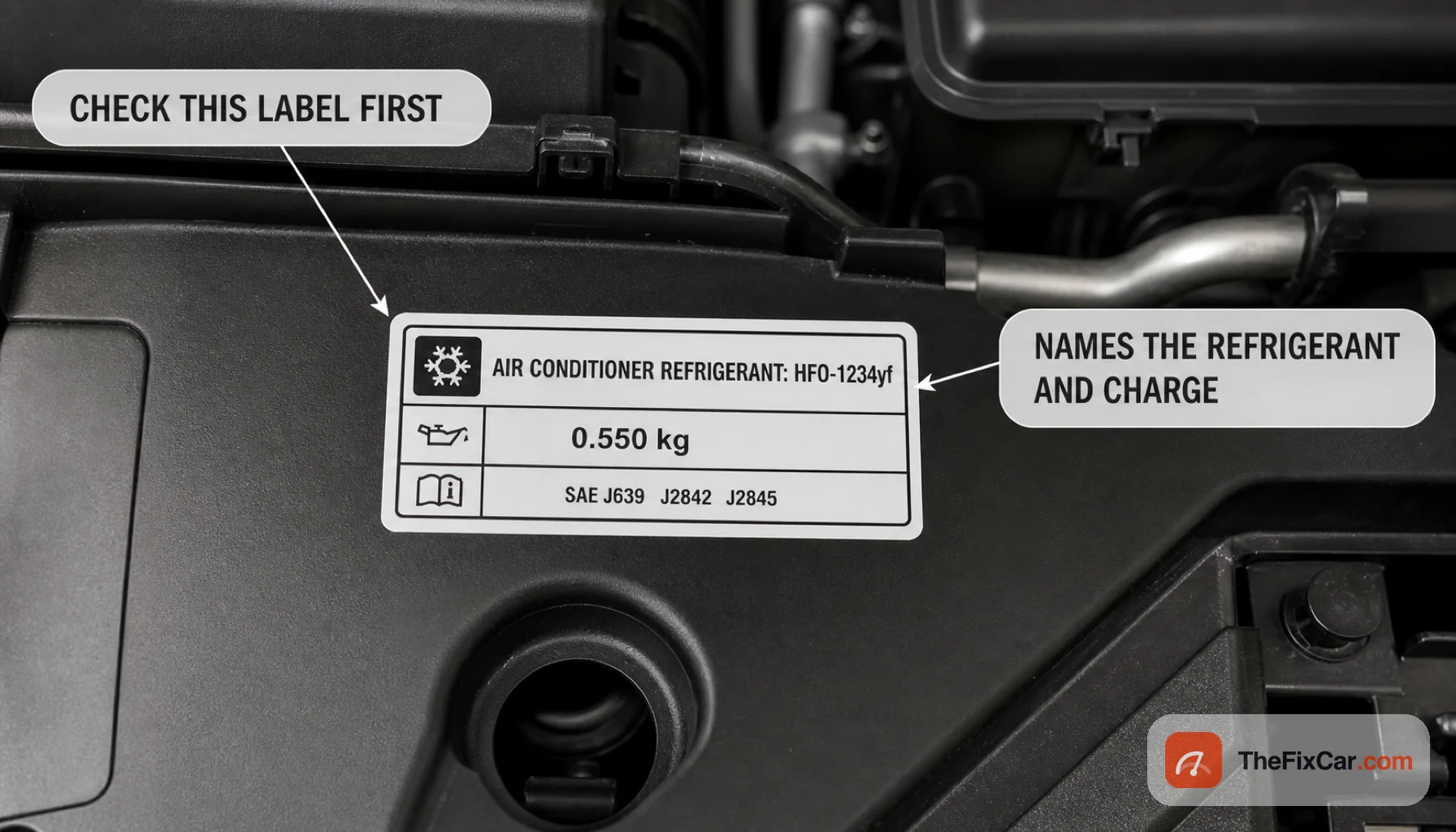
The underhood label is the authority. A sticker near the AC components or on the underside of the hood names the refrigerant and the charge amount. Year is a clue but not proof, because automakers switched at different times and the same model can differ by market. The low-side service fitting also differs between the two systems, so a R-1234yf charging hose will not connect to a R-134a port.
Performance and cost
R-1234yf has a much lower global warming potential than R-134a but usually costs more. A can of R-1234yf commonly sells for several times the price of R-134a, so a DIY recharge or a shop service on a newer car costs more. Exact prices depend on region, can size, and whether recovery and labor are included, so treat any figure as a current estimate rather than a fixed rate. Cooling capacity is close, and manufacturers calibrate the system around the specified refrigerant. For the owner, the practical difference is cost and the rule that you must use the refrigerant the car was designed for. Do not top off an unknown or previously serviced system without identifying the refrigerant first; if it was charged incorrectly before, adding the correct can on top can still leave a contaminated mix.
Flammability and safety
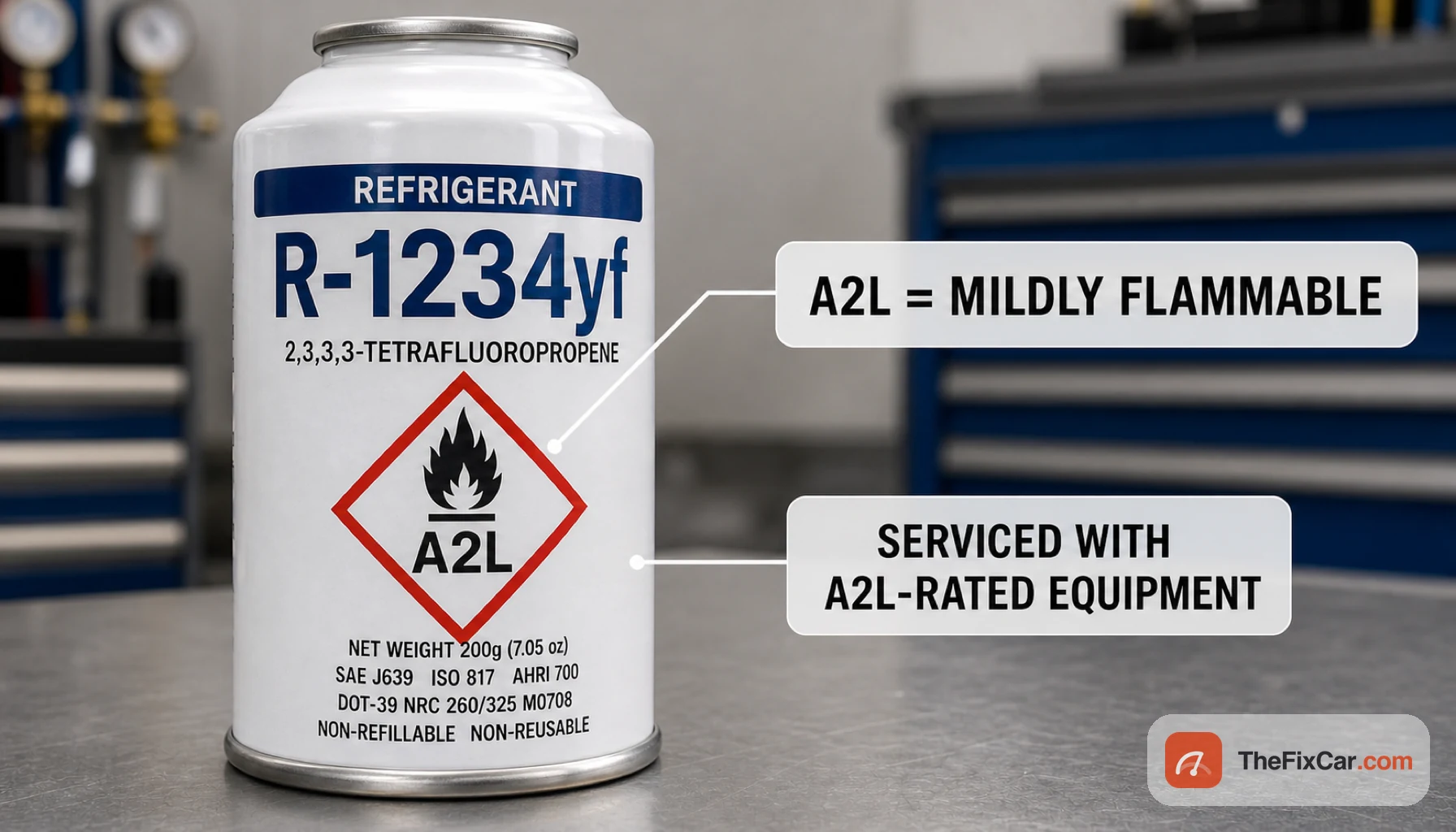
A2L means mildly flammable, not inert. R-1234yf carries an ASHRAE A2L rating, so it can ignite under the right conditions, unlike non-flammable A1 R-134a. Shops service it with A2L-rated equipment and leak detectors suited to the gas. The risk in normal driving is low, but it is one more reason the systems are kept separate and not retrofitted casually.
How to check
- Open the hood and find the AC label. Look near the condenser, on a strut tower, or on the hood underside for a sticker that lists the refrigerant type and charge weight.
- Read the refrigerant code. It will say R-134a or R-1234yf, sometimes written HFC-134a or HFO-1234yf.
- Do not identify it by trial-fitting equipment. The underhood label is the authority; forcing or adapting couplers risks contamination. If the label is missing or unreadable, use the VIN method below rather than testing hoses.
- Confirm with the year and market. A car built well before the mid-2010s is almost certainly R-134a, but verify against the label rather than the year alone.
- If the label is missing, ask a dealer. The parts or service department can look up the correct refrigerant by VIN.
What goes wrong
Cross-charging the wrong refrigerant. Mixing refrigerants contaminates the system, prevents correct recovery and recharge, and can create lubricant or performance problems. A contaminated system may need professional recovery, identification, flushing, and even component replacement. The mismatched service fittings exist to prevent it, but adapters and shortcuts defeat that safeguard.
Counterfeit R-1234yf. Because the real gas is expensive, fake or diluted product turns up, so buying from reputable suppliers and having shops run a refrigerant identifier before service is worth it.
Assuming a retrofit is simple. Swapping an older car from R-134a to R-1234yf, or vice versa, is not a drop-in job. It involves fittings, oil, and system compatibility, and is rarely worth it for a daily driver.
Sealant contamination. Stop-leak products can clog the system and foul a shop’s recovery machine. Many shops refuse to service a system that has had sealant added, regardless of refrigerant.
Can you use an adapter between R-134a and R-1234yf?
No. An adapter that lets a hose connect does not make the refrigerant, oil, fittings, recovery equipment, or vehicle calibration compatible. If the connector does not match the specified refrigerant, stop and verify the underhood label or VIN.
Can you mix R-134a and R-1234yf?
No. The two are not compatible, and mixing them contaminates the charge so it cannot be recovered or recharged correctly. A mixed system usually needs professional recovery, refrigerant identification, and flushing before it cools properly again.
How do I know if my car takes R-134a or R-1234yf?
Check the underhood AC label, which names the refrigerant and the charge amount. Year is only a clue, since automakers switched at different times and the same model can differ by market. If the label is missing, look up the specification by VIN through the dealer or a repair-information database rather than trial-fitting a hose.