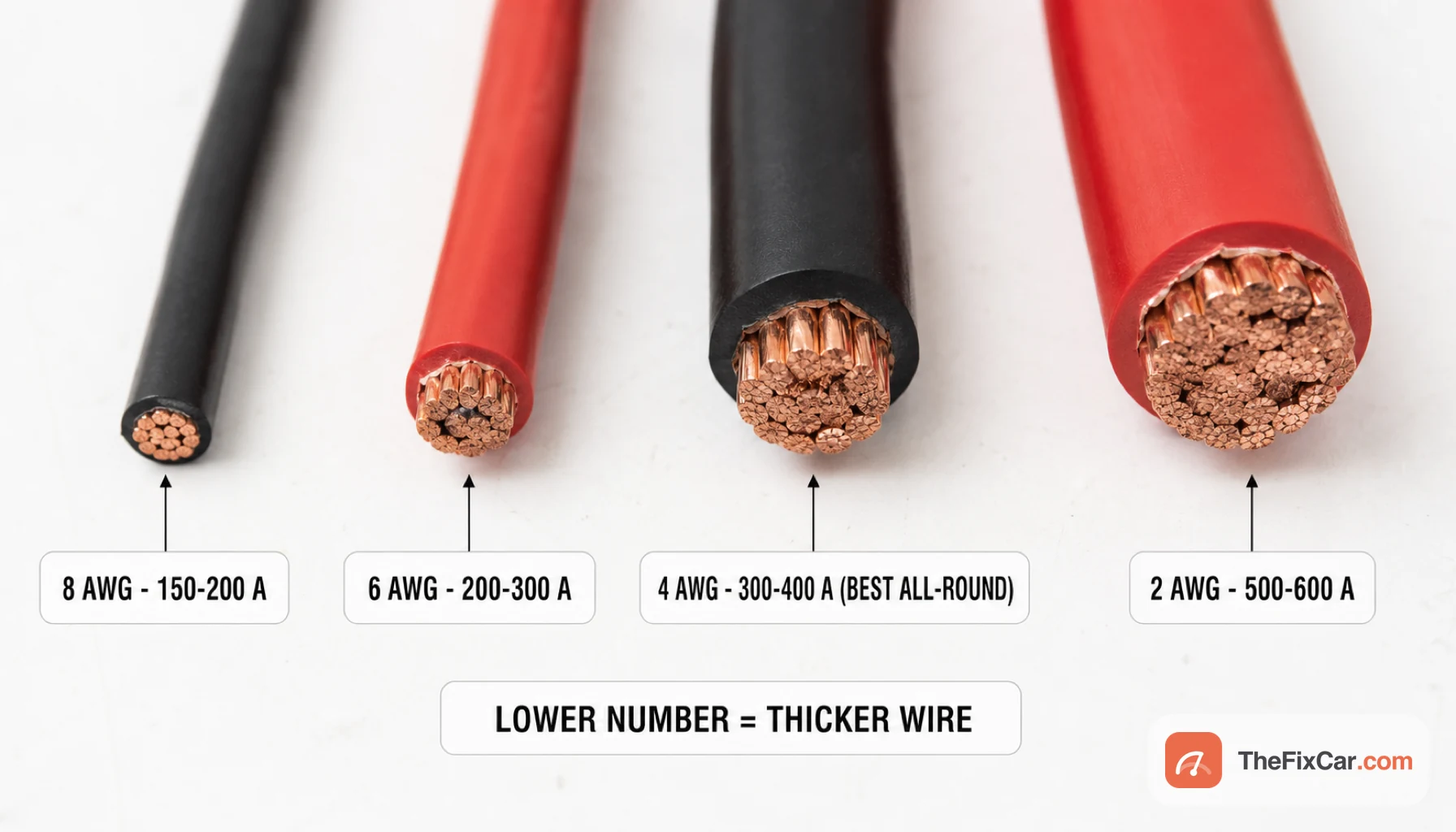
The gauge number printed on a set of jumper cables is supposed to tell you how much current they can move, but it is one of the easiest specs for sellers to exaggerate. A box can read “6 gauge, 800 amps” while the wire inside is thin copper-clad aluminum that struggles to crank a cold four-cylinder. Gauge runs backward from what most people expect: a lower number means a thicker conductor and more current, so 4 AWG is heavier than 8 AWG, not lighter.
Three things decide whether a cable actually delivers: the real conductor size, whether it is pure copper or copper-clad aluminum, and how long the cable is. Get those right and a modest gauge does the job. Get them wrong and a cable that looks beefy on the shelf gives you a click and a dashboard that dims when you turn the key.
Quick answer
For most cars and SUVs, 4 AWG pure copper jumper cables are the safe all-round choice: a 16 to 20 foot pure copper set is commonly rated around 300 to 400 amps, with enough headroom for most cold-start jumps. 6 AWG works for compact and midsize gas cars but is borderline in winter or with a deeply dead battery. Diesel trucks and large V8s want 2 AWG or 1 AWG. Whatever the number, pure copper beats copper-clad aluminum, and shorter is better than longer.
Once you have the right gauge, follow the safe jumper cable connection order before you clamp anything to a battery.
Choose your cable in 10 seconds
| Your vehicle or use | Buy this |
|---|---|
| Small gas car, mild climate | 6 AWG copper, 12 to 16 ft minimum |
| Most cars, crossovers, SUVs | 4 AWG copper, 16 to 20 ft |
| Full-size truck, van, V8 | 2 AWG copper, 16 to 20 ft |
| Diesel truck or heavy-duty | 1 AWG or 1/0 AWG copper |
| Copper-clad aluminum cable | Size up at least one step |
Specifications
| Gauge (AWG) | Typical range, pure copper 16 to 20 ft set | Best for | If it is CCA |
|---|---|---|---|
| 8 AWG | 150 to 200 A | Small economy cars | Too weak for most jumps; skip |
| 6 AWG | 200 to 300 A | Compact and midsize gas cars | Closer to budget, small-car use only |
| 4 AWG | 300 to 400 A | Most cars, crossovers, SUVs | Use only where 6 AWG copper would do |
| 2 AWG | 500 to 600 A | Full-size trucks, vans | Pick this if you wanted 4 AWG copper reliability |
| 1 AWG | 700 to 800 A | Diesel trucks, big rigs | Step to 1/0 AWG for diesel-grade margin |
Disclaimer: these are buying ranges, not certified ratings unless the cable is tested and labeled to SAE J1494. The figures are commonly reported values for pure copper booster cables and vary with conductor purity, cable length, clamp quality, and temperature. SAE J1494 sets minimum performance and user-information requirements for booster cable sets; cheaper cables that skip it can fall well short of the printed number.
4 AWG vs 6 AWG jumper cables
6 AWG is fine for compact and midsize gas cars in mild weather, and it costs less and coils smaller. 4 AWG is the better all-round buy: it holds up on an SUV, an older battery, a cold morning, or a 16 to 20 foot run where 6 AWG starts to sag. If you own one set for mixed use, 4 AWG copper is the safer default. Is 6 AWG enough? For a small warm-climate car, yes; as a do-everything set, it is borderline.
2 AWG vs 4 AWG jumper cables
4 AWG covers most cars, crossovers, and SUVs with headroom. Step to 2 AWG for full-size trucks, vans, large gas V8s, light diesels, or if you jump vehicles often and want margin in the cold. 2 AWG is heavier and pricier, so it is overkill for a commuter sedan but the right call for a work truck.
1 AWG vs 2 AWG jumper cables
1 AWG (or 1/0) mainly earns its place on diesels and heavy-duty rigs with 800 cold-cranking amps or more. For everyday cars and SUVs it is more weight and cost than the job needs. If you do not regularly jump a diesel, 2 AWG is usually the practical ceiling.
What the gauge number actually measures
Conductor cross-section, not the jacket. AWG describes the diameter of the metal conductor, not the rubber insulation around it. A cheap cable can wear a thick, soft jacket that feels heavy in the store while the copper inside is two or three sizes thinner than advertised. The only honest way to compare is by the conductor, so check the jacket marking, the product spec, and whether the brand clearly lists pure copper.
The numbers run backward. Each step down in gauge means more metal: 4 AWG has roughly double the conductor area of 7 AWG, and 1 AWG has far more again. That is why a 1 AWG cable is thick and stiff, while a 10 AWG cable is much thinner. When two boxes claim the same amperage but list different gauges, the lower number is the one telling the truth.
Copper vs copper-clad aluminum
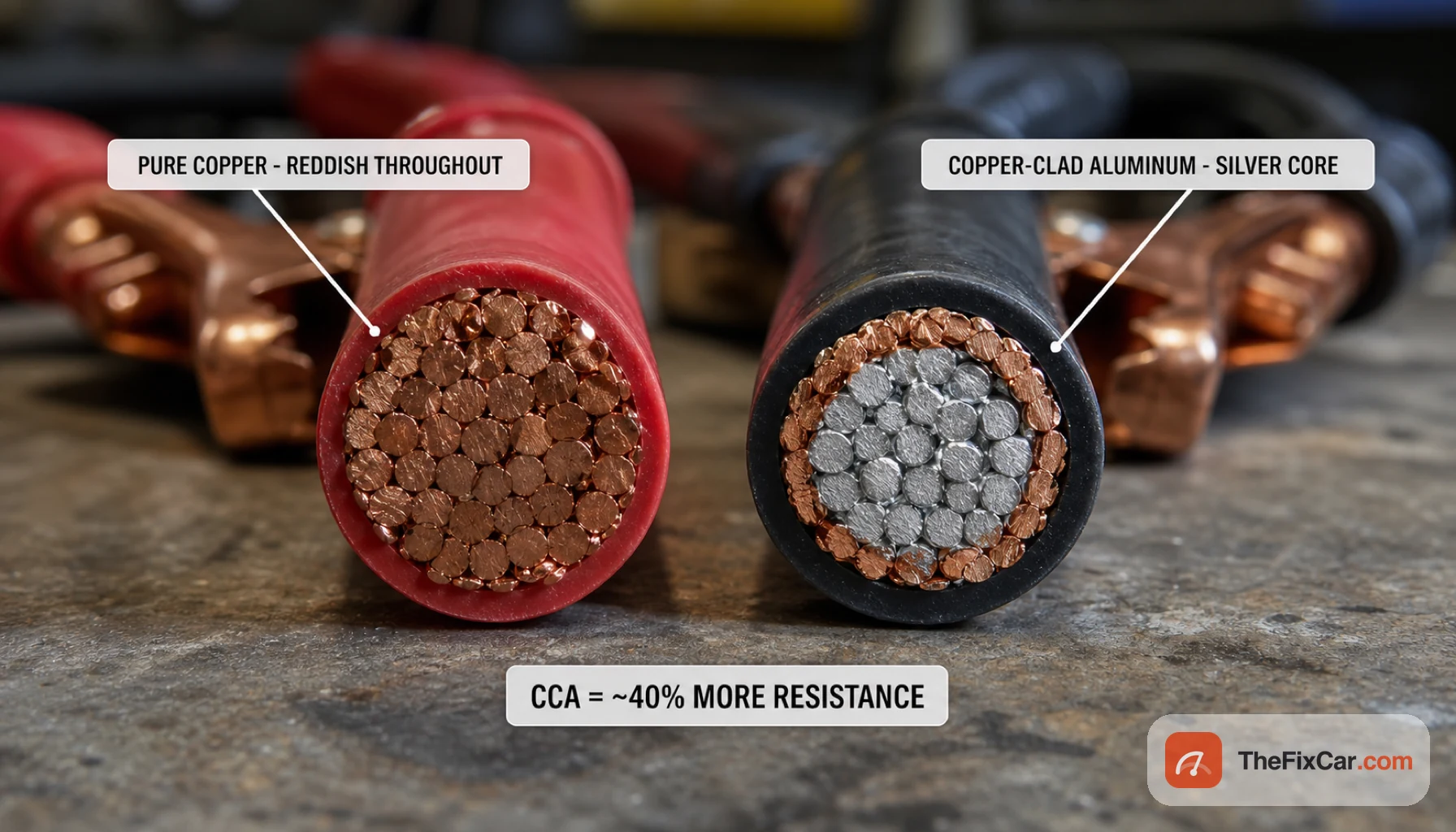
CCA is the catch. Many budget cables use copper-clad aluminum, an aluminum core with a thin copper skin. Aluminum carries far less current than copper for the same diameter, so CCA has higher resistance than pure copper. As a buying rule, treat copper-clad aluminum as one to two gauge sizes weaker than the same AWG in pure copper, especially on long cables or cold starts. That is how a box gets away with a big amperage claim on thin metal.
How to spot it. Pure copper cables usually say “100 percent copper” or “all copper” and cost more. CCA is often hidden behind a peak amp rating with no conductor material listed. Cut into a sacrificial cable end and copper is reddish all the way through; CCA shows a silvery aluminum core under the copper skin.
Cable length changes the math
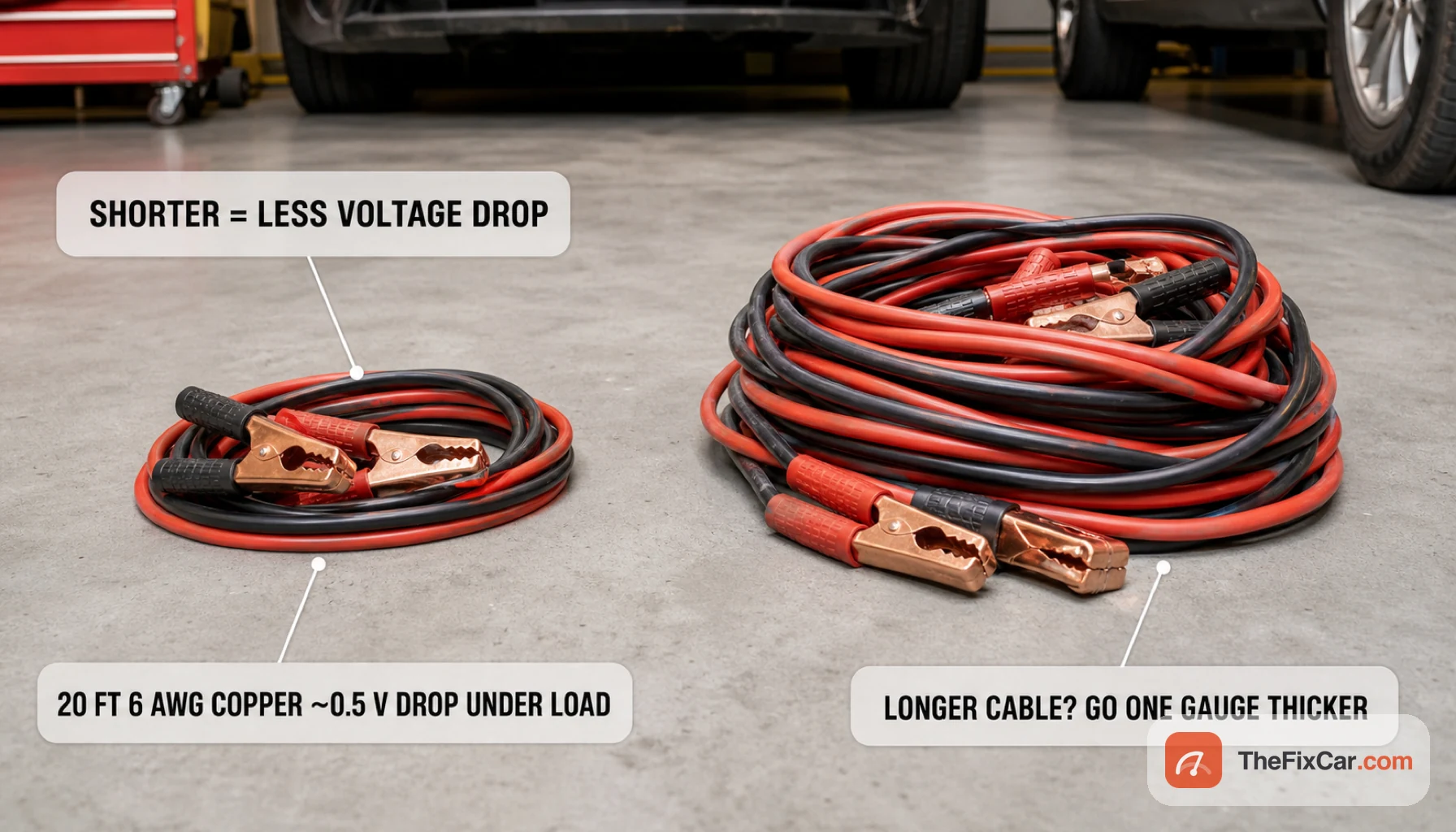
Longer cable, more voltage drop. Resistance climbs with length, and every volt lost on the way to a dead battery is a volt the starter never sees. A 20-foot run of 6 AWG pure copper drops roughly half a volt under load, and the same length in CCA drops noticeably more, which matters most on a cold morning when the battery is already weak.
Pick length for reach, then size up. Cables in the 16 to 20 foot range reach awkward parking situations where you cannot line the cars up nose to nose. If you want that length, step to a thicker gauge to claw back the resistance the extra cable adds. A short 4 AWG set and a long 4 AWG set are not the same tool.
How to check what you actually have
- Read the conductor, not the box. Look for a printed gauge on the cable jacket and the words “pure copper” or “all copper.” A peak-amp number with no gauge and no material is a warning sign.
- Weigh it in your hand. For a given length, pure copper is heavier than CCA. A 16-foot 4 AWG copper set has real heft; a suspiciously light “4 gauge” set is usually CCA or undersized.
- Flex the cable. Quality copper cable stays flexible in the cold. Cheap cable stiffens into a coil at low temperature, which makes it hard to handle exactly when you need it.
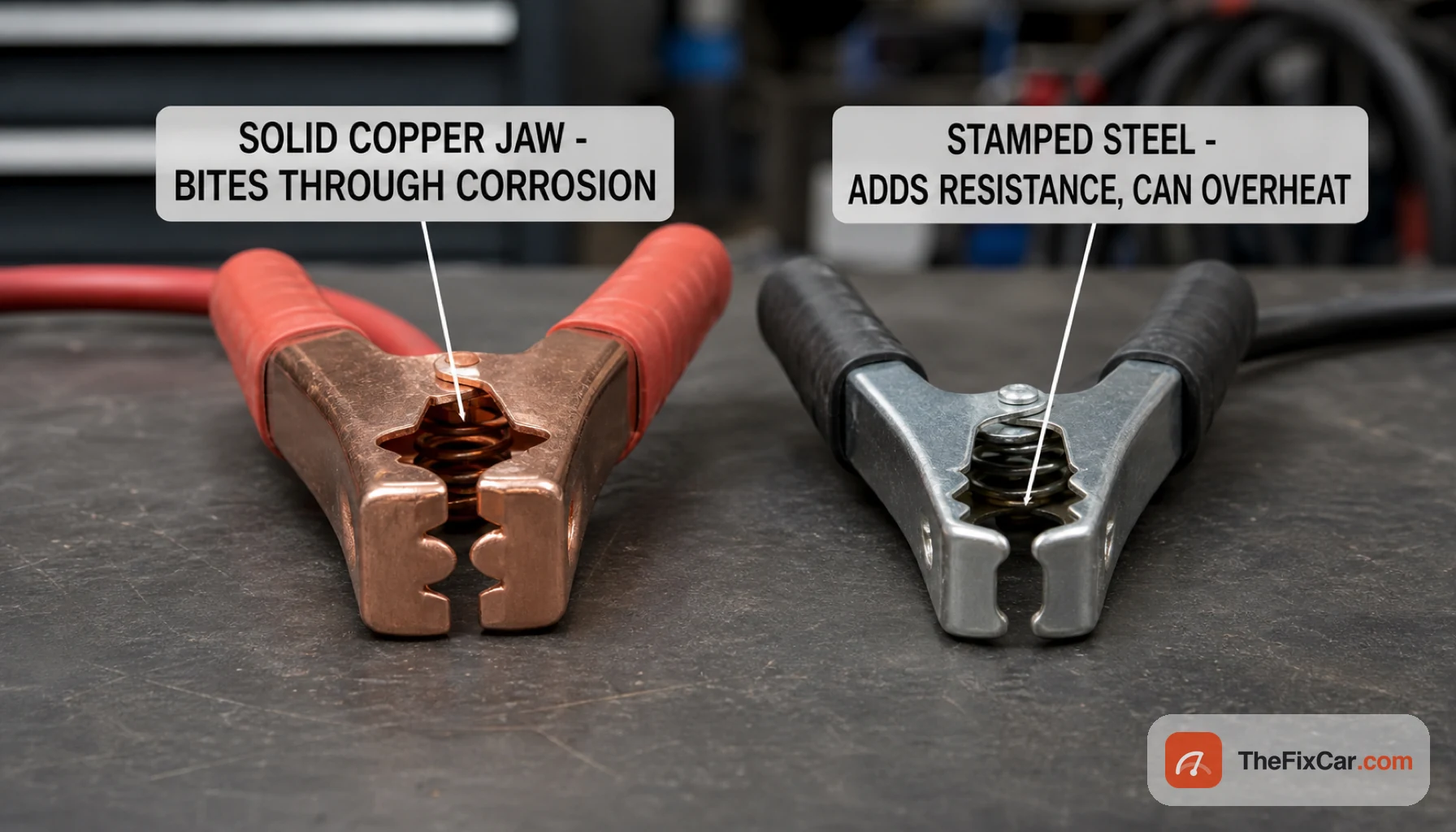
- Inspect the clamps. Solid copper clamps with strong springs and a wide jaw bite through corrosion. Thin stamped-steel clamps with a copper flash add resistance right at the connection.
- Check the length against your parking reality. Measure the gap you usually have to bridge. If 10 feet will not reach, buy longer and a gauge thicker rather than stretching a short set.
- Match the gauge to the bigger engine. Size for whichever vehicle in your circle has the largest battery, not your own daily driver, so the cables are not the weak link in a roadside jump.
What goes wrong
Mislabeled CCA cables. A box reads “6 gauge, 600 amps” but the wire is copper-clad aluminum sized like 8 AWG copper. It will jump a warm small car and then fail on a cold SUV, and the owner blames the battery instead of the cable.
Undersized for a diesel. Diesel trucks pull huge cranking current, often 800 cold-cranking amps or more. A 6 AWG cable bought for a sedan cannot feed that. The donor battery sags, the diesel barely turns, and long cranking on thin cable gets the cables hot.
Too long and too thin. A 25-foot bargain set in a thin gauge stacks the worst of both worlds: maximum resistance from the length, minimum copper to fight it. The clamps spark, the dead car still will not start, and nobody understands why a brand-new set failed.
Cheap clamps. The conductor can be fine while the clamps ruin it. Stamped steel jaws with weak springs make poor contact, heat up, and sometimes melt their insulation. Good copper clamps are the difference between a clean jump and a smell of burning plastic.
The printed gauge is a lie. Some imports print a gauge two or three sizes thicker than the metal inside. Do not assume the box rating proves the conductor size. The only defense is buying cables that meet SAE J1494 or come from a brand that states the conductor honestly.
What not to buy
Walk away from a set if any of these are true:
- The package lists only “peak amps” and never states the AWG.
- The material is not listed as copper, all-copper, or pure copper.
- The cable is unusually light for its length.
- The clamps are thin stamped steel with weak springs.
- The insulation is huge but the conductor inside looks small.
- Nothing on the box mentions SAE J1494 or any construction or testing standard.
Jumper cable gauge FAQ
Is 6 gauge enough for jumper cables? For a small gas car in mild weather, yes. As a do-everything set, it is borderline; 4 AWG copper is the safer pick for SUVs, cold starts, and longer cables.
Are 4 gauge jumper cables good for most cars? Yes. 4 AWG pure copper is the best all-round choice for cars, crossovers, and SUVs, with headroom for a cold morning.
What gauge jumper cables for a truck? Full-size trucks, vans, and large V8s do best on 2 AWG copper in a 16 to 20 foot length.
What gauge jumper cables for a diesel? Diesels and heavy-duty rigs want 1 AWG or 1/0 AWG copper, because their high cold-cranking demand magnifies any voltage drop.
Is copper-clad aluminum bad for jumper cables? It is not unusable, but treat CCA as one to two gauge sizes weaker than the same AWG in copper, and size up to compensate.
Are longer jumper cables worse? Longer cables add resistance and voltage drop. Buy the length you need to reach, then step to a thicker gauge to offset it.
Do amp ratings on jumper cables matter? Only when paired with a stated AWG, material, and length. A bare “peak amps” number with no gauge tells you almost nothing.