Hot air comes out of the vents when the AC button is on and the temperature knob is at maximum cold. The fan runs, engine load increases, but cabin temperature stays at or above outside air temperature. Several completely different failure modes produce that same result: refrigerant loss, a dead compressor clutch, a blocked condenser, a clogged cabin filter, a stuck blend door. Each one requires a different fix.
Quick answer
Refrigerant loss is the most common cause in vehicles older than four or five years. Without sufficient refrigerant pressure, the compressor clutch won’t engage and the system moves warm air. Workshop estimates for a shop recharge run $100 to $250. If the system cooled normally after a previous recharge and went warm again within one season, a slow leak exists and needs to be found before another recharge. Otherwise the new refrigerant escapes the same way.
Most common causes
- Low refrigerant from a slow leak: refrigerant escapes through an O-ring, hose fitting, or condenser puncture; once pressure drops below the compressor’s low-pressure cutoff, the clutch stops engaging entirely
- Compressor or compressor clutch failure: the clutch electromagnet wears out on high-mileage vehicles; a seized compressor is rarer but typically produces a sudden failure and a burning belt smell
- Blocked or damaged condenser: the condenser sits directly behind the front grille and collects insects, leaves, and road debris; bent fins from a minor collision can cut airflow enough to stop heat rejection
- Clogged cabin air filter: a filter packed with dust and debris starves the evaporator of airflow; the refrigerant cycle may be working, but very little air passes through the cold evaporator core
- Faulty expansion valve or orifice tube: controls refrigerant flow into the evaporator; stuck closed means no cooling; stuck open causes the evaporator to ice over and block airflow within minutes
- Blend door actuator stuck on the heat side: the blend door mixes hot engine coolant heat with cooled evaporator air; a failed actuator can hold the door open to the heater core even when the temperature dial says cold
- Condenser fan failure: at highway speeds, ram air cools the condenser; at idle the electric fan does the work; a failed fan produces AC that cools normally above 40 mph but blows warm at a stop
| Symptom pattern | Most likely cause |
|---|---|
| Warm at idle, noticeably colder while driving | Condenser fan failure or severely blocked condenser |
| No airflow at all (or very weak) from all vents | Blower motor, blown fuse, resistor pack, or severely clogged cabin filter |
| Cold for 10 to 15 minutes, then gradually turns warm | Evaporator icing from a faulty expansion valve or low refrigerant charge |
| Musty or mildewy smell when AC first turns on | Moisture buildup on the evaporator core or a long-overdue cabin filter |
| Clicking or ticking from behind the dashboard | Blend door actuator |
What to check first
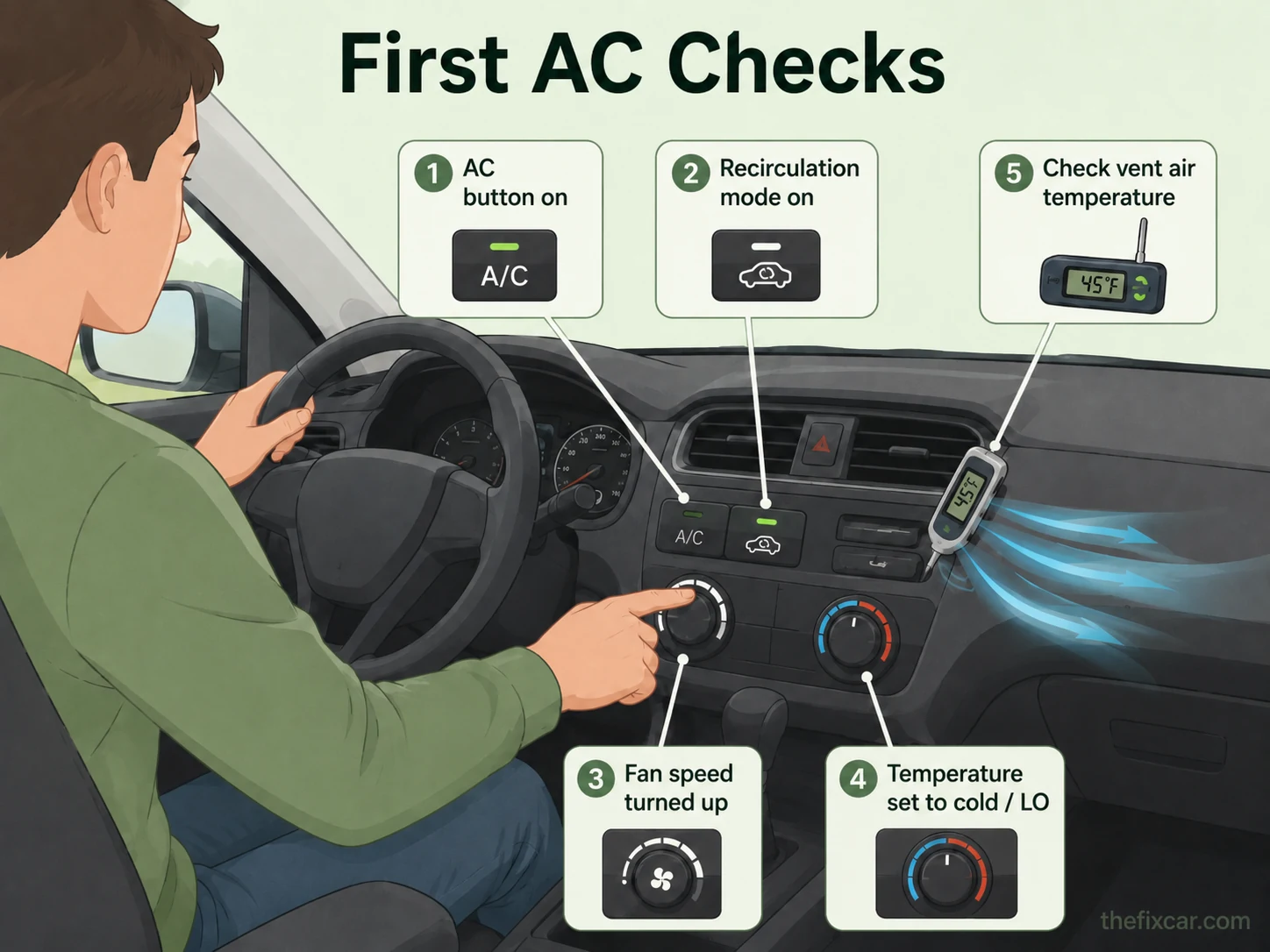
- Confirm the system is set correctly: AC button illuminated, temperature at the coldest position, fan speed at medium or high; recirculation mode helps the system cool the cabin faster in hot weather; if the AC only feels weak on very hot days, switching from fresh air to recirculation can make a noticeable difference
- Run a vent temperature check: place a thermometer in the center vent, set AC to max cold with recirculation on and fan at medium-high, and let the car run for 3 to 5 minutes; if vent temperature stays close to outside air temperature, the system is not cooling; if it gets cold only while driving, suspect condenser airflow or fan issues
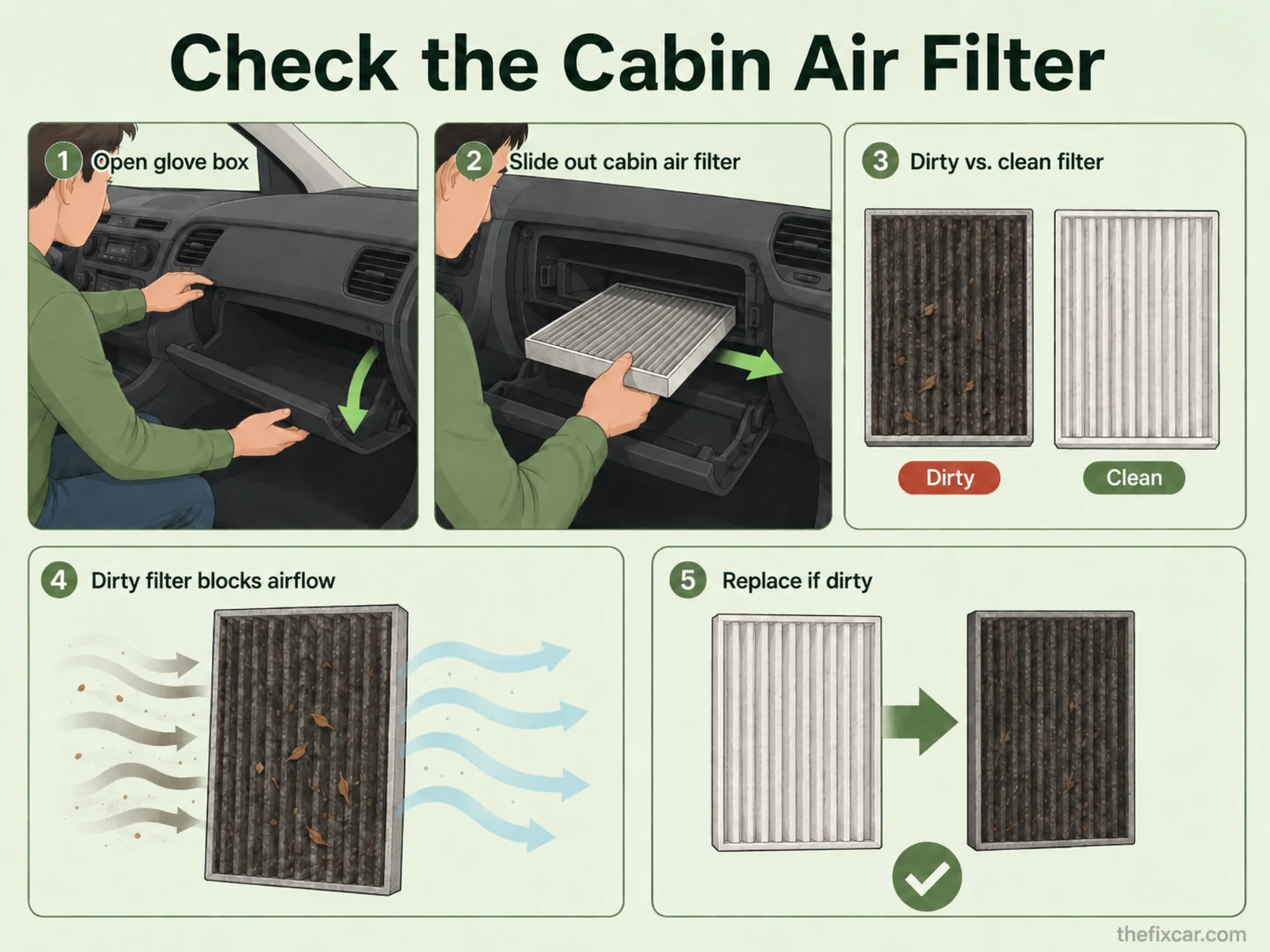
- Pull and inspect the cabin air filter: located behind the glove box on most vehicles; a visibly dark, debris-packed filter reduces airflow enough to make the AC feel warm even when the refrigerant system is fully functional
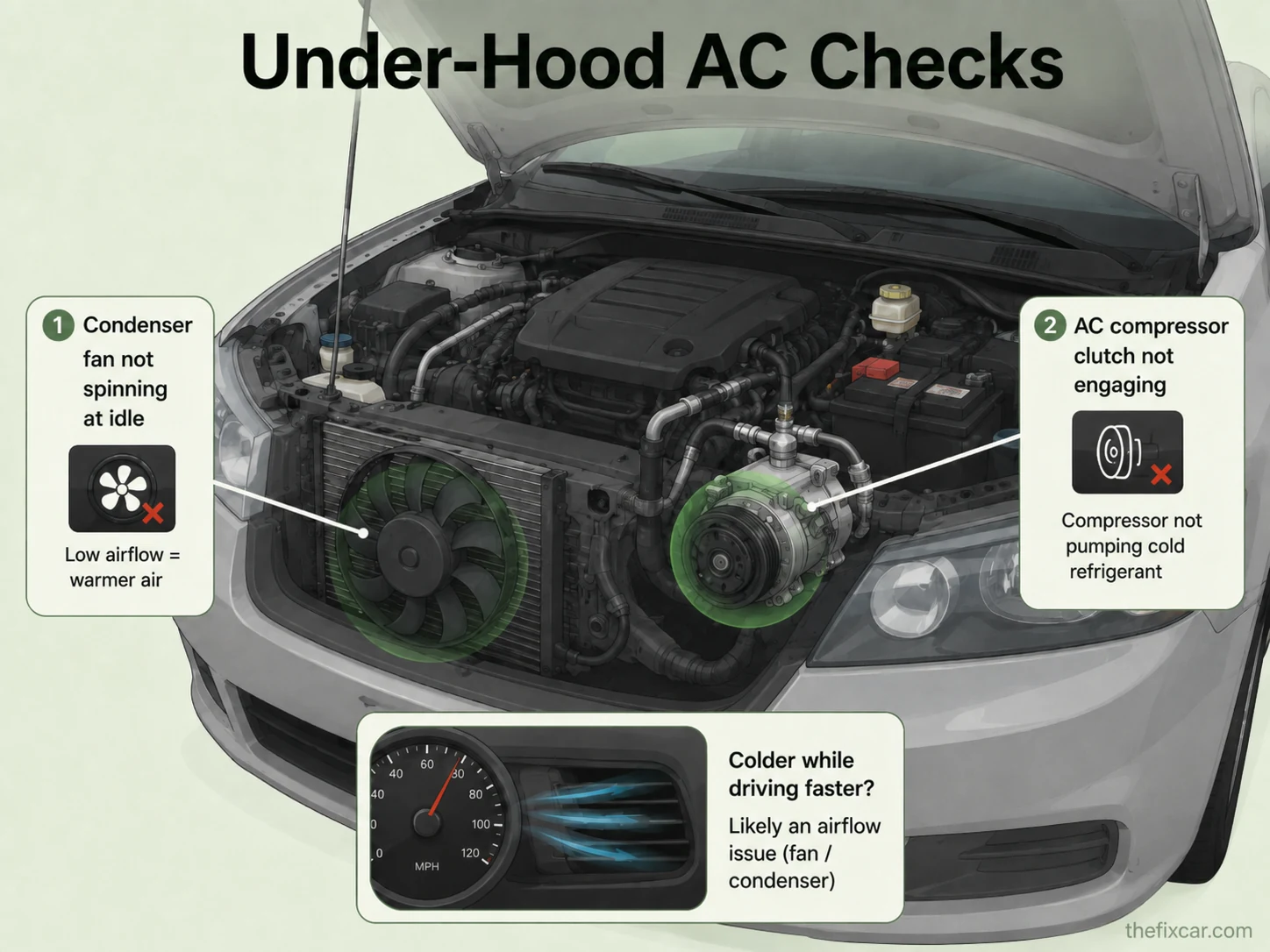
- Listen for compressor clutch engagement: with AC on and engine running, open the hood and watch the compressor; the center disc of the clutch should spin with the belt; if the outer pulley spins freely while the center hub stays still, the clutch or refrigerant pressure is the issue; this is a visual check only — keep hands, clothing, tools, and phone cables away from belts, pulleys, and fans
- Inspect the condenser face for blockage: look through the front grille at the condenser fins; visible debris, bent fins, or impact damage points to restricted airflow, especially after heavy insect season or a low-speed parking lot contact
- Test cooling at highway speed vs at idle: noticeably colder air above 45 mph that turns warm in traffic points to a condenser fan problem, not a refrigerant issue
- Check for oily residue near AC fittings and hoses: refrigerant oil escapes alongside refrigerant at a leak point; a UV dye trace or an oily film around a fitting, the compressor shaft seal, or the condenser surface confirms an active leak
Is it safe to drive?
A non-functioning AC does not affect driveability or engine safety on its own. One exception: if the engine temperature gauge rises when the AC is switched on, stop using the AC and check the cooling system before the next drive. A failed condenser fan affects both the AC condenser and the radiator on most vehicles, and an overheating engine is a stop-driving condition.
Do not do this
- Do not keep adding refrigerant without checking for a leak: repeated recharges without a leak diagnosis push refrigerant into a system that will vent it again; the underlying leak also lets air and moisture enter, which corrodes the compressor from the inside
- Do not use stop-leak products unless a shop recommends one: AC stop-leak sealants can clog the expansion valve, evaporator, and service port fittings; a shop that later opens the system to do proper repairs may refuse the job or charge for a flush first
- Do not clean condenser fins with high-pressure water: the aluminum fins are thin enough to bend under a pressure washer stream; bent fins block airflow and create the same problem as debris buildup; low-pressure rinsing or a soft brush is the right method
- Do not reach toward spinning fans, belts, or pulleys while the engine runs: the condenser fan and serpentine belt are unguarded near the condenser; confirming clutch engagement or checking for belt wear should always be done with the engine off
When the problem is urgent
- Engine temperature rises with AC on: the condenser fan serves both the condenser and the radiator on many cars; fan failure can lead to engine overheating within minutes in stop-and-go traffic
- Burning rubber smell when AC is active: the compressor clutch is slipping; a slipping clutch can destroy the clutch plate and eventually seize the compressor, turning a $150 fix into a $900 repair
- AC compressor belt also drives power steering or the alternator: a seized compressor can snap the serpentine belt and cut power steering and battery charging simultaneously
- System was recharged and went warm within 30 days: an active leak is releasing refrigerant; continued leaking pulls air and moisture into the system once pressure drops below atmospheric, causing corrosion and damage that costs far more than the original recharge
- Oily stain at the high-side fitting near the firewall: the high-side line carries refrigerant under high pressure; leaks here lose refrigerant faster than at low-pressure fittings
- MVAC service requires Section 609 certification: intentional refrigerant venting is illegal under U.S. law; anyone who services a mobile AC system for payment must be Section 609 certified, regardless of whether the system uses R-134a or R-1234yf; Section 609 also requires certified refrigerant handling equipment for MVAC service; EPA lists certified equipment categories for HFC-134a and HFO-1234yf systems, including R-1234yf recover/recycle/recharge equipment
Typical repair cost
- Cabin air filter replacement: $15 to $50 parts, DIY; most glove-box access points require no tools
- AC recharge, no leak found: workshop estimates $100 to $250 at an independent shop; dealer service typically runs $50 to $100 more
- Condenser cleaning: $50 to $150 at a shop; DIY with low-pressure water and a soft brush costs nothing beyond time
- Refrigerant leak repair (O-ring or hose): workshop estimates $150 to $400 parts and labor, depending on access and whether UV dye diagnosis is included
- Blend door actuator replacement: workshop estimates $200 to $450; the actuator itself costs $40 to $80, but labor on some platforms requires removing the entire dashboard
- Expansion valve or orifice tube: workshop estimates $200 to $500 parts and labor; the system must be recovered and recharged either way
- Condenser replacement: workshop estimates $400 to $900; cost varies based on whether the front bumper cover must come off and whether the refrigerant recharge is included
- AC compressor replacement: workshop estimates $700 to $1,500 parts and labor; R-1234yf systems typically sit at the higher end due to refrigerant cost