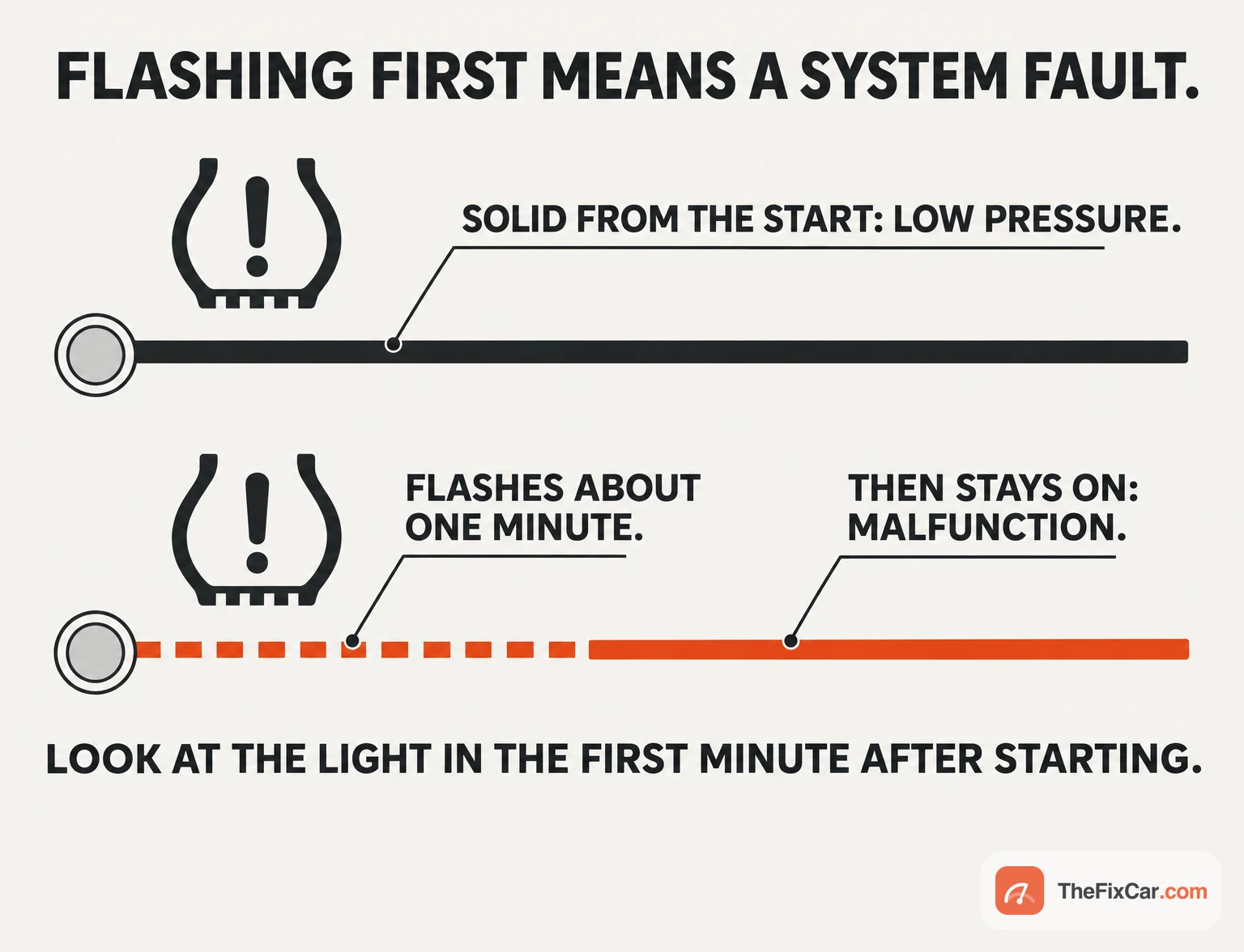
A Mazda that reports a TPMS malfunction is telling you about the monitoring system itself. The 2025 Mazda3 owner’s manual describes the sign: when the system detects a malfunction, the tire pressure light flashes for approximately one minute and then stays on, and it repeats that at every start for as long as the malfunction exists[1]. A light that is steady from the start points to pressure first. Either way, check all four tires with a gauge first, because with the malfunction indicator lit the system may not detect or signal low pressure[1].
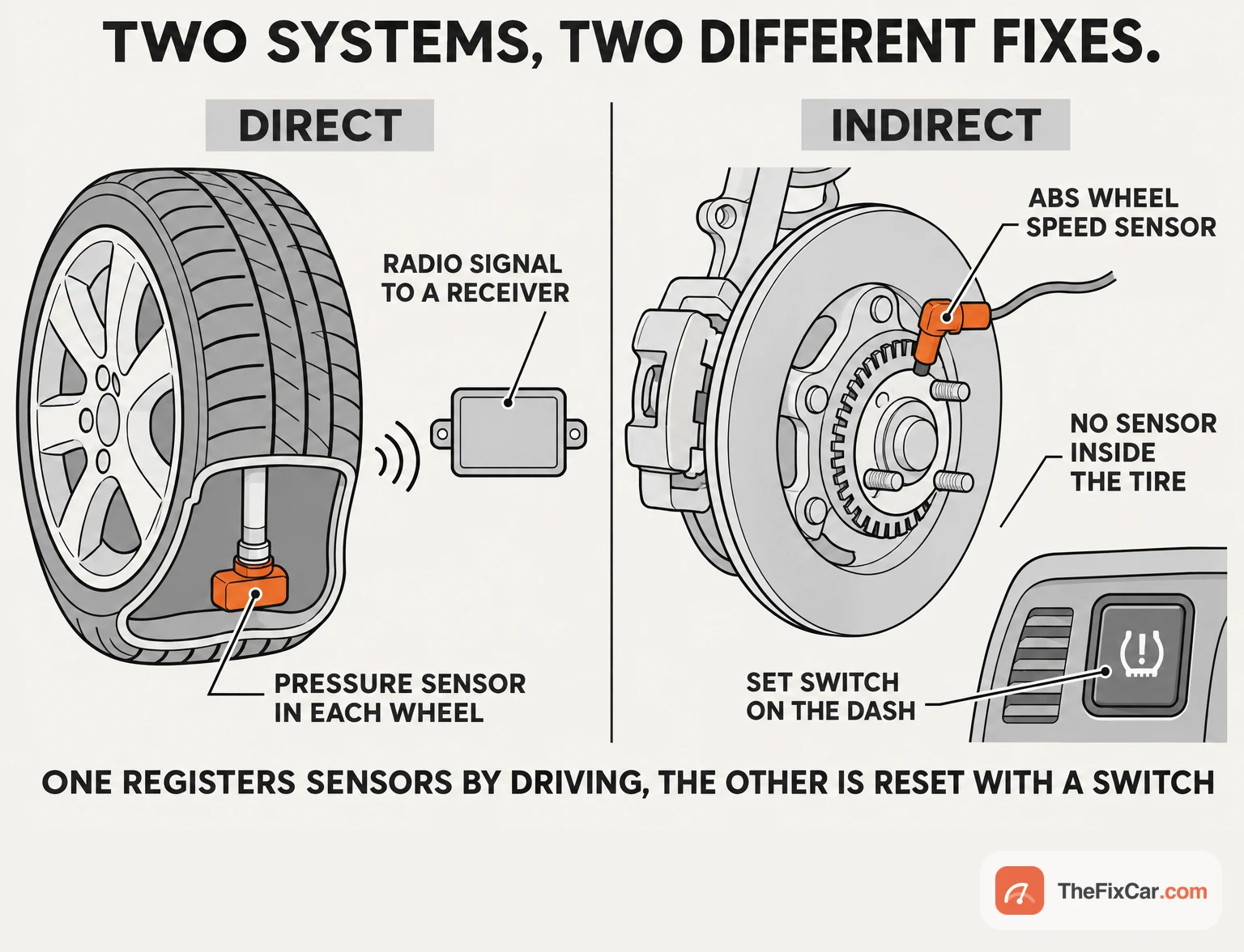
What happens next depends on which of two systems the car has. A 2025 Mazda3 or 2026 CX-50 reads pressure from a sensor in each wheel and registers those sensors by itself while driving, with no reset button[1][2]. A 2014 to 2018 Mazda3 or 2013 to 2016 CX-5 has no pressure sensors in its tires: it infers pressure from the ABS wheel speed sensors and is reset with a switch on the dash[3]. The reset written for one system does not exist on the other, and Mazda’s own lists of causes include several that are not a failed part.
Quick answer
Gauge all four tires cold, then start the car and watch the tire light for the first minute. After that, work out which system you have.
| What you see | Where to look | What to do first |
|---|---|---|
| Light solid from the start, with a low-pressure warning | The tire pressure label in the driver’s door opening, and a gauge | Look for a flat or damaged tire first. Set the pressures with the tires cold. On the 2025 Mazda3, if the light stays on with sound tires, drive 3 minutes or longer at 16 mph (25 km/h) or faster; if it still stays on, a tire may be flat[1] |
| Light flashes about a minute, then stays on | What was done to the wheels, and what is plugged in inside the car | Go through Mazda’s list of non-fault causes below before paying for a sensor. If none fits, Mazda’s instruction is an authorized dealer[4] |
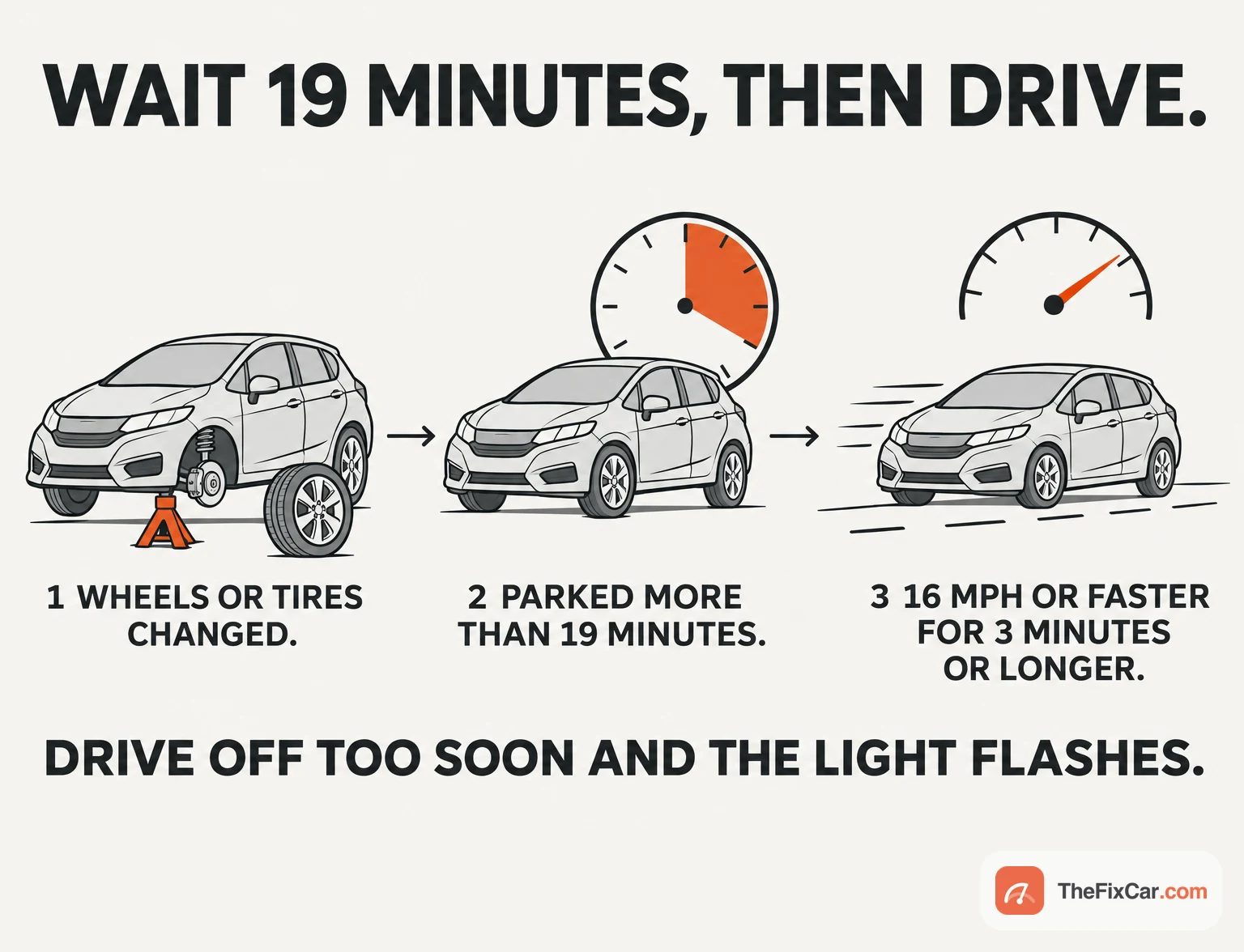
| Flashing began right after a tire or wheel change, direct system | The clock | With sound, correctly inflated tires: park for more than 19 minutes, then drive at 16 mph (25 km/h) or faster for 3 minutes or longer so the sensor IDs register (2025 Mazda3, 2026 CX-50)[1][2] |
| Light on after adding air, rotating tires or a battery disconnect, indirect system | The TPMS set switch on the dash | Parked with the parking brake on, regular tires fitted (not the spare), all four pressures set cold to the label and the ignition on, press and hold the switch until the light flashes twice and one beep sounds[3][5] |
| Tire light together with the TCS/DSC light, 2013 to 2018 cars | Stored codes | Have the codes read. Mazda bulletins trace this pairing to the brake control unit, a stuck code or the airbag module on specific models[6][7][8] |
| Missing or wrong pressures on the Mazda Connect screen, light off | Date and time settings, recent battery or wheel work | Mazda’s service alert for 2019 to 2026 Mazda3, 2020 to 2026 CX-30 and 2023 to 2026 CX-50 lists four causes: a wrong calendar date after a battery disconnect, an infotainment software update, the body control module losing the sensors during storage or transport, and a wheel or tire change. After a battery disconnect its remedy is to enable GPS time synchronization and drive 3 minutes or longer at 16 mph (25 km/h) or faster[9]. On the CX-5, CX-9 and 2024 and later MX-5, Mazda says individual pressures are not displayed at all and that this is expected behavior[10] |
A guide to where to look first, not a diagnosis: each row has more than one cause.
What a Mazda TPMS malfunction means
One light on the cluster carries both warnings. Mazda’s 2025 Mazda3 manual states that the malfunction indicator is combined with the low tire pressure telltale: on a malfunction it flashes for approximately one minute and then remains continuously illuminated, at every start-up while the malfunction exists[1]. Federal Motor Vehicle Safety Standard 138 sets the same pattern for a combined tire light: 60 to 90 seconds of flashing after the ignition is switched on, then steady, repeated until the cause is corrected[11]. Once the flashing has stopped the light is steady in both cases, which is how a malfunction gets mistaken for a slow leak.
The manuals for the 2023 CX-30 add that a message appears on the multi-information display together with the flashing light, and that the trigger is either a problem with the system or a drop in the voltage of a tire pressure sensor[4]. Mazda does not print the wording of that message in the manuals cited here, so go by the light: about a minute of flashing at start-up, then steady, is the malfunction pattern.
Which system your Mazda has
Mazda used two designs in the last decade, and the service documents say which models got which.
| System | How it works | Models named in Mazda’s documents | How it is reset |
|---|---|---|---|
| Indirect | No sensors in the tires. Pressure is inferred from ABS wheel speed sensor data[3] | 2014 to 2018 Mazda3, 2013 to 2016 CX-5, 2014 to 2017 Mazda6, 2016 to 2018 CX-3, 2016 to 2017 CX-9, 2016 to 2017 MX-5[3] | TPMS set switch on the dash, after setting pressures[3][5] |
| Direct | A pressure sensor in each wheel sends data by radio to a receiver in the car[1] | 2017 to 2018 CX-5, 2018 MX-5, 2018 CX-9[12]; 2019 Mazda3[13]; 2020 to 2021 CX-30[14]; 2021 CX-5[15]; 2025 Mazda3[1]; 2026 CX-50[2] | No switch. Sensor IDs register automatically while driving[1][12] |
The dashboard is a useful clue. Mazda’s service alert on the change to the direct system says there is no TPMS switch on those cars because it is no longer needed[12], while the indirect cars are initialized with a set switch[3]. If your model year is not in the table, the owner’s manual settles it in its first TPMS paragraph.
Symptoms and what else causes them
Mazda’s manuals list conditions under which the system cannot read the tires correctly and the light may flash. On the direct system most items on that list do not call for a new sensor. A dead sensor battery is the one worn-out part Mazda names there; other sensor or system faults still need a diagnosis.
| Symptom | Competing sources | Clues that shift suspicion |
|---|---|---|
| Flashing light after a wheel or tire change (direct) | Sensor IDs not registered yet; a wheel with no sensor; a sensor disturbed during the work | On the 2025 Mazda3, a car driven within 19 minutes of the change: Mazda says the light will flash because the IDs were not registered[1]. Winter wheels without sensors are on Mazda’s list too[4] |
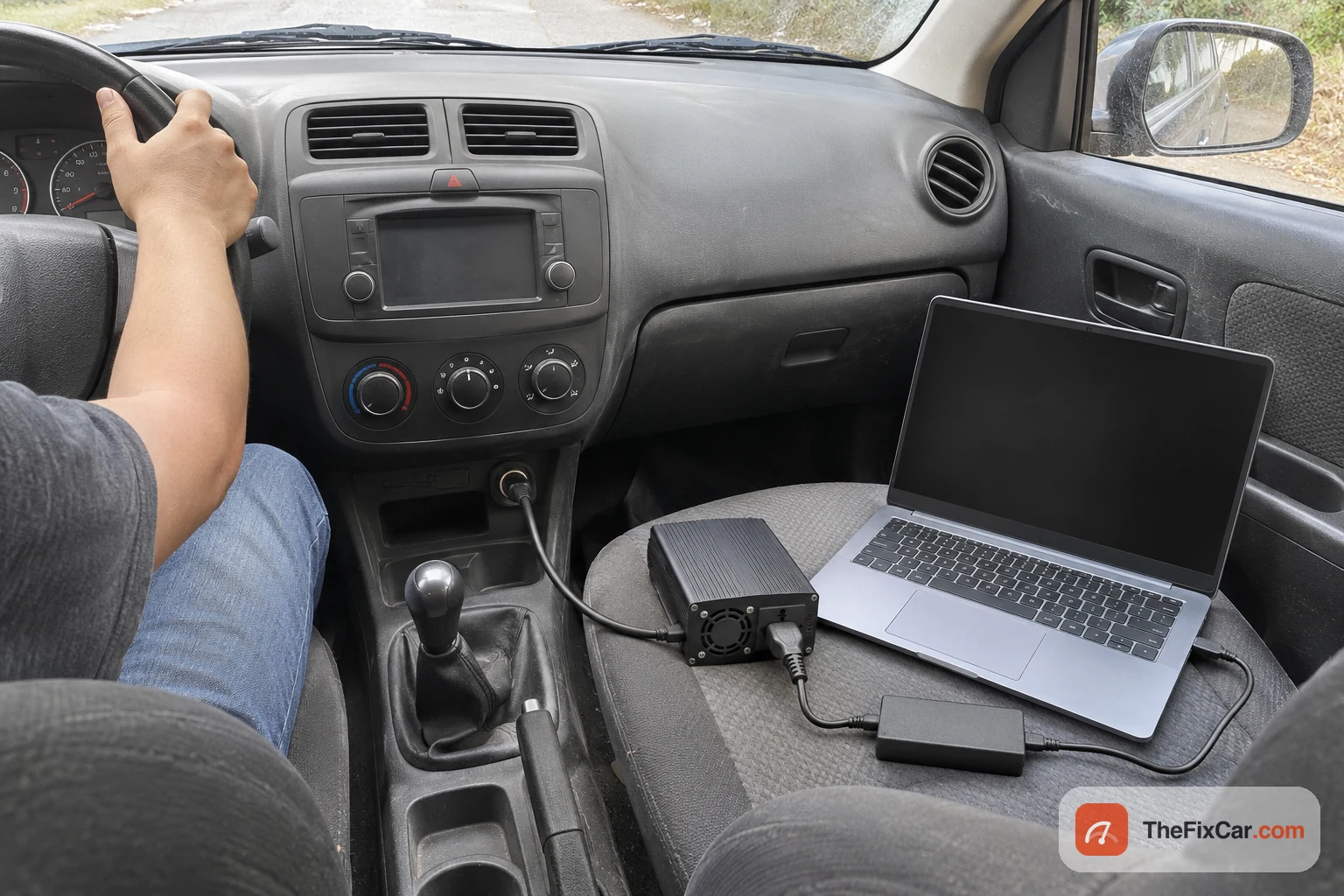
| Flashing light with electronics running in the cabin (direct) | Radio interference; a real system fault | Mazda names a DC-AC converter, a computer, a non-genuine electronic device near the center of the dashboard and nearby equipment on the sensors’ radio frequency[4]. Note what was running when the light appeared |
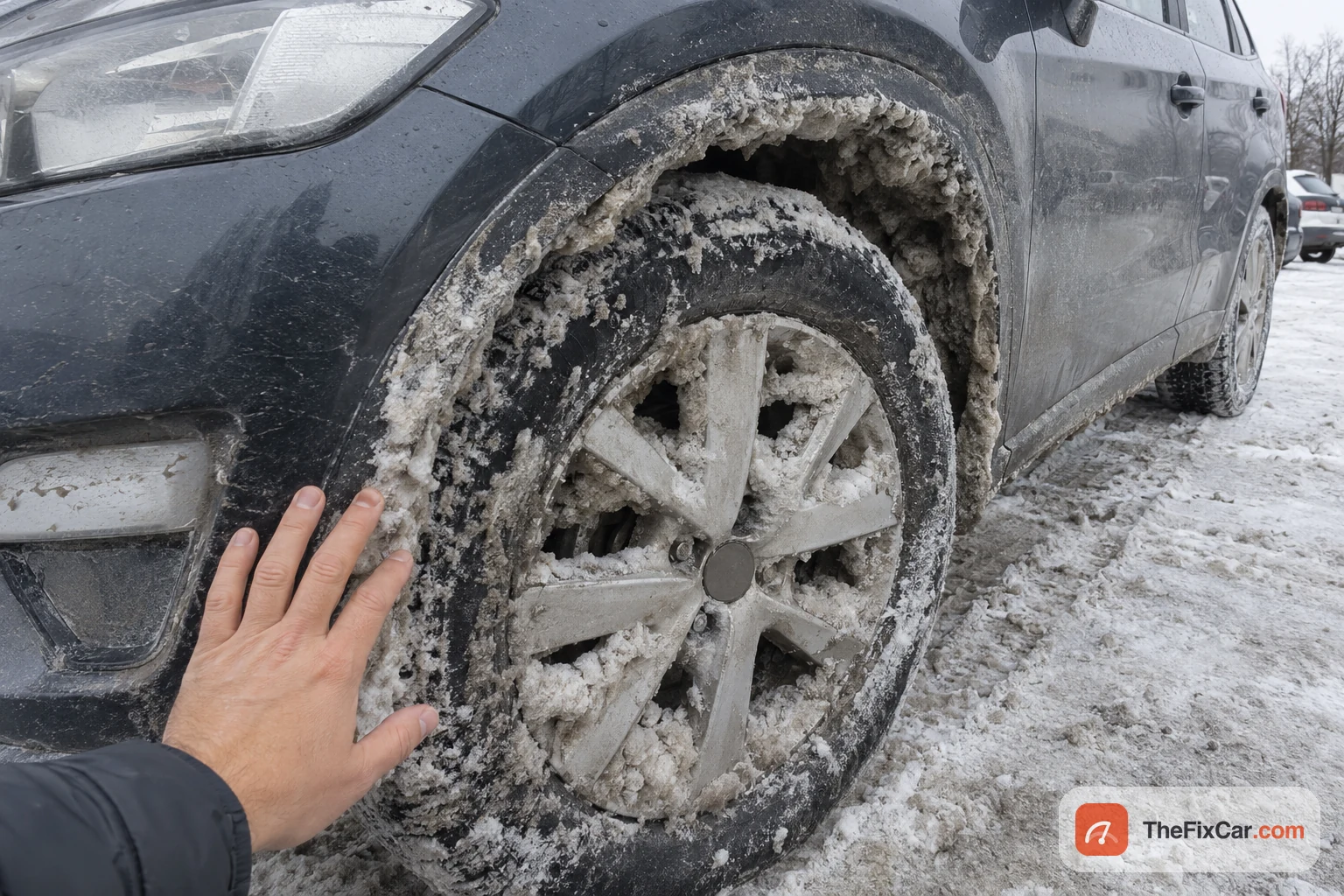
| Flashing light in deep winter (direct) | Snow or ice packed around the tires; tire chains; a weak sensor battery | Mazda lists a large accumulation of snow or ice around the tires and the use of tire chains[4]. Let the wheels clear of packed snow before judging the sensors |
| Flashing light with no change to the car (direct) | A dead sensor battery; a system fault | The 2023 CX-30 manual names a dead sensor battery and low sensor voltage among the causes[4]. Mazda’s instruction is an inspection at an authorized dealer[4] |
| Solid light that returns after pressing the set switch (indirect) | Pressures not set before the reset; a tire that is in fact low | If the switch is pressed without correcting the pressures, the system’s misuse prevention logic turns the light back on[3] |
| Tire light and TCS/DSC light together, 2013 to 2018 cars | Brake control unit; stuck communication codes; airbag control module | The stored codes point the way: Mazda has bulletins for C0051:62 on 2013 to 2018 CX-5 within listed VIN ranges, and for U0323, U0423 or U3000 on 2014 to 2018 Mazda3 and others[6][7] |
Sensor fault, or something else?
Several of the items above are not faults in a sensor at all. Three deserve a closer look.
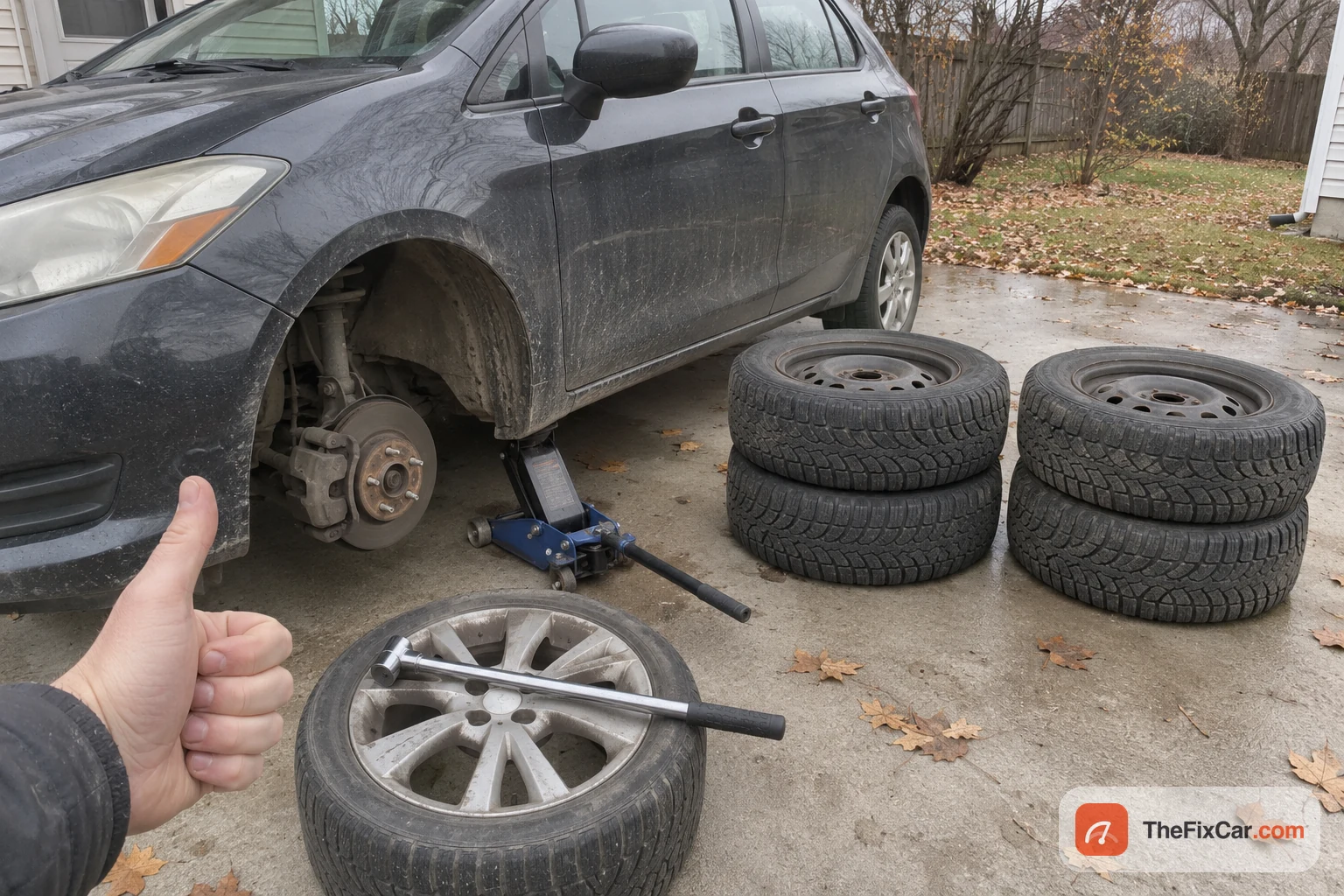
Driving off too soon after a wheel change. On the 2025 Mazda3 and 2026 CX-50 the car has to learn the ID code of each sensor after tires or wheels are changed, for example when winter tires go on. Mazda’s procedure is to wait more than 19 minutes, then drive at 16 mph (25 km/h) or faster for 3 minutes or longer; the IDs register automatically during that drive[1][2]. Drive within the 19 minutes and the light flashes. The 2021 CX-5 manual gives different numbers for the same idea: switch the ignition on and back off after the change, leave the car about 15 minutes, then drive for 10 minutes at 16 mph (25 km/h) or more[15]. Use the figures in your own manual.
Things in and around the car. The 2023 CX-30 manual’s list includes an inverter or a computer running in the cabin, snow and ice packed around the tires, tire chains, tires with steel in the sidewall, a wheel with no sensor[4]. The 2021 CX-5 manual gives a similar list under the heading “System Error Activation”[15]. Apart from the wheel that has no sensor, none of these is repaired by fitting one.
The brake control unit and stuck codes. On the indirect cars the tire monitor works from ABS wheel speed data[3], and several Mazda bulletins for 2013 to 2018 cars pair the tire light with stability control faults. Bulletin 04-003/19 covers 2013 to 2018 CX-5 vehicles within stated VIN ranges where the TCS/DSC light and the tire light come on together with code C0051:62, a steering angle value out of tolerance; Mazda’s repair is a replacement brake hydraulic and control unit under warranty terms[7]. M-Tips MT-010/18 describes 2014 to 2018 Mazda3 and other models with Mazda Connect where codes U0323, U0423 and U3000 cannot be cleared while the tire light flashes, after the ignition was switched off within 20 seconds of being switched on with the ROOM fuse not installed while the battery was low, or with the infotainment unit (CMU) disconnected; the repair starts with confirming the fuse and replaces no part[6]. Bulletin 08-001/15 ties tire, ABS and TCS/DSC lights on certain 2014 Mazda3, 2015 Mazda6 and 2014 to 2015 CX-5 vehicles to the airbag control module[8]. Each applies only to the vehicles and build dates it lists.
What to check first
Start with a gauge and the door label. Mazda’s warning for the 2025 Mazda3 is plain: do not drive at high speeds with the tire light on or flashing, and do not ignore it, because a tire may burst[1]. The label pressures are explained in our tire pressure specifications. Then:
- Restart and watch the light. About a minute of flashing before it goes steady is the malfunction pattern[1][11]. Steady from the start points to pressure first.
- Find out which system you have. The table above lists the models Mazda names; on the direct-type 2017 to 2018 CX-5, 2018 MX-5 and 2018 CX-9 Mazda says there is no TPMS switch on the dash[12].
- Match the light to recent events. Wheels or tires changed, pressures adjusted, battery disconnected, an inverter or laptop in use, snow in the wheels. On the indirect cars Mazda requires initialization after pressures are adjusted, tires are rotated, tires or wheels are replaced, and after the battery is disconnected or discharged[3].
How the reset works on each system
The two systems are reset in different ways. Use the steps in your own manual; the ones below are Mazda’s for the models named.
Indirect system, with the set switch (Mazda3 manual). Park, apply the parking brake, let the tires cool and set all four to the pressure on the door label. Switch the ignition on, then press and hold the TPMS set switch until the warning light flashes twice and one beep sounds[5]. Initialization is not performed while the car is being driven[5]. Order matters: Mazda warns that initializing without adjusting the pressures leaves the system unable to judge normal pressure, so it may stay quiet with a low tire or light up with normal ones[5]. With the spare fitted, Mazda says not to press the switch until the repaired or replacement tire is back on[5].
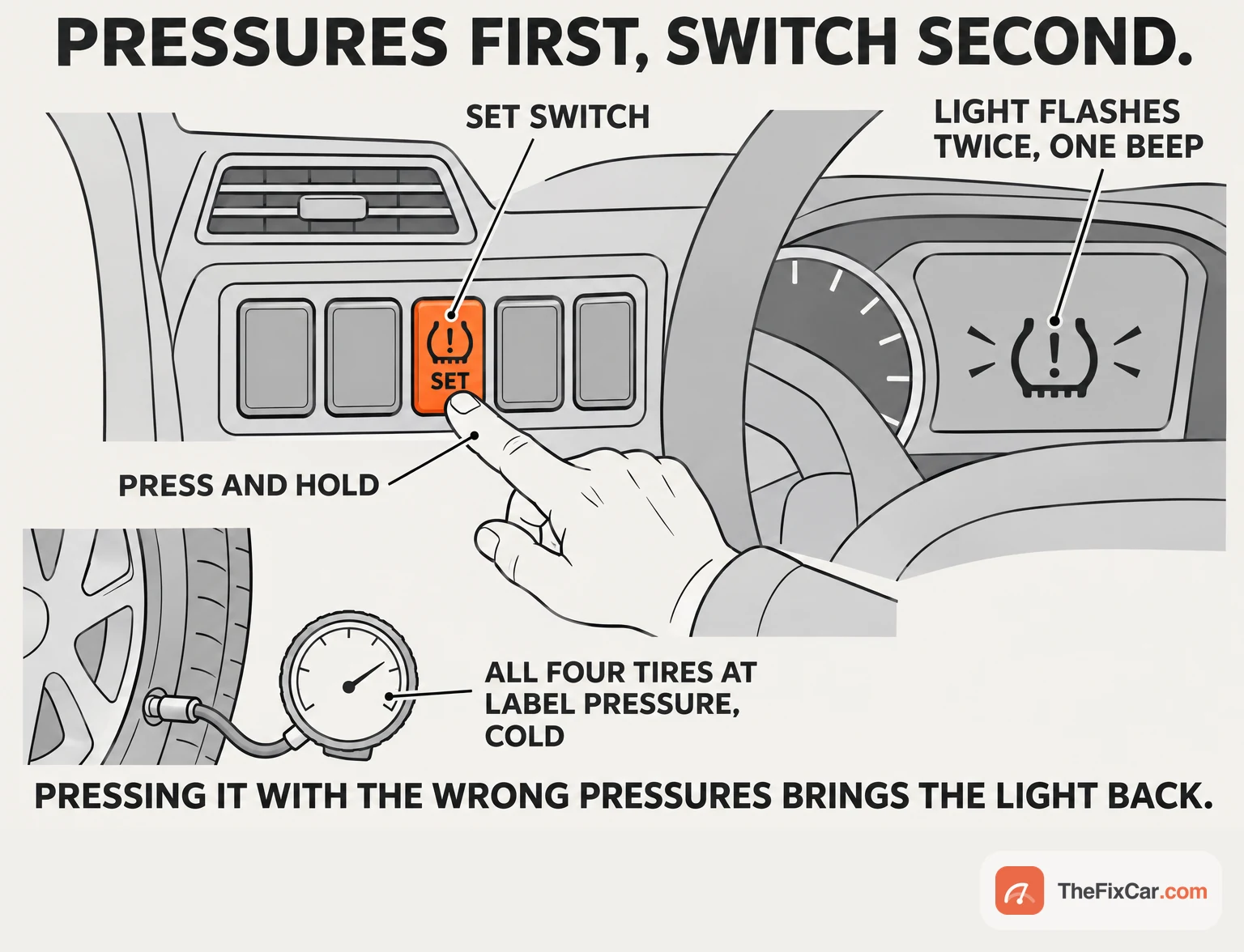
If the light returns after a reset done at the wrong pressures, the cure is not more button presses. Bulletin 02-011/18 describes a misuse prevention logic on these cars and, for most of the listed models, a dealer reset through the diagnostic tool followed by a learning drive (certain 2013 CX-5 units get a different procedure); Mazda states that this visit is not covered under its warranty policy[3]. Set the pressures cold, meaning after the car has sat for an hour or been driven less than a mile (1.6 km)[3].
Direct system, no switch. Nothing is pressed. After a wheel or tire change the sensors register during the wait-then-drive sequence described above[1]. A new sensor needs its ID registered as well, and Mazda sends owners to a dealer for that[1]. One detail matters at the tire shop: on the 2019 Mazda3 and 2020 to 2021 CX-30 Mazda fits a rubber-stem sensor that is not reusable, so a sensor removed from the wheel must be replaced[13][14].
Can you drive with a TPMS malfunction?
The light alone does not tell you the tires are sound. Gauge them and look them over first. Mazda gives no clearance to carry on as normal: its instruction is not to drive at high speeds and to deal with the warning promptly[1]. If the tires hold the label pressure, a careful drive to a shop is a reasonable reading of that, but do not count on a warning: Mazda says that with the malfunction indicator on, the system may not detect or signal low pressure[1]. Keep speeds moderate and check the pressures by hand until it is fixed.
Stop and deal with the tire if:
FAQ
What does TPMS malfunction mean on a Mazda?
It means the tire pressure monitoring system has detected a problem with itself. Mazda’s manuals describe the sign as a tire pressure light that flashes for about one minute after starting and then stays on[1]. The low-pressure warning is a light that comes on steady.
Why is my Mazda TPMS light flashing when the tires are fine?
On cars with wheel sensors, Mazda’s list of causes includes sensor IDs not yet registered after a wheel change, radio interference, an inverter or computer in the cabin, snow or ice around the tires, tire chains, a wheel without a sensor and a dead sensor battery[1][4]. Only the last is a worn-out part on that list; a fault elsewhere in the system still needs a diagnosis.
How do I reset the TPMS on a Mazda3 or CX-30?
It depends on the year. A 2014 to 2018 Mazda3 uses the dash set switch after the pressures are set[3][5]. Mazda’s service alert for the 2019 to 2026 Mazda3 and 2020 to 2026 CX-30 describes wheel sensors that register by themselves: after a wheel change, ignition on, ignition off, let the car sit 19 minutes or more, then with the engine running drive at 16 mph (25 km/h) or faster for 3 minutes or longer[9]. The 2025 Mazda3 manual says more than 19 minutes[1].
Does a spare tire cause a TPMS malfunction on a Mazda?
It can. The Mazda3 manual for the indirect system says the light may flash and then stay on with an emergency tire fitted[5]. The manuals for the direct system list a wheel not equipped with a tire pressure sensor among the cases where the light may flash[4]. They do not say whether a given spare carries a sensor.
Why are the TPMS and DSC lights on together on my Mazda?
For 2013 to 2018 models Mazda bulletins link the pairing to the brake control unit on certain CX-5 vehicles, to stuck communication codes on 2014 to 2018 Mazda3 and others, and to the airbag module on some 2014 and 2015 cars[6][7][8]. Have the codes read; our guide to wheel speed sensor symptoms covers the sensor side.
Can I replace a Mazda TPMS sensor myself?
The sensors are installed on the wheels, and a new sensor’s ID has to be registered, for which Mazda refers owners to a dealer[1]. On the 2019 Mazda3 and 2020 to 2021 CX-30 a removed sensor cannot be refitted[13][14].