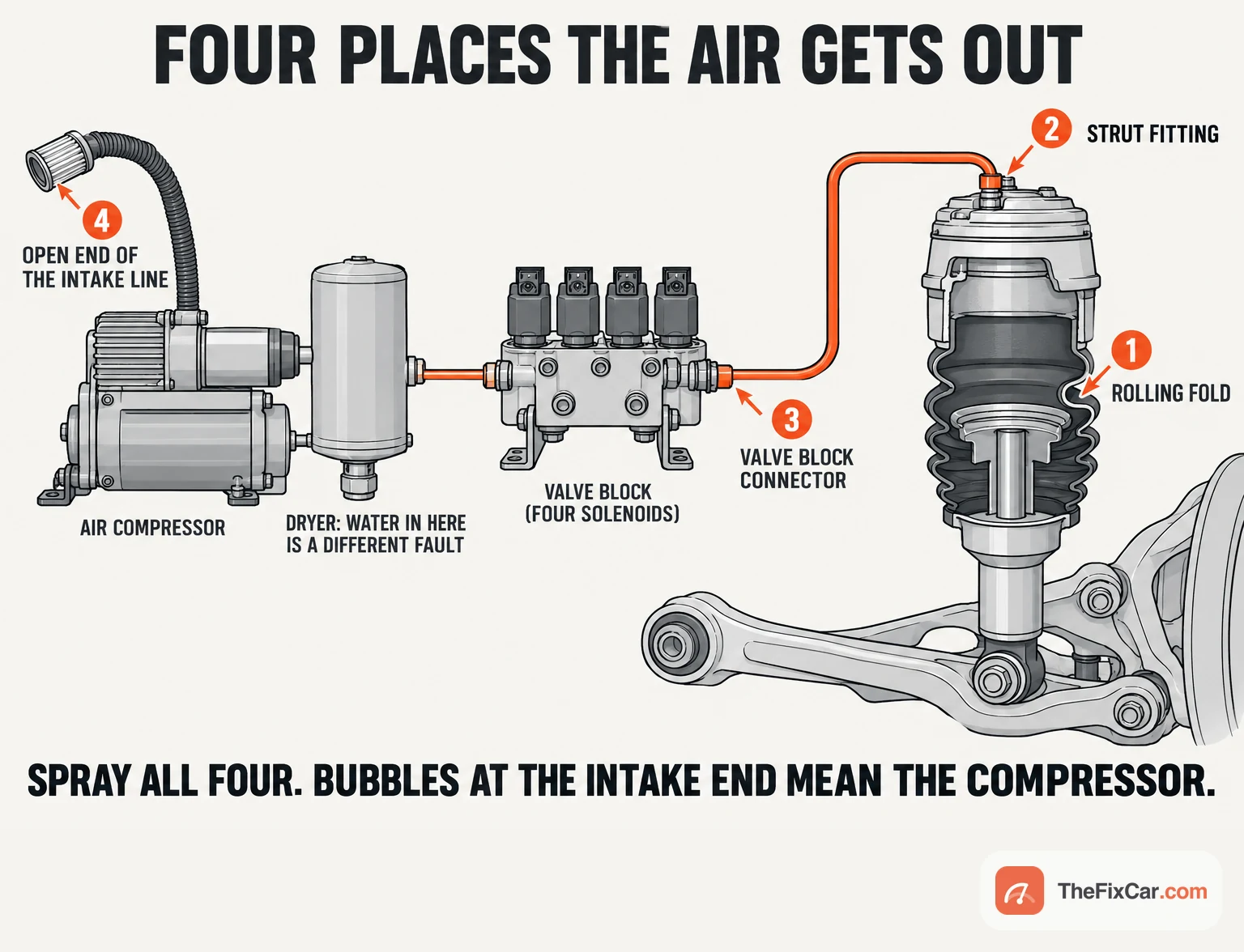
In the manufacturers’ notes on this page, air suspension loses air in four places, and all four are reached with a spray bottle before anything is unbolted: the rolling fold of the rubber bellows, the push-in fitting on top of the strut, the line connectors at the valve block, and the open end of the compressor intake line, where bubbles send the compressor out for replacement. A fifth finding is not a leak at all: water inside the dryer and the lines, which only shows when a line is opened, and which Mercedes treats as the fault that condemns the compressor and the valve block together.
The order below is assembled from four manufacturers’ procedures, each written for the cars it names: a measurement overnight so the leak is real before the search starts, soapy water from the bellows inward, a scan-tool hold per corner when the water finds nothing, and the moisture check last. Each test comes with what it does and does not prove, so that an air spring is not bought on one low morning.
Quick answer
Measure wheel centre to fender arch on both sides tonight and again in the morning, then spray the bellows fold and the strut fitting with soapy water at the highest ride height. The two steps take fifteen minutes of work and one night of waiting, no tools beyond a tape and a spray bottle, and the thing not to skip is the night: on the Mercedes models that publish a number, under 15 mm of overnight drop is the air cooling.
What each test proves
| Test | What it tells you | What it does NOT prove |
|---|---|---|
| Overnight height on both sides | Whether a corner is losing air at all, and roughly how fast | Where the air goes, and whether a system that re-levels while parked hid part of the drop |
| Soapy water at the highest setting | An external leak at the point where bubbles grow | A leak inside the valve block, a line that is not pushed home and lets the spring’s check valve close, or a leak that only opens under load |
| Scan-tool pressure hold per corner | Which corner’s circuit loses pressure with leveling disabled | Whether the loss is the spring, the line or the solenoid: the circuit, not the part |
| Opening the compressor line for water | Whether moisture got past the dryer | Where it got in; the fix is the compressor, valve unit and intake filter together, not a search |
Why the measurement comes before the spray bottle
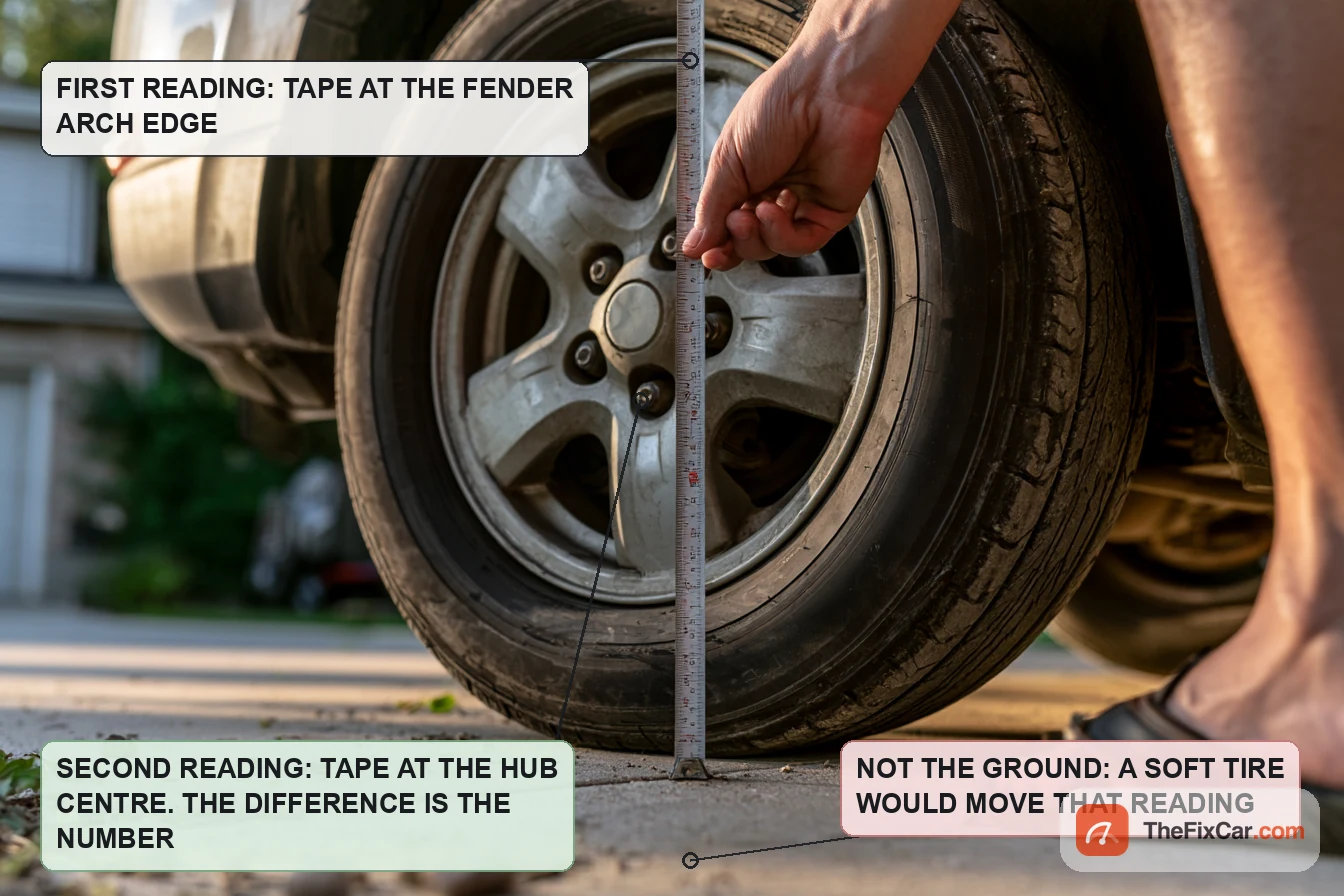
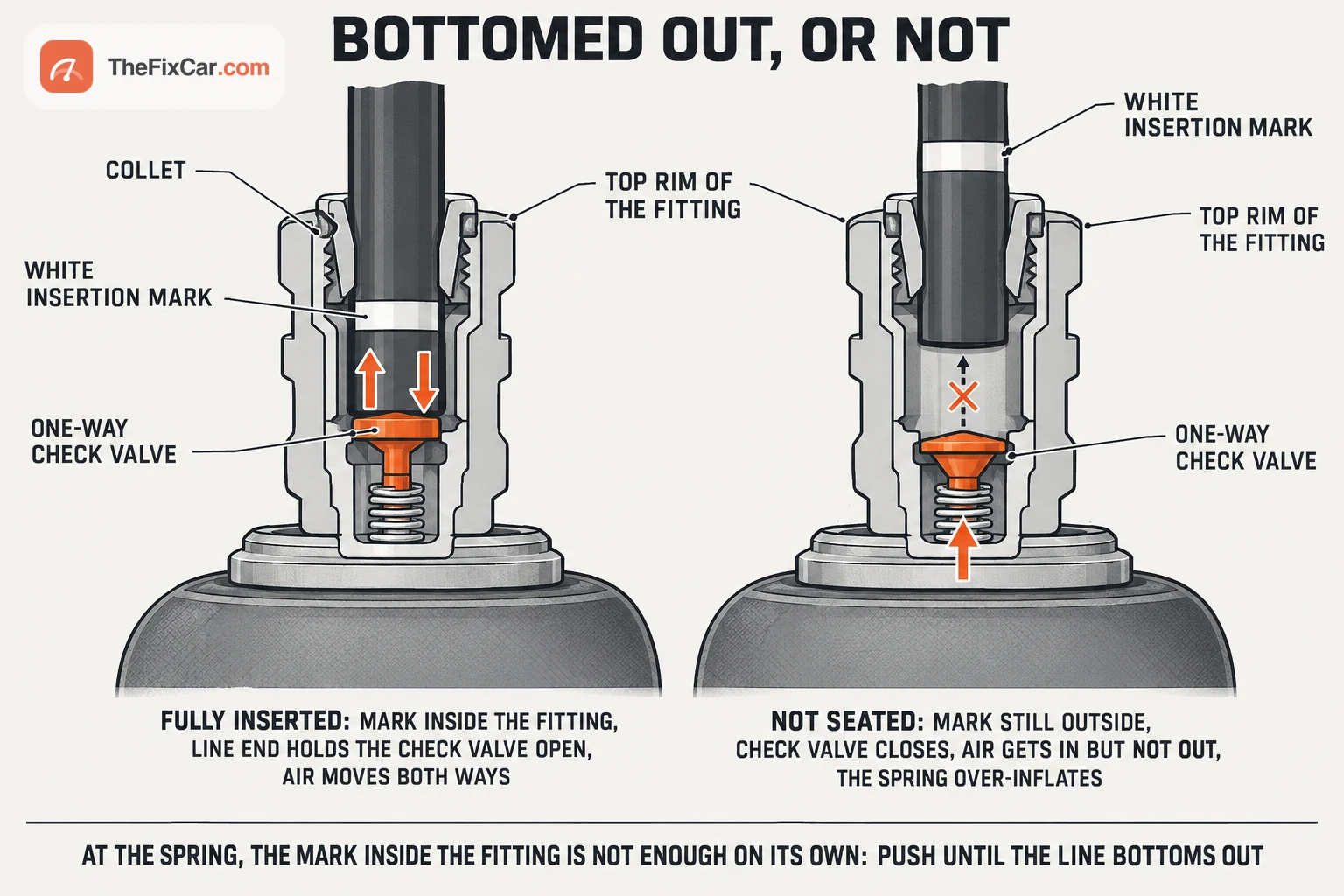
A corner that looks low in the morning has three explanations besides a leak: cold air, a module that re-leveled itself while the car sat, and a tire. Mercedes’ bulletin for the 212 and 218 series AIRmatic rear axle puts numbers on the first: the level falls about 1 mm for every 1 °C the air cools, so the car is measured after about two hours of standing, then again in the morning without touching the central locking or the ignition in between, and a drop under 15 mm is treated as cooling, not a leak. GM’s bulletin PIT5801F for the 2021 to 2026 Tahoe, Suburban, Yukon and Escalade with air ride adds the opposite trap: the fitting at each air spring has a one-way check valve that the fully inserted line holds open; a line that is not pushed home lets the valve close, air gets into the spring on an inflate command but cannot leave on a deflate command, that spring over-inflates, and the other side of the truck looks low.
Which corner is low, and how it behaves over a day, is worked out on the page about a single corner that drops; this page starts once a corner has failed the overnight test.
How to check
- Overnight height, both sides of the axle. Park on level ground, wait about two hours, measure from the centre of the wheel hub to the fender arch edge on both wheels of the axle, write the numbers down with the evening temperature. Do not unlock or start the car until morning, then measure again. Result, on the Mercedes cars that publish the figure: a drop of more than 15 mm on one side with no bubbles at the fittings is what the bulletin replaces the air spring for; under 15 mm on both sides is treated as cooling. The 15 mm line is Mercedes’ own, built on its 1 mm per 1 °C figure, so a night that cools another 15 °C after the two-hour wait would reach it on its own, and another maker’s threshold can differ. A side that drops well past its neighbour is losing air. The number says nothing about where, and on a car that wakes and re-levels while parked it understates the loss, so two nights are better than one. Measured from the hub centre, a soft tire drops out of the comparison; it would not if the tape ran from the ground.
- Soapy water at the highest ride height, bellows first. Raise the car to its highest setting so the fold of the rolling lobe is stretched over the piston, then spray the fold all the way round, the fitting on top of the strut, each line connector at the valve block, and, as Mercedes does it, the open end of the compressor intake line with the system at rest: bubbles there mean the bulletin replaces the compressor. The exhaust is not on the list, because it blows air on purpose when the system vents. Land Rover’s 2021 note for the Defender and Discovery front springs has the technician select off-road height and spray around the top of the air spring, and replaces the strut assembly on bubbles; on a Range Rover that has already put up a Suspension Fault message, the stored code names the corner before the spray bottle comes out. Result: bubbles that keep growing at one point. It proves an external leak there. It does not clear the valve block, and it does not catch a line that looks connected but is not pushed home: on GM’s trucks that line does not leak, it over-inflates the spring, and the bulletin’s check is that the white mark on the line has gone into the top of the fitting and the line has bottomed out.
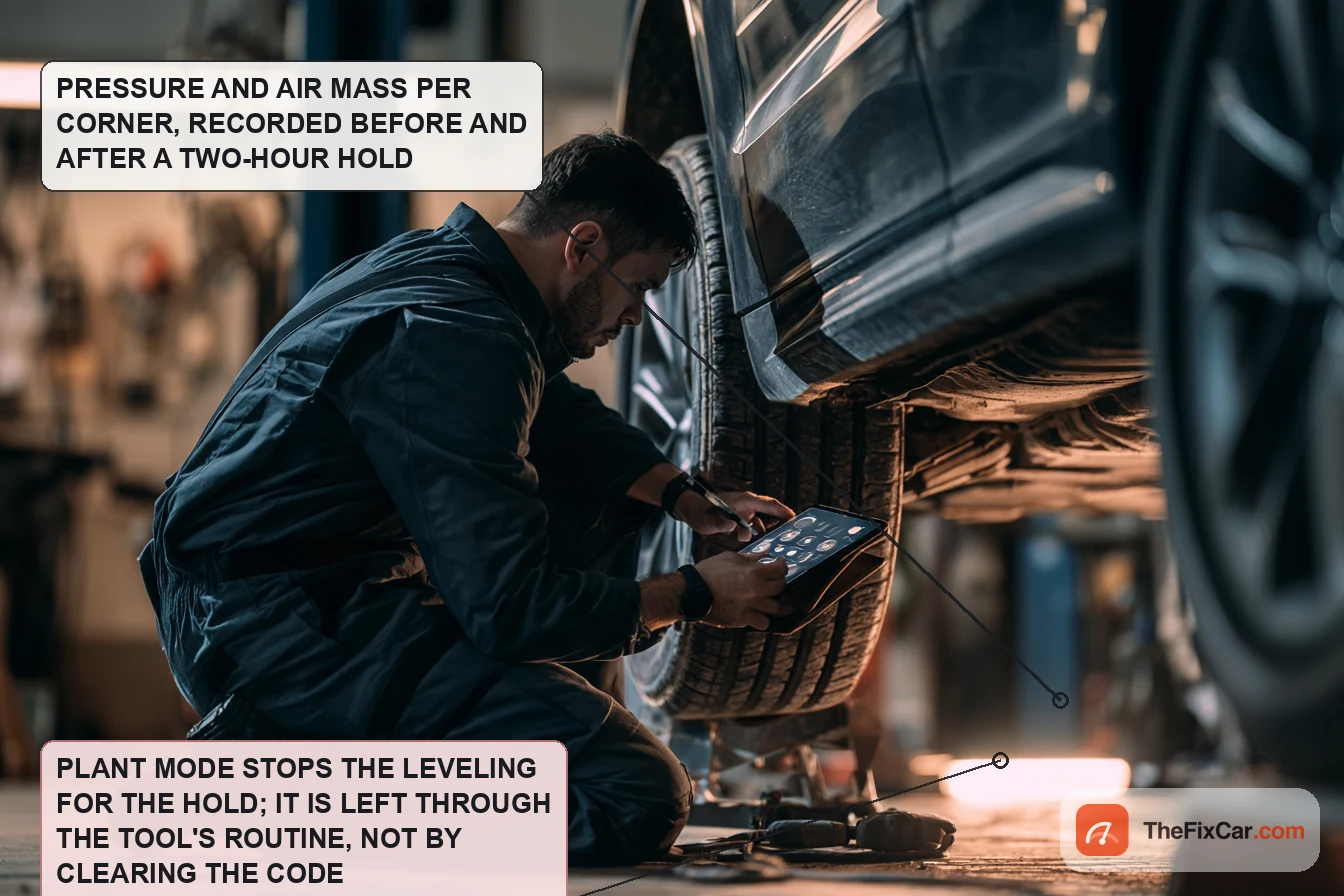
- Pressure hold per corner on the scan tool. When the water finds nothing and the tool reaches the suspension module, the module can watch each corner for you. FCA’s case notes for the Ram 1500 with air suspension raise the truck to Off Road 2, record pressure and air mass per corner, put the module into plant mode so it stops leveling (it sets C2212 while there), leave the truck for two hours, then compare the readings corner by corner; FCA’s wording is that the comparison helps identify the corner that may have leaked, and a corner whose pressure falls while the other three hold is the circuit to open first. Plant mode is left by completing an ASCM routine on the tool, not by clearing the code. Result: one corner’s pressure falls while the others hold. It points at a circuit. It does not separate the spring from its line or its solenoid.
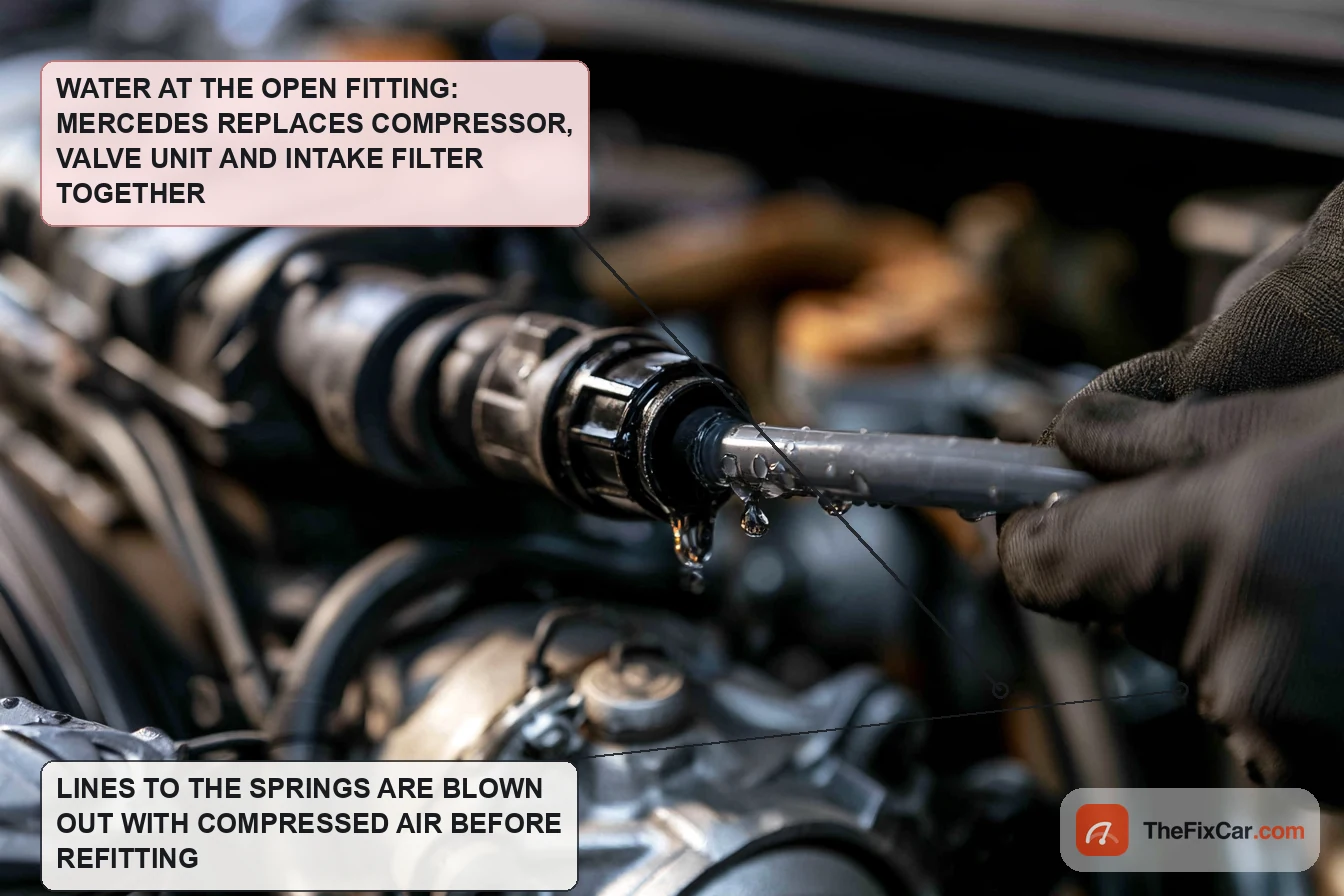
- The moisture check, last. With the system depressurized the way the manual describes, unscrew the pressure line between the compressor and the valve unit. Mercedes’ bulletin has the technician look for water at the connection, then run the compressor with the diagnostic tool and watch the open port: water running out means the compressor, the valve unit and the intake air filter are replaced together, the lines from the valve block to the springs are blown out with compressed air, and a reservoir with water in it is replaced too. Result: dry port, and the leak search goes on; water, and the compressor, valve unit and intake filter are replaced together. It proves moisture got past the dryer, not where it got in; the bulletin’s own note says a car that comes back with the same complaint soon after exceeded its fording depth.
What to do where the bubbles are
The place the bubbles grow decides the part, and the manuals on this page do not agree on the sequence for getting it out, so the sequence stays with the manual for the car. The decisions do travel:
- The fold of the bellows: the air spring, or the strut assembly where the spring is built into it; Land Rover’s 2021 note replaces the whole strut on bubbles at the top of the spring.
- The fitting on top of the strut or a connector at the valve block: release the line, cut the end square where the manual allows, push it home to the mark and the stop. Bubbles again mean a new connector; bubbles after that, with the connector seated, mean the spring or the block.
- The body of the valve block, away from the connectors: the block.
- The open end of the intake line: the compressor, on the Mercedes bulletin.
- Water at the opened pressure line: compressor, valve unit and intake filter together, the lines blown out, a wet reservoir replaced.
The sequence the manuals share
Seven steps that appear in each of the procedures cited here, with the number taken from the manual that publishes it:
- Depressurize first. Land Rover’s 2005 specification for the Range Rover Sport and LR3 lists a 35 bar burst pressure for its springs and up to 23 bar in the reservoir, which is the reason the system is emptied before a fitting is touched. The manual’s depressurization routine, through the scan tool or the exhaust valve, comes before any fitting is loosened, and the body goes on stands with the leveling disabled in the jacking mode the handbook names; the jack and stand sequence for a tire change is the floor, not the ceiling.
- Release the push-in fittings. Press the collet in and pull the line out straight. Where the manual allows a line to be cut back, cut the damaged end square; a scored or ovalled end will not seal, and some lines are replaced complete.
- Remove the strut or the spring with the line out of the way, following the model’s procedure for the top mount and the lower bolt; on a strut-type spring the damper comes out with it.
- New connectors where the manual says so. Land Rover’s 2017 and 2018 expansion chamber notes order three new Voss connectors with each chamber, and its 2005 specification for the Range Rover Sport and LR3 torques Voss connectors to 2.5 Nm at the valve blocks, 3.5 Nm at the air springs and 5 Nm at the reservoir.
- Push each line home. On GM’s air ride trucks the white band on the line has to go into the top of the fitting and the line has to bottom out, and the bulletin says the mark alone is not proof at a spring fitting. On lines without a mark, follow the fitting maker’s insertion depth.
- Refill the way the manual says. On the Ram 1500 with air suspension, FCA’s procedure purges the dryer by deflating to atmosphere, fills the reservoir with nitrogen and performs three partial deflations through the tool to pull humidity out before filling the system; other makes fill with the compressor and ask for a ride-height calibration afterwards, and the manual for the car says which.
- Leak-test the new joint with soapy water at the highest setting, then run the overnight measurement once more. A new spring that passes the spray and still fails the night points to a second leak, or to the night test itself: cooling, or a system that re-leveled while parked.
DIY difficulty and tools
Moderate for the diagnosis, moderate to hard for the replacement depending on access. The diagnosis needs a tape, a spray bottle, a notebook and, for step three, a scan tool that reads suspension pressures and can command the module; Ram and Mercedes use their dealer tools, WiTECH and XENTRY, for that step. The replacement needs the depressurization routine for the car, stands, new connectors, a torque wrench that reads single newton-metres, and on the Ram a nitrogen supply. The time goes into reaching the part: what has to come off to get at the strut top mount or the compressor sets the job, not the swap itself.
FAQ
How do I find a leak in my air suspension?
Measure both sides of the axle in the evening and in the morning without touching the car; if one side drops more than Mercedes’ 15 mm line, raise the car to its highest setting and spray soapy water on the bellows fold, the strut fitting, the valve block connectors and the open end of the compressor intake line. No bubbles sends you to the scan tool’s per-corner pressure hold.
Why does my air suspension leak only in the cold?
The documented cause is water that got past the dryer freezing in the lines or the compressor: FCA’s case notes for the Ram 1500 begin a cold-weather complaint of a system that will not lift with the fuse and a moisture purge. Cold-stiffened rubber at the fold is the other candidate. The tape does not separate the two; the spray bottle at the fold on the cold morning and the moisture check at the compressor line do.
How long does an air spring last?
None of the documents on this page gives a mileage. Mercedes’ bulletin for the 212 and 218 series replaced rear bellows for microscopic leaks at damaged sealing rings and introduced a revised part marked with a black ring; Land Rover’s 2021 note for the Defender and Discovery checks the manufacture date on the strut label. Age and fold cycles are what the bulletins look at, not miles.