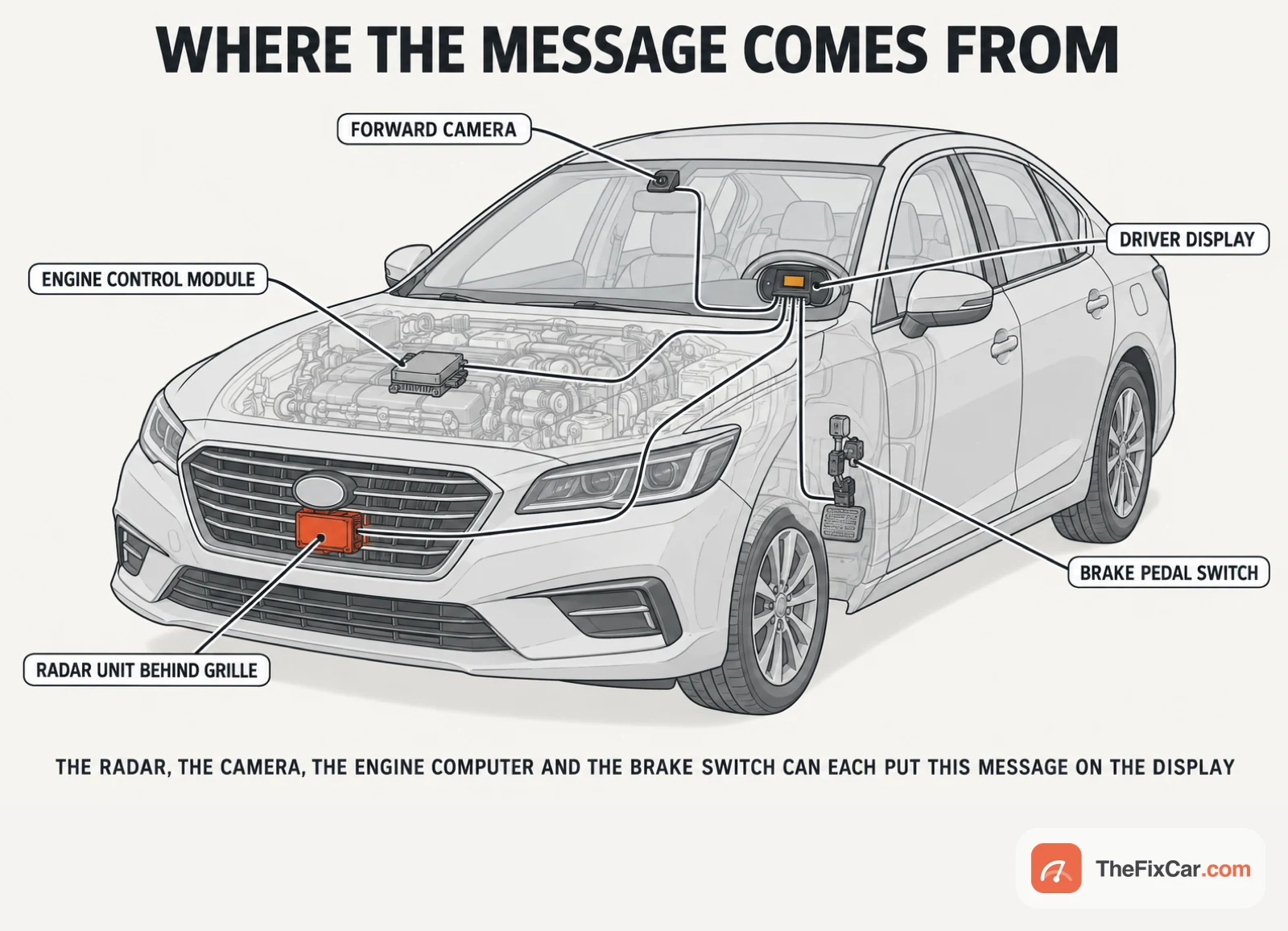
The full text on the driver information display is “Collision Mitigation Braking System Problem. See Your Dealer.” On the Hondas covered by Honda’s own bulletins it arrives in company: adaptive cruise control drops out or refuses to set, and the amber safety-support indicator stays on. Honda’s service documents put that one line, or the indicators that travel with it, next to at least four different stored codes, and the code plus the bulletin’s own conditions decide whether the answer is a cloth, an ignition cycle, a software update or a radar aiming job.[1][3][5]
This page separates the four. Two facts do most of the work: whether the message survives one restart, and which codes are stored with it, read before anyone clears them. A message that clears on the next ignition cycle with only U0401-92 stored, on a non-hybrid 2018 to 2019 Accord or 2019 RDX inside the bulletin’s VIN ranges and meeting its other conditions, is the case Honda fixed with an engine software update.[1][2] A message that comes back every drive with P2583-76 on a 2017 CR-V EX, EX-L or Touring within the VIN ranges of bulletin 17-064 is a radar problem: Honda’s order is the radar software update first, then aiming if the code remains, and no restart or cleaning changes that.[3][4]
Quick answer: can you keep driving with this message?
If this is the only warning, the brake pedal feels normal and the car otherwise behaves normally, treat CMBS as unavailable: do not rely on CMBS or adaptive cruise control, and arrange diagnosis. The 2018 Accord manual says CMBS does not prevent a collision or stop the vehicle automatically even when it works.[6] Stop driving if a brake-system warning appears, pedal feel changes, or the car brakes unexpectedly. Otherwise restart the car once, then have the codes read before anyone orders a radar unit.
| What you see | Where to look | What to do first |
|---|---|---|
| Message appears once, ACC drops out, gone after restart | Code memory: U0401-92 alone | On a non-hybrid 2018 to 2019 Accord or 2019 RDX, ask the dealer to check the five conditions in bulletin 19-051 and the PGM-FI program ID |
| Message on every start, ACC and RDM warnings with it | Code memory: P2583-76 | On a 2017 CR-V EX, EX-L or Touring within the VIN ranges of 17-064, the radar software update first, aiming if the code remains; other vehicles need their own procedure |
| Message after a battery disconnect, jump start or new battery | Amber indicators together | Follow the manual for your year; the 2023 Accord Hybrid manual says drive a short distance above 12 mph. If they stay, code check[8] |
| Message with the ACC and RDM indicators, driver rests a foot on the brake | Code memory: C0041-14 | On the 2019 to 2020 Civic: clear the code; if it returns with the foot on the dead pedal, brake switch circuit[5] |
| “Radar Obstructed” or the amber indicator alone, no “Problem” wording | Front emblem or lower bumper, windshield behind the mirror | Clean and re-check; on the cited models this is a temporary shutoff. If it keeps returning, have the codes read[8] |
A guide, not a diagnosis: each row has more than one cause, and the code check is what narrows it.
Why does this Honda warning appear?
The Collision Mitigation Braking System is not one part. On the 2018 Accord it uses a millimetre-wave radar and a camera behind the rearview mirror,[7] and the bulletins cited below add the engine control module that handles cruise-control requests, the brake actuator module and the switch on the brake pedal to the list of things whose faults reach the same display.[1][3][5] In those documents the “Problem” message, or the ACC, CMBS and RDM indicators together, accompany very different failures, so the wording alone does not name the failed circuit.
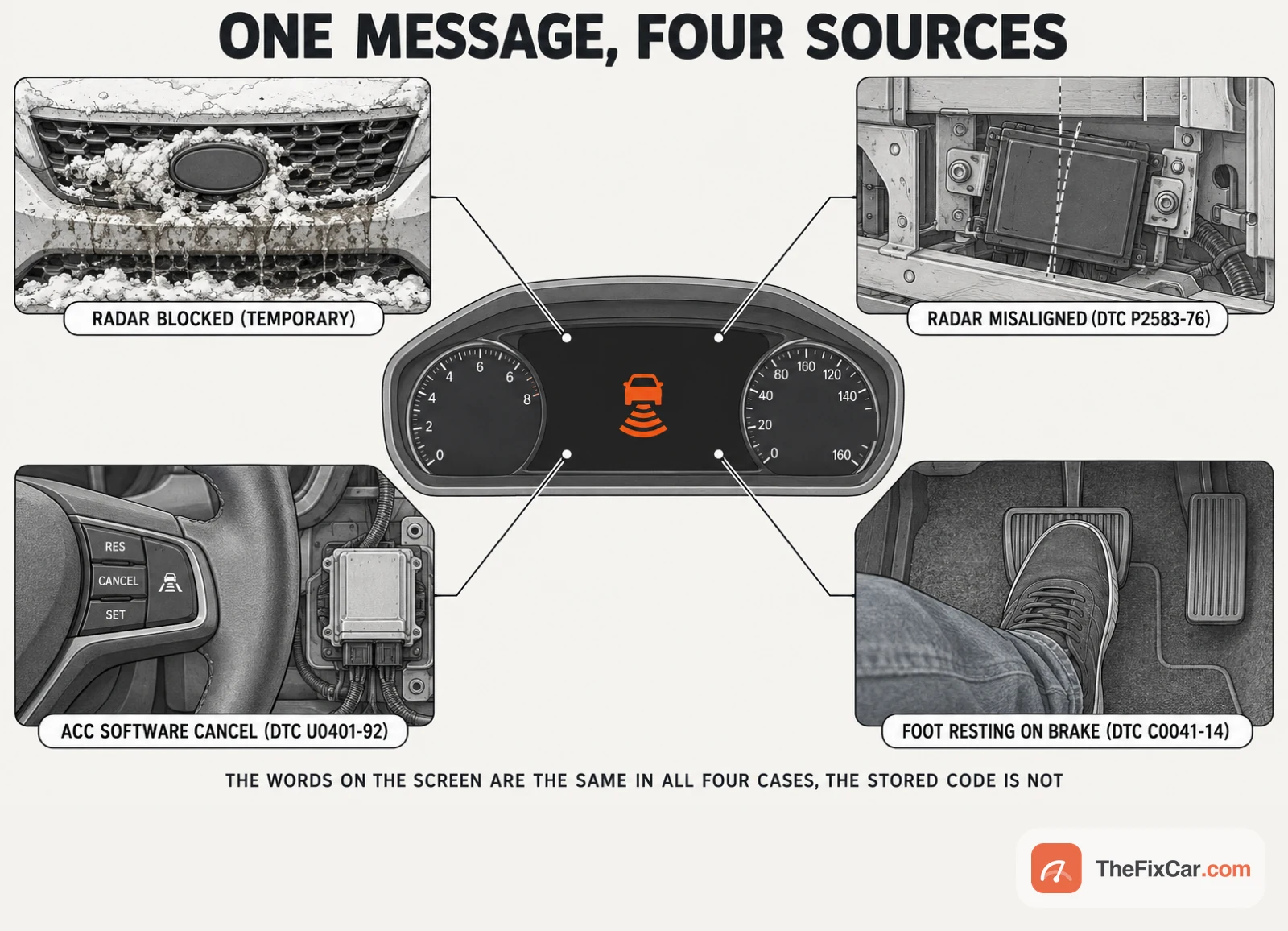
| Symptom | Competing causes | Clues that shift suspicion |
|---|---|---|
| Message appears while ACC is in use, ACC will not set again on that drive | Engine software cancelling ACC on a conflicting stop-and-go signal (U0401-92); brake switch signal (C0041-14); radar unit fault | Clears on the next ignition cycle and U0401-92 is the only code, on a vehicle 19-051 covers: the software case once the bulletin’s other conditions are met. C0041-14 instead, on the Civic A20090C covers: ask where the driver’s left foot sits[1][5] |
| Message on every start, with “Adaptive Cruise Control Problem” and “Road Departure Mitigation System Problem” | Radar misaligned (P2583-76); radar software; front-end repair, bumper or grille replacement | P2583-76 stored and it survives restarts: on a 2017 CR-V EX, EX-L or Touring within the 17-064 VIN ranges, radar software update first and aiming if it remains; on early-production cars it was the factory aiming itself[4] |
| Message or amber indicators right after a battery change or jump | Modules relearning after loss of power; low voltage during the event; a real fault that happened at the same time | The 2023 Accord Hybrid manual expects the indicators after a battery reconnect and says to drive above 12 mph, after which they should clear; check the manual for your year. On the 2017 CR-V that 17-064 covers, codes after a battery event can come from the radar software issue[3][8] |
| Warning appears “too frequently” in bad weather, then goes | Radar or camera temporarily blinded (rain, snow, fog, mud on the emblem); camera or radar temperature too high; radar software giving false “Radar Obstructed” | The manual treats this as automatic shutoff with the amber indicator, not the “Problem” message, and it returns when the sensor clears. A sporadic false obstruction message on 2017 CR-V was a software bug[3][8] |
| Message together with LKAS, VSA or brake system warnings | Brake actuator communication (U0416-68, U0416-92); steering angle learning (C0051-54); radar local CAN (U12B7-00) | Several systems failing at once shifts suspicion toward shared power, communication or control modules rather than the radar’s view of the road; the full code set and the model’s test procedure separate them[3] |
Is the radar blocked, or is it misaligned?
On the cited models, blocked and misaligned produce different words on the display, and that is the first clue. The 2023 Accord Hybrid manual lists dirt, wet snow, stickers, film or accessories over the front of the radar or camera as reasons the system shuts itself off, lights the amber safety-support indicator, and comes back on its own once the obstruction is gone.[8] A cleanable obstruction is a shutoff. A misaligned radar is a stored fault, P2583-76, which Honda describes as a temporary stop of the integrated driver support system for radar misalignment, and it persists; the code says the radar’s aim is wrong, not which part or bracket moved, and on the 2017 CR-V covered by 17-064 Honda’s order is software update first, aiming if it remains.[3][4]
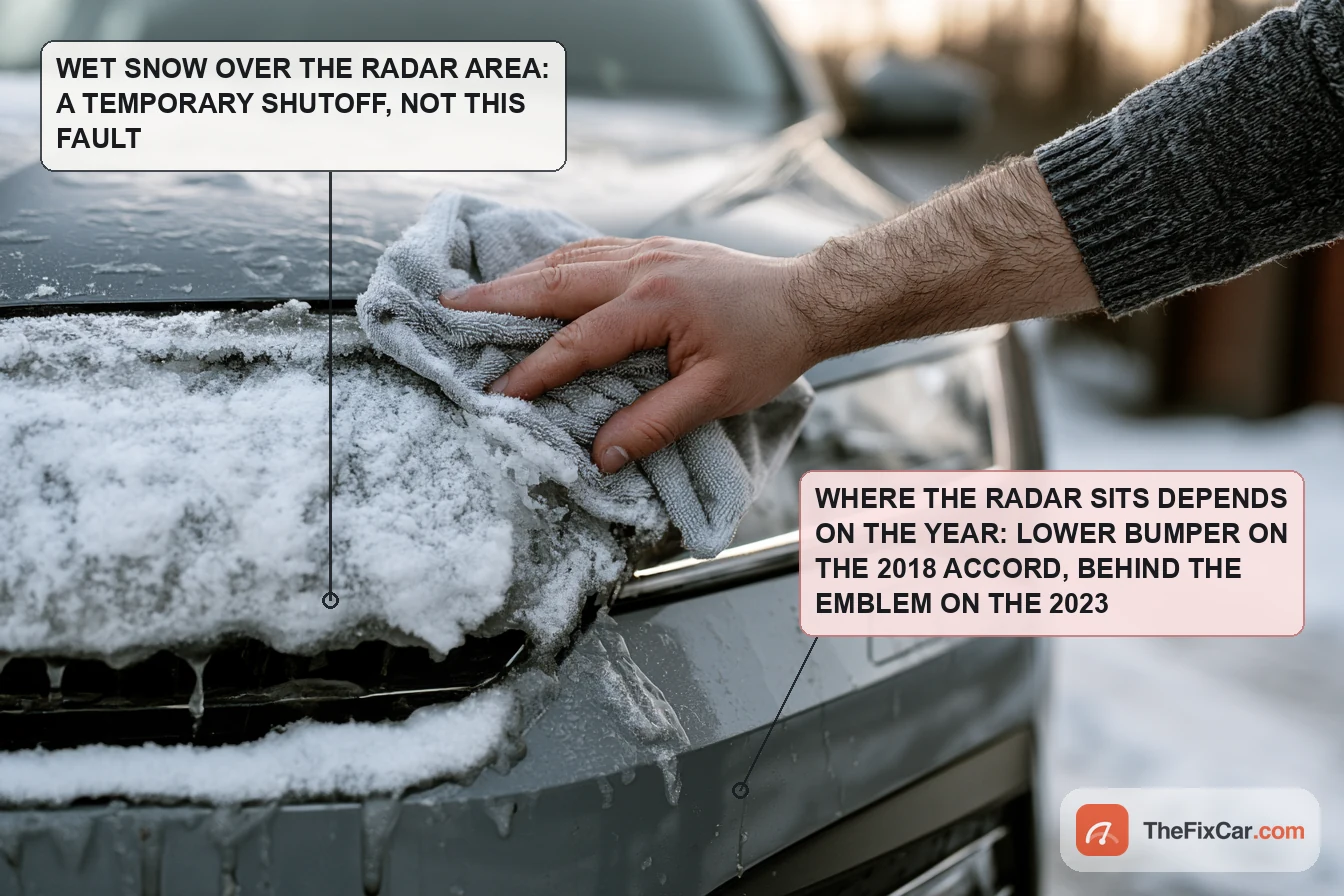
Where the radar sits depends on the year and model. The 2018 Accord manual puts it at the lower part of the front bumper and tells owners not to paint it, put stickers near it, or let a licence-plate frame intrude into the beam.[7] The 2023 Accord Hybrid manual describes the radar as behind the Honda emblem.[8] Wipe the wrong panel and the obstruction stays. The general logic of a blocked forward sensor, and why cleaning it is the check that costs nothing, is covered on the page about the pre-collision “clean sensor” warning; the Honda difference is the wording, because Honda separates a temporary obstruction from a “Problem”.
Misalignment has a history. Honda’s manual warns that lifting or lowering the car may stop the system working,[8] and after collision, bumper, suspension or radar-bracket work the OEM inspection and aiming procedure for that vehicle applies before the code is blamed on the radar unit. On 2017 CR-V EX and above, early-production cars set P2583-76 with no accident at all: Honda traced it to the factory radar aiming process.[4]
Can you reset or clear the message yourself?
Two things a driver can do without a tool: restart once, and after a battery reconnect follow the manual for that year, which on the 2023 Accord means a short drive above 12 mph so that the modules relearn and the amber indicators go out.[8] A message that is gone after a restart is information, not a repair: the 19-051 diagnosis tree lists recovery after an ignition cycle as one of its five conditions.[1]
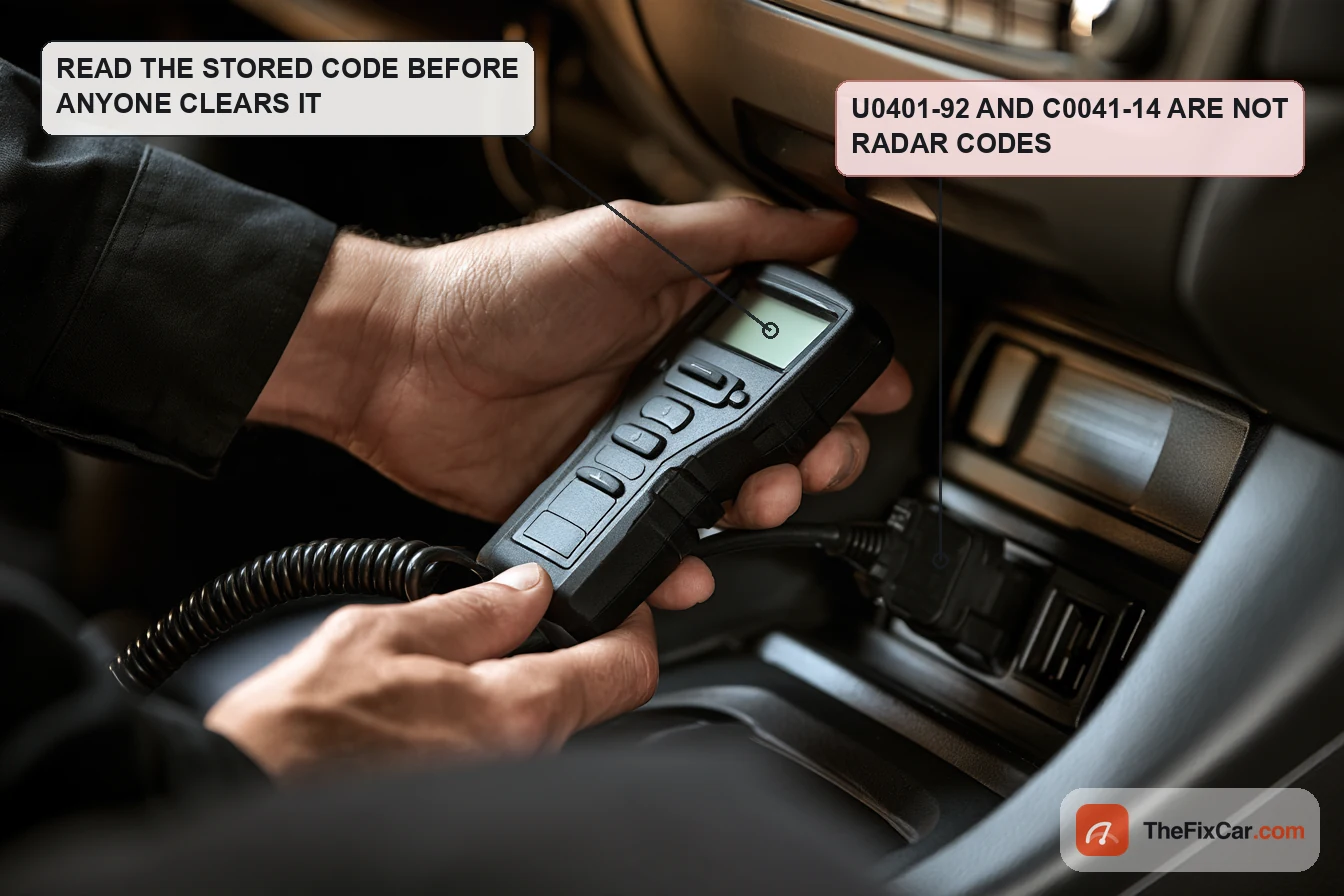
A restart and a scan-tool clear are not the same act. The restart removes the message and leaves the code stored, which is how 19-051 expects to find U0401-92 afterwards; a scan-tool clear erases the code, and with it the evidence that separates the four causes.[1] A generic OBD-II reader may not show the Honda-specific U, C and B codes at all; the bulletins name them from an all-DTC check on Honda’s i-HDS tool. How those codes are built, and why a U-code points at a network message rather than at the radar, is on the ADAS DTC code page.
What not to do: do not disconnect the battery as a reset. On the 2017 CR-V that Honda’s 17-064 covers, a battery disconnect, replacement or jump can set C0051-54, U0416-68 and U0416-92 on its own, adding codes to the problem you started with.[3] Do not turn CMBS off in the settings and call it solved: the 2023 Accord Hybrid manual turns it back on at every start, and on the cars in the 2015 recall the off button was only Honda’s interim advice until the software update.[8][12]
What do the Honda service bulletins say?
Service Bulletin 19-051 is the document with this exact message in it. Symptom: ACC turns off unexpectedly while in use and “Collision Mitigation Braking System problem. See Your Dealer.” appears on the MID. Cause: the PGM-FI software cancels ACC when it detects a conflicting stop-and-go signal. Honda’s diagnosis requires all five conditions at once: ACC was in use, ACC cannot be set again on that drive cycle, the message is on the MID, an ignition cycle restores ACC and removes the message, and an all-DTC check shows only U0401-92. If the PGM-FI software is already at the latest program ID, the bulletin does not apply and normal troubleshooting continues.[1]
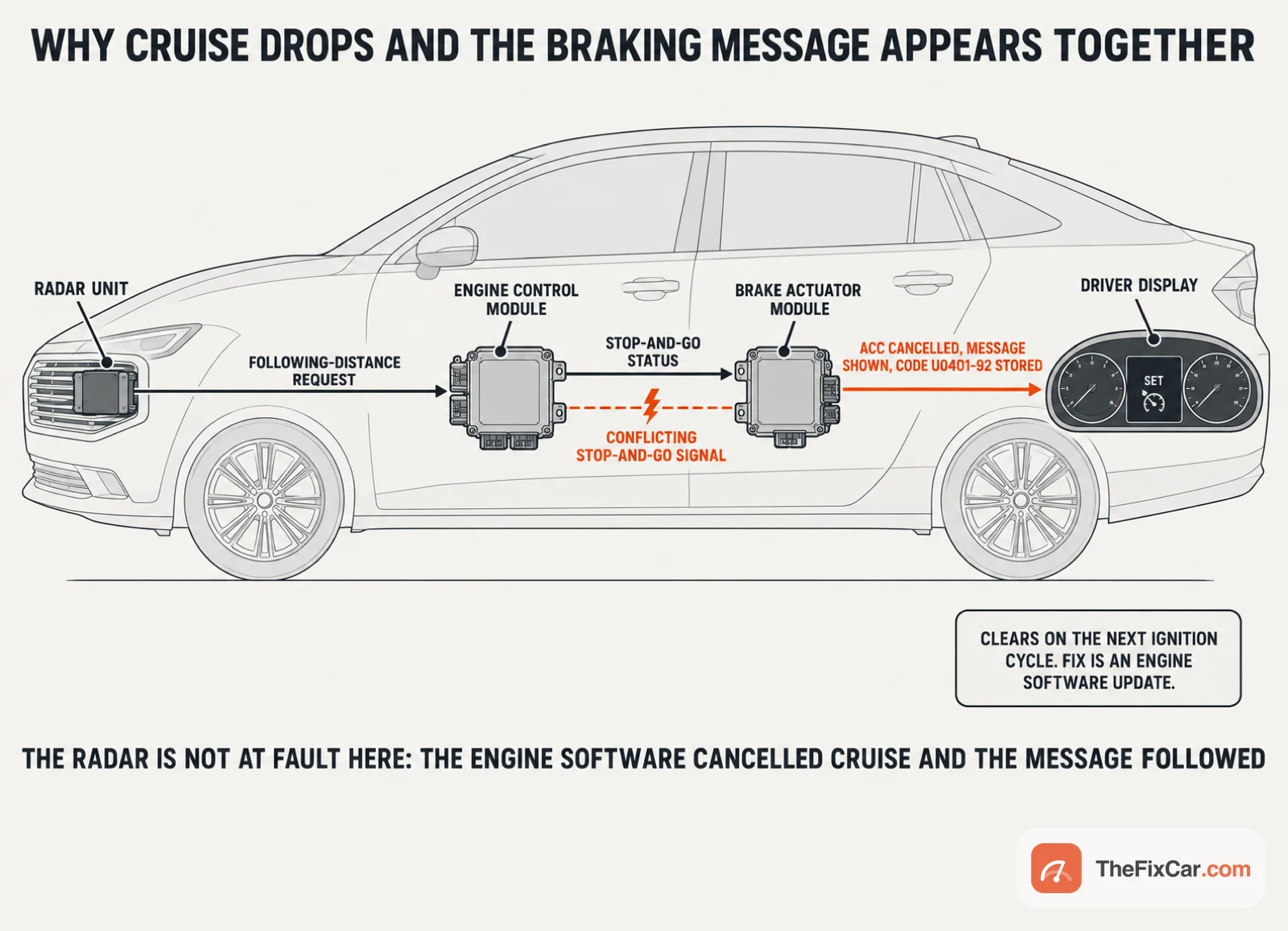
The repair is a PGM-FI software update through i-HDS with the J2534 rewrite application, 0.2 hour under warranty, with program IDs listed per engine and transmission, for the 2018 Accord (all except Hybrid) and 2019 Accord within stated VIN ranges.[1] Acura issued the same bulletin number and the same five-condition tree for the 2019 RDX in September 2019.[2] The radar is not touched in either document.
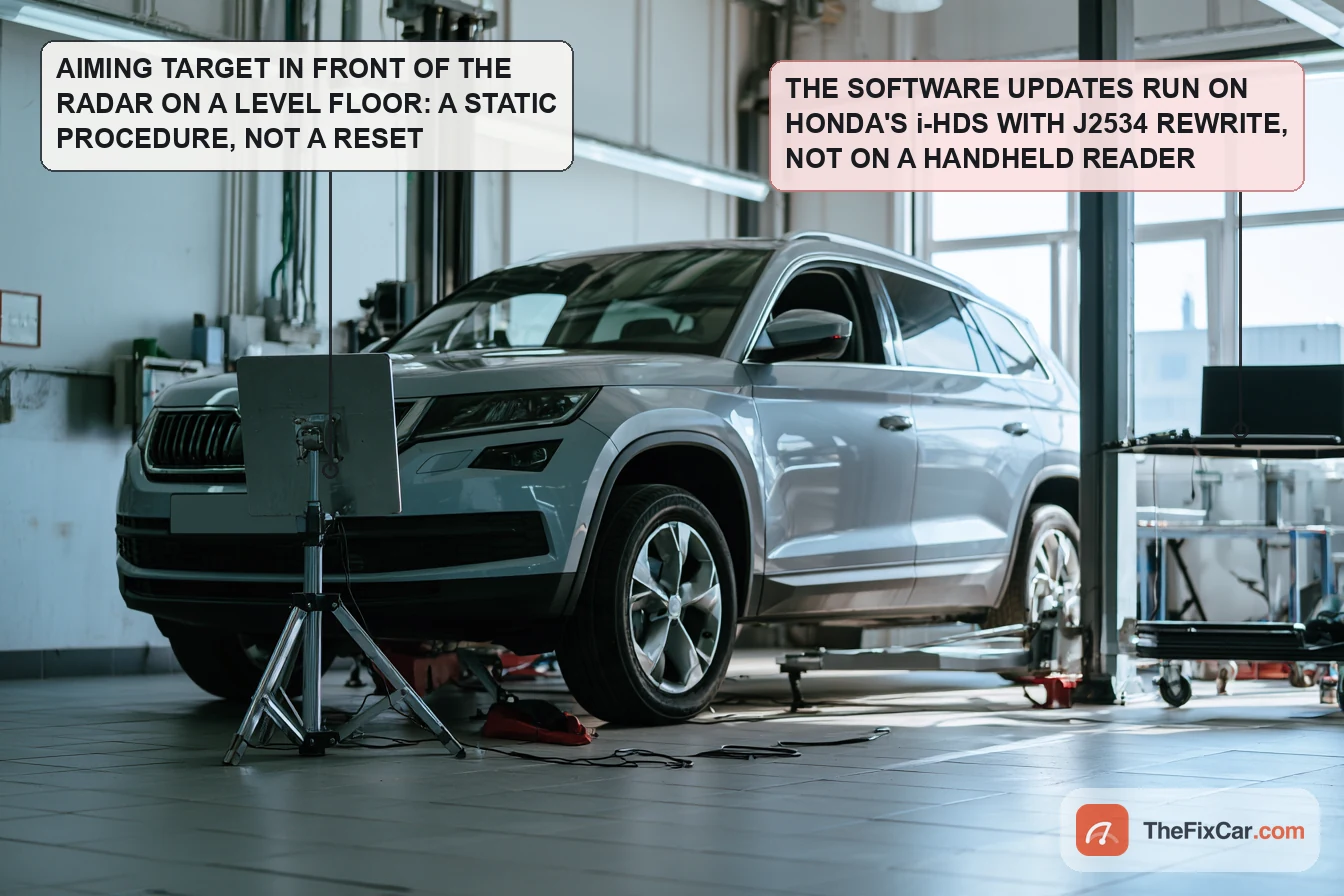
Bulletin 17-064 is the radar-side document, in its third revision from May 2018, which Honda issued to update the VIN ranges. For 2017 CR-V EX, EX-L and Touring within those ranges it lists an internal issue with the millimetre-wave radar software that can produce P2583-76 misalignment, sporadic false “Radar Obstructed” messages in rain, snow or fog, speed hunting on ACC at highway speed, the battery-disconnect codes, B2A60-98 for camera temperature, and U12B7-00 for the radar’s local CAN. The fix is a radar software update, 0.2 hour.[3] If P2583-76 is still present after the update, the radar needs aiming, which is a static procedure with a target: what Honda and other makers require for radar aiming is on the OEM ADAS calibration requirements page.
ServiceNews A20090C is the one with no parts in it. On 2019 to 2020 Civic with the Bosch ADAS unit, a driver resting the left foot on the brake pedal while driving turns on the ACC, CMBS and RDM indicators and sets C0041-14, brake switch signal circuit error. Honda’s advice to the service advisor is to ask about the left foot before writing the repair order; if that is the habit, clear the code and explain the dead pedal, and only otherwise adjust or replace the brake switch.[5]
Which models, years and codes are covered?
The table lists only what a Honda document ties to this message or its indicators. A Pilot, Odyssey or HR-V showing the same words is not excluded from these causes, but it is not covered by these bulletins either: the code names a circuit and a state, and the repair comes from that model’s own service information.
| Vehicle | Code and meaning | Honda document and fix |
|---|---|---|
| 2018 Accord (except Hybrid), 2019 Accord in listed VIN ranges | U0401-92, temporary stop of integrated driver support system | SB 19-051, PGM-FI software update[1] |
| 2019 Acura RDX, listed VIN ranges | U0401-92 | SB 19-051 (Acura), PGM-FI software update[2] |
| 2017 CR-V EX, EX-L, Touring, 2WD and 4WD, within the 17-064 VIN ranges | P2583-76 radar misalignment; C0051-54, U0416-68, U0416-92 after battery events; B2A60-98 camera temperature; U12B7-00 radar local CAN | SB 17-064 Version 3, radar software update, then aiming if P2583-76 remains[3] |
| 2017 CR-V EX and above, early production | P2583-76 from factory aiming | Tech Line ATS 170204, radar aiming[4] |
| 2019 to 2020 Civic with Bosch ADAS unit | C0041-14, brake switch signal circuit error | ServiceNews A20090C, clear code or brake switch[5] |
| 2014 to 2015 Acura MDX and RLX, 2014 RLX Hybrid | No code: CMBS braking for guardrails and fences it misread as obstacles | Recall 15V-301, ACC/CMBS software update, 19,502 vehicles[11][12] |
One NHTSA file belongs next to this message even though it never mentions it. NHTSA opened PE22-003 in February 2022 on 2018 to 2019 Accord and 2017 to 2019 CR-V, about 1,732,000 vehicles, after 278 complaints of the CMBS braking with nothing in the car’s path.[9] In 2024 the agency upgraded it to Engineering Analysis EA24-002 and widened it to 2020 to 2022 models, by then with 1,294 complaints, and noted that many owners were told by dealers that the braking was normal CMBS operation or could not be reproduced.[10] The investigation concerns reported braking, not this message, and it does not establish that one causes the other. A car that has braked by itself with nothing ahead should not be driven on to the diagnosis: write down the event and the warnings, keep the codes unerased, and have it towed or collected.
Can an owner fix this, or is it dealer work?
Owner-side: a wipe of the radar area and of the windshield in front of the camera, without removing the emblem or trim and without solvents the manual does not allow, the restart, the drive above 12 mph after a battery job, and honestly answering the left-foot question. None of these needs a tool. They are first checks: a warning that keeps returning, a temperature-related shutoff or any stored code moves the job to the year-specific manual and a scan tool.[5][8]
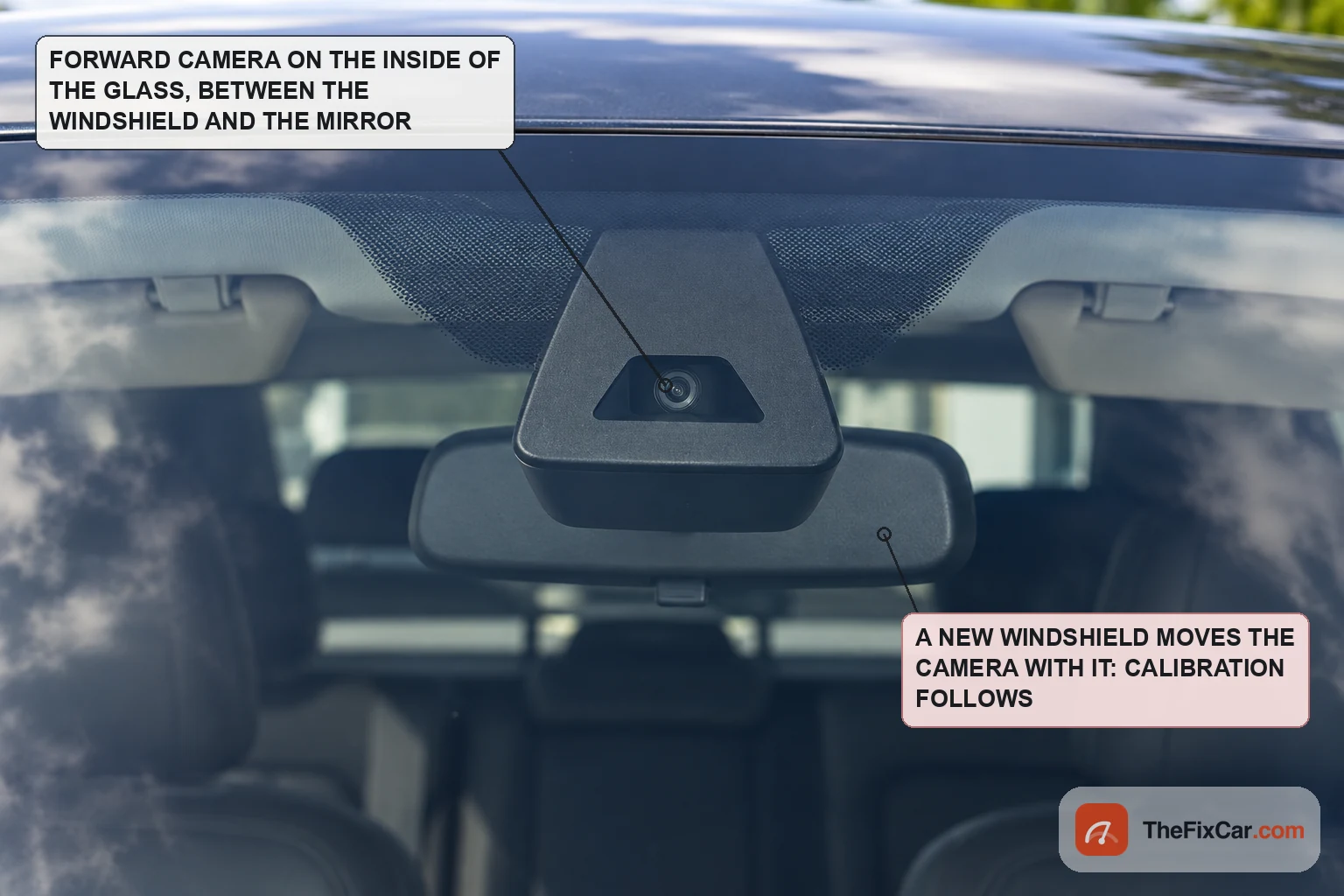
Dealer or an independent with Honda-capable equipment: software programming, radar aiming and any diagnosis past reading the codes. The software updates in 19-051 and 17-064 are done with i-HDS and the J2534 rewrite application on Honda’s MVCI or DST-i interface, with a jumper battery connected for the whole procedure; the bulletins name the tool versions and forbid standalone use.[1][3] Radar aiming follows the OEM procedure for that vehicle, with its specified target, floor and scan tool. The camera is the other half of the system and has its own rule: where it mounts to the windshield, a replacement glass moves it, and the checks that follow are on the page about ADAS calibration after windshield replacement.
Do not order a radar unit from a U0401-92 or a C0041-14. Neither code is the radar. The 19-051 fix is 0.2 hour of software under the bulletin’s flat rate; a radar unit is a part plus an aiming session, ordered from a code that never named it.[1][5]
When should you stop driving?
The message on its own removes an assist that Honda designs as a supplement to the driver; it does not say what else has failed.[6] If the pedal feels normal and there are no other brake-system warnings, the conventional brakes remain available; treat CMBS and ACC as unavailable and arrange diagnosis. The answer changes when other systems join in.
- Stop driving if the brake system warning or “Limited stopping power” message appears with it, or the pedal feels different. The brake actuator communication codes in 17-064 sit on the same network, and a brake warning is never triaged from the driver’s seat.[3]
- Stop driving if the car has braked hard by itself with nothing ahead. That is the behaviour NHTSA has been investigating as a rear-end collision risk, and it is not a nuisance.[9][10]
- Do not use adaptive cruise control until the message is resolved; on the 19-051 cars it will not set anyway, and on the others the fault behind the message may affect it too.[1]
- Do not test the system by driving at an obstacle or a parked car. Honda’s manual says CMBS may not go through all its stages and does not stop the vehicle automatically.[6]
FAQ
What does “Collision Mitigation Braking System Problem. See Your Dealer” mean on a Honda?
The collision mitigation function is off and a fault has been recorded. In Honda’s bulletins the message, or its companion indicators, appear with a cancelled-cruise software code (U0401-92), a radar misalignment code (P2583-76) and a brake switch code (C0041-14), so the message says the assist is off, and the stored code, read against the bulletin for that vehicle, says why.[1][4][5]
Can I drive my Honda with the Collision Mitigation Braking System problem?
If the brake pedal feels normal and there are no other brake-system warnings, the conventional brakes remain available, but treat CMBS and ACC as unavailable and arrange diagnosis.[6] Stop driving if a brake-system warning appears with it, pedal feel changes, or the car has braked by itself.
Why does the message come with the ACC and Road Departure Mitigation warnings?
On the cited vehicles they share sensor inputs and control modules. A radar misalignment on the 2017 CR-V put all three messages on the display at once, and a brake switch signal on the 2019 to 2020 Civic lit all three indicators.[4][5]
Is there a recall for the Honda Collision Mitigation Braking System?
For the Honda Accord and CR-V discussed here, no: EA24-002 is an NHTSA investigation into unexpected braking on the 2017 to 2022 CR-V and 2018 to 2022 Accord, opened in 2024, not a recall, and its current status is on NHTSA’s site.[10] A separate CMBS recall, 15V-301, covered certain 2014 to 2015 Acura MDX and RLX and 2014 RLX Hybrid vehicles for unexpected braking, fixed by a software update.[11] The “Problem” message itself appears in service bulletins, not in a recall.
Will a 2018 Honda Accord Collision Mitigation Braking System problem fix itself?
On a non-hybrid 2018 Accord that meets the five conditions in bulletin 19-051, the message clears with an ignition cycle and comes back the next time the software cancels ACC, until the PGM-FI update is done. Temporary obstructions clear themselves once the sensor is clean; a stored P2583-76 does not, and on the CR-V that 17-064 covers the order is software update first, then aiming if it remains.[1][8]
Does the Honda CMBS radar sit behind the emblem?
On the 2023 Accord, yes: the manual describes the radar sensor behind the Honda emblem. On the 2018 Accord the manual puts it at the lower part of the front bumper. Check the manual for the year before cleaning or fitting anything in front of it.[7][8]