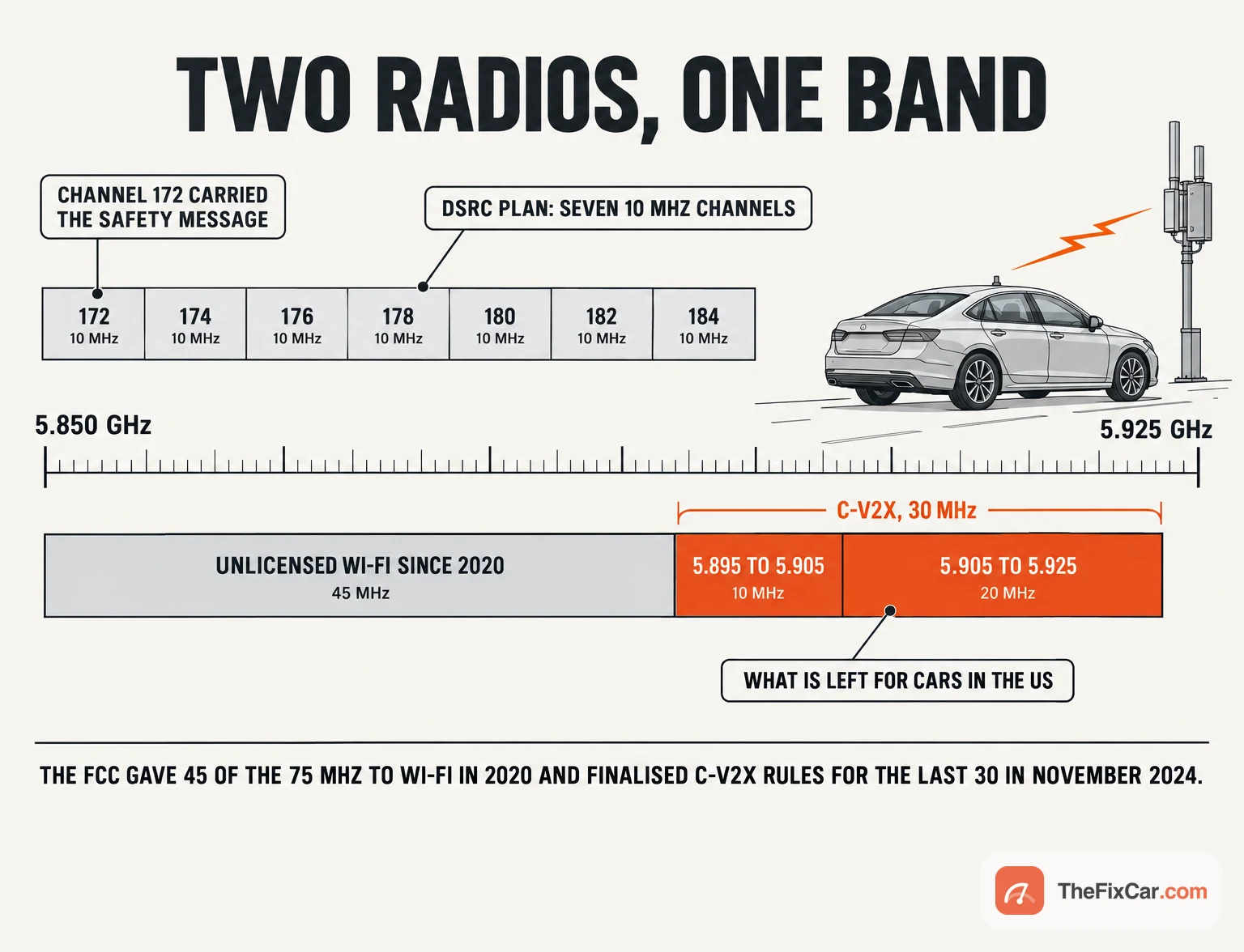
V2X is vehicle-to-everything data exchange: a car talking to other cars, to roadside equipment, to a network or to people on the road. The figures sold as “V2X specs” belong to four different documents and two different radios. The 300 m range and ten-messages-a-second rate come from a 2017 US rulemaking for DSRC that was withdrawn in 2023[2][3]. The 3 ms and 10 ms latency figures come from 3GPP’s requirements for cellular V2X and describe scenarios such as emergency trajectory alignment; the requirement says nothing about the latency of a current production car’s basic warning[4]. The 30 MHz of spectrum comes from the FCC’s 2024 order, after 45 of the original 75 MHz went to Wi-Fi in 2020[1]. And Volkswagen’s Car2X, with more than two million vehicles built, uses a third thing, ITS-G5, a Wi-Fi-derived radio on a different channel plan[7][10].
What follows is the published data, sorted by which document it comes from: the US band plan and power limits the FCC finalised in November 2024, the basic safety message content and rate in NHTSA’s withdrawn 2017 proposal, the latency and range targets 3GPP sets for its named C-V2X scenarios, the European channel and message-rate rules, and what Volkswagen, Cadillac and the US deployment plan say about the hardware that exists.
Quick answer
V2X carries position, speed, heading and similar data between vehicles, roadside units, networks and other road users so that a car can be warned about something its own sensors cannot see; depending on the service it uses a direct radio link, a network path, or both. This page compares the two direct 5.9 GHz radio families. Legacy DSRC and the deployed Release 1 ITS-G5 are based on IEEE 802.11p, and ETSI’s Release 2 extends ITS-G5 with IEEE 802.11bd; for Release 1 ITS-G5, ETSI specifies 10 MHz channels and mandatory rates of 3, 6 and 12 Mbit/s[7][19]. C-V2X comes from 3GPP: LTE-V2X was introduced in Release 14 and NR-V2X completed in Release 16 on 3 July 2020, and both can talk car-to-car over the PC5 sidelink without going through the cellular network[5][6]. In the United States the FCC’s Second Report and Order of 21 November 2024 gives C-V2X the upper 30 MHz of the 5.9 GHz band, 5.895 to 5.925 GHz, and requires DSRC stations to cease two years after the order’s Federal Register publication[1]. In Europe, Volkswagen has built more than two million cars with ITS-G5 Car2X since the 2020 Golf[10][11]. No single “V2X spec” exists: each figure below belongs to the document named in its row.
Verified specifications at a glance
| Document or vehicle | Specification | Conditions | Primary source |
|---|---|---|---|
| FCC, 5.9 GHz band, First Report and Order (Nov 2020) | Lower 45 MHz (5.850 to 5.895 GHz) reallocated to unlicensed use; upper 30 MHz (5.895 to 5.925 GHz) kept for ITS; ITS use of the lower part prohibited from 5 July 2022 | United States | FCC 24-123 background[1] |
| FCC 24-123, Second Report and Order (adopted 21 Nov 2024), RSU channels | Channel 180 (5895 to 5905 MHz) 23 dBm; channel 182 (5905 to 5915) 23 dBm; channels 180/182 combinable into 20 MHz channel 181 at 23 dBm; channel 184 (5915 to 5925) 33 dBm, 40 dBm for public-safety entities | Maximum EIRP for a roadside unit with antenna height not exceeding 8 m above the roadway | FCC 24-123, rule text for 47 CFR 90.377[1] |
| FCC 24-123, RSU antenna height | 8 m at full power; up to 15 m with EIRP reduced by 20 log(Ht/8) dB | Height of the antenna’s radiation centre above the roadway bed | FCC 24-123[1] |
| FCC 24-123, DSRC sunset and message priority | DSRC stations must cease operating in 5895 to 5925 MHz two years after publication; no new DSRC licences 60 days after; priority order safety-of-life, public safety, non-priority | Federal Register publication of the order | FCC 24-123[1] |
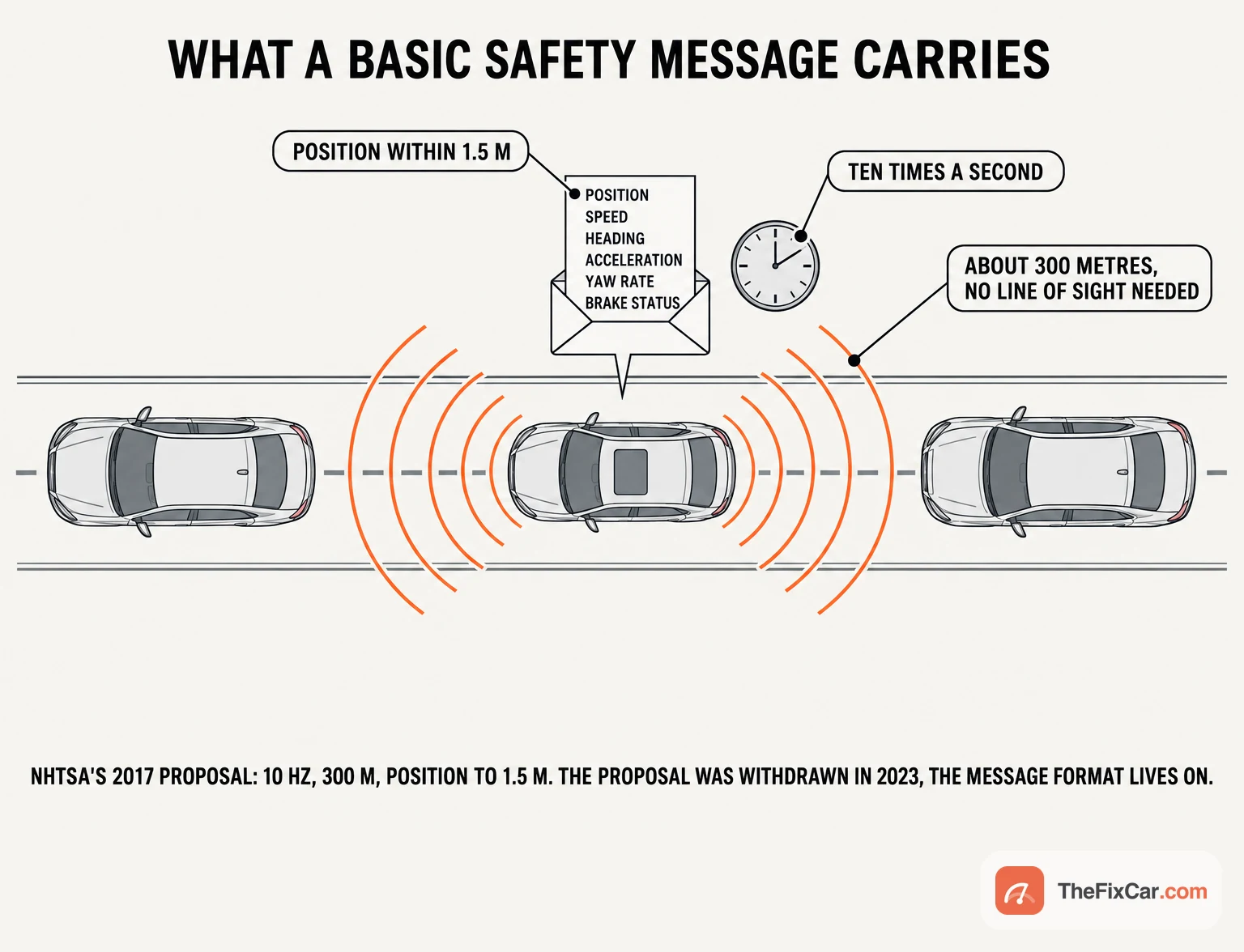
| NHTSA proposed FMVSS No. 150 (NPRM of 12 Jan 2017), basic safety message | Transmitted 10 times per second; operational range 300 m or farther; on DSRC channel 172 at 6 Mbps | Non-congested conditions; proposal for new light vehicles | NHTSA NPRM, 82 FR 3854[2] |
| NHTSA proposed FMVSS No. 150, position and time | Longitudinal and lateral position within 1.5 m, elevation within 3 m; time within ±1 ms of UTC; BSM position data no older than 150 ms at transmission | HDOP below 5, 1-sigma absolute error | NHTSA NPRM, S5.1.3 and BSM timing requirements[2] |
| NHTSA, V2V proposal withdrawn | The 2017 proposal was withdrawn, citing the arrival of LTE C-V2X and the FCC’s decision on the 5.850 to 5.895 GHz band | Withdrawal scheduled for Federal Register publication on 20 Nov 2023 | NHTSA withdrawal notice[3] |
| 3GPP TS 22.186 (Rel-19), cooperative collision avoidance | Max end-to-end latency 10 ms; reliability 99.99%; 100 messages/s; 2000-byte payload; data rate 10 Mbps | Between vehicles supporting V2X applications | ETSI TS 122 186 V19.0.0, Table 5.3-1[4] |
| 3GPP TS 22.186, emergency trajectory alignment | Max latency 3 ms; reliability 99.999%; data rate 30 Mbps; minimum range 500 m | Between vehicles supporting V2X applications | ETSI TS 122 186, Table 5.3-1[4] |
| 3GPP TS 22.186, information sharing for automated driving, lower degree of automation | Max latency 100 ms; 6500-byte payload; 10 messages/s; minimum range 700 m | Vehicle to vehicle, or vehicle to RSU | ETSI TS 122 186, Table 5.3-1[4] |
| 3GPP TS 22.186, sensor information sharing, lower degree of automation | Max latency 100 ms; reliability 99%; 1600-byte payload; 10 messages/s; minimum range 1000 m | Extended sensors between vehicles | ETSI TS 122 186, Table 5.4-1[4] |
| 3GPP TS 22.186, remote driving | Max latency 5 ms; reliability 99.999%; uplink 25 Mbps, downlink 1 Mbps; vehicle speed up to 250 km/h | Between a vehicle and a V2X application server | ETSI TS 122 186, Table 5.5-1[4] |
| ETSI EN 302 663 V1.3.1, ITS-G5 physical layer | OFDM “half-clocked” operation in 10 MHz channels per IEEE 802.11-2016 clause 17; mandatory transfer rates 3, 6 and 12 Mbit/s | European ITS-G5 access layer; safety-related band 5 875 to 5 905 MHz per Commission Decision 2008/671/EC | ETSI EN 302 663[7] |
| ETSI EN 302 637-2 V1.4.1, Cooperative Awareness Message | Generation interval not below 100 ms (10 Hz) and not above 1 000 ms (1 Hz); a new CAM is triggered when heading has changed by more than 4°, position by more than 4 m or speed by more than 0.5 m/s | Vehicle ITS station; DCC may lengthen the interval on ITS-G5 | ETSI EN 302 637-2[8] |
| USDOT National V2X Deployment Plan (Aug 2024), 2028 targets | V2X on 20% of the National Highway System; 25% of signalised intersections in the top 75 metro areas; two OEMs committed to 5.895 to 5.925 GHz capable vehicles by model year 2028 | Short-term goals 2024 to 2028 | USDOT plan[9] |
| USDOT National V2X Deployment Plan, 2036 targets | Full National Highway System; 85% of signalised intersections in the top 75 metros; 75% of the nation’s intersections; six OEMs with capable production vehicles; 20 V2X-capable models | Long-term goals 2032 to 2036 | USDOT plan[9] |
| Volkswagen, Car2X (ITS-G5) | Standard on the eighth-generation Golf presented 24 Oct 2019; more than two million vehicles produced with Car2X by 27 Oct 2025; direct vehicle-to-vehicle and vehicle-to-infrastructure communication without a mobile network | European market; Autobahn GmbH has equipped over 1,000 roadworks trailers | Volkswagen Newsroom[10][11] |
| Cadillac CTS 2017, V2V (DSRC) | Standard in the US and Canada; transmits and receives up to 1,000 messages per second from vehicles up to 300 m (1,000 ft) away | DSRC per IEEE 802.11p with GPS; supplier statement | Cohda Wireless[12] |
Note: these are the published values for the named documents and vehicles, not a universal table. The message rate a given car uses, and the radio it uses, come from that car’s own documentation.
What these numbers do NOT mean
- The 10 Hz and 300 m figures are from a proposed US standard that never became law. They remain the reference figures people quote for DSRC-based V2V, not a requirement on any new car[2][3].
- The 3 ms, 5 ms and 10 ms latencies are 3GPP service requirements for specific automated-driving scenarios. They say what the system shall support, not what a production car with a Release 14 modem achieves today[4].
- The FCC channel table is for roadside units. On-board unit power was handled through waivers during the transition, and the order’s discussion of a 33 dBm EIRP limit with a 27 dBm limit within ±5° of horizontal near federal radar sites should be read from the order itself, not from this summary[1].
- ETSI’s 5 875 to 5 905 MHz safety band and the FCC’s 5 895 to 5 925 MHz block overlap but are not the same allocation. An ITS-G5 radio and a C-V2X radio cannot exchange messages directly because their air interfaces differ, and even two units of the same family also need matching regional profiles, channel configuration, security credentials and message support[7][1].
Two radios: DSRC/ITS-G5 and C-V2X
Legacy DSRC in the United States and Release 1 ITS-G5 in Europe use the same IEEE 802.11p-based approach: an IEEE 802.11 radio run “half-clocked” in 10 MHz channels so that it tolerates the Doppler shift and multipath of two cars closing at highway speed. ETSI’s access-layer standard makes 3, 6 and 12 Mbit/s mandatory and specifies receiver sensitivity per rate, for example −85 dBm at 6 Mbit/s QPSK in the presence of interference[7]. On top of that layer sit the message standards: SAE J2735 for the message set in North America[15], ETSI EN 302 637-2 for the Cooperative Awareness Message in Europe[8].
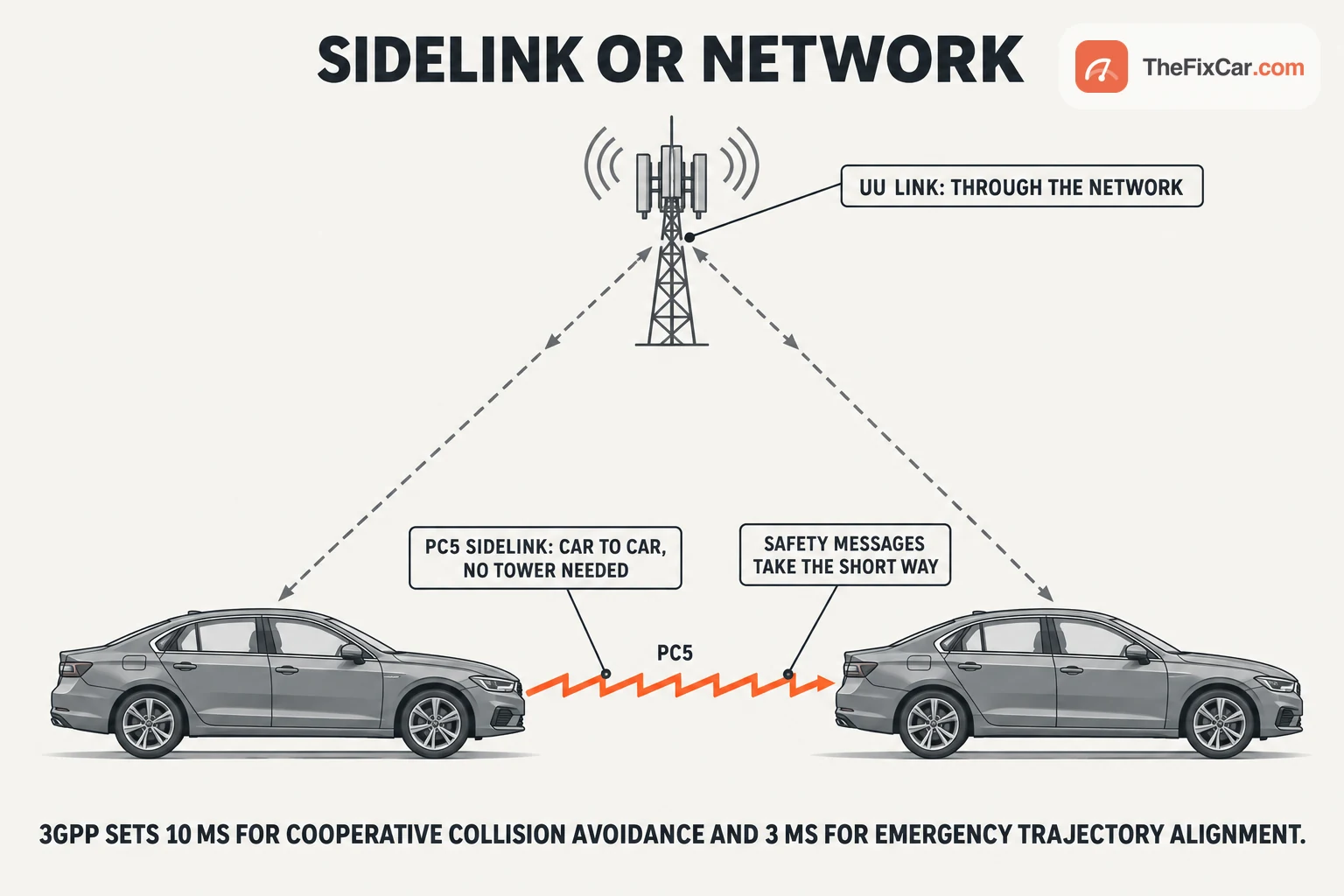
C-V2X is the 3GPP radio family. 3GPP introduced V2X in Release 14, with vehicle-to-vehicle as the headline feature[5], and completed Release 16, the release the FCC’s order refers to for enhanced 5G capabilities, on 3 July 2020[6]. PC5 is its direct sidelink: a radio link between two cars, or between a car and a roadside unit, that works without relying on a cellular base station or an active network connection, and that is where time-critical direct applications sit. Uu is the network interface through a base station, used for network-assisted V2X services. SAE’s J3161/1 profiles the basic safety message over “PC5 Sidelink V2X (mode 4)” as defined in Release 14[17], which is why the same J2735 message can ride either radio.
The European documents cited above are the Release 1 texts that the deployed Volkswagen fleet was built to. ETSI has since published Release 2: EN 303 797 V2.1.1 of February 2024 is the ITS-G5 access layer for Release 2, built on IEEE 802.11-2020 and its 802.11bd-2022 extension, EN 303 798 V2.1.1 of August 2024 is the access-layer specification for LTE-V2X and NR-V2X in the same 5 GHz band, and TS 103 900 V2.3.1 of May 2026 is the Release 2 Cooperative Awareness Service[19][20][21]. The Release 1 figures on this page describe what is on the road; the Release 2 texts describe what new equipment is being specified against.
The basic safety message: what is in it and how often
NHTSA’s 2017 proposal is still the clearest public statement of what a V2V broadcast contains, because it was written as a performance standard. Each basic safety message carries position, speed, heading, acceleration, yaw rate and brake status[2]. The proposed rule set the rate at 10 times per second under non-congested conditions, the operational range at 300 m or farther, “nearly double the detection distance afforded by some current and near-term vehicle-resident systems”, and the channel at 172, with a dedicated radio at 6 Mbps. Position had to be within 1.5 m laterally and longitudinally and 3 m in elevation at an HDOP below 5, the timestamp within ±1 ms of UTC, and the position data in a message no older than 150 ms when sent[2].
Europe’s rough functional analogue is the Cooperative Awareness Message; CAM and the North American BSM are different message definitions, not two encodings of one. The CAM rate is adaptive rather than fixed. ETSI EN 302 637-2 bounds the generation interval between 100 ms and 1 000 ms, that is, between 10 Hz and 1 Hz, and within those bounds a new message is triggered when, since the last one, heading has changed by more than 4°, position by more than 4 m or speed by more than 0.5 m/s[8]. So a car crawling in a jam can drop to one message a second and a car braking hard on a motorway can reach ten; on ITS-G5 the decentralised congestion control can stretch the interval further when the channel is busy[8].
The 2017 Cadillac CTS carried DSRC V2V as standard in the US and Canada; its supplier describes the DSRC-and-GPS system transmitting and receiving as many as 1,000 messages per second from other vehicles as far as 300 m away[12]. NHTSA withdrew the mandate proposal in November 2023, naming two reasons: the arrival of LTE C-V2X as an alternative to DSRC, and the FCC’s reallocation of the lower 45 MHz of the band[3]. The message format outlived the mandate.
The 5.9 GHz band: what the FCC left for cars
The 2020 reallocation and the 2024 order rewrote the US V2X spectrum rules. Until 2020 the 5.850 to 5.925 GHz band held seven 10 MHz DSRC channels, 172 through 184, with channel 172 reserved for safety-critical messages[2]. On 18 November 2020 the FCC reallocated the lower 45 MHz to unlicensed use and kept 30 MHz for ITS, with ITS use of the lower part prohibited from 5 July 2022[1][3]. The Second Report and Order, FCC 24-123, adopted on 21 November 2024, then wrote the C-V2X rules for what remained[1].
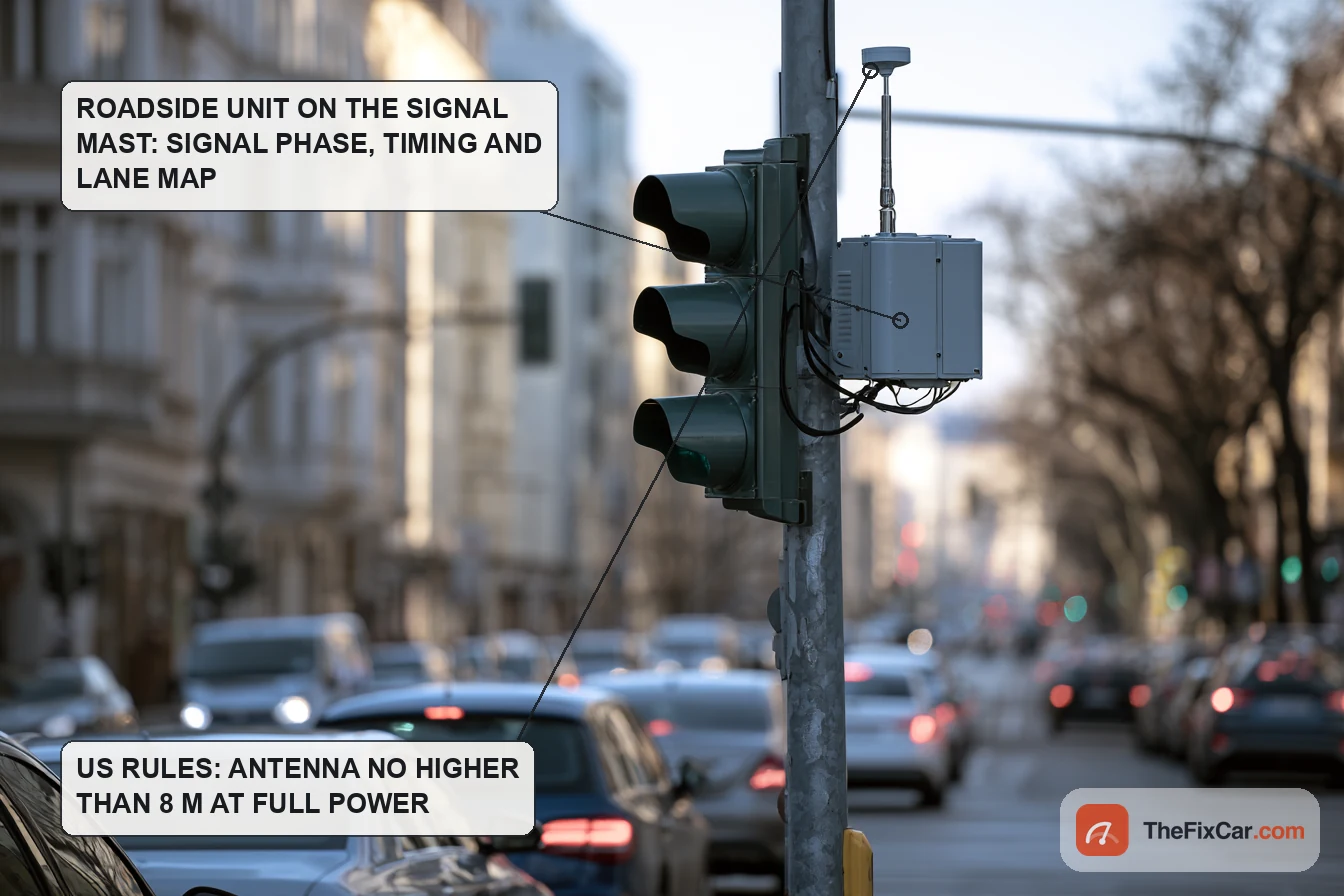
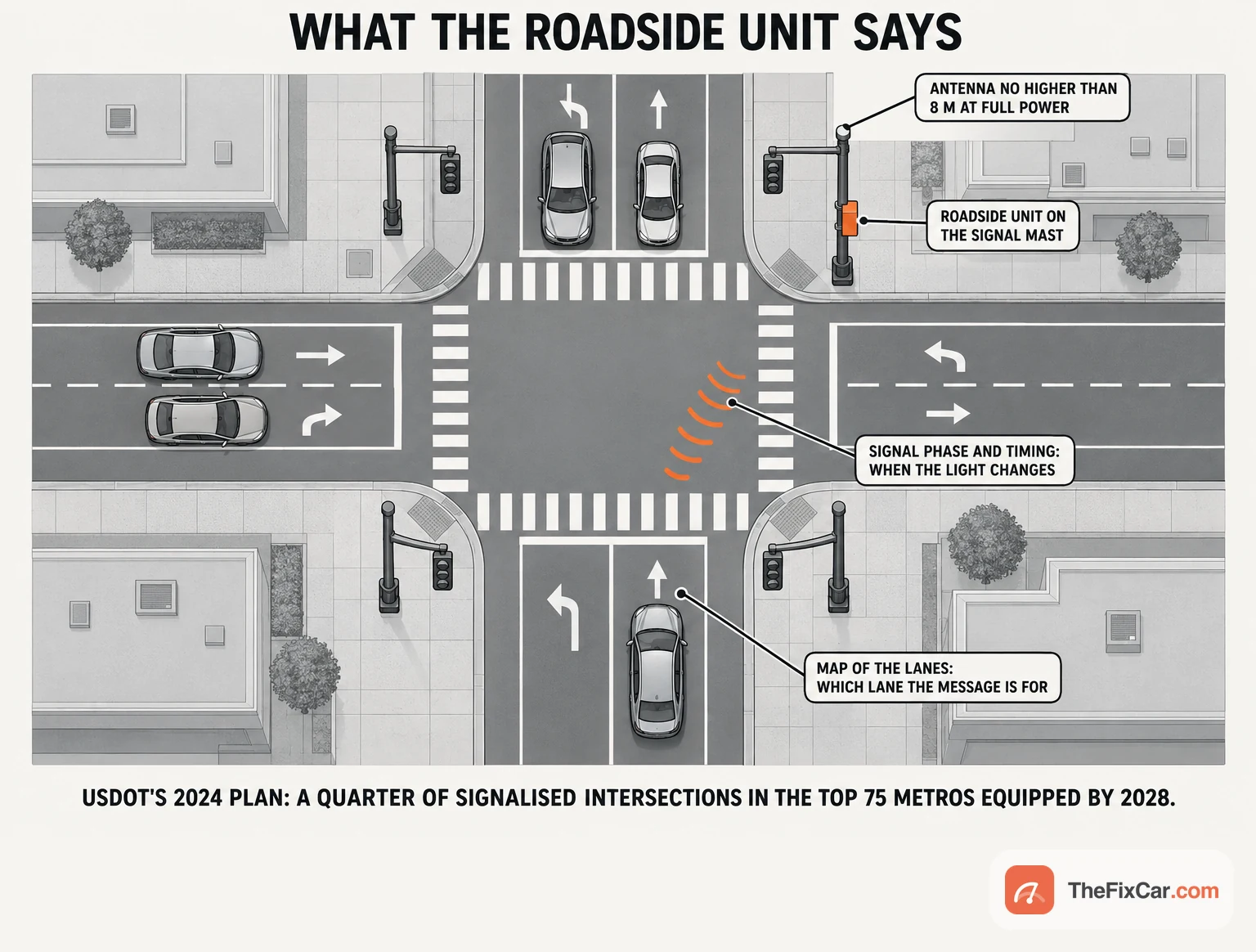
For roadside units the order’s table is specific. Channel 180 at 5895 to 5905 MHz and channel 182 at 5905 to 5915 MHz are each limited to 23 dBm EIRP; the two can be combined into a 20 MHz channel 181, also at 23 dBm; channel 184 at 5915 to 5925 MHz is designated for safety-of-life public-safety use at 33 dBm, or 40 dBm for public-safety entities. Those limits apply with the antenna no more than 8 m above the roadway; an antenna up to 15 m is allowed if EIRP is cut by 20 log(Ht/8) dB[1]. The order carries over the DSRC priority hierarchy, safety-of-life first, then public safety, then everything else, and sets the sunset: DSRC stations must cease operating in the band two years after the order’s Federal Register publication, and no new DSRC licences are issued after 60 days[1].
The European allocation cited by ETSI is different. Its ITS-G5 standard rests on Commission Decision 2008/671/EC, which harmonised 5 875 to 5 905 MHz for safety-related ITS, and refers to the CEPT decisions covering 5 875 to 5 925 MHz[7]. What the EU did split was the technology choice. The Commission’s 2019 delegated act on cooperative ITS drew legal objections from member states in April 2019[13], and the Council objected to it on 8 July 2019, as the cellular industry’s association reported when it welcomed the decision as a vote for technology neutrality between ITS-G5 and C-V2X[14]. Volkswagen went ahead with ITS-G5 anyway.
Latency and range: what 3GPP actually promises
The C-V2X latency numbers are service requirements, and 3GPP TS 22.186 lists them per scenario, with payload, rate, latency, reliability and range in a table for each use-case family. Cooperative collision avoidance between two vehicles: 2000-byte messages at 100 per second, 10 ms end-to-end latency, 99.99% reliability, 10 Mbps. Emergency trajectory alignment: 3 ms, 99.999%, 30 Mbps, 500 m minimum range. Information sharing for automated driving at a lower degree of automation: 100 ms, 6500 bytes, 700 m[4]. Extended sensors, where one car shares what its own sensors see, ask for 100 ms and 1000 m at the lower degree of automation, and 3 ms with 99.999% reliability for the imminent-collision case[4]. Remote driving through a server is specified at 5 ms, 99.999%, 25 Mbps up and 1 Mbps down, at vehicle speeds up to 250 km/h[4].
The table states requirements, not measured production-car performance. The 3 ms figures belong to the most demanding automated-driving scenarios, and the specification says the system “shall support” them; nothing in it says a 2026 production car with a Release 14 modem meets them. And the minimum ranges, 500 m for trajectory alignment, 700 m for information sharing, 1000 m for sensor sharing, are computed at 130 km/h and describe what an application needs, not what a given antenna on a given bumper delivers[4]. The 300 m of the DSRC proposal was an operational range for one message on one channel; the 3GPP ranges are per use case. Comparing them across the two documents is comparing different questions.
Roadside units: what the infrastructure says back
A roadside unit on a signal mast is the vehicle-to-infrastructure half of V2X, and it is where the USDOT plan puts its numbers. “Saving Lives with Connectivity”, published in August 2024, sets 2028 targets of V2X on 20% of the National Highway System, 25% of signalised intersections in the top 75 metro areas V2X-enabled, 12 interoperable deployments, 20 grants across at least ten states using the 5.895 to 5.925 GHz band, and two OEMs committed to capable vehicles by model year 2028. The 2031 goals double the highway and intersection shares to 50%, and the 2036 goals are the full National Highway System, 85% of top-75-metro signalised intersections, 75% of the nation’s intersections, six OEMs with capable production vehicles and 20 V2X-capable models[9].
The plan also records how deployment started before the rules were final: the FCC granted 14 waiver requests in April 2023, 17 in August 2023, 8 in November 2023 and 11 in April 2024 to state departments of transportation and others, all in the upper 30 MHz[9]. In Europe the same role is played by roadworks trailers and motorway roadside units broadcasting ITS-G5: Volkswagen’s 2025 release counts more than 1,000 Autobahn GmbH trailers in Germany and roadside units across the Austrian motorway network, sending warnings about wrong-way drivers, jams, obstacles and weather to cars that can hear them[10].
What V2X adds to the sensors a car already has
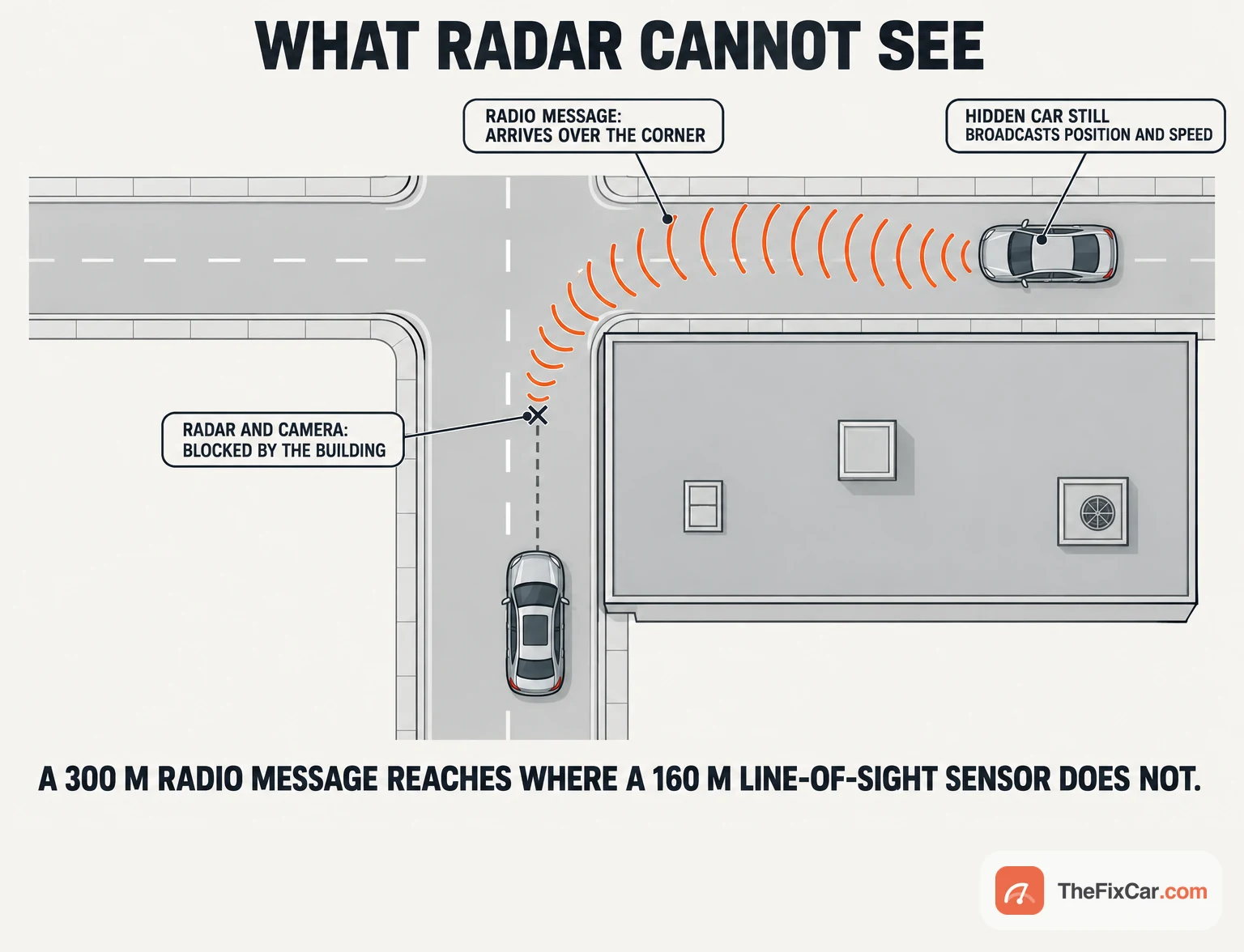
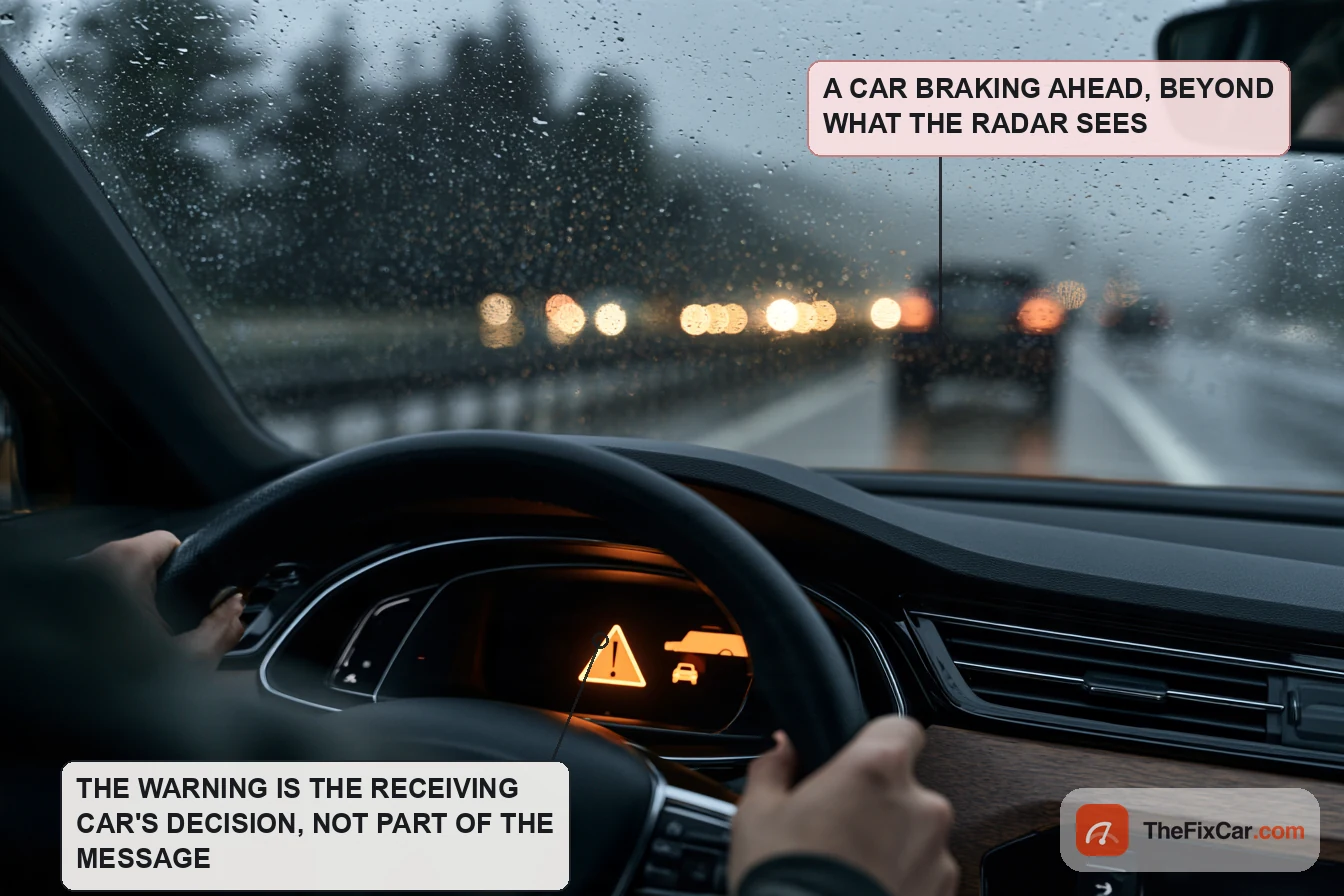
Sensor-based driver assistance sees by line of sight; maps and connectivity are the inputs that do not. The forward radars listed on our Bosch ADAS hardware page, the MRR4 at up to 160 m and the LRR4 at up to 250 m, are quoted for detection along that line of sight, and an object behind a building at a junction or behind a truck in the lane is outside it. A V2X message can carry information from beyond that line when both ends are equipped and the link is available. That was NHTSA’s argument for the 300 m range in 2017, “nearly double the detection distance” of onboard sensors, and it is the argument Volkswagen makes for Car2X when a car ahead brakes hard or an emergency vehicle approaches out of sight[2][10].
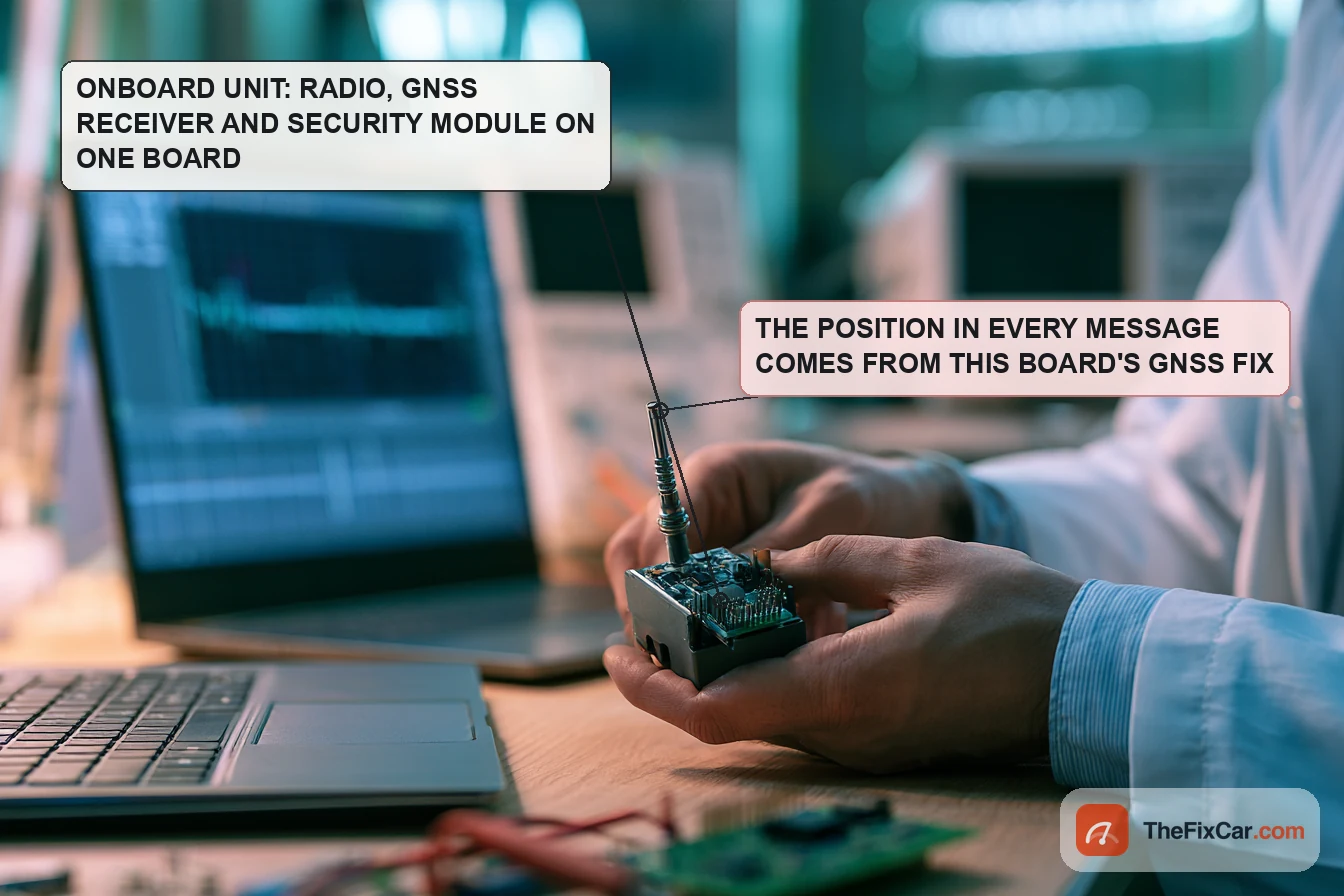
What V2X does not add is a decision. The message carries location, speed, heading, brake status and the other defined fields; whether that becomes a warning, a sensor-fusion input or a trigger for automatic braking depends on the receiving car’s architecture and software. On a car that reports a pre-collision system malfunction, that is the same software the message would have to go through. And the message is only as good as its position: the NHTSA proposal set 1.5 m horizontal accuracy under its stated test conditions because lane-level interpretation depends on it, and what a receiving system does with a worse fix is that system’s design[2].
What production cars actually carry
Volkswagen’s is the deployment with published numbers. It made Car2X standard on the eighth-generation Golf, presented on 24 October 2019 and on sale that December, using what the company calls “Wi-Fi p”, the ITS-G5 standard harmonised across the EU[11]. By 27 October 2025 it had produced more than two million vehicles with Car2X, offered as the “traffic hazard alert assist” across numerous models, partly standard and partly optional, warning of jams, accidents, roadworks and approaching emergency vehicles through direct communication “without requiring a mobile network”[10].
North America has the earlier start. The 2017 Cadillac CTS carried DSRC V2V as standard in the US and Canada[12]. Ford announced in January 2019 that it would deploy C-V2X on all new US models from 2022[18]; by the time the FCC finalised the C-V2X rules in November 2024, Ford was filing comments asking for a 33 dBm EIRP limit for on-board units to “provide broader coverage including emergency/public safety vehicles”[1]. The USDOT plan’s target for OEM commitment is two manufacturers by model year 2028, a target rather than a count[9]. Whether a given 2026 car carries a 5.9 GHz radio is a question for its feature documentation, build data or service information, not for this page.
How to use these values
- Quote the document with the number. “300 m” is NHTSA 2017; “3 ms” is 3GPP TS 22.186 for emergency trajectory alignment; “23 dBm” is an FCC roadside-unit limit on channel 180. Mixing them implies a single tested configuration that does not exist.
- Check which radio a car or a roadside unit uses before assuming it can hear another. The Volkswagen deployment is ITS-G5 and the FCC allocation is for C-V2X; two units also need matching profile, channel configuration, credentials and message support.
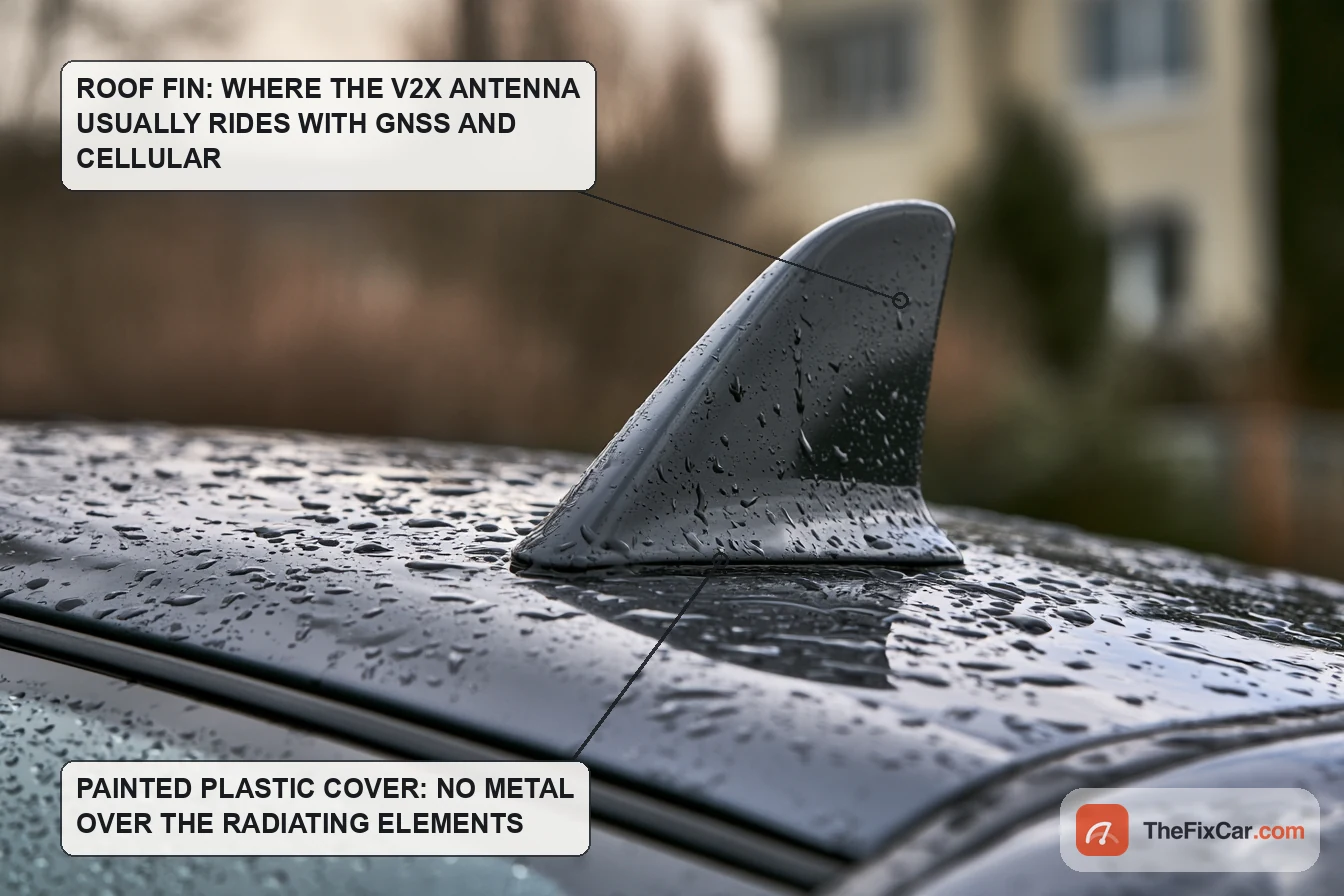
- For a car that reports a V2X or Car2X fault, treat it like any other ADAS code: the code names a condition, not a part, and the checks the OEM procedure walks through run from power, ground, wiring and connectors to the antenna and its cable, the GNSS input, configuration or software, and only then the module.
FAQ
What is the difference between V2X and C-V2X?
V2X is the general term for vehicle-to-everything communication over any radio. C-V2X is the 3GPP cellular version, introduced in Release 14 and extended in Release 16, whose PC5 sidelink lets cars talk directly without a network[5][6]. DSRC and ITS-G5 are the older IEEE 802.11p-based alternative[7].
How far does V2X reach?
The US DSRC proposal specified an operational range of 300 m or farther[2]; the 2017 Cadillac’s supplier quotes 300 m[12]; 3GPP’s requirements ask for 500 to 1000 m depending on the scenario, calculated at 130 km/h[4]. Real range depends on the antenna, the power limit and what is between the two radios.
How fast is a V2X message?
A basic safety message is sent 10 times a second under the US proposal[2]; a European CAM between once and ten times a second under its movement triggers and congestion-control rules[8]. End-to-end latency targets in 3GPP run from 100 ms for information sharing down to 3 ms for emergency trajectory alignment[4].
Is V2X mandatory anywhere?
Not by US federal rule: NHTSA withdrew its V2V mandate proposal in November 2023[3]. Not by EU-level act either: the Council objected to the Commission’s C-ITS delegated act in July 2019[14], which says nothing about individual countries elsewhere. In both places deployment runs on manufacturer choice and public-agency funding[9][10].
Which frequency does V2X use?
In the US, 5.895 to 5.925 GHz under the FCC’s 2024 rules, after the lower 45 MHz of the old 5.850 to 5.925 GHz band went to unlicensed use in 2020[1]. In Europe, ITS-G5 operates in the 5.9 GHz ITS band with 5 875 to 5 905 MHz harmonised for safety-related applications[7]. Those are the direct-link allocations; network-based C-V2X services run over ordinary cellular spectrum.
Sources & verification
Last technically reviewed: Sep 2026
Reviewed by: Jamie Kowalski, Vehicle Safety Editor
Primary references: FCC order and rule text, NHTSA rulemaking documents, 3GPP and ETSI technical specifications, the USDOT deployment plan, manufacturer press releases and SAE standard scopes
Suggested citation: TheFixCar, “V2X and C-V2X Specs: Vehicle-to-Vehicle, Infrastructure and Road-Safety Communication,” updated Sep 2026. https://thefixcar.com/specs/v2x-c-v2x-specs/