Caliper work splits into four jobs that get treated as one: looking at it, servicing the parts that move, rebuilding the hydraulic end, and replacing the unit. Which one you need is often decided before the wheel comes off, and decided on the wrong evidence. A caliper that pushes back on the bench is not proof of a healthy caliper, and a pin that slides in your hand says nothing about the piston beside it.
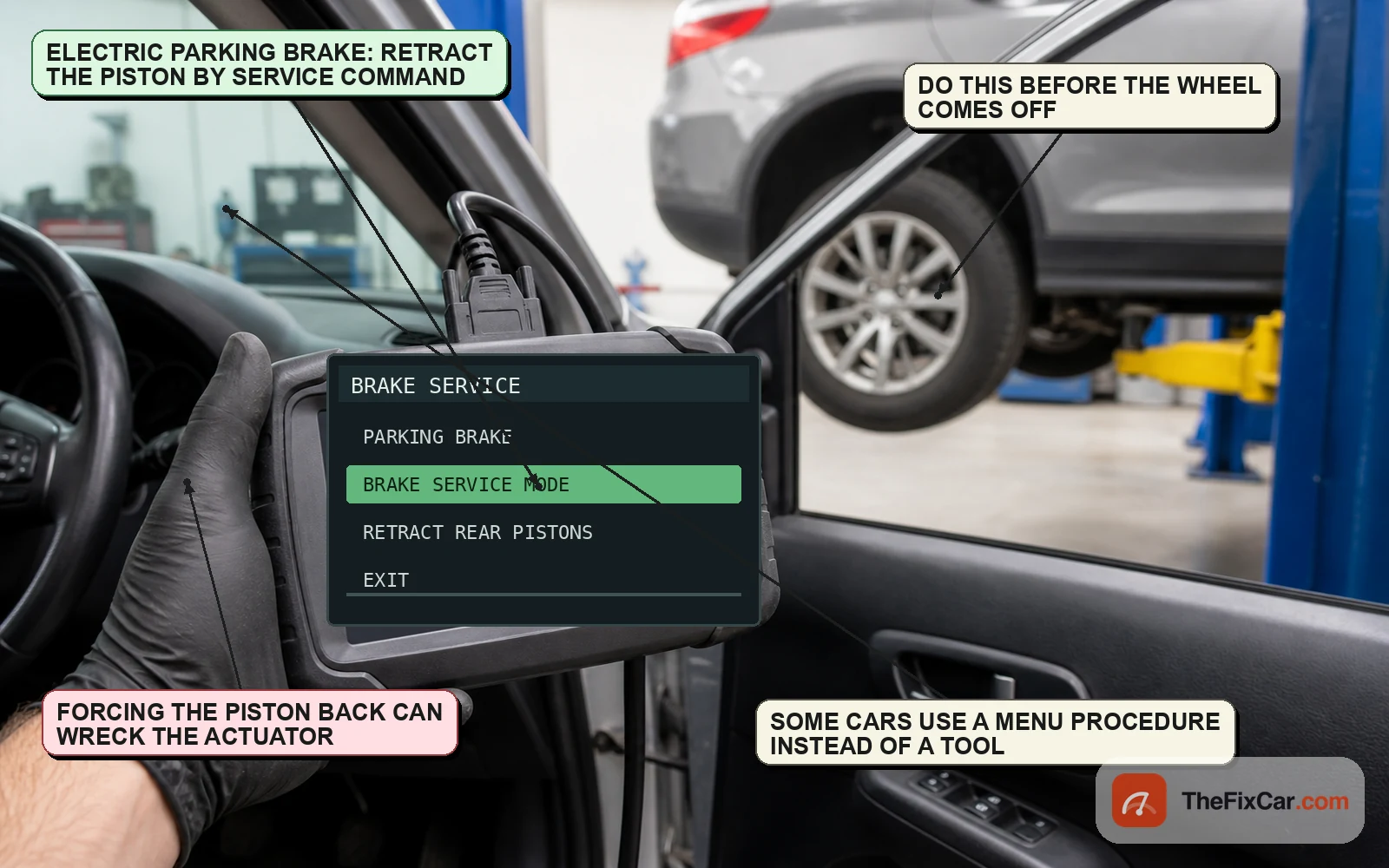
One step outranks the rest on many modern cars. Where the rear caliper carries an electric parking brake, the piston is normally retracted through a manufacturer service procedure rather than by force, and that happens before anything is dismantled. Volvo states that on its vehicles with an electrical parking brake, retracting the rear caliper pistons by a special service command is required when replacing the rear pads[1]. Access to that mode and the retraction method differ between manufacturers, so look yours up. Forcing the piston back instead can damage the actuator mechanism, depending on the design.
Quick answer
Decide between service, rebuild and replacement before you order parts. Inspection finds the fault and service frees the slides and hardware. Then the split that matters: rebuild where the hydraulic parts are the problem and the caliper passes its own overhaul rejection criteria, replace where the bore, body, threads or an integrated parking brake actuator fail those criteria or no kit exists for the part number. Clean and lubricate where only the slides and hardware have seized, after inspecting the pins for scoring, the bracket and clips for corrosion, and any visible piston surface for corrosion. The bore itself can only be judged during a documented overhaul. Replace any part that cleaning cannot restore. Rebuild or replace where the piston is the problem, and review the vehicle’s maintenance and repair history before choosing, which is what Mazda directs on the vehicles its alert covers. Replace outright where the bore, the mounting or the parking brake mechanism is damaged. On an EPB car, follow your manufacturer’s retraction procedure before dismantling, as Volvo requires on its vehicles[1], and torque everything on reassembly to the figures for your vehicle rather than to a remembered number.
What each check actually proves
| Check | Expected result | What it proves | What it does NOT prove |
|---|---|---|---|
| Slide the guide pins by hand | Move smoothly through their travel | The pins are free at bench temperature | Nothing about the piston, and nothing about how they behave hot and loaded |
| Push the piston back, by the method your procedure specifies | Retracts evenly into the bore | The piston moves under an outside force | That it releases on its own when you lift off the pedal |
| Inspect the piston and pin boots | Intact, supple, correctly seated | No obvious path for water and grit today | That the bore is already clean, or that a past breach did no damage |
| Look for fluid at the caliper | Dry body, dry boot, dry bleeder | Nothing is leaking enough to show now | That the piston seal is sound, since a seal can be passing fluid before enough reaches the outside of the boot to be obvious |
| Spin the wheel after assembly | Turns with normal light drag | Nothing is binding cold | That it stays free once the brake is hot and the fluid has expanded |
| Torque the fasteners to spec | Wrench clicks at the figure | The wrench reached the specified torque on that fastener | That the thread is sound, that the clamp load is right on a stretched or reused bolt, or that the correct new bolt was used where one is required |
Every one of these checks is worth doing, and none of them clears the caliper on its own. The last column is what each check leaves untested.
Inspection: what to actually look at
- Boots first, on both ends. Piston boot and pin boots. Mazda’s service alert links a piston return problem to water entry through a broken or poorly sealing piston boot[2], so a split boot is a finding, not cosmetic.
- The bore, once the piston is out during a documented overhaul. Pushing the piston back does not expose it for a meaningful look. Pitting or scoring in the bore is one of the findings that rules a rebuild out, alongside a cracked body, damaged threads and elongated mounting holes.
- Guide pins and their bores. Pull them out rather than judging by feel through the boot. Mazda’s procedure for seized pins is to remove them, then clean and lubricate[2].
- The bracket abutments. Rust scale under the clips squeezes the pad ears and produces drag that is not the caliper’s fault at all.
- The hose and its fitting. A hose can hold pressure and imitate a stuck piston, so confirm which one is holding pressure before replacing either.
- The parking brake mechanism on the rear. BMW makes a specific point here: when checking rear wheels for drag, the ability to move the wheel must not be induced by pressing back the parking brake actuating lever on the caliper by hand[3]. In other words, do not create the result you are testing for.
Service: the parts that move
Guide pins. Remove, clean, inspect for scoring, and lubricate with the product the service information names. Reinstall with new boots where the old ones are hard, torn or swollen.
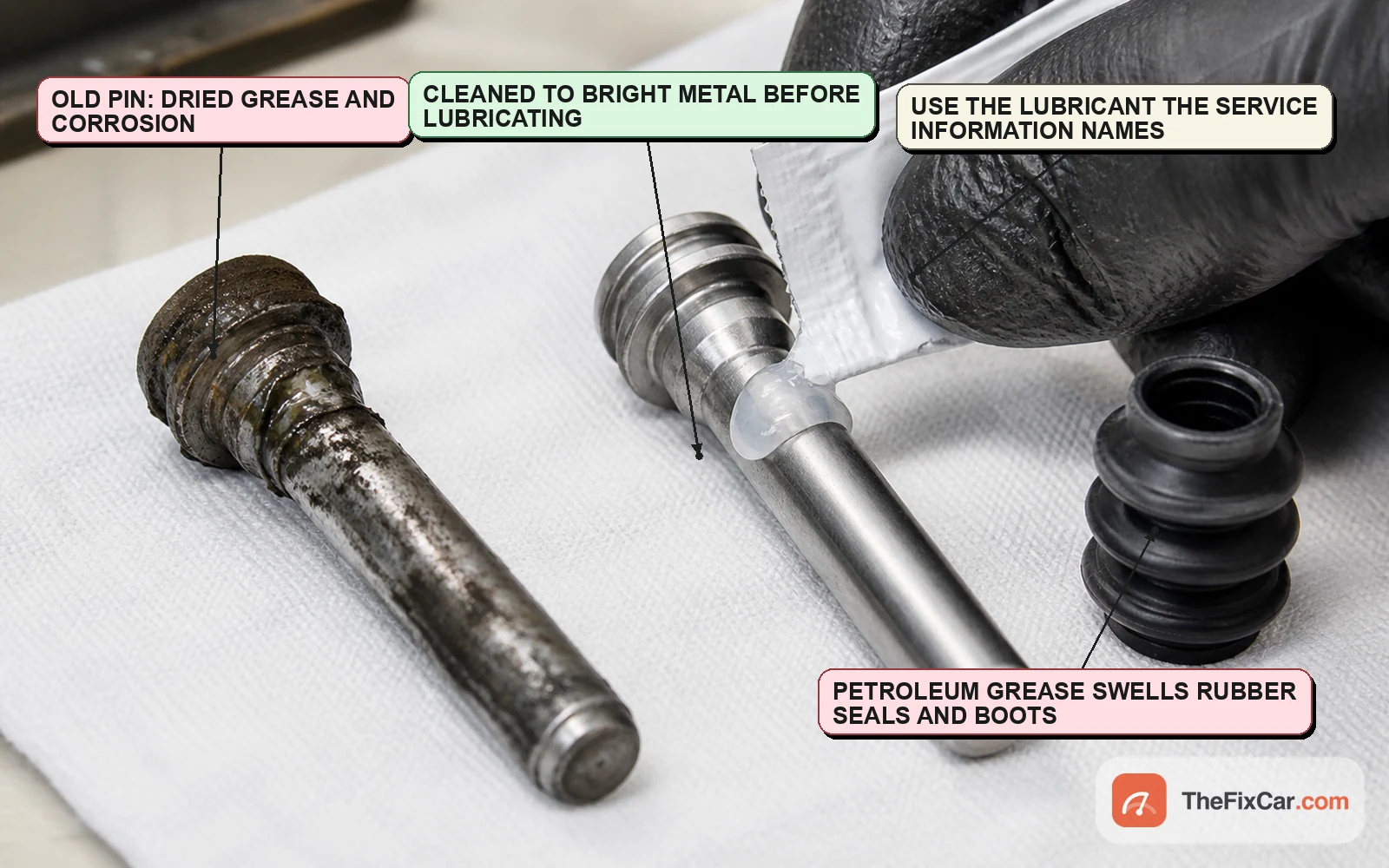
Use the lubricant the procedure names. Use the product your service information names for the pins and for the seals, and keep it off the friction surfaces. Where a manufacturer names a specific lubricant for a caliper, use that one rather than a general-purpose grease, and keep it away from the pad and rotor faces. A swollen or softened seal can be why a freshly serviced caliper starts to drag. The same care applies to the fluid itself: federal brake fluid labelling requires the warning that contamination with dirt, water, petroleum products or other materials may result in brake failure or costly repairs[4].
Pad abutments and hardware. Clean the contact surfaces properly. Ford’s procedure for a rear brake complaint has the technician clean the pad to anchor plate contact surfaces with metal brake parts cleaner, a wire brush and a super fine abrasive pad[5]. Where the pad set supplies new clips, fit them rather than reusing corroded ones.
Do not damage what you are working around. Honda’s caliper procedure includes two useful cautions: be careful not to damage the pin boot, and be careful when pivoting the caliper body up because the spring can pop out of position[6]. It also has the technician check the hose and pin boots for damage and deterioration while the caliper is off.
Rebuild: when it is an option and when it is not
The decision is documented, not a matter of taste. Mazda’s alert tells the technician to review the vehicle’s maintenance and repair history before deciding whether to rebuild or replace the caliper[2], and elsewhere to rebuild or replace the caliper and sliders as necessary. So a rebuild is a sanctioned outcome on the vehicles that alert covers, with the history as one input the procedure asks for rather than the whole answer. Treat it as an example of how the decision gets made, not as a standard for every make.
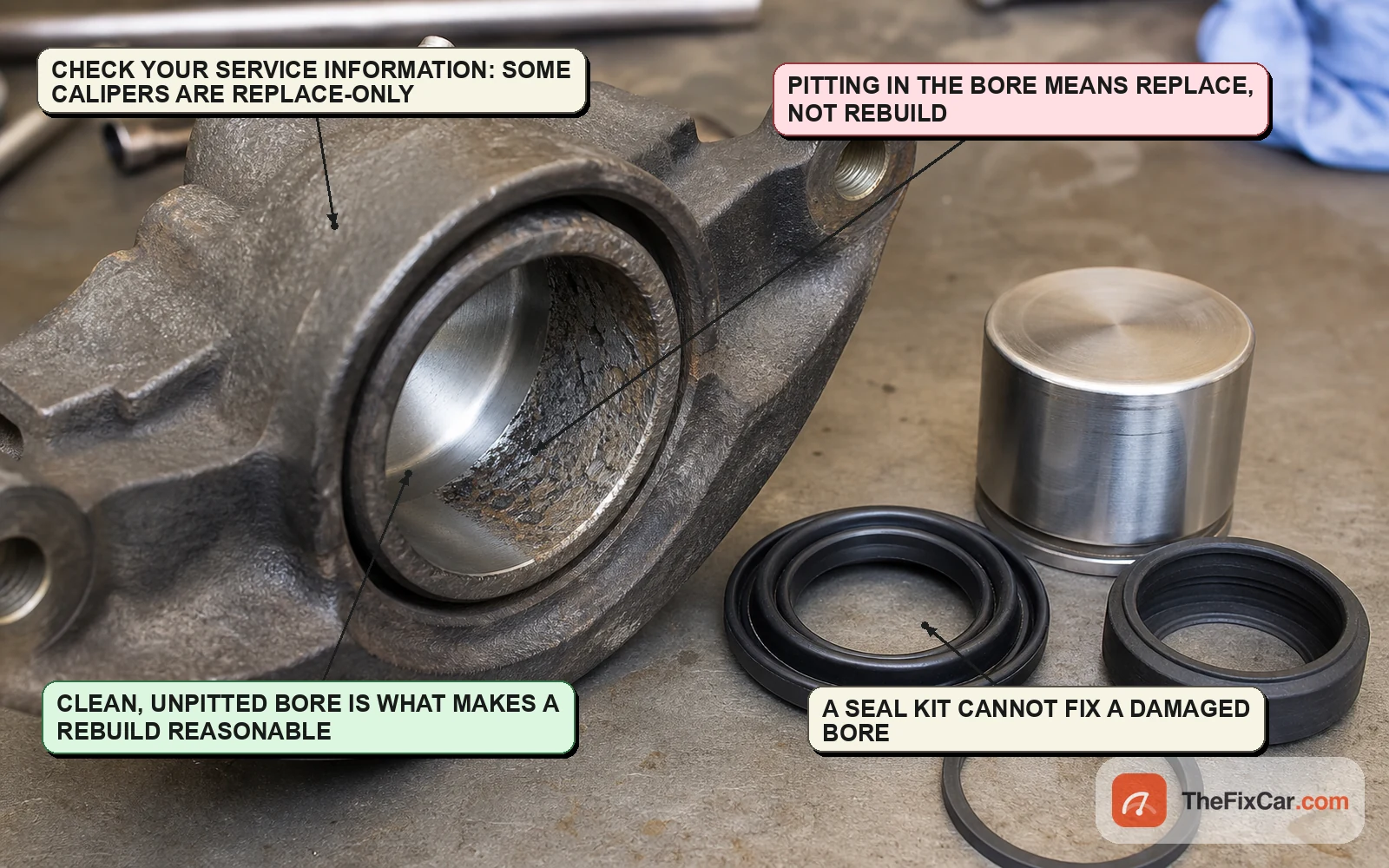
A rebuild is reasonable when the bore is clean, the piston is unpitted or replaced as part of the kit, the mounting and bracket are undamaged, the parking brake mechanism on that corner works, and a seal kit is actually available for the part number.
Judge it against the published rejection criteria, not by eye. Work from the overhaul procedure for that exact caliper, and do not assume a cleaning method is allowed: check whether any abrasive may touch the bore at all, and which one the procedure names. Pitting, scoring, seal groove damage or corrosion beyond the limit that procedure sets normally moves the repair to replacement, as do a cracked body, elongated mounting holes, damaged threads in the caliper, a piston with no replacement available, or an integrated parking brake actuator your parts information does not list as serviceable. In those cases the kit and the bleeding time go into a caliper that is still damaged.
Whatever you decide, check your own service information. Some manufacturers publish an overhaul procedure with a seal kit; others treat the caliper as a replace-only assembly, and a rebuild there leaves you outside the documented repair.
Replacement: doing the job
- On an EPB vehicle, run the retraction procedure first. Two manufacturers document their own version: Volvo requires the rear pistons to be retracted by service command on its EPB cars[1], and Ford’s rear brake procedure opens by activating brake service mode before the wheel comes off[5]. Find the equivalent step for your own vehicle rather than assuming either one applies to it.
- Raise the vehicle properly. A lift, or jack stands at the manufacturer’s lifting points. Never a jack alone.
- Check the reservoir level before pushing any piston back, because retracting a piston pushes fluid up the system. Follow your service information on whether the cap comes off and on how to catch any overflow.
- Remove the caliper in the order your procedure gives. On the Honda front brake it covers, that is the brake hose mounting bolt where the hose is being disturbed, then the flange bolts, lifting the body clear without straining the hose[6]. Fastener names and the hose step differ between vehicles.
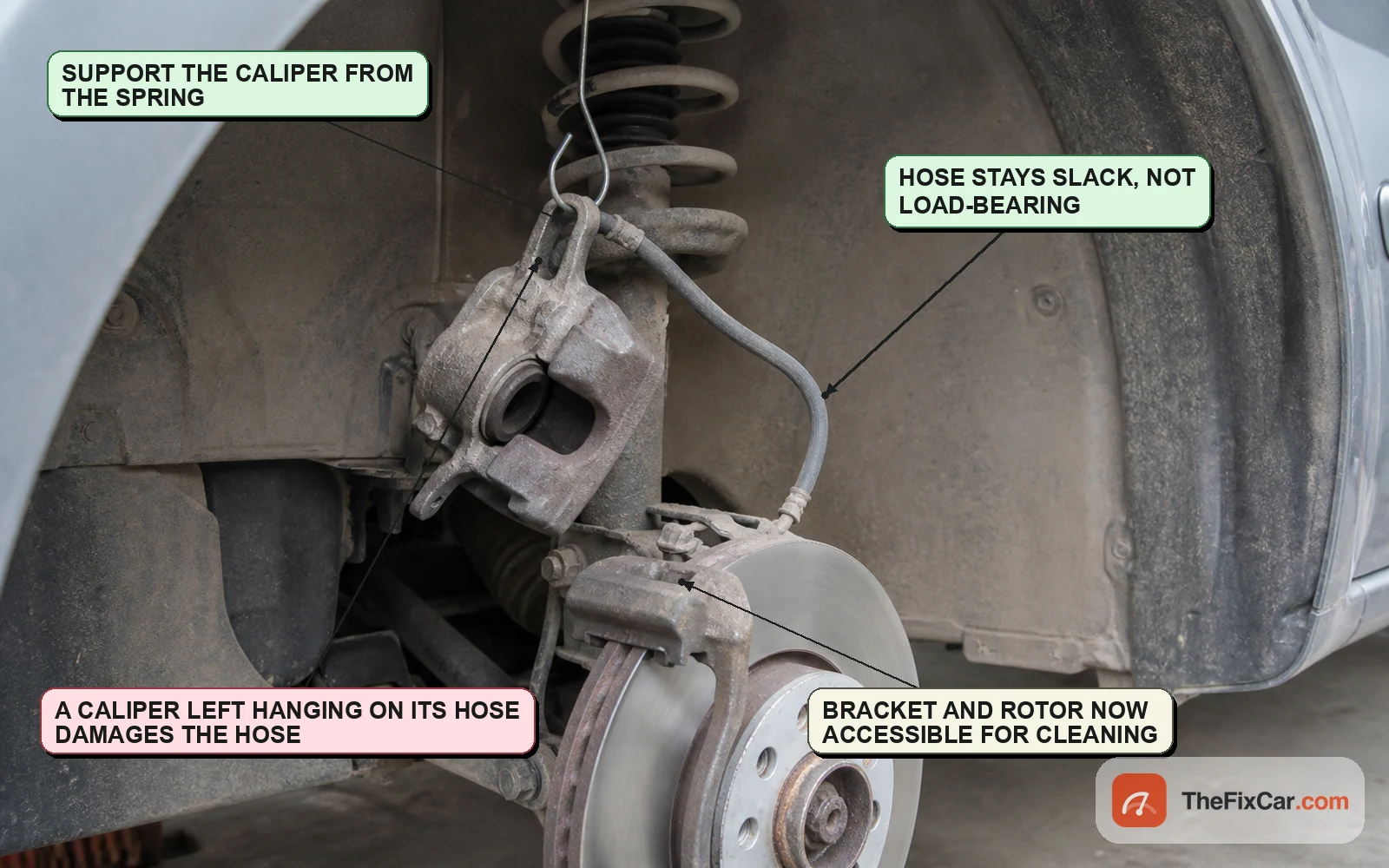
- Support the caliper. Hang it from a hook on a structure that will carry it, not from the hose and not from anything that will move. A caliper left dangling on its hose can damage the hose, and a damaged brake hose can leak or rupture under pressure.
- Transfer or renew the hardware. Clips, shims and pin boots, cleaned or new as the inspection decided.
- Fit the new or rebuilt caliper. A new or reman unit normally arrives with the piston already retracted, so check before pressing on anything. Where you are refitting the original caliper, compress the piston as your own procedure directs: on the models its bulletin covers, Ford’s step is to compress the piston until it bottoms in the bore[5].
- Torque every fastener to the figure for your vehicle. Ford specifies 63 N·m (46 lb-ft) for the caliper anchor plate bolts on the models that bulletin covers[5], and a guide pin bolt and a bracket bolt on the same car can differ by a factor of several. Our page on published brake caliper torque figures and why they differ so widely collects the verified examples.
- Use new bolts where the procedure says new. Some caliper bracket and adapter bolts are specified as replacement items rather than reusable, and the torque figure does not tell you which.
- Bleed the system if it was opened, following the sequence, fluid grade and method for your vehicle. Some vehicles need a full-system or axle sequence, and some require a scan tool to cycle the ABS modulator, so a single-corner bleed is not a safe default.
- Exit service mode and cycle the parking brake on an EPB car, then confirm the system sets and releases.
- Pump the pedal to a firm feel before moving the vehicle, then check the reservoir level and look over every fitting you disturbed for leaks with the pedal held down. Only then bed the pads as the pad manufacturer directs, and recheck for drag and leaks once everything has been through a heat cycle.
DIY or shop
- DIY difficulty: Moderate on a front floating caliper, where the parking brake is not part of that corner. Harder at the rear on an EPB car, where the retraction procedure is the job, and where many vehicles need a scan tool or an in-car menu to run it. A rebuild adds bore inspection and bleeding to the list.
- DIY cost: Roughly $15 to $60 for a hardware and pin kit, $20 to $70 for a seal kit where one exists, $60 to $200 for a reman caliper, plus fluid and a torque wrench you can trust.
- Shop cost: Roughly $400 to $700 per corner on many conventional applications for a caliper fitted and bled. Some straightforward jobs come in below that, while premium, multi-piston or EPB-integrated assemblies can reach $900 to $1,500 or more. Pads, rotors and related repairs add to the total.
Rough U.S. workshop estimates, not quotes. Warranty coverage, model, part choice and local labour rates all move them.
FAQ
Can you rebuild a brake caliper instead of replacing it? Sometimes, and one manufacturer puts the decision in writing: Mazda has the technician review the vehicle’s maintenance and repair history before choosing between rebuilding and replacing[2]. A pitted bore, a cracked body, damaged threads or an integrated parking brake actuator move the answer to replacement.
Do I need a scan tool to change rear brakes? On many vehicles with an electric parking brake, yes, because the piston is retracted by service command rather than by force[1]. Some vehicles use an in-car menu procedure instead, and a few rear designs still wind back mechanically. Check before you start, not after the wheel is off.
What happens if I force an EPB piston back? Depending on the design you risk the actuator and the mechanism behind the piston, which turns a pad job into a caliper job. Volvo’s journal covers the related problem of pistons that do not retract on command and what to do about it[1].
What grease goes on caliper slide pins? The product your service information names, and nothing chosen by guess. Where the manufacturer names one, use it: an unsuitable product can swell or soften the seals and boots in that caliper. Federal labelling makes the parallel point about the fluid: contamination with dirt, water, petroleum products or other materials may result in brake failure or costly repairs[4].
Should I replace calipers in pairs? Not automatically. A caliper can be replaced on its own where the opposite unit tests correctly and the vehicle manufacturer does not require paired replacement. Inspect that opposite side for corrosion, drag, leakage and similar age-related deterioration before deciding. Pads are commonly serviced as an axle set, though follow the procedure for your vehicle, and rotor replacement depends on condition against the applicable service limits. Some shop and parts guidance recommends replacing calipers in pairs even where the manufacturer procedure does not require it, so be clear which you are being quoted.
Do I have to bleed the brakes after changing a caliper? Yes, if you opened the hydraulic system, which replacing a caliper does. Follow the sequence and the fluid grade for your vehicle, and keep the reservoir topped so you do not draw air in.
How do I know the job worked? Not from one check. Spin the wheel cold first. If nothing binds and there is no leak, soft pedal or warning light, hold the pedal firmly and check for leaks with the vehicle stationary, then test the brakes at walking pace in a controlled area away from traffic, and only after a short controlled drive compare wheel temperatures without touching anything, since a dragging brake can get hot enough to burn. Brakes warm up in normal use, so the comparison is against the opposite side. A corner that comes back much hotter than its pair still has drag somewhere, which may be the caliper, the pad hardware, the hose, the parking brake mechanism or a bearing, even if the caliper was just replaced.
Related brake caliper guides
- Bad brake caliper symptoms and what else produces them, for proving the problem first
- Brake caliper specs: torque, piston size and hardware, for the numbers this job needs
- When to replace brake pads and what wear actually looks like
- How often to change brake fluid and why moisture matters
- Lug nut torque specifications: the other fastener you will touch
Sources & verification
Last technically reviewed: Aug 2026
Reviewed by: Marcus Holt
Primary references: manufacturer service bulletins filed with NHTSA (Volvo, Mazda, BMW Group, Ford, American Honda) and 49 CFR 571.116
Suggested citation: TheFixCar, “Brake Caliper Inspection and Service: Rebuild vs Replacement,” updated Aug. 2026. https://thefixcar.com/maintenance/brake-caliper-inspection-service-rebuild-replacement/