You press the button on the plug, the cable does not budge, and the car is stuck at the charger in a parking garage or your own driveway. A stuck EV charging cable usually comes down to a lock or charging session that has not released, but the exact release path depends on the vehicle, charger type, and whether an adapter is involved. The fix is a short sequence, and forcing the connector is the one move that turns a two-minute problem into a damaged charge port.
Quick answer
Many EVs hold the connector with a charge-port lock or latch while the car is charging or locked, so the release is a short sequence, not a tug-of-war. Work through this checklist in order.
- Do not force the plug. Stop pulling if it does not release normally.
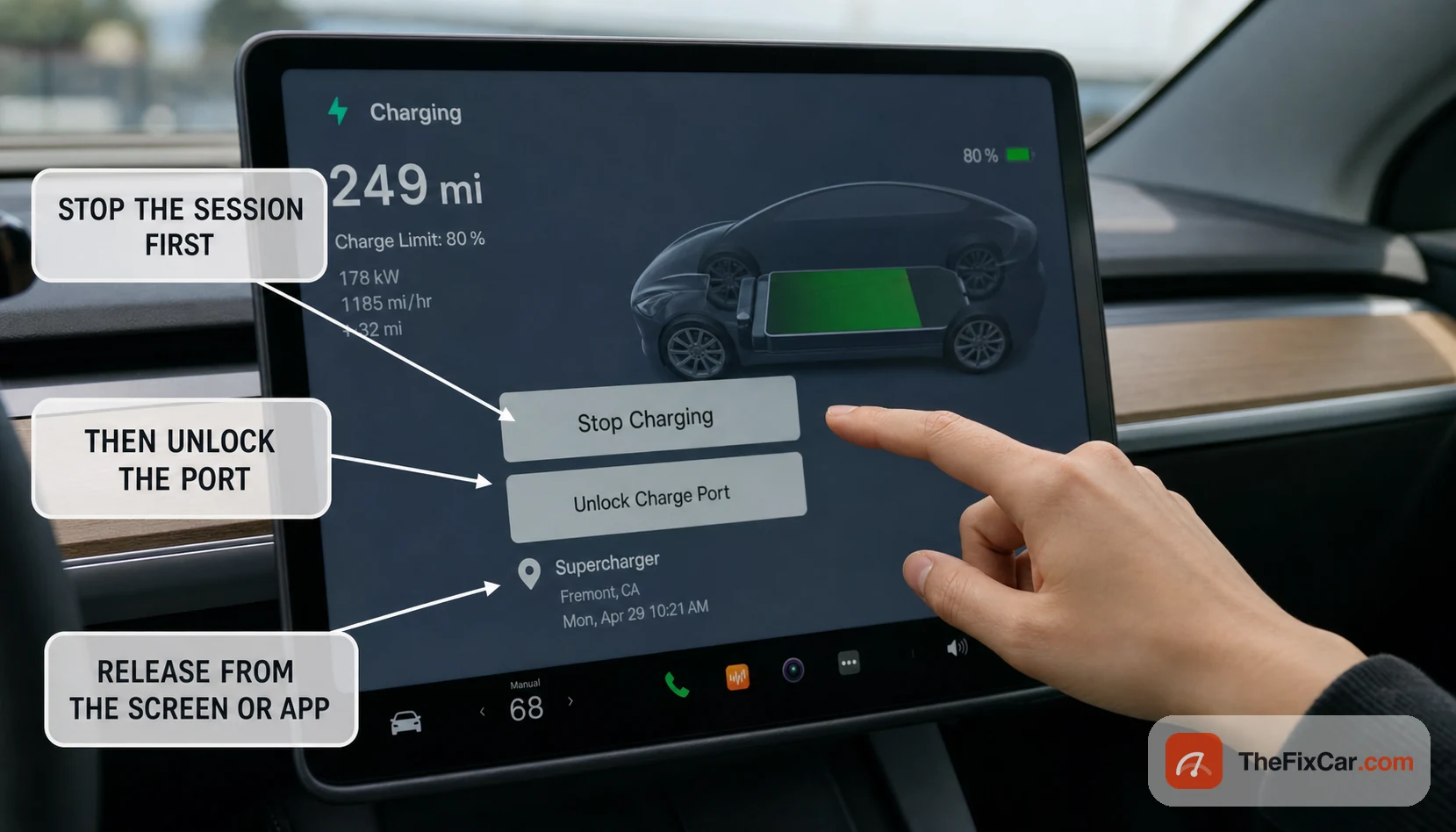
- Stop the charging session in the app, on the car screen, or at the public charger.
- Unlock the vehicle with the key fob or app and wait a few seconds.
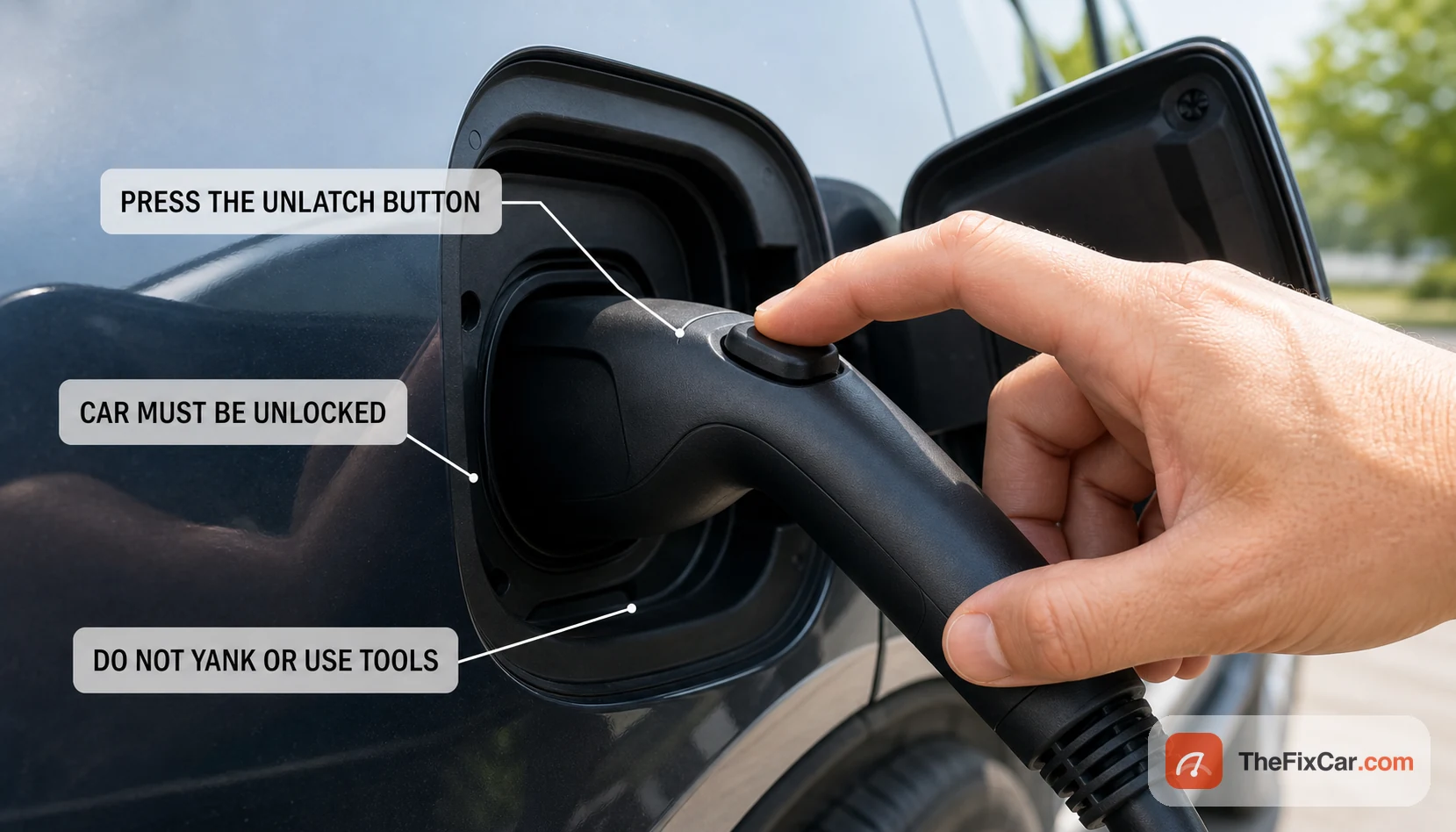
- Press the connector release or the car’s charge-port release button.
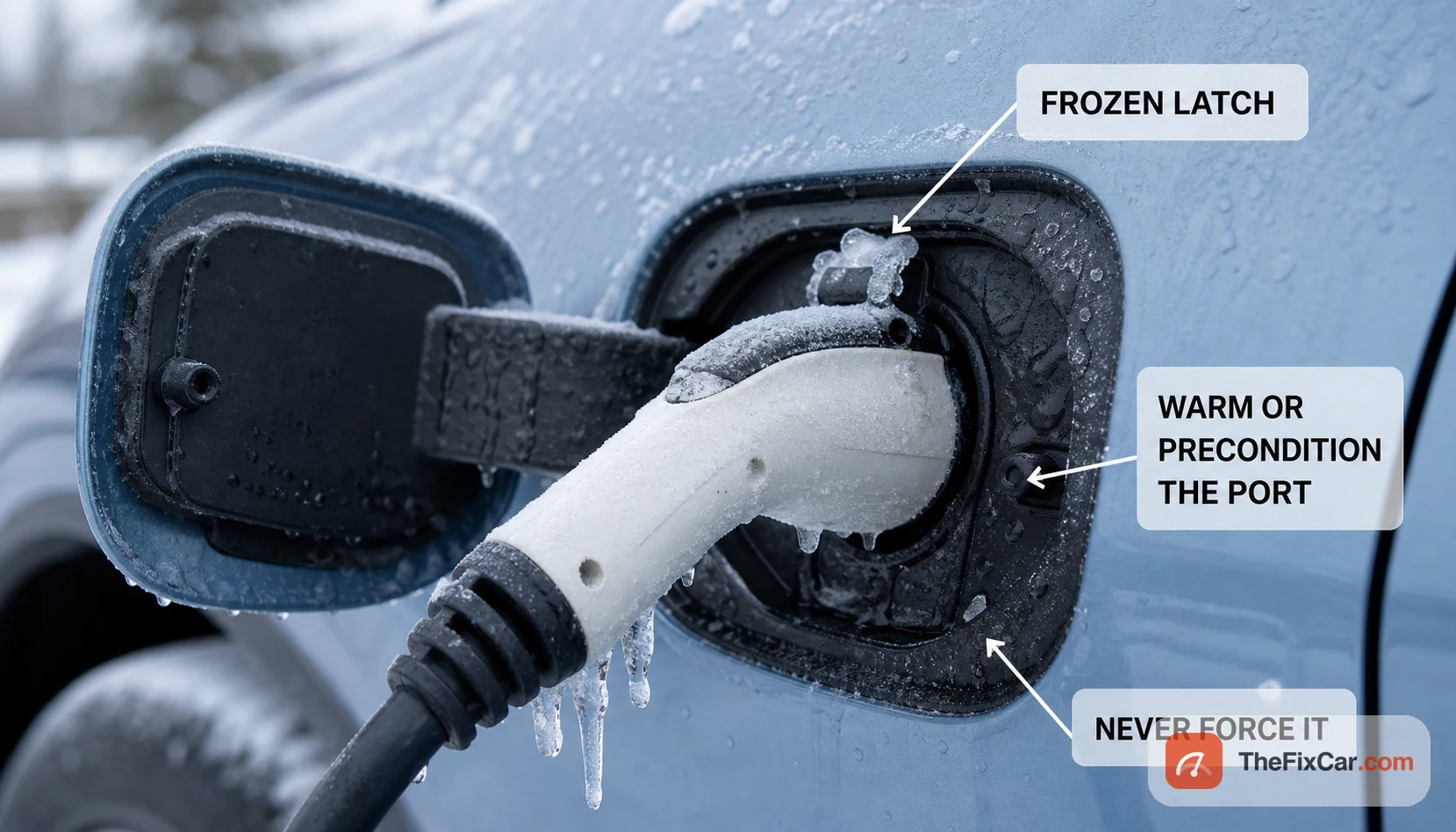
- If it is frozen, warm the port with preconditioning or a vehicle-safe de-icer.
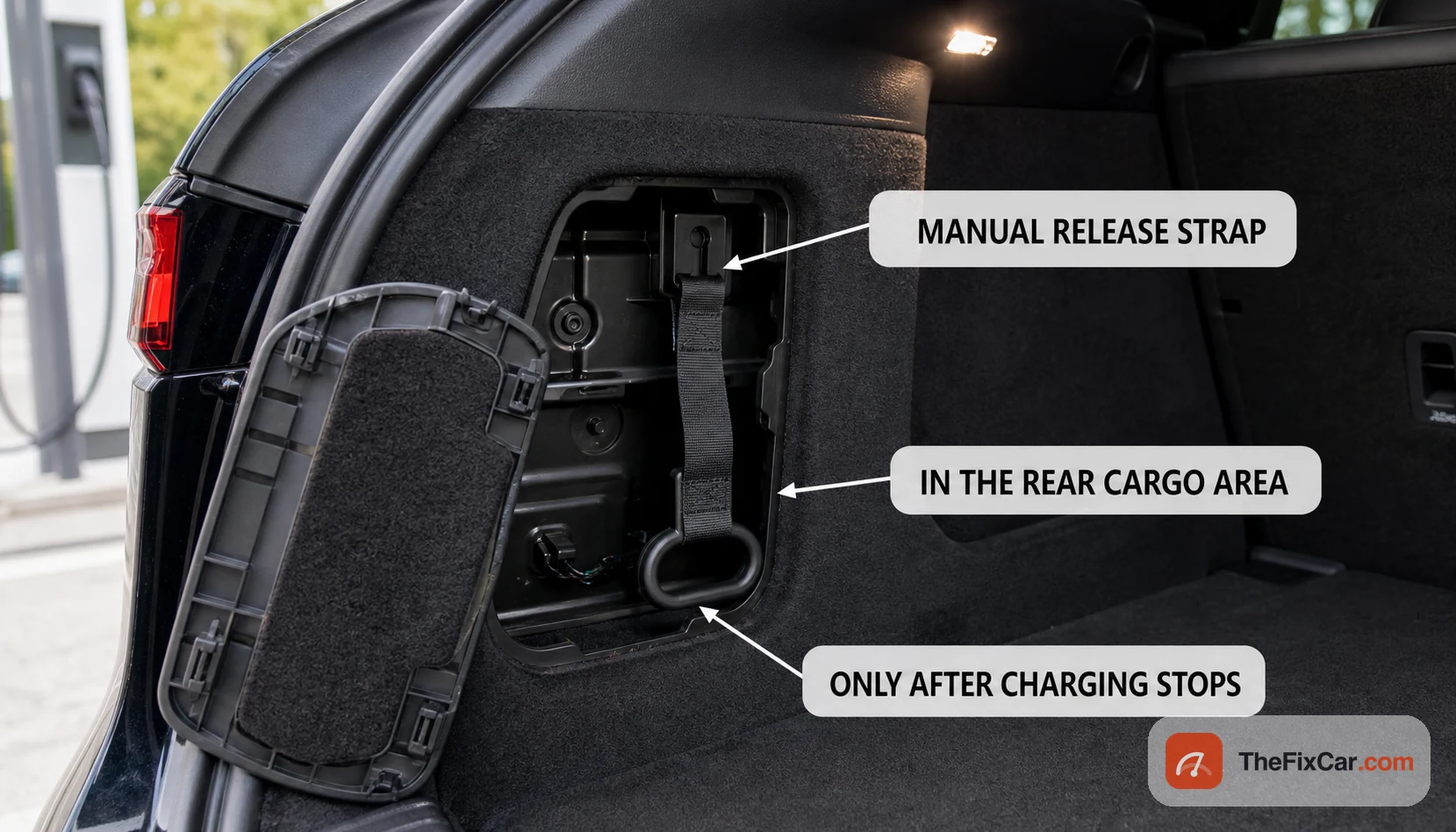
- Use the manual release only after charging has stopped.
- Call the charging network or roadside help if the cable is hot, damaged, sparking, or still locked.
The fix is usually free; the only real cost comes if someone forced it and cracked the charge port, which can run into the hundreds.
Most common causes
- Car is still locked: on most EVs a locked car keeps the charge port latched, so the cable will not come out until you unlock it.
- Charging session not stopped: the latch stays engaged while current is flowing, so the plug holds until you end the session in the app, on the screen, or at the station.
- Frozen latch: water seeps into the port seam and freezes in cold weather, locking the connector in place until the area warms up.
- Software or handshake glitch: a hung charging session can leave the car thinking it is still charging, so the latch never releases until you reset it.
- Debris or a misaligned plug: grit, a bent pin, or a connector seated at an angle can bind the latch mechanically.
- Stuck adapter: a NACS-to-CCS or CCS-to-NACS adapter can wedge between the car and the cable, so the cable releases but the adapter does not.
- Failed latch actuator: the small motor or solenoid that drives the locking pin can fail, the one cause that is an actual hardware fault.
- Weak 12V battery: the high-voltage pack may still hold charge, but the low-voltage system powers the locks, modules, and some release actuators. If the car will not wake up or the charge-port release is dead, check the 12V system.
Where is it stuck?
| Stuck point | Likely cause | Best next step |
|---|---|---|
| Plug stuck in the car | Car lock, active session, frozen latch, or failed actuator | Stop the session, unlock the car, use the vehicle or manual release |
| Cable stuck in a public charger | Station session or network lock | End the session in the app or at the station, then call the operator |
| Adapter stuck | Adapter latch, misalignment, or a communication glitch | Follow the car or adapter release order; do not pry or twist |
What to check first
- Stop the charging session. End it in the app, on the car screen, or with the stop button on a public station, and wait for the current to drop to zero.
- Unlock the car. Press unlock on the key fob or in the app; a locked car keeps the port locked on most EVs.
- Use the built-in release. Tap the charge-port release on the car screen or app, or press the unlatch button on the plug handle.
- Try the maker’s shortcut. Some vehicles have model-specific release shortcuts; on some Tesla models, holding the rear door handle for a few seconds can trigger a charge-cable release when the normal unlatch button does not.
- Warm a frozen port. If it is below freezing, run preconditioning or the cabin heater, or use a vehicle-safe de-icer, then try the release again.
- Find the manual release. Check the owner’s manual for the exact emergency release location, usually a strap in the rear cargo area, and use it only after charging has stopped.
- If the car is also dead. A stuck cable plus dark screens, no app response, or no unlock response points more toward a low-voltage problem than a simple latch, so check the 12V battery.
Do not do this
- Do not twist, pry, kick, or pull the connector with tools.
- Do not drive forward to yank the cable out.
- Do not use the manual release while current is still flowing.
- Do not touch the pins or any damaged contacts.
- Do not keep trying if the connector is hot, melted, sparking, or smells burned.
Is it safe to drive?
You cannot, and should not try. Nearly every EV blocks drive mode while a charging cable is connected, so the car will not move with the plug in, and trying to pull away to yank the cable free will damage the port, the cable, or both. The car itself is safe to sit in and safe once the cable is out; the only hazard is a connector that is hot, sparking, or damaged, which is a stop-and-call situation rather than a drive-away one.
When the problem is urgent
- The connector or cable feels hot or smells of burning plastic: stop, do not touch the pins, and contact the network or your dealer.
- You see sparking, melting, or scorch marks at the port: leave it connected, keep people back, and call for help.
- The cable or charge port is visibly cracked or damaged: do not force it, because damaged contacts may not de-energize or disconnect safely.
- A public DC fast charger will not end the session: call the number on the station before attempting any manual release.
- The manual release does nothing and the car stays locked onto the cable: stop pulling and get mobile service or a tow, not more force.
Typical repair cost
These are rough U.S. repair ranges; warranty coverage, vehicle model, charger type, and local labor rates can move the final price higher or lower.
- Unlock, app reset, or stop the session $0, the fix for most stuck cables
- De-icer or preconditioning for a frozen port roughly $10 for a vehicle-safe de-icer, or free with the car’s own heating
- Mobile service or tow if it will not release commonly $75 to $250 depending on distance
- Latch actuator or release motor repair often $150 to $500 parts and labor
- Charge port assembly replacement frequently $500 to $1,500 or more, mostly when a forced cable cracked it
FAQ
Why is my EV charging cable stuck after charging finished? The car often keeps the latch locked until you both end the session and unlock the vehicle. Stop the session in the app or on the screen, unlock the car, then use the release again.
Can I use the emergency release while the car is still charging? No. Stop the charging session first so no current is flowing, then use the manual release. Pulling it under load can be unsafe and can damage the connector.
Why is my charging cable stuck in a public charger? The station, not your car, may still hold the session or a network lock. End the session in the network app or at the station, and if it stays locked, call the operator on the number on the unit.
Can a weak 12V battery stop the charge plug from releasing? Yes. The 12V system powers the locks and release actuators, so a flat or weak 12V battery can leave the port locked even when the main pack is fine.
What should I do if my EV charging cable is frozen? Warm the port with the car’s preconditioning or cabin heat, or use a vehicle-safe de-icer, then try the release again. Never force a frozen connector.