You hooked up the cables, the donor car is running, you turn the key, and the dead car still does nothing, clicks, or cranks but never catches. A jump that fails usually means one of three different problems, and the sound the car makes when you try to start it tells you which one. In many failed jump-start attempts, the problem is still the current path: weak clamp contact, corrosion, undersized cables, or a donor battery that has not been allowed to charge the dead battery long enough.
Quick answer
The sound the car makes when you turn the key tells you which problem you have. Find your row and start there.
| What happens | Most likely | Do first |
|---|---|---|
| Nothing, no dash lights | No current reaching the car | Reseat clamps, clean the contact points, check the donor |
| Rapid clicking | Weak current path | Wait 2 to 5 minutes, use thicker cables, clean the terminals |
| One loud click | Starter or main connection | Stop forcing it, check the starter, voltage, and ground |
| Cranks but will not fire | Not a battery problem | Stop jumping, check fuel, spark, and the immobilizer |
Use this as a rough guide, not a full diagnosis. The same sound can have more than one cause, and a deeply discharged battery can mimic several of these at once.
Most common causes
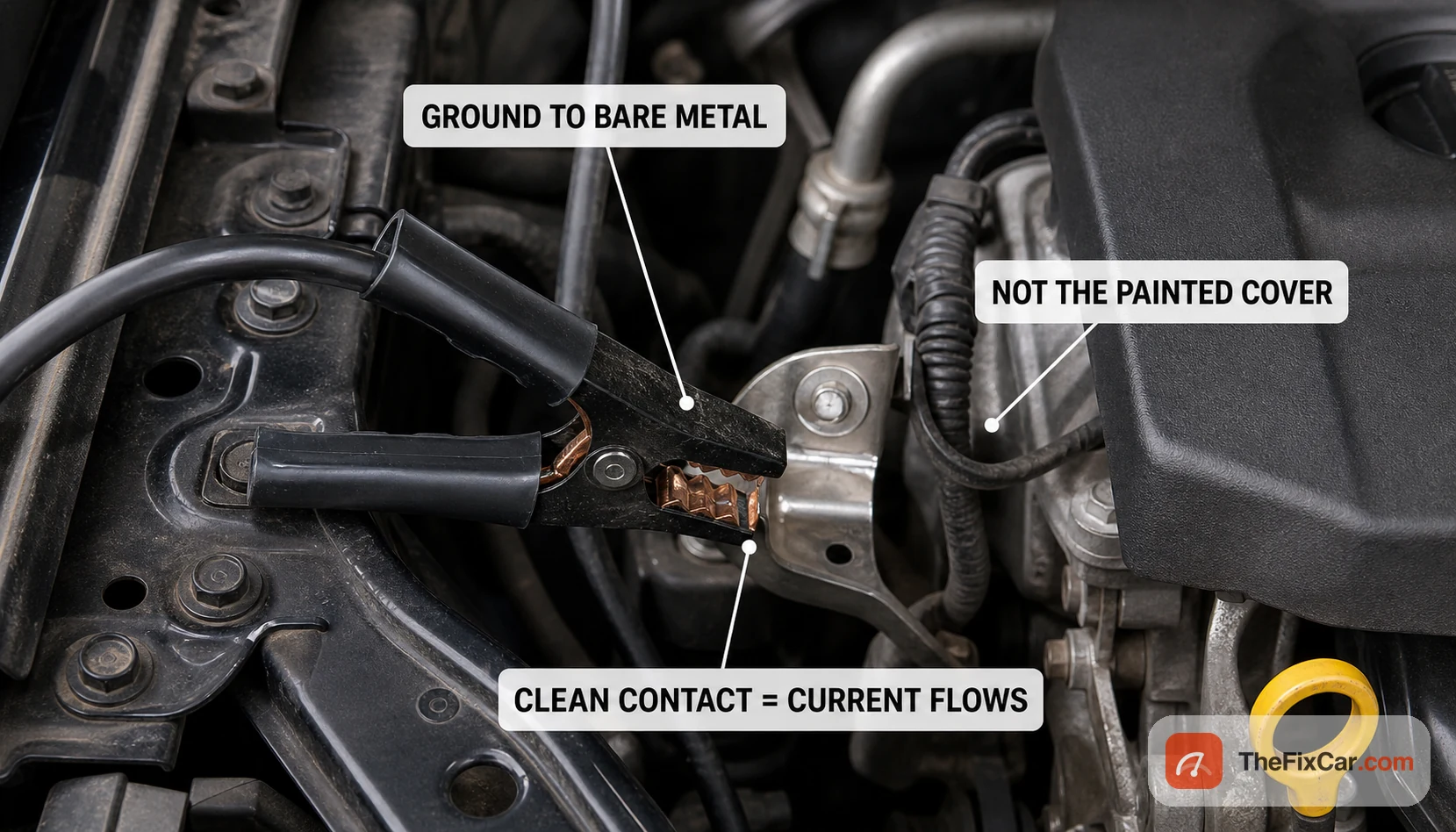
- Poor clamp contact: a clamp resting on a painted bracket, a dirty terminal, or a rusty bolt passes almost no current even though it looks connected.
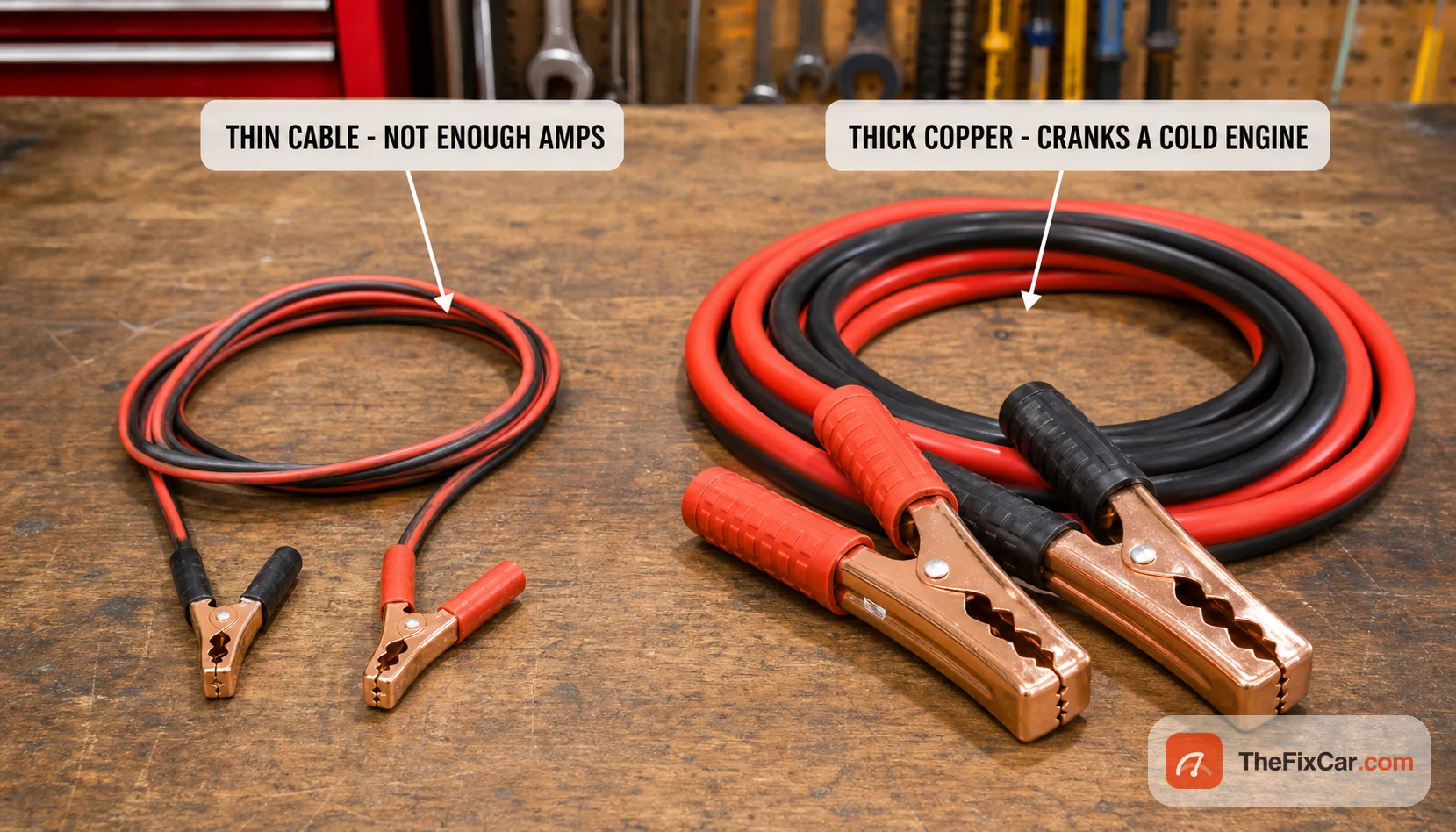
- Cables too thin: a budget set, often copper-clad aluminum sized like 8 or 10 AWG, cannot carry enough current to crank a cold or larger engine.
- Donor battery too weak: a small or half-charged donor cannot spare the amps, especially if you try to crank immediately without letting it run.
- Deeply dead battery: a battery sitting at a few volts may need several minutes of charging from the donor before it will accept enough to start.
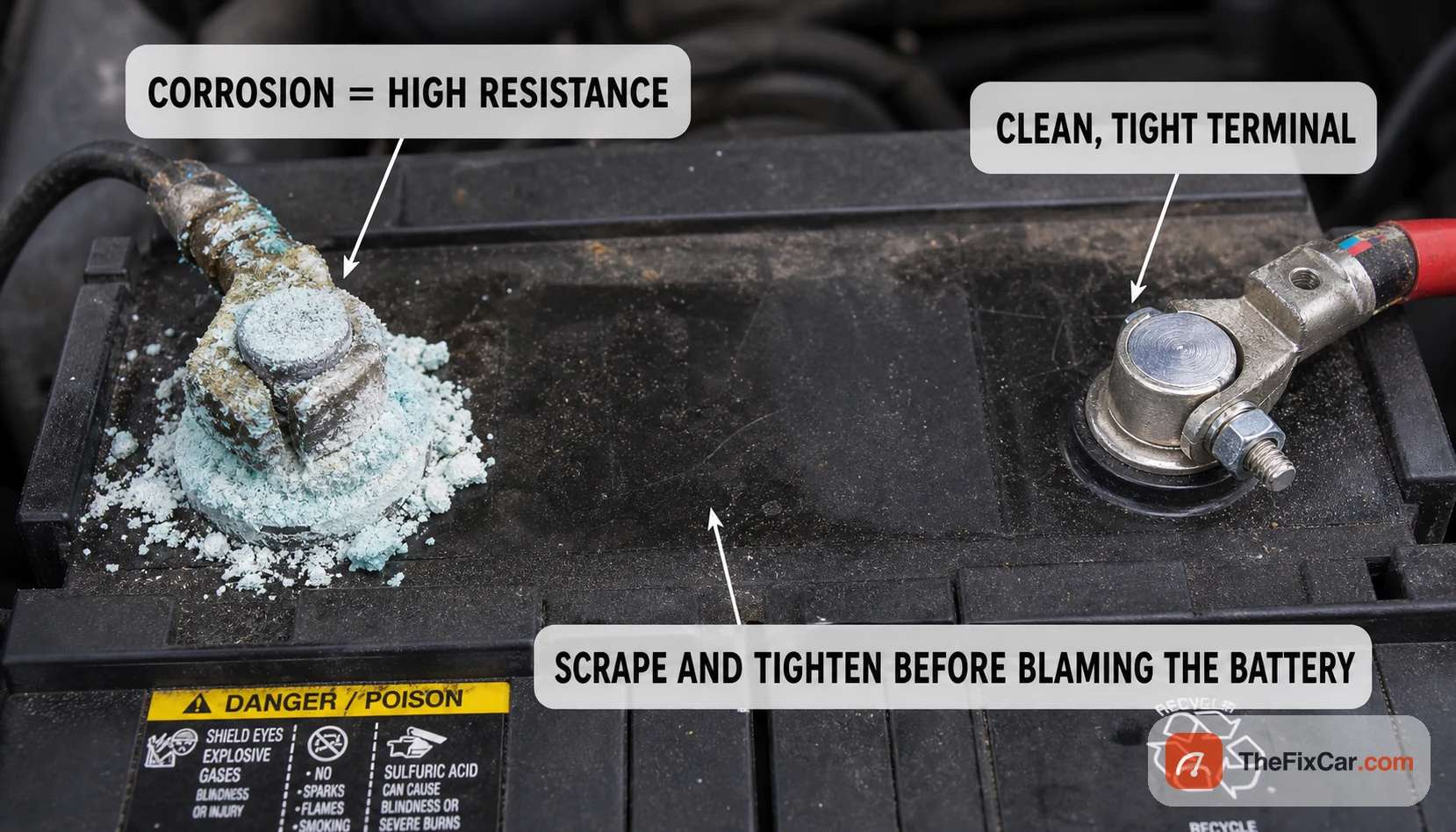
- Corroded or loose terminals: white or green crust on the posts adds resistance right where you need a clean path.
- Failed starter or solenoid: a single hard click with good voltage points at the starter, not the battery.
- Something other than the battery: if it cranks normally and still will not run, the fault is likely fuel, spark, immobilizer, compression, timing, or engine-management related.
What to check first
- Reseat every clamp. Clip the dead car ground to clean, bare, unpainted metal, not the painted engine cover, and rock each clamp so the teeth bite.
- Confirm the order. A jump done in the wrong order is a safety risk and can leave you with a poor ground: review the safe jumper cable connection order and redo it.
- Look at the cables themselves. Thin, light, very cheap sets often cannot deliver the amps; the right jumper cable gauge matters more than the price on the box.
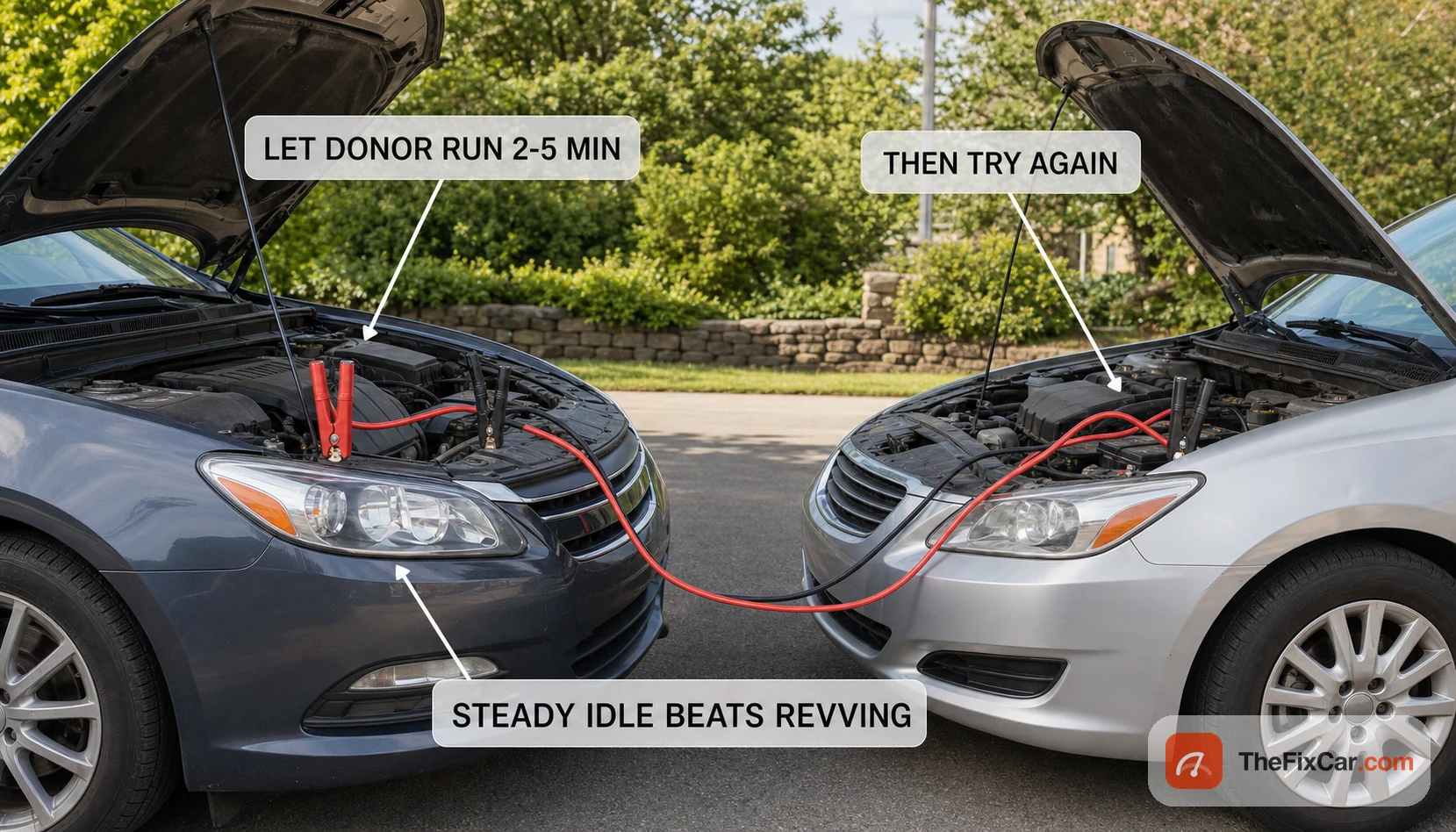
- Let the donor run. Keep the donor engine running 2 to 5 minutes, then try again, so it both charges and feeds the dead battery. The Texas Department of Insurance also advises a short wait before the second attempt.
- Clean the terminals. Scrape off corrosion and tighten the posts before you decide the battery is finished.
- Listen to the sound. Match what you hear to the table above to decide whether you are chasing a connection, a starter, or a no-spark problem.
If it still will not start after two good attempts
- Still no dash lights: suspect bad clamp contact, a dead donor, a blown main fuse, or a completely failed battery.
- Still rapid clicking: let the donor run longer, or move to a stronger donor or jump pack and thicker cables.
- One hard click: stop repeated cranking and suspect the starter, solenoid, main ground, or a battery cable.
- Cranks normally but will not fire: stop using jumper cables; the problem is probably fuel, spark, the immobilizer, or engine control.
Modern cars, hybrids, and remote jump terminals
Some vehicles do not give you direct battery access. Hybrids, EVs, many European cars, and models with the battery in the trunk or under a seat use a designated positive post and ground point under the hood instead. If the clamps look correct but the car still does nothing, check the owner’s manual for the approved jump-start points before you move the clamps, because clamping to the wrong spot can make a healthy jump look like a failure.
Is it safe to drive?
If you do get it started, it is usually safe to drive straight to a shop or auto-parts store for a battery and charging test, but do not switch the engine off until you are somewhere you can get help. If the car only started after a long charge or dies again soon after the cables come off, the charging system may not be keeping up, which is a separate problem covered in car starts with a jump then dies. A car that merely cranks without firing should not be force-cranked repeatedly.
Do not do this
- Do not crank for more than about 10 seconds at a time; long cranking overheats the starter and thin cables.
- Do not clamp the final ground to the dead battery negative post; attach it to bare engine metal away from the battery, the practice the Texas Department of Insurance recommends to keep sparks away from battery gases.
- Do not rev the donor hard hoping for more power; a steady idle for a few minutes does more than revving.
- Do not keep jumping a battery that boils, smells of rotten eggs, or has a swollen case; replace it.
- Do not assume a no-fire crank is the battery; you will flatten the donor chasing the wrong fault.
When the problem is urgent
- The battery case is swollen, hot, or leaking: stop and replace it, do not keep jumping.
- You smell rotten eggs or see white vapor at the battery: the battery may be venting gas from overcharging or internal failure, so step back and ventilate.
- The starter clicks once and smoke or a burning smell follows: the starter or a cable is overheating.
- The car started but the battery or charging light stays on: the alternator may not be charging.
- It cranks strongly but never fires after several tries: stop cranking to avoid flooding or starter damage and get it diagnosed.
Typical repair cost
These are typical U.S. repair ranges for common passenger cars; trucks, luxury vehicles, hybrids, EVs, and hard-to-access engines can cost more.
- New jumper cables or a clean connection $20 to $60 for a decent pure-copper set, often the only fix needed
- Battery terminal clean or replacement $10 to $40 in parts if the terminals or clamps are corroded
- New 12V battery commonly $120 to $300 installed depending on size and type
- Starter motor typically $300 to $700 parts and labour, more on hard-to-reach engines
- Alternator commonly $400 to $900 installed if the charging system is the real fault
FAQ
Why does my car only click with jumper cables? Current is reaching the starter but not enough of it, usually from a loose or dirty clamp, corroded terminals, thin cables, or a donor that has not run long enough to charge the dead battery.
Why does my car crank but not start with a jump? If it cranks at normal speed, the battery and connection are fine. The fault is elsewhere: fuel, spark, the immobilizer, or engine control, so more jumping will not help.
How long should I let the donor car run before trying again? Let the donor idle 2 to 5 minutes with the dead car connected, longer if the dead battery was deeply discharged, then try the start.
Can bad jumper cables stop a car from starting? Yes. Thin, corroded, or copper-clad aluminum cables can drop too much voltage to crank a cold or larger engine even when everything else is fine.