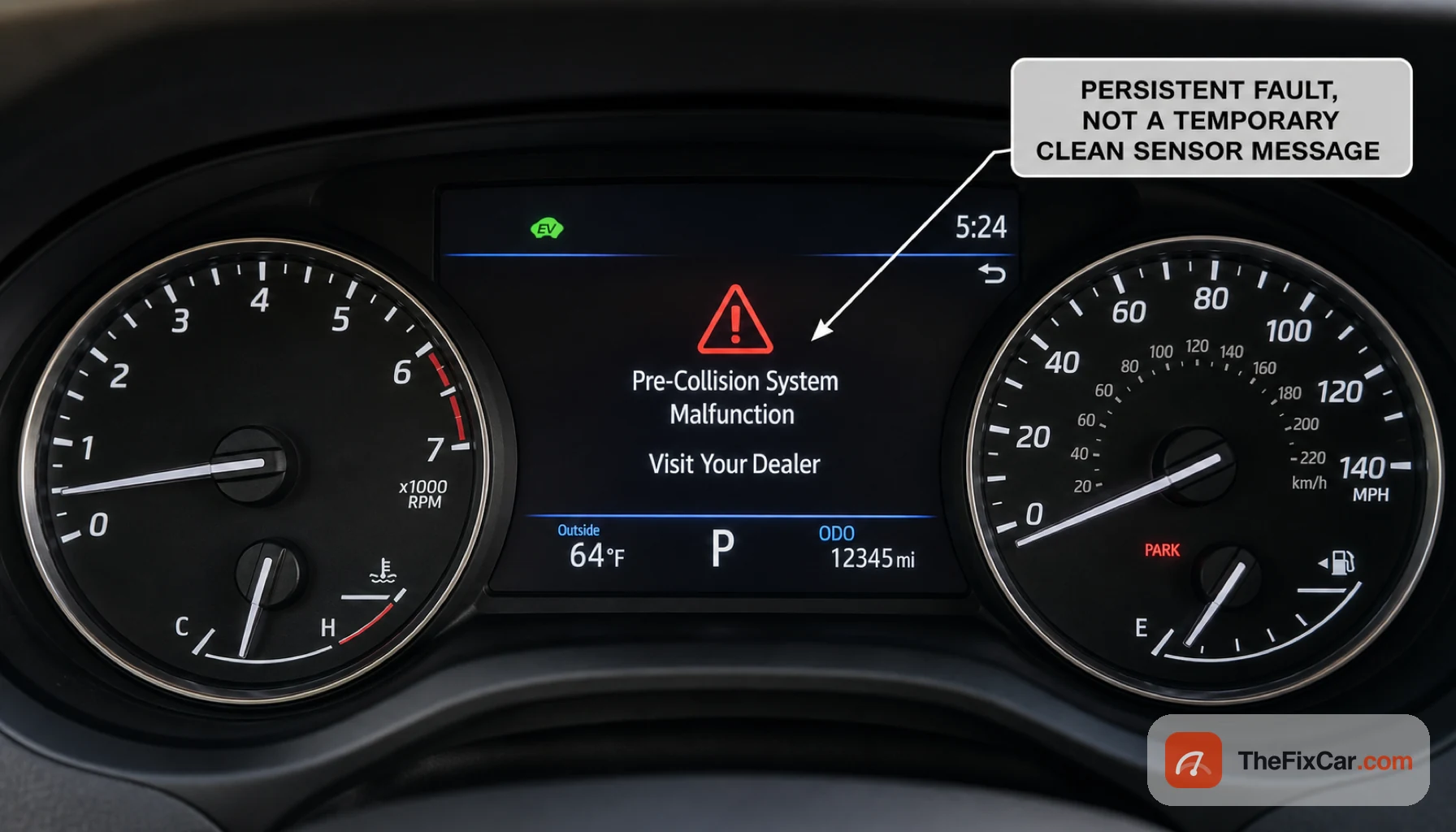
A red triangle and the message “Pre-Collision System Malfunction,” often paired with “Visit Your Dealer,” lights up on a Toyota or Lexus dash and, unlike the temporary “Unavailable” or “Clean Sensor” warning, this one tends to stay on. It commonly shows up on a cold morning, after a jump start, or as the car gets older. The timing matters: warnings that begin after a cold start or jump-start justify testing the 12-volt battery before replacing pre-collision components.
Quick answer
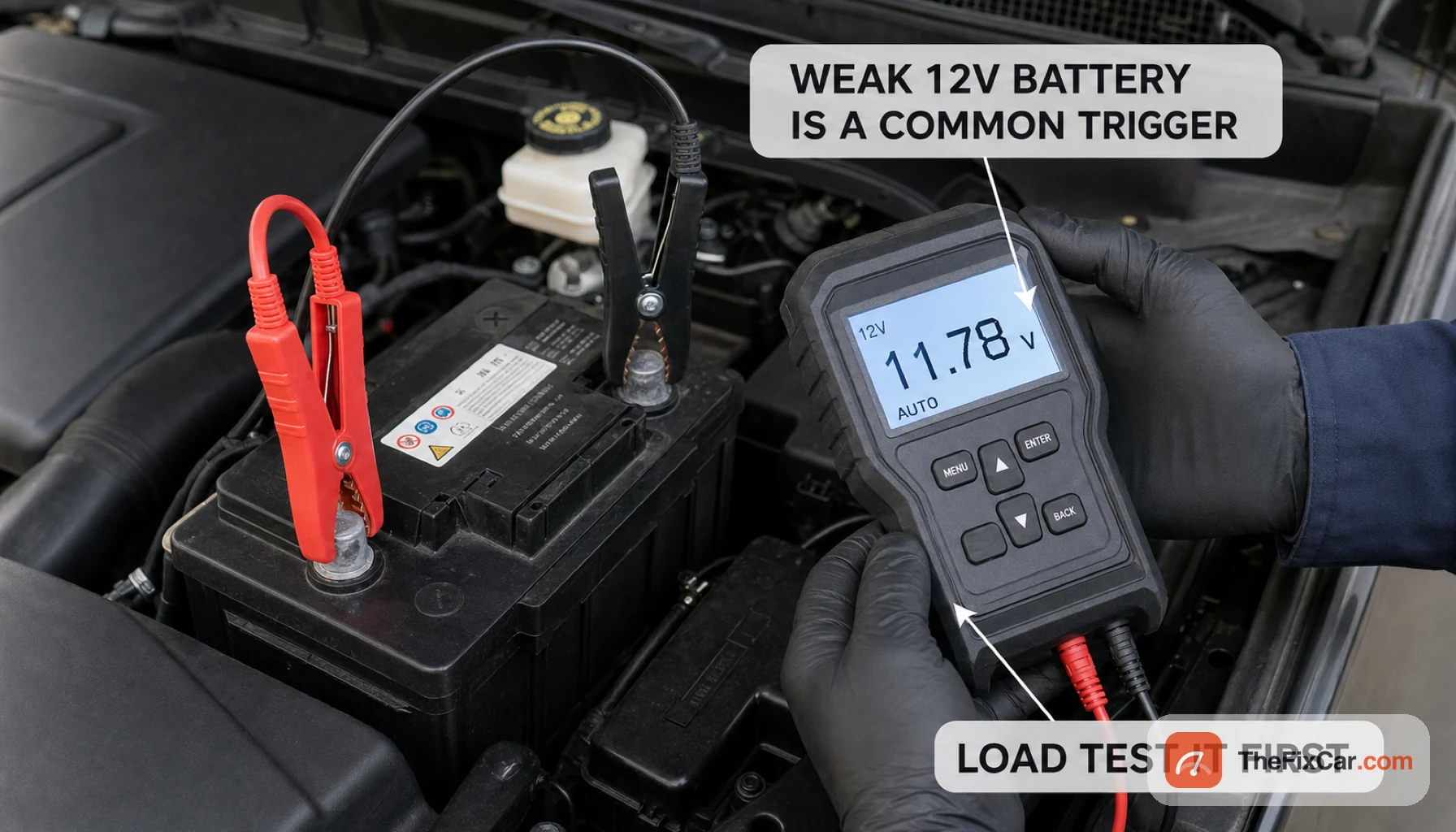
On Toyota and Lexus, a weak or low 12-volt battery is one possible trigger, especially when the warning begins after a cold start or jump-start: a voltage dip can make the safety system flag a fault even when the sensors are fine. A blocked or out-of-calibration front radar or camera can do the same. Basic steering and driver-operated braking may remain available when this is the only warning, but automatic emergency braking and some cruise-control functions may be disabled until it clears. If the battery tests good, the next step is a code scan; the model section below lists the Toyota bulletins that explain this message on specific models.
Malfunction vs Unavailable: which message is it?
| Message | Usually means | First step |
|---|---|---|
| Pre-Collision System Unavailable / Clean Sensor | Sensor view is blocked or weather-limited | Clean the radar and camera areas |
| Pre-Collision System Malfunction / Visit Your Dealer | Stored or persistent fault: voltage, calibration, wiring, or sensor | Scan codes and check the 12V battery |
Most common causes
- Weak or low 12-volt battery: low voltage can trigger multiple warning messages, particularly after a cold start or jump-start; confirm battery condition and stored codes before blaming the sensors.
- Blocked front sensor: dirt, snow, ice, or condensation on the front radar, whose location varies by model, or the camera near the rearview mirror, escalated from an “Unavailable” message.
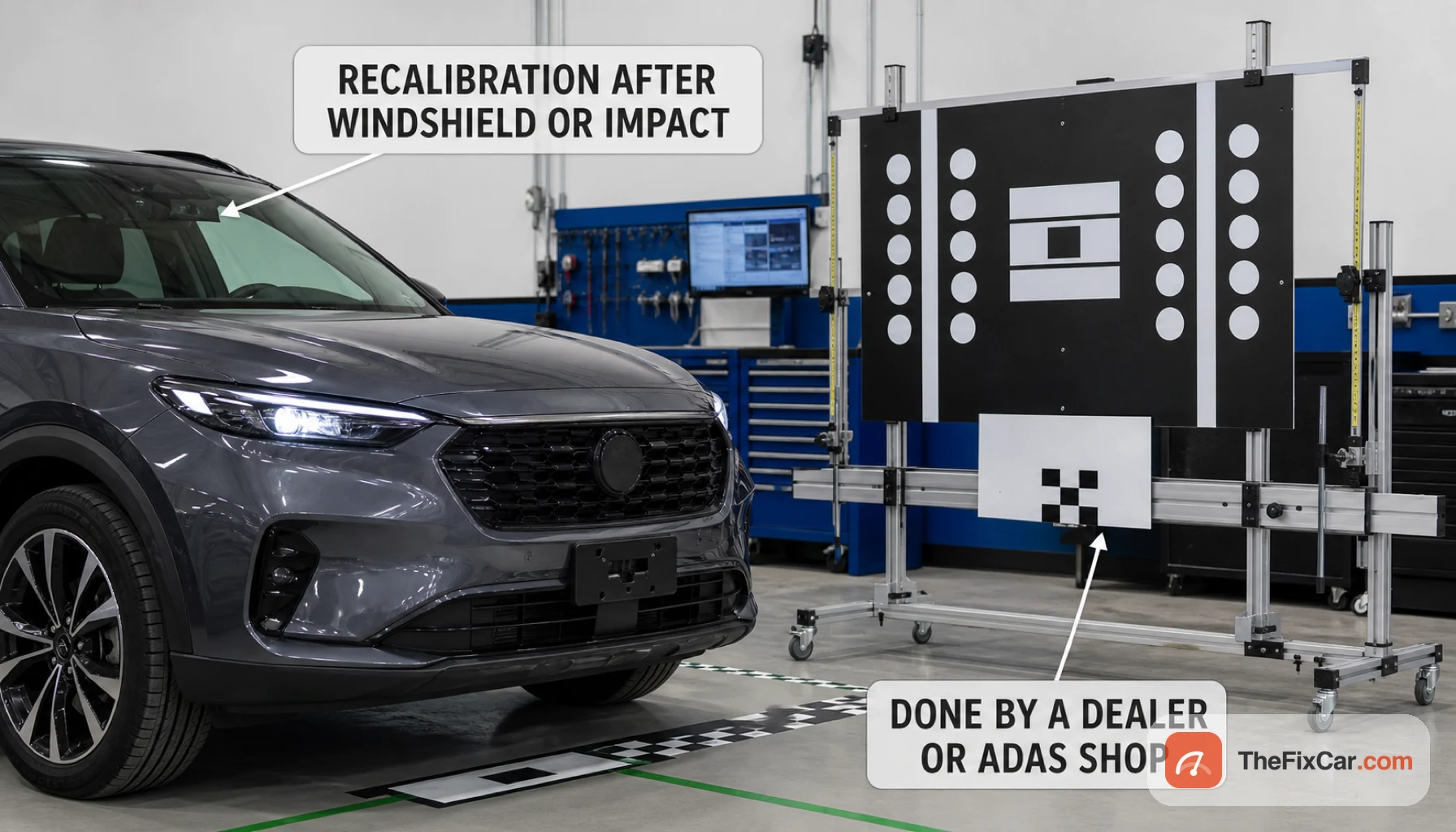
- Calibration fault: the camera or radar reads as out of alignment after windshield or camera work, radar or grille removal, suspension or ride-height changes, or a front-end impact; model-specific procedures determine whether calibration is required.
- Software glitch: a temporary fault that clears with a drive cycle or reset, sometimes addressed by a dealer software update.
- Blown fuse or wiring fault: a loose connector or failed circuit to the sensor keeps the system offline.
- Failed radar or camera: less common, but a faulty sensor keeps the message on even after cleaning and a good battery.
What to check first
- Note when it appeared. After a cold night, a jump start, or alongside a battery warning points to the 12-volt battery, so have it load tested.
- Clean the front emblem and lower grille where the radar sits, and the windshield in front of the camera near the mirror, to rule out a simple blockage.
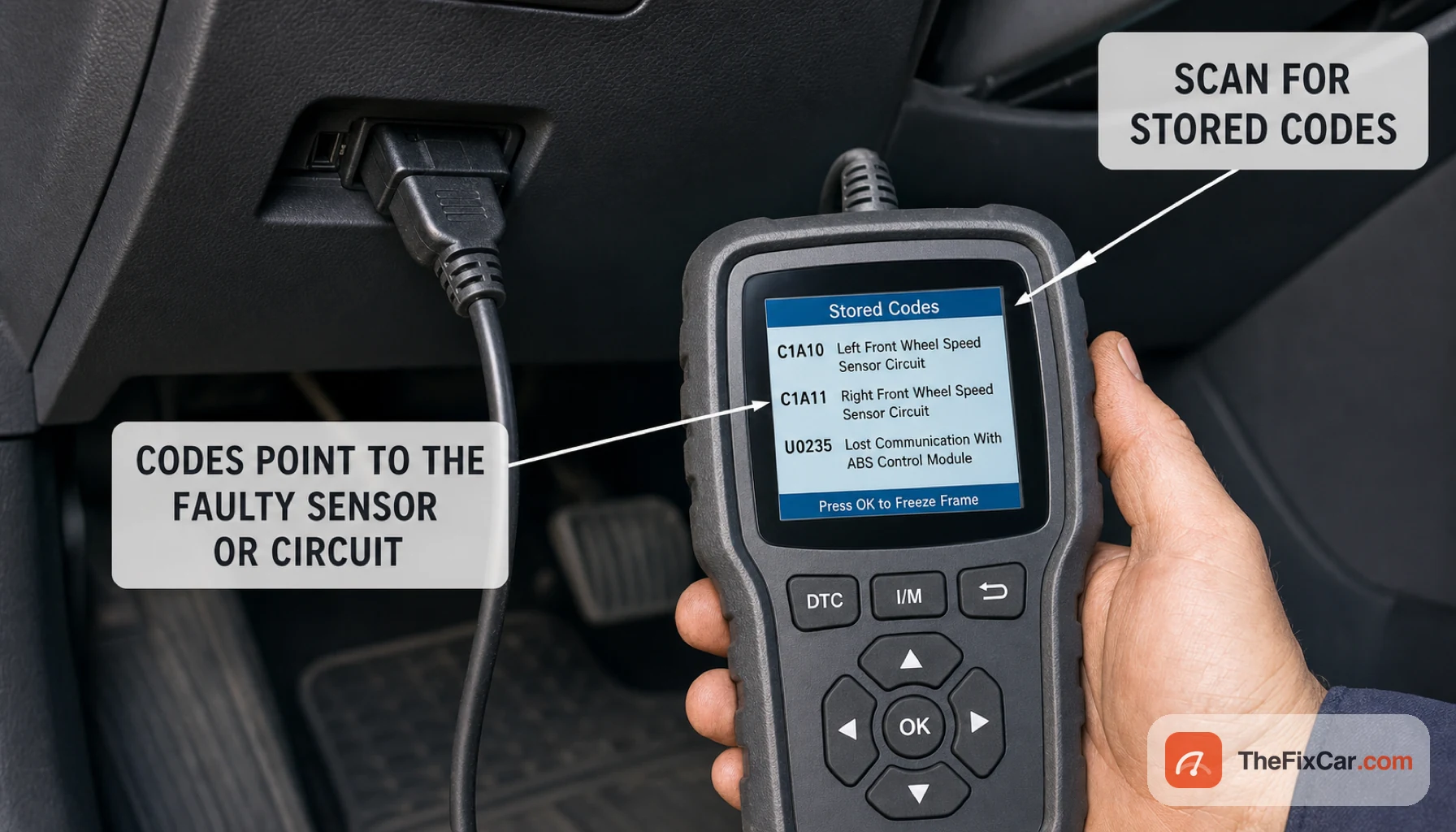
- Scan for stored trouble codes with a Toyota-capable tool; the codes point to which sensor or circuit is involved.
- Read and record any trouble codes before clearing anything. A normal drive cycle can clear a one-time glitch, but recalibration may still be needed. Do not disconnect the battery solely as a reset unless the model’s service information permits it and you understand the required initialization steps.
- Check recent history. After a windshield replacement, radar or grille removal, a bumper replacement or a front-end knock, look up the model’s service information: Toyota’s C-HR manual, for example, requires radar recalibration when the radar or grille is removed or the bumper replaced, and a dealer inspection after a strong impact[9]. Other models have their own rules.
- If the message returns in clean, dry conditions with a healthy battery, have it diagnosed by a dealer or a qualified ADAS shop.
By model: what Toyota’s own bulletins say
The wording of the message is shared across Toyota and Lexus models, but the documented causes are not. Toyota has published campaigns and bulletins for specific models, and they point at different parts of the system: water in the radar on two pickups, a software issue in the camera on other models, a radar that was never switched on at the factory on another. If your car is on one of these lists, start there before paying for diagnosis.
| If you have | Toyota document | Check first |
|---|---|---|
| Tacoma or Tundra, 2018 to 2019 | Special Service Campaign K0B | Water in the radar behind the emblem; aftermarket grille, grille guard, lift or oversized tires block the campaign |
| Sequoia, Tacoma, Tundra 2018 to 2021 or 4Runner 2020 to 2021 with a lift, bars or oversized tires | T-SB-0026-20 | The modification itself; Toyota’s documented option is to disable the system, not repair it |
| Camry or Camry Hybrid, 2018 to 2020, code C1AAE | T-SB-0005-20 | Non-genuine windshield or an aftermarket camera heater hood |
| Corolla Cross 2023, bZ4X 2023, Sienna Hybrid 2021 to 2023 | Special Service Campaign 25TC03 | Camera software below version 02.02; free update and, if damaged, free camera |
| C-HR 2021 (US); Yaris, Yaris Cross, GR Yaris, C-HR built May 2020 to July 2021 (NZ) | Recall 22V-107 / NZ sensor inspection | Radar never initialized at the plant; no warning shown at all |
| HiLux or Fortuner | None found | Bars, lift, taller tyres, dirt on the emblem, front-end knock, then the 12-volt battery |
| Corolla, RAV4, Prius, Lexus NX, RX, ES, IS | None found | The general checklist above; windshield, grille, bumper and impact history first |
Campaigns and bulletins apply to VIN ranges, trims and markets, and all but the New Zealand notice above are US documents. Before asking a dealer to apply one, check your VIN on Toyota’s recall lookup or ask the dealer to confirm coverage; a bulletin for a US truck is a lead for the same model elsewhere, not a procedure your dealer is bound to.
Tacoma and Tundra, 2018 to 2019: water in the radar behind the emblem
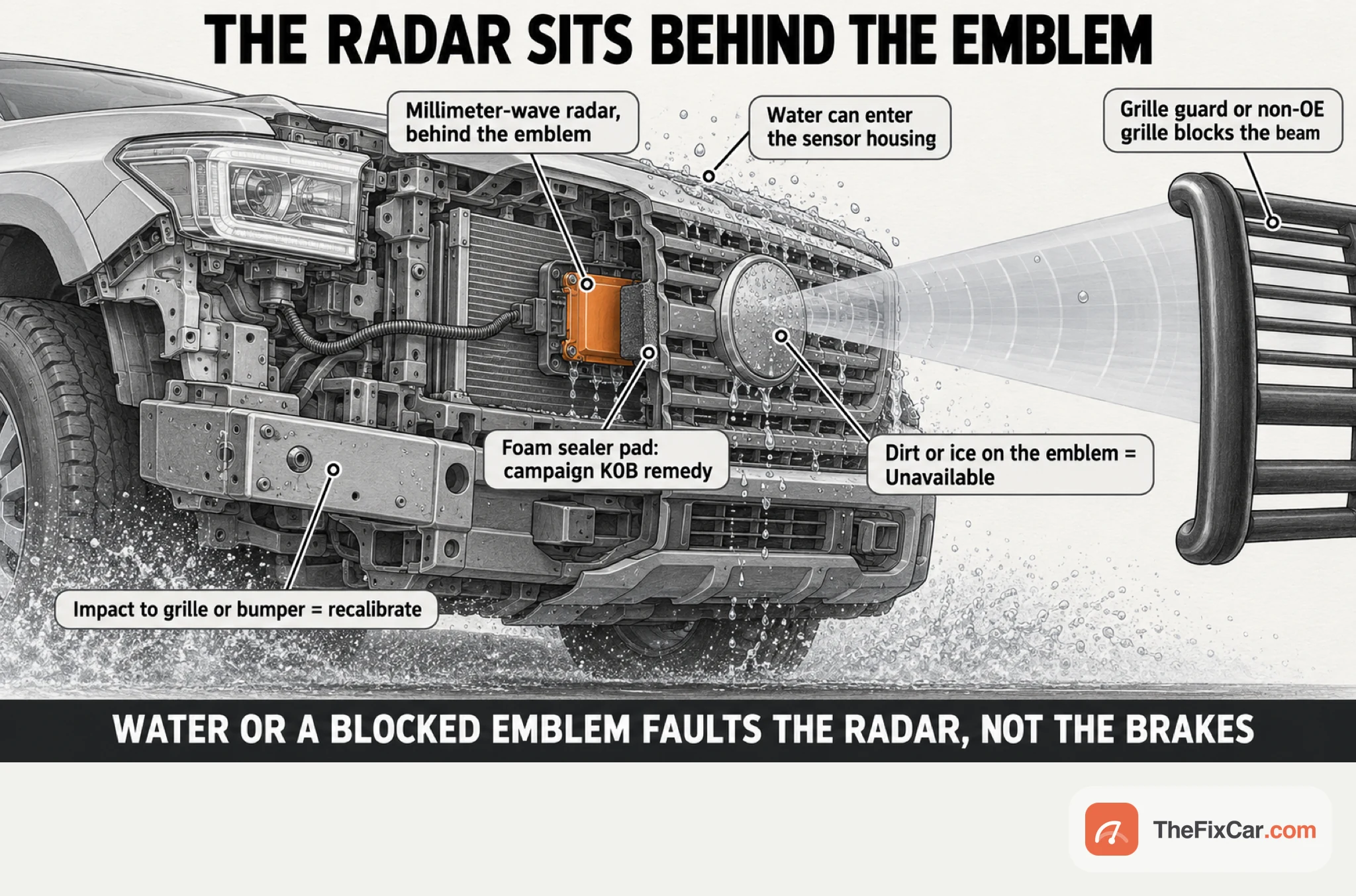
Toyota’s Special Service Campaign K0B covers certain 2018 to 2019 Tacoma and Tundra vehicles. The millimeter-wave radar sensor “is located behind the Toyota emblem of the radiator grill,” and Toyota states that “due to the mounting of one of the system’s sensors, it is possible for water to enter the sensor. This can lead to PCS deactivation or inadvertent brake activation resulting in limited deceleration for a short duration of time”[1]. The remedy is a foam EPT sealer pad applied to the grille and the sensor “to seal against water and dirt,” a check for an updated Pre-Collision 2 calibration ID, and a new sensor when the DTC diagnosis calls for one[1]. The campaign applies to those two models and years; the same symptoms on a different Toyota are not covered by it.
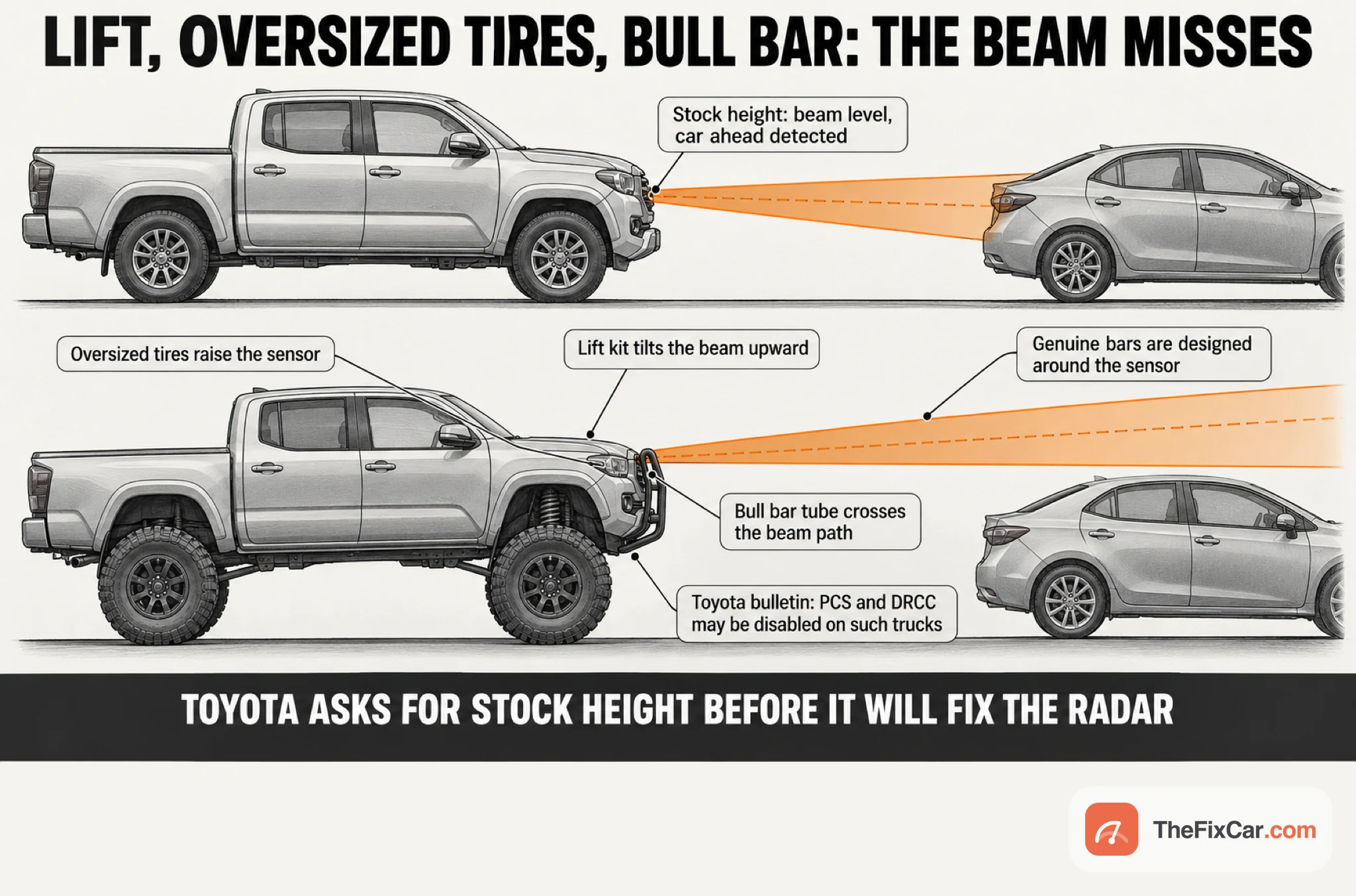
One detail in K0B matters beyond those two trucks: the technician is told to check for an aftermarket grille or a “front bumper or grille guard that could interfere with the view of the MWRS,” and if the vehicle has “a suspension lift or oversized tires,” to tell the owner that “the vehicle needs to be returned to its original condition before this Safety Recall can be completed”[1].
Modified Sequoia, Tacoma, Tundra and 4Runner: the bulletin that disables the system
Bulletin T-SB-0026-20 (Rev1) for 2018 to 2021 Sequoia, Tacoma, Tundra and 2020 to 2021 4Runner says it plainly: “It is recommended to disable the PCS and DRCC systems on vehicles that have been modified (ride height, oversized wheels/tires, brush bars, etc.) in a way that potentially disrupts the functionality of these systems.” The dealer needs the “owner’s written consent,” and once the calibration is done “the PCS and DRCC systems will be PERMANENTLY DISABLED. Replacing the millimeter wave radar is REQUIRED to reinitiate” them[2]. On those four models and years, a lift kit, a brush bar or oversized tires is not a side note: under this bulletin the dealer may offer to disable the system rather than diagnose it, so establish what has been fitted before paying for a diagnosis. The bulletin names only these models and years; it is not a general Toyota policy.
Camry, 2018 to 2020: the camera, the windshield and code C1AAE
Bulletin T-SB-0005-20 describes 2018 to 2020 Camry and Camry Hybrid that “may exhibit one or more of the following conditions: Diagnostic Trouble Code (DTC) C1AAE is displayed. A camera malfunction error message is displayed on the Multi-display Unit and/or hood damage from aftermarket parts is exhibited.” Toyota’s stated possible cause: “These conditions may be caused by an aftermarket forward recognition hood also known as a camera heater.” The repair procedure checks whether the windshield is Toyota genuine (genuine glass carries a Toyota logo) and replaces it if not, and the work is “Not Applicable to Warranty”[3]. If your Camry has a non-genuine windshield or an aftermarket camera heater hood, this is the bulletin that applies.
Corolla Cross, bZ4X and Sienna Hybrid with TSS 3.0: a software issue that can damage the camera
Special Service Campaign 25TC03, published April 17, 2025, covers about 84,600 vehicles: 2023 Corolla Cross and Corolla Cross Hybrid, 2023 bZ4X and 2021 to 2023 Sienna Hybrid. Toyota’s description: “In rare cases, a software programming issue can damage the forward recognition camera. This will result in the Pre-Collision System not working the next time the car is started,” and the owner “may see warning lights, hear chimes, and see the message.” The fix is a free update of the TSS 3.0 camera software to version 02.02 (vehicles that received campaign 23TC01 must have it completed first), and if the camera has already been damaged, a free camera[4]. Toyota adds a line worth remembering for any model: “these warning lights and the warning message may be shown for issues unrelated to this specific issue”[4]. The message by itself does not tell you which of these it is.
C-HR, 2021: the opposite problem, no message at all
Recall 22V-107 (Toyota 22TA02) covers 36,558 2021 C-HR in the US. The radar sensor’s “initialization may not have been completed correctly at the vehicle assembly plant,” so “the radar sensor would not be activated,” and in that state “the vehicle would not display a message or indicator to the driver that PCS is not functional”[5]. Toyota estimated about 0.03 percent of the involved cars actually had the fault; dealers inspect and initialize the sensor free of charge[5]. Toyota New Zealand ran the same inspection on 3,615 Yaris, Yaris Cross, GR Yaris and C-HR built between May 2020 and July 2021[6]. A dash with no warning is therefore not proof that the system works.
HiLux and Fortuner: no bulletin, but the same sensor rules
The HiLux got Toyota Safety Sense across the range in its Safety Sense update: “All models gain pre-collision safety system with day and night pedestrian detection and day cyclist detection (PCS),” together with active cruise control and lane departure alert[7]. We did not find a HiLux- or Fortuner-specific campaign or bulletin for this message in Toyota Australia’s notices or in the US bulletin archive. What Toyota does publish is its position on a common front-end addition on these vehicles: Toyota Australia sells genuine bull bars and states that “they are compatible with Toyota Safety Sense (TSS) technology, parking sensors and airbag deployment”[8]. The page does not describe how that compatibility was tested. Toyota’s US bulletins show the logic from the other side: equipment that “potentially disrupts the functionality” of the radar, such as brush bars or a ride-height change, is treated as a reason to disable the system rather than repair it[2]. Those are documents for US-market trucks; they show how Toyota treats the problem, not a procedure a HiLux dealer will follow. For the Fortuner we found no Toyota document at all; where the vehicle has Toyota Safety Sense, the same front-sensor checks apply.
So for a HiLux or Fortuner that shows the malfunction message, our checklist, in this order: an aftermarket bar, nudge bar, light bar or winch fitted since the last time the system worked; a suspension lift or taller tyres; mud, ice or a sticker on the emblem and grille after farm or beach use; a front-end knock, which Toyota’s C-HR manual says calls for a dealer inspection when “the radar sensor, front grille, or front bumper has been subjected to a strong impact”[9]; then the 12-volt battery, as on any model. A sensor fault is what is left when those are ruled out.
Corolla, RAV4, Prius and Lexus NX, RX, ES, IS
For these models we did not find a bulletin tied to this specific message in the NHTSA bulletin archive or in Toyota Australia’s and New Zealand’s notices. Toyota’s C-HR manual describes the layout as a radar sensor behind the front grille and a camera behind the windshield, with the radar needing recalibration “when the radar sensor or front grille are removed and installed, or replaced” and “when the front bumper is replaced”[9]; check your own manual for the same section. Treat these models with the general checklist above, with the history question first: windshield, grille, bumper, impact.
Is it safe to drive?
Usually, if this is the only warning and the car steers and brakes normally. The pre-collision braking and adaptive cruise will not act while the message is up, so increase your following distance, stay ready to brake yourself, and do not keep driving if braking feels abnormal, the system brakes on its own, or other critical warnings appear. Get it diagnosed soon so you are not relying on a safety system that is offline.
When the problem is urgent
- The car brakes hard on its own for no reason, which is a false activation and a reason to stop using the system and have it checked.
- A battery or charging warning shows at the same time, which suggests the 12-volt battery or alternator is failing.
- Several driver-assist or dash warnings appear together, pointing to a wider electrical fault.
- The message comes right back after a reset in clear weather with a good battery, which indicates a persistent fault that may involve power supply, wiring, network communication, software, calibration, or a sensor.
- It appears after a front-end collision, so the system needs recalibration before you rely on it.
Typical repair cost
These are broad U.S. estimates before tax; model, sensor type, local labor rates, and any required calibration can change the total substantially. These ranges are planning estimates as of June 2026; request an itemized quote showing diagnosis, parts, static or dynamic calibration, and post-repair verification separately.
- 12-volt battery test: often free at a parts store or shop.
- Battery replacement: commonly $150 to $350 for a quality battery, fitted.
- Diagnostic scan: commonly $50 to $150 to read codes and identify the next steps.
- Camera or radar recalibration: typically $150 to $400, often needed after a windshield or alignment change.
- Radar or camera replacement: often $500 to $1,500 or more with parts, labor, and calibration.
Can a weak battery cause Pre-Collision System Malfunction?
A weak 12-volt battery is one of the easiest causes to rule out first, especially if the warning appeared after a cold start, jump-start, or alongside multiple dash warnings. The radar, camera, and braking modules need steady voltage; an aging 12-volt battery or a cold-start dip can drop below what they expect, so the system flags a fault to stay safe. If testing confirms low voltage, charging or replacing the battery may resolve voltage-related warnings; persistent warnings still require code-based diagnosis.
Can I reset the Pre-Collision System Malfunction myself?
A normal drive cycle may clear a temporary glitch. Avoid disconnecting the 12V battery just to reset the warning unless the owner’s manual or service procedure allows it, because stored codes and initialization data may be lost. If the warning returns, the system needs a proper scan and likely a recalibration rather than another reset.
What does “Visit Your Dealer” add to the message?
It means the system logged a fault it could not clear on its own, so it wants the car scanned. It does not always mean a sensor failed; a weak battery, a calibration that drifted, or a software issue can all set it. A scan reads the stored codes and tells the technician whether it is electrical, calibration, or a failed part.