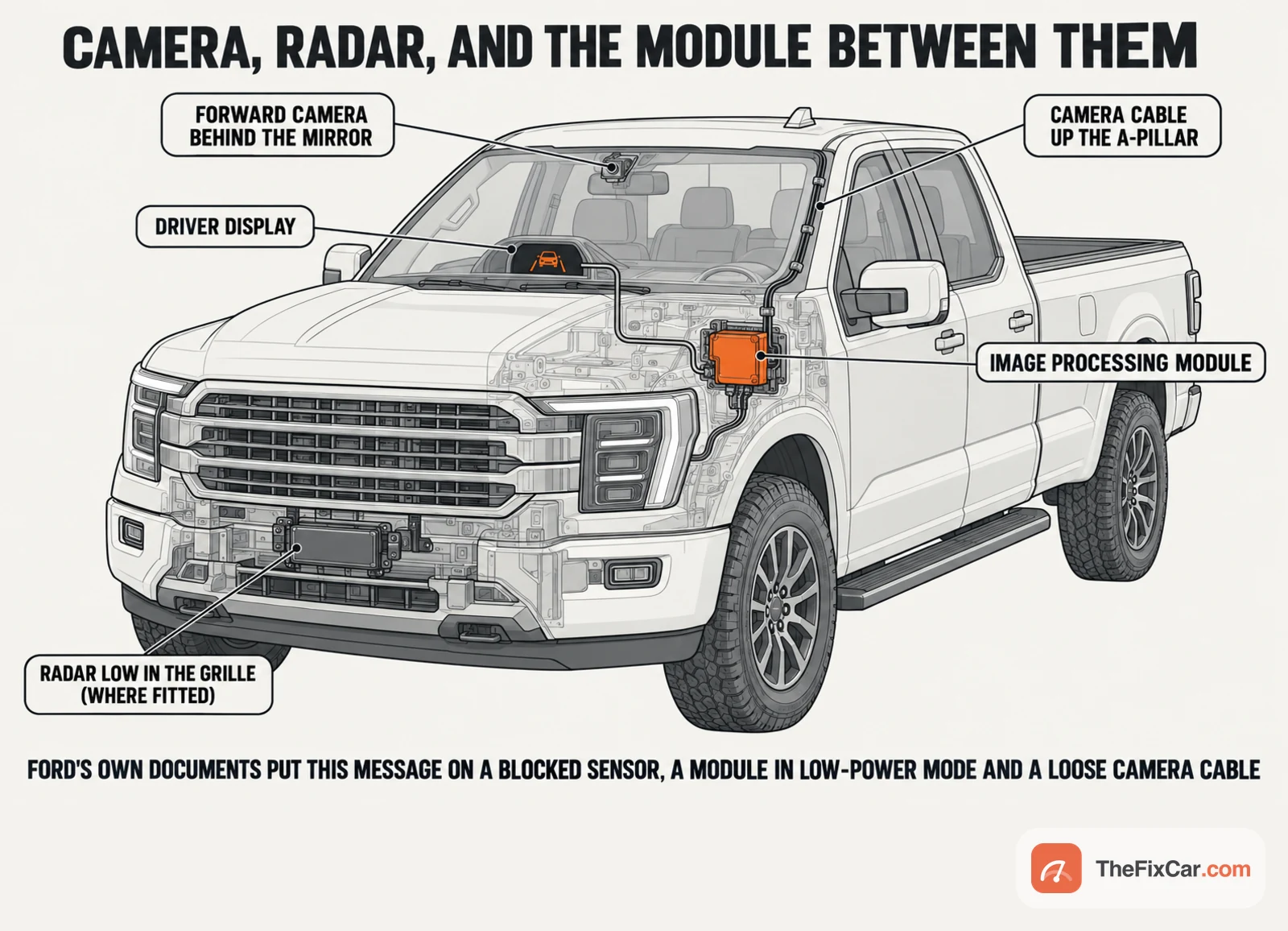
Ford’s manual, in the 2020 Transit edition cited here, lists two versions of this message, and they call for different things. “Pre-Collision Assist Not Available Sensor Blocked” means the camera behind the mirror or the radar in the grille cannot see: the manual’s table for it runs from dirt and snow through heavy weather and camera heat to a misaligned radar, and for the cleanable cases the answer is to clean and wait several minutes.[1] “Pre-Collision Assist Not Available” without the sensor line is a system fault, and the manual’s answer is to have the vehicle checked.[1] The 2021 F-150 manual carries the same two messages with the same split: a blocked sensor from bad weather, ice, mud or water in front of the radar that you can typically clean, against a fault to have checked as soon as possible.[2] Sensor positions differ by model; the manual for the exact vehicle names them. Ford’s own bulletins then add the part the manual does not: on the models they cover, the fault version has arrived after a remote start, on rough roads, and from a coaxial cable working loose behind the A-pillar trim.[3][4][5]
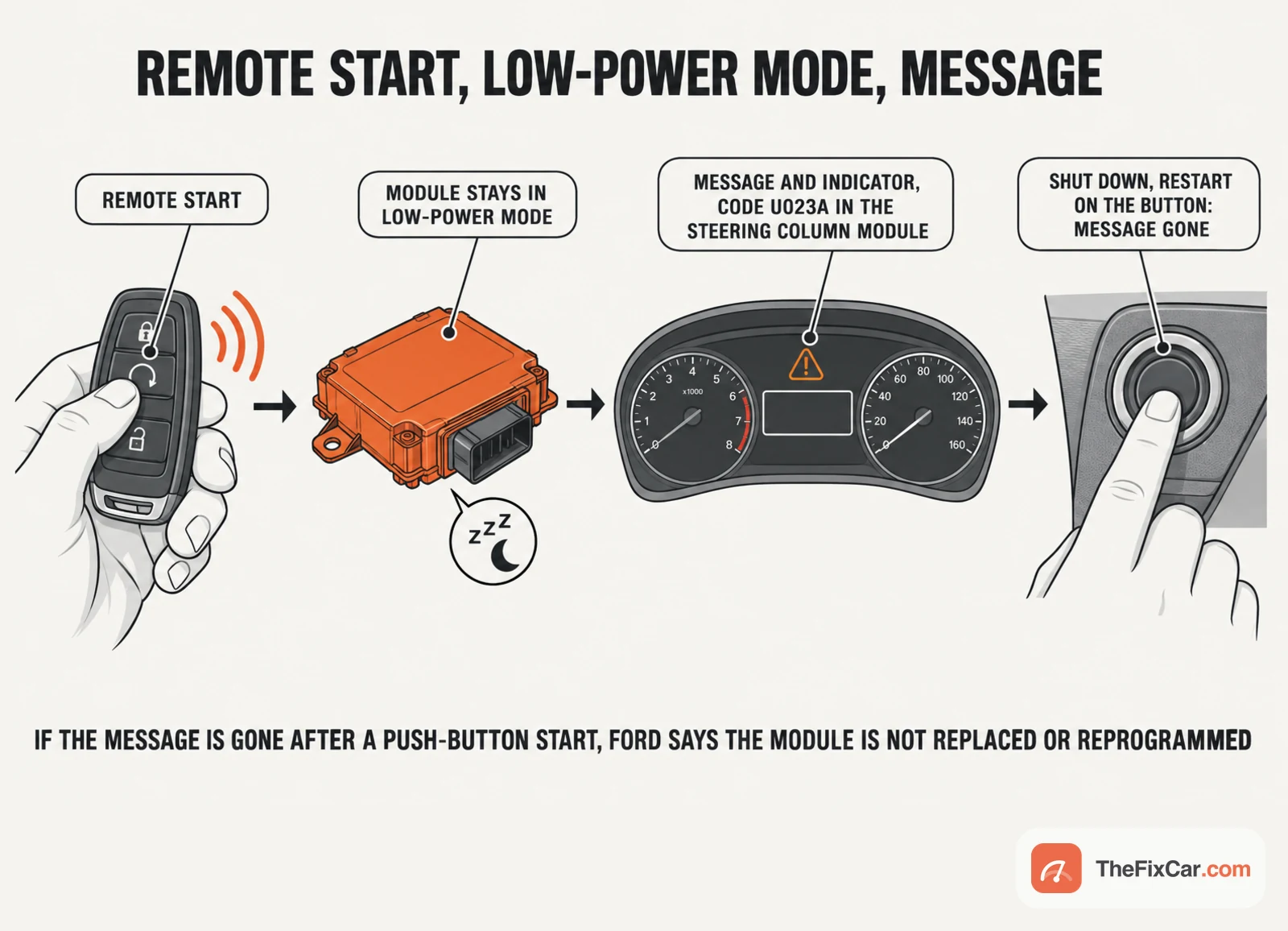
The observation that separates them is cheap: whether the message survives a normal push-button start with a clean windshield. Ford’s 2024 Mustang message that appears only after a remote start, with U023A stored in the steering column control module, is a module stuck in low-power mode, and Ford’s instruction is that if it is gone after a push-button start, the module is neither replaced nor reprogrammed.[3] A message that stays, with codes in the image processing module, is where the bulletins on software, cables and alignment begin.[4][5]
Quick answer: can you keep driving with Pre-Collision Assist not available?
If this is the only warning, the brake pedal feels normal and the vehicle otherwise behaves normally, the conventional brakes remain available; treat Pre-Collision Assist and adaptive cruise control as unavailable and arrange diagnosis if it does not clear. The manual describes the system as an aid that warns, then supports and applies braking, on top of the driver’s own braking.[1] Stop driving if a brake-system warning appears with it, pedal feel changes, or the vehicle brakes by itself. On the SUVs in Ford’s 2026 recall, the same module fault can also take away the rearview camera image, so check the reversing camera before backing up.[6]
| What you see | Where to look | What to do first |
|---|---|---|
| “Pre-Collision Assist Not Available Sensor Blocked” | Windshield in front of the camera behind the mirror; grille in front of the radar; weather | Clean the outside of the glass and the grille surface, then wait several minutes; in heavy rain, spray, snow or fog, wait for the weather[1] |
| “Pre-Collision Assist Not Available” only after a remote start, gone after a push-button start | Code memory: U023A in the steering column control module | On the 2024 Mustang in SSM 52077, nothing is replaced; Ford was preparing a software fix[3] |
| “Front Camera Fault” or “Pre-Collision Assist Fault” on rough roads | Code memory: C1001:78 and U2107:68 in the image processing module | On the 2023 Escape in SSM 52246, reprogram the module and run the alignment[4] |
| “Front Camera Fault Service Required”, Pre-Collision Assist and adaptive cruise inoperative, alignment will not complete | Code memory: C1001:31, U3000:89, U3000:49 in the image processing module | On the 2021 to 2023 Mustang Mach-E in TSB 26-2021: software update first, then the connector check, then coax cable replacement, with camera or module replacement only if the later steps require it[5] |
| Message stays after cleaning and a normal restart, other driver-assist warnings with it | All modules, image processing module included | Codes read before anything is cleared; on the 2025 Explorer and Aviator and the 2026 recall SUVs, Ford’s own documents put the module software on the list, and VIN eligibility for the SSM or the recall is checked first[7][6] |
A guide, not a diagnosis: each row has more than one cause, and the stored code is what narrows it.
Why does this Ford warning appear?
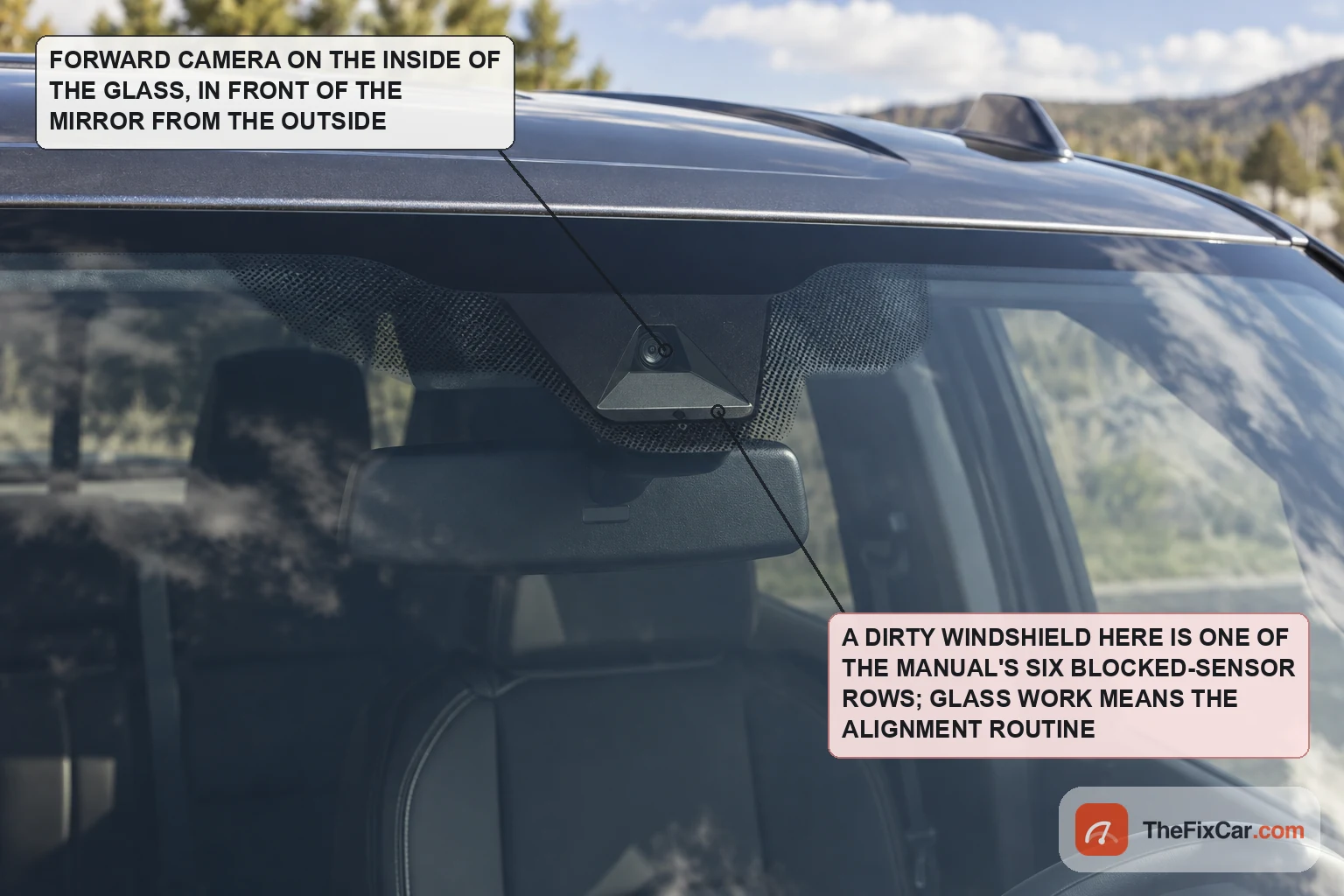
The system uses a forward camera mounted behind the interior mirror and, on equipped models, a front radar; on the Transit whose manual is cited here the radar sits behind the front grille below the license plate. The Ford bulletins discussed here focus mainly on the image processing module, which Ford’s documents call the IPMA, and on its camera connection; other models place the sensors differently, and the wiring information for the exact vehicle says how they connect.[1][4] The message is the display’s word for any of those three being unable to do their job: a blocked lens or grille, a module that is asleep, reset, or running old software, or a camera that has stopped talking to the module over its cable.[3][5][6]
| Symptom | Competing causes | Clues that shift suspicion |
|---|---|---|
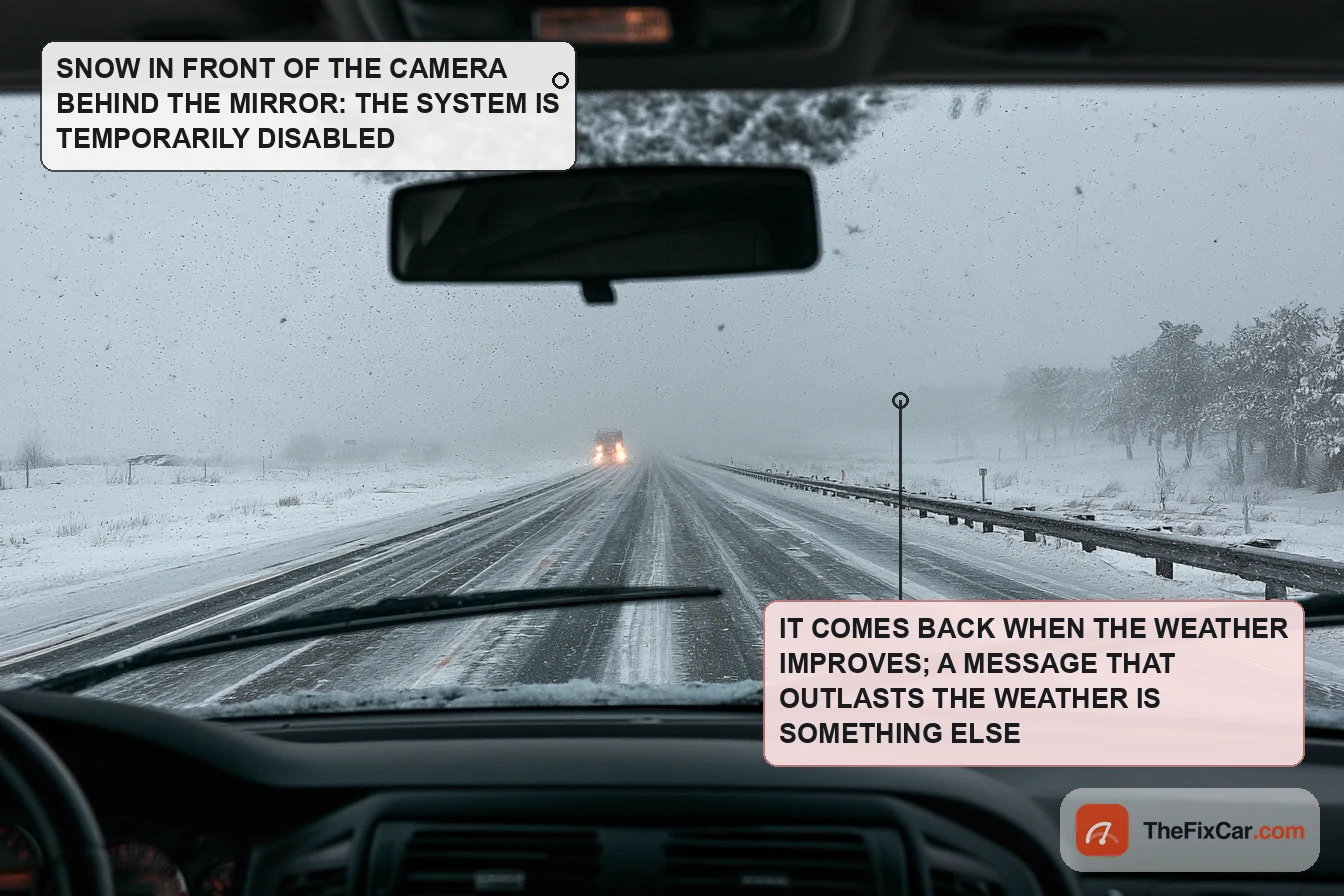
| “Sensor Blocked” in bad weather or after a muddy road, then gone | Dirt, snow or ice on the grille or glass; heavy rain, spray or fog; excessive camera temperature | Clears after cleaning and waiting several minutes, or when the weather changes: the manual’s temporary case. Persists on a clean vehicle in clear weather: the manual says have it checked, and a misaligned radar is on its list[1] |
| “Not Available” only after remote start | Image processing module in low-power mode; a separate fault that happens to coincide | Gone after shutting down and starting on the button, U023A the only code, and the vehicle is a 2024 Mustang: the SSM 52077 case, no repair. Stays after a push-button start: workshop manual diagnosis[3] |
| Camera fault or Pre-Collision fault when the road is rough | Module software (2023 Escape); a camera cable or connector moving with vibration (Mach-E); a loose coaxial connection to a camera (2021 F-150) | C1001:78 with U2107:68 on a 2023 Escape is the bulletin’s software case. C1001:31 with U3000:89 or U3000:49 on a 2021 to 2023 Mach-E sends the technician up Ford’s ladder: software, connectors, coax cables, then camera or module. B115E:15 or B115E:31 on a 2021 F-150 sends them to the camera coax; none of the codes proves the part by itself[4][5][8] |
| Several driver-assist warnings at once, lost-communication codes in other modules | Image processing module not communicating (2025 Explorer and Aviator); module resets in dense traffic (2026 recall population); a network or power fault outside the module | Codes for invalid data or lost communication in modules that should not store them, and warnings that come and go with traffic density, match the two module cases Ford describes; network, power, ground and connector faults can look the same, and the VIN-specific routine separates them[7][6] |
| Message after a windshield replacement or front-end repair | Camera or radar moved and needing alignment; a cable disturbed during the job; glass fitted with the camera bracket out of position | The manual tells owners not to perform windshield repairs near the sensor area, and the bulletins cited here end their module repairs with the alignment routine: whether it was run after the job is the first question, and the vehicle’s service information says whether alignment, initialisation or inspection is required[1][4][9] |
Is the sensor blocked, or is it something else?
The manual’s own table for the blocked-sensor message has seven rows, and only two of them are dirt. A dirty or obstructed radar surface: clean the grille or remove the obstruction. A clean radar with the message still showing: wait several minutes for the system to detect again. Heavy rain, spray, snow or fog: the system is temporarily disabled and comes back when the weather improves. A misaligned radar: have the vehicle checked. A dirty windshield in front of the camera: clean the outside of the glass. A clean windshield with the message still showing: wait several minutes. Excessive camera heat: wait for the temperature to come down.[1] The manual also asks owners to keep the sensors free of snow, ice and large accumulations of dirt, and not to clean them with sharp objects.[1]
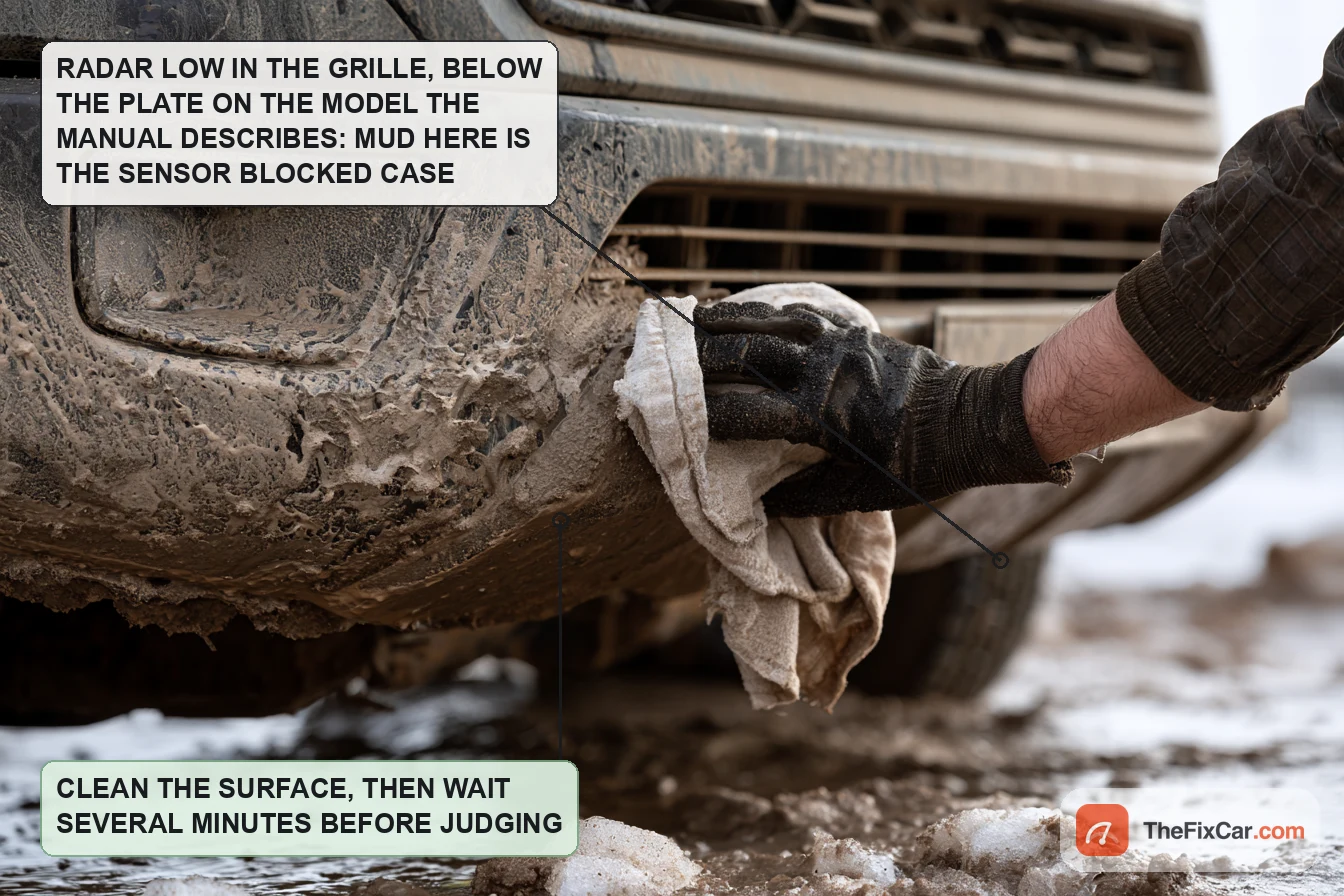
So a blocked-sensor message that persists on a clean vehicle in dry weather, after the wait the manual asks for, is unlikely to be fixed by more cleaning, and the manual’s own table says so: a misaligned radar sits in it next to the dirt.[1] The general logic of a forward sensor that is blocked rather than broken is the same as on the Toyota page about the “clean sensor” warning; what Ford adds is a second message for the fault, so that the wording itself separates the two.
Can you reset it yourself?
Two things, both from Ford’s documents. Shut the vehicle down and start it on the push button rather than by remote start: on the 2024 Mustang in SSM 52077, that alone removes the message and restores the system, and Ford tells dealers that a message which does not return on a push-button start needs no module work.[3] And after cleaning a sensor, wait the several minutes the manual asks for before deciding the cleaning did nothing.[1]
Clearing the codes with a scan tool is not a reset. Each Ford document cited here starts from the stored codes: which module holds them, and which detail code follows the colon. U023A in the steering column module, C1001:78 with U2107:68 in the image processing module, C1001:31 with U3000:89 or U3000:49, B115E:15 or B115E:31: each pair sends the technician down a different path, and a cleared memory erases the evidence that picks the path.[3][4][5][8] One code has its own reset in Ford’s tooling: when diagnosis on a 2021 F-150 reaches U3000:49 that would not clear because of the module’s learned values, and the fix is to reset those values and immediately run the camera alignment, both from the Ford diagnosis tool.[9] How the B-, C- and U-prefixed codes are built, and why a code does not prove a failed part, is on the ADAS DTC code page.
What do Ford’s bulletins say?
Special Service Message 52077 is the document with this exact message in it. Some 2024 Mustangs show “Pre-Collision Assist Not Available” and its indicator after a remote start, with U023A stored in the steering column control module, because the image processing module stays in a low-power mode. The message clears when the vehicle is shut down and started on the button; Ford’s instruction is to confirm that, replace or reprogram nothing if it holds, and told dealers in November 2023 that engineering was working on a fix expected in January 2024.[3] If the message survives a push-button start, the bulletin sends the technician to the workshop manual. That was interim guidance that anticipated later work, so current VIN-specific Ford information is checked before it is applied.
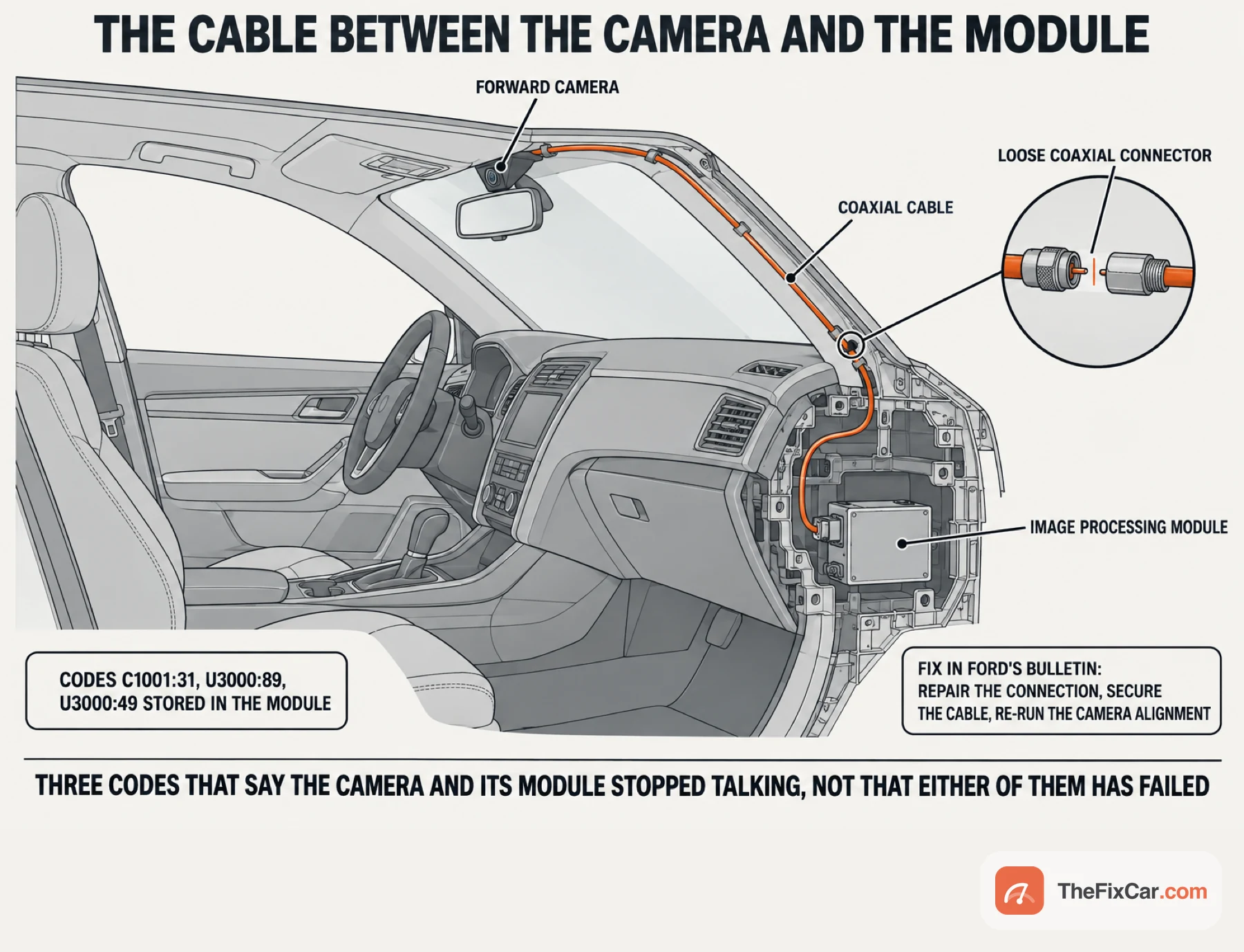
SSM 52246 is the software case. Some 2023 Escapes show “Front Camera Fault” or “Pre-Collision Assist Fault” with C1001:78 and U2107:68 stored in the image processing module when driven on uneven roads; Ford attributes it to the module’s software, and the repair is reprogramming with the latest Ford diagnosis tool software, then the module alignment procedure, a self-test and a code clear.[4] TSB 26-2021, issued in January 2026 and superseding 25-2156, is the cable case: 2021 to 2023 Mustang Mach-E with C1001:31, U3000:89 or U3000:49 and at least one of a “Front Camera Fault Service Required” message, inoperative Pre-Collision Assist, inoperative adaptive cruise, or a camera alignment routine that will not complete. Ford traces it to the connection between the camera and the module, and the procedure is a ladder rather than a single repair. First the module software: if an update is available and it clears the condition, the job ends there. Then the codes: with C1001:31 or U3000:89 stored, or in the vehicle’s 60-day code history, the technician inspects the coaxial cables between camera and module and wiggle-tests the two connectors. A loose connector is reconnected and the codes re-checked. If nothing was loose and the codes come straight back, the camera-to-A-pillar cable is replaced; if the codes do not come back, Ford calls the fault intermittent and directs replacement of both sections of coax, from camera to A-pillar and from A-pillar to module, even without a visible defect, overlaid on the old harness and taped, not zip-tied, near the curtain airbag. If C1001:31 or U3000:89 survive the cable work, the camera is replaced. And if U3000:49 is stored, the learned values are reset and the alignment run; if U3000:49 is still there after the reset, the module is replaced. Labor is claimed as actual time up to seven hours.[5]
Two 2021 F-150 special service messages cover further module cases. SSM 50006 covers an inoperative camera with C1001:01 in the SYNC module and B115E:15 or B115E:31 in the image processing module, traced to a loose coaxial cable or circuit connection, with a wiring-diagram cell to check before any part is ordered.[8] SSM 49684 covers U3000:49 that will not clear, fixed by resetting the module’s learned values and running the alignment.[9] And SSM 53863, for the 2025 Explorer and Aviator, describes the module dropping off the network, leaving driver-assist warnings and lost-communication codes in other modules; the interim fix is a module recovery application, network authentication and the alignment, with Ford advising customers that a permanent repair was to follow.[7] That was interim guidance from 2025; for the 2025 Explorer and Aviator VINs now covered by recall 26V-165, the remedy is the recall’s image processing module software update, over the air or at a dealer.[6]
Is there a recall for Pre-Collision Assist Not Available?
For the message on its own, no recall is cited here. One recall names it as a symptom. In March 2026 Ford recalled 2022 to 2025 Lincoln Navigator, 2024 to 2025 Lincoln Nautilus, and 2025 Lincoln Aviator and Ford Explorer, about 254,640 vehicles by NHTSA’s count, because the image processing module can reset repeatedly when it is overloaded tracking many moving objects in dense traffic, and repeated resets over several ignition cycles can leave the rearview camera image and several driver-assist features off. Ford’s report lists “Front Camera Fault”, “Pre-Collision Assist Not Available” and “Lane-Keeping System Off” among the warnings a driver may see, and the remedy is a module software update, over the air or at a dealer, with owner letters from March 30, 2026.[6][10]

The risk NHTSA records is the lost rearview camera image during reversing; the Pre-Collision Assist message is listed as a warning that accompanies the reset, not as the hazard.[6] On those four SUVs, a message that comes and goes in city traffic and takes the reversing camera with it matches the recall’s symptoms, and eligibility is a VIN check; a message on a truck or car outside that list is one of the bulletin cases above, or something the bulletins do not cover.
Which models, years and codes are covered?
The table lists what a Ford document ties to the message, to the camera fault that travels with it, or to the module behind both; the two 2021 F-150 rows are module and camera cases rather than the message itself. A model year and a code do not by themselves make a bulletin apply: each has its own symptom conditions, and the VIN decides coverage. A model outside the table is not excluded from these causes, but the bulletins do not cover it either, and the repair comes from that vehicle’s own workshop manual.
| Vehicle | Code and condition | Ford document and fix |
|---|---|---|
| 2024 Mustang | U023A in the steering column control module, after remote start | SSM 52077, interim direction of November 2023: no repair if the message clears on a push-button start; current VIN-specific guidance for anything later[3] |
| 2023 Escape | C1001:78 and U2107:68 in the image processing module, rough roads | SSM 52246, module reprogramming and alignment[4] |
| 2021 to 2023 Mustang Mach-E | C1001:31, U3000:89, U3000:49 in the image processing module | TSB 26-2021: software update, connector check, coax cable replacement (both sections if the fault is intermittent), then camera or module replacement only if the later diagnostic steps require it[5] |
| 2021 F-150 | U3000:49 will not clear | SSM 49684, reset learned values, then alignment[9] |
| 2021 F-150 | C1001:01 in the SYNC module; B115E:15, B115E:31 in the image processing module | SSM 50006, inspect the named coaxial and circuit connections from the wiring-diagram cell before ordering parts[8] |
| 2025 Explorer and Aviator | Image processing module off the network; lost-communication codes elsewhere | SSM 53863 interim: module recovery, authentication, alignment; for VINs covered by recall 26V-165, the recall software update[7][6] |
| 2022 to 2025 Navigator, 2024 to 2025 Nautilus, 2025 Aviator and Explorer | Module resets in dense traffic; camera image and driver-assist features lost | Recall 26V-165, module software update over the air or at a dealer[6][10] |
The F-150 appears in the table only through two 2021 cable and code documents. That is not evidence that later F-150s do not show it; it is the limit of what we found published through NHTSA under this wording, and a 2022 or later truck with the message starts from its own stored codes and its own workshop manual.
Can an owner fix this, or is it dealer work?
Owner-side: cleaning the outside of the windshield in front of the camera and the grille in front of the radar, without sharp objects; the wait the manual asks for; on a 2024 Mustang that matches SSM 52077, a shutdown followed by a push-button start in place of the remote start; and a look at what has been fitted in front of the grille. Checking whether the reversing camera still shows an image is also yours, and on the recall SUVs it is the more important check.[1][3][6]
Dealer, or an independent shop with Ford-capable equipment: interpreting the codes, programming, the learned-value reset, the module recovery, wiring repair and the camera alignment. In the bulletins cited here those run in Ford’s diagnosis tool, and Ford’s bulletin on module programming for the 2021 F-150 and Mustang Mach-E warns that the installation fails if the power steering, cruise, rear camera or cluster modules are not at their latest software first; other models carry their own programming instructions.[4][9][11] The cable repair on the Mach-E is trim-off work behind the A-pillar with an airbag nearby; it is a technician’s job in Ford’s document.[5] What camera alignment after new glass involves, and what to check before driving, is on the page about ADAS calibration after windshield replacement, and the procedures makers publish for radar and camera aiming are on the OEM ADAS calibration requirements page.
Do not order an image processing module from the message or from a code alone. In the documents cited here, the module-related cases were handled as software first, and the Mach-E ladder reaches the camera or the module only after the software, connector and cable steps have failed to clear the codes.[4][5]
When should you stop driving?
The message on its own removes an assist that the manual describes as a supplement to the driver; it does not say what else has failed. If the pedal feels normal and there are no other warnings, the conventional brakes remain available; treat Pre-Collision Assist and adaptive cruise as unavailable and arrange diagnosis.[1] The answer changes when other systems join in.
- Stop driving if a brake-system warning appears with it, pedal feel changes, or the vehicle has braked hard by itself with nothing ahead.
- If the rearview camera image has gone with the message on a 2022 to 2025 Navigator, 2024 to 2025 Nautilus, or 2025 Aviator or Explorer, do not reverse until the path behind is confirmed clear by an unobstructed direct view or a spotter, and arrange the recall remedy: the lost image is the hazard in the 2026 recall, and the software update is the fix.[6]
- Do not use adaptive cruise control until the message is resolved; in the Mach-E bulletin it is inoperative for the same reason Pre-Collision Assist is.[5]
- Do not test the system by driving at an obstacle. The manual describes it as a supplement to the driver, not a substitute.[1]
FAQ
What does “Pre-Collision Assist Not Available” mean on a Ford?
The system is off and will not warn or brake for an obstacle. With “Sensor Blocked” after it, the camera behind the mirror or the radar in the grille cannot see; on the 2020 Transit manual cited here that covers dirt, weather, camera heat and radar misalignment, and for the cleanable cases the answer is to clean and wait several minutes. Without that line, the same manual treats it as a fault to be checked, and Ford’s bulletins tie it to a module in low-power mode after remote start, module software, and a camera cable, each with its own stored code.[1][3][5]
Can I drive my Ford with Pre-Collision Assist not available?
If the brake pedal feels normal and there are no other brake-system warnings, the conventional brakes remain available, but treat Pre-Collision Assist and adaptive cruise as unavailable and arrange diagnosis. Stop driving if a brake warning appears with it, pedal feel changes, or the vehicle brakes by itself.[1]
Where is the Pre-Collision Assist sensor on a Ford?
On the 2021 F-150, the camera is behind the interior mirror and the radar, where fitted, is behind the fascia cover in the center of the lower grille; the manual adds that front-end damage can shift the radar’s sensing zone and asks for it to be checked.[2] On the 2020 Transit the radar is behind the front grille below the license plate.[1] Locations differ by model; the manual for the exact vehicle names them.
Why does my F-150 say Pre-Collision Assist Not Available in the rain?
Ford’s 2021 F-150 manual says snow, ice, rain, spray and fog can make the system fail or run with reduced function, and that the “Sensor Blocked” message comes from bad weather, ice, mud or water in front of the radar, which you can typically clean. Excessive heat at the camera or a potential misalignment shows as temporary unavailability and clears on its own when the temperature drops or the sensor recalibrates.[2] If the message stays after the weather clears and the glass and grille are clean, weather has stopped being a likely cause, and the truck needs its own diagnosis.
Why does the message appear after a remote start?
On the 2024 Mustang, Ford traced it to the image processing module staying in a low-power mode after remote start, with U023A stored in the steering column control module. Shutting down and starting on the push button clears it, and Ford’s instruction is that no module replacement or reprogramming is needed if it does.[3]
Is there a recall for Ford Pre-Collision Assist Not Available?
Not for the message itself. Recall 26V-165 of March 2026 covers 2022 to 2025 Navigator, 2024 to 2025 Nautilus and 2025 Aviator and Explorer for an image processing module that resets in dense traffic, and lists the message among the warnings it produces; the remedy is a software update. The other cases on this page are service bulletins; whether a given vehicle has a recall is a VIN check, because the message alone does not decide it.[6][10]