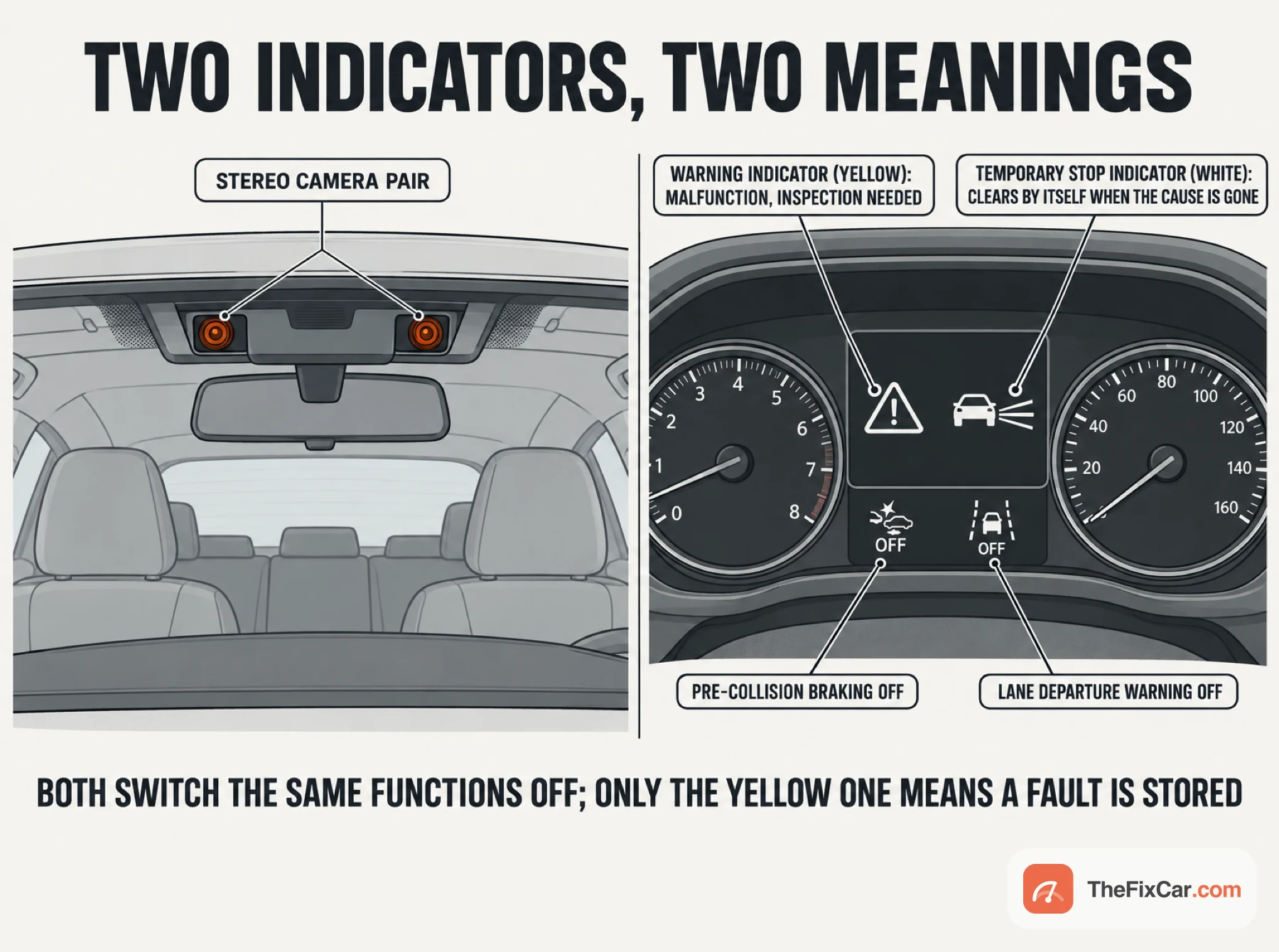
Subaru’s EyeSight manual, in the 2021 supplement cited here, uses two different messages for two different states, and the indicator next to them tells you which one you have. “EyeSight Disabled”, with a second line such as “No Camera View”, “Temp Range” or “Check Manual”, comes with a white temporary-stop indicator, one short beep, and the Pre-Collision Braking OFF and Lane Departure Warning OFF lamps. Subaru’s manual says the system restarts by itself once the cause is gone.[1] “EyeSight Off Check Manual” comes with the yellow EyeSight warning indicator, lit or flashing, and the same two OFF lamps: that is a malfunction, including a stereo camera out of position or angle, and the manual’s instruction is an inspection at a dealer.[1]
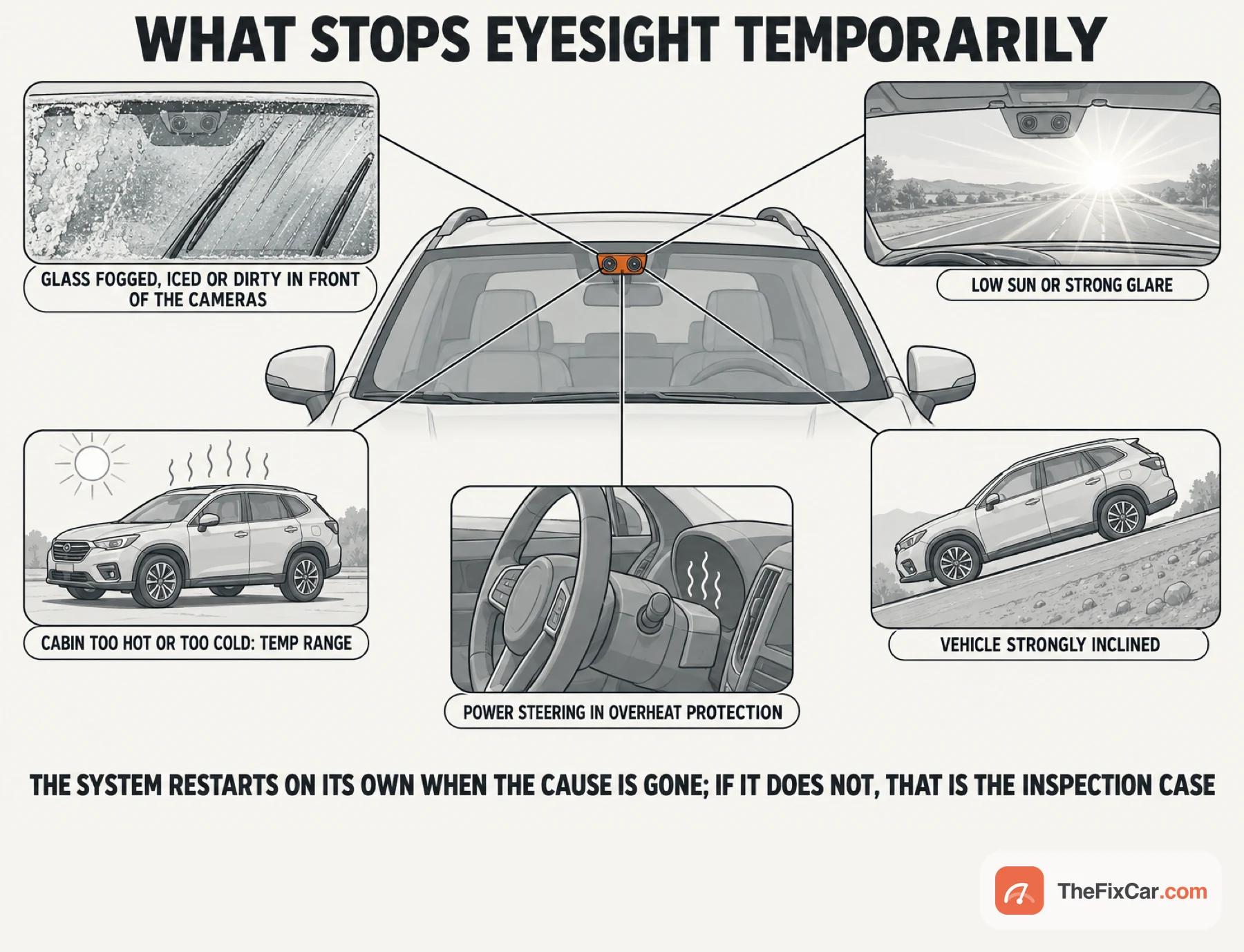
The “EyeSight Disabled” screens the manual lists are glass, weather, glare, cabin temperature and a handful of vehicle states, and for the glass cases the fix is a clean windshield; for weather, glare and temperature the manual’s fix is time, the system restarting once you have driven for a while and conditions have improved. The exceptions are the ones that do not restart: a brake-pedal switch that the system reads as a lost signal, a battery that dipped to 10 volts, a camera whose cooling fan stalled after a hot, humid park, and a handful of software faults Subaru has reprogrammed under bulletin. Each of those leaves a code on the models Subaru’s documents cover, and the code, read before anyone clears it, is where the separation starts.[2][3][4]
Quick answer: can you keep driving with EyeSight disabled?
If this is the only warning, the brake pedal feels normal and the car otherwise behaves normally, the conventional brakes remain available; treat EyeSight, adaptive cruise and Reverse Automatic Braking as unavailable and drive as you would in a car without them. The manual says normal driving is still possible with the system stopped, and that during a temporary stop no EyeSight function can be used except conventional cruise control.[1] Stop driving if the brake warning appears with it, braking feels abnormal, or the brake lights do not work. A VDC warning with it does not by itself mean the hydraulic brakes have failed, but it moves the car to diagnosis now; and the CHECK ENGINE light on at the same time is the combination the manual singles out for a repair as soon as possible.[1]
| What you see | Where to look | What to do first |
|---|---|---|
| “EyeSight Disabled No Camera View”, white indicator | Windshield in front of the twin cameras, inside and out; weather; low sun | When parked, clean the glass in front of both cameras; the system restarts once conditions improve[1] |
| “EyeSight Disabled Temp Range”, white indicator | Cabin temperature after the car sat in sun or hard frost | Let the cabin come back into range; it restarts on its own[1] |
| “EyeSight Disabled Check Manual”, white indicator | Start-up, steep incline, three secondary-braking events, engine stopped, power steering in overheat protection, steering wheel removed, wheels out of balance or alignment | Resolve the cause and wait; if it never restarts, inspection[1] |
| “EyeSight Off Check Manual”, yellow warning indicator lit or flashing | Malfunction or camera misalignment; codes in the stereo camera | Stop safely, restart the engine once; if the indicator stays, dealer inspection with codes read first[1] |
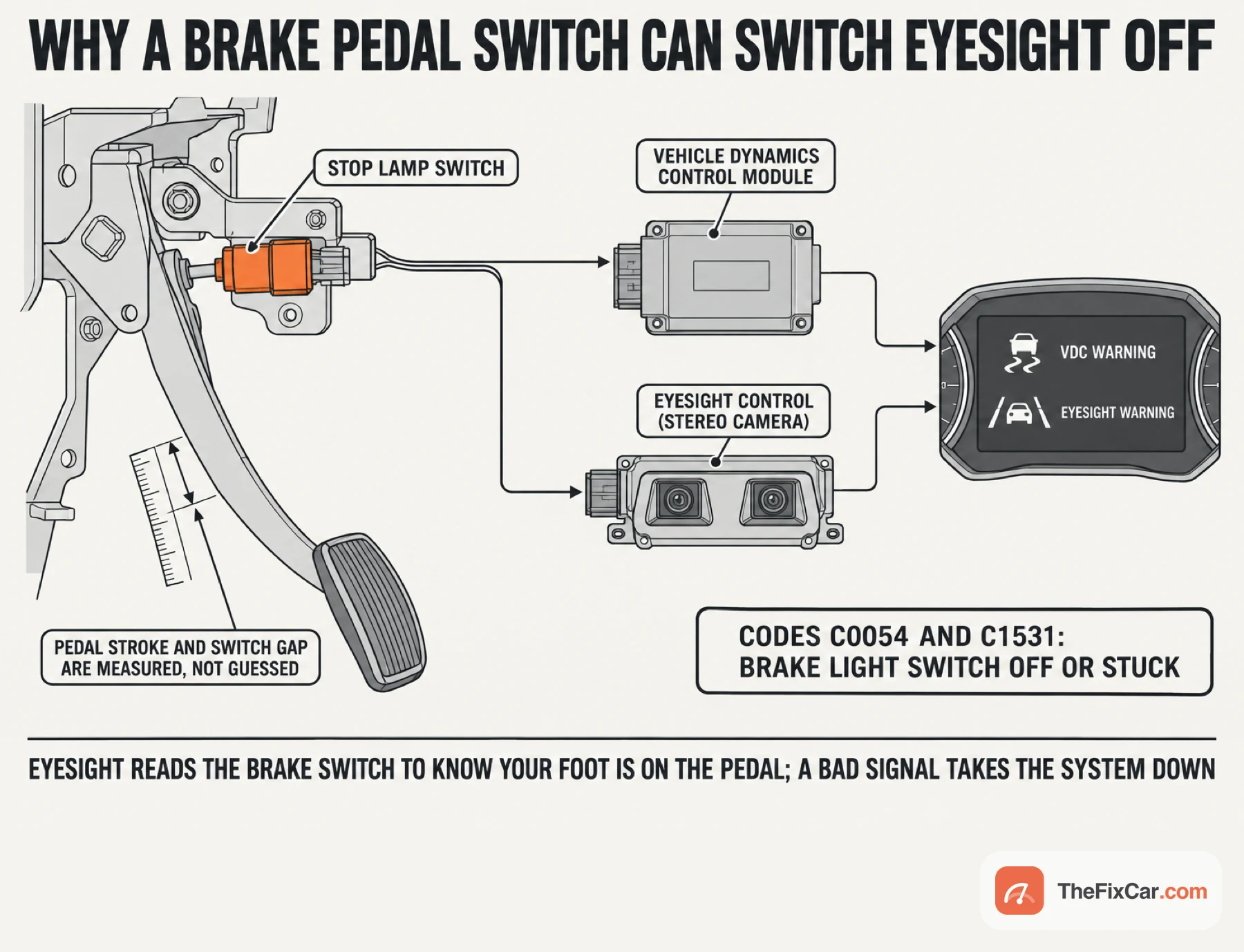
| EyeSight warning together with the VDC warning | Brake lights, then the stop-lamp switch and its circuit | Check the brake lights work; if they do not, stop driving. On vehicles covered by bulletin 07-131-18 or recall 19V-149, check campaign status by VIN and treat C0054 or C1531 as system codes, not proof of a failed switch[4][5] |
| EyeSight warning right after a jump start, dead battery or long crank | Battery voltage during the event | On the years in SIB 18-218-22, ask whether B281C is stored; Subaru’s trigger there is a dip to 10 volts or below[3] |
A guide, not a diagnosis: each row has more than one cause, and the stored code is what narrows it.
Why does the EyeSight Disabled message appear?
EyeSight’s primary forward sensor is a stereo camera pair mounted near the top of the windshield, one lens either side of the mirror; some newer models add a third wide-angle camera, but the stereo pair remains the basis of the system, and it needs both lenses. The manual says that if even one lens is obstructed the system does not operate properly, and it lists a fogged or dirty windshield, poor weather, strong light from the front, complete darkness, a uniformly white snow-covered scene, reflections in the glass, a smeared lens, and a camera knocked out of alignment by a strong impact as reasons the system either misreads the road or stops.[1] Beyond the cameras, Subaru’s own documents show two outside inputs taking EyeSight down with a warning on the models they cover: the electronic power steering module going undetected after a voltage dip to 10 volts or below, and a stop-lamp switch that is faulty or out of adjustment.[3][4]
| Symptom | Competing causes | Clues that shift suspicion |
|---|---|---|
| “EyeSight Disabled” comes and goes on the same drive | Fog or film on the inside of the glass; rain, snow or spray; low sun; wiper streaks in front of the cameras | Returns in the same weather or at the same time of day and clears after some driving once conditions improve: the manual’s temporary-stop case. Stopping “repeatedly” and “several times” is the manual’s own wording for when to have it inspected[1] |
| “EyeSight Disabled Temp Range” on a hot or freezing morning | Cabin temperature outside the camera’s range; on 2023 to 2024 Ascent, Legacy and Outback, 2024 Impreza and Crosstrek, 2022 to 2023 WRX and 2022 to 2023 Forester, a camera cooling fan that stalled after a hot, humid park, DTC B28C7 | Clears as the cabin normalises: temperature. Stays after the cabin is comfortable, or B28C7 is stored with the fan-speed detail codes the bulletin names: check whether the bulletin’s reprogramming applies[1][2][6] |
| “EyeSight Off Check Manual” with the yellow indicator, stays after a restart | Stereo camera fault (B28A6 internal communication on covered models); camera position or angle after a windshield, mirror or collision job; power steering not detected (B281C); brake switch signal | Restart clears nothing and a camera code is stored: camera-related circuits, installation and module communication, worked through with that vehicle’s service information; the code sets the starting point, not the failed part. Appeared after a jump start or a battery that went flat on a covered year: B281C at 10 volts or below. Appeared with the VDC lamp: the stop-lamp circuit[1][7][3][4] |
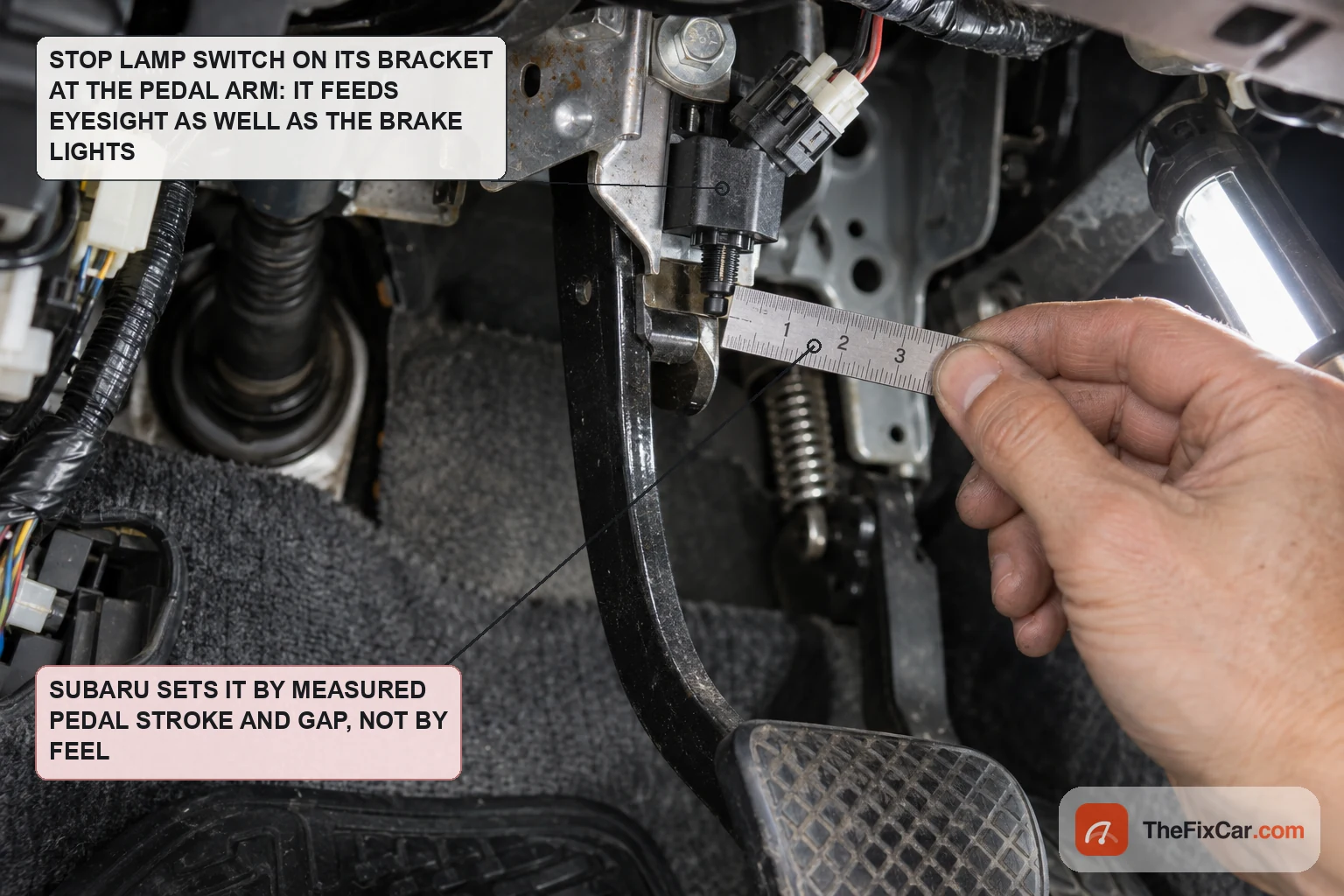
| EyeSight and VDC warnings together, brake lights doubtful | Brake lamp switch failed or out of adjustment (C0054, C1531); wiring to the switch; a switch contaminated by silicone gas on the 2019 recall population | Brake lights that do not come on with the pedal make the stop-lamp circuit the first thing to test: switch, fuse, wiring and lamps; Subaru’s adjustment bulletin measures pedal stroke and switch gap rather than guessing[4][5] |
| EyeSight warning with the CHECK ENGINE light | Engine or transmission fault that EyeSight refuses to work alongside; separate faults at the same time | The manual says EyeSight cannot be used with an engine abnormality and asks for a repair as soon as possible: read the engine codes first, the EyeSight warning may be a consequence[1] |
Temporary stop or malfunction: which one do you have?
Look at the colour of the indicator before you read the words. A white temporary-stop indicator means the system chose to pause and is expected to come back; the manual’s own action for every “EyeSight Disabled” screen is to remove the cause and wait, and to contact a dealer only if the system does not restart after the conditions have improved and time has passed.[1] A yellow warning indicator, steady or flashing, means the system has found a malfunction, in the camera, its position, or an input it depends on, and the manual’s action is the opposite: stop in a safe place, turn the engine off and on once, and if the indicator is still there, all EyeSight functions are stopped until a dealer inspection.[1]
The temporary causes are broader than dirt on the glass. The manual lists system start-up, a strongly inclined vehicle, secondary braking that has already operated three times since the engine was started, the engine stopped, the electronic power steering in overheat prevention after the wheel was worked at a standstill, a steering wheel that has been removed and refitted, and wheels out of balance or alignment, all under the “Check Manual” version of the disabled screen.[1] Two of those follow ordinary shop work: an alignment left outside specification, and a steering wheel off for an airbag or clock-spring job.
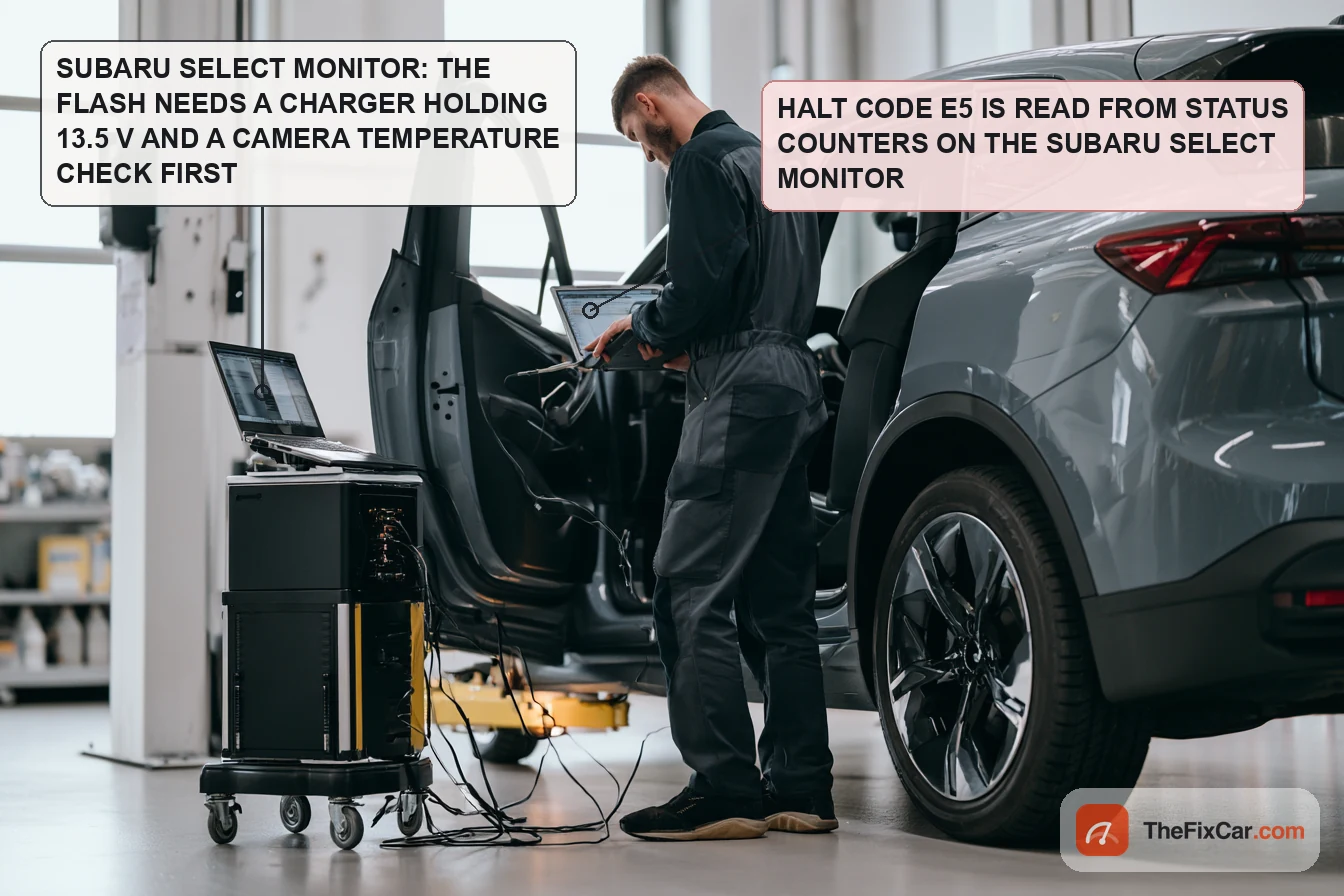
Temperature has its own screen, and it has its own bulletin. The manual’s “Temp Range” case is a cabin left in bright sun or hard cold, and the fix is time.[1] On 2023 to 2024 Ascent, Legacy and Outback, 2024 Impreza and Crosstrek, 2022 to 2024 WRX and 2022 to 2024 Forester, Subaru found a camera whose cooling fans became inoperable after the car sat unused in high humidity and heat, storing B28C7 with a fan-speed detail code, and released reprogramming for it; the same files cover the E5 halt code, where the camera enters a temporary halt and Subaru reads specific status counters on the Select Monitor before flashing. The scope is not uniform: the 2024 WRX and the 2024 Forester are inside the E5 case but excluded from the B28C7 case.[2][6][8] A “Temp Range” that outlasts the weather on one of those cars is a reason to check the bulletin’s code and detail-code criteria, not a diagnosis by itself.
Can you reset EyeSight yourself?
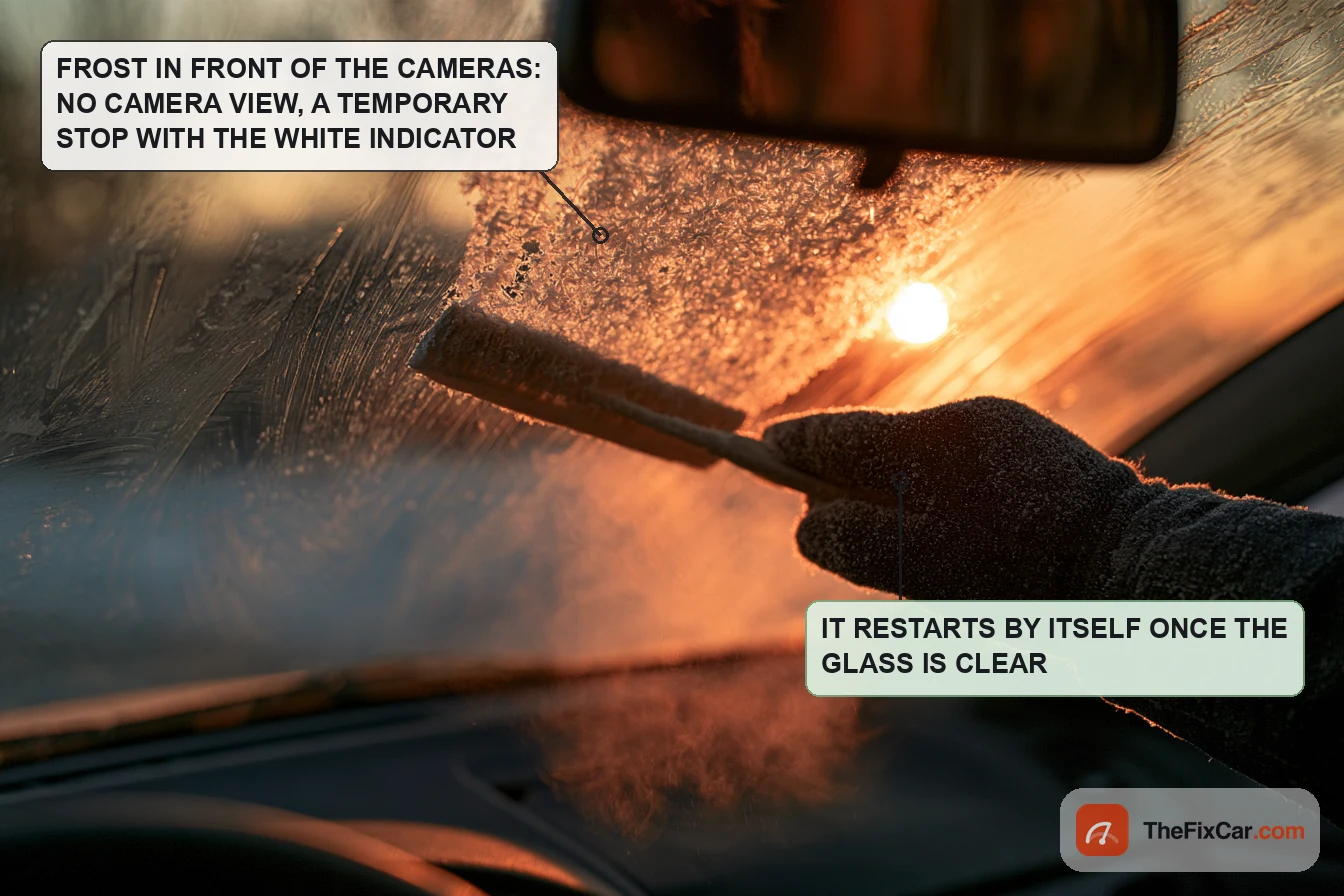
Three things are yours to do, and all three are in the manual. Restart the engine once when the yellow indicator is on. Clean the windshield, outside and inside, in front of both camera lenses, without touching the lenses: the manual says fingerprints smear them, and it asks that the camera covers be covered when a service station cleans the inside of the glass.[1] And wait out weather, glare and temperature, because the temporary stop cancels itself.[1]
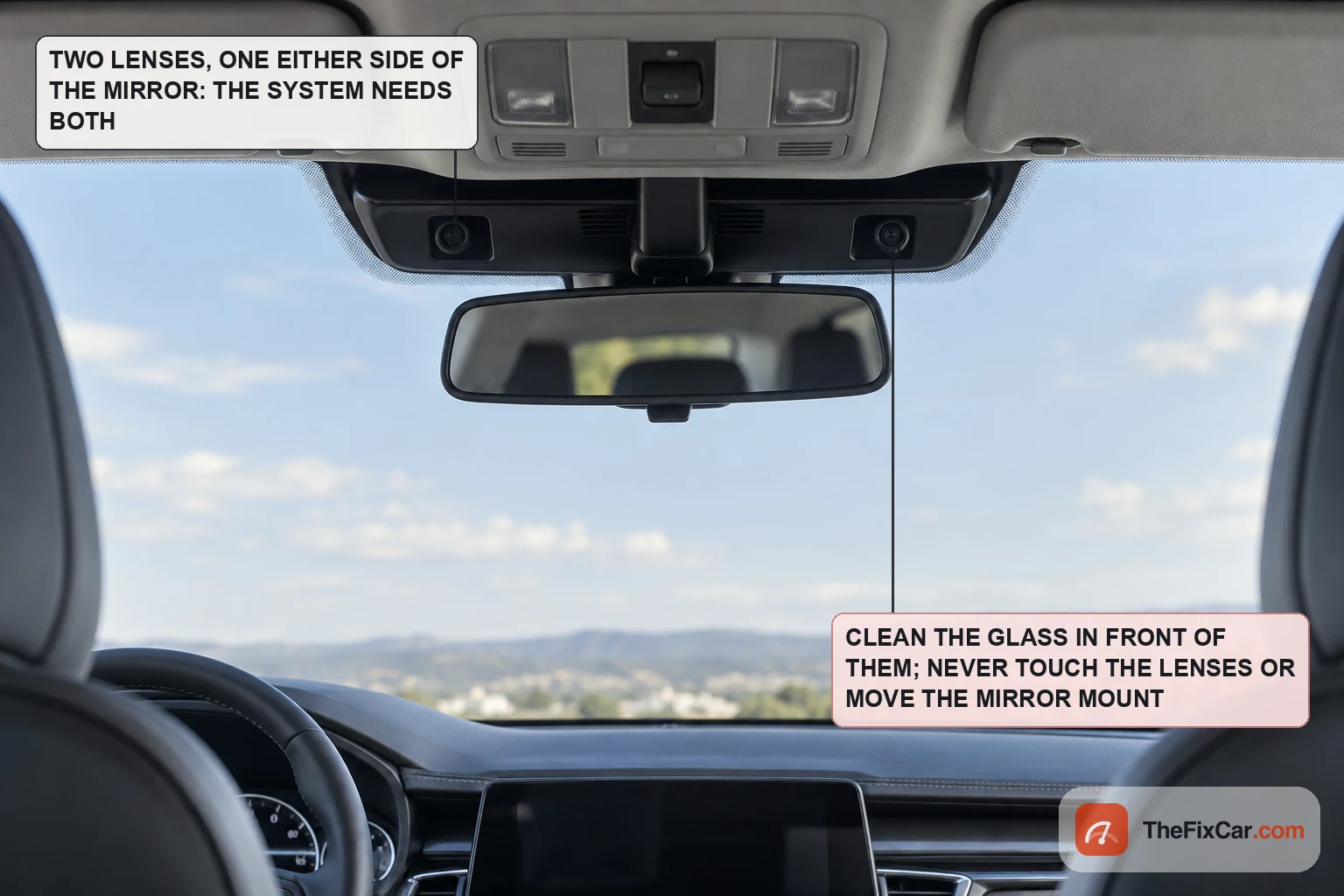
Three things are not. Do not remove, disassemble or knock the stereo camera, do not change where it or the surrounding structure sits, and do not fit a non-genuine rearview mirror; the manual forbids all of them because the pair depends on its geometry.[1] That is also why a windshield replacement, a collision repair around the mirror mount, or a strong impact can end in the yellow malfunction indicator with “position/angle misalignment of stereo camera” as the manual’s stated cause, and why the OEM procedure for that job decides whether the camera is aimed afterwards, at a dealer or a calibration shop. What that calibration involves, and what to check after new glass, is on the page about ADAS calibration after windshield replacement.
Clearing the codes with a scan tool is not a reset either. The 2024 reprogramming bulletins cited here start by asking whether a specific code is stored and then read its failure detail code and freeze-frame data to decide whether the software applies; a cleared memory erases that evidence, and the fault may have to recur before anyone can act on it.[2] How the B-, C- and U-prefixed codes are built, and why a code does not prove a failed part, is on the ADAS DTC code page.
What do the Subaru bulletins say?
Bulletin 07-225-24R, for 2023 to 2024 Ascent, Legacy and Outback, and its sibling 07-226-24R, which in its April 2025 revision covers 2024 Impreza and Crosstrek and 2022 to 2024 WRX, are the software documents discussed here; bulletin status is confirmed by VIN before either is used. Three symptoms on the first, two on the second: the stalled cooling fans and B28C7 after a hot, humid park, which 07-226-24R applies to every covered model except the 2024 WRX; the E5 temporary halt, which applies across both; and, on the Ascent, Legacy and Outback only, B28A6 internal stereo camera communication with a specific detail code. Being in the model-year list is not the test: each symptom has its own code, detail-code and status-counter criteria, and the reprogramming applies only when they are met. The repair is reprogramming the stereo camera through the Subaru Select Monitor with a charger holding 13.5 volts and the camera below 176°F, and both bulletins state that no camera recalibration is needed afterwards. The 2022 WRX has its own caution: its reprogramming goes through a different file type, the tool does not check whether the latest software is already installed, and Subaru warns that flashing a camera that already has it will damage the assembly. Later production has the software from the factory, with starting VINs listed per model. Bulletin 12-253-23R, revised in April 2025, is the Forester version of the same fix for 2022 to 2024 cars, with B28C7 limited to 2022 to 2023.[2][6][8]
Bulletin 07-209-22R, revised in March 2024, covers the 2022 Forester and a different B28A6 problem: the camera’s self-diagnosis flagging an internal communication fault that was not real. The new software tightens the self-diagnosis, and Subaru requires that any genuine faults be diagnosed, repaired and cleared before the flash.[7] Service Information Bulletin 18-218-22 explains one that, on the models it lists, looks like a camera fault and is not: when battery voltage drops to 10 volts or below, the EyeSight control module cannot see the electronic power steering module, sets B281C and shuts EyeSight off with a warning on the meter. Subaru corrected the diagnostic tree for 2020 to 2022 Legacy and Outback, 2017 to 2022 Impreza, 2018 to 2022 Crosstrek and 2019 to 2022 Forester and Ascent to include that voltage scenario.[3]
The brake-pedal switch has the longest paper trail. Bulletin 07-131-18 says an improperly adjusted or faulty stop lamp switch can set C0054, C0075 or C1531 and light the VDC or EyeSight warning lamp, and it gives a measured pedal-stroke and switch-adjustment procedure for 2010 to 2018 Legacy and Outback, 2017 Impreza, 2018 Crosstrek and 2008 to 2013 Forester.[4] Recall 19V-149 replaced the brake lamp switch on about 1.3 million 2008 to 2017 Impreza, Crosstrek, Forester and WRX vehicles because silicone gas from consumer products could coat the contacts; Subaru’s notice lists EyeSight operation among the functions that can be lost, and says the brakes themselves are unaffected.[5] Four years earlier, recall campaign WQS-54 reprogrammed EyeSight on 2015 Legacy, Outback, Impreza and XV Crosstrek and 2016 WRX because the system was slow to detect a failed switch, so that after “Obstacle Detected” appeared, automatic braking would not follow.[9]
Which models, years and codes are covered?
The table lists only what a Subaru document ties to an EyeSight message or warning. A model or year outside it is not excluded from these causes, but the bulletins do not cover it either, and the repair comes from that vehicle’s own service information.
| Vehicle | Code or condition | Subaru document and fix |
|---|---|---|
| 2023 to 2024 Ascent, Legacy, Outback | B28C7 fan motor RPM after heat and humidity; halt code E5; B28A6 internal communication | TSB 07-225-24R, stereo camera reprogramming, no recalibration[2] |
| 2024 Impreza and Crosstrek; 2022 to 2024 WRX | B28C7 by the bulletin’s criteria, 2024 WRX excluded; halt code E5 across all listed years | TSB 07-226-24R (rev. April 2025), stereo camera reprogramming; separate file procedure and software-check caution on the 2022 WRX[6] |
| 2022 to 2024 Forester | B28C7 on 2022 to 2023 only; halt code E5 on 2022 to 2024 | TSB 12-253-23R (rev. April 2025), stereo camera reprogramming, no recalibration[8] |
| 2022 Forester | B28A6 detected in error | TSB 07-209-22R (rev. March 2024), stereo camera reprogramming[7] |
| 2020 to 2022 Legacy and Outback, 2017 to 2022 Impreza, 2018 to 2022 Crosstrek, 2019 to 2022 Forester and Ascent | B281C incompatible with EyeSight (EPS) after battery voltage at 10 V or below | SIB 18-218-22, corrected diagnostic tree[3] |
| 2010 to 2018 Legacy and Outback, 2017 Impreza, 2018 Crosstrek, 2008 to 2013 Forester | C0054, C0075, C1531 from the stop lamp switch; VDC or EyeSight warning | TSB 07-131-18, switch measurement and adjustment[4] |
| 2013 to 2017 Crosstrek, 2014 to 2016 Forester, 2008 to 2016 Impreza, 2008 to 2014 WRX | Brake lamp switch contact failure; EyeSight operation among affected functions | Recall 19V-149 (WUE-90), switch replacement[5] |
| 2015 Legacy, Outback, Impreza, XV Crosstrek; 2016 WRX | Delayed detection of a failed brake lamp switch; automatic braking would not occur | Recall WQS-54 (15V-366), EyeSight reprogramming[9] |
What the table does not contain is a cost, a parts number for a camera, or a general claim that EyeSight cameras fail. On every covered vehicle above, the documented repair was software, a switch, or a diagnostic correction. The camera assembly itself is replaced only where the service manual’s own diagnosis lands there, and a stored B28A6 on a 2022 Forester or a covered Ascent is checked against the bulletin’s detail-code criteria before it is a part.[2][7]
Can an owner fix this, or is it dealer work?
Owner-side: the clean windshield, inside and out, with the lenses untouched; the engine restart the manual asks for when the yellow indicator lights; and a wait when the screen says No Camera View or Temp Range. Checking that the brake lights come on with the pedal is also yours; a dead brake light moves suspicion onto the stop-lamp circuit, switch, fuse, wiring or lamps, and the car should not be driven until that is sorted.[1][5]
Dealer, or an independent shop with Subaru-capable equipment and service information: programming, code-guided diagnosis, switch adjustment and calibration. The reprogramming in the 2024 bulletins is done with a charger in power-supply mode holding 13.5 volts and a camera temperature check before the flash, and the halt-code diagnosis reads Select Monitor counters and status values; do not assume a generic scan tool reaches them.[2] The stop lamp switch adjustment in 07-131-18 has the knee airbag module lowered to reach the switch, which is why Subaru wrote it for technicians.[4] Camera position and angle after glass or collision work is aiming equipment specified per vehicle, and the procedures makers publish for it are on the OEM ADAS calibration requirements page.
When should you stop driving?
The message on its own removes an assist that Subaru’s manual calls a supplement to the driver; it does not say what else has failed. If the pedal feels normal and there are no other warnings, the conventional brakes remain available; treat EyeSight and its cruise and reverse braking functions as unavailable and arrange diagnosis.[1] The answer changes when other lamps join in.
- Stop driving if the brake lights do not come on with the pedal. A following driver gets no warning that you are braking, which is the crash risk in the 2019 recall notice, and on that recall population the same switch failure can also remove EyeSight operation.[5]
- Have it checked as soon as possible if the EyeSight warning indicator and the CHECK ENGINE light are on together; the manual reserves that wording for this combination.[1]
- Do not rely on Reverse Automatic Braking while either indicator is on: the manual says RAB will not operate with the warning indicator and may not operate during a temporary stop.[1]
- Do not test the system by driving at an obstacle. The manual says EyeSight is never a substitute for driver involvement and may not operate under all conditions.[1]
FAQ
What does “EyeSight Disabled” mean on a Subaru?
The system has paused itself and will restart when the cause is gone. The second line says why: “No Camera View” for a fogged, dirty or glare-struck windshield or bad weather, “Temp Range” for a cabin too hot or too cold, and “Check Manual” for the list of other temporary conditions, from a steep incline to power steering in overheat protection. The white temporary-stop indicator marks it as this state and not a malfunction.[1]
What is the difference between “EyeSight Disabled” and “EyeSight Off Check Manual”?
The indicator colour. “EyeSight Disabled” comes with the white temporary-stop indicator and clears itself. “EyeSight Off Check Manual” comes with the yellow EyeSight warning indicator, lit or flashing, which the manual defines as a malfunction including camera misalignment: restart the engine once as the manual directs, and if it stays, arrange a dealer inspection.[1]
Can I drive my Subaru with EyeSight disabled?
If the brake pedal feels normal and there are no other warnings, the conventional brakes remain available, but treat EyeSight, adaptive cruise and Reverse Automatic Braking as unavailable and arrange diagnosis if it does not restart. Stop driving if the brake lights have failed, and have the car checked as soon as possible if the CHECK ENGINE light is on with the EyeSight warning.[1]
Why does my Subaru say EyeSight disabled in cold weather?
Two reasons in the manual: the cabin is below the camera’s operating temperature after the car sat in hard frost, which shows as “Temp Range”, and frost, fog or wiper streaks on the glass in front of the cameras, which shows as “No Camera View”. Both clear as the cabin warms and the glass is cleaned.[1]
Is there a recall for Subaru EyeSight being disabled?
None of the documents cited here recalls the “EyeSight Disabled” message itself, and recall status is a VIN check on Subaru’s or NHTSA’s site. Two recalls touched EyeSight through the brake lamp switch: 19V-149 replaced the switch on about 1.3 million 2008 to 2017 Impreza, Crosstrek, Forester and WRX, and the 2015 campaign WQS-54 reprogrammed EyeSight on 2015 Legacy, Outback, Impreza and XV Crosstrek and 2016 WRX. The 2022 to 2024 camera software fixes are service bulletins, not recalls.[2][5][9]
Does a windshield replacement cause EyeSight Off?
It can. The manual names position or angle misalignment of the stereo camera as a malfunction cause, and it forbids changing where the camera or the surrounding structure sits or fitting a non-genuine mirror. New glass or a repair around the mirror mount can change exactly that, and the OEM procedure for the job says whether the camera is aimed afterwards.[1]