A hardwired GPS tracker sits on your battery every hour of every day, so the fair question is whether it pulls enough to leave you with a car that will not start. For most quality trackers the honest answer is no, not on their own. A tracker in sleep mode draws a tiny trickle next to what your car’s own computers already use while it is parked.
What decides the outcome is not the number on the box. It comes down to three things: whether the unit actually drops into sleep mode when the ignition is off, how long the car sits between drives, and how healthy the battery already is. A good tracker on a healthy battery can ride out weeks in a driveway. A cheap unit that never sleeps, wired into a constant-power circuit, on a battery that is already five years old, is a different story.
Here is how to tell which of those situations you are in, and how to prove it in about half an hour with a cheap meter.
Quick answer
If your car dies after a tracker goes in, measure the key-off current draw before you blame the tracker. Many properly installed trackers draw about 2 to 10 mA in sleep mode, while many vehicles should stay near or below about 50 mA total key-off draw after the modules sleep. A basic parasitic-draw diagnosis often runs about $60 to $150 in the U.S., but labor rates and diagnostic time can move that higher. The one thing you must not skip: let the car sit 20 to 30 minutes so its modules fall asleep before you read the meter, or the number will be falsely high.
How long a parked battery lasts at a given draw
These are rough figures for a healthy battery with normal reserve, and they cover the whole car’s draw, not the tracker alone. A weak battery dies far sooner, and heat speeds it up. These estimates assume a fully charged, healthy 12-volt starting battery with roughly 40 to 60 Ah of usable reserve before starting becomes unreliable.
| Total key-off draw | Rough time to a no-start | Verdict |
|---|---|---|
| About 25 mA (normal) | Around a month | Usually fine |
| About 50 mA | Roughly two weeks | Watch it |
| About 85 mA | Around ten days | Investigate |
| 150 mA or more | Under a week | Fault likely |
Why it matters
What damages a battery is usually not a small standby draw by itself; it is repeated deep discharge. A standard flooded lead-acid battery is not built to be run flat and recharged over and over. Each deep cycle costs a little capacity, and sulfation sets in when the plates sit at a low charge. A tracker that keeps nudging an already marginal battery below a healthy state of charge can shave months off its life even while the car still starts most mornings.
The other failure mode is the long park. Leave a car at the airport for three weeks, and a small key-off draw plus normal self-discharge, which runs around 5 percent a month at moderate temperatures and climbs in heat, is exactly what turns a weak-but-working battery into a dead one. The tracker did not break anything; it just used up the margin the battery no longer had.
What about hybrids and EVs?
Hybrids and electric vehicles still lean on a 12-volt battery or a low-voltage system to wake control modules, run telematics, and bring the car online. A GPS tracker usually will not touch the high-voltage traction battery directly, but it can add load to the low-voltage side while the car is parked.
If an EV shows low-voltage warnings, charging-communication problems, or wake-up trouble after sitting, do not assume the main battery is bad. Check the 12-volt side too. Our guide to why an EV 12V battery stops charging and how it differs from a weak traction battery walks through that split.
Signs it’s due for a check
- Slow crank after the car sits. The engine spins lazily after a day or two parked but fine right after a drive. Charge is draining while it sits.
- Trouble started with the install. If the no-starts began the same week the tracker went in, that timing is a strong hint toward the tracker or its wiring.
- Dead only after long parks, fine daily. A slow parasitic draw shows up on the car that sits for a week, not the daily driver, which points away from a failing alternator.
- The tracker housing feels warm with the car off. A unit that stays awake runs warm and pulls far more current than its sleep-mode spec.
- Rested voltage keeps dropping. A battery that reads a little lower each morning, with the car untouched, is feeding something.
- Repeat jump-starts with a healthy charging system. The alternator tests fine, yet the battery keeps going flat overnight.
How to test the draw
A parasitic draw test tells you in about half an hour whether the tracker, or anything else, is pulling too much with the key off.
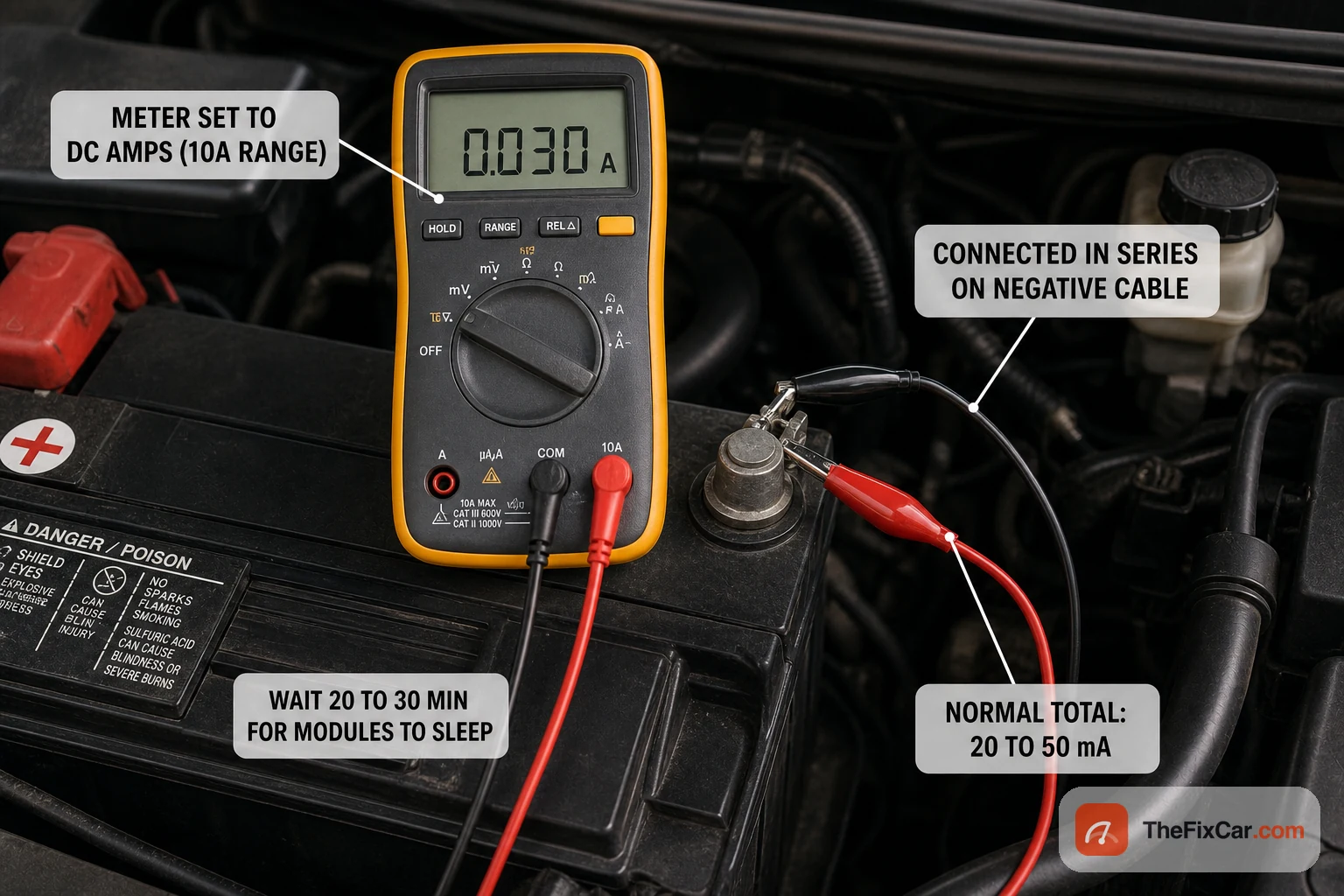
- Start with a fully charged, known-good battery so a weak cell does not muddy the result. If the battery is old and suspect, load-test it first.
- Turn off everything, take the key or fob out of range, and close the doors. If your vehicle requires a battery-support procedure or has anti-theft or radio codes, memory settings, or module relearns, check the owner’s manual before disconnecting the cable. Use the door latch pin or a switch clip so the interior lights and modules do not stay awake.
- Let the car sit 20 to 30 minutes. Modern modules take that long to sleep, and reading too early gives a falsely high number.
- Set a multimeter to DC amps. Start on the 10 A range so a surprise surge does not blow the meter’s internal fuse. Never crank the engine or turn on high-load accessories while the meter is in series.
- Loosen the negative battery cable and connect the meter in series: one lead on the negative post, one on the cable end, so all current runs through the meter.
- Once things settle, read the current. A healthy modern car usually lands around 20 to 50 mA total.
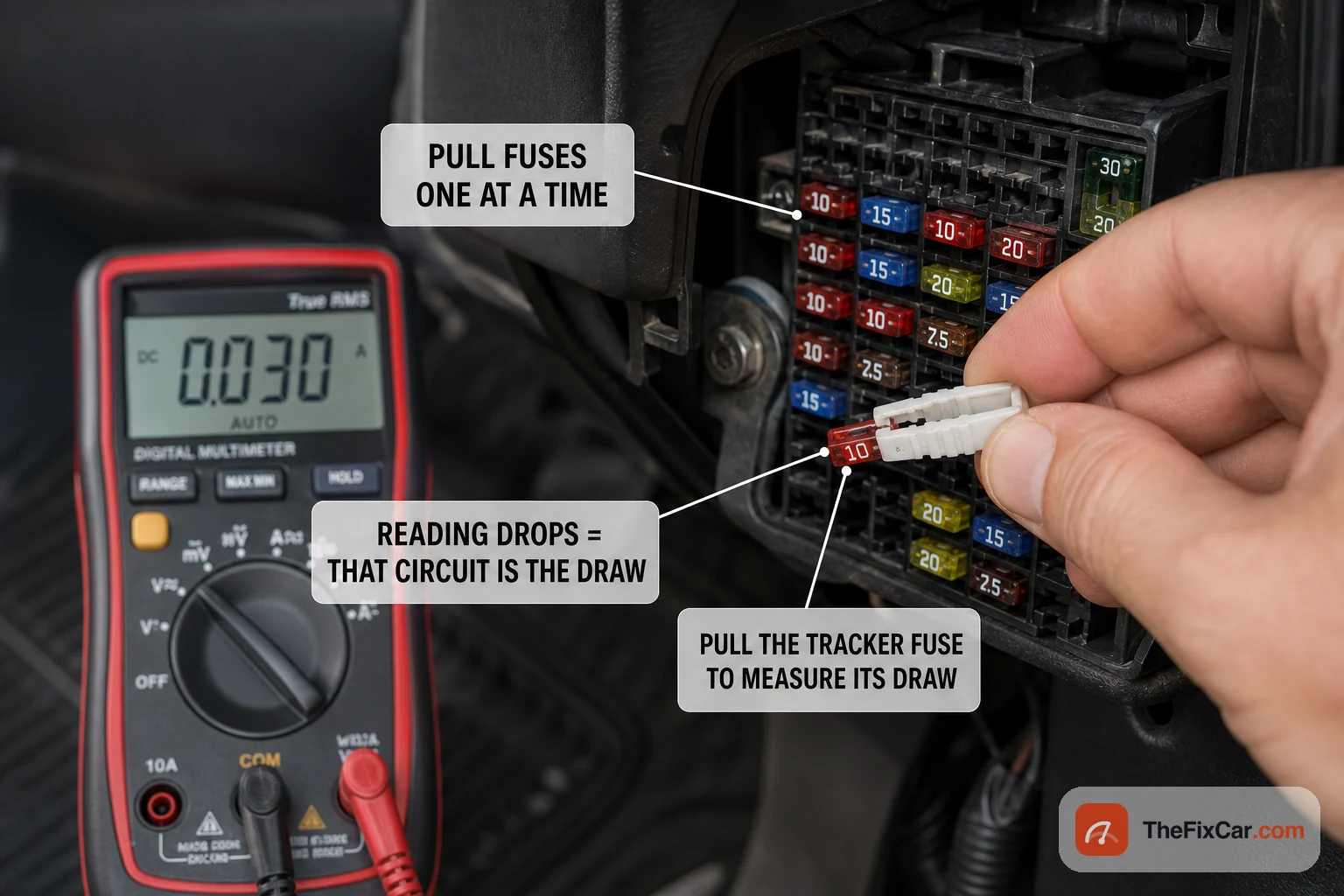
- If the reading is high, pull fuses one at a time and watch the meter. The fuse that makes the number drop points to the circuit at fault.
- To isolate the tracker, unplug it or pull its fuse and note how far the reading falls. That drop is the tracker’s real draw.
- Judge the result: a few milliamps means the tracker is not your problem, so keep looking. A steady 100 mA or more with the key off means the unit is not sleeping and needs attention.
Do not open a door or turn the key during the test. That wakes the modules and can blow the meter fuse. For a step-by-step meter walkthrough, see our guide on how to test a car battery with a multimeter, including the connections and safe ranges to use.
Tracker types and battery risk
Not every tracker touches your battery the same way. Match your unit to the row below.
- Hardwired, constant power. Draws 24/7 and depends entirely on a working sleep mode. This is the type worth testing.
- OBD-II plug-in. Pulls from the port’s always-on pin, so it behaves like a hardwired unit, but you can simply unplug it to rule it out.
- Battery-powered or magnetic. Runs off its own internal cell and puts zero load on the car, so it cannot flatten your starter battery.
Fleet and delivery vehicles need a different check
Fleet vehicles, delivery cars, rental units, and service vans often carry more than one add-on. A GPS tracker may sit alongside a dash cam, a telematics box, an alarm, a fuel monitor, a Wi-Fi hotspot, or a driver-behavior device. Each one may sip only a little on its own, but the combined key-off draw adds up fast when the vehicle sits over a weekend or between shifts.
For fleet use, do not judge the tracker by its advertised sleep-mode current alone. Measure the total key-off draw of the whole vehicle after every module has gone to sleep, then unplug the tracker or pull its fuse to see how much that single device contributes. That gives you a real number instead of a guess from the spec sheet.
Before you blame the tracker
- Test the battery itself first. A tired battery gets blamed on the newest gadget more often than it deserves.
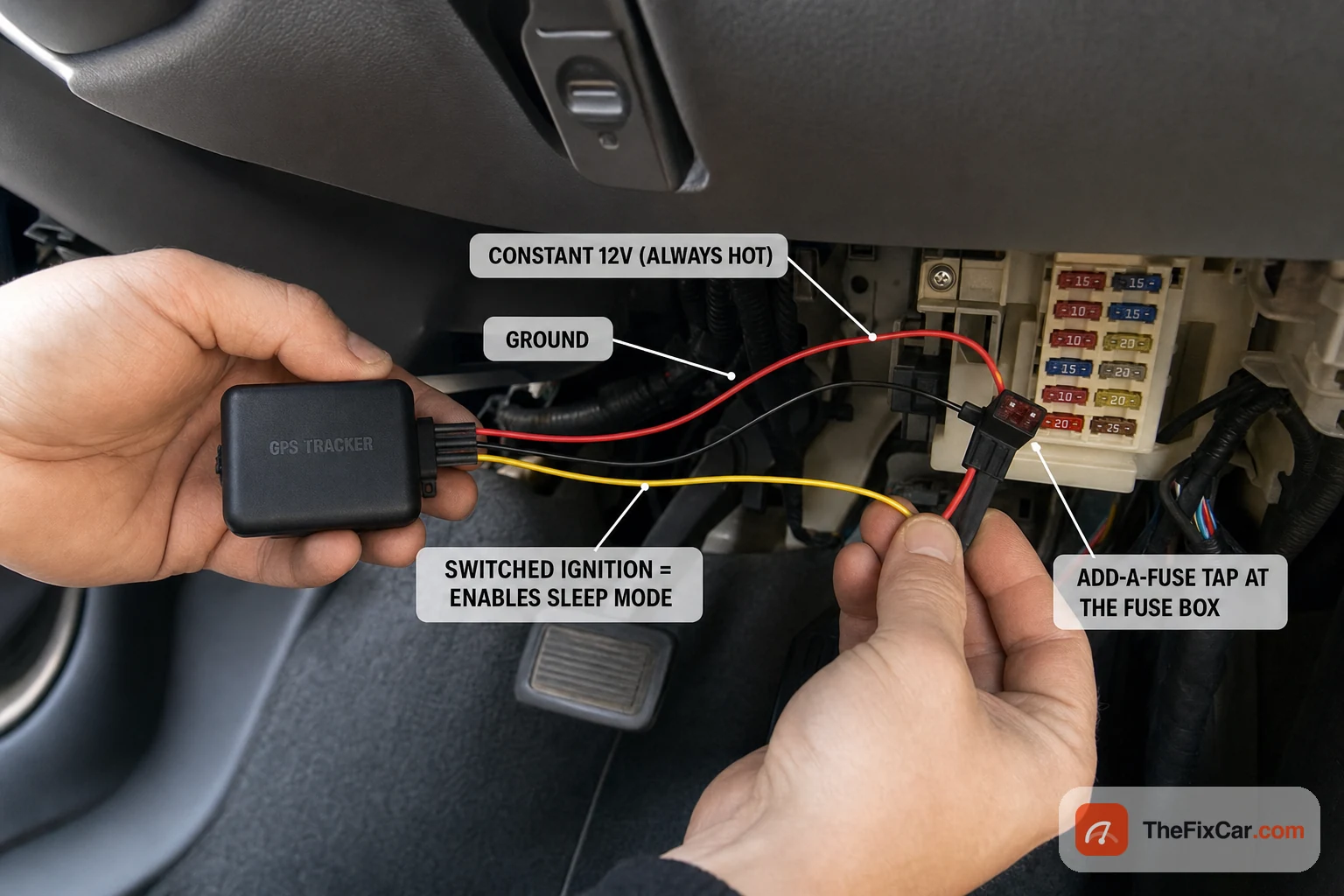
- Confirm the unit is wired to a switched or properly fused constant-power source, not spliced into a random hot wire.
- Check that sleep mode is enabled in the tracker’s app or settings; some ship in a high-report mode by default.
- Rule out the obvious drains too: a glovebox light, an aftermarket stereo, or a hardwired dash cam that keeps recording in parking mode.
- If the car starts with a jump then dies again, the tracker may not be the main fault; read whether a battery or alternator is behind the repeat no-starts.
Bad wiring can matter more than the tracker itself
A tracker that is wired correctly may draw only a few milliamps while parked. The same unit can cause real trouble if it is tapped into the wrong constant-power circuit, grounded poorly, connected with a loose or reversed fuse tap, or run without inline fuse protection. If the battery problem started right after the install, inspect the power feed, the ground point, the fuse tap orientation, and whether the unit actually sees an ignition signal drop when the car is off. A unit that never sees ignition go away often never sleeps.
FAQ
Can a GPS tracker drain a car battery? Yes, but a quality unit in sleep mode rarely does it alone. The usual culprits are a tracker that never sleeps, a bad install, or a battery that was already weak. Long parks stack the odds against you.
How much power does a hardwired GPS tracker use? In sleep mode, commonly about 2 to 10 mA. During active reporting it can briefly draw 20 to 50 mA, but those bursts are short. A unit sitting at 100 mA with the key off is misbehaving.
How long can a car sit with a GPS tracker before the battery dies? On a healthy battery with a well-behaved tracker, often several weeks. With a weak battery or a unit that will not sleep, it can be days. Cold or hot weather shortens both.
Do OBD plug-in trackers drain the battery? They can, because they run off the port’s constant-power pin. The upside is you can unplug one in seconds to test whether it is the cause.
Can an insurance or teen-driver OBD tracker drain the battery? Yes, it can, because most OBD trackers draw from an always-live pin in the diagnostic port. A good unit drops to a low-power mode when the car is parked, but a faulty device, a weak battery, or a car that sits for long stretches can still lead to a no-start. The easiest test is to unplug the OBD tracker for several days and see whether the battery still drops.
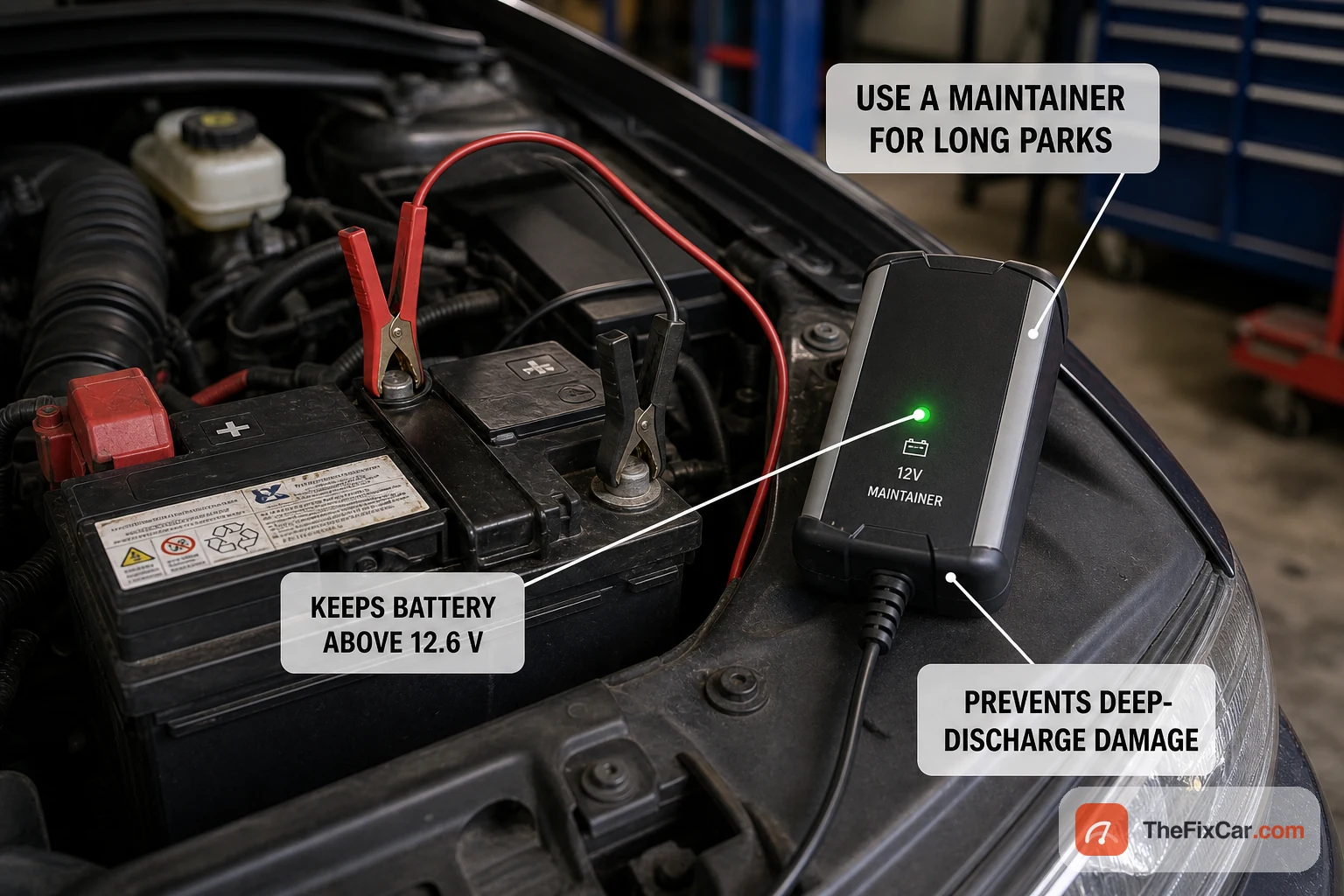
How do I stop a GPS tracker from draining my battery? Enable sleep mode, confirm the install uses a proper fused feed, and put the car on a maintainer if it sits for long stretches. Replace an old battery that no longer holds a charge.
DIY or shop
- DIY difficulty: Easy to Moderate. The meter hookup is simple; the fiddly part is keeping modules asleep and reading the right range.
- DIY cost: A basic DC multimeter runs about $15 to $40, and a battery maintainer for long parks is roughly $30 to $60.
- Shop cost: A parasitic draw diagnosis commonly runs about $60 to $150, more if they have to chase an intermittent draw across several modules.
Cost ranges here are rough U.S. figures. Warranty, vehicle, part type, and local labor rates all move the price.