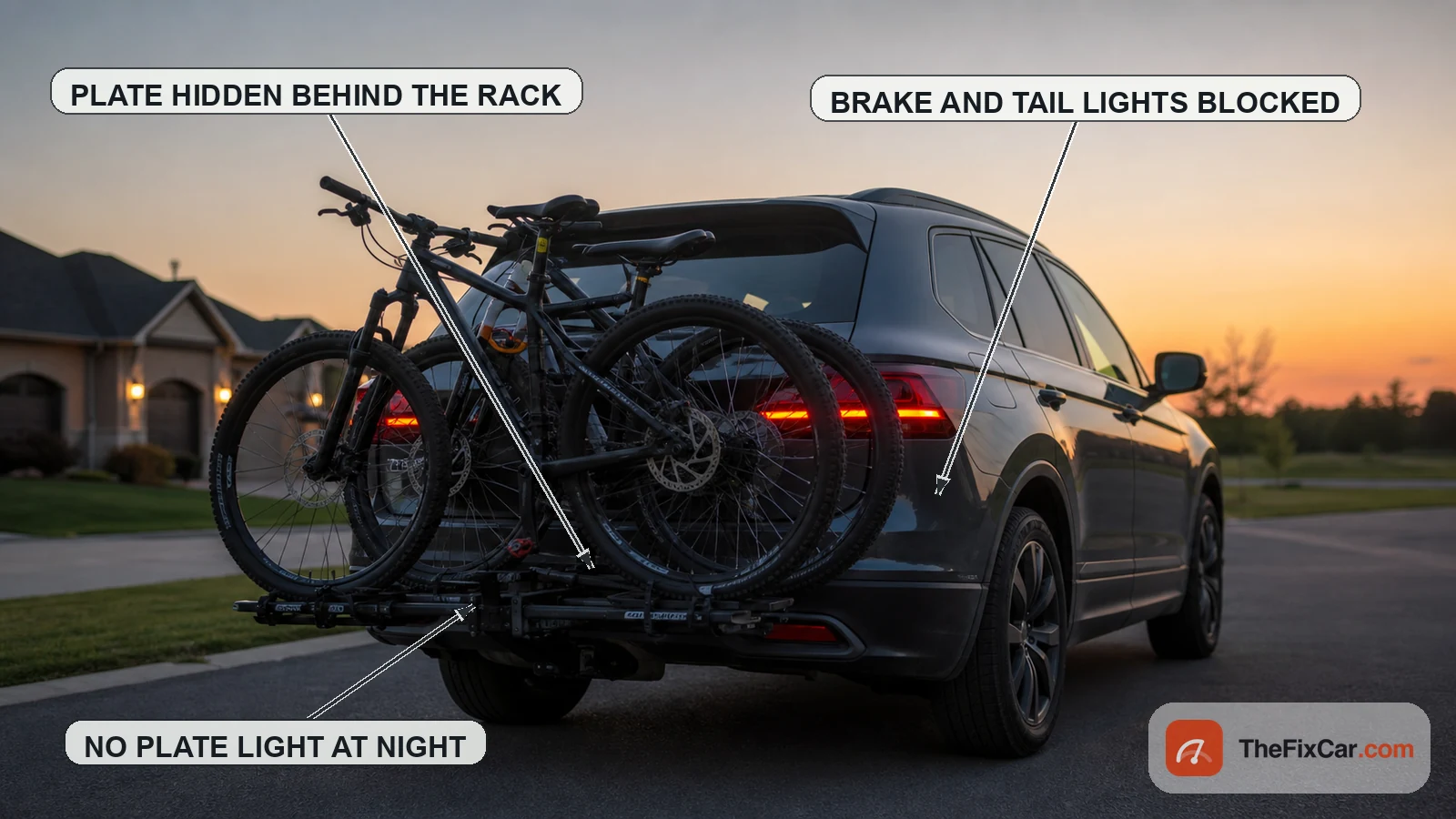
A bike rack on the hitch or trunk sits right where your license plate and rear lights live. Load two bikes and the plate disappears, a brake light hides behind a wheel, and after dark there is no white light on the plate at all. Police can pull cars over for exactly this, and a plate a toll camera cannot read can lead to missed toll notices, manual review, or disputed charges.
You need a fix when the loaded rack blocks the plate, plate light, brake lights, turn signals, or tail lights from normal viewing angles. Roof racks usually leave the rear clear. Hitch and trunk racks often need a plate bracket, auxiliary plate light, or full rack light board.
On many cars, the fix is a bolt-and-plug job; cars without a trailer connector may need a model-specific T-connector harness or shop installation. Here is how to keep the plate legible and the lights working with the bikes loaded.
Quick answer
Mount an auxiliary light board on the rack, move your plate to its bracket, and plug it into a 4-pin flat trailer connector. Boards commonly run about $25 to $60 and install in under an hour with basic hand tools. The one thing you must not skip is a working white plate light and visible brake lights, because that is what a ticket is written for.
| Fix | What it covers | Rough US cost | Wiring |
|---|---|---|---|
| Reposition the rack or bikes | Nothing added, only if the plate and lights stay visible | $0 | None |
| Plate-only auxiliary light | Plate plus a white plate light | ~$10 to $25 | Tap the plate-light wire or a 4-pin connector |
| Rack light board | Plate, brake, turn, and tail | ~$25 to $60 | 4-pin flat trailer connector |
Costs are rough US figures. Vehicle wiring, board quality, and whether you already have a trailer connector move the price.
Why it matters
Two separate problems ride on that rack. The first is visibility to the driver behind you: a bike wheel over a brake light shortens the warning they get when you slow down, and a hidden turn signal hides your intent to change lanes. The second is legal. Federal Motor Vehicle Safety Standard 108 requires a white rear license-plate lamp on the vehicle, and many state codes require the rear plate to be visible and readable at night from a set distance such as 50 feet, so a covered or dark plate can be an equipment violation on its own.
A blocked plate also costs money in quieter ways. Toll-by-plate systems, parking cameras, and red-light cameras read the rear plate, and a rack that hides or shades it can turn into a missed toll notice or a disputed ticket weeks later. Getting the plate onto a lit board fixes the ticket risk and the camera reads in one step.
Signs it’s due
- The plate vanishes with bikes loaded. Stand 50 feet behind the car with the rack full. If you cannot read the plate, a camera and an officer cannot either.
- A light hides behind a wheel or frame. Have someone press the brake and run the turn signals while you watch from behind. A wheel or a bike tube over a lens is enough to fail.
- No white light on the plate at night. The factory plate lights sit on the bumper or hatch, which the rack now blocks, so the plate goes dark even if the car’s own light still works.
- You already got a warning or fix-it ticket. An obstructed-plate or lighting citation means it is visible enough that an officer noticed from the road.
- Toll or camera notices you did not expect. A shaded or angled plate can misread, which shows up as a wrong-plate toll or a bounced violation.
E-bikes make the problem worse
E-bikes are heavier and wider than many standard bicycles, and their frames, wheels, batteries, and fenders can sit directly in front of the rear plate or tail lamps. If you carry one or two e-bikes on a hitch rack, check the plate and lights with the bikes fully loaded, not with the empty rack. Remove loose batteries if the rack maker recommends it, stay within the rack’s weight rating, and make sure the added light board is still visible from behind.
How to do it
Most boards mount to the rack frame and wire into the same trailer connector a small trailer uses. If you are adding a converter or tapping accessory power, watch for the same 4-pin wiring or accessory power issues that trip up other add-ons.
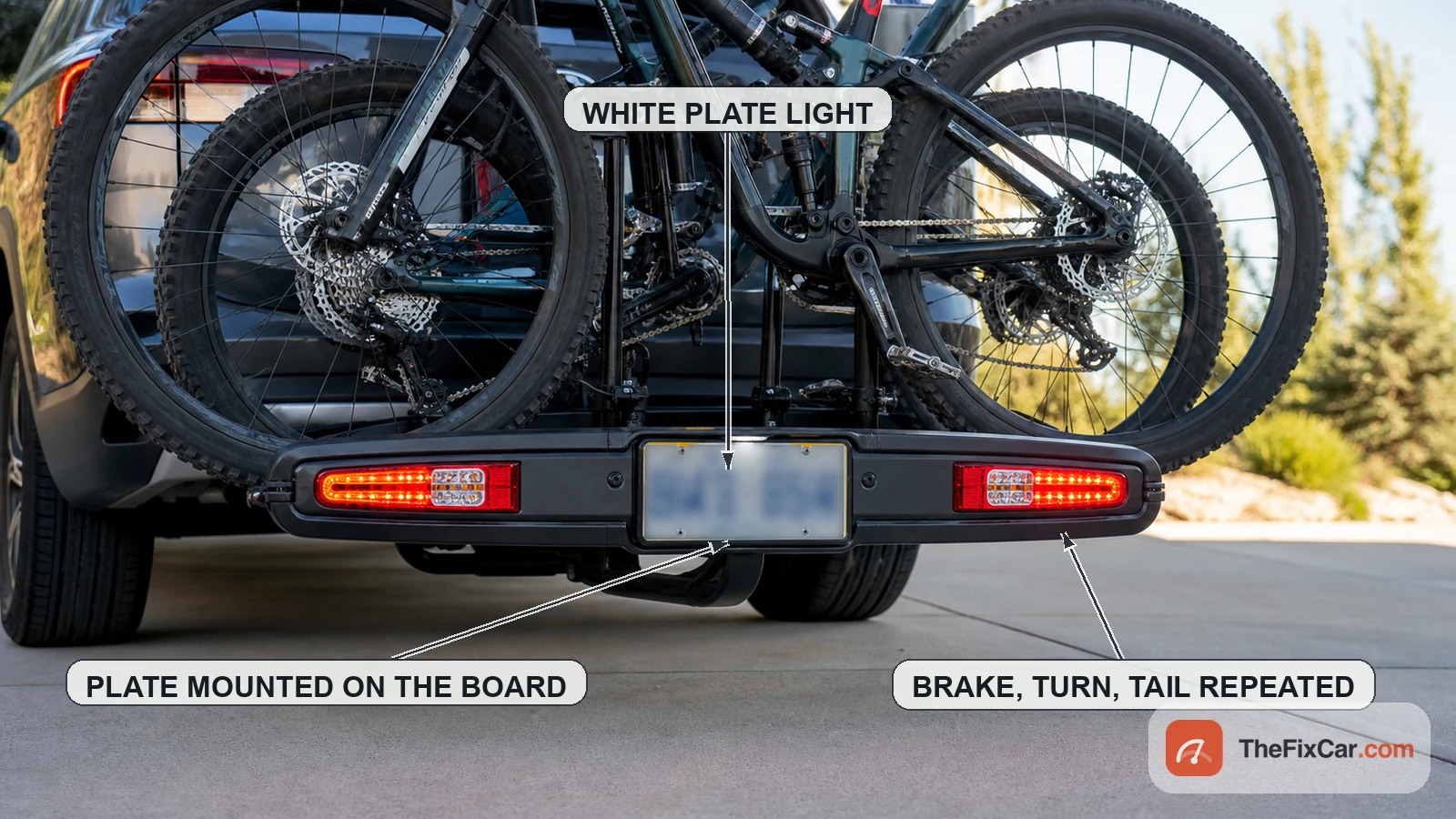
- Pick the board that matches your gap. A plate-only light covers a plate the rack hides; a full light board adds brake, turn, and tail lamps when the bikes cover those too.
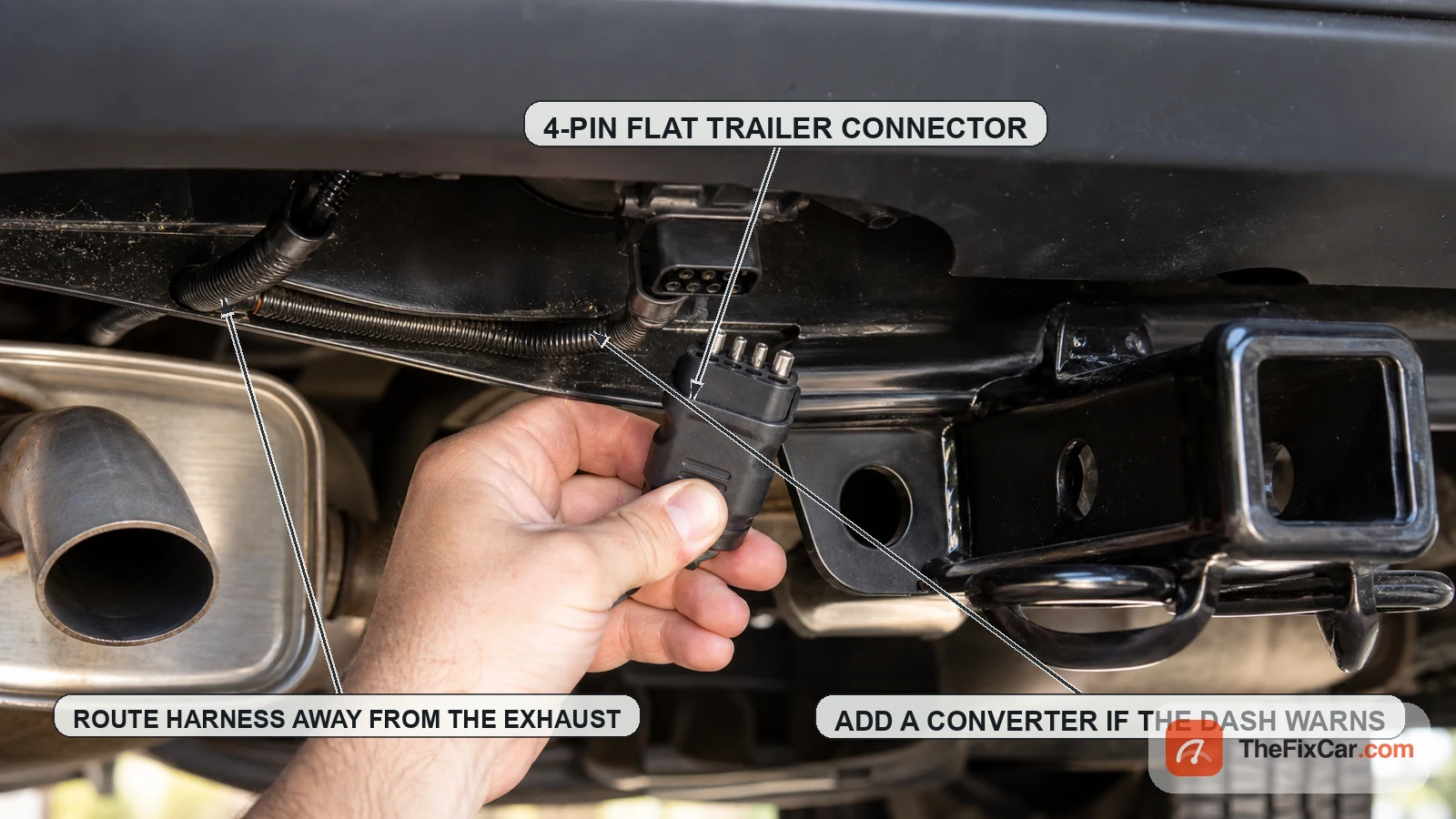
- Check for a factory trailer connector. Many SUVs, trucks, and towing-package vehicles have a 4-pin flat plug tucked behind the rear bumper or in the cargo area, so check your owner’s manual and cargo-area panels before you buy a wiring kit.
- Mount the board on the rack crossbar behind the bikes, high and centered so no wheel or frame blocks a lamp or the plate.
- Move the license plate to the board’s bracket with the supplied hardware. Leave the plate light aimed at the plate, not out at traffic.
- Connect the board to a 4-pin flat connector. If the car has no connector, add a plug-in T-connector harness made for your model rather than splicing into the tail-light wires.
- Route the harness up and away from the exhaust and the ground. A wire that touches the muffler melts, and one that drags will snag. Secure it with clips or ties every foot or so.
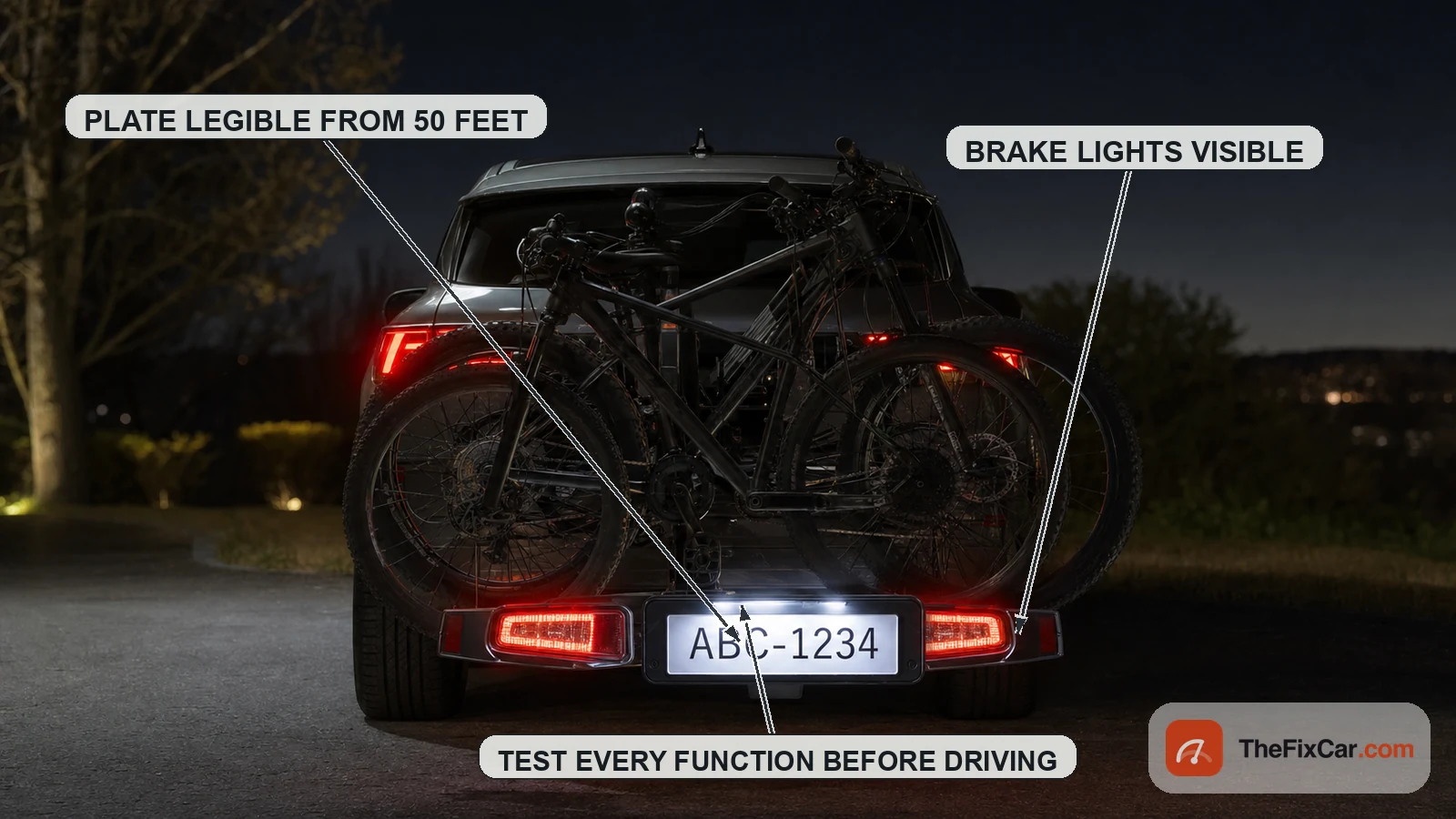
- Test every function before you drive. With a helper, check tail lights, brake, left and right turn signals, and the white plate light, all with the bikes loaded.
- Watch for a dashboard bulb or trailer warning. Some vehicles read LED boards as a fault, which a plug-in converter or the correct model-specific harness resolves.
- Recheck the plate from 50 feet at night. Confirm it is lit, unshaded, and readable, which is the standard an officer and a camera use.
- Unplug and stow the harness when the rack comes off so the connector stays clean and dry between trips.
Check the rear camera and parking sensors too
A loaded bike rack can also block the backup camera and rear visibility, parking sensors, rear cross-traffic sensors, or the view through the rear window. Those systems are not a substitute for visible brake lights or a readable plate, but they matter when backing out of parking spaces, hotel lots, trailheads, or driveways. After loading the bikes, put the car in reverse while parked safely and check what the camera and sensors can still see. A rack across the glass cuts rear visibility the way heavy tint does, so lean on your mirrors and back out slowly.
Do not do this
- Do not just zip-tie the plate to a bike. It stays unlit at night and still reads as an obstructed plate.
- Do not let the harness hang near the muffler or drag on the road. Heat and abrasion are the two most common ways this wiring fails.
- Do not skip the brake and turn-signal test. A working tail light does not prove the brake and signal circuits reach the board.
- Do not mount the board where a wheel or bike frame can swing over a lamp on bumps. Recheck it after loading each time.
- Do not rely on reflective tape in place of a plate light. Reflectors are not a substitute for the required white illumination.
- Do not run the wire through a hatch or trunk that pinches it shut. A crushed wire shorts and can blow a fuse.
DIY or shop
- DIY difficulty: Easy to Moderate. Bolting on the board is simple; the only real work is finding or adding a trailer connector and routing the harness cleanly.
- DIY cost: A light board runs roughly $25 to $60, and a model-specific T-connector harness adds about $30 to $70 if your car has no factory plug.
- Shop cost: A shop that installs the connector and board typically charges around $60 to $150 in labor, more if the vehicle needs a converter for LED-sensing electronics.
Costs are rough US figures. Warranty, model, part quality, and local labor rates move the price. When a procedure or connector location is model-specific, check your owner’s manual or the rack maker’s fit guide.
Frequently asked questions
Is it illegal for a bike rack to cover your license plate? Usually, yes if the rack or bikes prevent the rear plate from being clearly visible or lit, but the exact rule depends on state law. The rear plate has to be visible and, at night, lit by a white light legible from 50 feet, so a rack or bikes that hide or darken it is an equipment violation. Check your own vehicle code for the specifics.
Does a roof bike rack block the license plate or lights? Usually no. A roof rack normally leaves the rear license plate, brake lights, turn signals, and tail lights visible. The bigger risk with a roof rack is height clearance, such as garages, hotel entrances, drive-thrus, trees, and low parking structures.
Do I need lights on my bike rack? You do when the rack or bikes block the car’s brake lights, turn signals, tail lights, or plate light. A rack light board repeats those functions behind the bikes so drivers behind you still get the signals.
How do I wire a bike rack light board? Most boards use a 4-pin flat trailer connector. If your car has a factory connector, you just plug in; if not, add a model-specific T-connector harness that clips into the tail-light wiring without cutting it.
Can I move the license plate onto the bike rack? In some places, a visible temporary plate mount or auxiliary plate holder may be allowed, but rules vary by state or country. The important point is that the plate should be readable from behind and lit at night. Use a proper bracket and plate light if required, and check your local rule before driving with the plate moved.
Will a light board trigger a dashboard warning? It can on vehicles that monitor bulb current, because LED boards draw little power and read as a fault. A plug-in converter or the correct model-specific harness stops the false warning.