A multimeter turns a vague “maybe the battery is dying” into a number you can act on. Two minutes and a $20 meter tell you whether the battery is charged, whether it holds up while cranking, and whether the alternator is topping it back up. Most people stop at the first reading, but a single resting voltage only tells part of the story.
The job is three quick tests, not one: resting voltage, voltage while cranking, and voltage with the engine running. Each one rules out a different problem, and together they separate a tired battery from a charging fault. The trap is reading the battery right after a drive, when surface charge makes a weak battery look full.
Here is how to do all three correctly, what each number means, and when the meter is telling you to replace the battery.
Quick answer
Set a digital multimeter to DC volts, touch red to positive and black to negative, and read the rested battery. On a rested 12 V lead-acid battery at about 70 F, 12.6 to 12.8 V usually means fully charged, 12.4 V is about 75 percent, and anything under 12.0 V is discharged; above about 12.9 V usually means surface charge or recent charging, so rest it and retest. The test is free if you own a meter and takes about 5 minutes. The one thing you must not skip is letting the battery rest first, because a recent drive leaves a surface charge that hides a weak battery.
| Test | Good reading | Bad sign |
|---|---|---|
| Rested battery | 12.6 to 12.8 V | Under 12.4 V: recharge and retest |
| Cranking | Stays above about 9.6 V | Big drop: weak battery or starting-circuit issue |
| Engine running | 13.7 to 14.7 V | Low: charging fault; high: overcharging |
Values are commonly published ranges for a 12 V lead-acid battery at around room temperature. Cold lowers resting voltage slightly, and AGM batteries can read a touch higher, so check your battery maker’s chart for exact figures.
Why it matters
A battery that reads 12.2 V is sitting at roughly half charge, and a half-charged battery sulfates over time, loses cranking power in the cold, and leaves you stranded with no warning. Catching that early means a recharge or a clean terminal instead of a tow.
The bigger payoff is telling the battery and the alternator apart. A weak battery and a failing alternator feel identical from the driver’s seat: slow cranking, dim lights, a no-start. The voltage tests split them in under a minute, so you know whether to charge and load-test the battery or inspect the alternator circuit next. If the charging voltage is wrong, the problem may not be the battery at all, a pattern covered in car starts with a jump then dies.
Signs it’s due
- Slow cranking. The starter turns lazily or hesitates on a cold morning, the classic early sign of a battery losing capacity.
- Dim or flickering lights. Headlights or dash lights dip at idle and brighten when you rev, which points at charge level or the alternator.
- Battery warning light. A glowing battery icon means the charging system, not just the battery, needs checking, as explained in battery light came on while driving.
- Age past 4 years. Most lead-acid batteries last about 3 to 5 years, so a meter check makes sense every few months once yours is in that window.
- Electronics acting up. Stored radio presets, clock, or pairings resetting overnight can signal a battery that cannot hold voltage while parked.
- Recent jump start. Any battery that needed a jump deserves a voltage check to see whether it recovered or is on its way out.
How to do it
Run the three tests in order: rested voltage first, then cranking, then charging.
- Gather your tools. You need a digital multimeter, safety glasses, and gloves. A battery vents hydrogen, which OSHA warns can be explosive, so work in a ventilated spot and keep sparks and flames away. Remove metal jewelry, do not lay tools across the terminals, and do not test a cracked, leaking, swollen, or frozen battery.
- Let the battery rest. For an accurate resting reading, leave the car off for a few hours, or turn the headlights on for one minute and back off to drain the surface charge from a recent drive. If the car was just driven or charged, wait several hours or remove the surface charge before you trust the resting-voltage number.
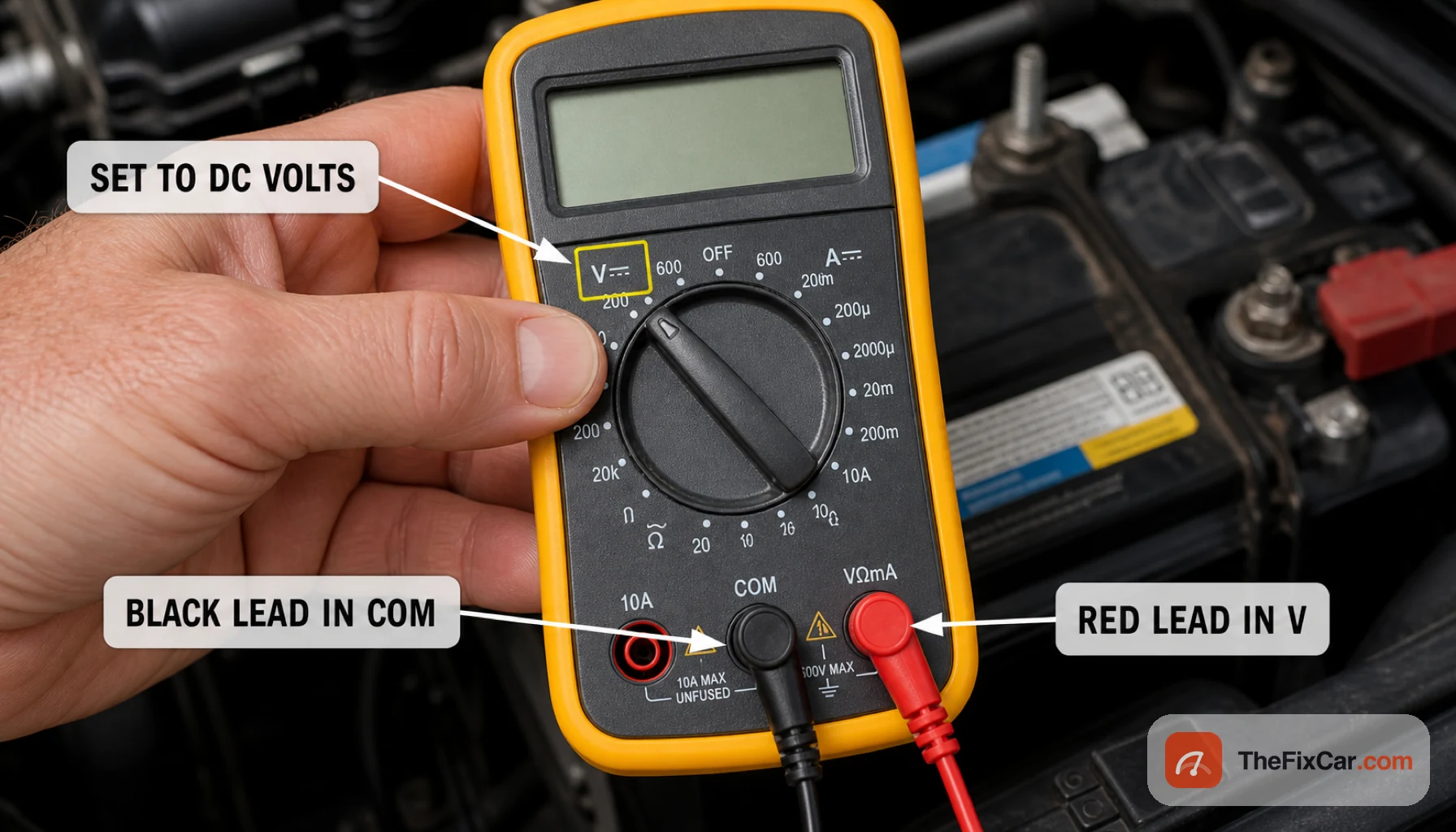
- Set the meter. Turn the dial to DC volts (often marked V with a straight line). On a manual-range meter pick the 20 V setting; an auto-ranging meter needs no range.
- Connect the leads. Touch the red lead to the positive (+) terminal and the black lead to the negative (-) terminal. Reversed leads just show a minus sign, they do not harm anything.
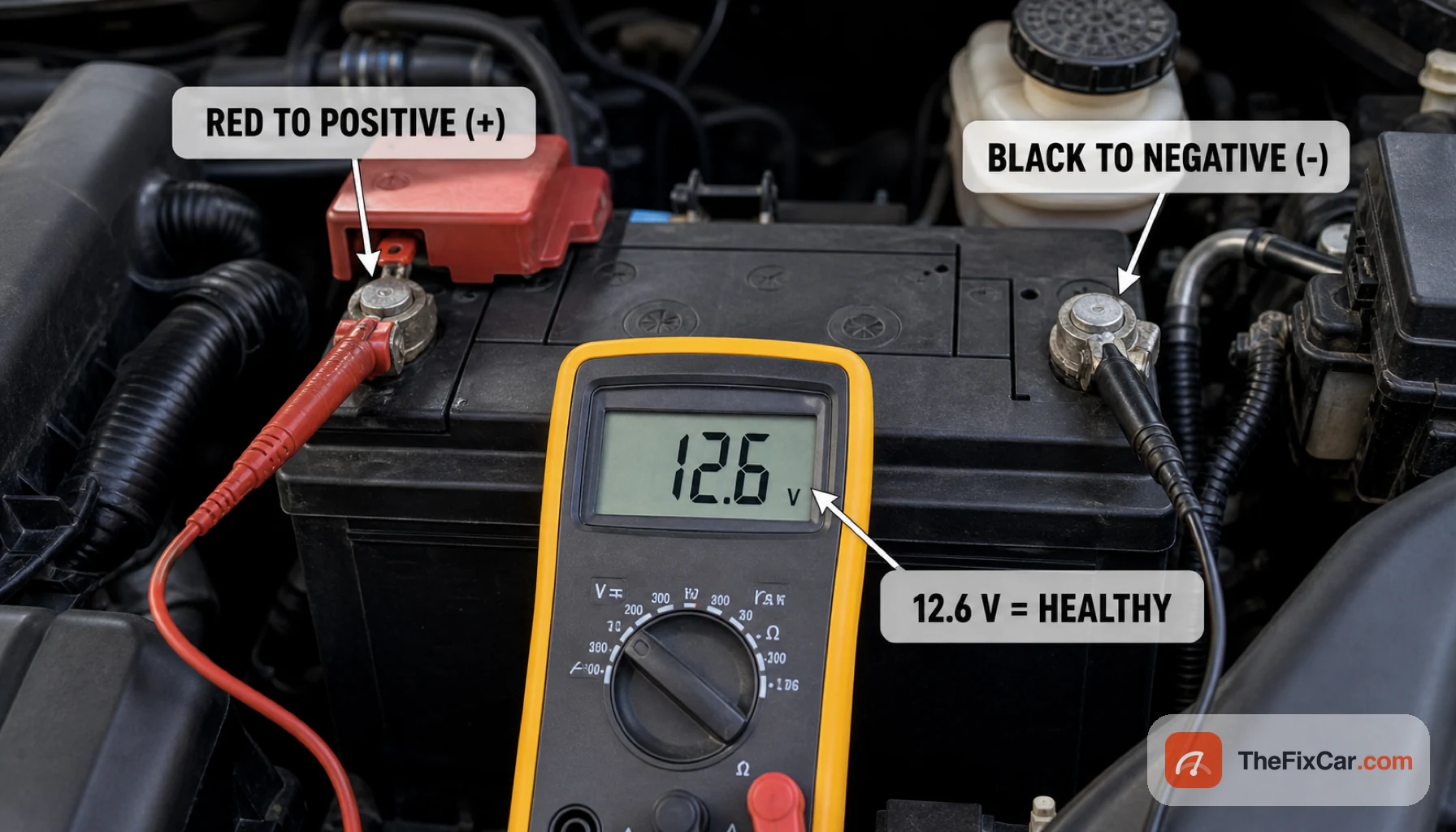
- Read the resting voltage. 12.6 V or higher is healthy, 12.4 V is about 75 percent, 12.2 V is about 50 percent, and below 12.0 V is discharged. A reading under about 12.4 V means recharge and retest.
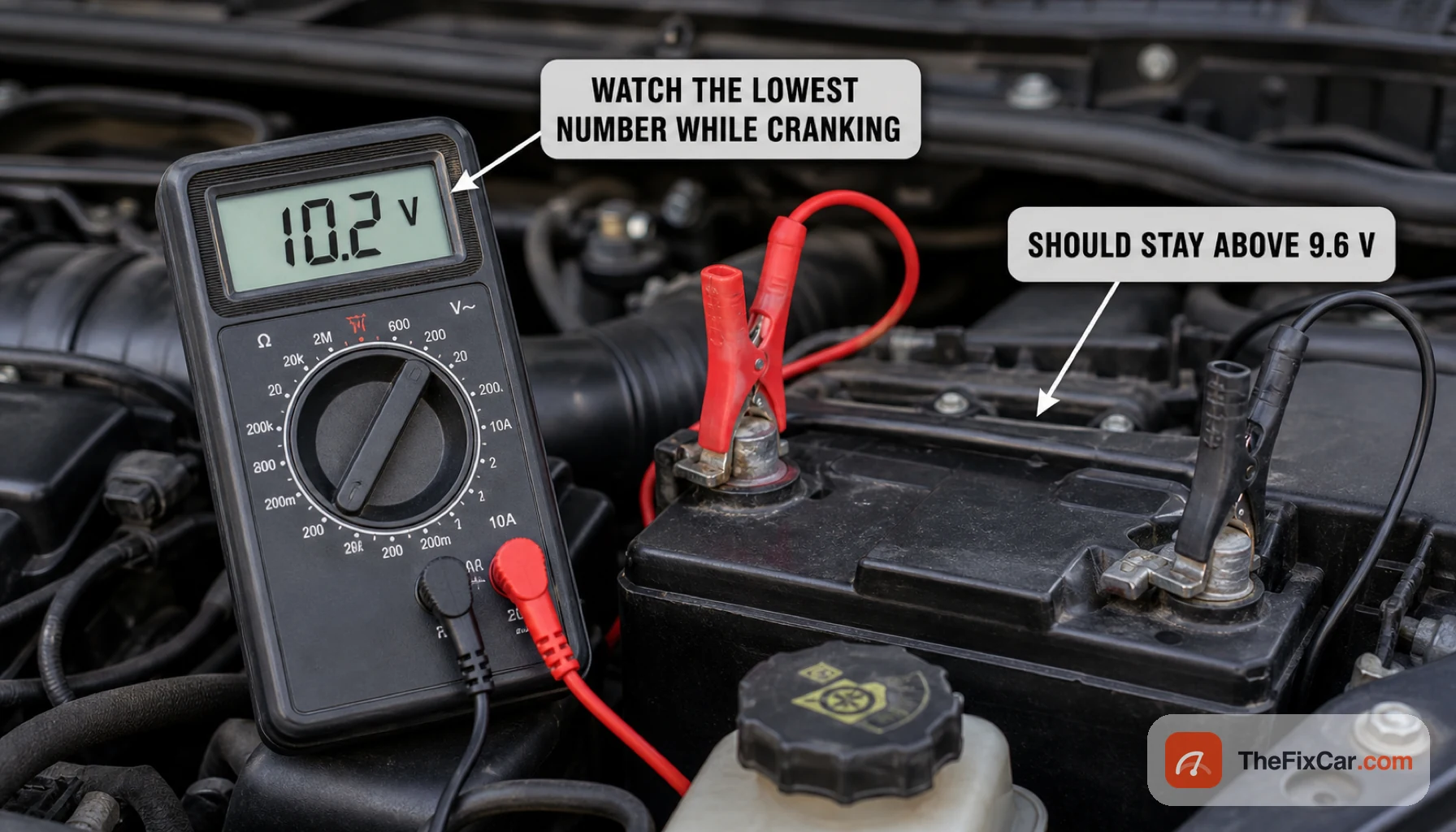
- Run the cranking test. Keep the leads on the terminals, have a helper start the engine, and watch the lowest number as it cranks. At about 70 F, a healthy battery should usually stay above about 9.6 V while cranking; cold weather can lower this threshold, so a big drop below spec points to a weak battery or a high-current starting problem.
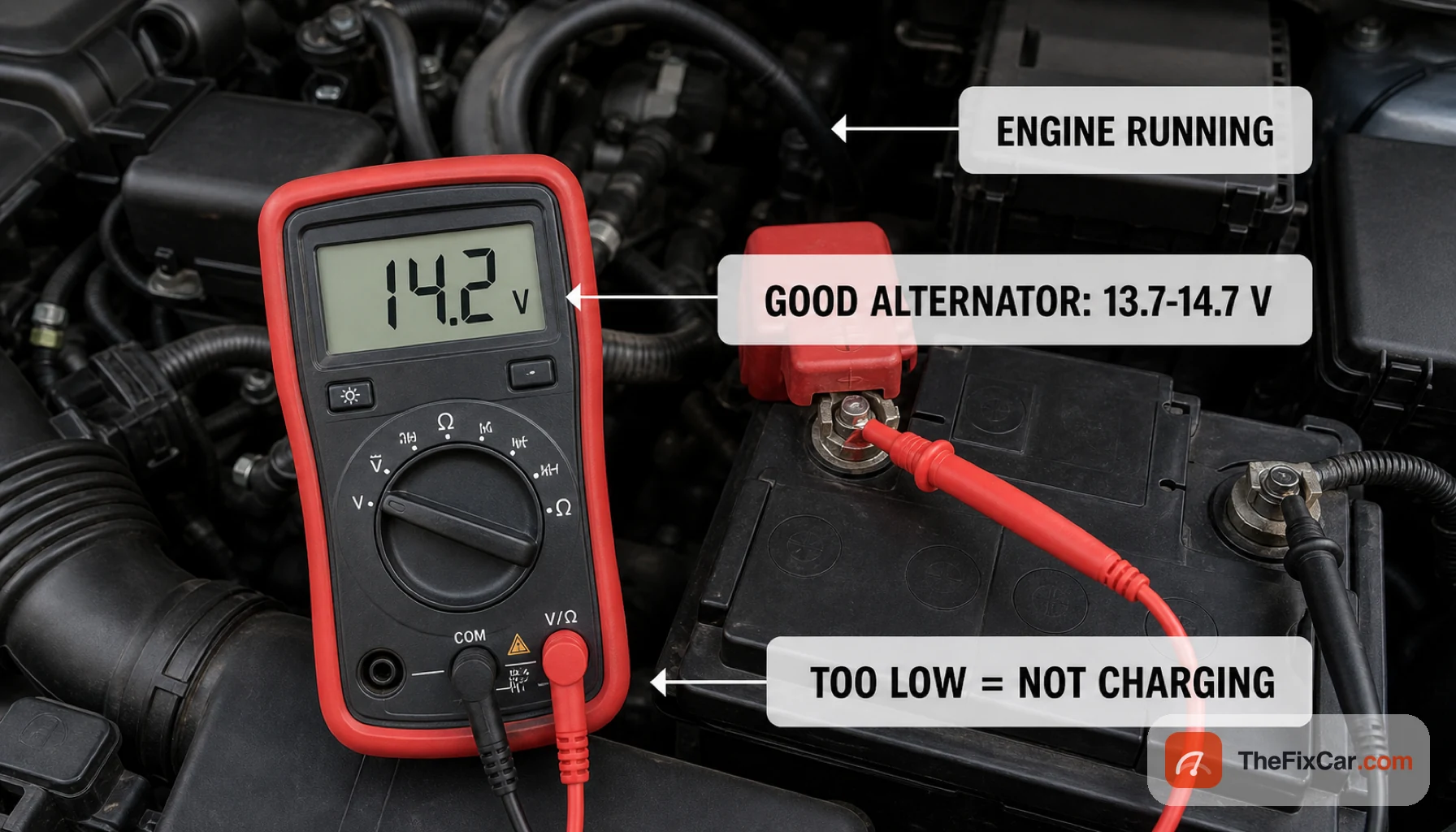
- Check the charging voltage. With the engine running, read the terminals again. A good alternator holds roughly 13.7 to 14.7 V. Much lower means it is not charging; much higher can mean an overcharging regulator.
- Read the combination. Low rested voltage that also collapses while cranking points to the battery. A healthy rested battery with low engine-running voltage points to the alternator or its wiring.
- Rule out bad terminals. If readings are erratic, clean corrosion off the posts and clamps, retighten them, and test again before condemning the battery.
- Decide the next step. Recharge and retest a low but otherwise sound battery; if it will not hold 12.6 V after a full charge or fails the cranking test, have it load tested or replace it. If a fully charged battery tests good but is low again after sitting overnight, test for parasitic draw before replacing the battery.
Before you replace the battery
- Recharge it fully if rested voltage is below about 12.4 V.
- Let it rest, then test the voltage again.
- Clean and tighten the terminals.
- Run the cranking test.
- Check charging voltage with the engine running.
- If it passes but dies overnight, check for parasitic draw.
Voltage shows the current charge level, not how much life the battery has left, so a load test or a parts-store check confirms a borderline case before you spend on a new battery.
DIY or shop
- DIY difficulty: Easy. The only care points are touching the right terminals and keeping sparks away from battery gases.
- DIY cost: A usable digital multimeter runs about $15 to $40, and after that every test is free.
- Shop cost: Many auto-parts stores test a battery free, while a shop charging-system diagnosis commonly runs $20 to $50. A load tester gives a more definitive verdict than voltage alone.
FAQ
What voltage should a car battery read with the engine off? A rested, healthy 12 V battery reads about 12.6 to 12.8 V. At 12.4 V it is around 75 percent charged, and below 12.0 V it is discharged.
Is 12.2 volts a bad car battery? Not always, but 12.2 V is only about half charged. Recharge it fully, let it rest, and test again; if it still falls back to 12.2 V, the battery is likely worn.
What voltage is too low while cranking? A healthy battery usually holds above about 9.6 V at around 70 F while the engine cranks. A drop well below that points to a weak battery or a high-current starting fault.
What should a battery read while the car is running? With the engine running, a good alternator holds roughly 13.7 to 14.7 V. Much lower means it is not charging, and much higher suggests overcharging.
Can a battery show 12.6 volts and still be bad? Yes. Voltage shows charge level, not capacity. A battery with high internal resistance can read 12.6 V at rest yet collapse under load, which is why the cranking test or a load test matters.