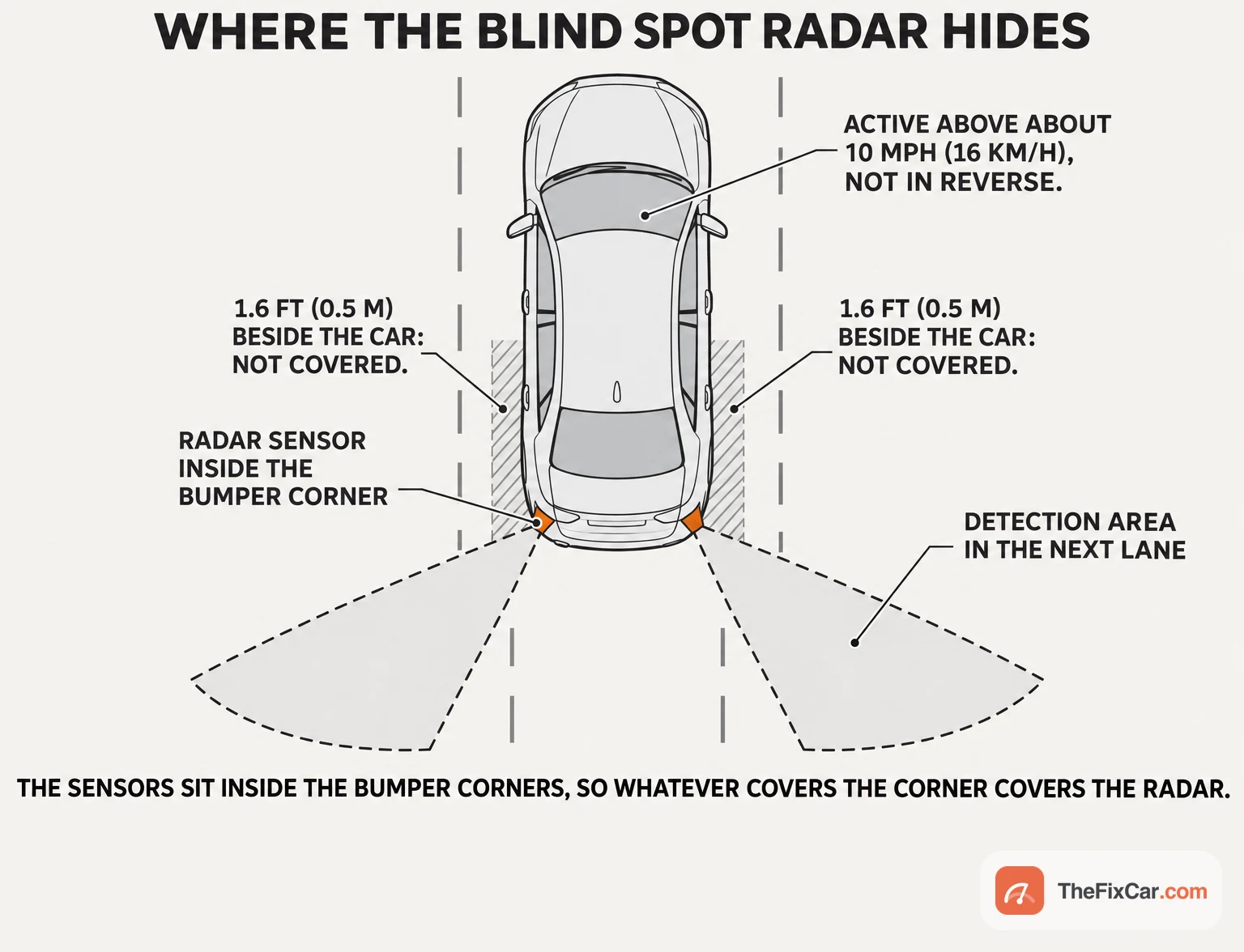
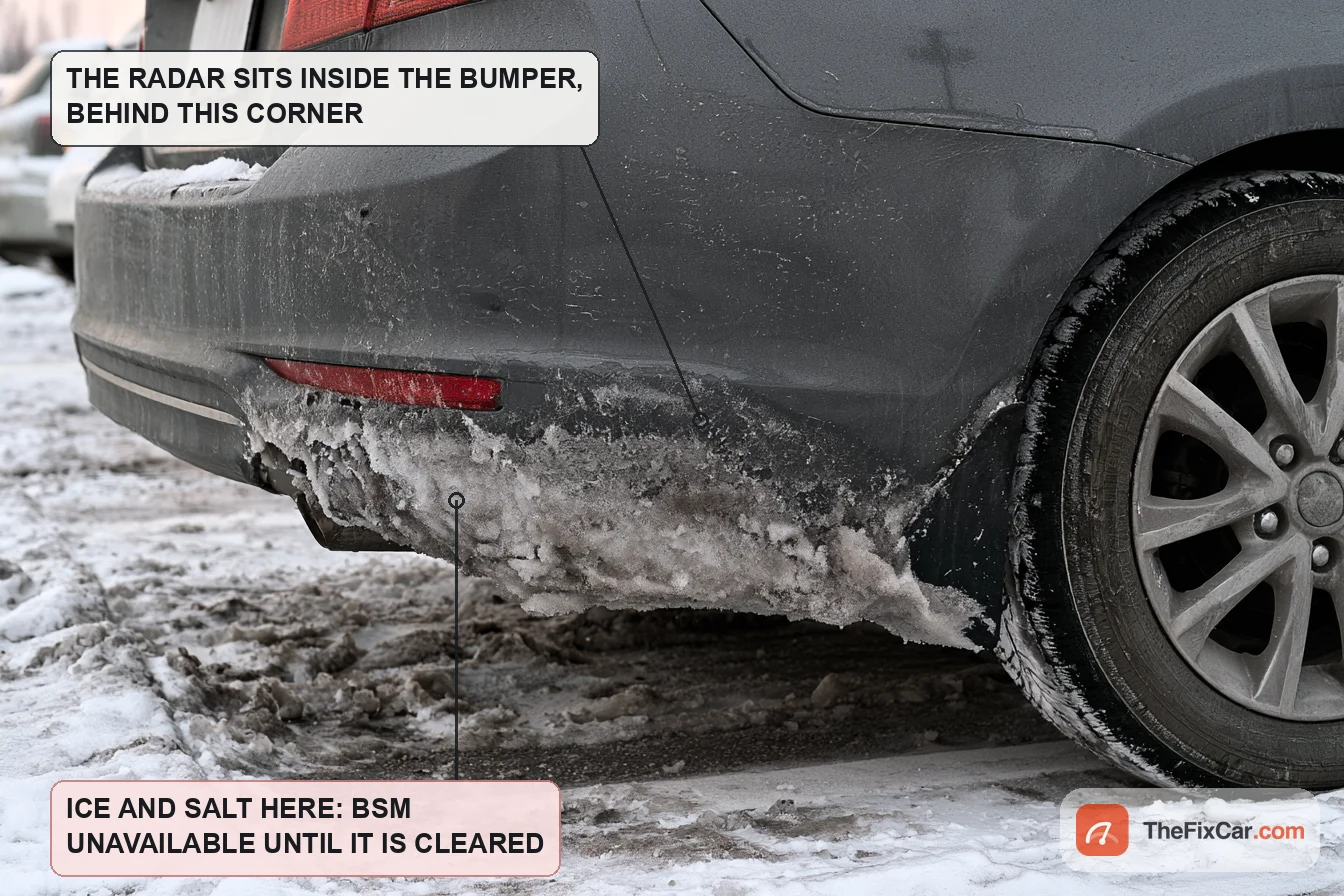
“Blind Spot Monitor Unavailable” on a Toyota means the mirror indicators are not watching the next lane, and the first place to look is the rear bumper, not the mirrors. The Corolla Hybrid owner’s manual Toyota hosts, the one cited throughout this page, gives one explanation for it: ice, snow or mud attached to the rear bumper around the sensors, and it says the system should return to normal once the bumper is cleared[1]. The two radar sensors sit behind the left and right sides of the rear bumper, so whatever covers those corners covers the radar[1].
The message that calls for an inspection is a different one. In the same manual, “Blind Spot Monitor Malfunction Visit Your Dealer” means a sensor may have failed or moved off its axis, and it calls for an inspection[1]. Toyota’s Tacoma bulletins for a blind spot warning with codes stored end in two new sensors and an operation check with a reflector target, on the model years, VIN ranges and codes they name[2][3]. Which message is on the screen, and whether the bumper corner has been hit, painted or wrapped, sets the first checks; it does not decide between cleaning, a wiring repair, an alignment and new sensors.
Quick answer
Read the exact wording. For “Unavailable”, the Corolla Hybrid manual cited here says to clean the rear bumper around the sensors, then drive with the system on, out of Reverse and above about 10 mph for around 10 minutes; “Malfunction Visit Your Dealer” means the sensors need to be inspected[1]. Other model-year manuals may word the procedure differently, so check your own.
| What you see | Where to look | What to do first |
|---|---|---|
| “Blind Spot Monitor Unavailable” in winter, after a car wash or a dirt road | Both rear bumper corners, the area around the sensors | Clear ice, snow and mud as your manual directs, then, when the road and the car allow it, drive with the system on, out of Reverse, above approximately 10 mph (16 km/h) for about 10 minutes; the speed and time are the Corolla Hybrid manual’s[1] |
| “Unavailable” in heavy rain, standing water or extreme heat and cold | Rear bumper corners first, then the weather | Check for dirt and ice first. The manual lists wet roads in bad weather and extreme temperatures as conditions where the sensors may not work correctly; the weather alone does not prove the cause[1] |
| “Unavailable” that never clears, bumper looks clean | Stickers, transparent film, aluminium tape, a bike carrier, a repaint, a parking knock | Remove a carrier by its instructions and have film or tape taken off without damaging the finish; the manual bans stickers and tape on the sensor area and says an impact can move the sensor off position[1] |
| “Blind Spot Monitor Malfunction Visit Your Dealer” | DTCs in the blind spot monitor master and slave sensors | Have the codes read: C1AC1 and C1AC2 are horizontal axis misalignment, U0232 and U0233 are lost communication with one sensor[2] |
| “Malfunction” message or BSM dead, 2024 to 2025 Grand Highlander, with C1AB413 or C1AB513 | Software in the two BSM sensors | Toyota’s fix is a flash reprogram of both sensors, and the bulletin says not to replace them; it applies only when the stored calibration is older than the one it lists[9] |
| Mirror light stays on with nobody beside you, 2021 to 2022 RAV4 Prime | The sensor brackets behind the rear bumper | For a RAV4 Prime that matches the bulletin’s symptom, Toyota’s fix is a pair of sensor covers clipped to the brackets, not new sensors; the bulletin’s first step is confirming that symptom[4] |
A guide, not a diagnosis: every row has more than one cause.
What the two messages mean
Toyota’s owner’s manual for the Corolla Hybrid separates the two messages by what the driver can do about them. For “Blind Spot Monitor Unavailable” it says ice, snow, mud and the like may be attached to the rear bumper around the sensors, that the system should return to normal after they are removed, and that the sensors may also not operate normally in extremely hot or cold environments[1]. For “Blind Spot Monitor Malfunction Visit Your Dealer” it says there may be a sensor malfunction or a misaligned sensor, and tells the driver to have the vehicle inspected[1].
The same manual sets the operating conditions that decide whether the message can clear on its own. The Blind Spot Monitor works only when it is switched on, the shift lever is out of R, and the vehicle is faster than approximately 10 mph (16 km/h)[1]. After clearing dirt or snow, Toyota’s instruction is to drive with those conditions met for approximately 10 minutes; if the warning is still there, the car goes to the dealer[1]. Cleaning the bumper while parked does not complete that check.
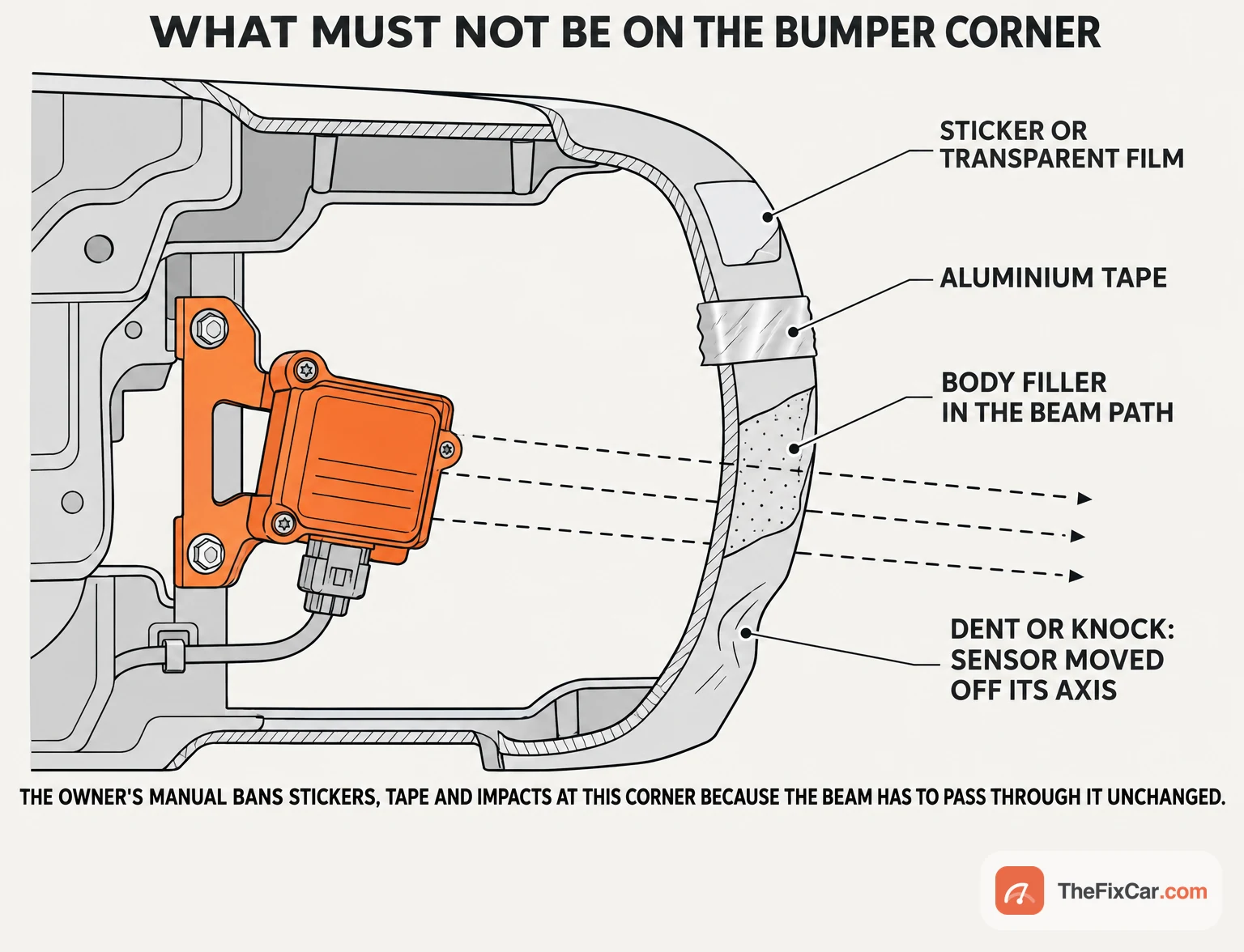
The detection area explains why the bumper corner matters so much. On the Corolla Hybrid the sensors watch from approximately 1.6 ft (0.5 m) to 11.5 ft (3.5 m) out from either side, about 3.3 ft (1 m) forward of the rear bumper, and from 9.8 ft (3 m) up to 197 ft (60 m) behind it for fast-approaching traffic[1]. The manual says the strip between the body and that 0.5 m line cannot be detected[1]. Both beams leave through the painted plastic of the bumper corners, which is why the manual says not to paint the bumper any colour other than an official Toyota colour and not to attach stickers, transparent stickers or aluminium tape anywhere near the sensors[1].
Symptoms and what else produces them
| Symptom | Competing sources | Clues that shift suspicion |
|---|---|---|
| “Unavailable” on cold mornings, gone by midday | Ice or slush on the bumper corners[1]; extreme temperatures, which the manual lists separately[1]; an intermittent sensor or wiring fault | Recovery after cleaning supports the manual’s first explanation; recovery as the day warms up supports the temperature one[1]. Neither rules out an intermittent fault that happens to clear at the same time |
| “Unavailable” and “Rear Cross Traffic Alert Unavailable” together | A blocked or faulty rear radar sensor shared by both functions[1]; shared power, wiring or communication problems | RCTA uses the BSM rear side radar sensors, so two messages at once make a shared problem worth checking first; the messages alone do not say which sensor or what cause[1] |
| “Unavailable” that started after a bumper repair or repaint | A repaint or repair that does not follow Toyota’s restrictions for the sensor area; body filler or a sticker over the sensor; a sensor refitted off its mounting angle[1][5] | A warning that begins after bumper work puts the repair materials, the sensor mounting angle, the connectors and the required operation check at the top of the list; the checks depend on the model and year[1][5] |
| “Malfunction Visit Your Dealer” with C1AC1 or C1AC2 stored | Sensor moved by an impact; a sensor that failed; on 2016 to 2019 Tacoma built before the production change, a known sensor condition Toyota fixes with two new sensors[2][3] | A parking knock on one corner suggests misalignment; a Tacoma in the bulletin VIN range with no body damage suggests the bulletin[2][3] |
| “Malfunction” with U0232 or U0233 | Lost communication with the slave or master sensor: wiring, connector, a sensor that is not powering up[2] | On Tacoma trucks inside the bulletin, the repair is the bulletin’s; outside it, the vehicle’s diagnostic procedure checks power, ground, connectors and network communication to that sensor before deciding it has failed[2] |
| Mirror indicator stays on after a car passes, no warning message | An apparent false alert; on 2021 to 2022 RAV4 Prime a known condition fixed with sensor covers[4]; a sensor misaligned by an impact, which the manual lists as a cause of unnecessary detection[1] | A RAV4 Prime that lights the mirror after being passed and then will not switch off matches Toyota’s bulletin wording; on other vehicles the symptom is investigated with the applicable procedure: nearby objects, accessories, sensor mounting and stored codes[1][4] |
Sensor fault, or something else?
Not every item below is a failure of the sensor. Obstruction, weather, mounting and electrical faults can all produce the same complaint, and the Tacoma bulletins below prescribe new sensors only for trucks that meet their stated VIN range and code conditions[1][2][3].
Dirt, ice and weather
The manual’s instruction is to keep the sensors and the surrounding areas on the rear bumper clean at all times, and it says a dirty or snow-covered sensor may stop the system and bring up the warning[1]. The list of conditions where the system may not detect vehicles correctly also includes a road surface wet with standing water in heavy rain, snow or fog, and the sensors may not operate normally in extremely hot or cold environments[1]. Obstruction and weather can stop the system without a failed component; a warning that persists or keeps returning still needs diagnosis.
Stickers, tape, carriers and paint
Toyota bans accessories, stickers including transparent stickers, and aluminium tape on a sensor or its surrounding area on the rear bumper[1]. A bicycle carrier installed at the rear is listed twice: as a condition where the system may not detect vehicles correctly, and as one where unnecessary detections may increase[1]. A repaint in a colour that is not an official Toyota colour is on the same forbidden list[1]. Paint, stickers and tape sit on the bumper surface the radar beam leaves through; a rear carrier is a separate accessory that the manual lists as a source of missed and unnecessary detections[1]. The manual’s instruction for each is the same: keep that area as Toyota built it[1].
Impact and misalignment
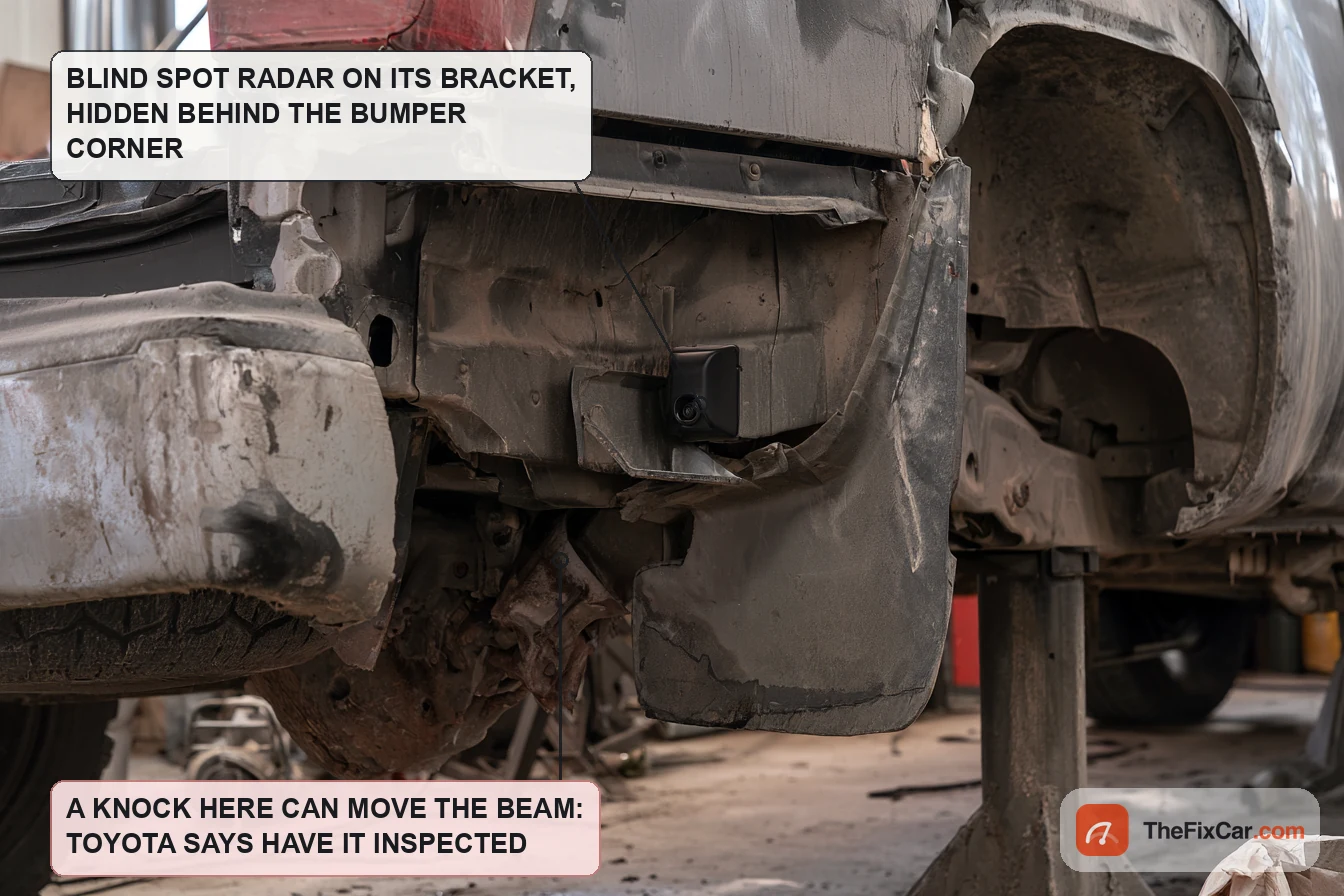
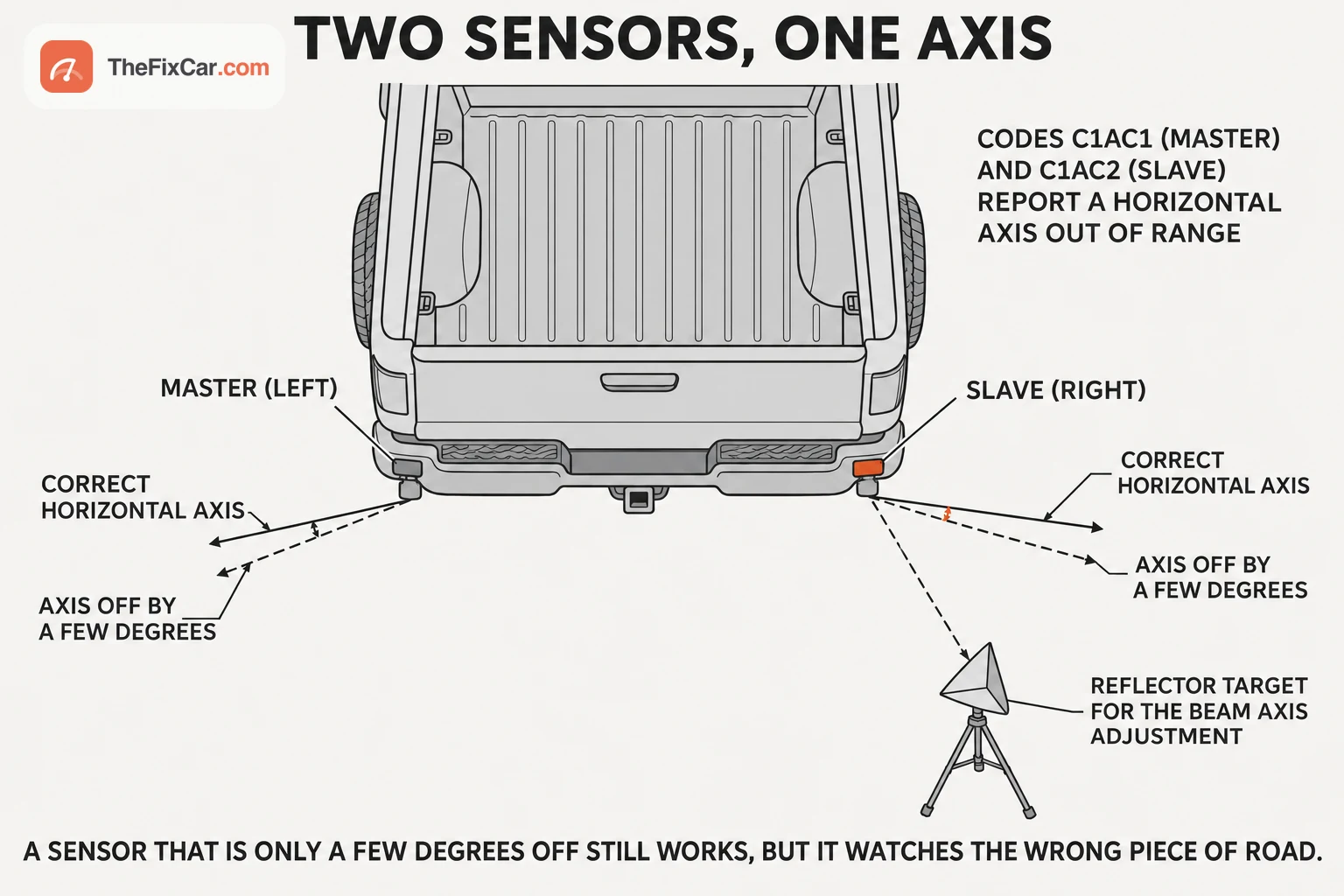
The manual says a sensor moved even slightly off position may make the system malfunction and miss vehicles, and it tells the owner to have the car inspected after a strong impact to a sensor or its surrounding area, or when that area is scratched, dented or partly disconnected[1]. In the Tacoma bulletins, C1AC1 for the master sensor and C1AC2 for the slave are named “Horizontal Axis Misalignment”[2]; the codes report the condition, not what caused it. Toyota’s Tech Tip T-TT-0537-19 describes the sensor-angle check for the models it lists: with the rear bumper cover removed, a digital angle gauge goes on the outward-facing surface of each sensor to confirm its vertical angle against the repair manual, and the horizontal angle is checked by dropping a plumb bob from the inner and outer mounting studs and measuring the difference from the vehicle centreline[5].
Wiring and communication
U0232 and U0233 are lost communication with the blind spot monitor slave module and master module[2]. On the 2016 to 2018 Tacoma in T-SB-0063-19 those two codes sit in the same list as the misalignment and internal-fault codes, and the bulletin’s fix for all six is to replace both sensors, but only on trucks built before the production change VINs it prints, and only after the codes have been confirmed with Techstream[2]. Outside that bulletin, a lost-communication code can involve power, ground, wiring, connectors, the network or the module itself, and the code prefix alone does not say which; our guide to ADAS C and U codes explains what each family of codes does and does not tell you.
False alerts rather than no alerts
A mirror light that stays on with nobody there is the opposite complaint, and Toyota handles it differently. For 2021 to 2022 RAV4 Prime, T-SB-0027-22 describes the outer mirror indicator staying on without a vehicle in the detection area after being passed, and the fix is a left and right blind spot monitor cover clipped onto the sensor brackets behind the rear bumper, a 0.9-hour labour allowance, no new sensors[4]. The owner’s manual lists the other causes of unnecessary detection: a sensor misaligned by an impact, a guardrail or wall close alongside, narrow lanes, slipping tyres and, again, a bicycle carrier[1].
By model: what Toyota’s documents fix
2016 to 2018 Tacoma (T-SB-0063-19)
Some 2016 to 2018 Tacoma built before the production change VINs may show the Blind Spot Monitor System warning with any of U0232, U0233, C1AC1, C1AC2, C1AB6 or C1AB7 stored[2]. Toyota’s repair is to remove the rear bumper assembly, replace both sensors with part 88162-04013, torque the three nuts on each to 9.0 N·m (80 in·lbf), refit the bumper temporarily without the extension housings over the sensors, run the operation check, then take the bumper off again to reassemble it properly[2]. The bulletin’s labour allowance under operation EL1817 is 3.0 hours, which is not a workshop quote, the essential tools are the laser radar adjusting reflector 09870-60000 and reflector C 09870-60040-02, and the bulletin needs Techstream software 14.10.028 or later[2]. Applicability matters: if none of the six codes is present, Toyota says the bulletin does not apply[2].
2019 Tacoma (T-SB-0001-20)
The 2019 Tacoma got its own bulletin for C1AC1 and C1AC2 alone, again limited to trucks before the production change VINs[3]. This bulletin also specifies replacing both sensors and running the operation check, with previous part 88162-04014 superseded by 88162-04015, 9.0 N·m on the nuts, bumper on without extension housings for the operation check, a 3.0-hour labour allowance under operation EL1921, Techstream 14.20.019 or later[3]. Both bulletins describe the repair as covered under the 36-month or 36,000-mile basic warranty, whichever comes first from the in-service date[2][3]; a bulletin does not extend that coverage, so eligibility depends on the truck’s age and mileage.
2018 to 2019 Camry, 2019 Avalon, 2018 to 2019 Sequoia (T-TT-0558-19)
For these models Toyota published a tech tip because the beam axis may not update during the beam-axis confirmation[6]. The check is a before-and-after reading of the “Angle Adjustment by Auto Alignment” value in the sensor’s Techstream data list: if the value after the adjustment utility is close to the angle the display utility showed, the axis updated; if it is unchanged, the adjustment did not take, and Toyota’s instruction is to confirm the repair manual procedure and the reflector placement[6]. The same tip adds that the value normally drifts after the vehicle has been driven for a while, and that the system sets a DTC on its own if it detects a beam-axis problem[6]. The tip is about confirming that an adjustment took on the listed vehicles; an “Unavailable” message or a stored code on its own does not mean it applies.
2021 to 2022 RAV4 Prime (T-SB-0027-22)
Covered above under false alerts: a mirror indicator that stays on after being passed, fixed with covers 88163-42020 and 88173-42020 on the sensor brackets[4]. Toyota’s first step is to confirm that the mirror indicator stays on without a vehicle in the detection area after being passed; if it does not, the bulletin does not apply and diagnosis continues with the repair manual[4].
2024 to 2025 Grand Highlander and Grand Highlander Hybrid (T-SB-0037-25)
The newest bulletin in this set is a software fix. Some 2024 to 2025 Grand Highlander and Grand Highlander Hybrid may have the Blind Spot Monitor inoperative, a BSM malfunction message on the multi-information display or the driving assist information indicator lit, with C1AB413 or C1AB513 stored, which Toyota names “Outer Mirror Indicator (Module B Side) Circuit Open” and “(Module A Side) Circuit Open”[9]. Despite the word “circuit” in the code names, the bulletin’s cause is the sensor software: Toyota updated it to reduce the possibility of these conditions, and the repair is a flash reprogram of both BSM sensors with GTS+, under a 1.1-hour labour allowance, with a note in capitals that the sensors are not to be replaced[9]. The bulletin applies only when the stored calibration IDs are older than the ones it lists; a vehicle already on the latest calibration goes back to the repair manual[9]. The A and B files are different even though their calibration IDs look alike, and the battery has to be held at 13.5 V by a battery diagnostic tool during the flash[9].
Target placement in Toyota’s and Lexus’s tech tips
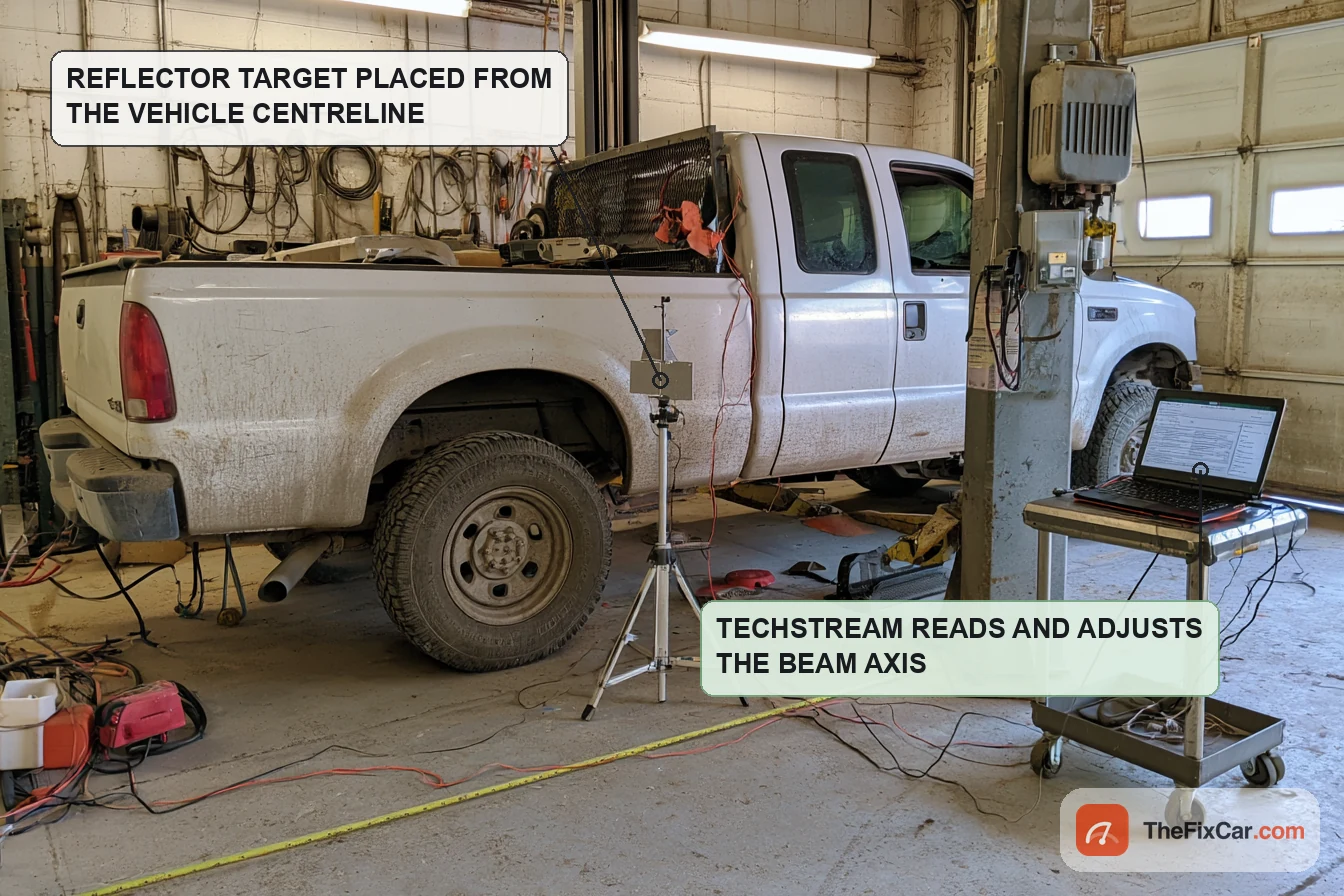
Toyota’s target placement tech tip lists 2016 to 2022 models with TSS or BSM, among them the Corolla, Camry, RAV4, Highlander, Tacoma and Tundra, and Lexus has a matching one for the IS, ES, GS, RX, NX, LS, LX and RC[7][8]. For the vehicles it lists, the procedure starts with the vehicle centreline: a plumb bob from the front emblem and another from the rear emblem, a 90-degree laser aligned to both marks, and the centreline extended past the rear of the vehicle for the BSM setup[7]. A perpendicular crossline is marked at a distance from Toyota’s Blind Spot Monitor calculator or the repair manual, and the reflector is placed on it at a set distance from the centreline[7]. That is static target placement; our guide to OEM ADAS calibration requirements explains how static, dynamic and scan-only procedures differ. After bumper or sensor work, the vehicle’s repair information says which mounting checks, calibrations or confirmations are required[7][8].
What to check first
- The wording, and the weather. “Unavailable” with a dirty or iced bumper is the manual’s case: look at both rear corners for dirt, ice and visible damage, clear what is there, and, if nothing is damaged or loose and no other warning is up, drive with the system on, out of Reverse and above about 10 mph for around 10 minutes before deciding anything[1]. “Malfunction Visit Your Dealer” calls for an inspection; cleaning is not a substitute for diagnosing it[1].
- The bumper corners themselves. Look for stickers, transparent film, aluminium tape, a bike carrier, a repaint in a colour other than an official Toyota colour, a dent, a scratch or a corner that has been pushed in; the manual lists each as a reason the system may not work or may need inspection[1]. Take off a carrier by its own instructions and have adhered film, tape or coatings removed in a way that does not damage the bumper finish; the manual says a sensor or bumper that needs removing or refitting is dealer work, because the mounting and calibration checks depend on the vehicle[1]. An official colour alone does not make a bumper repair right for the radar; have the repair checked against the repair information.
- The codes, before anything is cleared. Record the exact codes and which module set them. In Toyota’s Tacoma bulletin, C1AC1 and C1AC2 are horizontal axis misalignment, U0232 and U0233 are lost communication, and C1AB6 and C1AB7 are the master and slave module internal codes[2]. The descriptions point the diagnosis; they do not by themselves prove which part needs replacing. Bulletin applicability and the model-specific procedure decide between a harness repair, an aiming check with a reflector and, on the Tacoma years in the bulletins, two new sensors[2][3].
Can you keep driving?
An isolated blind spot warning does not by itself make the car unsafe to drive. If there is no collision damage, nothing loose on the bumper, no other warning and the car drives normally, you can continue while treating the feature as absent: the manual says the driver remains solely responsible for checking the surroundings and that the system cannot judge whether a lane change is safe[1]. Check over the shoulder. Rear Cross Traffic Alert uses the same rear radar sensors and may be affected too, so do not rely on its alerts and reverse only when you can see the path is clear[1].
If the warning followed an impact, assess the damage before driving on. Have it looked at when the bumper corner has taken a hit hard enough to dent or crack it, or when a sensor or its surroundings are scratched, dented or partly disconnected: the manual’s instruction for those cases is an inspection, because a sensor only slightly off position can miss vehicles while the mirror light stays dark[1].
FAQ
What does “Blind Spot Monitor Unavailable” mean on a Toyota?
In the Corolla Hybrid manual it means ice, snow, mud or similar may be attached to the rear bumper around the sensors, and the system should come back once the bumper is cleared and the car has been driven with the system’s conditions met for about 10 minutes[1]. The manual also lists extreme temperatures and roads wet with standing water in heavy rain, snow or fog as conditions that can impair detection; it does not say each of them produces this exact message[1].
Why is my blind spot monitor unavailable when the bumper is clean?
A clean bumper does not rule out the things a wash does not remove: stickers including transparent ones, aluminium tape, an accessory such as a bicycle carrier, a repaint in a colour other than an official Toyota colour, a sensor moved off position by an impact, or an electrical fault[1]. The manual lists those as conditions that can impair detection or need inspection, not as confirmed causes of this exact message[1]. If the warning stays after the recovery drive in your own model-year manual, arrange a diagnosis[1].
How do I fix “Blind Spot Monitor Unavailable”?
Clean both rear bumper corners as your owner’s manual directs, then, when it is safe to do so, drive with the Blind Spot Monitor switched on, the shift lever out of R and the speed above approximately 10 mph (16 km/h) for approximately 10 minutes[1]. Take a carrier off by its own instructions and have film or tape removed in a way the bumper finish tolerates; bumper and sensor removal is dealer work in the manual[1]. If the message is “Malfunction Visit Your Dealer” or it does not clear, have the codes read and follow the diagnostic procedure for the exact model; C1AC1 or C1AC2 calls for the reported alignment condition to be investigated, and the repair depends on what is found and on any bulletin that applies[1][2][5].
Does “Blind Spot Monitor Unavailable” reset by itself?
The Corolla Hybrid manual’s wording is that the system should return to normal operation after the ice, snow or mud is removed, and it gives the 10-minute drive described above as the way to let it recover[1]. Follow your own model-year manual. If the warning stays, arrange a diagnosis rather than repeating the drive.
What are DTCs C1AC1 and C1AC2 on a Toyota?
C1AC1 is “Master Module Horizontal Axis Misalignment” and C1AC2 is “Slave Module Horizontal Axis Misalignment”; on the Tacoma the left sensor is the master and the right is the slave[2]. On 2016 to 2019 Tacoma built before the production change VINs in T-SB-0063-19 and T-SB-0001-20, Toyota replaces both sensors and runs the operation check[2][3]. On other models the diagnostic procedure for the exact vehicle decides the next step; the angle-check and adjustment-confirmation tips cited here apply only to the models they list[5][6]. Not every BSM code is a sensor: on the 2024 to 2025 Grand Highlander, C1AB413 and C1AB513 are fixed with a software reflash of both sensors[9].
Is the Lexus message the same thing?
Lexus publishes the same target placement procedure: the Lexus tech tip L-TT-0303-21 mirrors the Toyota one for the 2016 to 2022 IS, ES, GS, RX, NX, LS, LX and RC[8]. The owner’s manual wording for the Lexus message is not covered by the Toyota manual cited here, so check the Lexus manual for the exact text and conditions.