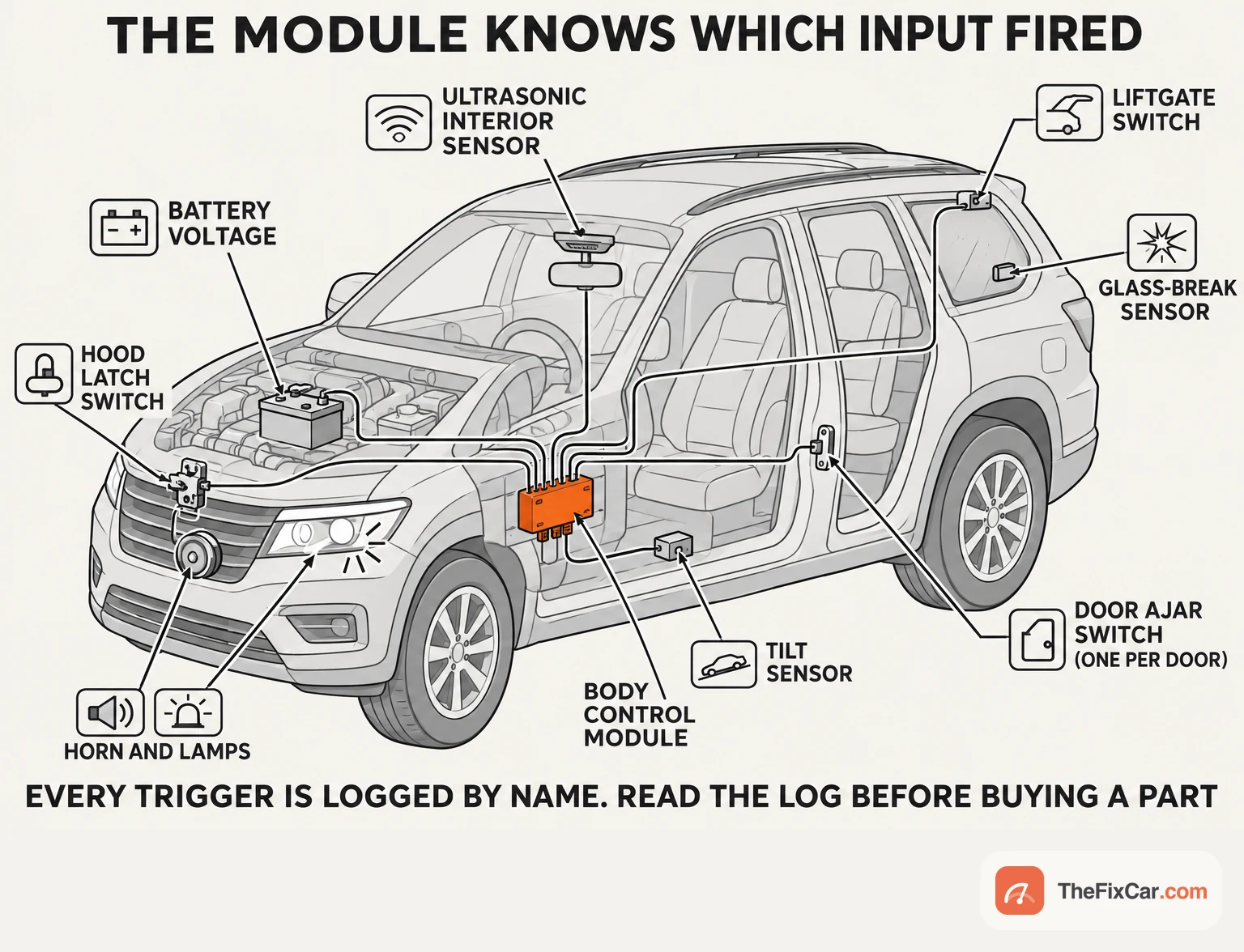
A factory alarm that keeps going off is reacting to something: a hood or door switch that reads open, movement the interior sensor picked up, a change in tilt, a glass-break circuit, a voltage event, a remote command, or, in one GM case, a siren that fires on its own. On the vehicles in the bulletins cited below, the body control module keeps a short history of those events, and Honda, Acura, GM, Nissan, Land Rover and Lincoln each start their diagnosis by reading it. Not every car exposes that history and not every event is recorded, but where it exists, that entry is the closest thing to one exact answer. This page covers factory systems; an aftermarket alarm has its own sensors, its own installer wiring and its own manual.
The entry names an event, not a failed part. For hood warnings and unwanted alarms, the documents below name possible causes that include excess latch clearance, moisture inside the switch, a bracket or panel out of position, and a loose module ground, and the prescribed remedies range from a new latch to a rubber cap to a retorqued ground. This page lists the trigger names, what produced each one in the published cases, and the clues that move suspicion from the sensor to the thing around it.
Quick answer
Cancel the alarm the way your owner’s manual describes, then have the trigger history recorded before any code is cleared or any part is replaced.
| What you notice | Where to look | What to do first |
|---|---|---|
| Alarm sounds while parked and armed, nobody near the car | Security-system trigger history, where your maker stores it | Record every entry before clearing codes; the entry identifies an event, not necessarily a failed component |
| “Hood Open” or “Hood Ajar” message with the hood closed | Hood latch, hood switch, switch bracket, module ground | Confirm the hood latches mechanically, then have the hood switch state read on live data with the hood shut, using the service information for that model |
| Alarm fires when you lock, unlock, or open a door with the fob | Trigger history and the bulletin for your model | On the Nissans in NTB17-081, a BATTERY entry with this symptom is part of the module-replacement criteria; on other cars, the label alone does not diagnose the battery |
| Alarm fires after a drive, once the car has sat a while | Accessory tilt-sensor mounting on the GM trucks in PIT5209A; interior sensor | Record the history first; if inclination is logged on a covered truck, inspect the mounting location PIT5209A specifies |
| Alarm fires during remote start, including in cold weather | Glass-break connectors, rear defogger connection, siren voltage | Note whether the siren alone sounds, or the horn and lamps too |
These observations guide the next check; they do not identify a failed component.
Read the trigger log first
The cited documents keep the history under different names and menus, and each needs a scan tool that talks to the body module, not a basic code reader. GM’s PIT5379E covers the 2015 to 2019 Cadillac Escalade, Chevrolet Suburban and Tahoe, and GMC Yukon with the Theft Protection Package (RPO UTT).
| Maker and tool | Where the history lives | What it shows |
|---|---|---|
| GM, GDS2 or Tech 2[2][6] | Body Control Module, Data Display, Content Theft Deterrent Alarm Trigger Data (Theft Data on Tech 2) | Three trigger history parameters; erased by a BCM Clear DTC request |
| Honda and Acura, i-HDS or HDS[1][4] | Body Electrical, Security, History Data | An “Alarm Device” column naming the input, for example Ignition Switch (IG1) or Security Hood Switch |
| Nissan, CONSULT-III plus[7] | BCM, THEFT ALM, Work Support, THEFT ALM TRG | The last item to trigger the alarm, as monitor items set On or Off; cleared from the same screen |
| Lincoln and Ford, FDRS[9] | BCM parameter identifications | ALARM_EVT_1 to ALARM_EVT_4, for example “Interior Motion Detected” |
| Land Rover, SDD[5] | Alarm trigger history in Symptom Driven Diagnostics | Whether hood switch activation is featured |
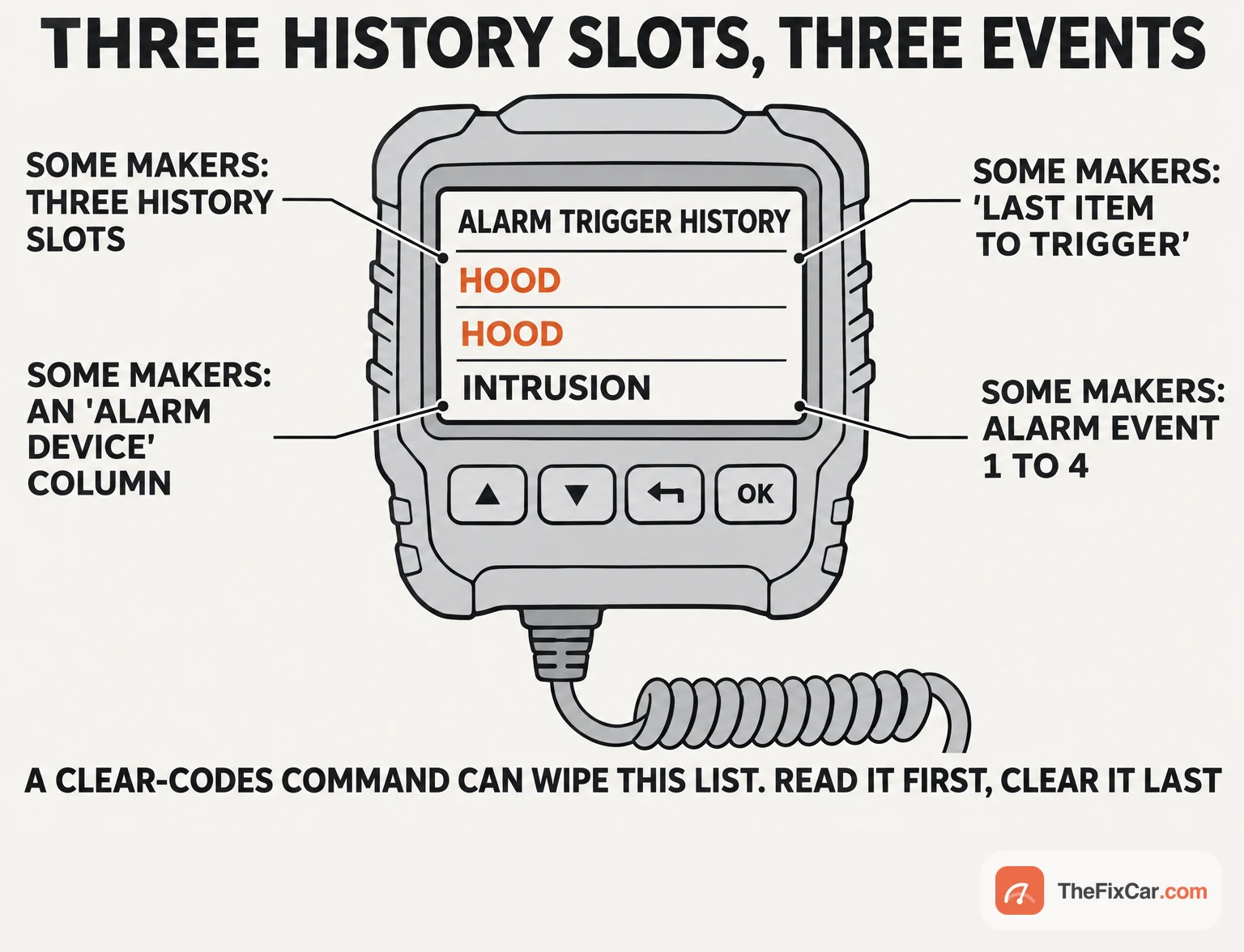
GM’s list of trigger names for those SUVs is the longest in the documents: each door, rear closure, tonneau cover, hood, ignition voltage, intrusion, inclination, telematics enhanced service alarm (OnStar), battery reconnect detected, unauthorized power mode change, security indicates tamper, and glass breakage.[2] The same bulletin gives a sorting method that needs no scan tool on those SUVs: a content-theft trigger other than Telematics Enhanced Services chirps the horn 28 times with the siren, while an OnStar request or a panic-button press chirps 30 times with no siren, and the panic press leaves no history entry.[2] Record the history before any code clearing: on those GM SUVs a BCM Clear DTC request erases it.
Symptoms and what else causes them
| Symptom | Competing causes | Clues that shift suspicion |
|---|---|---|
| History names “hood” | Excess latch clearance; moisture inside the latch switch; the switch itself; bracket or panel position; loose module ground | On early-build 2013 Equinox and Terrain, GM reports that adjusting the latch helps only briefly and names moisture inside the switch as a possible cause[3] |
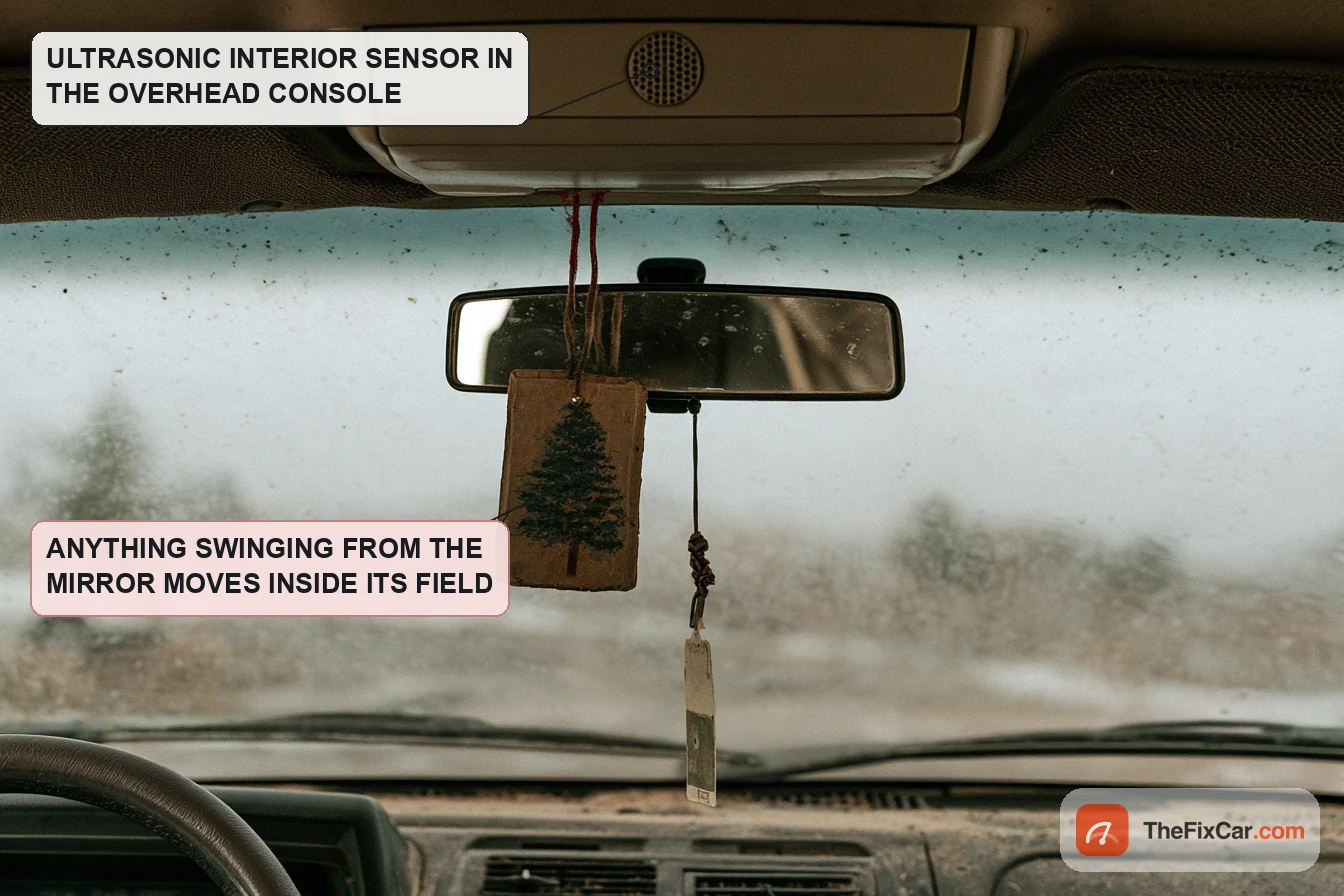
| History names “intrusion” or “interior motion” | Insects, a pet, an air freshener or lanyard on the mirror, a solar toy on the dash; module software | GM removes the moving items and retests before any further diagnostics[2]; Lincoln reprograms the module when the event PIDs show “Interior Motion Detected”, otherwise it runs the normal false-alarm test[9] |
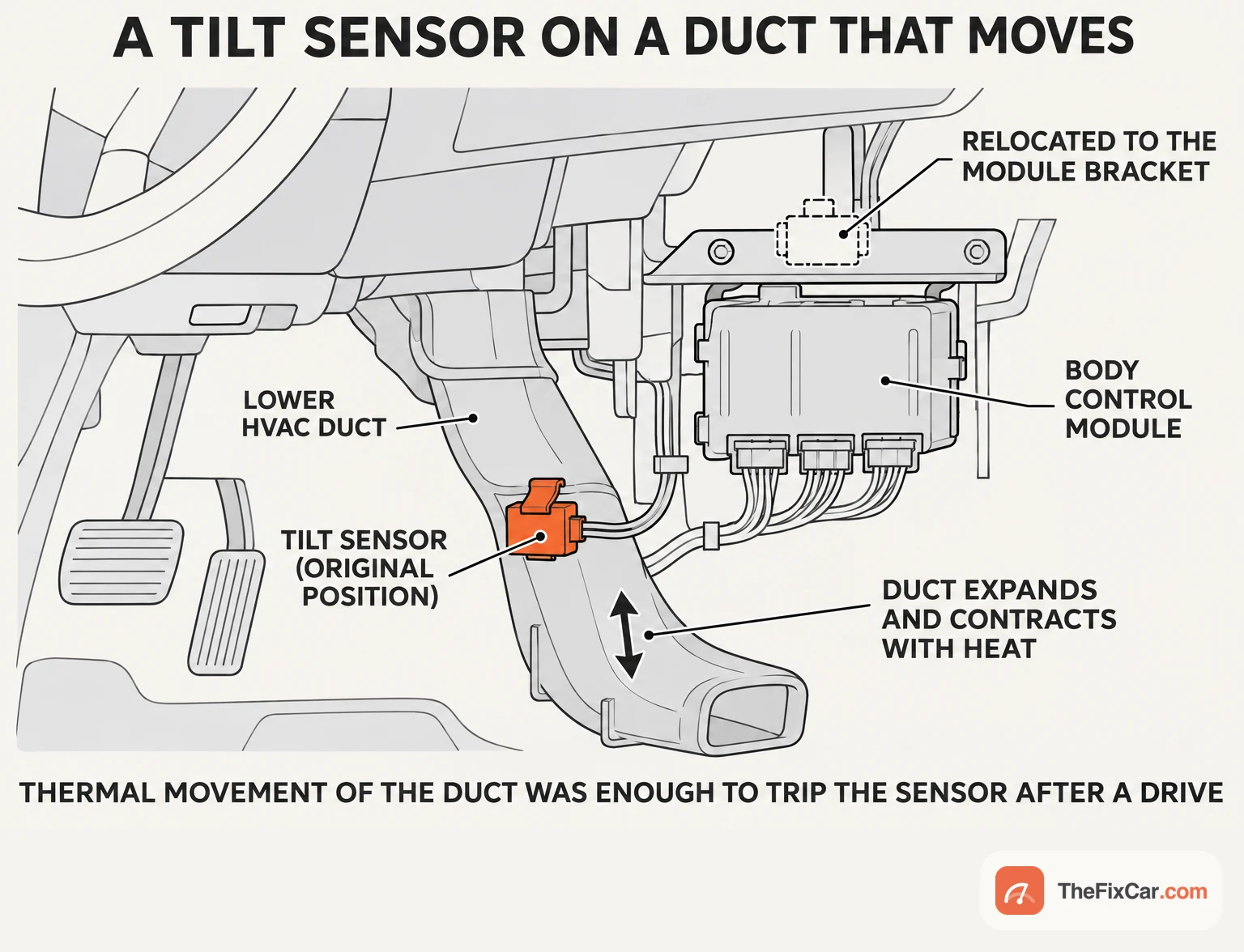
| History names “inclination” | Thermal movement of the accessory sensor’s HVAC-duct mounting, as in PIT5209A | An alarm after the vehicle has sat following a drive matches the timing in GM’s accessory-sensor bulletin; the mounting inspection decides whether it applies[6] |
| History names “glass breakage” | Loose quarter-window sensor connector; rear defogger connection | A trigger that coincides with remote-start cranking fits a connector that opens when the body shakes[2] |
| History names “battery” or “ignition voltage” | Battery reconnect event on the GM SUVs in PIT5379E; body control module under the vehicle and symptom conditions in NTB17-081 | Nissan replaces the module when BATTERY is logged with its listed fob and handle symptoms; the label alone does not diagnose either part[7] |
| History names “Ignition Switch (IG1)” | Keyless Access/TPMS control unit on 2017 to 2019 Ridgeline | Honda replaces that unit only when IG1 is the logged Alarm Device; without it the bulletin does not apply[1] |
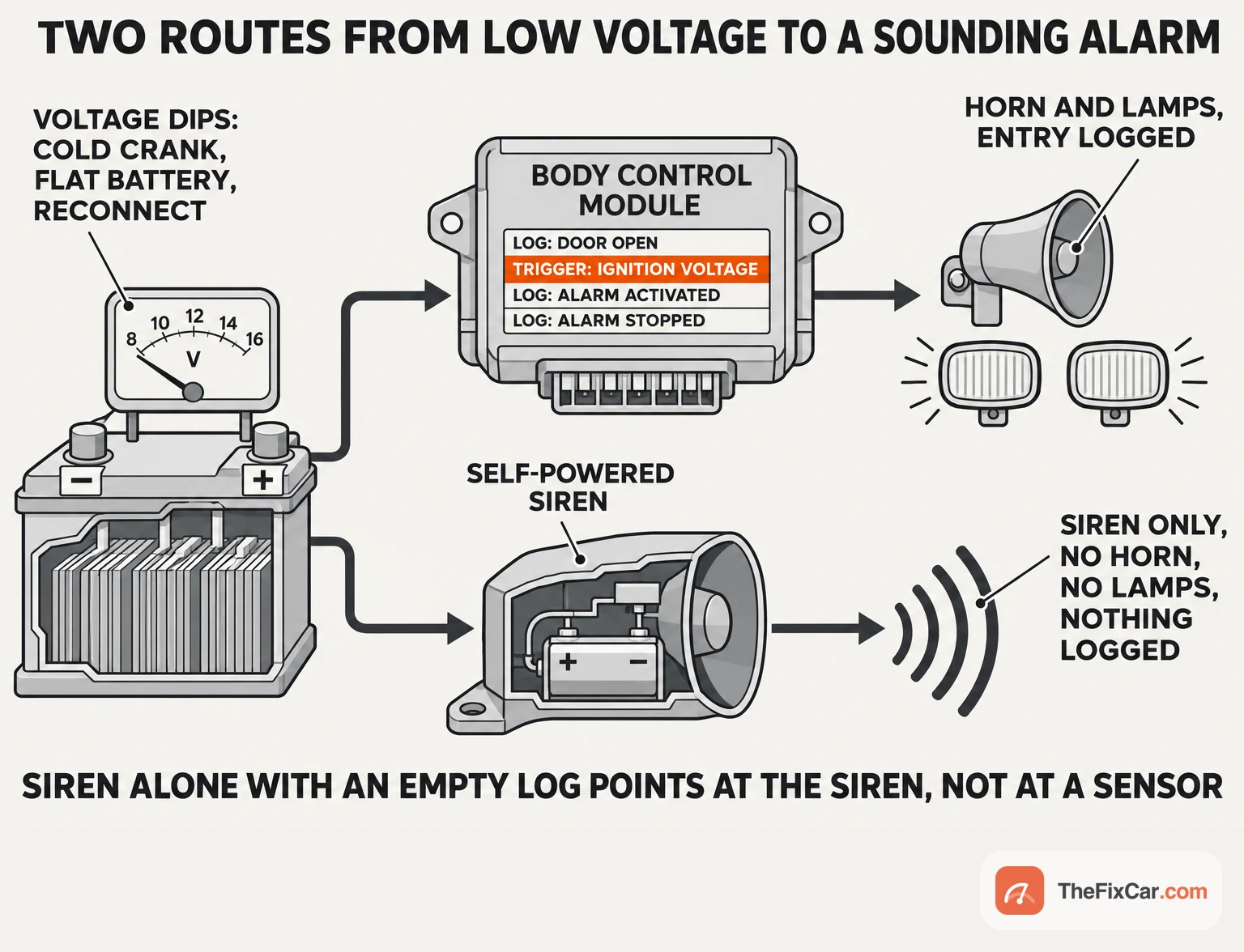
| No history, siren sounds alone | Self-powered siren activating on low voltage | On PIT5379E SUVs built before July 2014, siren only, no horn or lamps, during a cold remote-start crank matches GM’s documented siren concern[2] |
Sensor fault, or something else?
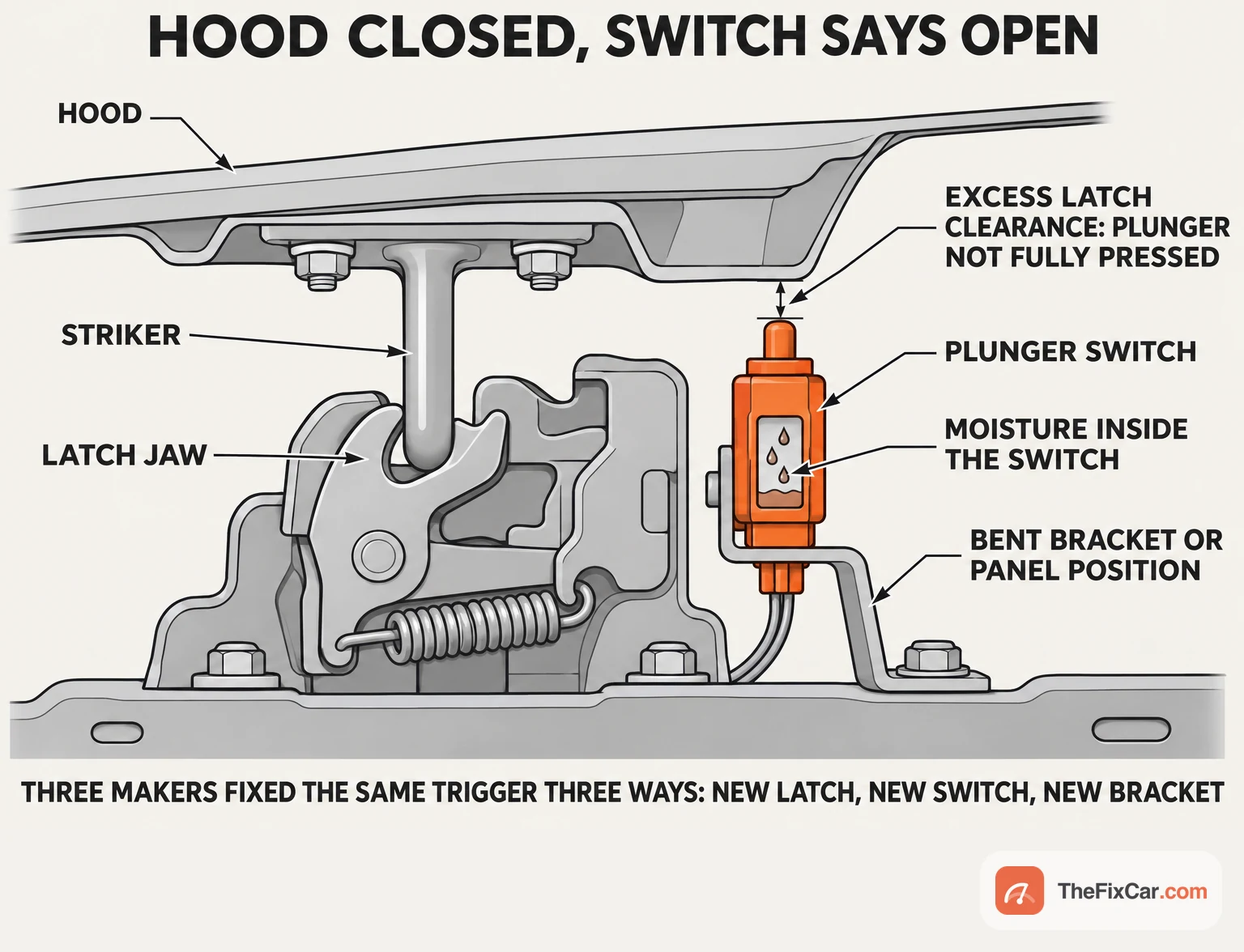
A hood-open indication with the hood shut can be the switch, or one of the latch, bracket, panel-position or ground concerns below. The indication alone does not separate them; the applicable bulletin says which check comes next.
Hood latch switch
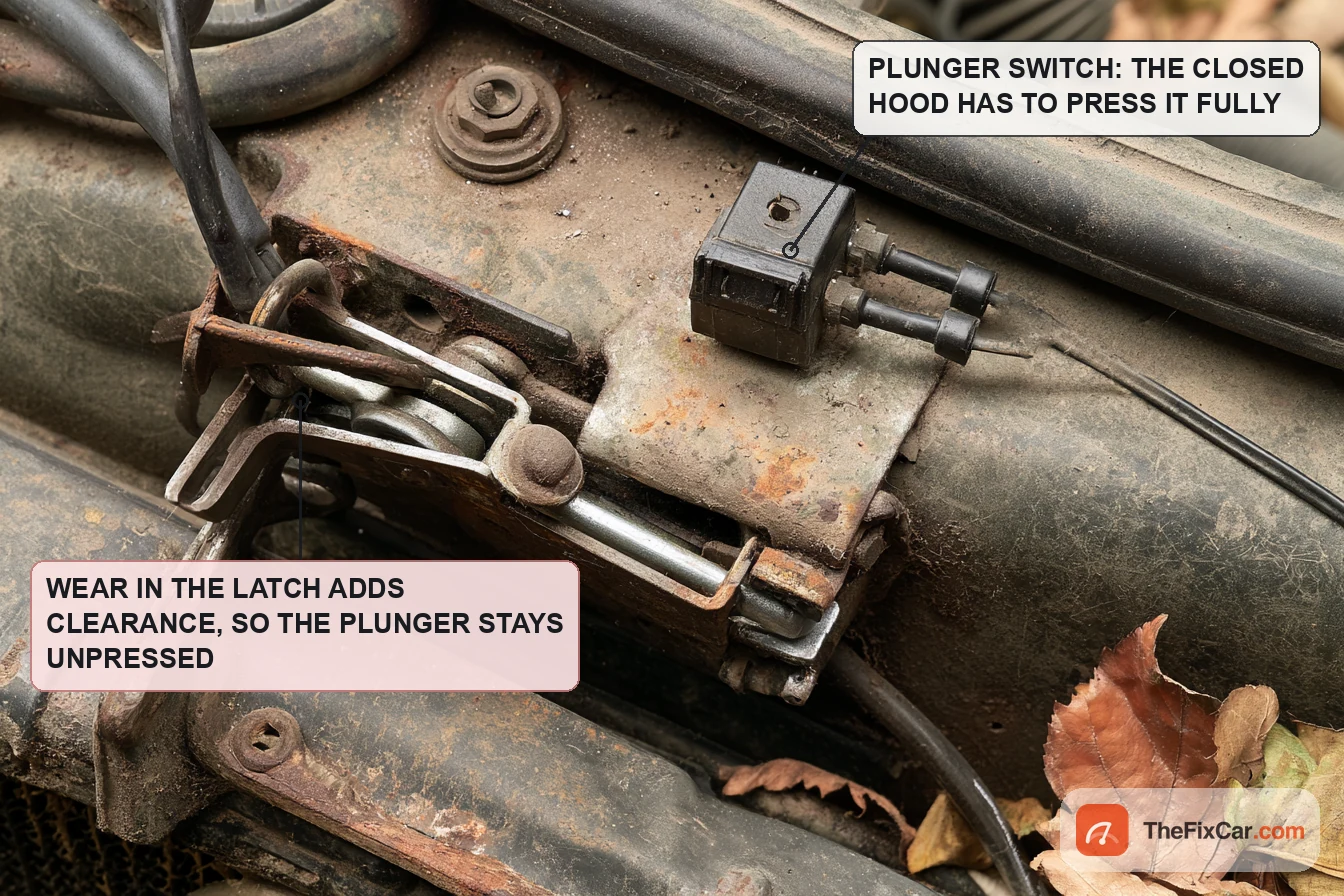
The cited vehicles use different hood-switch arrangements, from a switch built into the latch assembly to a separate plunger switch. Acura’s 15-046 covers all 2014 and 2015 MDX and listed 2016 VIN ranges and names excessive hood-latch clearance as a possible cause. For an alarm sounding by itself, the repair criterion is “Security Hood Switch” in the history data; for the not-setting complaint, the check is whether that signal reads ON with the hood closed. The repair is a new latch assembly at a listed 0.4 hour including diagnosis.[4] GM’s PIT5176B for 2013 Equinox and Terrain built before September 6, 2012 names moisture within the hood latch switch as a possible cause, says not to adjust the latch because the adjustment “only works for a short time”, and suggests a new latch assembly when diagnostics find nothing obvious.[3] Land Rover’s LTB00490NAS1 for 2010 to 2012 Range Rover (LM), VIN AA304426 to CA393639, names the switch bracket, the switch, or the bulkhead panel position, and starts with the trigger history, hood alignment and mechanical latching.[5]
Daimler’s note for BR453 vehicles with SA code V19 describes a contact-plate clearance: the hood contact “is not depressed sufficiently by the contact plate”, the alarm fires “particularly in windy conditions”, and a rubber cap pressed onto the sensor takes up the tolerance.[8] For the 2025 and 2026 Escalade, Suburban, Tahoe and Yukon, GM’s PIT6484 names a loose body control module ground, G200 or G201A at the A-pillar, as a possible cause of Hood Ajar messages and unwanted alarms, and asks for clamp load and torque to be verified, not just a wiggle test.[10] The Land Rover switch test requires a slow plunger release: pins 1 and 3 should show continuity with the plunger at rest and an open circuit when it is pressed, and a fast release can latch the plunger in a service mode that leaves the circuit open and misreads during testing.[5]
Door, trunk and liftgate switches
PIT5379E lists separate triggers for each door and for the rear closure on the covered GM SUVs; the label identifies the opening the module saw, not the part that failed.[2] Nissan’s NTB17-081 shows how far a label can mislead: on 2013 to 2016 Altima and Pathfinder, 2014 and 2015 Pathfinder Hybrid, 2015 Murano and 2016 Maxima, with build-date limits for 2016, an alarm that fires when a door or trunk is opened with the car already unlocked, or when the fob or handle switch is used, with BATTERY as the last trigger, is a body control module replacement.[7]
Interior ultrasonic sensor
On the same GM SUVs, ultrasonic intrusion sensors in the overhead console detect movement inside the vehicle, and GM lists what has set them off: flying insects, pets, items hanging from the rear-view mirror, and solar-powered dancing figures on the dash, all to be removed and the system retested before additional diagnostics.[2] For the 2024 and 2025 Nautilus, Lincoln’s SSM 55019 addresses a possible module-software cause: monitor ALARM_EVT_1 through 4, reprogram the module with the latest FDRS software when they show “Interior Motion Detected”, and otherwise run the workshop manual’s false-alarm pinpoint test.[9]
Tilt sensor
GM’s PIT5209A covers the accessory inclination sensor on 2007 to 2014 Escalade, 2007 to 2013 Avalanche, Silverado, Suburban, Tahoe, Sierra and Yukon, and listed 2014 Silverado and Sierra 2500/3500, Suburban, Tahoe and Yukon. The sensor was mounted on the driver’s side lower HVAC duct: “with thermal cycling the duct could expand and contract enough that, depending on exact sensor location, movement of the duct might cause the sensor to trip”, normally after the vehicle has sat a while following a drive.[6] If the CTD trigger history names inclination and the sensor is found on that duct, the bulletin relocates it to the top of the module bracket, 0.5 hour.[6]
Glass-break sensor and the rear defogger
On those GM SUVs the quarter-window glass-break sensors connect through a plug “that looks similar to a 9 volt battery connector”, and unseated plugs have tripped the alarm, in GM’s reports during remote start, when the body shakes.[2] On those SUVs the rear defogger grid serves as the liftgate glass-break sensor, so a defogger connection problem can produce a glass-breakage trigger.[2] The defogger link shows up again as a system fault rather than a sounding alarm: GM’s PIT6551 from September 2026 covers the 2026 and 2027 Escalade, Escalade ESV, Escalade IQ and IQL, Suburban, Tahoe, Yukon and Yukon XL with RPO UTR, a “Service Theft Alarm System” message with DTC B192A Symptom 13 while the defogger runs, cause under investigation, with an instruction to replace nothing.[11]
Battery, voltage and the module itself
Mazda’s 2025 CX-50 manual says the horn and hazards activate when the lead-acid battery is charged or replaced after going dead while the alarm was armed, and PIT5379E lists “battery reconnect detected” as a history event on its GM SUVs.[12][2] On the PIT5379E SUVs built before July 2014, the self-powered siren could activate on its own on a cold remote-start crank, with no horn, no lamps and no history entry; GM released updated software for the power sounder to address it.[2] Battery condition is measured, not guessed; the voltage and load checks are in how to test a car battery with a multimeter, and a hardwired camera’s parked draw is covered in dash cam hardwire battery drain. Neither Honda nor Nissan says that a passing battery test points at the control unit. Both prescribe a control unit for a specific history entry on specific vehicles. Honda’s 21-055 is the documented case: 2017 to 2019 Ridgeline, alarm sounding intermittently while parked and armed, possible cause “an internal failure within the Keyless Access/TPMS Control Unit”, replaced at 0.8 hour only when “Ignition Switch (IG1)” appears under Alarm Device, with all keys available for the required key registration, plus a TPMS sensor learn and tire check.[1]
What to check first
- Cancel it the way the manual says, then read the history. Mazda’s 2025 CX-50 manual lists the unlock button on the key, starting with the push button, touching the door-handle sensing area, or the liftgate opener with the key carried.[12] Other cars list their own set, and PIT5379E notes that an OnStar-requested alarm on its SUVs cannot be cancelled with the fob.[2] Then record the trigger history with a scan tool that reads body-module data, before clearing anything.
- Match the entry to a physical check. On the GM SUVs in PIT5379E, an intrusion entry means removing the listed moving items and retesting before further diagnostics; other makers have their own step.[2] For a hood or door entry, confirm the closure latches mechanically, then have the live switch state read with the model’s service information; a current open indication supports the entry but does not by itself prove what fired an earlier alarm.
- A BATTERY entry does not diagnose the battery. Test it before replacing it. On the Nissans in NTB17-081, the BATTERY entry together with the listed symptoms is the bulletin’s criterion for a new body control module.[7] On the 2025 CX-50, charging or replacing a battery that died while armed triggers the alarm by design.[12]
Can you keep driving it?
A false-alarm complaint by itself says nothing about whether the car is safe to drive; the closures do. If a hood or door warning appears, confirm that closure is latched before driving. Land Rover’s procedure checks mechanical hood latching before anything electrical.[5] Do not drive with an unconfirmed hood latch. Do not improvise a switch bypass or pull fuses to silence the alarm; use the cancellation method in the owner’s manual and have the history read.
FAQ
Why does my car alarm keep going off for no reason?
In the documents cited here: a hood contact not pressed far enough[8], moisture in the hood switch[3], a loose module ground[10], things moving in the cabin and loose glass-break connectors[2], a tilt sensor on a mount that moves[6], a battery reconnect[2], a control unit fault[1][7], or module software[9]. The trigger history narrows the list. On the GM SUVs in PIT5379E a panic press leaves no entry, and on those built before July 2014 the siren could fire alone with nothing logged.[2]
Why does my car alarm go off randomly at night?
The documents do not give a night-specific cause. They describe alarms after the vehicle has sat following a drive (the duct-mounted tilt sensor), during cold remote-start cranks (the self-powered siren), and from moisture inside a hood switch.[6][2][3] Record the time, the weather and the history entry instead of diagnosing from the hour.
How do I stop my car alarm from going off right now?
Use the method in your owner’s manual. For the 2025 Mazda CX-50, that is the unlock button on the key, starting with the push button, touching the door-release sensing area, or the electric liftgate opener with the key carried.[12] On the GM SUVs in PIT5379E, an OnStar-requested alarm cannot be cancelled with the fob and times out after 30 chirps.[2]
Can a low battery cause the car alarm to go off?
In the specific case GM documents, yes: on PIT5379E SUVs built before July 2014, the self-powered siren could activate on a cold remote-start voltage dip.[2] A BATTERY history entry does not by itself mean a weak battery; Nissan’s NTB17-081 replaces the body control module for its listed vehicles and symptoms.[7]
How long will a car alarm go off?
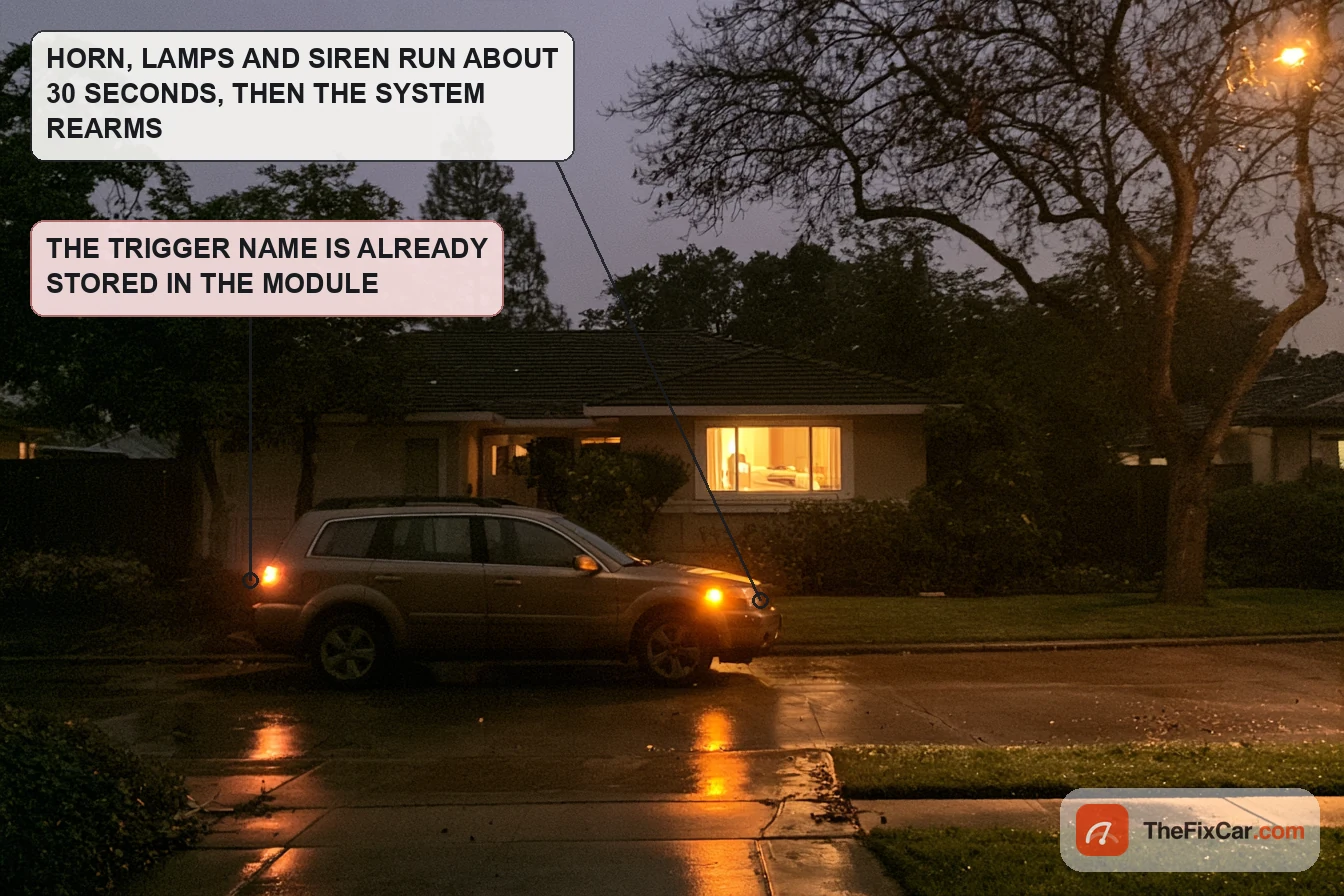
About 30 seconds per trigger on the 2025 Mazda CX-50.[12] On the GM SUVs in PIT5379E, content-theft triggers other than Telematics Enhanced Services sound for 28 seconds; an OnStar request or a panic press lasts 30.[2]